Asbestos Testing in Yucaipa, CA — MoldRx
Vetted Asbestos Testing Specialists Serving Yucaipa and the Inland Empire
Yucaipa sits at roughly 2,000 feet of elevation in the foothills of the San Bernardino Mountains, a community whose name — derived from the Serrano word "Yukaipa't," meaning wetlands — recalls the marshy valley floor that sustained the region's indigenous inhabitants long before European settlement. For most of its modern history, Yucaipa was defined by agriculture. After the Redlands and Yucaipa Land Company subdivided 11,000 acres in 1910, the area became a patchwork of small farms — five to twenty acres each — and for five decades Yucaipa served as one of Southern California's productive fruit baskets, with apples, peaches, plums, and walnuts spread across the valley. Then came World War II, and the region began a slow transformation that would stretch across the second half of the twentieth century. Fruit production diminished, and many of the former orchards were repurposed for trailer parks, chicken ranches, and small housing tracts during the 1950s and 1960s. By 1960, Yucaipa had 50 mobile home estates and had established itself as a popular retirement destination. Construction continued through the 1970s and 1980s, and the community finally incorporated as a city in 1989. Today, with approximately 55,000 residents and a housing stock that spans seven decades of construction — from postwar bungalows and mid-century ranch homes to established manufactured home parks and newer foothill developments — Yucaipa contains a diverse mix of property types. A substantial share were built during the decades when asbestos-containing materials were standard in construction. Professional asbestos testing before any renovation, demolition, or property purchase is essential. MoldRx only sends vetted asbestos testing professionals who understand Yucaipa's unique housing mix and every applicable federal and state regulation.
Request your free estimate — we will help you determine if testing is needed for your project.
When Asbestos Testing Is Required in Yucaipa
California enforces overlapping federal and state regulations that make asbestos testing a legal prerequisite for most work on older buildings — both site-built homes and manufactured housing.
Before Any Renovation or Demolition
SCAQMD Rule 1403 requires an asbestos survey before renovation or demolition in the South Coast Air Quality Management District, which includes Yucaipa. The survey must be performed by a certified asbestos consultant before permits are pulled. Notification to SCAQMD must be submitted at least 10 working days before any removal of asbestos-containing materials. For demolition, the survey requirement applies regardless of building age. The only narrow exception is single-unit dwelling renovation disturbing less than 100 square feet of intact material.
Cal/OSHA Title 8, Section 1529 requires identification of asbestos-containing materials through laboratory testing before any renovation or demolition in pre-1980 structures. All thermal system insulation, surfacing materials, and resilient flooring in pre-1980 buildings are legally presumed to contain asbestos until laboratory testing proves otherwise. This applies equally to site-built homes, manufactured homes, and commercial properties.
Federal OSHA 1926.1101 (the construction-industry asbestos standard) applies to all construction activities that may disturb ACM. It establishes a permissible exposure limit of 0.1 fiber per cubic centimeter as an 8-hour time-weighted average, requires wet methods and engineering controls, and mandates pre-work assessments for all renovation, demolition, and maintenance activities.
When Buying or Selling Property
California disclosure laws require sellers to report known hazards, including asbestos. A pre-purchase asbestos test gives buyers a clear picture of what they are acquiring — particularly important in Yucaipa, where a buyer might be evaluating anything from a 1965 manufactured home to a 1970s ranch to a newer foothill development. Sellers benefit from documented results that remove uncertainty from the transaction.
When Materials Show Damage or Deterioration
Yucaipa's semi-arid foothill climate — hot summers, cool winters, occasional freezing at elevation, and dry winds through the San Gorgonio Pass — subjects older building materials to conditions that accelerate deterioration. When roofing begins to crumble, siding cracks, ceiling texture flakes, or pipe insulation frays, testing determines whether those materials contain asbestos and whether fiber release is occurring.
Yucaipa's Construction History and Asbestos Risk
A Staggered Development Timeline
Unlike cities built out in a single postwar rush, Yucaipa's residential development occurred in overlapping waves across multiple decades. This means the city's housing stock contains properties from nearly every era of asbestos use — from peak application through gradual phase-out — and the risk profile varies significantly from one neighborhood, one block, and even one property to the next.
1950s and 1960s — The First Suburban Wave. As Yucaipa's agricultural economy contracted after World War II, the first wave of suburban housing replaced orchards and farms. Small tract homes and starter houses appeared in the downtown area and along Bryant Street. Simultaneously, mobile home parks proliferated across the valley floor — by 1960, there were 50 mobile home estates in the Yucaipa area. Homes and manufactured units from this period have the highest probability of containing asbestos in multiple building materials. Construction during these decades occurred at the absolute peak of asbestos use, when the mineral was considered an ideal additive for fire resistance, durability, and insulation.
1970s — Continued Expansion. Residential construction continued through the 1970s as the Inland Empire's population grew. Single-family homes filled in remaining parcels near downtown and extended outward into the surrounding foothills. Asbestos remained widespread through the mid-1970s. The gradual phase-out that began in the late 1970s was slow and incomplete. Homes built between 1970 and 1978 carry high asbestos probability.
1980s — Growth Before Incorporation. The decade before Yucaipa's 1989 incorporation saw continued residential development, including newer subdivisions in the foothill areas and replacement of some older mobile home stock. While asbestos use declined significantly after 1980, some building products manufactured through the mid-1980s still contained asbestos. Homes from the early to mid-1980s warrant testing if renovation work will disturb original materials.
1990s and Newer — Generally Low Risk. Post-incorporation development brought newer housing to Yucaipa's hillside areas and remaining undeveloped parcels. These homes are generally considered low risk, though SCAQMD Rule 1403 still requires a survey before demolition regardless of building age.
The Manufactured Home Factor
One of Yucaipa's most distinctive housing characteristics is the prevalence of mobile and manufactured homes. The city is home to 42 mobilehome parks containing approximately 4,270 spaces, and manufactured housing accounts for roughly 20 percent of Yucaipa's total housing stock. These communities range from smaller parks to large developments with full amenity packages, serving both family and senior populations.
Manufactured homes built before 1980 deserve the same testing attention as site-built homes from the same era. Mobile homes from the 1960s and 1970s commonly contain asbestos in:
- Vinyl flooring and sheet goods — Both the surface material and the backing layer
- Ceiling panels — Pressed panels and spray-applied textures
- Duct wrapping and HVAC components — Insulation around forced-air ductwork
- Exterior siding — Cement-asbestos and composite siding panels
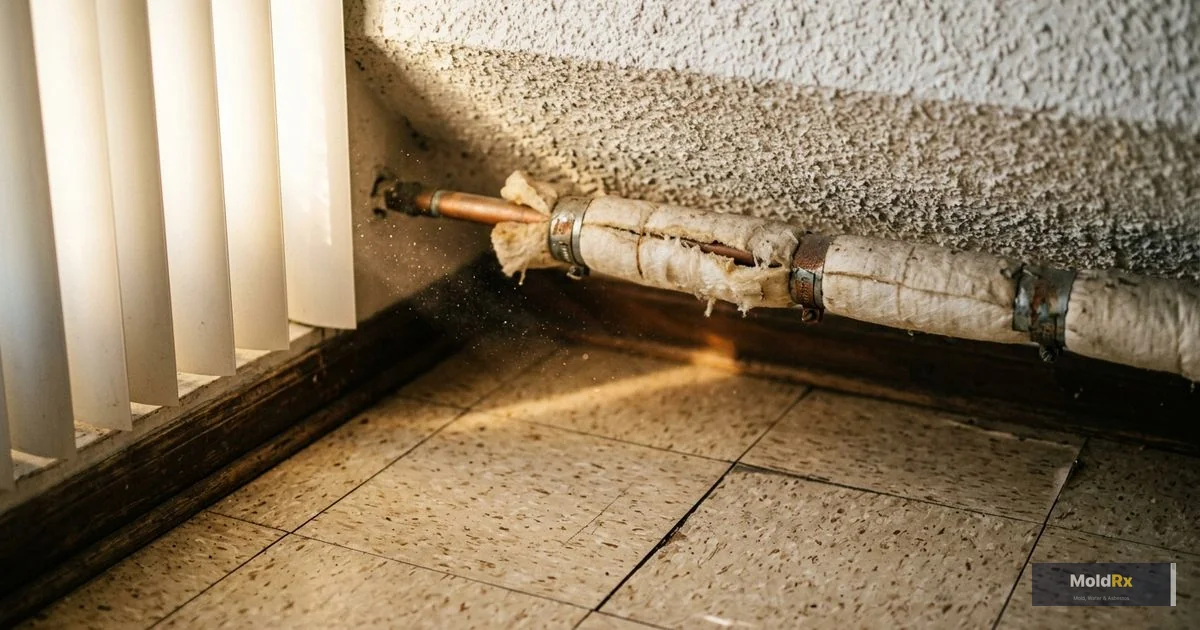
- Pipe insulation — Wrapping on water heater connections and supply lines
- Wall and floor insulation — In walls, beneath floors, and around plumbing penetrations
The compact construction of manufactured homes adds urgency to testing. Unlike site-built homes where walls and separate HVAC zones may partially contain fiber release, a manufactured home's open layout and shared duct system mean that disturbance in one area can spread contamination throughout the entire unit rapidly. Pre-renovation testing is especially critical for manufactured home owners.
Climate and Material Deterioration
Yucaipa's semi-arid foothill climate subjects building materials to conditions that accelerate deterioration. Summer temperatures in the 90s and occasional triple digits cause expansion; winter lows at elevation — occasionally dropping to freezing — cause contraction. This thermal cycling, repeated thousands of times over decades, stresses rigid materials like cement-asbestos siding and roofing. The dry winds through the San Gorgonio Pass and periodic winter rain further compound the stress. Older building materials degrade faster here than in milder coastal locations. This matters because deteriorating asbestos-containing materials are more likely to release fibers — making testing important not just before renovation, but when older materials show signs of damage.
Common Asbestos-Containing Materials in Yucaipa Properties
Based on the construction eras and building methods typical for the Yucaipa area, the following materials are priority testing targets in both site-built and manufactured homes:
Popcorn and acoustic ceiling textures. Spray-applied finishes containing chrysotile asbestos at concentrations of 1 to 10 percent. Found throughout Yucaipa's mid-century homes and also used in some manufactured home ceilings.
Vinyl floor tiles and mastic. Both the 9-inch and 12-inch tiles and the black adhesive beneath them commonly contained asbestos in pre-1980 construction. Many Yucaipa homes have multiple layers of flooring, with original asbestos-containing tiles hidden beneath later additions.
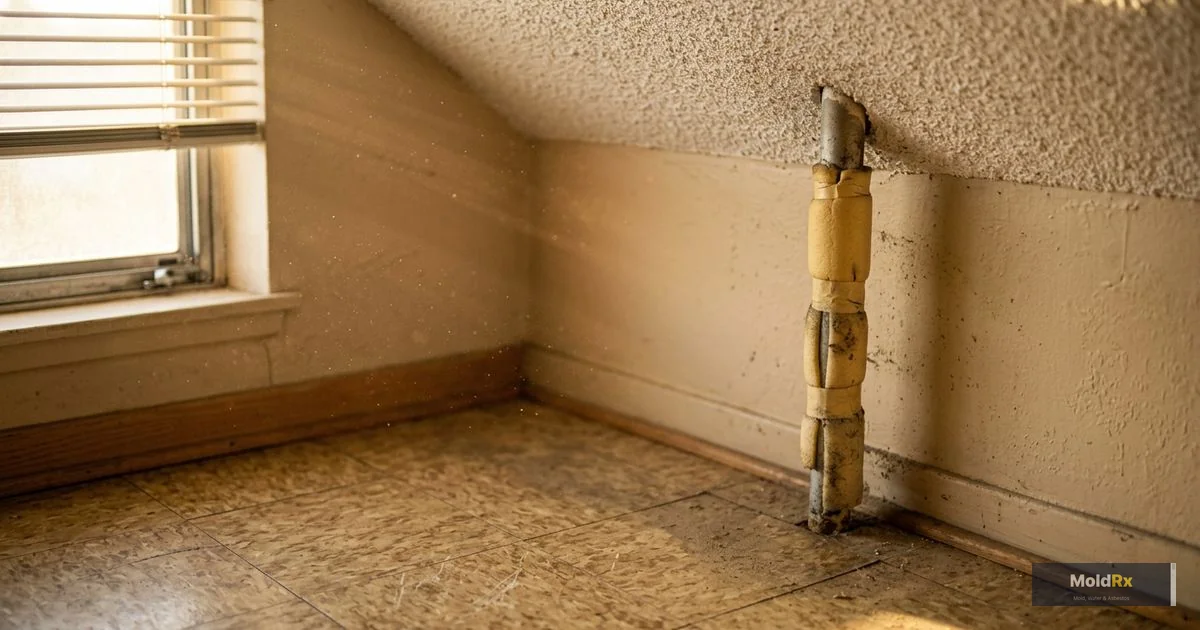
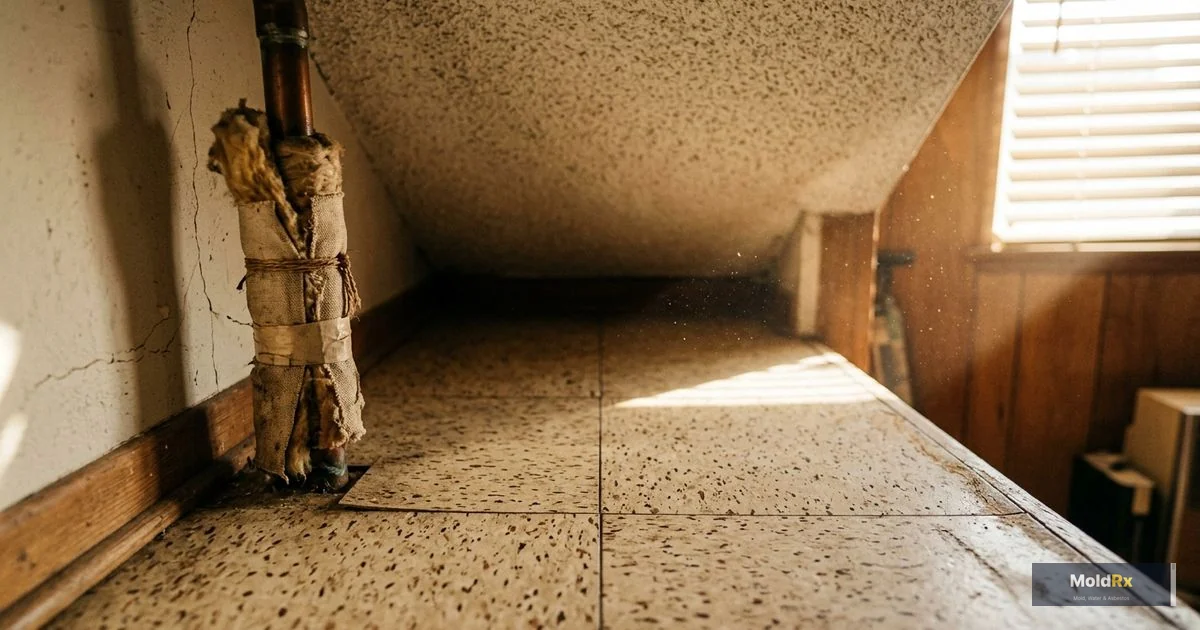
Pipe insulation. Asbestos wrapping on hot water pipes, boiler connections, furnace components, and under-slab plumbing runs. Given the demands that Yucaipa's climate places on heating and cooling systems, pipe insulation is found extensively in homes of all types.
Vermiculite attic insulation. Loose-fill insulation sold under the Zonolite brand and other names, consisting of small accordion-shaped granules that may contain naturally occurring tremolite asbestos from the contaminated Libby, Montana mine.
Duct insulation and duct tape. Particularly significant in Yucaipa, where forced-air HVAC systems work hard year-round due to summer heat and cooler winter conditions at elevation. The cloth tape used to seal duct joints and the insulation wrapped around ductwork frequently contain asbestos.
Roofing shingles, felt, and underlayment. Cement-asbestos roofing products were standard on mid-century Southern California homes and remain in place on many Yucaipa properties.
Cement-asbestos siding. Transite exterior cladding — a rigid cement board reinforced with asbestos fibers — was widely used on homes built during the 1950s through 1970s.
Joint compound and wall textures. Drywall taping mud and textured wall coatings that used asbestos as a reinforcing and binding agent.
Fireplace and wood stove components. Heat shields, millboard, flue liners, hearth pads, and gaskets in homes with wood-burning heating. Wood stoves and fireplaces are common in Yucaipa's foothill homes, where elevation and cooler winters make supplemental heating practical.
Window glazing and caulking. Older putty compounds and caulking used around windows and exterior joints in pre-1980 construction.
You cannot identify asbestos by looking at a material. Two tiles that appear identical may come from different manufacturers — one using asbestos, one not. Laboratory analysis of a physical sample is the only reliable determination.
Call (888) 609-8907 to schedule testing — honest answers, no pressure.
Understanding Asbestos Health Risks
Asbestos fibers are extraordinarily small — thinner than a human hair by a factor of several hundred — invisible to the naked eye, odorless, and tasteless. When asbestos-containing materials are intact and undisturbed, they pose no hazard. The danger begins when those materials are cut, drilled, sanded, scraped, broken, or allowed to deteriorate to the point where fibers become airborne. Once airborne, fibers are inhaled and travel deep into the lungs, where they become permanently embedded. The human body has no mechanism to dissolve, break down, or expel them.
Over years and decades, these trapped fibers cause chronic inflammation, progressive scarring, and cumulative DNA damage. The resulting diseases are serious and often fatal:
Mesothelioma — an aggressive cancer of the lung or abdominal lining, caused almost exclusively by asbestos exposure, with a median survival time of 12 to 21 months after diagnosis. There is no cure.
Asbestosis — irreversible fibrosis of lung tissue that progressively reduces breathing capacity. It develops slowly over years and has no reversal.
Lung cancer — risk is substantially elevated by asbestos exposure, multiplying dramatically for individuals who also smoke.
The Latency Problem
The defining characteristic of all asbestos-related disease is latency. Symptoms do not appear until 10 to 50 years after exposure. A Yucaipa homeowner who inhales fibers while scraping a ceiling in 2026 may not develop symptoms until the 2040s or beyond. By the time a diagnosis is made, the damage is irreversible. This is why testing before renovation is critical — asbestos exposure is completely silent at the moment it occurs, and the only prevention is identifying which materials contain asbestos before anyone disturbs them.
The Complete Regulatory Framework for Yucaipa Properties
California enforces stringent asbestos regulations that apply to all property types in Yucaipa — site-built homes, manufactured homes, and commercial buildings alike. Here is the full regulatory landscape:
SCAQMD Rule 1403
SCAQMD Rule 1403 requires an asbestos survey before renovation or demolition. For demolition, this applies regardless of building age. The survey must be performed by a certified consultant. Notification to SCAQMD is required at least 10 working days before asbestos removal begins. Prescribed work practices govern handling and disposal. Non-compliance penalties can exceed $20,000 per day.
Cal/OSHA Title 8, Section 1529
Cal/OSHA Section 1529 requires identification of ACM through laboratory testing before renovation or demolition in pre-1980 structures. Thermal system insulation and surfacing materials are presumed to contain asbestos until testing proves otherwise. This applies to contractors, but affects homeowners directly — your contractor must comply before starting work on your Yucaipa property.
Federal OSHA 1926.1101
OSHA 1926.1101 is the federal construction-industry asbestos standard. It sets the permissible exposure limit at 0.1 fiber per cubic centimeter (8-hour TWA) with an excursion limit of 1.0 fiber per cubic centimeter over 30 minutes. It classifies asbestos work into categories (Class I through IV) with escalating safety requirements, requires wet methods to suppress fiber release, and mandates pre-work assessments for all construction activities that may disturb ACM.
AHERA (Asbestos Hazard Emergency Response Act)
While AHERA directly regulates schools and public buildings, its protocols and laboratory accreditation requirements form the foundation for all residential testing practices. AHERA requires that all asbestos analysis be performed by NVLAP-accredited laboratories, and inspectors performing residential surveys hold AHERA-accredited certifications. Sampling procedures used in Yucaipa residential testing are derived from AHERA protocols.
CSLB C-22 Asbestos Abatement Licensing
When asbestos removal is required, California law mandates that abatement be performed by a contractor holding a CSLB C-22 asbestos abatement license and registered with the Division of Occupational Safety and Health (DOSH). The C-22 classification requires four years of documented asbestos abatement experience, passage of trade and law examinations, and active DOSH registration. No other contractor classification authorizes asbestos removal work in California.
Our Asbestos Testing Process in Yucaipa
MoldRx coordinates professional asbestos testing through vetted specialists who understand Yucaipa's diverse housing stock — from mid-century site-built homes to established manufactured home parks to newer foothill developments — and the specific regulatory requirements that apply to each.
Step 1: Consultation and Scope
Every testing engagement begins with a conversation about your property. We discuss the building type, construction era, previous renovation history, and your current project plans. For Yucaipa's varied housing stock, the testing scope is tailored to what your specific property actually needs. A homeowner renovating a bathroom in a 1970s ranch home needs targeted testing of the materials in that space. A buyer evaluating a 1965 manufactured home needs a scope calibrated to mobile home construction of that era. A family updating a 1980s foothill home needs a different approach entirely. We design the inspection around your property, not a one-size-fits-all checklist.
Step 2: Professional Sample Collection
Vetted specialists collect samples on-site following EPA-established protocols. Each suspect material is wetted before sampling to suppress any fiber release. Small, representative samples are extracted using specialized tools, sealed in labeled containers, and documented with full chain-of-custody records. Where the same material type appears in multiple locations, separate samples are collected from each, because identical-looking materials installed at different times may have different compositions. EPA procedures require a minimum of three samples per homogeneous material in each distinct area.
For manufactured homes, specialists are experienced with the specific construction methods, material types, and access challenges unique to mobile home design. Sample collection in manufactured homes requires particular care to avoid disturbing surrounding materials in the compact living space.
Step 3: NVLAP-Accredited Laboratory Analysis
All samples are analyzed at an NVLAP-accredited laboratory — accredited by the National Voluntary Laboratory Accreditation Program administered by NIST, as required by AHERA.
PLM (Polarized Light Microscopy) is the standard analytical method for asbestos identification in bulk building material samples. PLM identifies asbestos fiber type (chrysotile, amosite, crocidolite, or tremolite) and measures the concentration percentage, following EPA Method 600/R-93/116. PLM has a detection limit of approximately 1%, which is also the regulatory threshold for classifying a material as ACM under NESHAP.
TEM (Transmission Electron Microscopy) provides higher magnification and greater sensitivity. TEM is used when PLM results are inconclusive, for air monitoring samples, for post-abatement clearance testing, or when materials with complex matrices (certain floor tiles, mastics, vermiculite) may mask fibers under PLM. TEM provides the highest level of analytical certainty and is the required method for airborne fiber analysis.
Standard laboratory turnaround is 3 to 5 business days. Rush processing — as fast as 24 hours — is available for time-sensitive projects.
Step 4: Results and Actionable Recommendations
Your report identifies each material tested, its location in the property, and whether asbestos was detected. For positive results, the asbestos type and concentration percentage are clearly documented. Any material exceeding 1% asbestos is classified as ACM. We explain what the findings mean for your specific situation: which materials must be professionally removed before your renovation can proceed, which can be managed in place through monitoring or encapsulation, and what the realistic options are for each scenario. The goal is to give you a clear, honest understanding of your property's condition — not to generate unnecessary work.
What to Expect
-
On-site time: Sample collection for a typical Yucaipa site-built home takes two to four hours, depending on the number of materials being sampled. Manufactured home inspections are generally faster due to the smaller footprint, typically one to three hours.
-
Results timeline: Standard laboratory results from an NVLAP-accredited lab are available within 3 to 5 business days. Rush processing is available for time-sensitive projects including real estate closings and scheduled renovation starts.
-
Documentation: Your report meets Cal/OSHA Section 1529 and SCAQMD Rule 1403 regulatory standards and provides the documentation needed for contractor coordination, permit applications, regulatory compliance, and real estate transactions.
-
Honest guidance: If testing is unnecessary for certain materials based on their age, type, or condition, we will tell you. If results come back negative, you will have documented proof that you can proceed with confidence. If asbestos is found, we provide clear, direct guidance on your options without pressure toward unnecessary removal.
Common Testing Scenarios in Yucaipa
Pre-Renovation Testing
The most frequent reason Yucaipa homeowners contact us. Remodeling a kitchen in a 1970s ranch home. Replacing original flooring. Scraping textured ceilings. Upgrading an aging HVAC system. Converting a garage. Removing a wall. These are everyday renovation projects, and in a pre-1980 Yucaipa home, every one of them involves disturbing materials that may contain asbestos. California law requires testing before the work begins.
Manufactured Home Renovation and Repair
Replacing flooring, updating ceiling panels, repairing plumbing, or replacing HVAC components in a pre-1980 manufactured home all carry asbestos risk. The compact nature of these units means any fiber release affects the entire living space quickly. Testing before disturbance is critical — and the same regulations that apply to site-built homes apply with equal force to manufactured housing.
Real Estate Transactions
Buyers evaluating older properties in Yucaipa — whether site-built homes or manufactured units — benefit from asbestos testing as part of pre-purchase due diligence. Understanding the asbestos condition before closing allows for informed negotiation, accurate renovation budgeting, and avoidance of post-purchase surprises.
Damaged or Deteriorating Materials
Yucaipa's climate accelerates deterioration of older building materials. When roofing begins to crumble, siding cracks and separates, ceiling texture flakes, or pipe insulation frays, testing determines whether those materials contain asbestos and whether fiber release is occurring.
HVAC and Maintenance Work
Before any work on older heating, cooling, or plumbing systems — duct replacement, furnace installation, water heater swaps, pipe repairs — testing of surrounding insulation materials is required if the home was built before 1980. This is especially relevant in Yucaipa, where HVAC systems are heavily used due to hot summers and cool winters at elevation, and the materials around them may have been disturbed by previous maintenance.
Fireplace and Wood Stove Projects
Yucaipa's foothill location makes fireplaces and wood stoves common in older homes. Renovation, replacement, or removal of wood-burning installations from the 1960s through 1980s should include testing of flue liners, hearth pads, heat shields, millboard, and gaskets — all of which commonly contained asbestos during those construction eras.
Yucaipa Areas We Serve
MoldRx provides asbestos testing throughout Yucaipa, including Wildwood Canyon, Chapman Heights, Dunlap Acres, Oak Glen, North Bench, Upper Yucaipa, Rolling Hills, the historic downtown area, and manufactured home communities throughout the city. We serve the 92399 ZIP code and the surrounding area.
Our coverage extends to neighboring communities including Calimesa to the west, Redlands to the southwest, Mentone to the northwest, and the mountain communities toward Big Bear and Running Springs to the north. Whether your property is a 1960s bungalow near downtown, a manufactured home in an established park, or a newer foothill development, our vetted specialists understand the construction patterns and materials specific to your home's era and type.
Related Services in Yucaipa
In addition to asbestos testing, we also offer Mold Removal in Yucaipa, Asbestos Removal in Yucaipa, Water Damage Restoration in Yucaipa, and Mold Testing in Yucaipa services to Yucaipa property owners.
→ Learn more about remediation services in Yucaipa
Frequently Asked Questions
Is asbestos testing legally required before renovating in Yucaipa?
Yes. Cal/OSHA Section 1529 requires identification of ACM through laboratory testing before renovation or demolition in pre-1980 structures. SCAQMD Rule 1403 requires an asbestos survey before renovation or demolition — and for demolition, the requirement applies regardless of building age. Federal OSHA 1926.1101 mandates pre-work assessments for all construction activities that may disturb ACM. These regulations apply equally to site-built homes, manufactured homes, and commercial properties.
What laboratory accreditation should I look for?
All asbestos analysis should be performed by an NVLAP-accredited laboratory. The National Voluntary Laboratory Accreditation Program, administered by NIST, accredits laboratories for both PLM and TEM asbestos fiber analysis. AHERA requires NVLAP accreditation for asbestos analysis, and this standard represents the benchmark for reliable, legally defensible results. MoldRx only works with NVLAP-accredited laboratories.
What about asbestos in manufactured homes in Yucaipa?
Manufactured homes built before 1980 should be tested before any renovation, repair, or maintenance work that will disturb original materials. Common asbestos locations in pre-1980 manufactured homes include vinyl flooring and backing, ceiling panels, duct insulation, exterior siding, and pipe wrapping. The compact design of manufactured homes means fiber release in one area can quickly spread throughout the unit, making pre-work testing especially important. The same regulations — Cal/OSHA Section 1529, SCAQMD Rule 1403, and OSHA 1926.1101 — apply to manufactured homes with equal force.
Does Yucaipa's climate affect asbestos risk?
Yes. Yucaipa's semi-arid foothill climate subjects building materials to significant thermal cycling — hot summers, cool winters, and occasional freezing at higher elevations. This cycling, combined with dry wind exposure through the San Gorgonio Pass and periodic moisture from rain, accelerates the deterioration of older asbestos-containing materials. A material that might remain stable for decades in a milder coastal climate may degrade faster in Yucaipa, potentially reaching a condition where fiber release becomes more likely.
What is the difference between PLM and TEM analysis?
PLM (Polarized Light Microscopy) is the standard EPA-accepted method for identifying asbestos in bulk building material samples. It determines fiber type and estimates concentration, with a detection limit of approximately 1% — which is also the regulatory threshold. TEM (Transmission Electron Microscopy) provides higher magnification and sensitivity, detecting fibers too small for light microscopy. TEM is used when PLM results are inconclusive, for air monitoring, for post-abatement clearance testing, and when complex material matrices may mask fibers. Both methods are performed at NVLAP-accredited laboratories.
What happens if asbestos is found in my Yucaipa property?
Not all asbestos requires immediate removal. Intact materials in good condition that will not be disturbed by renovation or maintenance can often be managed in place through periodic monitoring or encapsulation. Materials that are damaged, deteriorating, or that will be disturbed by planned work must be professionally removed by a CSLB C-22 licensed asbestos abatement contractor before that work begins. SCAQMD Rule 1403 requires notification at least 10 working days before removal. Your testing report provides specific recommendations for each identified material based on its condition and your project plans.
Can I handle a small renovation without testing first?
If your Yucaipa home or manufactured unit was built before 1980 and the work will disturb any original building materials, California law requires testing first — regardless of the project's size. Even seemingly minor work — pulling up a section of old flooring, scraping a textured ceiling, cutting into a wall to run new wiring — can release asbestos fibers if the materials contain asbestos. There is no "small project" exemption under Cal/OSHA Section 1529 or SCAQMD Rule 1403. Testing provides certainty and legal compliance.
How are samples collected in a manufactured home?
The same EPA protocols apply to manufactured homes as to site-built structures. Specialists wet materials before sampling, extract small representative sections with specialized tools, and seal samples in labeled containers with chain-of-custody documentation. Specialists take particular care with the compact access points unique to manufactured homes — crawl spaces, utility closets, and tight ceiling cavities — to ensure thorough sampling without unnecessary disruption.
Get Asbestos Testing in Yucaipa
Yucaipa's housing stock spans seven decades — from postwar bungalows and established manufactured home parks to newer foothill developments. Across all eras and property types, the question is the same: do the materials in your home contain asbestos, and what does that mean for your plans?
Our vetted specialists understand Yucaipa's diverse construction patterns — site-built homes, manufactured housing, foothill properties — and will give you honest, clear guidance about what is in your property and what those findings mean for your renovation, your purchase, or your peace of mind.
No guesswork. No runaround. No pressure.
Call MoldRx to schedule your asbestos test — (888) 609-8907. Know before you start.