Emergency Water Damage Restoration in Wildomar, CA — MoldRx
24/7 Water Damage Restoration Specialists Serving Wildomar and the Temecula Valley
There is no convenient time for water to invade your home. It happens at 2 AM when a toilet supply line cracks and floods the hallway. It happens on Christmas Eve when an atmospheric river dumps inches of rain onto already saturated soil and Murrieta Creek reminds everyone that flood control projects are still under construction. It happens slowly, invisibly, when a slab leak beneath your kitchen runs for weeks before the warped flooring finally tells you what the foundation already knows.
In Wildomar, every one of these scenarios is not just possible — they are happening right now, somewhere in this city of 37,000 residents. And the physics of water damage do not care whether you are ready. Within 24 hours, clean water begins absorbing contaminants from building materials. Within 48 hours, mold colonization starts on wet surfaces. Within 72 hours, a manageable extraction becomes a demolition-and-rebuild project.
If water has entered your Wildomar home or business, contact MoldRx immediately. Every hour you wait increases the damage, the cost, and the timeline for getting your life back to normal.
Why Wildomar Faces Serious Water Damage Risk
Wildomar is one of Riverside County's newest cities — incorporated on July 1, 2008, after residents of Wildomar and Sedco Hills voted to become the county's 25th city. But "new city" does not mean "new problems." Wildomar inherited decades of development, aging infrastructure, and flood risk that predate its incorporation by generations. Understanding why this city is uniquely vulnerable to water damage requires looking at three converging factors.
The Murrieta Creek Reality
Murrieta Creek runs directly through Wildomar on its way south through Murrieta and Temecula before joining Temecula Creek to form the Santa Margarita River. This is not a quaint seasonal stream. It is a flood channel that has demonstrated, repeatedly and catastrophically, what it can do when winter storms overwhelm its capacity.
In January 1993, several days of heavy rain caused Murrieta Creek to overflow its banks. The resulting flood inundated homes and businesses across the west sides of Wildomar, Murrieta, and Old Town Temecula, killing multiple people and causing approximately $100 million in damage. That single event reshaped flood policy for the entire Temecula Valley and launched the Murrieta Creek Flood Control Project — a multi-phase Army Corps of Engineers initiative that has been under construction, in various phases, for decades.
The operative word is "under construction." The project is not complete. Phase 2B — the $43.6 million section running through Uptown Temecula — broke ground in September 2025, but full 100-year flood protection for the entire Murrieta Creek corridor has not yet been achieved. Properties in Wildomar near the creek, along Clinton Keith Road, and in low-lying areas along the Lemon Street and Palomar Street corridors remain at elevated risk during significant storm events.
The December 2025 atmospheric river that triggered Governor Newsom's state of emergency declaration across Riverside County — alongside L.A., Orange, San Bernardino, and San Diego counties — was a reminder that this risk is not historical. It is active and ongoing. High-intensity rainfall on saturated soils creates flash flooding conditions along Murrieta Creek and its tributaries that can push water into homes with terrifying speed.
The Housing Stock: Two Eras, Two Vulnerabilities
Wildomar's housing stock spans two distinct construction periods, each with its own set of water damage failure modes:
1970s-1990s construction makes up a significant portion of Wildomar's established neighborhoods, particularly in areas like Wildomar Estates and communities along Grand Avenue and Lemon Street. These homes are now 30 to 55 years old, with plumbing systems that are well past their expected service life. Galvanized steel pipes from this era corrode internally, restricting flow and eventually developing leaks. Polybutylene supply lines — a plastic piping material installed in millions of homes between 1978 and 1995 before being effectively discontinued due to its failure rate — may be present in homes from this period. Polybutylene is notorious for sudden, catastrophic failures as the material degrades from the inside out, often without any warning signs.
These older homes frequently sit on raised foundations with crawlspaces — spaces that trap moisture, encourage wood rot in floor joists and subflooring, and create ideal incubation environments for mold when water enters from above. Many also have aging HVAC systems with deteriorating condensate drain lines that overflow into ceiling assemblies and wall cavities without any visible evidence until staining or mold growth appears.
1990s-2010s tract homes dominate newer developments like Windsong, Copper Canyon, and communities along Clinton Keith Road. These homes feature slab-on-grade foundations, copper supply lines, and stucco exteriors — the standard Southern California tract-home package. At 15 to 30 years old, they are now entering the critical failure window:
-
Slab leaks are endemic in this construction era. Copper lines embedded in concrete are stressed by Wildomar's expansive clay soils, which swell during the rainy season and shrink during the long dry months, flexing the slab and the pipes within it. Pinhole leaks develop at stress points and can run for weeks, saturating hundreds of square feet of concrete before flooring symptoms — warping, discoloration, unexplained dampness — finally appear.
-
Builder-grade water heaters, appliance supply lines, and fixture components are at or past their expected service life. Rubber washing machine hoses, plastic dishwasher connectors, and cheap shut-off valves installed during original construction become brittle and fail — often catastrophically, with pressurized water flowing continuously until someone discovers it.
-
Stucco exteriors seal the building envelope tightly but conceal water intrusion brilliantly. A failed window flashing, a cracked stucco joint, or a compromised kickout at a roof-to-wall transition allows rain to enter the wall assembly, where it saturates the paper-backed lath and sheathing without any exterior symptoms. Interior evidence — staining, soft drywall, musty odors — may not appear for weeks or months.
Climate: Deceptive Dryness
Wildomar sits at approximately 1,270 feet elevation in the heart of the Temecula Valley, with a semi-arid Mediterranean climate characterized by long, hot summers and a concentrated rainy season. Summer temperatures regularly reach the mid-90s to low 100s. Annual rainfall averages about 14 inches — but virtually all of it falls between November and March, often in intense bursts that overwhelm drainage systems and expose every vulnerability in the building envelope.
The dry months create a false sense of security. Homeowners in Wildomar go 6-7 months without thinking about water damage. Plumbing deteriorates. Caulking dries and cracks. Weatherstripping fails. Soil contracts away from foundations, opening gaps. Then the rains come, and every deferred vulnerability activates simultaneously.
The heat itself is a factor. Thermal expansion and contraction cycles stress pipe joints, accelerate degradation of rubber and plastic components, and cause the clay-heavy soil to shift beneath foundations. The majority of water damage in Wildomar does not come from storms — it comes from plumbing failures inside the home, often triggered or accelerated by conditions that developed during the hottest months.
Water Damage Categories: Why Classification Determines Everything
The ANSI/IICRC S500 Standard classifies water damage into three categories, and the category drives the entire restoration protocol — including which materials can be saved, which must be removed, and what antimicrobial treatments are required.
Category 1 (Clean Water): From a sanitary source — supply line break, water heater failure, sink overflow. Not immediately hazardous, but degrades to Category 2 within 24-48 hours as the water absorbs contaminants from building materials, carpet backing, and environmental particulates. This is the most common category in Wildomar and the most treatable if caught quickly.
Category 2 (Gray Water): Contains significant contamination that can cause illness on contact. Dishwasher discharge, washing machine overflow, toilet overflow with urine. Requires enhanced extraction, antimicrobial treatment, and removal of saturated porous materials.
Category 3 (Black Water): Grossly contaminated water harboring pathogens, bacteria, and toxins. Sewer backups, toilet overflow with feces, and all exterior floodwater — including Murrieta Creek overflow and storm flooding. Every porous material contacted by Category 3 water must be removed. No exceptions. No shortcuts.
Understanding these categories matters because time converts Category 1 into Category 2, and Category 2 into Category 3. A clean supply line break left for 48 hours is no longer clean water. A gray water event left for 72 hours in a warm environment becomes a black water event requiring the most aggressive — and most expensive — restoration protocol. Speed is not a sales tactic. It is science.
Our Emergency Restoration Process in Wildomar
Phase 1: Emergency Response and Water Extraction
Our vetted professionals arrive with commercial-grade extraction equipment — truck-mounted units, submersible pumps for standing water, and weighted extraction tools that pull water from carpet and pad. For Wildomar's slab-foundation homes, extraction includes systematic checking for lateral moisture migration beneath flooring materials — water on a slab does not respect room boundaries. For homes with raised foundations and crawlspaces, the protocol includes crawlspace access, standing water removal, and assessment of floor joists and subflooring for saturation and structural compromise.
The water source is identified and stopped. If the source is still active — an unrepaired pipe, a running appliance, a continuing roof leak — emergency mitigation of the source happens simultaneously with extraction setup. You cannot extract faster than an active leak can flow.
Phase 2: Moisture Detection and Damage Mapping
Visible water is the tip of the iceberg. In both construction eras present in Wildomar, water travels hidden paths:
- In older homes with plaster or older drywall, water wicks through wall cavities and saturates insulation that holds moisture like a sponge
- In newer tract homes, water migrates behind stucco through wall assemblies, pools on vapor barriers, and saturates areas that appear completely dry from the interior
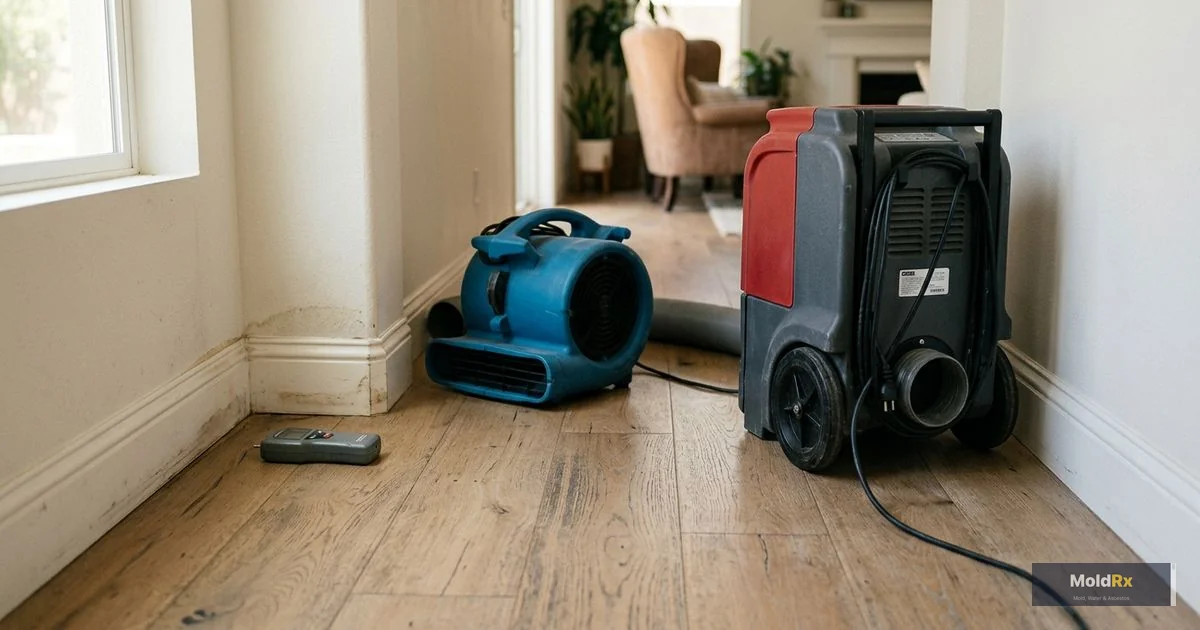
Our professionals deploy thermal imaging cameras to detect temperature differentials caused by hidden moisture, pin-type and pinless moisture meters for quantitative readings across all building materials, and thermo-hygrometers to establish ambient conditions and drying targets. Every wet area is mapped, documented, and photographed — creating both the blueprint for equipment placement and the evidence your insurance company requires.
Phase 3: Engineered Structural Drying
Proper drying is not about fans and time. It is an engineered process with measurable targets:
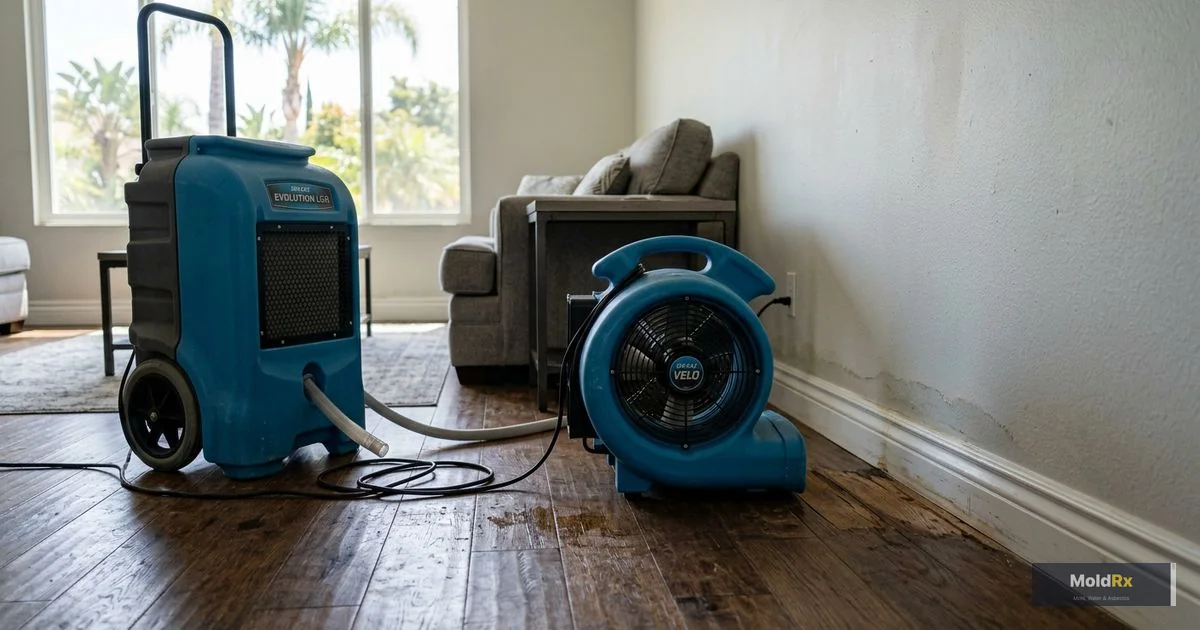
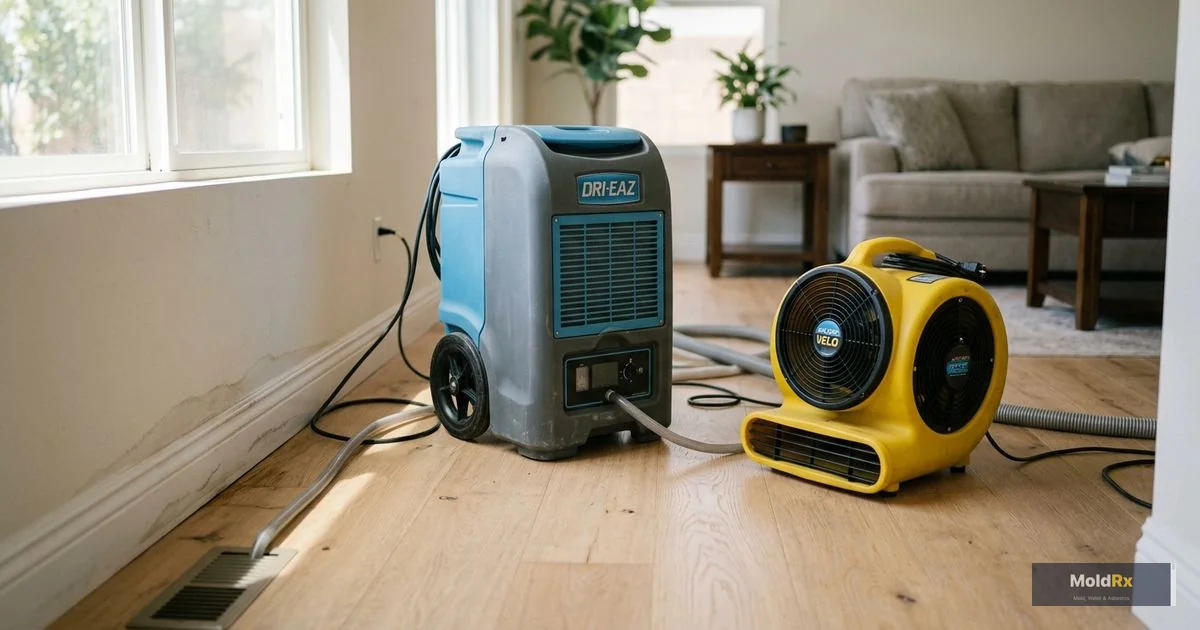
- Industrial air movers (2,500+ CFM commercial units) create sustained high-velocity airflow across wet surfaces
- Commercial dehumidifiers — desiccant or refrigerant depending on ambient conditions — capture moisture as it evaporates from building materials
- Injectidry wall-cavity systems force dry air behind intact drywall, enabling structural drying without unnecessary demolition
- Specialty floor drying systems create sealed vacuum zones over hardwood and engineered flooring
Daily moisture readings at every monitoring point track progress toward IICRC S500 dry standards. Equipment is repositioned as areas reach target levels. Drying is complete when quantitative readings confirm it — not when someone decides it feels dry enough.
For Wildomar's older homes with crawlspaces, the drying protocol extends below the floor — crawlspace ventilation, targeted dehumidification, and monitoring of floor joists and subflooring that may have absorbed significant moisture.
Phase 4: Antimicrobial Treatment and Contamination Removal
For Category 1 events, antimicrobial treatment is applied preventively to all affected surfaces — an inexpensive step that prevents the far more expensive consequence of post-restoration mold growth.
For Category 2 and Category 3 events, this phase includes:
- Removal of all contaminated porous materials — drywall to the required height, carpet pad, insulation, particleboard, OSB subflooring
- HEPA vacuuming of all structural surfaces to remove particulate contamination
- Application of EPA-registered antimicrobial agents to framing, concrete, and salvageable semi-porous materials
- Air scrubbing with HEPA filtration throughout the affected zone
- Post-treatment verification of microbial levels
Phase 5: Restoration and Reconstruction
The final phase returns your home to pre-loss condition. Drywall, flooring, baseboards, cabinetry, paint — everything removed during the restoration process is rebuilt to current building codes and matched to existing finishes. For Wildomar's tract homes where consistent architectural styles mean materials are typically available, seamless restoration is achievable. For older homes with unique materials or discontinued finishes, our professionals work to find the closest match or coordinate with homeowners on upgrade options.
What Honest Water Damage Restoration Looks Like
MoldRx exists because two neighbors — Tyler and Adrian — saw how difficult it was for property owners to find honest, reliable remediation help. That founding principle shows up in every interaction:
-
No manufactured urgency. The urgency in water damage is real. We do not need to exaggerate it. We will tell you exactly how serious your situation is — and if it is less severe than you feared, you will know.
-
No phantom damage. We do not tear out materials that can be saved, and we do not "discover" additional damage to inflate a project scope. Moisture meters do not lie — the numbers tell us what needs to go and what can stay.
-
No insurance games. We document everything your adjuster needs — moisture maps, daily readings, categorization reports, equipment logs, photos. We work with insurance companies on every project. We know exactly what they require and we provide it without games or shortcuts.
-
No ghost crews. The professionals who assess your property are the professionals who do the work. You will know who is in your home, what they are doing, and why.
-
Verified completion. The project is complete when moisture readings confirm it. Not when someone's schedule says it should be done. Cutting drying short is the single most common cause of post-restoration mold growth, and it is a compromise we will not make.
Wildomar Areas We Serve
Our vetted water damage restoration specialists respond to emergencies across all Wildomar neighborhoods and communities, including Windsong, Windsong Valley, Copper Canyon, Briggs Road Estates, Wildomar Estates, Baxter Road Bundy Canyon, the communities along Clinton Keith Road, Lemon Street, Grand Avenue, and Palomar Street, as well as properties near Bundy Canyon and the Murrieta Creek corridor. We cover ZIP code 92595 and surrounding areas.
We also respond to water emergencies in neighboring Murrieta to the south, Lake Elsinore to the northwest, Menifee to the northeast, and Temecula to the south. Whether your property is a 1970s home with a crawlspace and aging galvanized plumbing, a 2005 tract home with a hidden slab leak, or a commercial building along Clinton Keith Road, our professionals understand the construction types and water damage scenarios specific to this area.
Related Services in Wildomar
In addition to water damage restoration, we also offer Mold Removal in Wildomar, Asbestos Removal in Wildomar, Water Damage Restoration in Wildomar, Mold Testing in Wildomar, and Asbestos Testing in Wildomar services to Wildomar property owners.
Water damage and mold are inseparable problems in the Temecula Valley. Hidden moisture from a slab leak, a concealed plumbing failure, or storm intrusion can sustain active mold colonization inside wall cavities for months with no visible evidence. If your Wildomar property has experienced any water intrusion, mold testing is not optional — it is essential.
-> Learn more about remediation services in Wildomar
Frequently Asked Questions
How quickly should I address water damage in Wildomar?
Now. Not tomorrow. Not after the weekend. Now. The science is not debatable: clean water degrades to contaminated water within 24-48 hours. Mold colonization begins on most building materials within 48 hours of sustained moisture exposure. Structural damage — swelling of engineered wood, delamination of subfloor plywood, warping of hardwood, corrosion of metal fasteners and connectors — accelerates with every hour of contact. A $3,000 extraction caught in the first 12 hours becomes a $15,000 restoration project when the homeowner waits two days. Our Wildomar team responds to emergencies 24 hours a day, 7 days a week, 365 days a year.
What are the most common causes of water damage in Wildomar?
The leading causes in Wildomar are slab leaks (driven by copper lines stressed in the region's expansive clay soil), water heater failures (especially in homes where the current unit is past its 10-year expected lifespan), washing machine and dishwasher supply line failures (particularly homes still running original builder-grade rubber hoses), toilet and fixture failures, and storm-related flooding along the Murrieta Creek corridor and in low-lying areas near Clinton Keith Road and Palomar Street. Older homes in the 1970s-1990s construction era face additional risk from deteriorating polybutylene piping and aging HVAC condensate drain lines.
Will my insurance cover water damage restoration in Wildomar?
Most homeowner's policies cover sudden and accidental water damage — a burst pipe, a failed water heater, a ruptured appliance supply line. What is typically not covered: gradual damage from a slow leak you knew about or should have discovered, external flood damage (requires separate NFIP or private flood insurance — important for Wildomar properties near Murrieta Creek), and damage resulting from deferred maintenance. Proper documentation is the key to a smooth claims process. Our professionals provide water categorization reports, comprehensive moisture maps, daily drying progress logs, equipment inventories, and photographic documentation that gives your adjuster everything needed to process the claim.
How long does water damage restoration take in Wildomar?
For a minor Category 1 event caught quickly — a small supply line break, limited affected area: 3-5 days. For a moderate event — water heater failure, multiple rooms, some material removal: 7-10 days. For a major Category 3 event — storm flooding, sewer backup, extensive contamination requiring demolition and reconstruction: 2-3 weeks. Wildomar's low ambient humidity during dry months helps accelerate the drying phase, but proper drying is driven by moisture readings, not calendars. We give you honest timelines based on your specific situation — not optimistic estimates designed to win your business.
Can water-damaged materials in my Wildomar home be saved?
Salvageability depends on three variables: what the material is, what category of water contacted it, and how fast you called. Hardwood flooring can often be saved with specialty vacuum-drying systems if treatment begins within 24-48 hours of a Category 1 event. Carpet can sometimes be salvaged if the pad is replaced and the carpet itself is properly extracted and antimicrobially treated — but only for Category 1 water. Drywall can be dried in place for Category 1 events when wicking height is under approximately 24 inches. All porous materials contacted by Category 2 or Category 3 water — drywall, insulation, carpet pad, particleboard, OSB — must be removed. There are no exceptions to this rule. Our professionals will be direct about what can be saved and what must go. We do not demolish materials unnecessarily, and we do not leave contaminated materials in your home to save time.
I think I have a slab leak. What should I do?
Warning signs of a slab leak include: an unexplained spike in your water bill, the sound of water running when all fixtures are off, warm spots on the floor (indicating a hot water line leak), cracks in your slab or foundation, damp or buckled flooring, or a persistent musty smell. If you suspect a slab leak, turn off your main water supply and call MoldRx immediately. Do not wait for confirmation. Do not wait for the spot to get bigger. Slab leaks do not resolve themselves — they get worse, and the moisture they introduce into your slab and flooring creates conditions for mold growth that can spread throughout the home. We coordinate leak detection, emergency plumbing repair, and water damage restoration as a single, unified response.
Act Now: Emergency Water Damage Restoration in Wildomar
Water damage does not respect your schedule, your budget, or your plans. It does not slow down because you need to think about it. It does not pause because you are comparing quotes. Every hour that water sits in your home's structure — in the slab, behind the walls, under the flooring, in the crawlspace — it migrates deeper, contaminates further, and compounds the damage and the cost.
MoldRx coordinates emergency water damage restoration through vetted professionals who understand Wildomar's specific challenges — the Murrieta Creek flood risk, the mixed housing stock spanning two construction eras, the slab leaks driven by expansive clay soils, and the aging plumbing in homes that are quietly past their service life. We follow IICRC S500 standards. We document everything. We tell you the truth about what your property needs.
If water has entered your Wildomar home or business, contact MoldRx now. The clock started when the water did. Do not give it another hour.