Asbestos Testing in Wildomar, CA — MoldRx
Vetted Asbestos Testing Specialists Serving Wildomar and the Temecula Valley
Wildomar is a city where old and new sit side by side. The name itself was coined from the names of its three founders — the WIL from William Collier, the DO from Donald Graham, and the MAR from Margaret Collier Graham. Long before incorporation, Wildomar served as an outpost for the Butterfield Stage pony express route and later as a stop on the Southern California Railroad. After the railroad tracks washed out, growth stalled, and Wildomar settled into a quiet decades-long period as farming and ranching country — including a significant number of horse ranches that gave the area its distinctive rural character. Modern development began in earnest after the Temecula Valley Freeway (I-15) was completed through the area in the mid-1980s, bringing urban-type growth to what had been open land. Developers built a mix of luxury estates, rural homes on larger lots, and planned suburban communities through the 1990s and 2000s. Wildomar officially incorporated as a city on July 1, 2008, becoming the 25th city in Riverside County with a population of approximately 28,000. Today, Wildomar is home to roughly 37,000 residents, and the housing stock reflects every phase of the area's development — from 1960s and 1970s ranch homes and rural properties to subdivisions built during the 2000s housing boom. A significant share of those properties were built during years when asbestos-containing materials were either standard construction practice or still working their way out of building supply chains. MoldRx only sends vetted asbestos testing professionals who understand the Temecula Valley's mixed-era housing stock and every applicable regulation.
Request your free estimate — we will help you determine if testing is needed for your project.
What Makes Asbestos Dangerous
Asbestos is a naturally occurring mineral that was mined and processed into thousands of construction products from the 1920s through the 1980s. Six varieties of asbestos exist, but three were widely used in building materials: chrysotile (white asbestos, the most common), amosite (brown asbestos), and crocidolite (blue asbestos). All are classified as known human carcinogens by every major health authority.
The construction industry valued asbestos for its ability to resist fire and heat, its tensile strength, its resistance to chemical damage, and its low cost. Manufacturers added asbestos fibers to floor tiles, roofing products, pipe insulation, ceiling textures, drywall compound, siding, and dozens of other materials. A home built during the peak asbestos era might contain the mineral in a dozen or more different products.
Asbestos-containing materials are not dangerous when they remain intact and undisturbed. The hazard begins when these materials are cut, sanded, drilled, scraped, broken, or allowed to deteriorate to the point where fibers become airborne. Asbestos fibers are microscopic — invisible to the naked eye, odorless, and tasteless — and once airborne, they can be inhaled deep into lung tissue. The body cannot break down or expel these fibers. Over time, they cause inflammation, scarring, and cellular changes that lead to three serious diseases:
- Mesothelioma — an aggressive cancer of the lining of the lungs or abdomen, caused almost exclusively by asbestos exposure, with a median survival time of 12 to 21 months after diagnosis
- Lung cancer — risk is significantly elevated by asbestos exposure, particularly when combined with smoking
- Asbestosis — progressive, irreversible scarring of lung tissue that permanently reduces breathing capacity
These diseases develop slowly, typically appearing 10 to 40 years after the initial exposure. There is no established safe level of asbestos exposure for mesothelioma, and none of these conditions are reversible once they develop. This is why testing before disturbing suspect materials is so critical — a single renovation project that releases asbestos fibers can have consequences that do not become apparent for decades.
Wildomar's Construction History and Asbestos Risk
Construction Eras and What They Mean for Asbestos
Pre-1980 rural construction. The oldest homes in Wildomar — ranch properties, rural residential structures, and some commercial buildings along the main corridors — date to the 1960s and 1970s. These homes were built during the peak of asbestos use in American construction. Floor tiles, popcorn ceilings, pipe insulation, furnace duct tape, roofing felt, drywall joint compound, and transite siding from this era have a high probability of containing asbestos. Some of these properties sit on larger lots in the rural portions of Wildomar and may not have been significantly renovated since original construction — meaning original asbestos-containing materials are likely still in place.
1980s development. The completion of I-15 brought the first wave of planned communities to the Wildomar area. Homes built during the 1980s straddle a difficult transitional period for building materials. Some manufacturers had already switched to asbestos-free products; others had not. A home from 1986 might contain asbestos in its ceiling texture but not its floor tiles, or the reverse. This inconsistency makes the 1980s era particularly difficult to assess without testing.
1990s communities. Development continued through the 1990s, with additional subdivisions and planned communities. Homes built during the early 1990s still carry some risk of containing asbestos in specific products — particularly ceiling textures, roofing materials, and certain specialty coatings — as the final asbestos-containing inventory was depleted from supply chains. Homes built after the mid-1990s are generally considered low risk.
2000s and newer construction. The most significant building wave — roughly a third of Wildomar's current housing stock was added between 2000 and 2009. These homes used modern building materials and are not a significant concern for asbestos. However, SCAQMD Rule 1403 still requires an asbestos survey before demolition regardless of building age.
The Mix Matters
What makes Wildomar's asbestos situation distinct from purely newer cities is the coexistence of construction eras within the same community. A 1975 ranch home on a two-acre lot may sit directly adjacent to a 2005 subdivision. The older property could contain asbestos in multiple materials, while the newer one does not. Buyers and renovators need to evaluate each property individually based on its actual construction date and materials — not the character of the surrounding neighborhood.
Climate and Material Deterioration
Wildomar shares the Temecula Valley's semi-arid Mediterranean climate, with summer temperatures regularly reaching the mid-90s to low 100s and mild winters. The dry heat, UV exposure, and daily thermal cycling between warm days and cool nights take a toll on building materials over decades. Roof shingles crack and become brittle. Pipe insulation deteriorates. Textured ceiling coatings develop hairline fractures. When asbestos-containing materials break down from age and weather stress, they can release fibers into indoor air even without active renovation or disturbance. For Wildomar's older homes — many of which now have materials approaching or exceeding 50 years of age — this climate-driven deterioration is a real consideration.
Common Asbestos-Containing Materials in Wildomar Homes
Ceilings. Popcorn (acoustic) ceiling texture is one of the most commonly positive materials in Southern California homes. It was applied by spraying a textured mixture onto ceiling surfaces and was popular from the 1950s through the early 1980s. Some smooth-troweled ceiling textures and suspended ceiling tiles also contain asbestos.
Floors. Nine-inch-by-nine-inch vinyl floor tiles are a well-known asbestos indicator from the peak usage era. The black mastic adhesive used to bond vinyl tiles to the subfloor frequently contains asbestos even when the tiles do not. Sheet vinyl flooring backing from certain manufacturers also tests positive.
Walls. Drywall joint compound (mud) used through the early 1980s commonly contained chrysotile asbestos. Some plaster formulations, textured wall coatings, and stucco mixes also test positive.
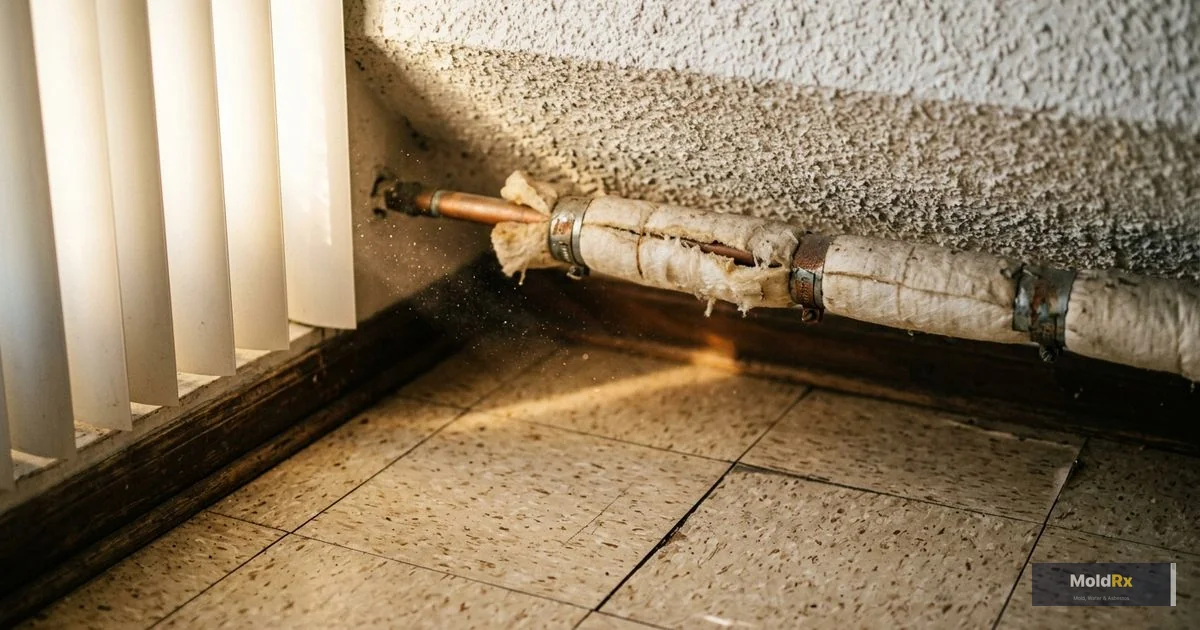
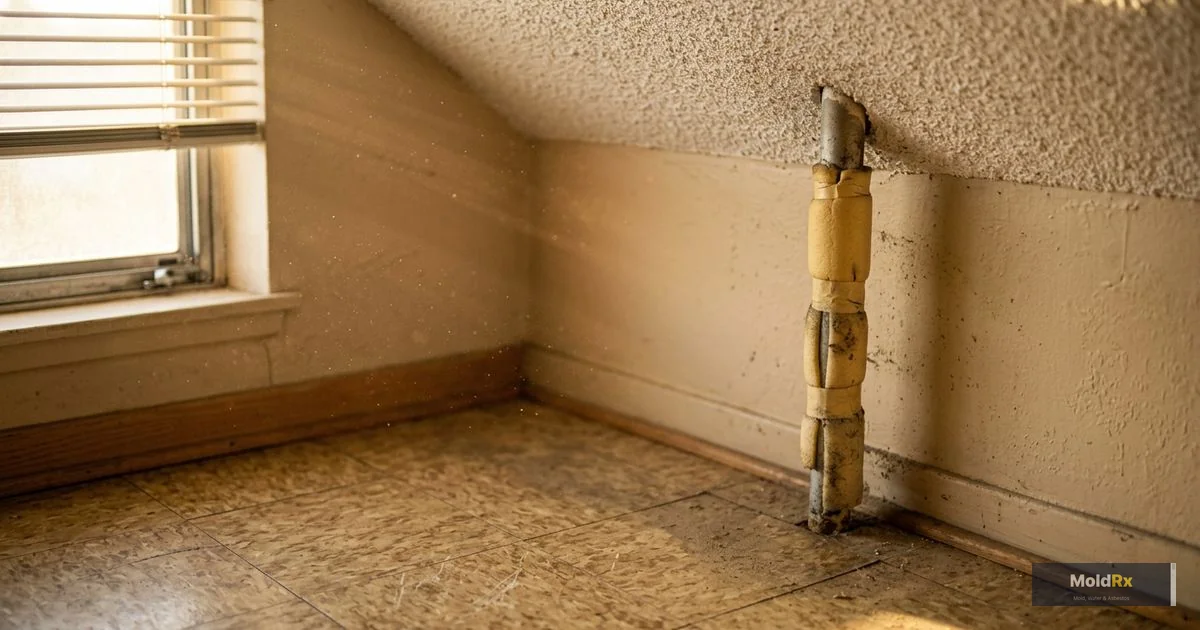
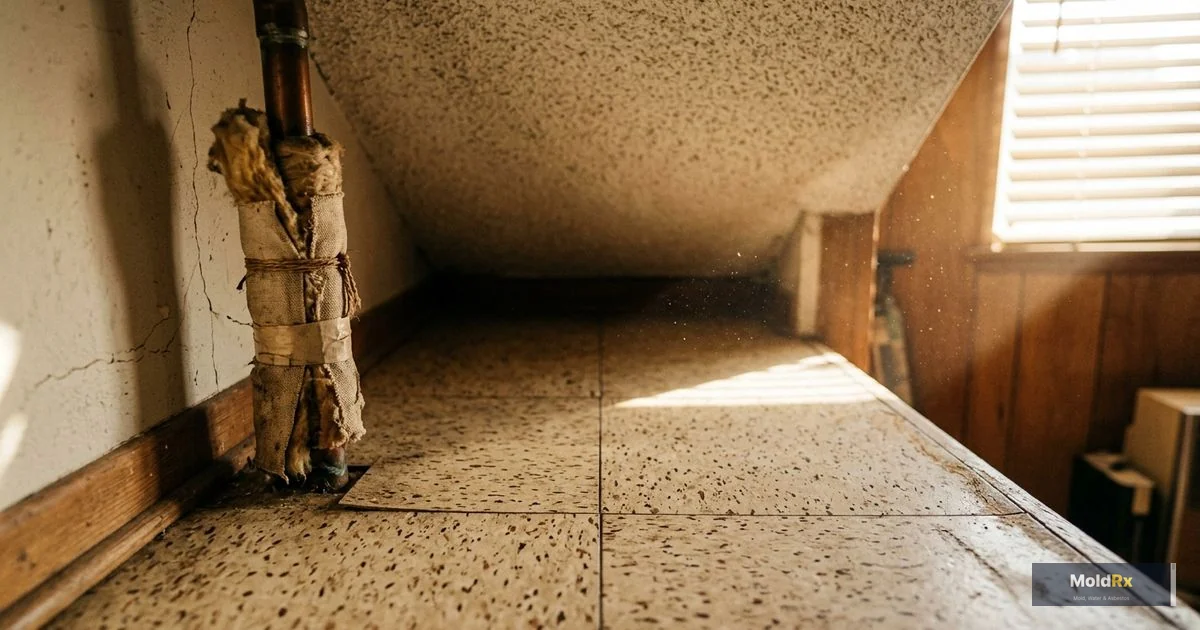
Insulation. Pipe wrapping and boiler insulation from pre-1980 installations are frequent asbestos sources. The cloth tape used to seal ductwork joints on HVAC systems is another common source. Vermiculite attic insulation — the loose, pebble-shaped material — poses a specific concern because much of the U.S. vermiculite supply came from an asbestos-contaminated mine in Libby, Montana.
Roofing. Asphalt shingles, roof felt (tar paper), roofing cement, and certain flashing materials from pre-1990 installations may contain asbestos.
Exterior. Transite siding (a rigid cement-asbestos panel that mimics wood grain) was used extensively from the 1930s through the 1970s. Some stucco formulations and window glazing compounds also contain asbestos.
Mechanical systems. Furnace flue pipes, HVAC duct insulation, and duct sealing tape on older heating and cooling systems frequently contain asbestos.
You cannot determine whether any of these materials contain asbestos by looking at them. Two tiles that look identical may come from different manufacturers — one using asbestos, one not. Laboratory analysis of a physical sample is the only reliable determination.
Call (888) 609-8907 to schedule testing — honest answers, no pressure.
Regulations That Require Asbestos Testing in Wildomar
Multiple overlapping federal and state regulations govern asbestos testing in Wildomar. Understanding which regulations apply to your project helps you plan timelines and avoid compliance issues.
SCAQMD Rule 1403 (Pre-Renovation/Demolition Survey)
The regulation most directly relevant to Wildomar homeowners. SCAQMD Rule 1403 requires an asbestos survey by a certified consultant before any renovation or demolition. For demolition, this applies regardless of building age. Notification to SCAQMD must be submitted at least 10 working days before any removal of asbestos-containing materials. Prescribed work practices govern all handling and disposal. The only narrow exception is single-unit dwelling renovation disturbing less than 100 square feet of intact material — but testing and documentation remain the safest approach.
Cal/OSHA Title 8, Section 1529
Cal/OSHA Section 1529 requires an asbestos survey before renovation or demolition in buildings constructed before 1980. All thermal system insulation, surfacing materials, and resilient flooring in pre-1980 buildings are legally presumed to contain asbestos until laboratory testing proves otherwise. This applies to contractors, but affects homeowners directly — your contractor must comply before starting work.
Federal OSHA 1926.1101
OSHA 1926.1101 is the federal construction-industry asbestos standard. It mirrors Cal/OSHA requirements and applies to all construction activities that may disturb ACM — including demolition, salvage, renovation, and maintenance. The standard establishes a permissible exposure limit of 0.1 fiber per cubic centimeter as an 8-hour time-weighted average, requires wet methods to suppress fiber release, and mandates pre-work assessments. For Wildomar homeowners, this means your contractor has a legal obligation to assess asbestos risk before beginning work.
AHERA (Asbestos Hazard Emergency Response Act)
While AHERA directly regulates schools and public buildings, its protocols and laboratory accreditation requirements form the foundation for all residential testing practices. Inspectors performing residential surveys hold AHERA-accredited certifications, sampling procedures are derived from AHERA protocols, and AHERA mandates that all asbestos analysis be performed by NVLAP-accredited laboratories — the same standard that applies to every sample MoldRx coordinates.
CSLB C-22 Asbestos Abatement Licensing
When removal is required, California law mandates that abatement be performed by a contractor holding a CSLB C-22 asbestos abatement license and registered with the Division of Occupational Safety and Health (DOSH). The C-22 classification requires four years of documented asbestos abatement experience, passage of trade and law examinations, and active DOSH registration. No other contractor classification authorizes asbestos removal work.
Real Estate Disclosure
California sellers are required to disclose known material defects, including the presence of asbestos. A professional test report provides clear documentation that protects both buyers and sellers.
Our Asbestos Testing Process in Wildomar
MoldRx coordinates professional asbestos testing through vetted specialists who understand the Temecula Valley's construction history and the specific materials used in homes from each era.
Step 1: Property Assessment and Sample Planning
A vetted asbestos specialist evaluates your property's construction era, identifies all materials that may contain asbestos, notes their current condition, and designs a sampling strategy tailored to your situation. If you are planning a specific renovation, sampling focuses on materials that will be disturbed. If you want a whole-home evaluation, the specialist examines all accessible suspect materials. For Wildomar's mixed-era housing stock, the assessment accounts for the specific materials and methods used during each construction decade.
Step 2: Professional Sample Collection
Samples are collected following EPA and Cal/OSHA protocols designed to prevent fiber release during the process. Each suspect material is wetted before sampling. The specialist uses proper tools and containment measures, seals each sample in a labeled container, and documents the collection location with photographs and full chain-of-custody records. EPA procedures require a minimum of three samples per homogeneous material in each distinct area. The sampling site is sealed or patched afterward.
Collecting asbestos samples is not a do-it-yourself task. Cutting into dry asbestos-containing material without proper containment can contaminate your home and expose your family to airborne fibers. Professional sampling costs a fraction of what a contamination cleanup would require.
Step 3: NVLAP-Accredited Laboratory Analysis
All samples are analyzed at an NVLAP-accredited laboratory — accredited by the National Voluntary Laboratory Accreditation Program administered by NIST, as required by AHERA and consistent with EPA, OSHA, and Cal/OSHA standards.
PLM (Polarized Light Microscopy): The standard method for most bulk building material samples. PLM identifies asbestos fiber type (chrysotile, amosite, crocidolite, or tremolite), estimates concentration as a percentage of total material, and follows EPA Method 600/R-93/116. PLM has a detection limit of approximately 1%, which is also the federal and state regulatory threshold for classifying a material as ACM.
TEM (Transmission Electron Microscopy): A higher-resolution method used when PLM results are inconclusive, for air samples, for post-abatement clearance testing, or when greater precision is needed — for example, when floor tile matrix material masks fibers or when testing vermiculite insulation. TEM provides the highest level of analytical certainty.
Standard laboratory turnaround is 3 to 5 business days. Rush analysis — as fast as 24 hours — is available for time-sensitive situations.
Step 4: Results and Guidance
We explain your results in plain, direct language. For each material tested, you receive a clear determination: asbestos detected or not detected. For any positive results, the fiber type and concentration percentage are documented. Any material exceeding 1% asbestos is classified as ACM under federal and California regulations. We then walk you through the practical options:
-
Leave in place and monitor. Intact, undamaged asbestos-containing materials that will not be disturbed can remain safely in place with periodic inspection.
-
Encapsulation. Applying a specialized sealant over the material creates a barrier that prevents fiber release. Appropriate for materials in good condition that need an added layer of protection.
-
Professional removal. Materials that are damaged, deteriorating, or will be disturbed by renovation work must be removed by a California-licensed CSLB C-22 asbestos abatement contractor following all applicable regulations including SCAQMD Rule 1403 notification requirements.
What to Expect When You Contact Us
-
Honest evaluation. If testing is not necessary for your specific situation, we will say so. We do not push unnecessary sampling or use scare tactics to generate work.
-
Fast turnaround. Standard laboratory results arrive within 3 to 5 business days. Rush analysis is available for time-sensitive situations.
-
Complete documentation. Your report includes sample locations, photographs, laboratory chain-of-custody records, and detailed findings — everything needed for real estate transactions, permit applications, contractor coordination, and regulatory compliance.
-
Professional standards. Our vetted specialists understand Cal/OSHA Section 1529, OSHA 1926.1101, EPA NESHAP requirements, and SCAQMD Rule 1403. Samples are collected and handled according to established protocols and analyzed at NVLAP-accredited laboratories.
Common Testing Scenarios in Wildomar
Pre-Renovation Testing
The most common reason Wildomar homeowners contact us. Remodeling a kitchen in a 1970s ranch home. Replacing original flooring. Scraping popcorn ceilings. Upgrading ductwork or an aging HVAC system. Converting a garage. Removing a wall. California law requires testing before work begins in pre-1980 buildings, and SCAQMD Rule 1403 extends survey requirements to renovation projects in structures of any age.
Real Estate Transactions
Buyers evaluating older properties in Wildomar benefit from asbestos testing as part of their pre-purchase due diligence. Understanding the asbestos condition of a home before closing allows for informed negotiation, accurate renovation budgeting, and avoidance of post-purchase surprises. Sellers benefit from documented results as well — removing uncertainty that could delay or complicate a transaction.
Damaged or Deteriorating Materials
Wildomar's semi-arid climate accelerates deterioration of older materials. When ceiling texture begins flaking, pipe insulation frays, floor tiles crack, or roofing shingles crumble, testing determines whether the damaged material contains asbestos and what response is appropriate — monitoring, encapsulation, or professional removal.
1980s Transitional-Era Homes
Wildomar's post-freeway development brought substantial 1980s construction. Homes from this decade straddle a particularly difficult transition period — some materials contain asbestos, others do not, and the only way to know which is which is laboratory testing. If your 1980s Wildomar home is facing renovation, targeted testing eliminates the guesswork.
HVAC and Plumbing Work
Before any work on older heating, cooling, or plumbing systems — duct replacement, furnace installation, water heater swaps, pipe repairs — testing of surrounding insulation materials is required if the home was built before 1980.
Wildomar Areas We Serve
Our vetted asbestos testing specialists serve all of Wildomar and the surrounding Temecula Valley. Whether your property is in the established neighborhoods near Bundy Canyon Road, the newer developments along Wildomar Trail, the horse properties and rural acreage in the eastern portion of the city, or anywhere within the 92595 ZIP code, we can help. We test single-family homes, multi-family properties, and commercial buildings throughout the city.
We also serve neighboring communities including Lake Elsinore to the north, Murrieta to the south, Menifee to the east, and Temecula to the southeast.
Related Services in Wildomar
In addition to asbestos testing, we also offer Mold Removal in Wildomar, Asbestos Removal in Wildomar, Water Damage Restoration in Wildomar, and Mold Testing in Wildomar services to Wildomar property owners.
→ Learn more about remediation services in Wildomar
Frequently Asked Questions
Is asbestos testing legally required before renovating in Wildomar?
Yes. Cal/OSHA Section 1529 requires an asbestos survey before renovation or demolition in buildings constructed before 1980. SCAQMD Rule 1403 requires notification and compliance before disturbing asbestos-containing materials in any structure — and requires a survey before demolition regardless of building age. Federal OSHA 1926.1101 requires pre-work assessments for all construction activities that may disturb ACM. Beyond regulatory mandates, testing is strongly recommended before purchasing older property, when you observe deteriorating materials, and before HVAC or plumbing work in older homes.
My Wildomar home was built in 1985. Should I get asbestos testing before renovating?
Yes. Homes from the mid-1980s were built during a transitional period when some manufacturers had eliminated asbestos from their products and others had not. A 1985 home may contain asbestos in certain materials while being clear in others. The only way to know which materials in your specific home contain asbestos is through professional testing. This is especially important if your renovation involves disturbing ceiling textures, flooring, insulation, or other suspect materials.
What laboratory accreditation should I look for?
All asbestos analysis should be performed by an NVLAP-accredited laboratory. The National Voluntary Laboratory Accreditation Program, administered by NIST, accredits laboratories for both PLM and TEM asbestos fiber analysis. AHERA requires NVLAP accreditation for asbestos analysis, and this standard represents the gold standard for residential testing. MoldRx only works with NVLAP-accredited laboratories.
What is the difference between friable and non-friable asbestos?
Friable asbestos-containing materials can be crumbled or reduced to powder by hand pressure — examples include spray-on insulation, deteriorating pipe wrap, and damaged ceiling texture. These materials pose a higher risk because fibers are more easily released into the air. Non-friable materials — such as intact vinyl floor tiles or cement siding — are harder and primarily release fibers when mechanically disturbed through cutting, sanding, or breaking. Both types require professional handling, but friable materials demand more stringent safety protocols during removal.
What happens if asbestos is found in my Wildomar home?
A positive test result does not automatically mean expensive removal. The appropriate response depends on the material's condition and your plans. Intact, undamaged materials can often be left in place and monitored. Materials that are damaged, deteriorating, or in the path of renovation work typically need to be addressed through encapsulation or professional removal by a licensed CSLB C-22 abatement contractor. Our report explains the recommended approach for each material tested.
How long does the asbestos testing process take?
The on-site inspection and sample collection typically takes one to three hours depending on property size and the number of samples. Laboratory analysis at an NVLAP-accredited lab requires 3 to 5 business days for standard turnaround. Rush analysis — as fast as 24 hours — is available for time-sensitive projects. Most Wildomar residential testing projects are completed within about one week from scheduling to final results.
How many samples need to be collected?
EPA procedures require a minimum of three samples per homogeneous material in each distinct area. A typical residential inspection in Wildomar involves sampling across ceiling texture, floor tile, mastic, joint compound, insulation, and roofing material — anywhere from 5 to 20 samples depending on the home's age and the scope of your project. Your inspector determines the exact number based on your property and renovation plans.
Get Asbestos Testing in Wildomar
Wildomar's blend of 1970s ranch properties, 1980s transitional-era homes, and modern subdivisions means there is no single answer to the question of whether your home might contain asbestos. Each property needs to be evaluated based on its actual construction date, the materials used, and their current condition.
Our vetted testing specialists understand the Temecula Valley's construction history and the specific materials used in homes from each era. They follow all EPA and Cal/OSHA protocols for proper sample collection, use NVLAP-accredited laboratories for analysis, and provide honest guidance about what your results mean.
Asbestos-related diseases are serious and irreversible, but they are entirely preventable when you know what is in your home before you disturb it. A straightforward test gives you the information you need to renovate safely, buy or sell with confidence, or simply understand what is behind the walls of the place where your family lives.
Call MoldRx to schedule your asbestos test — (888) 609-8907. Know before you start.