Asbestos Testing in Westminster, CA — MoldRx
Vetted Asbestos Testing Specialists Serving Westminster and Central Orange County
Westminster was founded in 1870 as a Presbyterian temperance colony on the flatlands between the Santa Ana River and Bolsa Chica. For most of the next seven decades, the community remained agricultural — beans, sugar beets, celery, and dairy farms defined the landscape. Then came World War II, and returning servicemen who had trained at nearby military bases discovered the mild Southern California climate and stayed. Westminster's population nearly quadrupled from roughly 2,500 in 1942 to close to 10,800 by 1956. The city incorporated in 1957, and over the following two decades tract homes replaced farm fields at a pace that transformed Westminster from a rural township into a fully built-out suburb. The 1960s brought the most dramatic growth: the population surged from roughly 25,000 at the start of the decade to about 60,000 by 1970, more than doubling in just ten years. Today, with approximately 92,000 residents and the nationally recognized Little Saigon district anchoring its cultural and commercial identity, Westminster is one of the most dynamic communities in Orange County. It is also a city where the overwhelming majority of homes were built during the peak decades of asbestos use in American construction. If you own, manage, or are purchasing property in Westminster, professional asbestos testing before any renovation, demolition, or real estate transaction is not optional — it is essential. MoldRx only sends vetted asbestos testing professionals who understand Westminster's housing stock and every applicable federal and state regulation.
Request your free estimate — we will help you determine if testing is needed for your project.
When Asbestos Testing Is Necessary in Westminster
Not every project requires asbestos testing, but far more situations demand it than most Westminster property owners realize. California enforces overlapping federal and state regulations that make testing a legal prerequisite — not a recommendation — for most work on older buildings.
Before Any Renovation or Demolition
SCAQMD Rule 1403 requires an asbestos survey before renovation or demolition in the South Coast Air Quality Management District, which includes all of Westminster. The survey must be performed by a certified asbestos consultant and completed before a permit is pulled. Notification to SCAQMD must be submitted at least 10 working days before any work that will disturb asbestos-containing materials. The only narrow exception is single-unit dwelling renovation disturbing less than 100 square feet of intact material. Kitchen tearouts, flooring replacement, popcorn ceiling removal, bathroom remodels — all require testing first.
Cal/OSHA Title 8, Section 1529 (California's construction-industry asbestos standard) requires determining the presence of asbestos-containing materials before any construction, alteration, repair, or renovation in pre-1980 buildings. All thermal system insulation, surfacing material, and resilient flooring in pre-1980 structures is legally presumed to contain asbestos until laboratory testing proves otherwise.
Federal OSHA 1926.1101 (the construction-industry asbestos standard) mirrors Cal/OSHA requirements and applies to all construction activities that may disturb ACM — including demolition, salvage, renovation, and maintenance. It establishes permissible exposure limits, work-practice controls, and pre-work assessment obligations.
Given that the median construction year for Westminster homes is 1970 and the vast majority of the city's housing stock was built before 1980, testing is a legal prerequisite for nearly any renovation in the city.
When Buying or Selling a Property
California disclosure laws require sellers to report known hazards, including asbestos. A pre-purchase asbestos test gives buyers a clear picture of what they are acquiring and what renovation will involve after closing. In Westminster's competitive market — where homes built in the 1950s, 1960s, and 1970s trade frequently — this information directly affects negotiations, renovation budgets, and closing timelines.
When Materials Are Visibly Damaged or Deteriorating
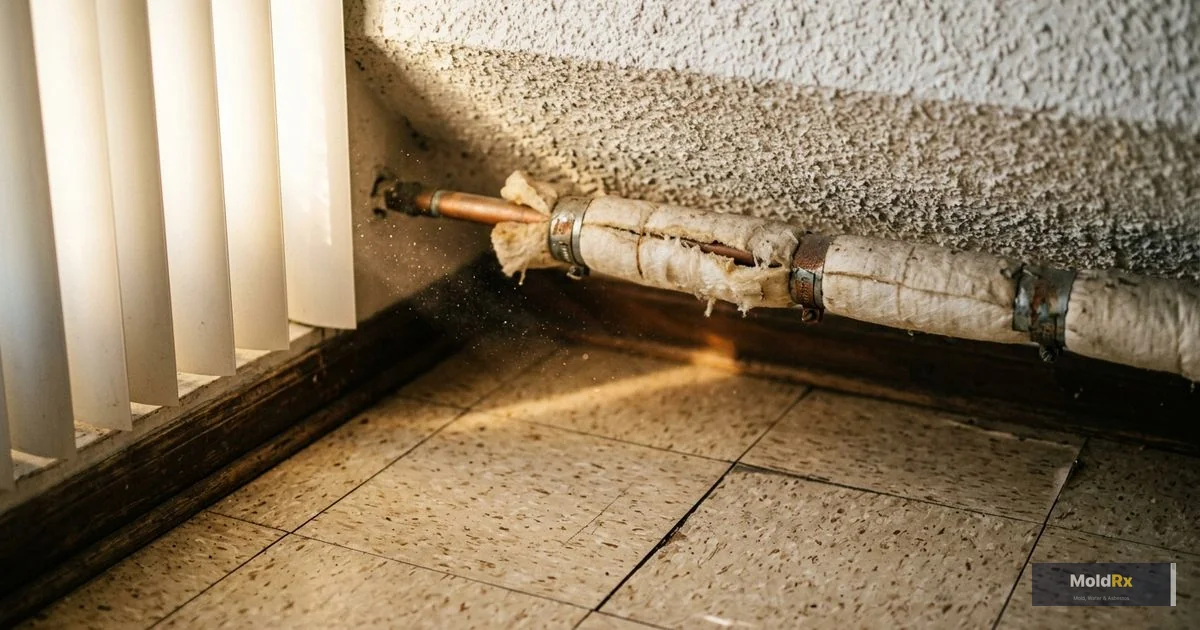
Crumbling pipe insulation, flaking ceiling texture, cracked floor tiles lifting at the edges, fraying duct wrap — if materials in a pre-1980 Westminster home show visible deterioration, the risk of fiber release increases significantly. Testing identifies whether the damaged material contains asbestos so you can make informed decisions about monitoring, encapsulation, or removal.
Westminster's Construction History and Asbestos Risk
Understanding Westminster's asbestos risk means understanding when and how the city was built. The timeline tells a clear story.
The Postwar Building Boom (1940s-1960s)
Westminster's residential explosion began in the late 1940s and accelerated through the 1950s. By the time the city incorporated in 1957, subdivision after subdivision had replaced the old agricultural parcels. The 1960s brought even more dramatic growth — the population more than doubled from roughly 25,000 to about 60,000 in a single decade. Construction during this period produced the dense, block-by-block residential fabric that defines Westminster today: ranch homes, modest two-bedroom starters, and mid-century tract developments lining the streets between Westminster Boulevard and Bolsa Avenue. These homes were constructed during the absolute peak of asbestos use in the United States, when the mineral was considered an ideal additive — fire-resistant, inexpensive, lightweight, and durable. Builders used it in dozens of products without restriction.
The 1970s — Last Major Wave
Additional construction during the 1970s filled remaining parcels. Asbestos remained widespread through the mid-1970s, and the gradual phase-out that began in the late 1970s was slow and incomplete. Homes built between 1970 and 1978 carry high probability of containing asbestos. Homes built between 1978 and 1980 carry moderate probability.
The 1980s and Beyond
Newer construction in Westminster consists of scattered infill projects, condominium developments, and occasional rebuilds. While asbestos use declined significantly after 1980, some building products manufactured through the mid-1980s still contained asbestos, and builders were permitted to use remaining stock. Homes from the early to mid-1980s warrant testing before renovation. Post-1990 construction is generally low risk.
What the Numbers Mean
Homes built before 1980 represent the overwhelming majority of Westminster's housing stock. For asbestos testing purposes, any Westminster home built before 1980 should be considered likely to contain asbestos-containing materials in one or more building components. Homes built between 1980 and 1990 carry moderate risk.
Common Asbestos-Containing Materials in Westminster Homes
Based on the construction methods and materials that were standard during Westminster's development decades, the following building components are priority testing targets:
Popcorn and textured ceiling coatings. Sprayed-on acoustic ceiling textures applied before 1980 frequently contained between 1 and 10 percent chrysotile asbestos. These "cottage cheese" ceilings are found throughout Westminster's tract homes and are among the most commonly disturbed materials during renovation.
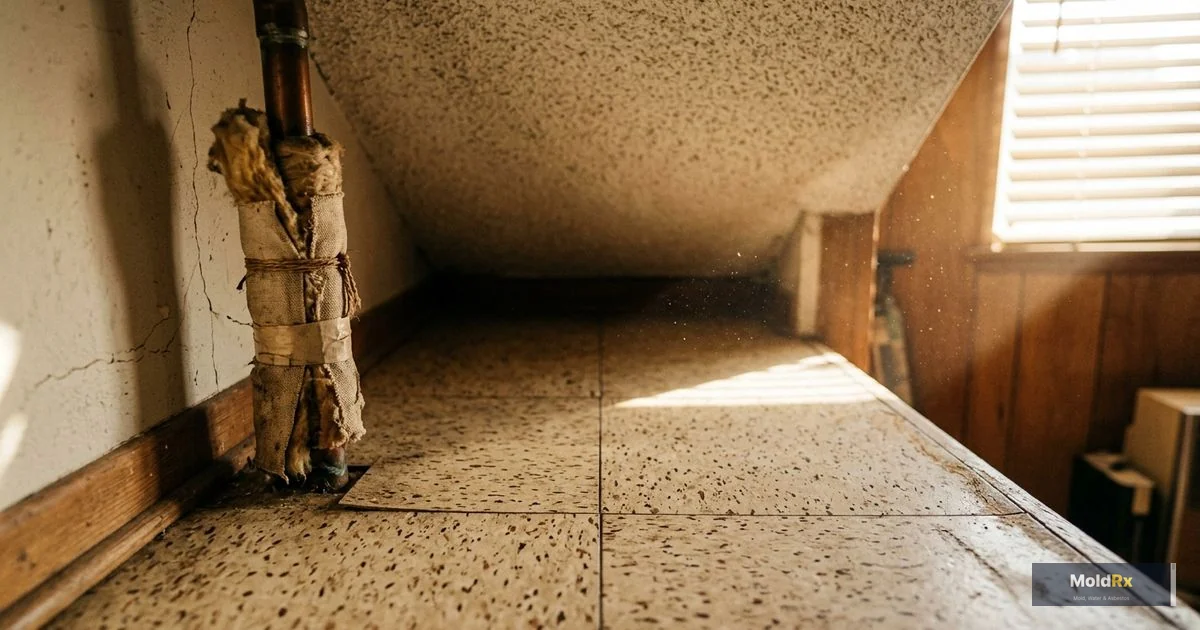
Vinyl floor tiles and sheet flooring. Both the 9-inch and 12-inch vinyl tiles manufactured before 1980 and the black mastic adhesive used to secure them commonly contained asbestos. Westminster's mid-century homes often have multiple layers of flooring, with original asbestos-containing tiles buried beneath later additions.
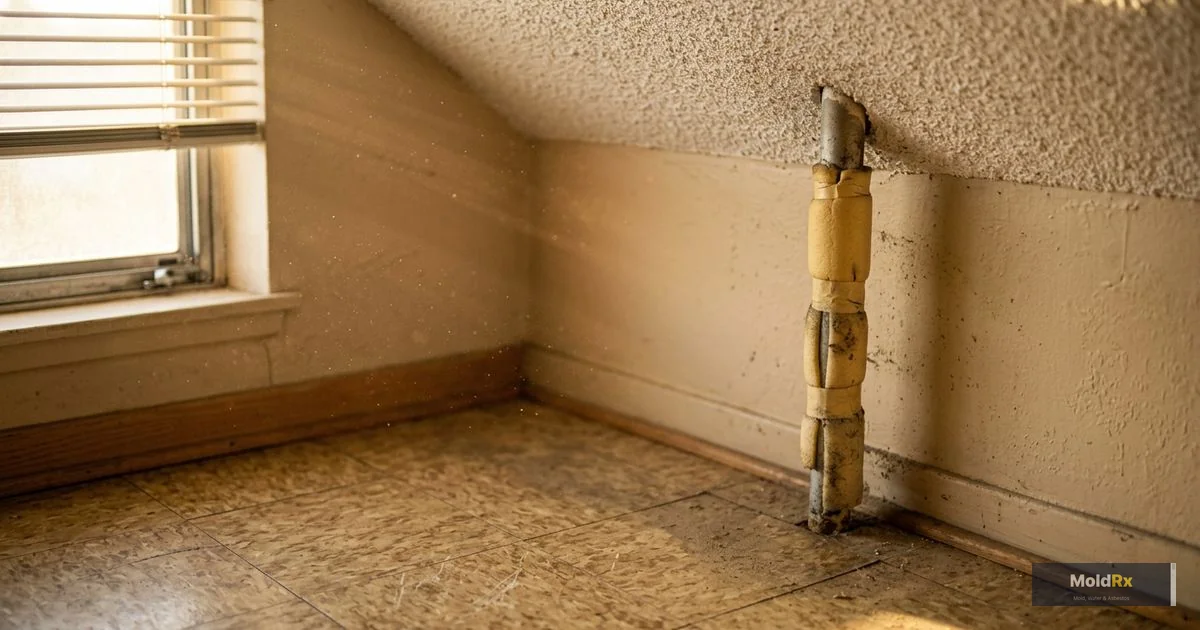
Pipe and duct insulation. Asbestos wrapping on hot water pipes, heating ducts, boiler connections, and HVAC components was standard practice throughout the postwar building era. The cloth tape used to seal ductwork joints is another frequent source.
Roofing materials. Cement-asbestos shingles, roofing felt, and felt underlayment used on Westminster homes built during the 1950s through 1970s frequently contained asbestos fibers for reinforcement and fire resistance.
Joint compound and wall textures. Drywall taping mud and textured wall coatings used asbestos as a binding and reinforcing agent. Any wall demolition or surface scraping in a pre-1980 Westminster home may disturb these materials.
Exterior cement-asbestos siding. Transite siding — a rigid cement board containing asbestos — was widely used on Southern California tract homes during the 1950s through 1970s. It is durable, which means many Westminster homes still have original transite in place.
Vermiculite attic insulation. Loose-fill attic insulation sold under the Zonolite brand and other names may contain tremolite asbestos originating from the contaminated Libby, Montana mine. The insulation appears as small, accordion-shaped granules in attic spaces.
Window glazing and caulking. Older putty and caulking compounds used around windows, bathtubs, and exterior joints in pre-1980 construction sometimes contained asbestos.
You cannot determine whether any of these materials contain asbestos by looking at them. Two tiles that appear identical may come from different manufacturers — one using asbestos, one not. Laboratory analysis of a physical sample is the only reliable determination.
Call (888) 609-8907 to schedule testing — honest answers, no pressure.
Little Saigon: Commercial Renovation and Asbestos
Westminster's Little Saigon district — formally designated along a 1.5-mile stretch of Bolsa Avenue in 1988 — is the largest Vietnamese-American commercial center in the United States. It encompasses thousands of businesses spread across shopping centers, strip malls, restaurants, professional offices, and retail spaces that line Bolsa Avenue and extend into surrounding streets. The district draws millions of visitors annually and has been the economic engine of Westminster for decades.
The commercial buildings that house these businesses were largely constructed during the 1960s and 1970s — the same decades when asbestos was at peak use. As businesses expand, relocate, remodel storefronts, and upgrade aging infrastructure, they disturb the original building materials in these structures. Tenant improvements — new walls, updated HVAC, reconfigured spaces — are constant in a commercial corridor this active. Every one of these projects in a pre-1980 building carries asbestos risk.
Business owners, commercial landlords, and tenants in the Little Saigon corridor all share responsibility for ensuring asbestos testing is completed before renovation work begins. SCAQMD Rule 1403 and Cal/OSHA Section 1529 requirements apply to commercial properties with the same force as residential ones. Federal OSHA 1926.1101 applies to all construction activities. The penalties for non-compliance are significant, and the health risks to workers, customers, and surrounding occupants are real.
Understanding Asbestos: How It Causes Harm
Asbestos becomes a health hazard only when its fibers are released into the air. This happens when asbestos-containing materials are cut, drilled, sanded, scraped, sawed, broken, or allowed to deteriorate. The fibers released are extraordinarily small — a single asbestos fiber can be 700 times thinner than a human hair. They are invisible, odorless, and tasteless. A room full of airborne asbestos fibers looks, smells, and feels exactly like a clean room.
The Mechanism of Disease
Once inhaled, asbestos fibers travel deep into the lungs and become permanently embedded in tissue. The body has no mechanism to break down, dissolve, or expel them. Over years and decades, the trapped fibers cause chronic inflammation, progressive scarring of lung tissue, and cumulative DNA damage to surrounding cells. This process ultimately leads to three primary diseases:
Mesothelioma — an aggressive cancer of the membrane lining the lungs, abdomen, or heart. It is caused almost exclusively by asbestos exposure, has no cure, and carries a median survival time of approximately 12 to 21 months after diagnosis.
Asbestosis — a chronic, progressive fibrosis of the lungs that causes worsening shortness of breath, persistent cough, and declining respiratory capacity. It develops slowly and has no reversal.
Lung cancer — asbestos exposure substantially increases the risk of developing lung cancer, with the risk multiplying dramatically for individuals who also smoke.
The Latency Problem
All asbestos-related diseases share a defining characteristic: an extended latency period between exposure and symptom onset. This period ranges from 10 to 50 years. A Westminster homeowner who disturbs asbestos during a renovation in 2026 may not develop symptoms until the 2040s or beyond. By the time disease is diagnosed, the exposure event is decades in the past and the damage is irreversible. This is why testing before renovation is critical — asbestos exposure produces no immediate symptoms, no warning of any kind. The only protection is identifying asbestos-containing materials before anyone disturbs them.
California's Regulatory Framework for Westminster Properties
California enforces some of the strictest asbestos regulations in the country. Multiple overlapping federal and state standards apply to Westminster property owners.
SCAQMD Rule 1403
Requires an asbestos survey before renovation or demolition in the South Coast district — residential and commercial, regardless of building age for demolition. Notification to SCAQMD must be submitted at least 10 working days before any removal of asbestos-containing materials. Prescribed work practices govern handling and disposal. Non-compliance penalties can exceed $20,000 per day.
Cal/OSHA Title 8, Section 1529
California's construction-industry asbestos standard requires identification of asbestos-containing materials through laboratory testing before any renovation or demolition that may disturb them in pre-1980 structures. All thermal system insulation, surfacing materials, and resilient flooring in pre-1980 buildings are legally presumed to contain asbestos until proven otherwise.
Federal OSHA 1926.1101
The federal construction-industry asbestos standard establishes permissible exposure limits (0.1 fiber per cubic centimeter as an 8-hour TWA), work-practice requirements including wet methods, and mandatory pre-work assessments for all construction activities that may disturb ACM.
AHERA (Asbestos Hazard Emergency Response Act)
While AHERA directly regulates schools and public buildings, its protocols and laboratory accreditation requirements form the foundation for residential testing practices. Inspectors performing residential surveys in California hold AHERA-accredited certifications, and sampling procedures are derived from AHERA protocols. AHERA requires that all asbestos analysis be performed by NVLAP-accredited laboratories.
CSLB C-22 Asbestos Abatement Licensing
When asbestos removal is required, California law mandates that abatement be performed by a contractor holding a CSLB C-22 asbestos abatement license and registered with the Division of Occupational Safety and Health (DOSH). The C-22 classification requires four years of documented asbestos abatement experience, passage of trade and law examinations, and active DOSH registration.
Our Asbestos Testing Process in Westminster
MoldRx coordinates professional asbestos testing through vetted specialists who understand Westminster's housing stock, its construction eras, and every applicable regulatory protocol.
Step 1: Property Assessment and Sample Planning
Every testing engagement begins with a detailed conversation about your property. We identify the building's age, construction type, previous renovation history, and the specific scope of your current project. For Westminster homes, we draw on knowledge of the materials and methods used by the tract builders who developed the city's neighborhoods during the 1950s, 1960s, and 1970s. If you are purchasing a property and want comprehensive testing before closing, we scope a full-home survey. If you are renovating a specific room or area, we target the materials that your project will disturb.
Step 2: Professional Sample Collection
Trained specialists collect samples on-site following EPA-established protocols. Each suspect material is carefully wetted before sampling to suppress any fiber release during the collection process. A small, representative sample is then extracted using specialized cutting and scraping tools, sealed in a labeled container, and documented with full chain-of-custody paperwork. Where the same type of material appears in multiple locations — for example, ceiling texture in different rooms — separate samples are collected from each location, because identical-looking materials applied at different times may have different compositions. EPA procedures require a minimum of three samples per homogeneous material in each distinct area.
Step 3: NVLAP-Accredited Laboratory Analysis
All samples are sent to an NVLAP-accredited laboratory for analysis. The National Voluntary Laboratory Accreditation Program, administered by NIST, ensures laboratories meet rigorous competency standards for asbestos fiber analysis.
PLM (Polarized Light Microscopy) is the standard analytical method for bulk building material samples. The analyst identifies asbestos fibers based on optical properties — refractive index, birefringence, color, and morphology — and determines the specific fiber type (chrysotile, amosite, crocidolite, or tremolite) along with the concentration percentage. PLM is accepted by EPA, OSHA, and Cal/OSHA for compliance purposes and follows EPA Method 600/R-93/116.
TEM (Transmission Electron Microscopy) provides higher magnification, detecting fibers too small for light microscopy. TEM is used when PLM results are inconclusive, for air monitoring samples, for post-abatement clearance testing, or when materials with complex matrices (certain floor tiles, mastics) may mask fibers under PLM. TEM provides the highest level of analytical certainty and is the required method for airborne fiber analysis.
Standard laboratory turnaround is 3 to 5 business days. Rush processing — as fast as 24 hours — is available for time-sensitive projects.
Step 4: Results and Actionable Guidance
Your report clearly identifies each material tested, its exact location in the property, and whether asbestos was detected. For any positive results, the report specifies the asbestos fiber type and concentration percentage. Any material exceeding 1% asbestos is classified as ACM under federal and California regulations. We then walk you through what the findings mean for your specific situation: which materials can safely remain undisturbed, which may benefit from encapsulation or management in place, and which must be professionally removed by a CSLB C-22 licensed asbestos abatement contractor before your renovation work can begin. The goal is to give you a clear, actionable understanding of your property's condition — not to push unnecessary work.
What to Expect
-
Turnaround: On-site sample collection for a typical Westminster home is completed in a single visit lasting two to four hours, depending on the number of materials being sampled. Standard laboratory results are available within 3 to 5 business days. Rush processing is available when project timelines or real estate closings require faster answers.
-
Minimal Disruption: Sample collection involves removing small pieces of material from inconspicuous locations. You do not need to move furniture, clear rooms, or vacate your home during the process. The work is quiet, contained, and minimally invasive.
-
Clear Documentation: Your report is formatted for multiple uses — contractor coordination, real estate disclosure, SCAQMD regulatory filings, insurance documentation, and your personal records. It provides the foundation for any subsequent abatement planning.
-
Honest Guidance: If certain materials in your Westminster home do not warrant testing based on their age, type, or condition, we will tell you rather than run unnecessary samples. If results come back negative, you will have documented confirmation that you can proceed with confidence. If asbestos is present, you will receive clear, pressure-free guidance on your options.
Common Testing Scenarios in Westminster
Pre-Renovation Testing
The most frequent reason Westminster homeowners contact us. Updating a 1960s kitchen with original vinyl flooring and a textured ceiling. Replacing HVAC ductwork in a 1970s ranch home. Converting a garage into a living space. Scraping popcorn ceilings before painting. Demolishing a wall to open up a floor plan. Every one of these projects involves disturbing materials that may contain asbestos, and California law requires testing before the work begins.
Real Estate Transactions
Buyers evaluating pre-1980 homes in Westminster increasingly request asbestos testing as part of their due diligence. Some lenders and insurers now require asbestos documentation for older properties. Sellers benefit from testing as well — documented negative results remove a potential obstacle to closing, while documented positive results allow for informed negotiation rather than last-minute surprises.
Damaged or Deteriorating Materials
When ceiling texture begins flaking, floor tiles crack and crumble, pipe insulation frays, or siding deteriorates, the question shifts from "will this be disturbed?" to "is it already releasing fibers?" Testing determines whether the damaged material contains asbestos and informs the appropriate response — monitoring, encapsulation, or professional removal by a CSLB C-22 licensed contractor.
Commercial Renovations in Little Saigon and Beyond
Tenant improvements, storefront remodels, restaurant build-outs, and office renovations throughout Westminster's commercial areas — including the Little Saigon corridor — require asbestos testing before permit-driven work can begin. Business owners and landlords need documented proof that asbestos has been properly identified and addressed before contractors start. SCAQMD Rule 1403 notification and Cal/OSHA Section 1529 compliance are non-negotiable.
Property Management and Maintenance
Landlords and property managers overseeing older multi-family buildings in Westminster have an ongoing obligation to identify asbestos hazards. Testing provides the documentation needed to manage maintenance activities safely and to fulfill disclosure obligations to tenants.
Westminster Areas We Serve
Our asbestos testing services cover all of Westminster, including the full 92683 and 92685 ZIP code areas. We serve the established residential neighborhoods along Bolsa Avenue, Westminster Boulevard, Goldenwest Street, Bolsa Chica Road, and Beach Boulevard. Our coverage includes the neighborhoods surrounding Westminster Mall, the residential areas adjacent to the Little Saigon commercial district, and every tract and subdivision throughout the city.
We work with properties across the full spectrum — single-family homes, duplexes, apartment buildings, condominiums, mobile homes, and commercial buildings. Our service area extends to the borders shared with Huntington Beach to the south, Garden Grove to the north, Fountain Valley to the east, and Seal Beach to the west.
Related Services in Westminster
In addition to asbestos testing, we also offer Mold Removal in Westminster, Asbestos Removal in Westminster, Water Damage Restoration in Westminster, and Mold Testing in Westminster services to Westminster property owners.
→ Learn more about remediation services in Westminster
Frequently Asked Questions
Is asbestos testing legally required before renovating in Westminster?
Yes. California law requires testing through multiple overlapping regulations. Cal/OSHA Section 1529 mandates identification of asbestos-containing materials before any renovation or demolition in pre-1980 structures. SCAQMD Rule 1403 requires an asbestos survey before renovation or demolition in the South Coast district — and for demolition, this applies regardless of building age. Federal OSHA 1926.1101 requires pre-work assessments for all construction activities that may disturb ACM. Given that the overwhelming majority of Westminster homes were built before 1980, testing is a legal prerequisite for nearly any renovation in the city.
What laboratory accreditation should I look for?
All asbestos analysis should be performed by an NVLAP-accredited laboratory. The National Voluntary Laboratory Accreditation Program, administered by NIST, accredits laboratories for both PLM and TEM asbestos fiber analysis. AHERA requires NVLAP accreditation for all asbestos analysis in schools and public buildings, and this same standard applies to residential testing as a matter of professional best practice. MoldRx only works with NVLAP-accredited laboratories.
My Westminster home was built in the early 1980s. Should I still test?
Yes. The phase-out of asbestos in construction materials was gradual, not instant. Some building products manufactured through the mid-1980s still contained asbestos, and builders were permitted to use existing stock even after new manufacturing restrictions took effect. If your home was built before approximately 1990 and you are planning renovation work that will disturb original materials, testing eliminates the uncertainty.
How many samples need to be collected?
EPA procedures require a minimum of three samples per homogeneous material in each distinct area. A three-bedroom Westminster home undergoing full renovation might need 10 to 20 samples across ceiling texture, floor tile, mastic, joint compound, insulation, and roofing material. Your inspector determines the exact number based on your property and project scope.
What happens if asbestos is found in my Westminster home?
The appropriate response depends on the condition of the material and whether your renovation plans will disturb it. Intact materials in good condition that will not be affected by your project can often be monitored in place or encapsulated. Materials that are damaged, deteriorating, or that will be disturbed by renovation work must be professionally removed by a CSLB C-22 licensed asbestos abatement contractor before that work begins. Your testing report provides the specific information needed to determine the right course of action for each material.
What is the difference between PLM and TEM analysis?
PLM (Polarized Light Microscopy) is the standard EPA-accepted method for identifying asbestos in bulk building material samples. It determines fiber type and estimates concentration, with a detection limit of approximately 1% — which is also the regulatory threshold. TEM (Transmission Electron Microscopy) provides higher magnification and greater sensitivity, detecting fibers too small for light microscopy. TEM is used when PLM results are inconclusive, for air monitoring, and for post-abatement clearance testing. Both methods are performed at NVLAP-accredited laboratories.
Can I stay in my home during asbestos testing?
Yes. When performed correctly by trained specialists, sample collection does not release significant quantities of fibers. The process is quick, minimally invasive, and does not require you to leave your home, move belongings, or make special preparations.
Does asbestos testing cover the entire home?
That depends on your needs. A comprehensive survey tests every suspect material throughout the entire property — appropriate for pre-purchase evaluations or whole-home renovations. A targeted inspection focuses only on the materials in the specific area where renovation work will occur. We help you determine the right scope during the initial consultation so that you pay only for the testing you actually need.
Get Asbestos Testing in Westminster
Westminster's identity has been shaped by more than 75 years of continuous development — from the postwar subdivisions that replaced the bean fields, through the vibrant Vietnamese-American community that transformed Bolsa Avenue, to the renovation projects that are updating the city's aging housing stock today. Through all of it, one constant remains: the majority of Westminster's buildings were constructed with materials that may contain asbestos, and those materials must be identified before anyone disturbs them.
Our vetted specialists understand the construction eras, building materials, and regulatory requirements that apply to Westminster properties. They will assess your home or commercial building honestly, test what needs testing, skip what does not, and give you clear answers about what the results mean for your plans.
No pressure. No unnecessary work. No guesswork.
Call MoldRx to schedule your asbestos test — (888) 609-8907. Know before you start.