Asbestos Testing in Villa Park, CA
MoldRx Only Sends Vetted Asbestos Testing Specialists to Villa Park and Central Orange County
Villa Park is the smallest city in Orange County — roughly 2.1 square miles, approximately 5,700 residents, and a single ZIP code (92861). It is also one of the most architecturally consistent communities in all of Southern California. When residents voted to incorporate on January 3, 1962, they did so specifically to preserve the area's semi-rural, large-lot character and prevent the City of Orange from annexing the land and approving higher-density development. That preservation impulse succeeded. More than six decades later, Villa Park remains what it was designed to be: spacious estate-style homes on half-acre lots or larger, tree-lined streets, and virtually no commercial development within city limits.
But the same construction timeline that gives Villa Park its character also gives it a well-defined asbestos problem. Nearly every home in the city was built between the late 1950s and late 1970s — the exact window when asbestos-containing materials were most prevalent in American residential construction. The former citrus groves and walnut orchards that became Villa Park's residential lots were built out with custom and semi-custom homes that used the premium building products of their era, many of which contained asbestos as a standard ingredient. Professional laboratory testing before any renovation, repair, or property transaction is the only way to determine which specific materials in a Villa Park home contain asbestos and which do not.
Ready to get started? Request your free estimate or call (888) 609-8907 to speak with someone today.
Why Villa Park Has Unusually High Asbestos Risk
A City Built During the Peak Asbestos Era
Villa Park's development history and the asbestos timeline overlap with unusual precision. The area that became Villa Park was agricultural land — citrus groves, walnut orchards, and other crops — through the first half of the 20th century. In 1920, the Jotham Bixby Company subdivided 250 acres in the northeast hills for Valencia orange groves, creating what became known as Cerro Villa Heights. But residential development on a large scale did not begin until the 1950s, when the citrus industry declined and landowners began converting agricultural parcels into residential lots.
By the time of incorporation in 1962, Villa Park had about 1,200 residents on approximately 1,800 acres. Over the next 15 years, nearly every available lot was developed with single-family homes. According to Census data, approximately two-thirds of Villa Park's housing supply was built between 1960 and 1979, with a median construction year of 1974. The remaining third includes a smaller number of homes from the 1950s and a limited number of later infill projects. By the late 1970s, Villa Park was essentially built out — and it has remained that way ever since, with a population that has hovered between 5,500 and 6,300 for decades.
That construction window — roughly 1958 through 1978 — represents the absolute peak of asbestos use in American residential building products. During these years, asbestos was not an unusual additive or a corner-cutting measure. It was a standard, valued ingredient in hundreds of construction products because it provided fire resistance, thermal insulation, and tensile strength. Builders, architects, and homeowners all considered asbestos-containing products to be premium materials. The higher the quality of the home, the more product variety it incorporated — and the more opportunities for asbestos inclusion.
Custom Construction Means Greater Material Variety
Villa Park's large-lot zoning — typically half an acre or more, with some properties exceeding a full acre — attracted custom builders rather than tract developers. While tract-home communities of the 1960s and 1970s used standardized material packages selected for cost efficiency, Villa Park's custom homes reflected individual builder and homeowner choices from a wider array of products. During an era when many premium-grade construction materials contained asbestos, more product variety meant more potential asbestos-containing materials in a single home.
A tract home from 1968 might have asbestos in its ceiling texture, floor tiles, and pipe insulation. A custom Villa Park home from the same year might have those same materials plus asbestos in its fireplace surround, exterior cement siding, specialized roofing, duct insulation, and additional finishing products selected individually. The testing scope for custom homes from this era is correspondingly broader than for standardized tract housing.
Zero-Growth Means Original Materials Remain in Place
Villa Park's population has been essentially flat since the 1970s — a current population of approximately 5,700, declining slightly at about 0.6 percent annually. Unlike cities where rapid growth brings waves of new construction and older homes are sometimes demolished and replaced, Villa Park's housing stock is remarkably stable. The homes that were built in the 1960s and 1970s are, overwhelmingly, still standing with their original materials in place. Original ceiling textures, original flooring, original pipe insulation, original ductwork, original roofing — materials that are now 50 to 65 years old and, in many cases, have never been tested for asbestos content.
This stability means that when a Villa Park homeowner decides to renovate a kitchen, replace flooring, update a bathroom, or modify the home's mechanical systems, they are almost certainly working with original materials from the peak asbestos era. And when newer buyers — attracted to Villa Park's large lots, excellent schools, low crime, and established neighborhood character — purchase these homes with plans to modernize older floor plans, the renovation scope can be extensive, touching multiple asbestos-containing materials simultaneously.
Common Asbestos-Containing Materials in Villa Park Homes
Based on the construction methods, builder preferences, and product availability during Villa Park's primary building period, the following materials warrant priority testing attention:
Textured and popcorn ceiling coatings. Spray-applied acoustic ceiling textures were applied throughout living areas, bedrooms, hallways, and bathrooms in homes of this era. These coatings frequently contained chrysotile asbestos at concentrations ranging from 1 to 10 percent. They are one of the most commonly identified asbestos sources in Villa Park homes and one of the most dangerous to disturb, because scraping or sanding releases fibers across a wide area.
Vinyl floor tiles and mastic adhesive. Both 9-inch and 12-inch vinyl floor tiles manufactured before 1980 frequently contained asbestos, as did the black mastic adhesive used to bond them to the subfloor. Many Villa Park homes have original tile flooring beneath later carpet or hardwood installations. Removing that carpet or hardwood and discovering old tiles underneath is a common renovation scenario — and a common way homeowners encounter asbestos they did not know they had.
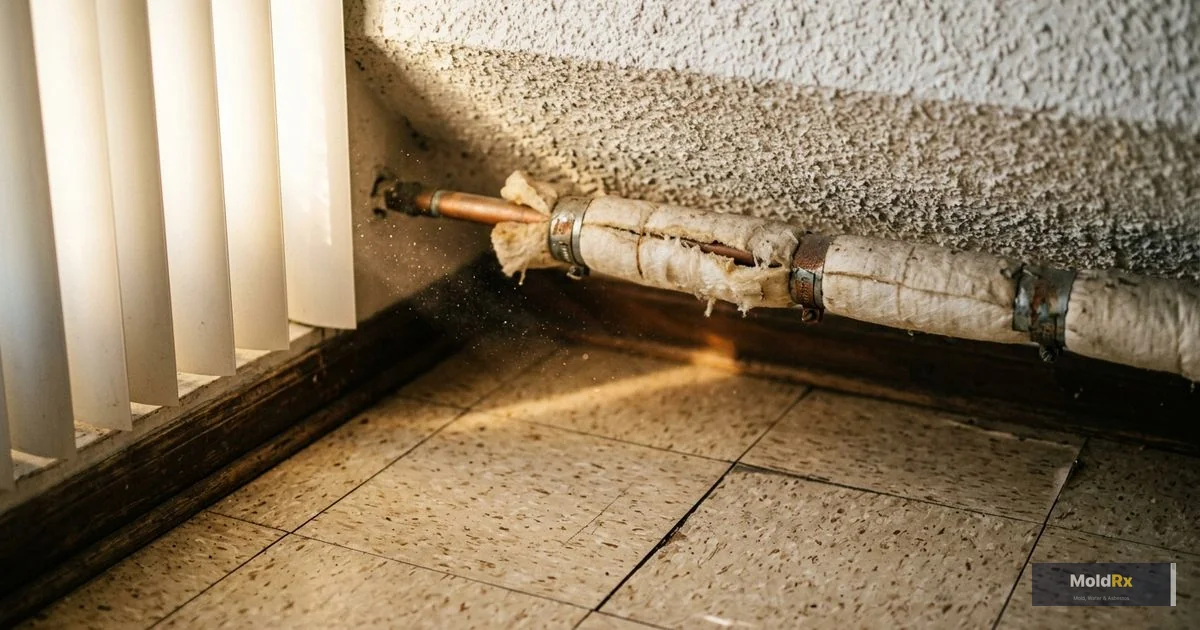
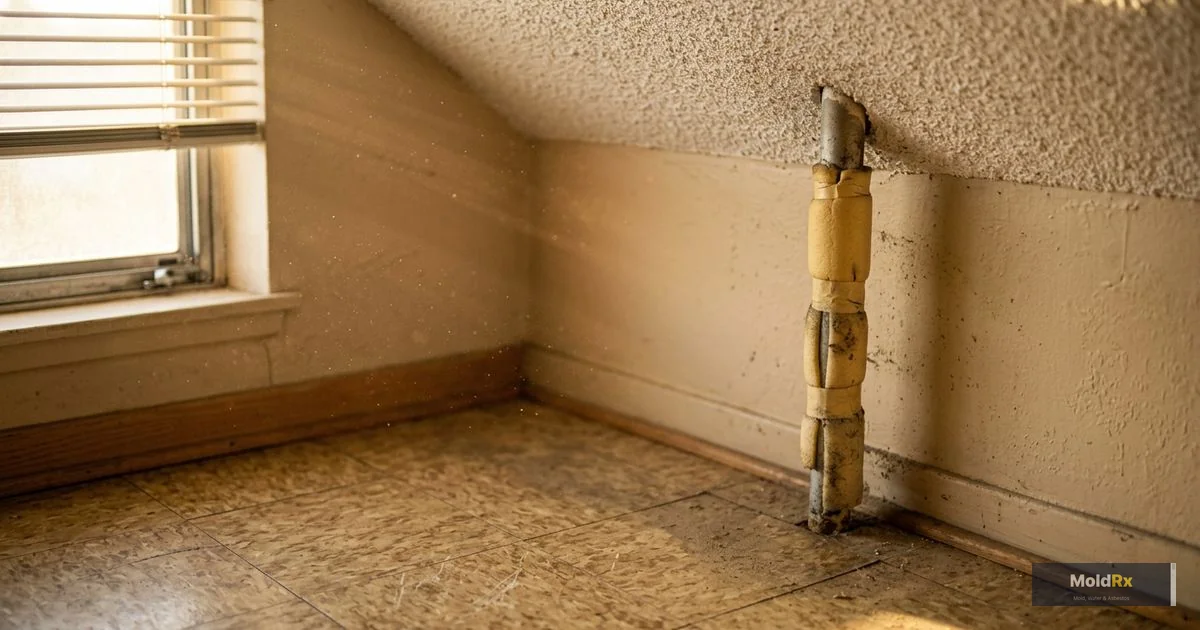
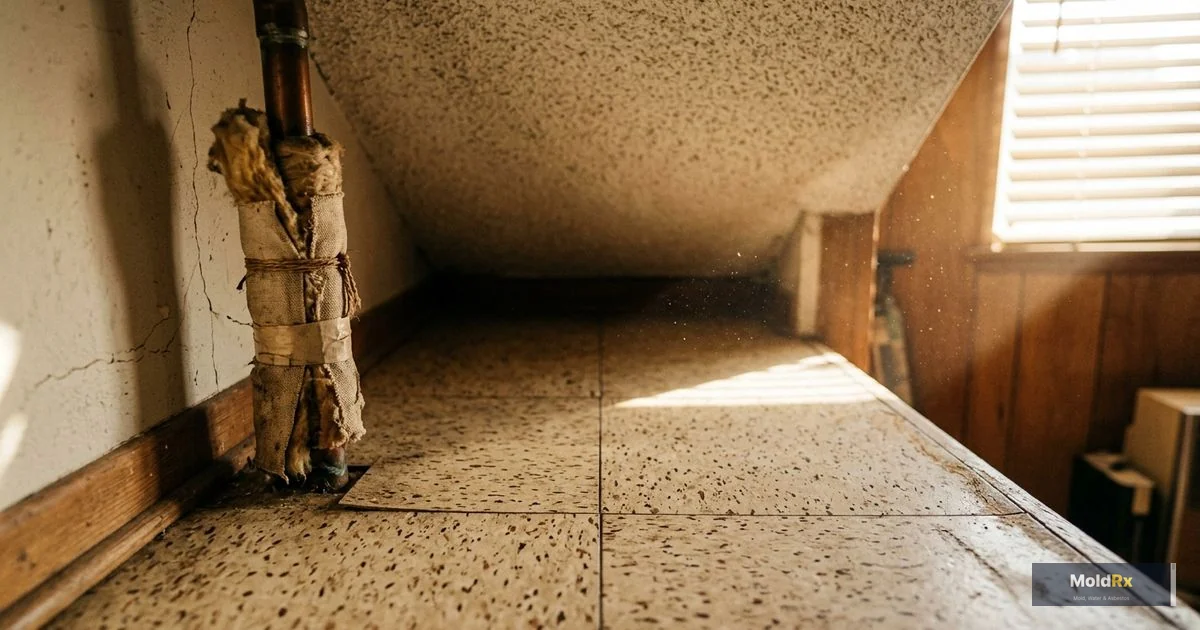
Pipe insulation and boiler wrapping. Insulation on hot water pipes, water heater connections, and heating system plumbing often contained asbestos. In Villa Park homes with original mechanical systems, this insulation is typically found in utility areas, garages, crawl spaces, and within wall cavities.
Cement-asbestos siding and roofing. Exterior cladding made from asbestos-reinforced cement (transite) and cement-asbestos roof shingles were widely used in Southern California residential construction during this period. These materials are remarkably durable — which is why many original installations remain in place after more than half a century.
Vermiculite attic insulation. Loose-fill vermiculite insulation, particularly products sourced from the Libby, Montana mine and marketed under the Zonolite brand, may contain tremolite asbestos. Villa Park homes with original attic insulation that has never been replaced should be tested before any attic work, insulation upgrades, or HVAC modifications involving the attic space.
Joint compound and drywall mud. The compound used throughout the home to tape, finish, and texture interior walls and ceilings frequently contained asbestos during this construction era. Because joint compound is present on virtually every wall and ceiling surface, a positive result has broad implications for any renovation involving drywall modification.
HVAC duct insulation and duct tape. The insulation wrapping forced-air ductwork and the tape used to seal duct connections commonly contained asbestos. In homes where the original heating and cooling system is still in service, these materials may have been deteriorating in place for decades.
Fireplace surrounds and heat shields. Villa Park's custom homes frequently included wood-burning fireplaces, and the surrounds, hearth pads, and heat shields behind fireplace inserts often contained asbestos for its fire-resistant properties.
Window glazing, caulking, and putty. The sealants used around original windows, bathtubs, sinks, and other fixtures in homes of this era can contain asbestos. These materials are small in quantity but are easily disturbed during window replacement, bathroom renovation, and plumbing work.
You cannot identify asbestos by looking at a material. It requires laboratory analysis using PLM (Polarized Light Microscopy) or TEM (Transmission Electron Microscopy). Asbestos fibers are microscopic, and they were mixed into dozens of product types in varying concentrations.
Santiago Creek and Moisture-Related Material Stress
Villa Park straddles Santiago Creek, which flows through the city from east to west before continuing through the City of Orange. The creek has a documented flood history — major events in 1825, 1861-62, 1884, 1916, 1938, and 1969 prompted the construction of Villa Park Dam, dedicated in January 1963, to provide flood protection to communities along the creek corridor.
For properties near Santiago Creek, moisture exposure over decades can accelerate the deterioration of asbestos-containing materials in foundations, lower walls, crawl spaces, and under-floor areas. Elevated ground moisture and seasonal water table fluctuations in creek-adjacent areas affect building materials differently than in the drier hillside portions of the city, causing materials that might otherwise remain stable to become friable and release fibers.
Southern California's broader climate also plays a role. Summer heat pushes attic temperatures well above 100 degrees. Roofing materials endure decades of UV exposure. Dry Santa Ana winds periodically erode the surface of exterior materials. The combination of age, sun, occasional moisture, and wind gradually degrades building materials that were designed to last — but not necessarily for 60 years.
The Regulatory Framework for Villa Park Property Owners
Two primary regulatory frameworks govern asbestos testing and management for Villa Park properties, with federal standards providing the foundation.
Federal OSHA Standard — 29 CFR 1926.1101
The federal OSHA asbestos standard for the construction industry (29 CFR 1926.1101) establishes baseline requirements for any work that may disturb asbestos-containing materials. The standard sets a permissible exposure limit (PEL) of 0.1 fibers per cubic centimeter of air averaged over an eight-hour workday, with an excursion limit of 1.0 f/cc over 30 minutes. It classifies asbestos work into four categories — Class I through Class IV — based on materials and disturbance level. Building owners must identify the presence, location, and quantity of asbestos-containing materials and notify all parties who may be exposed.
Cal/OSHA Title 8, Section 1529
California's Cal/OSHA Section 1529 requires identification of asbestos-containing materials before renovation or demolition work that may disturb them in structures built before 1980. Given that virtually every home in Villa Park falls into this category, this regulation applies to nearly all renovation projects in the city. Surveys must be performed by a Cal/OSHA-certified inspector or a current AHERA Building Inspector certificate holder. Cal/OSHA regulates asbestos at concentrations above 0.1 percent, and penalties reach $25,000 per serious violation.
SCAQMD Rule 1403
SCAQMD Rule 1403 goes further. The South Coast Air Quality Management District requires an asbestos survey before renovation or demolition regardless of building age. Key Rule 1403 requirements:
- The survey must be conducted by a Cal/OSHA-certified inspector or a current AHERA Building Inspector certificate holder
- All laboratory analyses must be performed by NVLAP-accredited facilities, as mandated by NIST
- Notification to SCAQMD is required at least 14 calendar days before any asbestos removal of 100 square feet or greater, or before any demolition
- All on-site supervisory personnel must hold AHERA Asbestos Abatement Contractor/Supervisor accreditation
- Asbestos-containing materials must be properly wetted, contained, and disposed of at approved facilities
CSLB C-22 Licensing for Abatement
Materials that your planned renovation will disturb — and that test positive for asbestos — must be professionally removed by a contractor holding a CSLB C-22 Asbestos Abatement license from the Contractors State License Board. The C-22 classification requires four years of journey-level abatement experience, trade and law examinations, and active registration with Cal/OSHA's Division of Occupational Safety and Health. This licensing requirement is one of the reasons testing and abatement should always be handled by separate, independent parties.
For Villa Park homeowners, the practical takeaway is straightforward: if you are planning any renovation work that will disturb original building materials in your 1960s or 1970s home, testing is both a legal obligation under multiple overlapping regulations and a health necessity.
Understanding the Health Risks
Asbestos fibers are microscopic — far smaller than a human hair, invisible to the naked eye, and undetectable by smell or taste. When asbestos-containing materials are intact and undisturbed, they generally do not release fibers and pose minimal risk. The hazard arises when those materials are cut, drilled, sanded, scraped, broken, or allowed to deteriorate to the point where fibers separate from the matrix material and become airborne.
Once airborne, asbestos fibers can remain suspended in indoor air for hours and settle into carpet, upholstery, and ductwork, where they can be re-suspended by ordinary activity. When inhaled, the fibers lodge permanently in lung tissue. The body cannot break them down or expel them. Over 10 to 50 years, they cause progressive inflammation, scarring, and cellular damage that can result in:
- Mesothelioma — An aggressive cancer of the tissue lining the lungs and abdomen, caused almost exclusively by asbestos exposure. Latency period of 20 to 50 years.
- Asbestosis — Chronic, irreversible scarring of lung tissue that progressively impairs breathing. No cure exists.
- Lung cancer — Significantly increased risk, especially in combination with tobacco smoking.
The decades-long latency period is what makes asbestos uniquely insidious. A homeowner who spends a weekend scraping an asbestos-containing ceiling or pulling up asbestos-containing floor tiles will not feel ill during the work or for years afterward. The damage is cumulative and silent. Testing before disturbance is the only reliable prevention. There is no safe threshold of exposure.
How Professional Asbestos Testing Works in Villa Park
Step 1: Consultation and Scope Definition
Every Villa Park property has its own testing profile based on its specific construction year, builder, materials, and planned work. Are you renovating a kitchen in a 1967 custom home? Replacing flooring throughout a 1973 Cerro Villa Heights property? Evaluating a home before purchase? Concerned about deteriorating materials in a home you have lived in for decades? The scope of your project determines which materials need testing. For a typical Villa Park home from the 1960s or 1970s, we focus on the materials most likely to contain asbestos and most likely to be disturbed by your planned work — while accounting for the wider range of materials that custom construction introduces.
Step 2: Professional Sample Collection
A vetted testing specialist collects samples following EPA NESHAP and Cal/OSHA Section 1529 protocols. Each suspect material is carefully wetted to suppress fiber release before a small representative sample is extracted using specialized cutting and coring tools. Every sample is sealed in an individually labeled container with complete chain-of-custody documentation. For Villa Park's custom homes, we pay particular attention to the wider range of materials that custom construction introduces — fireplace components, specialty cladding, unique insulation applications, and finishing products that may not be present in standard tract housing.
Step 3: NVLAP-Accredited Laboratory Analysis
All samples are submitted to an NVLAP-accredited laboratory for analysis. The primary method is Polarized Light Microscopy (PLM), which provides definitive identification of asbestos presence, fiber type (chrysotile, amosite, crocidolite, tremolite, or others), and concentration percentage. Transmission Electron Microscopy (TEM) is available for applications requiring greater analytical sensitivity, such as post-abatement air clearance testing or low-concentration confirmations.
NVLAP accreditation, administered by NIST, requires laboratories to maintain less than a 1 percent error rate on qualitative analysis, participate in biannual proficiency testing for PLM and annual testing for TEM, and comply with ISO/IEC 17025:2017 standards. This accreditation is mandatory for all analyses performed to comply with SCAQMD Rule 1403.
Step 4: Detailed Results and Actionable Guidance
Your report identifies each tested material by its location in the home, documents whether asbestos was detected, and specifies the fiber type and concentration for every positive result. Beyond the data, we explain what the results mean for your specific project:
- Materials requiring removal — those that your planned renovation will disturb — must be professionally abated by a CSLB C-22 licensed contractor before any other work proceeds
- Materials suitable for management — intact, undisturbed materials in good condition that will not be affected by your project can often be monitored or encapsulated in place
- Materials requiring prompt attention — items that are already damaged, deteriorating, or releasing fibers, regardless of whether you are planning renovation work
- Regulatory compliance steps — SCAQMD Rule 1403 notification timelines, CSLB C-22 contractor licensing requirements, and documentation needs for any removal work
Have questions about your Villa Park property? Request your free estimate or call (888) 609-8907 — no obligation, no pressure.
What to Expect During and After Testing
-
Timeline: On-site sample collection for a typical Villa Park home takes two to four hours, depending on the scope of materials being tested. Standard laboratory results using PLM arrive within three to five business days. Rush analysis is available when renovation schedules, real estate transactions, or contractor timelines require faster turnaround. TEM analysis may take slightly longer depending on the laboratory.
-
Minimal disruption: Sample collection involves removing small pieces of material — typically no larger than a square inch per sample. The process does not require moving furniture, vacating the home, or any significant preparation on your part beyond providing access to the areas being tested.
-
Full compliance documentation: Your report serves as official documentation for SCAQMD Rule 1403 compliance, Cal/OSHA Section 1529 requirements, OSHA 1926.1101 standards, AHERA protocols, contractor coordination, real estate disclosures, insurance records, and personal files. If asbestos is found and removal is later performed, the testing report establishes the baseline that CSLB C-22 abatement contractors and regulatory agencies work from.
-
Honest assessment: If specific materials in your Villa Park home are unlikely to contain asbestos based on their type, manufacturer, or installation date, we will tell you. If testing is unnecessary for certain areas, we will not push for it. MoldRx only sends vetted specialists whose goal is accurate information that serves your actual needs, not maximum scope.
Villa Park Areas We Serve
MoldRx sends vetted asbestos testing specialists to properties throughout Villa Park and the 92861 ZIP code. We serve homes along Santiago Boulevard, Wanda Road, Villa Park Road, throughout Cerro Villa Heights, and across all of the city's residential neighborhoods. Whether your property is a 1960s ranch-style estate near Santiago Creek, a 1970s custom-built home in the hills, or one of the distinctive 1973 Patrician Homes with their French Tudor and country chateau architecture, our vetted specialists understand the materials and construction methods specific to this community.
Our coverage extends to neighboring communities including Orange to the west and south, Anaheim Hills to the north, Tustin to the southwest, and the unincorporated canyon areas to the east including Silverado and Modjeska Canyon.
Related Services in Villa Park
In addition to asbestos testing, MoldRx also sends vetted specialists for Mold Removal in Villa Park, Asbestos Removal in Villa Park, Water Damage Restoration in Villa Park, and Mold Testing in Villa Park.
→ Learn more about remediation services in Villa Park
Frequently Asked Questions
Does every Villa Park home have asbestos?
Not every material in every Villa Park home contains asbestos, but the probability of finding asbestos in at least some materials is very high for homes built between 1958 and 1978 — which describes the vast majority of the city's housing stock, with a median construction year of 1974. NVLAP-accredited laboratory testing using PLM determines which specific materials contain asbestos and which do not. That distinction is critical because it determines which materials require professional handling by a CSLB C-22 licensed contractor during renovation and which can be worked with normally.
When is asbestos testing legally required in Villa Park?
Under Cal/OSHA Section 1529, testing is required before any renovation or demolition that may disturb materials in structures built before 1980. SCAQMD Rule 1403 requires an asbestos survey before renovation or demolition regardless of building age, with all analyses performed by an NVLAP-accredited laboratory. Federal OSHA 1926.1101 establishes additional requirements for any construction work that may encounter asbestos. Since nearly every home in Villa Park was built before 1980, these regulations apply to virtually all renovation projects in the city.
Can I collect asbestos samples myself?
California law permits homeowners to collect samples from their own property. However, we strongly advise against it. Improper sampling technique can release asbestos fibers into your home, creating the exact exposure hazard you are trying to evaluate. Additionally, self-collected samples may not be accepted as valid documentation for SCAQMD Rule 1403 or Cal/OSHA Section 1529 compliance. Professional sample collection uses containment procedures, wetting techniques, specialized tools, and personal protective equipment that minimize fiber release to virtually zero.
What types of asbestos are found in Villa Park homes?
Chrysotile (white asbestos) is the most common type, accounting for roughly 95 percent of asbestos used in American construction. It is found in ceiling textures, floor tiles, joint compound, cement products, and many other materials. Amosite (brown asbestos) appears less frequently, primarily in insulation products and some cement materials. Crocidolite (blue asbestos) is the rarest in residential construction but is occasionally found in specialized insulation. Tremolite may be present in vermiculite attic insulation. All types are hazardous when fibers become airborne, and all are identified through PLM or TEM laboratory analysis at NVLAP-accredited facilities.
What happens if asbestos is found in my Villa Park home?
Finding asbestos does not mean your home is unsafe or that immediate removal is required. Intact materials in good condition that will not be disturbed by your planned work can often be managed through periodic monitoring or encapsulation. Materials that renovation work will disturb must be professionally removed by a CSLB C-22 licensed abatement contractor before that work begins, with notification to SCAQMD under Rule 1403 at least 14 calendar days in advance for removal of 100 square feet or more. Materials that are already damaged, deteriorating, or actively releasing fibers should be addressed promptly. Your testing report provides material-specific guidance based on AHERA protocols so you can make informed decisions about each item.
How long does the testing process take?
On-site sample collection typically takes two to four hours for a standard Villa Park home, though larger properties or comprehensive surveys may take longer. NVLAP-accredited laboratory results using PLM are available within three to five business days under standard processing. Rush analysis is available when faster turnaround is needed for real estate closings, scheduled renovation starts, or contractor coordination. TEM analysis, used for higher-sensitivity applications, may require additional processing time.
Do I need special permits for asbestos abatement in Villa Park?
If testing reveals asbestos-containing materials that need removal, abatement must be performed by a CSLB C-22 licensed asbestos contractor following Cal/OSHA Section 1529, OSHA 1926.1101, and SCAQMD Rule 1403 regulations. Notification to the South Coast AQMD is required at least 14 calendar days before removal of 100 square feet or more of asbestos-containing material, or before any demolition. All on-site supervisory personnel must hold current AHERA Contractor/Supervisor accreditation.
Get Asbestos Testing in Villa Park
Villa Park's identity is defined by its consistency — the same large lots, the same tree-lined streets, the same residential character that residents voted to protect in 1962. But that consistency extends to construction materials as well. The building products that went into Villa Park's custom homes during the 1960s and 1970s routinely contained asbestos, and those materials remain in place in homes throughout the city today. For any homeowner planning renovation work — and for any buyer evaluating a Villa Park property — professional testing is the responsible, required, and straightforward first step.
MoldRx only sends vetted specialists who understand Villa Park's housing stock, know the materials that custom builders of the 1960s and 1970s favored, and deliver NVLAP-accredited laboratory results with full documentation for SCAQMD Rule 1403, Cal/OSHA Section 1529, OSHA 1926.1101, and AHERA compliance. You get honest answers about what is in your home and clear guidance about what it means for your plans.
No guesswork. No unnecessary testing. No runaround. Request your free estimate or call (888) 609-8907 to schedule asbestos testing for your Villa Park property.