Asbestos Testing in Twentynine Palms, CA
MoldRx Only Sends Vetted Asbestos Testing Specialists to Twentynine Palms and the Morongo Basin
Twentynine Palms sits at a crossroads that most homeowners never consider until they start planning a project. On one side, a desert community with deep roots — homesteading families who settled the Morongo Basin as far back as the 1920s, building modest structures designed to withstand extreme heat using whatever materials were cheap and available. On the other, decades of military-driven construction tied to the Marine Corps Air Ground Combat Center, where speed and function outranked everything else when buildings went up in the 1950s, 1960s, and 1970s. Both building traditions relied heavily on asbestos-containing materials, and both left behind a housing stock that demands professional laboratory testing before anyone picks up a hammer.
With an estimated population of roughly 26,000 to 28,000 residents spread across ZIP codes 92277 and 92278, Twentynine Palms is a community where civilian neighborhoods, military housing, and remote desert parcels all share the same fundamental risk: construction materials from the peak asbestos era that remain in place, untested, inside walls, ceilings, and floors. California law requires identification of those materials before renovation or demolition work, and the health consequences of skipping that step are irreversible.
This page covers why testing matters here specifically, how the process works under current federal and California regulatory frameworks, what military families need to know, and how to approach the entire process without overspending or under-preparing.
Ready to get started? Request your free estimate or call (888) 609-8907 to speak with someone today.
Why Twentynine Palms Has a Distinct Asbestos Risk Profile
Not every community carries the same level of concern. Twentynine Palms does, and the reasons are specific and well-documented.
Military Construction at MCAGCC (1952 Onward)
The Marine Corps Air Ground Combat Center traces its origins to what was originally called Condor Field, a small Army and Navy glider training facility. On February 6, 1953, the installation was redesignated as the Marine Training Center, Twentynine Palms. By February 1, 1957, it became Marine Corps Base Twentynine Palms. In 1976, an airfield was added with new air-ground capability, leading to redesignation as the Marine Corps Air Ground Combat Training Center in 1978. On February 16, 1979, the name was changed to its current form: Marine Corps Air Ground Combat Center (MCAGCC).
Construction at the base expanded rapidly through the 1950s, 1960s, and 1970s. Military construction during this era used asbestos in virtually everything. Barracks, family housing, administrative buildings, maintenance facilities — Department of Defense records confirm that asbestos-containing materials were standard in military construction from the 1940s through the late 1970s. The base's own environmental records have documented asbestos soil contamination at the former Fire Training School and broken asbestos-containing materials across multiple site locations.
Common asbestos materials found in military-era construction at MCAGCC include asbestos-cement siding, vinyl asbestos floor tiles (the classic 9-by-9-inch tile), pipe insulation and wrap, boiler insulation, roofing felt, joint compound, acoustic ceiling tiles, and textured coatings. On-base privatized housing, now managed by Lincoln Military Housing across 15 neighborhoods, includes many units that have undergone renovation — but that does not mean all asbestos-containing materials were identified and removed during every upgrade. Structures that received cosmetic updates, such as new carpet laid over old tile or drop ceilings installed below original acoustic tile, may still contain undisturbed asbestos that becomes a problem only when the next renovation goes deeper.
Civilian Development in the Morongo Basin
Twentynine Palms did not incorporate until November 23, 1987, but residential development started long before that. In the 1920s, Dr. James B. Luckie from Pasadena identified the area's moderate elevation and clean desert air as beneficial for respiratory conditions, and families began homesteading 160-acre parcels provided by the federal government. After World War I, many veterans suffering from tuberculosis and mustard-gas exposure settled here.
The civilian housing stock expanded significantly in the 1950s through 1970s as the Marine base brought thousands of service members and their families to the area. Homes, apartments, and small commercial buildings went up to serve a growing population. The materials used during those decades — popcorn ceilings, vinyl floor tiles, asbestos-cement siding, vermiculite attic insulation, pipe wrap — are the same materials that now require testing before disturbance.
Desert Climate Factors That Compound the Problem
Twentynine Palms sits in the Mojave Desert at roughly 2,000 feet of elevation. Summer temperatures regularly exceed 100 degrees Fahrenheit — reaching the triple digits on an average of 89 days per year — while winter nights can drop into the low 30s. Annual rainfall averages only 4 to 6 inches, and the city sees roughly 285 sunny days per year.
This extreme thermal cycling stresses building materials in ways that coastal or temperate climates do not. Decades of expansion and contraction can cause asbestos-containing materials to crack, become friable (crumbly to the touch), and release microscopic fibers into the air. Dry, windy conditions common across the Morongo Basin then carry those fibers through a structure. An intact asbestos floor tile from 1965 that sat undisturbed for decades may now be cracked and deteriorating from the cumulative stress of 60 desert summers. California regulators and the EPA treat damaged or friable asbestos-containing materials as an immediate hazard regardless of quantity.
The Regulatory Framework: What California and Federal Law Require
Twentynine Palms property owners must comply with overlapping federal, state, and regional regulations before disturbing building materials in older structures. Here is the full picture.
Federal OSHA Standard — 29 CFR 1926.1101
The federal OSHA asbestos standard for the construction industry (29 CFR 1926.1101) establishes the baseline requirements for any work that may disturb asbestos-containing materials. The standard sets a permissible exposure limit (PEL) of 0.1 fibers per cubic centimeter of air averaged over an eight-hour workday, with an excursion limit of 1.0 f/cc averaged over 30 minutes. It classifies asbestos work into four categories — Class I through Class IV — based on the materials involved and the level of disturbance. Building owners are required to identify the presence, location, and quantity of asbestos-containing materials and notify employers, employees, and other parties who may be exposed. A competent person must be designated for all worksites where asbestos work is performed.
Cal/OSHA Title 8, Section 1529
California's Cal/OSHA Section 1529 mirrors the federal standard but applies more aggressively. Cal/OSHA requires an asbestos survey before renovation or demolition of any structure built before 1980. The survey must be conducted by a Cal/OSHA-certified asbestos inspector or an individual holding a current AHERA (Asbestos Hazard Emergency Response Act) Building Inspector certificate. Cal/OSHA regulates asbestos at concentrations greater than 0.1 percent — a threshold stricter than many property owners expect. Any abatement project exceeding 100 square feet requires formal notification and must be performed by a contractor registered with Cal/OSHA's Division of Occupational Safety and Health (DOSH).
Penalties are substantial: up to $25,000 per serious violation under Cal/OSHA, with additional penalties possible under air quality regulations.
Mojave Desert AQMD Rule 1000 (Not SCAQMD)
Twentynine Palms falls under the Mojave Desert Air Quality Management District (MDAQMD), not the South Coast AQMD that covers much of the Inland Empire. MDAQMD enforces the federal Asbestos NESHAP under 40 CFR 61 Subpart M, per District Rule 1000.
Key MDAQMD requirements:
- Survey first. An asbestos survey is required before any renovation or demolition. If an existing survey is more than two years old, or if any renovation work has been completed since the last survey, a new survey may be required.
- Notification to MDAQMD. For non-exempt renovation or demolition work disturbing more than 160 square feet (or 260 linear feet on pipes, or 35 cubic feet of facility components), you must submit a Notification of Demolition/Renovation along with the survey results and applicable fees at least 10 working days before work begins.
- All asbestos must be removed before demolition. If you are tearing down a structure, all identified asbestos-containing materials must be removed first — no exceptions.
- NVLAP laboratory analysis required. All laboratory analyses must be performed by a facility accredited through the National Voluntary Laboratory Accreditation Program (NVLAP), administered by the National Institute of Standards and Technology (NIST).
For questions, MDAQMD can be reached at (760) 245-1661.
CSLB C-22 Licensing for Abatement
If asbestos is identified and removal is necessary, California law requires that the work be performed by a contractor holding a CSLB C-22 Asbestos Abatement license issued by the Contractors State License Board. The C-22 classification requires four years of journey-level experience, passage of a trade examination, and active registration with DOSH. This licensing requirement exists to ensure that only qualified, insured, and registered contractors handle asbestos removal — and it is one of the reasons testing and abatement should always be separate services performed by separate parties.
What This Means in Practice
If you are planning to replace flooring in a 1968 ranch house off Adobe Road, scrape a popcorn ceiling in a rental near Twentynine Palms Highway, update plumbing in a home along Sunfair Road, or tear down a deteriorating outbuilding on a Wonder Valley parcel — the law requires testing first. Skipping the survey does not just put your health at risk. It exposes you to regulatory fines and creates legal liability if asbestos fibers are released into the environment.
Common Asbestos-Containing Materials in Twentynine Palms Homes
Based on the construction eras and building practices typical in this area, these are the materials most likely to contain asbestos in a Twentynine Palms property:
-
Vinyl floor tiles and adhesive (mastic). The 9-by-9-inch floor tile is a hallmark of 1950s through 1970s construction. The tiles themselves often contain asbestos, and the black mastic adhesive beneath them frequently does as well. Extremely common in both military and civilian housing from the era.
-
Popcorn (acoustic) ceiling texture. Sprayed-on acoustic ceiling texture applied before 1980 has a high probability of containing chrysotile asbestos. This is one of the most commonly disturbed materials during renovation and one of the most dangerous when scraped without testing.
-
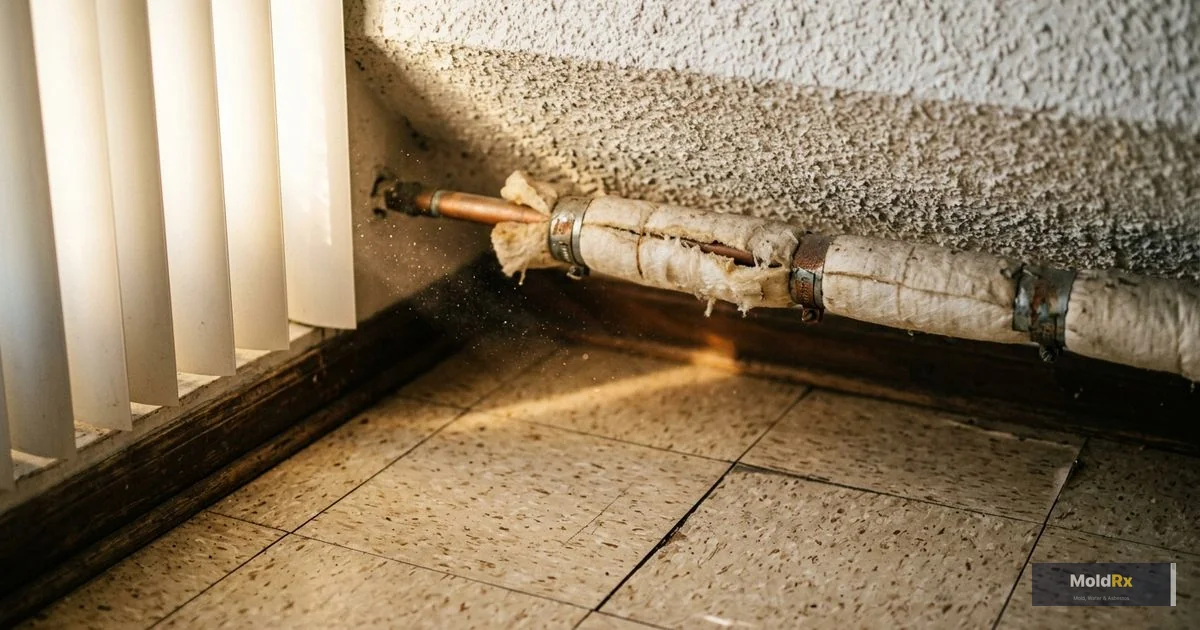
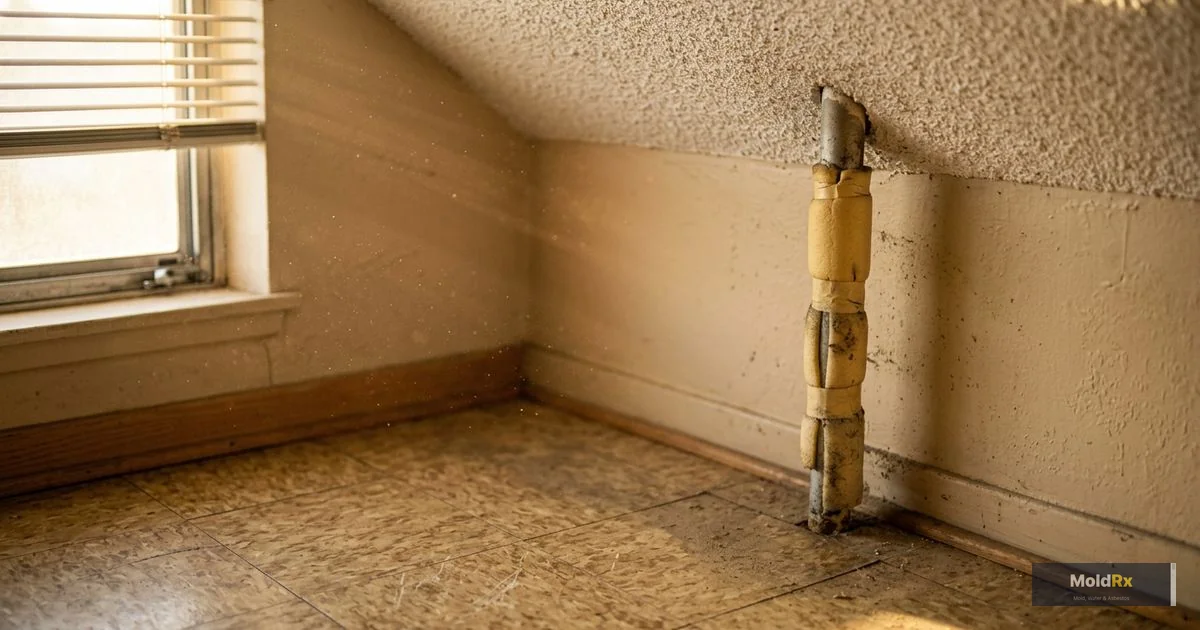
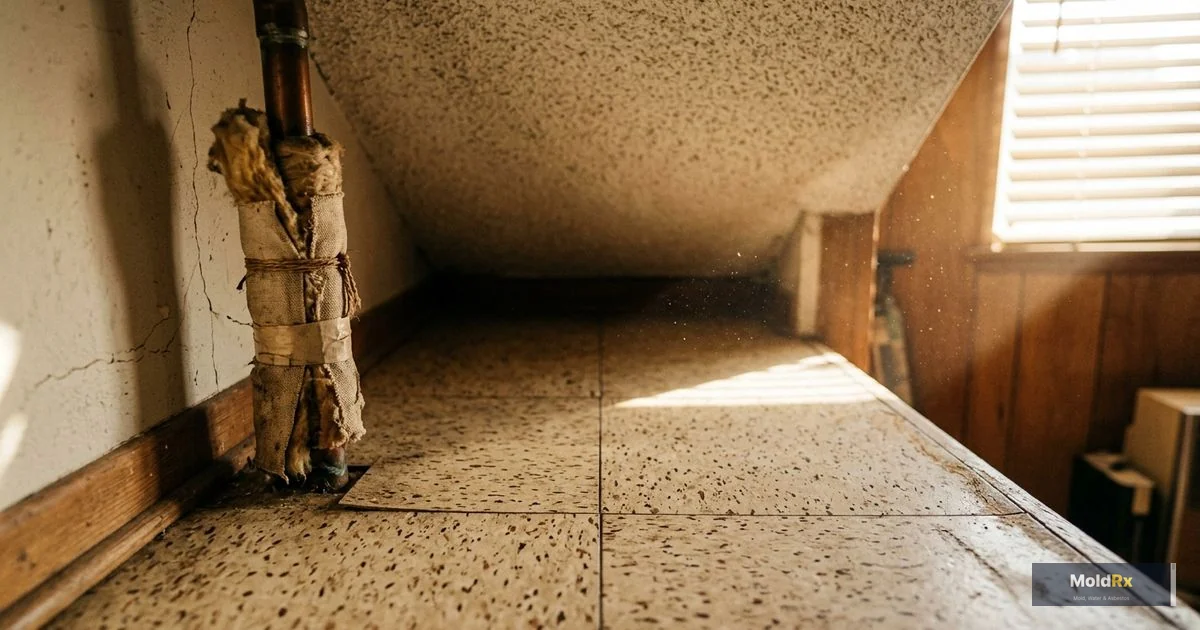
Pipe insulation and wrap. Older homes with original plumbing often have asbestos-containing insulation wrapped around hot water pipes, especially near water heaters and boilers. The corrugated white or gray wrap is a frequent finding in Twentynine Palms homes.
-
Duct insulation and tape. HVAC ductwork in desert homes gets heavy use. Original duct insulation and the tape used to seal duct joints in pre-1980 systems may contain asbestos.
-
Joint compound and drywall mud. Asbestos was added to joint compound to improve workability and fire resistance. Any home with original drywall from the 1950s through mid-1970s may have asbestos in the compound used at seams and corners.
-
Roofing materials. Asbestos-cement roofing shingles, roofing felt, and flashing cement were standard in desert construction for their heat resistance and durability.
-
Cement siding and stucco. Asbestos-cement siding was popular in mid-century desert homes. Some stucco mixes also contained asbestos fibers.
-
Vermiculite attic insulation. Loose-fill vermiculite insulation, particularly if sourced from the Libby, Montana mine (marketed as Zonolite), is frequently contaminated with tremolite asbestos. Attic insulation is common in High Desert homes as a defense against summer heat.
-
Textured wall coatings. Troweled-on or sprayed textured finishes on walls — sometimes called "orange peel" or "knockdown" texture — may contain asbestos in pre-1980 applications.
You cannot identify asbestos by looking at a material. It requires laboratory analysis. Asbestos fibers are microscopic, and they were mixed into dozens of product types in varying concentrations.
How Professional Asbestos Testing Works
Step 1: Initial Consultation and Scope
We start with a conversation about your property — when it was built, what work you are planning, and what materials concern you. For Twentynine Palms homes, this often touches on the property's connection to the military base, prior renovations (and whether previous testing was done), and the scope of your planned project.
This step determines how many samples are needed and from which materials. A focused test before a bathroom remodel requires fewer samples than a whole-house survey before a major renovation or property sale.
Step 2: Professional Sample Collection
A vetted, certified asbestos inspector visits your property to collect samples following EPA NESHAP and Cal/OSHA Title 8 Section 1529 protocols:
- Suspect materials are dampened before sampling to suppress fiber release
- Small representative samples are carefully removed using specialized tools
- Each sample is sealed in a labeled container with chain-of-custody documentation of its exact location
- Multiple samples may be collected from the same material type if it appears in different areas or conditions throughout the property
Sample collection for a typical residential inspection takes one to two hours depending on the size of the home and number of materials involved.
Step 3: NVLAP-Accredited Laboratory Analysis
Samples are submitted to an NVLAP-accredited laboratory for analysis. The primary method is Polarized Light Microscopy (PLM), which identifies asbestos fiber type (chrysotile, amosite, crocidolite, tremolite) and concentration in bulk material samples. When higher sensitivity is required — such as post-abatement air clearance testing or low-concentration confirmations — Transmission Electron Microscopy (TEM) provides detection at significantly lower thresholds.
NVLAP accreditation, administered by NIST, requires laboratories to maintain less than a 1 percent error rate on qualitative analysis, participate in biannual proficiency testing for PLM and annual proficiency testing for TEM, and comply with ISO/IEC 17025:2017 standards. This accreditation is mandatory for all laboratory analyses performed under MDAQMD Rule 1000 and SCAQMD Rule 1403 (for properties in SCAQMD jurisdiction) and is strongly recommended as the minimum standard for any asbestos analysis regardless of jurisdiction.
Results typically arrive within three to five business days, with rush processing available when project timelines are tight.
Step 4: Results Review and Planning Guidance
You receive a written report with clear findings for each sample location. For each material tested, you will know:
- Whether asbestos was detected
- The type and concentration if present
- The current condition of the material (intact, damaged, friable)
- Whether the material can remain in place, needs encapsulation, or requires professional removal by a CSLB C-22 licensed abatement contractor before your project proceeds
This is where testing pays for itself. Knowing exactly which materials contain asbestos — and which do not — means you avoid unnecessary removal of safe materials and focus resources where they are actually needed.
Have questions about your property? Request your free estimate or call (888) 609-8907 — no obligation, no pressure.
Asbestos Testing for Military Families at MCAGCC
A significant portion of the Twentynine Palms population is connected to the Marine Corps Air Ground Combat Center. Military families face asbestos testing situations that deserve specific attention.
PCS Moves and Base Housing Inspections
If you are a military family moving into on-base or off-base housing in Twentynine Palms, environmental hazard awareness should be part of your move-in process. Current DoD policy requires 30-day deadlines for environmental hazard remediation in military housing — including asbestos, mold, lead, and water intrusion — and mandatory third-party inspections at move-in, move-out, and lease renewal.
However, a Department of Defense Office of Inspector General report found that five of eight military installations examined did not have accurate records of where asbestos was located in housing units, and at six locations, officials did not notify residents of the dangers. These findings apply broadly to military housing built between the 1930s and 1980s, which describes a substantial portion of the MCAGCC housing inventory.
If you are moving into an older unit managed by Lincoln Military Housing, you have the right to:
- Request existing environmental testing results during your move-in walkthrough
- Ask specifically whether an asbestos survey has been completed and when it was last updated
- Request independent testing if you have concerns about older materials in your assigned unit
- Report damaged or deteriorating materials — crumbling ceiling texture, cracked floor tiles, fraying pipe insulation — through your housing office and request testing before any repairs are made
Can I Request Independent Testing for On-Base Military Housing?
Yes. While on-base privatized housing is managed by Lincoln Military Housing and environmental testing falls under their operational responsibilities, DoD policy mandates third-party inspections and 30-day remediation timelines for environmental hazards. If documentation of prior testing is unavailable or outdated, you have the right to request current testing. If your housing office is unresponsive, you can escalate through the installation's Environmental Health Officer or contact the Military Housing Office directly.
Service members and their families should be aware that military housing built during the 1950s through 1970s at MCAGCC used the same asbestos-containing materials found in civilian construction of the same era. The materials were standard, not exceptional, and the risk profile is the same.
Off-Base Rentals and Purchases
Many service members and their families rent or purchase homes in the civilian community surrounding the base. These properties fall under standard California regulations — Cal/OSHA Section 1529, MDAQMD Rule 1000, and federal OSHA 1926.1101 — meaning the landlord or seller has disclosure obligations and you have the right to request testing before committing to a lease or purchase. For homes built before 1980, which describes a large portion of the Twentynine Palms rental market, asking about asbestos status is not paranoid. It is practical.
Renovation of Off-Base Properties
If you purchased a home near the base and want to update it during your time at MCAGCC, the same Cal/OSHA and MDAQMD requirements apply. A common scenario: a family buys a 1960s ranch house, plans to update the kitchen and bathrooms, and discovers during testing that the floor tiles, joint compound, and pipe insulation all contain asbestos. Without that test, a weekend demolition project could have exposed the family to airborne fibers with health consequences that develop over 20 to 50 years.
Health Risks: Why Testing Is Not Optional
Asbestos fibers are microscopic — far too small to see, feel, or taste. When asbestos-containing materials are disturbed through cutting, sanding, scraping, drilling, or simply deteriorating with age, these fibers become airborne and can remain suspended in indoor air for hours. Once inhaled, they lodge permanently in lung tissue. The body cannot break them down or expel them.
The health consequences develop over decades:
- Mesothelioma — A rare, aggressive cancer of the lung or abdominal lining. Almost exclusively caused by asbestos exposure. Latency period of 20 to 50 years. Median survival after diagnosis: 12 to 21 months.
- Asbestosis — Progressive, irreversible scarring of lung tissue that reduces breathing capacity. No cure exists.
- Lung cancer — Asbestos exposure significantly increases risk, with the risk multiplying for smokers.
- Pleural plaques and thickening — Non-cancerous but permanent changes to the lung lining causing chest pain and breathing difficulty.
The long latency period is what makes asbestos uniquely dangerous. A homeowner who spends a weekend scraping a ceiling or pulling up old floor tiles will not feel ill during the work or for years afterward. The damage is cumulative and silent. Testing before disturbing any suspect material is the only reliable form of prevention. There is no safe threshold of exposure.
What to Expect When You Work with MoldRx
MoldRx only sends vetted asbestos testing specialists who understand Twentynine Palms' construction history and regulatory landscape:
-
Honest scoping. If your home was built after 1990 and uses clearly modern materials, we will tell you that testing is probably unnecessary. We do not sell tests you do not need.
-
Plain-language results. Lab reports can be technical. We translate them into clear guidance: what was found, where it was found, whether it is a problem, and what you should do about it.
-
Full compliance documentation. You receive proper documentation that satisfies Cal/OSHA Section 1529, OSHA 1926.1101, MDAQMD Rule 1000, AHERA requirements, contractor requirements, and real estate disclosure obligations. This paperwork matters if you are pulling permits, selling a home, or coordinating with a CSLB C-22 licensed abatement contractor.
-
No pressure toward removal. Finding asbestos does not always mean removal. Intact, undisturbed materials in good condition can often be managed in place through monitoring or encapsulation. We explain your actual options — not the option that generates the largest project.
-
Separation of testing and abatement. If removal is necessary, we connect you with licensed abatement professionals who work in the High Desert. Testing and removal are separate services for good reason — the inspector who identifies the problem should not be the same party who profits from fixing it.
Twentynine Palms Areas and Neighborhoods We Serve
MoldRx sends vetted asbestos testing specialists to properties throughout Twentynine Palms and the surrounding Morongo Basin, including:
- Downtown Twentynine Palms and the commercial corridor along Twentynine Palms Highway (CA-62)
- Adobe Road area and the neighborhoods south of the highway
- Sunfair Heights and the Sunfair Road corridor
- Wonder Valley and the rural properties east of the city
- Homes and properties in ZIP codes 92277 and 92278
- Nearby communities including Joshua Tree, Yucca Valley, Morongo Valley, and Landers
Whether your property is a 1950s homestead cabin, a 1970s ranch house built during the base expansion, a commercial building on the highway, or a former military housing unit, we provide the same thorough, protocol-driven approach.
Related Services in Twentynine Palms
In addition to asbestos testing, MoldRx also sends vetted specialists for Mold Removal in Twentynine Palms, Asbestos Removal in Twentynine Palms, Water Damage Restoration in Twentynine Palms, and Mold Testing in Twentynine Palms.
→ Learn more about remediation services in Twentynine Palms
Frequently Asked Questions
How long does asbestos testing take in Twentynine Palms?
On-site sample collection typically takes one to two hours for a standard residential property. Samples are sent to an NVLAP-accredited laboratory for analysis using PLM (Polarized Light Microscopy), with results arriving within three to five business days. Rush processing is available when project timelines require faster turnaround. TEM (Transmission Electron Microscopy) is used when higher analytical sensitivity is needed. From initial contact to final report, most Twentynine Palms homeowners have their results within a week.
Is asbestos testing required before renovating a home in Twentynine Palms?
Yes. Cal/OSHA Section 1529 and MDAQMD Rule 1000 (enforcing federal Asbestos NESHAP) require an asbestos survey before renovation or demolition of structures built before 1980. Federal OSHA 1926.1101 establishes additional requirements for any construction work that may disturb asbestos-containing materials. Skipping the survey can result in fines up to $25,000 per violation under Cal/OSHA and additional penalties under MDAQMD, and creates personal liability if fibers are released.
What if my Twentynine Palms home was built after 1980?
Homes built after 1980 are less likely to contain asbestos, but "less likely" is not "impossible." Asbestos was not fully banned from all building products, and some materials manufactured into the mid-1980s still contained it. If your home was built using salvaged materials or had additions constructed with older stock, testing may still be warranted. We evaluate your situation and advise honestly.
Do I need asbestos testing if I am buying a home in Twentynine Palms?
California law requires sellers to disclose known hazards, but they are not required to conduct testing before a sale. As a buyer, requesting asbestos testing as part of your due diligence on any pre-1980 property is strongly recommended. The results inform your purchase decision, your negotiating position, and your renovation budget. Finding asbestos before closing beats discovering it mid-project.
What happens if asbestos is found in my home?
Finding asbestos does not automatically mean removal. The response depends on the material's condition and your plans:
- Intact, undisturbed material in good condition: Can often be left in place and monitored. This is called "management in place" and is a legitimate, accepted approach.
- Material that will be disturbed by renovation: Must be professionally removed by a CSLB C-22 licensed abatement contractor before your project proceeds.
- Damaged or friable material: Requires prompt attention regardless of whether you are planning renovation, because deteriorating asbestos-containing materials can release fibers during normal occupancy.
Your testing report will include condition assessments and specific recommendations for each material where asbestos was identified.
Can I collect asbestos samples myself?
Legally, homeowners in California can collect samples from their own property. However, we advise against it. Improper sampling can release fibers into your living space, and self-collected samples may not be accepted by regulators or contractors as valid documentation for MDAQMD Rule 1000 or Cal/OSHA Section 1529 compliance. Professional collection ensures both safety and compliance.
I am stationed at MCAGCC and living in on-base housing. Do I need separate asbestos testing?
On-base privatized housing is managed by Lincoln Military Housing, and environmental testing falls under their operational responsibilities. Current DoD policy mandates third-party inspections and 30-day remediation timelines for environmental hazards. However, a DoD Inspector General report found that many installations lacked accurate records of asbestos locations in housing units. If you have concerns — visible damage to older materials, dusty residue from ceiling or floor materials, planned renovations — request documentation of prior testing through your housing office. If documentation is unavailable or outdated, you have the right to request current testing. You can escalate through the installation's Environmental Health Officer if needed.
Does my landlord have to test for asbestos before I renovate a rental in Twentynine Palms?
If you are renting and plan to make modifications (even with landlord approval), the property owner bears responsibility for ensuring compliance with Cal/OSHA Section 1529 and MDAQMD Rule 1000. This means requesting that your landlord arrange testing before any work begins. California landlords have disclosure obligations for known hazards, and renovation in an untested pre-1980 property creates liability for both the owner and anyone performing the work.
Get Asbestos Testing in Twentynine Palms
If you are planning renovation work on a pre-1980 property, buying or selling a home, or dealing with damaged materials — testing is where responsible project planning starts. It is not optional under California law for renovation and demolition, and it is the only way to know what you are dealing with before you or your contractor disturbs anything.
MoldRx only sends vetted asbestos testing specialists who understand the Morongo Basin's building history — the military construction at MCAGCC, the homestead-era properties, the civilian development of the 1960s and 1970s. They follow all EPA, OSHA 1926.1101, Cal/OSHA Section 1529, and MDAQMD Rule 1000 protocols and deliver NVLAP-accredited laboratory results you can use to make informed decisions.
No scare tactics. No unnecessary services. No pressure toward removal when management in place is the better option. Just honest, documented answers about what is in your property so you can move forward with confidence.
Request your free estimate or call (888) 609-8907 to schedule asbestos testing for your Twentynine Palms property.