Asbestos Testing in Tustin, CA — MoldRx
Vetted Asbestos Testing Professionals Serving Tustin and Central Orange County
Tustin is a city of contrasts and layers. Old Town Tustin, with homes and commercial buildings dating to the 1880s and 1920s, sits alongside the massive Tustin Legacy development on the former Marine Corps Air Station — a modern planned community where the newest construction coexists with the documented asbestos legacy of a military base commissioned in 1942. Between these two poles, most of Tustin's residential neighborhoods were built during the 1950s through 1980s, creating a housing stock where asbestos-containing materials are both common and varied. With a population of approximately 82,000 residents and a median home age that places a significant portion of properties in the pre-1980 asbestos-risk window, Tustin homeowners face real questions about what is in their walls, ceilings, and floors — questions that only laboratory analysis can answer definitively. MoldRx only sends vetted asbestos testing professionals who follow EPA sampling protocols, use NVLAP-accredited laboratories, and deliver results that satisfy SCAQMD Rule 1403 and Cal/OSHA requirements.
Request your free estimate — we will help you determine if testing is needed for your Tustin property.
What Makes Asbestos Hazardous
Asbestos is a group of six naturally occurring fibrous minerals that were mined and processed into thousands of construction products from the 1920s through the late 1970s. The industry valued asbestos for its heat resistance, fireproofing capability, tensile strength, and low cost. Three types were most commonly used: chrysotile (white asbestos), amosite (brown asbestos), and crocidolite (blue asbestos). All six are classified as known human carcinogens.
Asbestos-containing materials (ACM) are not dangerous while intact and undisturbed. The hazard begins when materials are cut, sanded, drilled, scraped, or allowed to deteriorate — releasing microscopic fibers that can remain airborne for hours. When inhaled, these fibers lodge permanently in lung tissue where the body cannot break them down, causing progressive damage over decades:
- Mesothelioma — An aggressive cancer of the lung or abdominal lining, caused almost exclusively by asbestos. Latency period of 20 to 50 years; median survival 12 to 21 months after diagnosis.
- Asbestosis — Chronic, irreversible scarring of lung tissue that progressively restricts breathing. No cure exists.
- Lung cancer — Risk significantly elevated by asbestos exposure, particularly combined with tobacco use.
- Pleural plaques — Permanent thickening of the lung lining causing chronic breathing difficulty.
There is no established safe level of asbestos exposure. A single renovation project that disturbs ACM can release enough fibers to cause disease decades later — which is why Tustin's layered construction history makes testing particularly important.
Why Tustin's Construction History Creates Distinct Asbestos Risk
From Citrus Groves to Suburban Community
Tustin's roots reach back to the 1870s, when Columbus Tustin purchased 1,300 acres of land that would become the city's core. The area developed as an agricultural community centered on citrus — Valencia oranges, apricots, and walnuts dominated the landscape through the early twentieth century. The city was formally incorporated in 1927 with a population of only about 900 residents.
The original townsite — now called Old Town Tustin — was laid out around Main Street and El Camino Real. Historic structures span over twelve decades: the Stevens House (1887, Queen Anne Victorian), the Leihy House (circa 1915, California Craftsman bungalow), the Pankey Residence (1928, California Monterey), and commercial buildings along West Main dating to 1914. Homes in Old Town date primarily from the 1920s through the 1960s, with styles ranging from Craftsman bungalows and Spanish Revival cottages to post-war ranch homes.
These structures represent the highest asbestos risk in the city because they span the full arc of peak asbestos use — from early asbestos-containing plaster and pipe insulation in the 1920s through heavy reliance on asbestos in virtually every material category during the 1950s and 1960s.
The Military Era and Its Asbestos Legacy
In 1942, the United States Navy commissioned a lighter-than-air station on Tustin farmland — Naval Air Station Santa Ana, designed for blimp operations during World War II. The iconic wooden hangars, standing over 17 stories high and over 1,000 feet long, became Tustin's most recognizable landmarks. The base was decommissioned in 1949, reactivated in 1951 to support the Korean War, and eventually became Marine Corps Air Station (MCAS) Tustin.
The military connection to asbestos is both direct and well-documented:
Direct asbestos contamination. Military construction during the 1940s through 1970s used asbestos extensively. A 2000 Navy report found asbestos in hangar roofing, wall panels, pipe insulation, and floor tiles — some classified as friable. When the North Hangar caught fire in November 2023, debris tested at asbestos concentrations as high as 37%, and several Tustin Unified schools temporarily closed. The event underscored how present the asbestos legacy remains.
Indirect effect on surrounding neighborhoods. Housing demand from the base drove residential construction throughout Tustin during the 1950s-1970s. Neighborhoods like Tustin Meadows, early Tustin Ranch, and areas near Peters Canyon were built with the same asbestos-containing materials standard across the industry.
MCAS Tustin closed on July 3, 1999, and the 1,600-acre site was transferred for redevelopment. The resulting Tustin Legacy (specific plan adopted 2003) combines new residential, commercial, and educational construction. Homes in Tustin Legacy are modern and asbestos-free, but sit adjacent to older neighborhoods where asbestos is common.
Asbestos Risk by Neighborhood and Construction Era
Understanding where Tustin's asbestos risk concentrates requires looking at the city neighborhood by neighborhood:
Old Town Tustin (1880s-1960s) — HIGH RISK. The historic core contains the oldest structures. Homes may contain asbestos in plaster, pipe insulation, roofing, stucco, window putty, linoleum, and heating components. Many have been partially renovated over the decades, meaning ACM may be layered under newer surfaces — old floor tiles beneath modern flooring, original plaster behind drywall.
Mid-Century Neighborhoods (1950s-1970s) — HIGH RISK. The majority of Tustin's housing. Tract homes from these decades commonly contain asbestos in 9x9-inch floor tiles, popcorn ceilings, pipe and duct insulation, roofing, cement siding, joint compound, and HVAC tape. Areas along Main Street, Red Hill Avenue, and central Tustin are predominantly from this era. Industry data suggests 80% or more of pre-1980 buildings contain at least one ACM.
Tustin Ranch and Foothills (1970s-1990s) — MODERATE RISK. Late-1970s and early-1980s homes may contain asbestos materials that were in stock when construction began. Properties from the mid-1980s onward are lower risk but should be assessed if original materials are being disturbed.
Tustin Legacy and Columbus Grove (2000s-Present) — LOW RISK. Modern construction on the former MCAS site. No asbestos in original materials, but the base's documented contamination history means any work involving pre-redevelopment structures requires testing.
Common Asbestos-Containing Materials in Tustin Homes
In Tustin properties built before 1980, these materials frequently contain asbestos:
- 9x9-inch vinyl floor tiles and black mastic adhesive — The most commonly identified ACM in mid-century Tustin homes. The black mastic beneath tiles frequently contains asbestos even when the tiles themselves test negative.
- Popcorn or acoustic ceiling texture — Sprayed-on ceiling coatings applied from the late 1950s through the early 1980s, with chrysotile asbestos at concentrations of 1% to 10%.
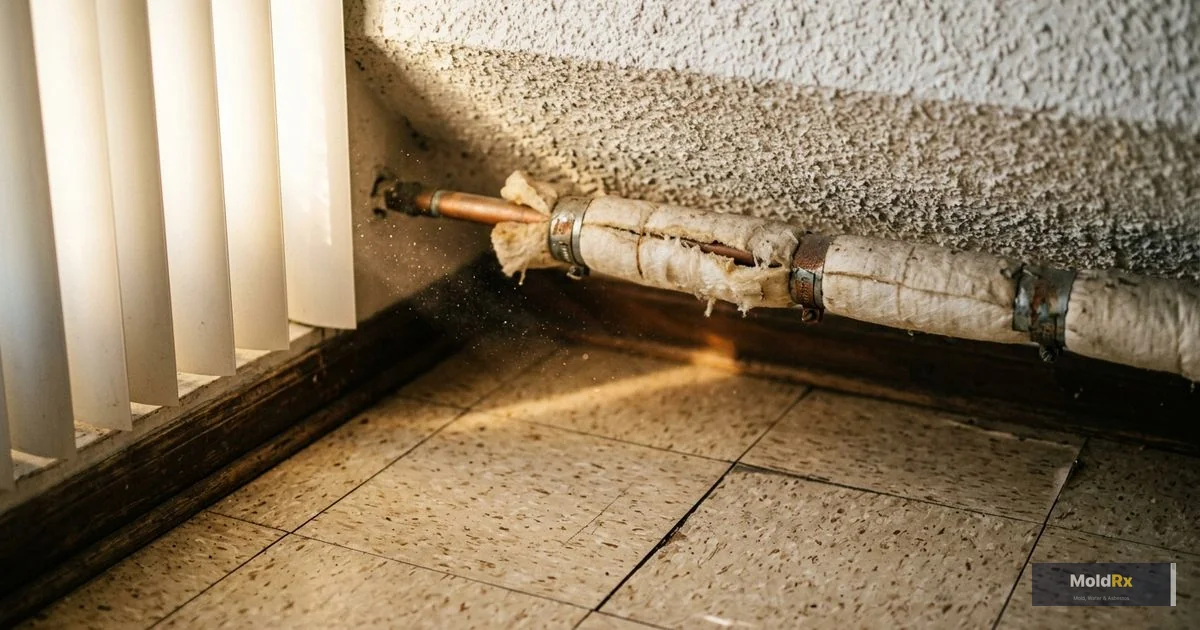
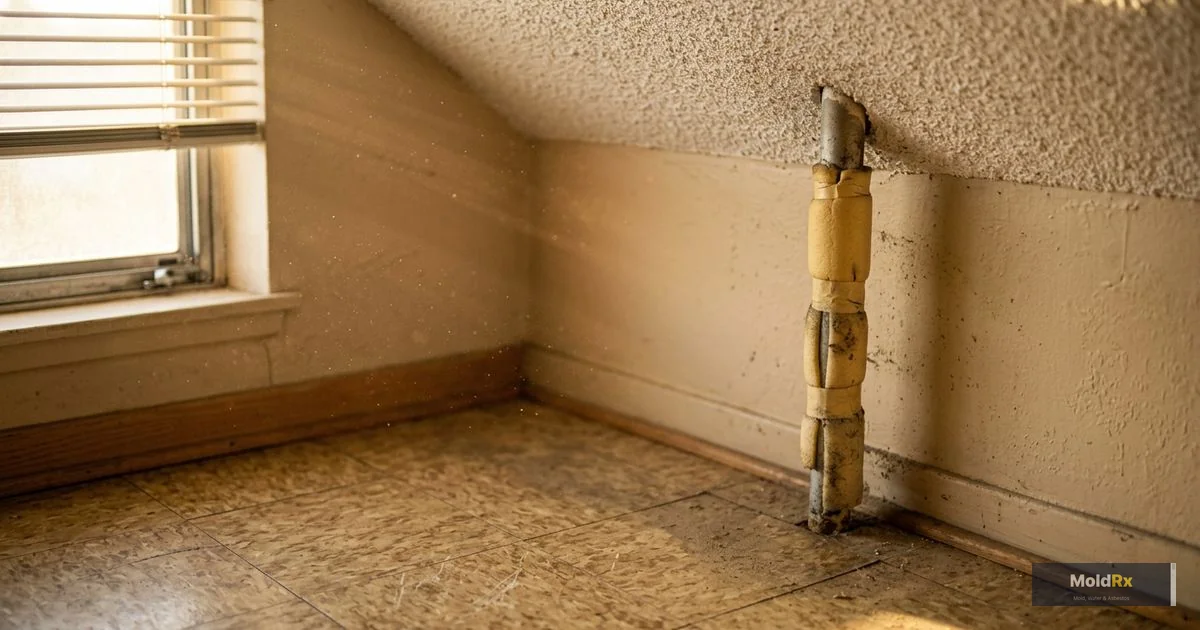
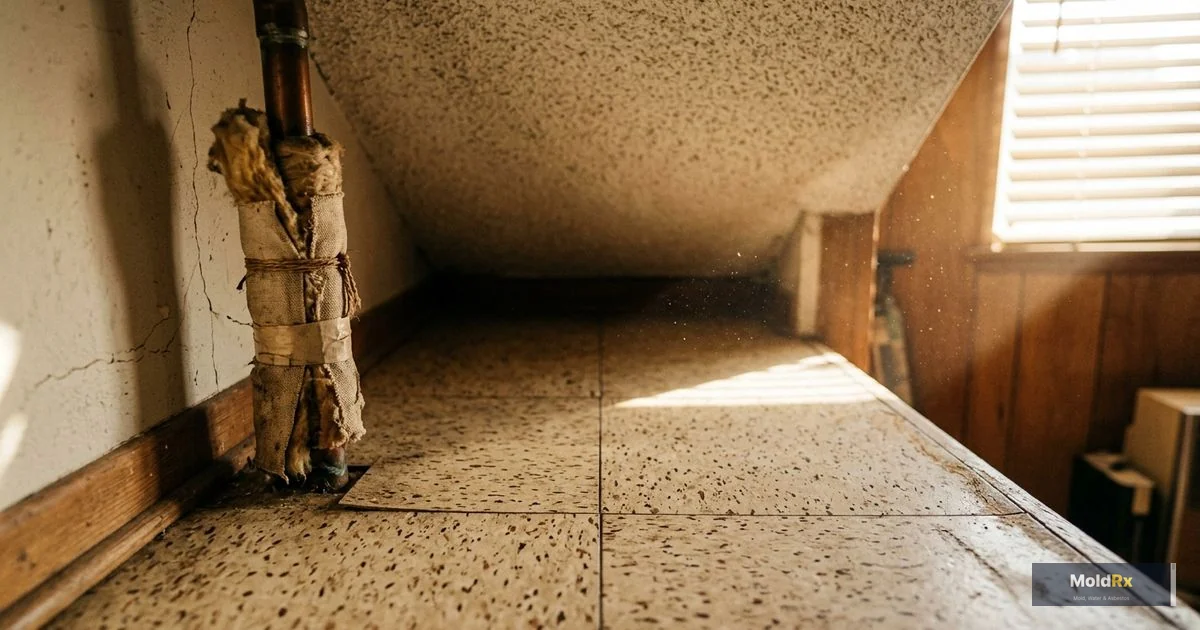
- Pipe and duct insulation — White or gray fibrous wrapping around hot water lines and HVAC ducts, often becoming friable with age.
- HVAC duct tape and insulation — Older cloth-type tape and paper-backed duct insulation from pre-1980 systems.
- Roofing shingles and felt underlayment — Asbestos-cement shingles and tar-saturated roofing felt common on mid-century homes.
- Cement siding — Fiber-cement (transite) exterior panels used throughout the post-war building era.
- Drywall joint compound — Pre-1980 mud used to finish drywall seams, formulated with asbestos for crack resistance.
- Textured wall coatings — Decorative plaster textures and knockdown finishes in living areas.
- Vermiculite attic insulation — Loose-fill insulation, potentially from the contaminated Libby, Montana mine.
- Original plaster — In Old Town homes, lime plaster often incorporated asbestos fibers for strength and fire resistance.
- Window glazing and caulking — Older putties and sealants that become brittle and crumble with age, releasing fibers.
Visual inspection cannot determine whether any of these materials contain asbestos. Only laboratory analysis using PLM or TEM methods provides a definitive answer.
Climate Factors
Tustin's semi-arid climate — summer highs in the mid-80s to low 90s, mild winters in the 50s to 60s — means heavy HVAC use year-round. Older ductwork, insulation, and heating components are common asbestos repositories, and decades of thermal cycling cause these materials to degrade and shed fibers into circulated air. Periodic Santa Ana wind events create pressure differentials that can draw deteriorated particles from wall cavities into living areas.
When Asbestos Testing Is Necessary in Tustin
Before Any Renovation or Demolition (California Law)
SCAQMD Rule 1403 requires an asbestos survey before renovation or demolition of any structure within the South Coast Air Quality Management District — which includes all of Tustin. A certified consultant must complete the survey before work begins. The only narrow exception is single-unit dwelling renovation disturbing less than 100 square feet of intact material. Kitchen remodels, bathroom tearouts, flooring replacement, popcorn ceiling removal, wall demolition, and HVAC upgrades all require testing first. Non-compliance fines can exceed $20,000 per day.
Before Purchasing a Home
Particularly in Old Town Tustin and mid-century neighborhoods where the probability of asbestos is high. Testing results inform your purchase decision and help you budget accurately for any future renovation work. In a market where a 1930s Craftsman cottage and a 2008 Tustin Legacy townhome may be listed on the same day, the construction era defines asbestos risk — and that information directly affects the true cost of ownership.
Before Selling a Home
California disclosure laws require sellers to report known material defects. A professional asbestos test report creates clear documentation that protects you legally and gives buyers confidence in what they are acquiring. This is especially relevant for Old Town and mid-century Tustin properties.
When Materials Are Visibly Deteriorating
Crumbling ceiling texture, cracked floor tiles lifting at the edges, fraying pipe wrap, or peeling exterior materials in an older Tustin home should prompt testing immediately. Damaged ACM can release fibers into your living space without any renovation activity.
After Water Damage or Seismic Events
Any damage to older building materials — from plumbing leaks, roof failures, flooding, or seismic activity — may cause previously stable ACM to become friable and release fibers. Water damage in a 1960s Tustin home should trigger both water remediation and asbestos assessment.
Schedule your free estimate today or call (888) 609-8907 — no pressure, no obligations.
Regulatory Framework: What Tustin Homeowners Need to Know
SCAQMD Rule 1403 (Pre-Renovation and Demolition Survey)
SCAQMD Rule 1403 requires an asbestos survey by a certified consultant before any renovation or demolition within the South Coast Air Quality Management District. Tustin falls entirely within SCAQMD jurisdiction. If ACM is found, SCAQMD must be notified at least 10 working days before removal begins, through the district's online notification application. Penalties for non-compliance can exceed $20,000 per day.
Cal/OSHA Title 8, Section 1529
Cal/OSHA Section 1529 — California's construction-industry asbestos standard — requires determining the presence and quantity of ACM or presumed ACM (PACM) before any construction, alteration, repair, or renovation. In pre-1980 buildings, all thermal system insulation, surfacing material, and resilient flooring is presumed to contain asbestos until testing proves otherwise. Both contractors and property owners face liability if work proceeds without a proper survey.
OSHA 1926.1101 (Federal Construction Standard)
The federal standard OSHA 1926.1101 establishes permissible exposure limits of 0.1 fibers per cubic centimeter averaged over an 8-hour work shift and defines four classes of asbestos work (Class I through Class IV) with escalating requirements for worker protection, air monitoring, and decontamination. Any contractor performing renovation work on your Tustin property must classify the work appropriately and ensure all ACM is handled according to these federal standards.
EPA AHERA (Asbestos Hazard Emergency Response Act)
AHERA establishes inspection and management requirements for asbestos in public and commercial buildings. While it does not directly regulate single-family homes, AHERA mandates that laboratories analyzing asbestos samples for schools be accredited through the National Voluntary Laboratory Accreditation Program (NVLAP) administered by NIST. This NVLAP accreditation standard — which requires biannual proficiency testing and error rates below 1% — is what MoldRx requires of every lab partner for residential testing as well. AHERA-accredited inspector certifications ensure consistent, high-quality methodology across all property types.
Tustin residents are particularly aware of AHERA given the 2023 North Hangar fire, when schools in the Tustin Unified School District were closed due to asbestos contamination from the blaze. The incident demonstrated that asbestos is not just a historical construction concern in Tustin — it remains an active environmental issue.
CSLB C-22 Asbestos Abatement Classification
If testing reveals ACM that requires removal, California law requires that abatement be performed by a contractor holding a CSLB C-22 Asbestos Abatement classification from the Contractors State License Board. C-22 holders must complete DOSH-registered training per Cal/OSHA Section 1529, maintain appropriate insurance, and follow strict containment, removal, and disposal protocols. MoldRx can connect you with licensed C-22 contractors if abatement is needed, but there is no obligation to bundle services.
California Real Estate Disclosure
California law obligates sellers to disclose known hazards, including asbestos. A professional test report creates documentation that protects all parties in a transaction and facilitates rather than complicates the sale of older Tustin properties.
Our Asbestos Testing Process in Tustin
Step 1: Consultation and Property Assessment
We start by understanding your property and your goals. Are you renovating a 1960s ranch home near Main Street? Purchasing a Craftsman bungalow in Old Town? Planning to scrape popcorn ceilings in a 1970s tract home? Assessing a property near Tustin Legacy for environmental due diligence? The assessment identifies which materials need testing based on your home's age, construction type, neighborhood, and your specific project plans.
Step 2: Professional Sample Collection (EPA Protocol)
Our vetted specialists collect samples following EPA and Cal/OSHA protocols — wetting materials before cutting, using containment barriers, wearing protective equipment, and sealing each sample for chain-of-custody transport. For Old Town homes, this may include testing plaster, original flooring layers beneath newer surfaces, and pipe insulation. For mid-century homes, the focus shifts to floor tiles, ceiling textures, duct insulation, joint compound, and roofing. The sampling site is cleaned after collection.
Step 3: NVLAP-Accredited Laboratory Analysis
Every sample is submitted to an NVLAP-accredited laboratory for analysis:
-
Polarized Light Microscopy (PLM): The EPA-accepted standard for bulk building material analysis. PLM identifies asbestos fibers by type, estimates concentration, and determines whether the material meets the 1% regulatory threshold. NVLAP accreditation ensures accuracy through biannual proficiency testing.
-
Transmission Electron Microscopy (TEM): A higher-resolution method used when PLM results are inconclusive, for air monitoring, or when materials have complex matrices where fibers may be masked. TEM provides detection limits well below 1% and is required for post-abatement clearance testing. For Old Town properties with layered construction, TEM can be especially valuable.
Each sample receives a formal laboratory report specifying whether asbestos was detected, the fiber type, and the approximate concentration.
Step 4: Clear Results and Guidance
You receive a detailed report explaining findings for each tested material. If asbestos is present, your options are explained clearly based on material condition, location, and your renovation plans:
- Leave undisturbed — Intact materials in good condition can remain safely in place with periodic monitoring. This is often the safest and most cost-effective approach when ACM is not in the path of planned work.
- Encapsulation — Coating or sealing materials to prevent fiber release. Appropriate when materials are in fair condition and encapsulation provides adequate long-term protection.
- Professional abatement — Licensed removal by a C-22 contractor when materials are damaged, friable, or in the path of planned renovation or demolition work.
The report is suitable for contractor coordination, building permits, real estate transactions, SCAQMD compliance documentation, or your own records.
What Sets MoldRx Apart
- Vetted professionals only. MoldRx only sends vetted asbestos testing professionals we stand behind. No subcontractor roulette.
- NVLAP-accredited lab partners. Every sample is analyzed by a nationally accredited laboratory using PLM and, when warranted, TEM methods that meet EPA, AHERA, and Cal/OSHA standards.
- Honest assessment. If testing is unnecessary for your situation, we will tell you. If your Tustin Legacy home was built in 2010, you likely do not need testing.
- Clear communication. No jargon, no scare tactics — plain language and a clear path forward for your Tustin project.
- Reasonable timeline. On-site sampling takes one to two hours. Lab results arrive within 3 to 5 business days, with rush processing available.
Tustin Neighborhoods and Areas We Serve
MoldRx provides asbestos testing throughout Tustin and surrounding Central Orange County, covering ZIP codes 92780, 92781, and 92782. We serve all Tustin neighborhoods including:
- Old Town Tustin — Historic core with 1880s-1960s homes. Highest asbestos probability.
- Mid-Century Central Tustin — 1950s-1970s tract homes along Main Street, Red Hill Avenue, and Newport Avenue.
- Tustin Meadows — Established mid-century area with high ACM probability.
- Tustin Ranch — Mixed-era development (1970s-1990s), moderate risk in earlier phases.
- The Foothills — Properties near Peters Canyon Regional Park.
- Columbus Grove and Tustin Legacy — Modern construction on the former MCAS site. Low risk, but due diligence applies to any base-era structures.
We also serve neighboring communities including Irvine to the south, Orange and Santa Ana to the north, North Tustin to the northeast, and Costa Mesa to the west.
Related Services in Tustin
- Mold Removal in Tustin
- Asbestos Removal in Tustin
- Water Damage Restoration in Tustin
- Mold Testing in Tustin
Frequently Asked Questions
Is asbestos testing required before renovation in Tustin?
Yes. SCAQMD Rule 1403 requires an asbestos survey before renovation or demolition in the South Coast district, which includes all of Tustin. Under Cal/OSHA Section 1529, an asbestos survey is also required before renovation or demolition work in buildings constructed before 1980. For Tustin, this encompasses Old Town, most mid-century neighborhoods, and early-phase Tustin Ranch development. Non-compliance fines can exceed $20,000 per day.
How many samples need to be collected in a Tustin home?
EPA procedures require a minimum of three samples per homogeneous material in each distinct area. A typical mid-century Tustin home undergoing renovation might need 8 to 15 samples across ceiling texture, floor tile, mastic, joint compound, insulation, and roofing material. Old Town homes with layered construction — original materials beneath newer surfaces — may require additional samples to test each layer. Your inspector determines the exact number based on your property and project scope.
Are Tustin Legacy homes at risk for asbestos?
Homes built in the Tustin Legacy development are modern construction and do not contain asbestos in their original materials. However, the former MCAS Tustin site has a documented asbestos contamination history — the 2000 Navy report found asbestos in hangar roofing, wall panels, pipe insulation, and floor tiles, and the 2023 North Hangar fire released asbestos-containing debris into the surrounding area. Any renovation or demolition involving structures that predate the redevelopment should include asbestos testing as part of environmental due diligence.
How long do asbestos test results take?
Standard PLM analysis through an NVLAP-accredited laboratory takes 3 to 5 business days from the time samples arrive at the lab. Rush service is available with turnaround as fast as 24 hours when project timelines are tight. TEM analysis, if needed for inconclusive results or complex material matrices, typically requires 5 to 7 business days.
What does a positive asbestos test mean?
A positive result means asbestos fibers were detected above 1%, classifying the material as ACM under federal and California regulations. A positive result does not mean immediate danger — intact, undisturbed ACM does not actively release fibers. But if your renovation will disturb that material, licensed abatement by a CSLB C-22 contractor must be performed first, in compliance with Cal/OSHA Section 1529 and OSHA 1926.1101.
What materials should be tested in a Tustin home?
Common ACM in Tustin homes include 9x9-inch floor tiles and black mastic adhesive, popcorn ceiling texture, pipe and duct insulation, HVAC tape, roofing shingles, cement siding, drywall joint compound, textured wall coatings, original plaster, vermiculite attic insulation, and window putty. In Old Town Tustin homes, also consider original linoleum beneath newer flooring, exterior stucco, and any materials that may be layered under subsequent renovations.
Can I collect asbestos samples myself?
California does not prohibit homeowners from collecting samples in their own single-family home, but it is strongly discouraged. Improper technique can release fibers into your living space, and samples collected by uncertified individuals may not be accepted for regulatory compliance. If you need results for a building permit, SCAQMD notification, or real estate transaction, use a certified inspector.
What is the difference between friable and non-friable asbestos?
Friable ACM can be crumbled or reduced to powder by hand pressure — pipe insulation, spray-applied ceiling texture, deteriorated thermal insulation. Friable materials release fibers more readily and are subject to stricter handling requirements under OSHA 1926.1101. Non-friable ACM is bound into a solid matrix — floor tiles, cement siding, roofing shingles. Non-friable materials can become friable through cutting, grinding, or sanding, which is why renovation triggers testing requirements regardless of current material condition.
Do all pre-1980 Tustin homes contain asbestos?
No, but industry data suggests 80% or more of pre-1980 buildings contain at least one ACM. Some homes may have had asbestos removed during previous renovations; others were built with non-asbestos alternatives for specific products. PLM or TEM laboratory testing is the only way to determine what your specific Tustin home contains. Assumptions based on age alone — in either direction — are unreliable.
Get Asbestos Testing in Tustin
Tustin's layered history — from 1880s citrus-farming community to World War II military base to modern planned development — means the city's housing stock spans nearly a century and a half of construction practices. For homeowners in Old Town and the mid-century neighborhoods that make up the majority of Tustin's residential fabric, understanding what is in your property before disturbing it is not optional. It is a health necessity and a legal requirement under SCAQMD Rule 1403, Cal/OSHA Section 1529, and OSHA 1926.1101.
Our vetted testing specialists understand Tustin's construction patterns across every era and every neighborhood. Whether you are renovating a 1920s Old Town Craftsman bungalow, updating a 1970s ranch home along Red Hill Avenue, assessing a property near the former MCAS site, or purchasing your first home in any of Tustin's established neighborhoods, we provide accurate results from NVLAP-accredited laboratories using PLM and TEM analysis, honest guidance, and the documentation you need to proceed safely and in full regulatory compliance.
No guesswork. No runaround. Just clear answers about what is in your home.
Call MoldRx to schedule your asbestos test — (888) 609-8907. Know before you start.