Emergency Water Damage Restoration in Temecula, CA — MoldRx
24/7 Water Damage Restoration Specialists Serving Temecula and the Temecula Valley
Right now, somewhere in Temecula, water is destroying a home. A slab leak that started as a barely audible hiss beneath the kitchen floor three weeks ago has saturated 200 square feet of concrete and is wicking moisture up through tile, into baseboards, and behind lower cabinets. A water heater in a Redhawk garage gave out at midnight and dumped 50 gallons onto the garage floor — water that is now migrating through the firewall into the living space. A washing machine supply line in a Harveston laundry room cracked while the family was at work, and eight hours of continuous flow has turned the entire first floor into a Category 1 water event that is rapidly degrading toward Category 2.
None of these situations will get better on their own. Within 24 hours, clean water absorbs contaminants from building materials and becomes gray water. Within 48 hours, mold spores — always present in the air, always waiting for moisture — begin colonizing. Within 72 hours, structural damage that could have been addressed with extraction and drying now requires demolition and reconstruction.
If water has entered your Temecula property, contact MoldRx immediately. The cost of waiting is not measured in hours. It is measured in thousands of dollars and weeks of displacement.
Why Temecula Properties Are Uniquely Vulnerable
Temecula is Southern California's wine country — beautiful, prosperous, and home to approximately 113,000 residents. But behind the Mediterranean aesthetics and manicured master-planned communities, the city harbors a convergence of water damage risk factors that few homeowners fully appreciate until they are standing in a flooded living room.
The Housing Boom Time Bomb
The vast majority of Temecula's residential housing stock was built during the 1990s and 2000s construction boom that transformed the city from a small unincorporated community into one of Riverside County's largest cities after its incorporation in 1989. Neighborhoods like Redhawk, Harveston, Wolf Creek, Crowne Hill, Paloma Del Sol, Vail Ranch, and Temeku Hills were developed rapidly during this period, with homes now ranging from 15 to 35 years old.
This age range is critical because it represents the failure window for virtually every water-related component in a home:
-
Copper supply lines embedded in slab foundations are 15-25 years into their service life, stressed by the region's aggressive clay soil that expands and contracts with seasonal moisture changes. The soil literally shifts the slab, flexing copper lines until they develop pinhole leaks. Slab leaks are the single most common water damage event we see in Temecula.
-
Tank-style water heaters have a typical lifespan of 8-12 years. Most Temecula homes built in the late 1990s and early 2000s are on their second or third water heater — and homeowners who replaced units 10+ years ago are overdue again. When these fail, they can release 40-80 gallons of water in minutes, flooding garages and adjacent rooms.
-
Builder-grade appliance supply lines, fill valves, and shut-off valves — the cheap rubber hoses and plastic components installed during original construction — have a failure rate that climbs exponentially after 15 years. Washing machine supply line failures are among the most devastating water events we respond to because they involve pressurized water flowing continuously until discovered.
-
Stucco exteriors common throughout Temecula's housing stock are excellent at concealing water intrusion. A compromised stucco joint or failed window flashing allows rain to penetrate the wall assembly, where it saturates the paper-backed lath and sheathing without any visible exterior evidence. By the time interior symptoms appear — staining, bubbling paint, soft drywall — the wall cavity has been wet for weeks or months.
Geography and Climate: The Perfect Storm
Temecula sits at approximately 1,000 feet elevation in a valley flanked by hills, with Murrieta Creek running through the heart of the city and Temecula Creek marking its southern boundary before both converge to form the Santa Margarita River. This geography creates a natural drainage funnel that concentrates storm runoff from surrounding hillsides directly into the city's developed areas.
The city averages only about 14 inches of annual rainfall with roughly 287 sunny days per year — conditions that lull homeowners into complacency. But the rainy season, concentrated between November and March, delivers that rainfall in intense, concentrated events. Flash flooding along the Murrieta Creek corridor during heavy storms is not a historical anomaly — it is a recurring reality.
In January 1993, several days of heavy rain caused Murrieta Creek to overflow its banks, flooding surrounding homes and businesses, killing multiple people and causing approximately $100 million in damage. That catastrophic event led to the ongoing Murrieta Creek Flood Control Project, a multi-phase Army Corps of Engineers initiative designed to provide 100-year flood protection. Phase 2B of this project — the section running through Uptown Temecula between Rancho California Road and Winchester Road — broke ground in September 2025 as a $43.6 million construction effort. Until the full project is complete, properties near the creek corridor remain at elevated flood risk.
The December 2025 atmospheric river events brought this risk into sharp focus. Riverside County was included in Governor Newsom's state of emergency declaration as atmospheric rivers delivered high-intensity rainfall to already saturated soils, triggering flash floods, debris flows, and widespread water intrusion across the Temecula Valley.
And then there is the heat. Summer temperatures regularly exceed the mid-90s, with spikes above 100 degrees that stress plumbing components, dry out caulking and weatherstripping, and create thermal expansion cycles in copper piping. When summer humidity spikes above 45% — common during monsoonal moisture events — any standing water or hidden moisture creates conditions for explosive mold growth in as little as 24 hours.
Understanding Water Damage Categories
Proper water damage restoration begins with proper classification. Under the ANSI/IICRC S500 Standard, every water intrusion event falls into one of three categories — and the category determines the entire restoration protocol:
Category 1 — Clean Water: Water from a sanitary source with no substantial risk from contact. Broken supply lines, overflowing sinks, water heater failures. This is the most common category in Temecula and the most treatable — if caught quickly. Left unaddressed, Category 1 water degrades to Category 2 within 24-48 hours as it absorbs contaminants.
Category 2 — Gray Water: Significantly contaminated water that can cause illness on contact. Dishwasher and washing machine discharge, toilet overflows with urine. Requires enhanced extraction protocols, antimicrobial treatment, and removal of porous materials that absorbed the contaminated water.
Category 3 — Black Water: Grossly unsanitary water containing pathogens, bacteria, and toxins. Sewer backups, toilet overflows with fecal matter, all exterior floodwater. Every porous material contacted by Category 3 water must be removed — carpet, pad, drywall, insulation, particleboard. No exceptions. Storm flooding in Temecula is automatically Category 3 because the water contacts soil, sewage infrastructure, and organic debris.
The difference in restoration cost between a properly treated Category 1 event and a Category 3 event involving the same square footage can be 300-500%. This is why speed matters. A clean supply line break addressed within 12 hours remains Category 1. The same break ignored for two days becomes Category 2, requiring significantly more aggressive — and expensive — intervention.
Our Emergency Restoration Process in Temecula
Phase 1: Rapid Response and Extraction
Minutes matter. Our vetted professionals arrive with truck-mounted extraction units, submersible pumps, and weighted extraction tools designed to remove water from carpet, pad, hard surfaces, and structural cavities. For Temecula's ubiquitous slab-on-grade homes, extraction includes systematic checking for moisture migration beneath flooring — water on a slab travels laterally along the concrete surface, saturating areas well beyond the visible wet zone.
The water source is identified and stopped before extraction begins. If the source is a plumbing failure, emergency plumbing coordination happens simultaneously with extraction setup — you cannot extract your way out of an active leak.
Phase 2: Comprehensive Moisture Mapping
The visible water is never the full extent of the damage. In Temecula's tract-home construction — stucco exteriors, drywall interiors, slab foundations, tight building envelopes — water travels behind finished surfaces with no visible evidence.
Our professionals deploy:
- Thermal imaging cameras to identify temperature differentials caused by hidden moisture in walls, ceilings, and under flooring
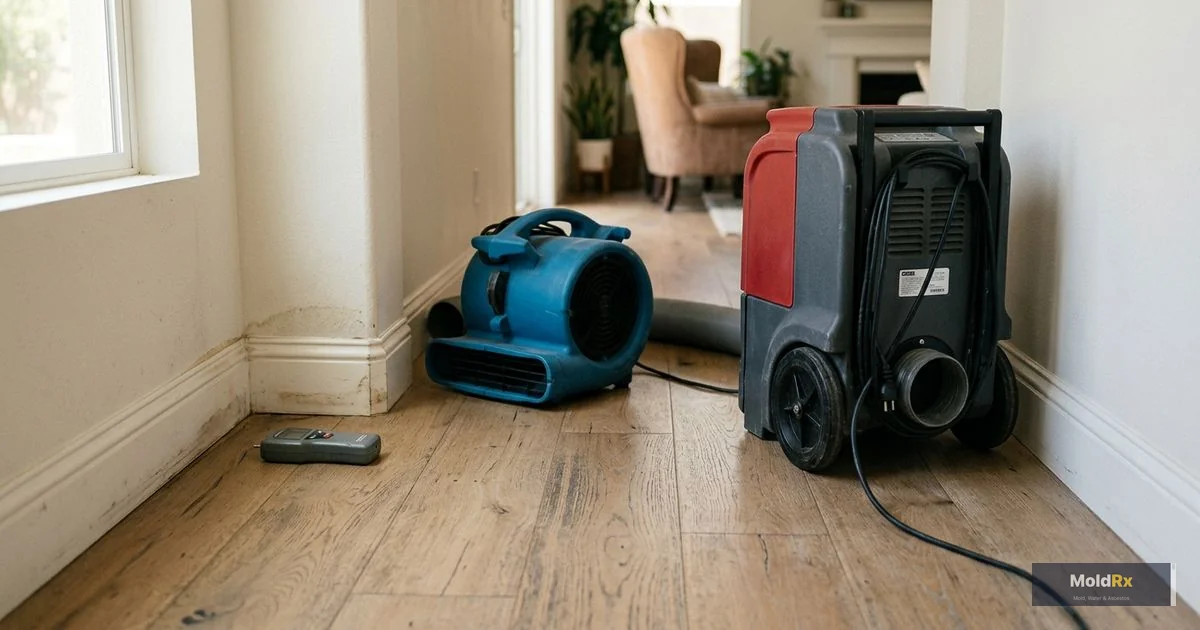
- Pin-type and pinless moisture meters providing quantitative readings across all building materials
- Thermo-hygrometers measuring ambient conditions to establish drying targets
Every wet area is mapped, documented, and photographed. This moisture map becomes the blueprint for equipment placement and the evidentiary basis for your insurance claim.
Phase 3: Engineered Structural Drying
Drying a water-damaged home is not about running fans and hoping for the best. It is an engineered process with measurable targets and daily verification:
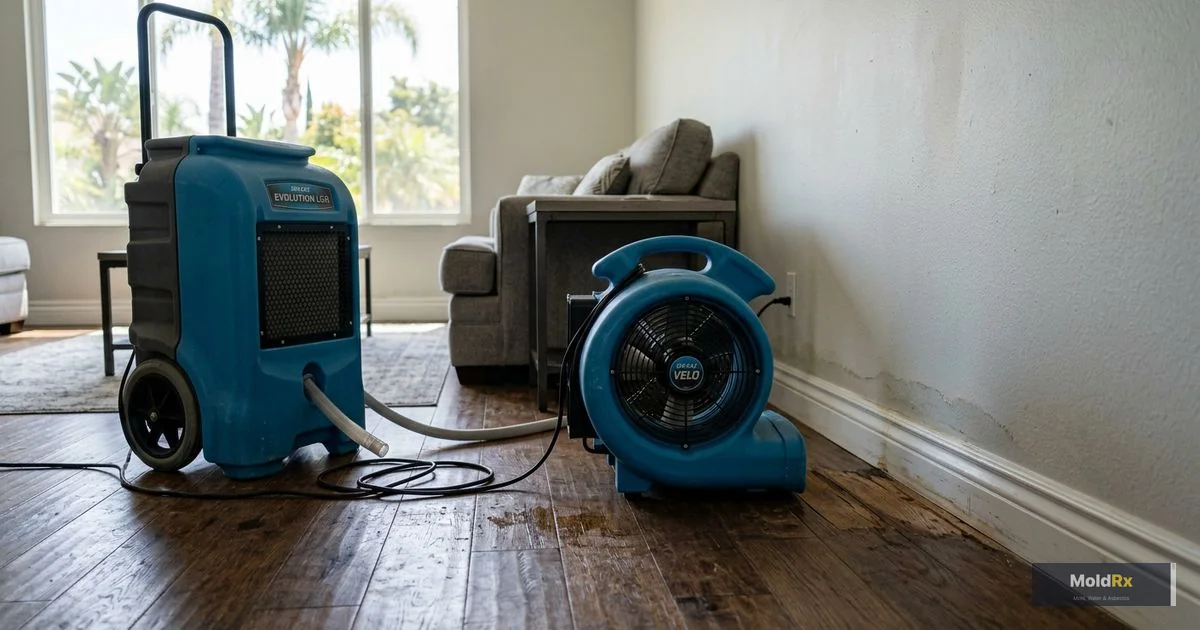
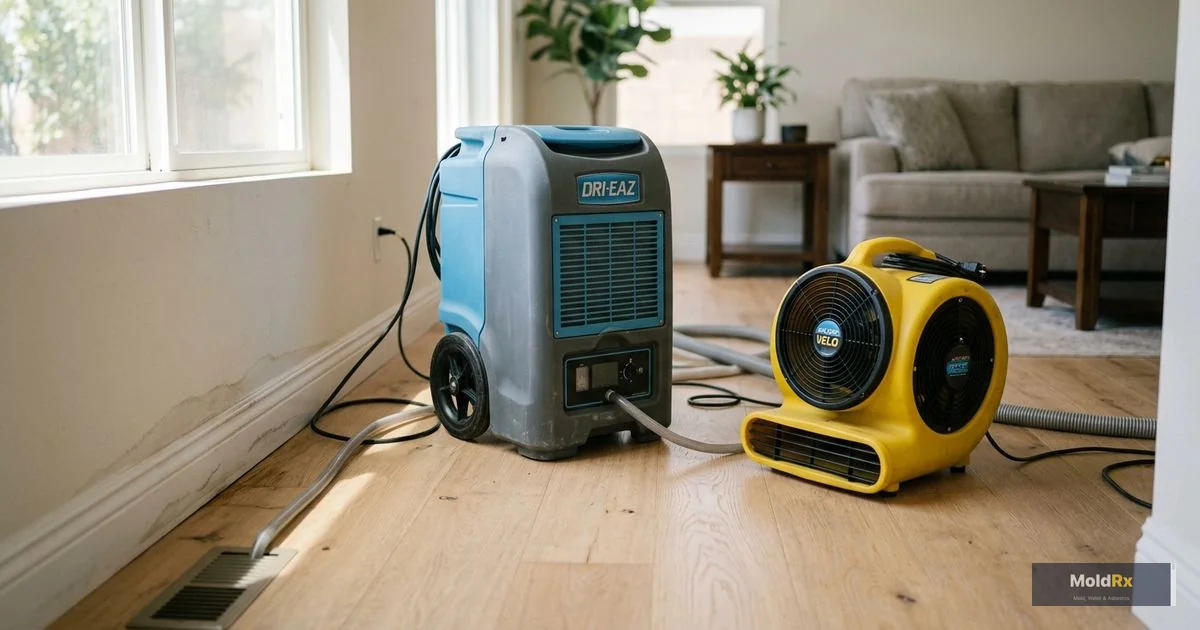
- High-velocity air movers (commercial units producing 2,500+ CFM) create sustained airflow across wet surfaces, accelerating evaporation
- Commercial dehumidifiers — desiccant or refrigerant units depending on conditions — capture airborne moisture as it leaves building materials
- Injectidry wall-cavity systems force dry air behind intact drywall, allowing structural drying without unnecessary demolition
- Specialty floor drying mats create sealed vacuum zones over hardwood and engineered flooring, drawing moisture out without requiring floor removal
Daily moisture readings at every monitored point track progress toward the IICRC S500 dry standard. Equipment is repositioned as drying targets are met in some areas while others require continued treatment. The process is not complete when surfaces feel dry — it is complete when quantitative moisture readings confirm that all materials have returned to acceptable levels.
In Temecula's climate, outdoor humidity is typically low enough to support aggressive drying — but during the rainy season or monsoonal moisture events, higher ambient humidity requires additional dehumidification capacity. Our professionals adjust equipment loads based on real-time conditions, not assumptions.
Phase 4: Antimicrobial Treatment and Contamination Control
For Category 2 and Category 3 events, this phase includes:
- Complete removal of all contaminated porous materials — drywall to the required height, carpet pad, insulation, any particleboard or OSB subflooring
- HEPA vacuuming of all structural surfaces
- Application of EPA-registered antimicrobial agents to framing, concrete, and salvageable semi-porous materials
- Air scrubbing with HEPA filtration to capture airborne particulates and spores
- Post-treatment verification to confirm microbial levels are within acceptable parameters
For Category 1 events caught early, antimicrobial treatment is applied as a preventive measure to all wet surfaces — a standard protocol that costs relatively little and prevents the far more expensive problem of post-restoration mold growth.
Phase 5: Restoration and Reconstruction
The final phase rebuilds what was removed — drywall, flooring, baseboards, cabinetry, paint. Our vetted professionals ensure reconstruction meets current building codes and matches existing finishes. For Temecula's tract homes, where consistent architectural styles mean materials and finishes are typically available, seamless restoration is achievable in most cases.
What to Expect When You Call MoldRx
-
Honest assessment. We will tell you exactly what you are dealing with — the category, the extent, the realistic timeline, and the likely cost range. If your situation is less severe than you feared, you will know. If it is worse, you will know that too, along with a clear explanation of why each step is necessary.
-
No pressure, no upselling. We do not manufacture urgency to sell services you do not need. The urgency in water damage restoration is real and inherent — we do not need to fabricate it. You will receive recommendations based on what your property actually requires, not what generates the largest invoice.
-
Insurance-ready documentation. Detailed moisture maps, daily readings, equipment logs, categorization reports, and photo documentation. We work with insurance companies constantly — we know exactly what adjusters need to approve claims without delays or disputes.
-
Clear communication throughout. You will understand what is happening in your home and why at every stage. Water damage restoration can take days to weeks depending on severity — you deserve to know the status, the timeline, and any decisions that need to be made.
-
Verified completion. The job is complete when moisture readings confirm it, not when someone's gut says it looks dry. Cutting this step short is how mold problems start 30 days after a restoration company leaves.
Temecula Areas We Serve
Our vetted water damage restoration specialists respond to emergencies throughout Temecula, including Old Town Temecula, Redhawk, Harveston, Wolf Creek, Crowne Hill, Paloma Del Sol, Vail Ranch, Temeku Hills, Rancho Highlands, the Wine Country corridor, and commercial properties along Rancho California Road, Winchester Road, and Ynez Road. We cover ZIP codes 92590, 92591, 92592, and 92593.
We also respond to water emergencies in neighboring Murrieta to the north, Fallbrook to the southwest, Lake Elsinore to the northeast, Menifee to the north, and Wildomar to the northwest.
Related Services in Temecula
In addition to water damage restoration, we also offer Mold Removal in Temecula, Asbestos Removal in Temecula, Water Damage Restoration in Temecula, Mold Testing in Temecula, and Asbestos Testing in Temecula services to Temecula property owners.
Water damage left unresolved always becomes a mold problem — particularly in Temecula's climate where hidden moisture in wall cavities can sustain active mold growth for months without visible evidence. If your property has experienced any water intrusion event, mold testing should be a non-negotiable part of the restoration process.
-> Learn more about remediation services in Temecula
Frequently Asked Questions
How quickly should I address water damage in Temecula?
Within hours, not days. The IICRC S500 standard exists because the science of water damage is unforgiving. Clean water degrades to contaminated water within 24-48 hours. Mold colonization begins within 48 hours on most building materials. Structural damage — swelling of engineered wood, delamination of plywood, warping of hardwood, corrosion of metal fasteners — accelerates with every hour of exposure. The difference between a $4,000 extraction-and-dry job and a $20,000 demolition-and-rebuild project is often 12-24 hours of response time. Our Temecula team responds to emergencies 24/7, 365 days a year.
What are the most common causes of water damage in Temecula?
Slab leaks are the number one cause we see in Temecula, driven by copper supply lines stressed by the region's expansive clay soil and decades of thermal cycling. After slab leaks: water heater failures (especially in homes where the original or second unit is past its 10-year expected life), washing machine and dishwasher supply line failures, toilet fill valve and wax ring failures, and during the rainy season, storm-driven flooding along the Murrieta Creek corridor and in low-lying hillside neighborhoods. HVAC condensation issues are increasingly common in older systems as drain lines clog and overflow into ceiling assemblies and wall cavities.
Will my insurance cover water damage restoration in Temecula?
Most homeowner's policies cover sudden and accidental water damage — a pipe burst, a water heater failure, an appliance malfunction. What is typically excluded: gradual damage from long-term leaks (insurers argue you should have detected and repaired these), flood damage from external water sources (requires separate NFIP or private flood insurance), and damage resulting from deferred maintenance. The key is documentation. Our professionals provide categorization reports, moisture maps, daily readings, and comprehensive photo documentation that gives adjusters the evidence they need. We interact with insurance companies on every project — we understand their requirements and we document accordingly.
How long does water damage restoration take in Temecula?
For a minor Category 1 event (small supply line break, limited area, caught quickly): 3-5 days including extraction, drying, and minor material replacement. For a moderate event (water heater failure, multiple rooms affected, some material removal required): 7-10 days. For a major Category 3 event (storm flooding, sewer backup, extensive contamination): 2-3 weeks for complete drying, demolition, antimicrobial treatment, and reconstruction. These are realistic ranges, not marketing promises. We will give you an honest timeline after assessing your specific situation.
Can water-damaged materials in my Temecula home be saved?
Material salvageability depends on three factors: what the material is, what category of water contacted it, and how quickly restoration began. Hardwood flooring can often be saved with specialty drying if addressed within 24-48 hours of a Category 1 event. Carpet can sometimes be salvaged if the pad is replaced and the carpet is properly extracted and treated — but only for Category 1 water. Drywall can be dried in place for Category 1 events if wicking height is under approximately 24 inches. Any porous material contacted by Category 3 water — drywall, insulation, carpet, pad, particleboard — must be removed regardless of condition. We will tell you honestly what can be saved and what cannot. We do not demolish materials unnecessarily, and we do not leave compromised materials in place.
I have a slab leak in my Temecula home. What should I do?
Slab leaks are the most insidious form of water damage in Temecula because they are invisible until significant damage has already occurred. Signs include: unexplained increases in your water bill, the sound of running water when all fixtures are off, warm spots on the floor (for hot water line leaks), cracks in the slab or foundation, and damp or warped flooring. Do not wait for confirmation. If you suspect a slab leak, shut off your main water supply and contact MoldRx immediately. We coordinate leak detection, emergency plumbing repair, and water damage restoration as a unified response — ensuring the leak is fixed and the resulting moisture is properly extracted and dried before mold growth begins.
Act Now: Emergency Water Damage Restoration in Temecula
Water damage in Temecula does not pause while you research your options. It does not slow down while you wait for a callback. Every hour that moisture sits in your home's structure, it migrates further, degrades the water category, accelerates mold colonization, and increases the cost and scope of restoration.
MoldRx coordinates emergency water damage restoration through vetted professionals who understand Temecula's housing stock — the slab leaks endemic to its clay soils, the aging plumbing in its 1990s and 2000s tract homes, the storm flooding risk along its creek corridors, and the stucco exteriors that hide water intrusion until the damage is extensive. We follow IICRC S500 standards without shortcuts. We document everything. We tell you the truth.
If water has entered your Temecula property, contact MoldRx now. Not tomorrow. Not after you finish looking at other websites. Now. The clock started the moment the water did.