Asbestos Testing in Temecula, CA — MoldRx
Vetted Asbestos Testing Professionals Serving Temecula and the Temecula Valley
Temecula's transformation from a quiet agricultural valley to one of Riverside County's most desirable cities happened remarkably fast. The completion of I-15 in 1985 opened the valley to Southern California commuters, and by the late 1980s subdivisions were going up across the landscape. Today, Temecula is home to approximately 115,000 residents, a nationally recognized wine country, and a housing stock that spans several important construction eras — including the critical transitional years of the mid-1980s through early 1990s when asbestos was still working its way out of building supply chains. Whether you own an older property in Old Town, a late-1980s home in Redhawk, or a wine country estate with original structures from the 1960s, laboratory testing is the only way to determine what your building materials actually contain. MoldRx only sends vetted asbestos testing professionals who follow EPA sampling protocols, use NVLAP-accredited laboratories, and deliver results that satisfy SCAQMD Rule 1403 and Cal/OSHA requirements.
Request your free estimate — we will help you determine if testing is needed for your Temecula property.
What Makes Asbestos Hazardous
Asbestos is a group of six naturally occurring fibrous minerals that were mined and processed into thousands of commercial products throughout the twentieth century. The construction industry valued asbestos for an unusual combination of properties: exceptional heat resistance, fireproofing capability, tensile strength, resistance to chemical corrosion, and low manufacturing cost. From the 1920s through the late 1980s, manufacturers added asbestos fibers to floor tiles, roofing materials, insulation, pipe wrapping, drywall joint compound, textured ceiling coatings, cement siding, and dozens of other building products.
Three types were most commonly used in residential construction: chrysotile (white asbestos, the most prevalent), amosite (brown asbestos), and crocidolite (blue asbestos). All six types are classified as known human carcinogens by the EPA, OSHA, and international health agencies.
The health hazards of asbestos were identified by medical researchers decades before regulators acted comprehensively. When asbestos-containing materials (ACM) are disturbed — cut, sanded, drilled, broken, scraped, or allowed to deteriorate — they release microscopic fibers into the air. These fibers are small enough to be inhaled deep into lung tissue, where the body cannot break them down or expel them. Over time, the accumulated fibers cause three serious and often fatal diseases:
- Mesothelioma — An aggressive cancer of the lining surrounding the lungs or abdomen, caused almost exclusively by asbestos exposure. The disease has a latency period of 20 to 50 years and a median survival of 12 to 21 months after diagnosis.
- Lung cancer — Asbestos exposure significantly increases lung cancer risk, especially in combination with smoking. The two risk factors multiply rather than simply add.
- Asbestosis — Chronic, irreversible scarring and inflammation of lung tissue that progressively reduces breathing capacity. There is no cure.
There is no established safe threshold of asbestos exposure for mesothelioma. A single renovation project that releases asbestos fibers can have consequences that do not become apparent for decades. This is why testing before disturbing any suspect material is the only reliable prevention strategy.
The Regulatory Timeline Matters for Temecula
The EPA began restricting certain asbestos products in 1973, with expanded restrictions through the 1980s. A broader ban was issued in 1989 but was partially overturned by a federal court in 1991. The practical result: asbestos-containing building materials were still being manufactured and installed through the late 1980s and, in some product categories, into the early 1990s. This timeline is directly relevant to Temecula, where the majority of the housing stock was built during exactly this transitional period.
Why Temecula's Development Timeline Creates Specific Asbestos Concerns
Temecula's construction history does not follow the pattern of older California cities like Anaheim or Santa Ana, where the primary risk is concentrated in pre-1970s housing. Understanding how and when Temecula was built is essential to assessing asbestos risk accurately.
The Pre-Freeway Era (Before 1985)
Before the I-15 was completed through the valley, the Temecula area was primarily agricultural land — cattle ranching on the vast Vail Ranch (originally 87,500 acres assembled by Walter Vail from four Mexican-era ranchos), citrus groves, and the early vineyards that would eventually become the Temecula Valley American Viticultural Area (AVA), recognized in 1984. The first winery, established by Vincenzo and Audrey Cilurzo, opened in 1967. Callaway Winery followed in 1974, marking the beginning of commercial winemaking in the valley. Residential development was sparse — Temecula's population was only about 1,800 in 1980.
Homes and structures from this era — particularly those built during the 1960s and 1970s — fall squarely within the peak period of asbestos use. Floor tiles, popcorn ceilings, pipe insulation, furnace duct tape, roofing felt, and drywall compound from these years have a high probability of containing asbestos. While these properties represent a small fraction of Temecula's total housing stock, they do exist in Old Town, along older rural roads, and among the ranch properties and agricultural structures that predate suburban development.
The 1985-1995 Boom: Temecula's Critical Transitional Period
The completion of I-15 in 1985 changed everything. Families from San Diego, Orange County, and Los Angeles discovered that affordable housing was available just an hour's commute from the coast. Temecula's population exploded — from approximately 1,800 in 1980 to 27,099 by the 1990 census. The city officially incorporated in 1989, and master-planned communities began reshaping the valley landscape.
This is the critical era for Temecula asbestos risk, and the one that makes testing so important here. Homes built between 1985 and the early 1990s were constructed during a transitional period for building materials. Some manufacturers had switched to asbestos-free formulations; others were still working through existing inventory or using products from suppliers who had not yet made the transition. A home built in 1988 might contain asbestos in its popcorn ceiling texture but not its floor tiles, or vice versa. There is no way to predict which materials contain asbestos without laboratory analysis — even within the same home, different products from different manufacturers can yield entirely different results.
Many of Temecula's most established neighborhoods date to this transitional period, including early phases of communities like Redhawk, Vail Ranch, and areas along Rancho California Road. Homeowners in these neighborhoods who assume their late-1980s or early-1990s homes are "too new for asbestos" are making an assumption that only laboratory testing can validate or refute.
The 1995-2010 Expansion
The late 1990s and 2000s brought continued rapid growth, with master-planned communities adding thousands of homes:
- Harveston — A large planned community developed beginning in the early 2000s
- Crowne Hill — Developed through the late 1990s and 2000s
- Wolf Creek — A master-planned community built primarily in the 2000s
- Roripaugh Ranch — Construction began around 2006, with development continuing through the 2010s
Construction during this period used modern, asbestos-free building materials. These newer homes are generally not a concern for asbestos in original materials. However, SCAQMD Rule 1403 still requires a survey before demolition regardless of building age, and any home that has undergone undocumented renovation work using salvaged or non-standard materials should be evaluated on its own merits. Some imported construction products from this period have also tested positive for asbestos at low rates.
Wine Country and Estate Properties
Temecula's wine country district along Rancho California Road and De Portola Road includes a mix of property types — winery buildings, tasting rooms, barrel storage facilities, agricultural structures, and estate homes. Some of these properties include original structures dating to the 1960s and 1970s that may have been renovated or expanded multiple times over the decades. If you own wine country property with structures from the asbestos era, testing before renovation provides both safety and regulatory protection. Commercial buildings in the wine country district may also fall under AHERA inspection protocols depending on their use.
Old Town Temecula Commercial Properties
Old Town Temecula's commercial buildings, along with strip malls, restaurants, and office spaces constructed before the early 1990s, may contain asbestos in fire-rated insulation, acoustic ceiling tiles, floor tiles, and fireproofing materials. Commercial renovation or tenant improvement projects in older buildings typically require asbestos testing under California law — specifically Cal/OSHA Section 1529 and SCAQMD Rule 1403.
Common Asbestos-Containing Materials in Temecula Homes
The following materials are frequently found to contain asbestos in Inland Empire homes from the relevant construction eras. Visual inspection cannot determine asbestos content — only laboratory analysis provides a definitive answer.
Ceilings. Popcorn (acoustic) ceiling texture applied before the mid-1980s commonly contains chrysotile asbestos at concentrations of 1% to 10%. This is one of the most frequently positive materials in Southern California homes. Some smooth textured finishes and suspended ceiling tiles also test positive.
Floors. Nine-inch-by-nine-inch vinyl floor tiles are a strong indicator of potential asbestos content. The black mastic adhesive beneath vinyl tiles frequently contains asbestos even when the tiles themselves do not. Sheet vinyl flooring backing from some manufacturers also tests positive.
Walls. Drywall joint compound used through the early 1980s commonly contained asbestos for crack resistance. Some plaster, stucco, and textured wall coatings also test positive.
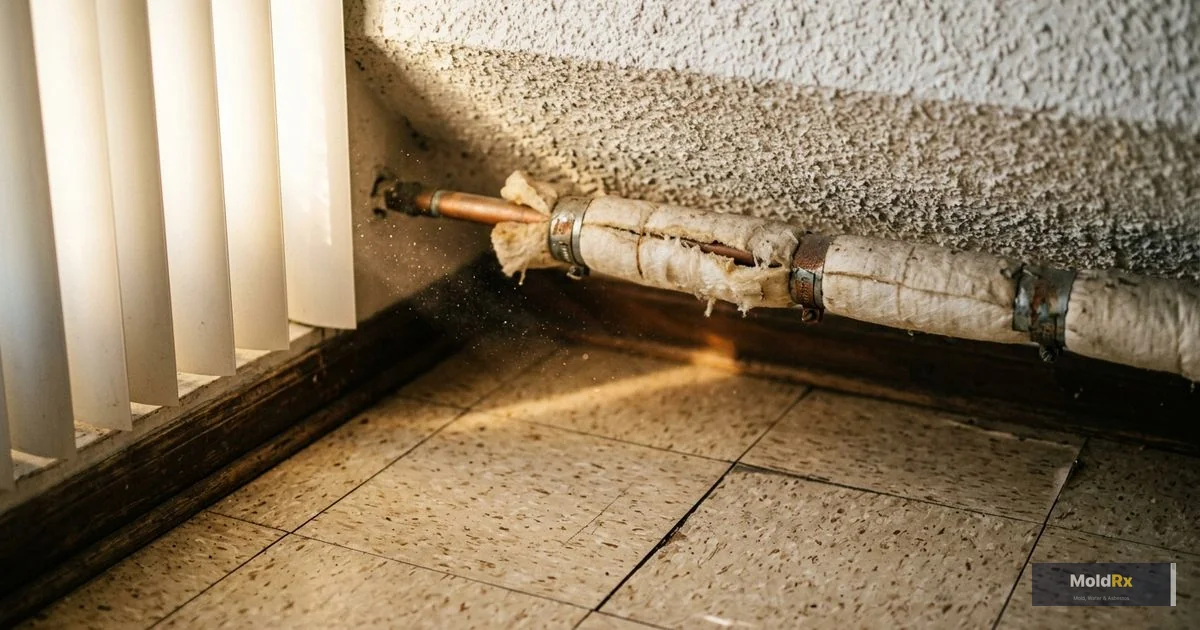
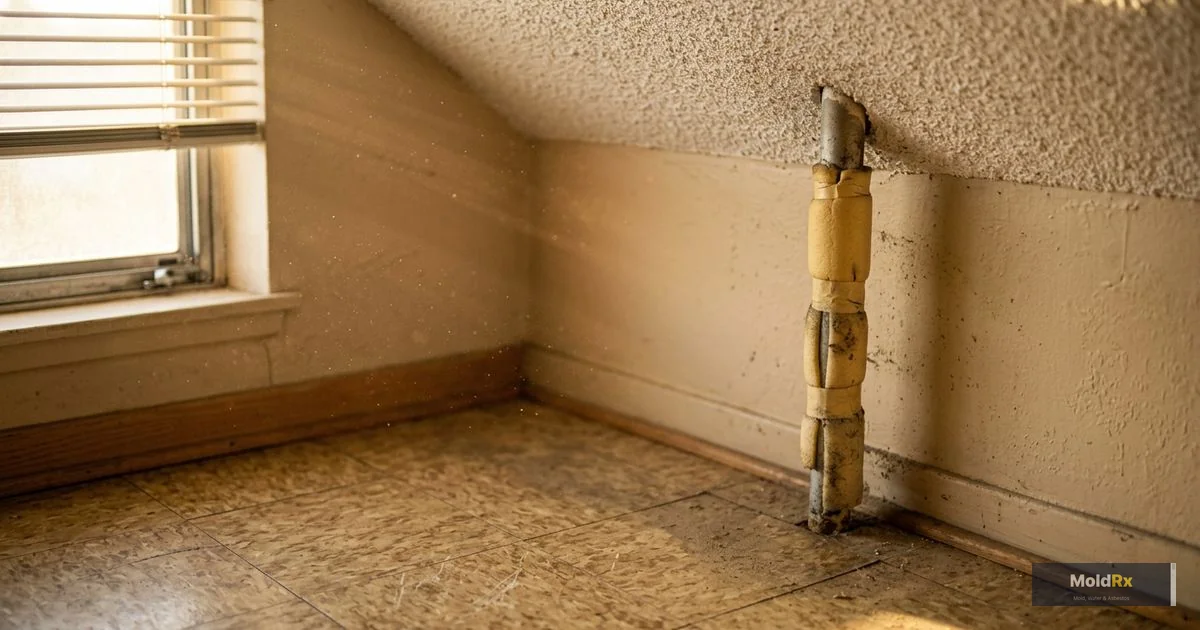
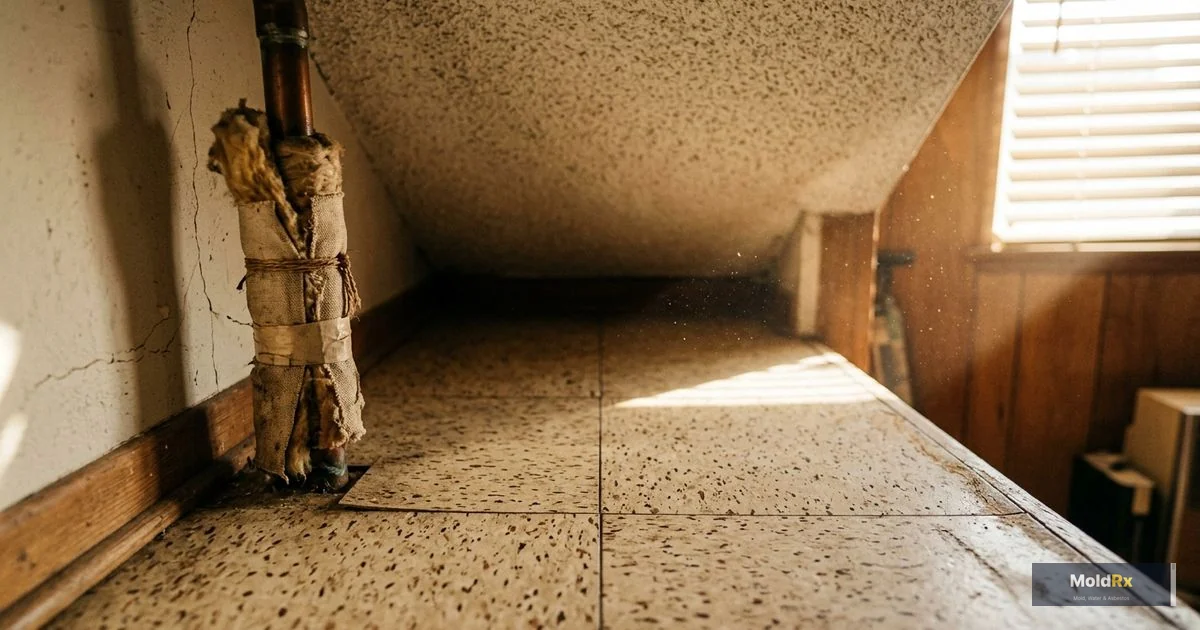
Insulation. Pipe wrapping, boiler insulation, and the cloth tape used to seal HVAC ductwork joints are common sources. Vermiculite attic insulation is a particular concern — much of the vermiculite sold in the U.S. came from the Libby, Montana mine contaminated with tremolite asbestos.
Roofing. Asphalt shingles, roof felt, roofing cement, and certain flashing materials from pre-1990 installations may contain asbestos. Temecula's intense sun and heat — summer temperatures regularly exceeding 95 degrees — accelerate roofing material deterioration, which can increase fiber release risk from aging roofs.
Exterior. Transite siding (a rigid cement-asbestos composite), certain stucco mixes, and window glazing compound have tested positive in Riverside County homes.
HVAC systems. Furnace flue pipes, duct insulation, and duct tape on older heating and cooling systems are common asbestos sources. This is especially relevant in Temecula, where high summer temperatures mean HVAC systems run heavily and homeowners frequently upgrade or replace aging equipment — work that can disturb ACM around ducts and furnace components.
Regulatory Framework: What Temecula Property Owners Need to Know
SCAQMD Rule 1403 (Pre-Renovation and Demolition Survey)
SCAQMD Rule 1403 requires an asbestos survey by a certified consultant before any renovation or demolition within the South Coast Air Quality Management District, which includes Temecula. If asbestos-containing materials are found, SCAQMD must be notified at least 10 working days before removal begins. There is a narrow exception for single-unit dwelling renovation disturbing less than 100 square feet of intact material, but testing and documentation remain the safest approach. Non-compliance fines can exceed $20,000 per day.
Cal/OSHA Title 8, Section 1529
Cal/OSHA Section 1529 requires determining the presence and quantity of ACM or presumed ACM before any construction, alteration, repair, or renovation. In pre-1980 buildings, all thermal system insulation, surfacing material, and resilient flooring is presumed to contain asbestos until tested. Contractors working on your Temecula property must comply before starting work — and experienced Temecula-area contractors typically require survey results before beginning renovation on any home from the asbestos era.
OSHA 1926.1101 (Federal Construction Standard)
The federal standard OSHA 1926.1101 establishes permissible exposure limits of 0.1 fibers per cubic centimeter averaged over an 8-hour work shift. It defines four classes of asbestos work with escalating requirements for worker protection, air monitoring, and decontamination. For Temecula homeowners, the practical impact is that your contractor must classify the work appropriately, protect workers, and ensure all ACM is handled by certified, registered professionals.
EPA AHERA (Asbestos Hazard Emergency Response Act)
AHERA establishes inspection and management requirements for asbestos in public and commercial buildings and mandates that laboratories analyzing asbestos samples for schools be accredited through the National Voluntary Laboratory Accreditation Program (NVLAP) administered by NIST. While AHERA does not directly regulate single-family homes, its protocols and accreditation standards form the foundation for residential testing practices. AHERA-accredited inspector certifications ensure consistent methodology across residential and commercial work. NVLAP lab accreditation — which MoldRx requires of every lab partner — is the gold standard that guarantees analytical quality.
CSLB C-22 Asbestos Abatement Classification
If testing reveals ACM that must be removed, California law requires that abatement be performed by a contractor holding a CSLB C-22 Asbestos Abatement classification from the Contractors State License Board. C-22 holders must complete DOSH-registered training per Cal/OSHA Section 1529, carry appropriate insurance, and follow strict containment, removal, and disposal protocols. MoldRx can connect you with licensed C-22 contractors if abatement is needed.
Schedule your free estimate today or call (888) 609-8907 — honest answers, no pressure.
Our Asbestos Testing Process in Temecula
Step 1: Consultation and Property Assessment
A vetted asbestos specialist visits your property and performs a thorough assessment. The specialist evaluates the home's construction era, identifies all materials that may contain asbestos based on appearance, location, and condition, and reviews your specific project plans. The goal is a targeted sampling strategy that covers every relevant material without unnecessary duplication.
For Temecula's transitional-era homes (mid-1980s through early 1990s), the specialist pays particular attention to materials that may have inconsistent asbestos content — situations where one product in the home contains asbestos while a similar-looking product in another room does not. This is the reality of testing in a city where the majority of the housing stock was built during the industry's transition away from asbestos.
Step 2: Safe Sample Collection (EPA Protocol)
Samples are collected following EPA and Cal/OSHA protocols to prevent fiber release. The specialist wets each material before sampling to suppress airborne fibers, carefully extracts a small sample using specialized tools, places the sample in a sealed and labeled container, and documents the collection location for chain-of-custody transport. Containment measures prevent any fiber release during the process, and personal protective equipment is worn throughout. The sampling site is cleaned afterward to prevent residual contamination.
Professional sampling matters because improper technique — cutting into dry material, using household tools, or failing to seal the sampling site — can contaminate your home and expose your family to airborne fibers.
Step 3: NVLAP-Accredited Laboratory Analysis
Every sample is submitted to an NVLAP-accredited laboratory for analysis using established methods:
-
Polarized Light Microscopy (PLM): The EPA-accepted standard method for bulk building material samples. PLM identifies asbestos fibers by type (chrysotile, amosite, crocidolite, tremolite, actinolite, or anthophyllite), estimates fiber concentration, and determines whether the material meets the 1% regulatory threshold for classification as ACM. NVLAP accreditation requires biannual proficiency testing with an error rate below 1%, ensuring analytical accuracy.
-
Transmission Electron Microscopy (TEM): A higher-resolution method used when PLM results are inconclusive, for air monitoring samples, or when greater analytical precision is needed. TEM provides detection limits well below 1% and can identify fibers in complex material matrices — like floor tile or certain mastics — where PLM may be limited. TEM is also the method required for post-abatement clearance air testing.
Each sample receives a formal laboratory report specifying whether asbestos was detected, the fiber type, and the approximate concentration.
Step 4: Results, Interpretation, and Next Steps
When results arrive, we explain them clearly and discuss what they mean for your plans:
- Negative results — No asbestos detected in the tested materials. You can proceed with your renovation, transaction, or project with confidence and documentation.
- Positive results, material in good condition — Intact, undamaged ACM that will not be disturbed during your project can often remain in place. We recommend periodic monitoring to ensure the material stays in good condition and explain the management approach.
- Positive results, material damaged or to be disturbed — Materials that are deteriorating or in the path of renovation work should be addressed before the project begins. Options include encapsulation (sealing the material to prevent fiber release) or professional removal by a California-licensed C-22 asbestos abatement contractor.
You receive a complete report with sample locations, laboratory chain-of-custody records, and detailed results — everything needed for real estate transactions, contractor coordination, permit applications, and SCAQMD regulatory compliance.
What Sets MoldRx Apart
- Vetted professionals only. MoldRx only sends vetted asbestos testing professionals we stand behind. No subcontractor roulette — the people who arrive at your Temecula property are specialists we trust with our own homes.
- NVLAP-accredited lab partners. Every sample is analyzed by a nationally accredited laboratory using PLM and, when warranted, TEM methods that meet EPA, AHERA, and Cal/OSHA standards.
- Honest guidance. If testing is not warranted for your situation, we will say so. If your 2005-built Harveston home has no specific risk indicators, we are not going to push sampling for the sake of it.
- Fast turnaround. Standard laboratory results return within 3 to 5 business days. Rush analysis is available for real estate closings, permits, and time-sensitive projects.
- No pressure. We provide testing and honest interpretation. If asbestos is found and professional removal is needed, we can connect you with licensed C-22 abatement contractors, but there is no obligation to bundle services.
Temecula Neighborhoods and Areas We Serve
Our vetted asbestos testing specialists serve all of Temecula and the surrounding Temecula Valley. From the established neighborhoods of Redhawk, Harveston, Crowne Hill, and Vail Ranch to the hillside communities of Wolf Creek and Roripaugh Ranch, we cover every part of the city. We serve all Temecula ZIP codes including 92590, 92591, 92592, and 92593.
We also serve Old Town Temecula commercial properties, wine country estates along Rancho California Road and De Portola Road, and neighboring communities including Murrieta to the north, Wildomar and Lake Elsinore to the northwest, Menifee to the northeast, and Fallbrook to the south.
Related Services in Temecula
- Mold Removal in Temecula
- Asbestos Removal in Temecula
- Water Damage Restoration in Temecula
- Mold Testing in Temecula
Frequently Asked Questions
Is asbestos testing required before renovating in Temecula?
Yes. Under Cal/OSHA Section 1529, an asbestos survey is required before renovation or demolition work in buildings constructed before 1980. SCAQMD Rule 1403 applies to all structures within the district — which includes Temecula — and requires notification before disturbing ACM. Many Temecula contractors will not begin work on older homes without documentation showing suspect materials have been tested. Even when not strictly required by law, testing protects your family, your contractors, and your liability.
My Temecula home was built in 1989. Is asbestos testing really necessary?
Yes, and homes from the late 1980s are actually among the most important to test. The phase-out of asbestos was gradual and uneven across manufacturers. Homes from Temecula's 1985-1995 building boom were constructed during a period when some products still contained asbestos while others did not. A 1989 home might have asbestos-free floor tiles but asbestos-containing ceiling texture, or vice versa. The only way to know is through PLM or TEM laboratory analysis of physical samples.
What about homes built in the mid-to-late 1990s in Temecula?
Homes built after the early 1990s are significantly less likely to contain asbestos, and mid-to-late 1990s construction is generally considered low risk. Testing is not typically necessary for these homes unless there are specific concerns about particular materials. However, SCAQMD Rule 1403 still requires a survey before full demolition regardless of building age. If you have questions about your specific home, we will give you honest guidance.
How many samples need to be collected?
EPA procedures require a minimum of three samples per homogeneous material in each distinct area. Most residential inspections involve 5 to 15 samples from different suspect materials, depending on the home's age and the scope of your project. For transitional-era Temecula homes, more samples may be needed because materials from different manufacturers in the same home can yield different results. Your inspector determines the exact number based on your property.
How long do asbestos test results take?
Standard PLM analysis through an NVLAP-accredited laboratory takes 3 to 5 business days. Rush service is available with turnaround as fast as 24 hours for real estate closings, permits, and time-sensitive projects. TEM analysis, if needed, typically requires 5 to 7 business days. From initial scheduling to receiving final results, most Temecula residential projects are completed within one week.
What does a positive asbestos test mean for my renovation?
A positive result means asbestos fibers were detected above 1%, classifying the material as ACM under federal and California regulations. If your renovation will disturb that material, licensed abatement by a CSLB C-22 contractor must be performed first, in compliance with Cal/OSHA Section 1529 and OSHA 1926.1101. If the ACM is in good condition and will not be disturbed, it can often remain safely in place with periodic monitoring.
Can I just test one room instead of the whole house?
Absolutely. If you are renovating a specific room or area, we can focus sampling on materials that will be disturbed during that project. However, we may also flag visible concerns in other areas of the home during the assessment — you can decide whether to include those materials in the testing at that time. There is no requirement to test the entire home for a targeted renovation.
What is the difference between PLM and TEM analysis?
PLM (Polarized Light Microscopy) is the EPA-accepted standard for bulk building material analysis. It identifies asbestos fiber type and estimates concentration, with a detection limit of approximately 1% — which is also the regulatory threshold. TEM (Transmission Electron Microscopy) provides higher resolution and lower detection limits. TEM is used when PLM results are inconclusive, for air monitoring samples, and for post-abatement clearance testing. Both methods are performed by NVLAP-accredited laboratories with strict quality controls.
Do wine country properties need special attention?
Wine country properties along Rancho California Road and De Portola Road may include structures from multiple construction eras — original 1960s-70s buildings alongside later additions and renovations. Each structure or building section should be evaluated independently based on its construction date. Winery buildings, tasting rooms, and agricultural structures from the asbestos era can contain ACM in insulation, fireproofing, ceiling tiles, and flooring, and commercial spaces may fall under additional AHERA inspection requirements.
Get Asbestos Testing in Temecula
Whether you are renovating a 1988 home in Redhawk, purchasing an older property in Old Town, upgrading HVAC systems in a Vail Ranch house, or dealing with deteriorating materials in a wine country estate, asbestos testing gives you the information you need to move forward safely and in compliance with California law.
Our vetted testing specialists understand Temecula's construction timeline — from the pre-freeway ranch properties to the transitional-era subdivisions to the modern master-planned communities — and they know where to look for asbestos-containing materials in each type of home. Every sample is analyzed by an NVLAP-accredited laboratory using PLM or TEM methods that meet AHERA, Cal/OSHA Section 1529, OSHA 1926.1101, and SCAQMD Rule 1403 standards.
The health consequences of asbestos exposure are serious and irreversible, but they are entirely preventable when you know what is in your home before you disturb it. Testing is straightforward and gives you a clear, documented answer.
Call MoldRx to schedule your asbestos test — (888) 609-8907. Know before you start.