Water Damage Restoration in Stanton, CA — MoldRx
Vetted Water Damage Restoration Specialists Serving Stanton and Central Orange County
Water is in your Stanton home right now, and every minute it sits there the damage is compounding. A burst pipe behind a wall. A water heater that finally gave out in the garage. Storm runoff pooling against a foundation that was never designed to handle it. A washing machine supply line that cracked while you were at work. Whatever brought you here, the situation is urgent and it is getting worse.
Stanton's housing stock is uniquely vulnerable. This compact city of roughly 40,000 residents crammed into just 3.15 square miles was built almost entirely during a single era — the 1950s through 1970s post-war boom. That means virtually every home, apartment, and mobile home in Stanton is now 50 to 70 years old, with plumbing systems, water heaters, and supply lines that are at or past the end of their engineered lifespan. When these systems fail — and they are failing across Stanton right now — water damage escalates fast. Within 24 to 48 hours in Orange County's humidity, mold colonization begins. Within 72 hours, your restoration costs can multiply by five. You do not have time to shop around. You need professionals now.
Why Stanton Is a Water Damage Crisis Waiting to Happen
Stanton is not just another Orange County suburb with some older homes. The city's unique combination of age, density, housing types, and flat terrain creates a concentrated water damage risk profile that exceeds almost any city its size in the region.
An Entire City Built in a Single Generation
Stanton was incorporated on June 4, 1956, during the explosive post-war growth that transformed Orange County from agricultural land into suburban sprawl. In the early 1950s, the area experienced such rapid population growth that neighboring cities were annexing land in every direction. The residents responded by incorporating into what is today's City of Stanton — and the construction boom that followed built the vast majority of the city's housing stock within roughly two decades.
This matters enormously for water damage risk because it means the entire city's infrastructure is aging out simultaneously. There is no gradual turnover where newer construction compensates for older failures. When galvanized pipes in a 1958 ranch home corrode through, the galvanized pipes in the 1961 ranch home next door, and the one across the street, and the one behind it, are in the same condition. Stanton is not experiencing isolated plumbing failures. It is experiencing a city-wide infrastructure aging event.
Galvanized steel pipes installed in homes from the 1950s and early 1960s have a useful life of 40 to 50 years. They are now 65 to 75 years old. Internal corrosion has been building for decades — restricting flow, creating pressure imbalances, and slowly perforating the pipe walls with pinhole leaks that often run undetected inside wall cavities until staining, warping, or mold growth becomes visible.
Copper supply lines installed during the 1960s and 1970s construction wave have been exposed to chemically treated municipal water for half a century or more. Prolonged contact with chlorine and chloramine compounds creates pitting corrosion that leads to slab leaks — pinhole failures in the copper lines running beneath concrete foundations. Slab leaks are among the most insidious forms of water damage because they are invisible from above. The first sign is often a warm spot on the floor, an unexplained spike in the water bill, or the sound of running water when every fixture is off.
Polybutylene pipes, used extensively in construction from the late 1970s through the early 1990s, are present in many Stanton homes built or remodeled during that period. These plastic pipes were marketed as a cheaper alternative to copper but are now known to become brittle and fail without warning. Micro-fractures from chlorine exposure can cause a supply line to go from functional to catastrophically burst in a matter of seconds.
The Mobile Home Vulnerability
Stanton's housing stock includes a significant number of mobile homes and mobile home parks — a defining characteristic of the community that sets it apart from wealthier Orange County neighbors. Mobile homes face disproportionately higher water damage risk than conventional construction for several critical reasons.
Mobile home plumbing systems are lighter-duty than site-built construction. Supply lines, drain connections, and water heaters in mobile homes were designed to meet different standards and have shorter effective lifespans. Many of Stanton's mobile homes are the same vintage as the surrounding stick-built housing — 1960s through 1970s — meaning their plumbing is equally aged but less robust.
Mobile home foundations create unique water damage dynamics. Homes on pier-and-beam or block foundations can experience water accumulation beneath the structure that goes unnoticed until moisture has migrated upward through flooring and subfloor materials. Homes with skirting may trap humid air beneath the structure, accelerating deterioration. And because mobile homes use thinner wall assemblies and flooring systems than conventional construction, water penetrates structural materials faster and causes damage that is proportionally more severe relative to the size of the structure.
Research confirms that mobile home communities face higher flood risk overall, partly because many parks were originally sited on land with poor drainage characteristics and built with infrastructure that has deteriorated over decades. In Stanton's flat terrain, where drainage is already a challenge, this compounds the risk.
Flat Terrain, Poor Drainage
Stanton sits on essentially flat ground in the heart of Orange County. There are no slopes to direct water away from structures. There are no natural drainage channels running through the city to carry storm runoff. When it rains — and Orange County's rainy season concentrates roughly 13 inches of annual rainfall almost entirely between November and March — water has nowhere to go but sideways.
In neighborhoods where aging gutters, deteriorated grading, and decades of soil compaction have compromised the original drainage design, storm water pools against foundations. It backs up through failing drainage systems. It seeps through foundation cracks that have developed over 60-plus years of soil movement and thermal cycling. For mobile home communities, storm water can accumulate beneath structures and remain trapped by skirting and landscaping.
Orange County Humidity Accelerates Everything
Stanton shares the Orange County coastal-influenced climate that elevates ambient humidity to around 60 to 70 percent for much of the year. This is not the dry Inland Empire heat where you might have 48 hours before mold colonizes. In Stanton's humidity, mold spores can transition from dormant to actively growing colonies in as little as 24 hours after water intrusion. The warm, enclosed spaces inside water-damaged walls, beneath saturated flooring, and within mobile home subfloor assemblies are perfect mold incubators.
This accelerated mold timeline is the single most important factor in Stanton water damage response. It means the difference between a contained restoration and a mold remediation crisis is measured in hours, not days.
Emergency Water Damage Restoration: Our Process
When you call about water damage in your Stanton home, our vetted specialists deploy a systematic restoration process engineered to beat the mold clock.
Phase 1: Emergency Assessment and Source Identification
The first objective is stopping the water source if it is still active. The second is mapping the full scope of damage — which in Stanton's older construction is almost always more extensive than what is visible.
Water category classification drives every subsequent decision:
- Category 1 (clean water): From supply line breaks, faucet failures, or toilet tank leaks. Least hazardous but still destructive if not extracted promptly.
- Category 2 (gray water): From washing machines, dishwashers, or toilet overflows. Contains biological and chemical contaminants requiring specific protocols.
- Category 3 (black water): From sewage backups, storm flooding, or standing water that has become a bacterial hazard. Health emergency requiring containment, removal, and decontamination of all affected porous materials.
In Stanton's 1950s-1970s construction, water routinely travels further than the visible damage zone. Moisture wicks up drywall at roughly one inch per hour. It migrates along floor joists. It collects in wall cavities behind intact paint that looks completely normal. Professional moisture meters and thermal imaging cameras reveal the true extent of infiltration, ensuring nothing is missed.
For mobile homes, assessment includes inspection of the subfloor assembly, any crawl space or beneath-structure areas, and the lighter-gauge wall systems where moisture can penetrate to structural framing more quickly than in conventional construction.
Phase 2: Rapid Water Extraction
Standing water is removed immediately using professional-grade extraction equipment. Truck-mounted units and portable extractors remove hundreds of gallons per hour. The goal is simple: minimize the contact time between water and building materials.
In Stanton's slab-foundation homes, extraction addresses not just standing water on the surface but moisture trapped beneath flooring materials. For mobile homes, extraction may include addressing water accumulation beneath the structure where pier-and-beam foundations allow pooling.
Phase 3: Structural Drying and Dehumidification
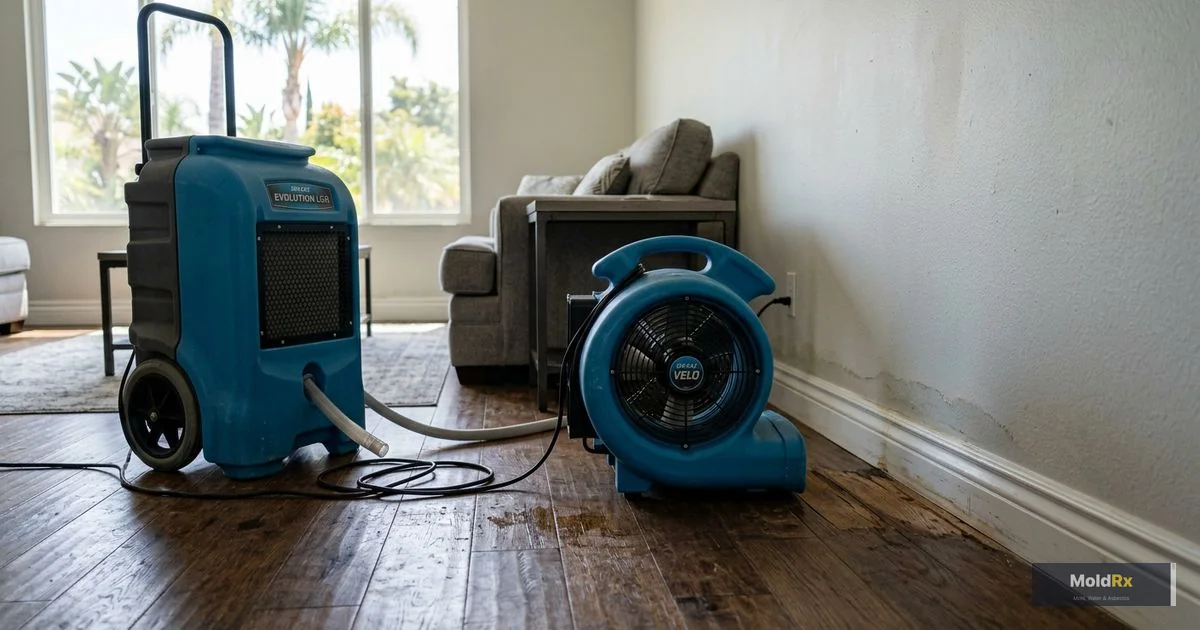
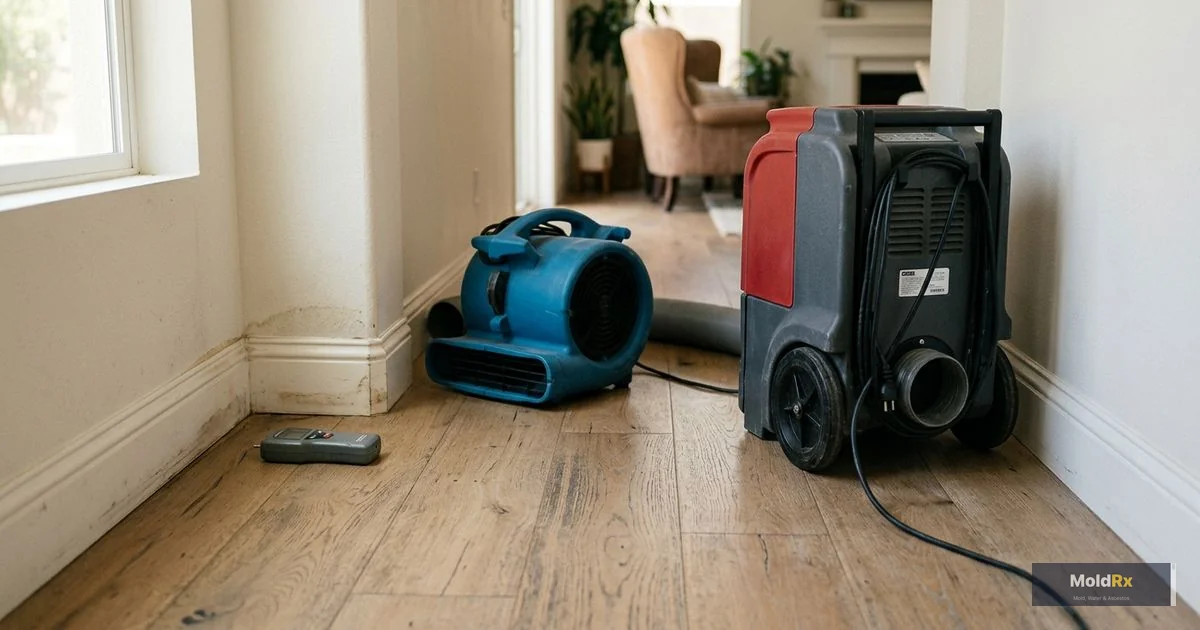
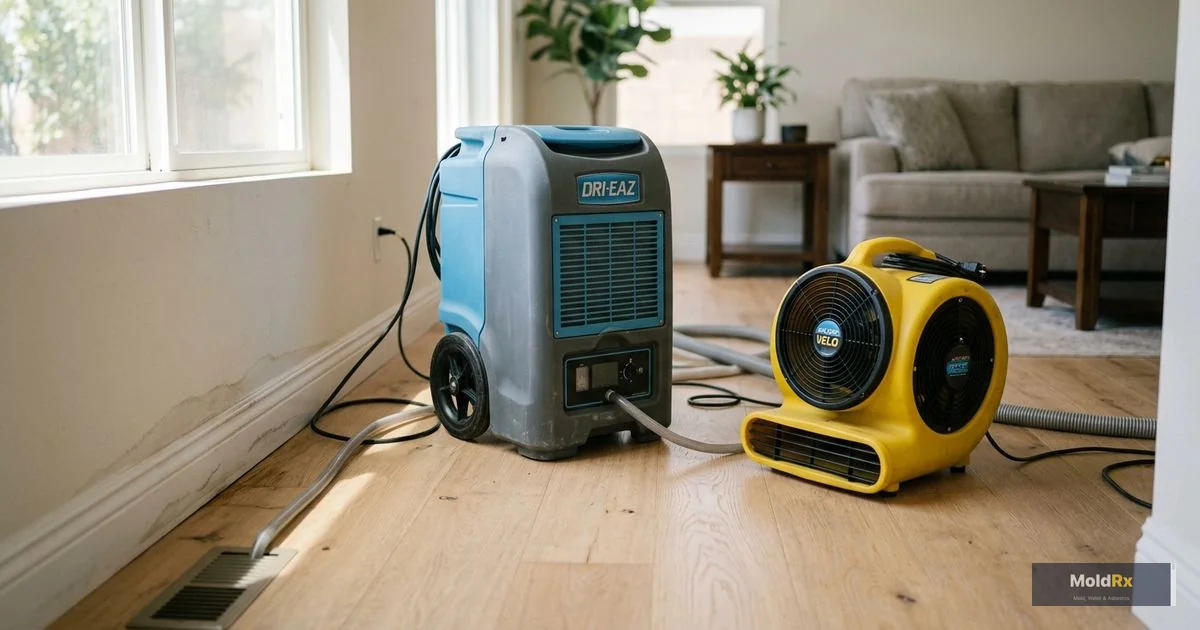
After extraction, the critical drying phase begins. Industrial air movers create high-velocity airflow across wet surfaces, while commercial dehumidifiers capture moisture from the air and from within materials. Equipment placement is calculated — not random — based on the specific materials affected, the layout of the structure, and the measured moisture levels at multiple points.
Stanton's ambient humidity demands more aggressive dehumidification than what would be needed in drier inland communities. The equipment must overcome not just the water that was introduced by the damage event, but the persistent moisture in the surrounding air that resists drying. Moisture readings are taken daily at established measurement points, and equipment configurations are adjusted as conditions change.
Drying timelines in Stanton typically run 3 to 5 days for contained incidents and 7 to 10 days for more extensive damage. Mobile homes, with their thinner wall and floor assemblies, may dry faster in some areas but can present challenges in subfloor and framing assemblies where moisture becomes trapped.
Phase 4: Cleaning, Sanitization, and Material Removal
Once instrument-verified drying is complete, affected surfaces are cleaned and treated with antimicrobial solutions to eliminate any microbial activity that may have initiated during the wet period. For Category 2 and Category 3 events, all contaminated porous materials — carpet, pad, lower drywall sections, insulation — are removed and disposed of according to protocol.
Phase 5: Restoration and Reconstruction
Damaged materials are replaced and the property is returned to pre-loss condition. In Stanton's older homes, this phase may include upgraded materials — for example, replacing original drywall removed during restoration with moisture-resistant alternatives, or installing new flooring with improved moisture barriers. The goal is not just restoration to the way things were, but restoration that makes the structure more resilient to future water events.
What Every Stanton Homeowner Needs to Know About Hidden Damage
In Stanton's vintage housing stock, the most dangerous water damage is the damage you cannot see. Slab leaks that have been running for weeks beneath the foundation. Pinhole pipe leaks inside walls that are wicking moisture into framing and insulation. Slow roof leaks from deteriorated flashing that drip into attic spaces during every rain event.
These hidden water sources create the perfect conditions for mold growth — sustained moisture in warm, enclosed spaces with abundant organic material (wood framing, drywall paper, insulation) to feed on. By the time visible signs appear — staining, warping, musty odors, or respiratory symptoms among occupants — the problem has often been developing for weeks or months.
If you have noticed any of these warning signs in your Stanton home, the situation is already more advanced than it appears. Immediate professional assessment — including moisture mapping and potentially mold testing — is critical to understanding the true scope of what you are dealing with.
What to Expect When You Work With Us
-
Honest, Direct Assessment: We tell you exactly what we find — even if the damage is less extensive than you feared. If it is more extensive than what is visible (common in Stanton's older homes and mobile homes), we explain precisely what is happening, where the moisture is, and what needs to happen to resolve it. No inflated scope. No unnecessary services.
-
Clear Communication at Every Stage: Restoration equipment is loud and disruptive. Parts of your home will be inaccessible. In Stanton's compact homes, this disruption is felt everywhere. We keep you informed about what is happening, why each step matters, and when you can expect normal access to resume.
-
Complete Insurance Documentation: Our restoration professionals document every phase — photographs, moisture readings with timestamps and locations, material inventories, and detailed work reports. This documentation is specifically structured to support homeowner's insurance claims and reduce processing friction.
-
Mold Prevention as the Primary Objective: In Stanton's humidity, mold prevention is not a secondary benefit of water damage restoration — it is the entire point. Every decision about extraction speed, equipment deployment, drying duration, and antimicrobial treatment is made with mold prevention as the overriding priority.
Stanton Areas We Serve
Our vetted water damage restoration professionals serve all of Stanton, including neighborhoods along Beach Boulevard, Katella Avenue, Cerritos Avenue, Dale Street, and Western Avenue. We respond to emergencies throughout the 90680 ZIP code, covering all residential areas including single-family neighborhoods, apartment complexes, and mobile home communities throughout the city.
We also serve neighboring communities including Cypress to the west, Anaheim to the north, Garden Grove to the east, and Westminster to the south. Whether your property is a single-family home near Stanton Central Park, a unit in one of the city's many apartment complexes along Beach Boulevard, a mobile home, or a commercial property, we have the expertise and equipment to handle your water damage emergency.
Related Services in Stanton
In addition to water damage restoration, we also offer Mold Removal in Stanton, Asbestos Removal in Stanton, Mold Testing in Stanton, and Asbestos Testing in Stanton services to Stanton property owners.
→ Learn more about remediation services in Stanton
Frequently Asked Questions
How quickly should I address water damage in Stanton?
Immediately. Every hour that water sits in your Stanton home, it is penetrating deeper into building materials and moving closer to the mold colonization threshold. In Orange County's humidity — averaging 60 to 70 percent — mold can begin growing within 24 hours of sustained moisture exposure. Stanton's older building materials, including original drywall, wood framing, and the lighter-gauge assemblies in mobile homes, are especially hospitable to mold growth. If you have active water damage right now, call now.
What are the most common causes of water damage in Stanton?
The most common cause is plumbing failure from aged-out systems — galvanized pipe corrosion, copper slab leaks, and polybutylene pipe bursts are endemic in Stanton's 1950s-1970s housing stock. Water heater failures are extremely common, as many Stanton homes still have original or decades-old units. Appliance supply line failures from washing machines and dishwashers are the second most frequent cause. Storm-related intrusion during the November-through-March rainy season — including poor drainage pooling against foundations and overwhelmed gutter systems — affects both conventional homes and mobile home communities. In mobile homes specifically, subfloor moisture accumulation from failing plumbing connections or drainage problems beneath the structure is a significant and often-overlooked risk.
Will my insurance cover water damage restoration in Stanton?
Most homeowner's insurance policies cover sudden and accidental water damage — a pipe burst, an appliance failure, or a water heater rupture. Gradual damage from slow leaks, flooding from rising water or storm surge, and damage from deferred maintenance are typically excluded without additional coverage. Mobile home owners should verify their specific policy terms, as coverage can vary from standard homeowner's policies. We document everything — photographs, moisture readings, work reports — to support your claim.
How much does water damage restoration cost in Stanton?
Costs depend on the water category, the square footage affected, the materials involved, and critically, how quickly restoration begins. What remains true across every scenario is that cost increases with delay. A water event addressed within the first 12 hours is nearly always less expensive than the same event addressed after 48 hours, and dramatically less expensive than one that has progressed to mold growth. Contact us to discuss your specific situation.
How long does water damage restoration take in Stanton?
Contained incidents — a single appliance failure or small pipe break — typically take 3 to 5 days from extraction through drying verification. Moderate damage involving multiple rooms or significant subfloor involvement may take 7 to 10 days. Severe events involving Category 3 water, structural saturation, or concurrent mold remediation can extend to 2 weeks or longer. Mobile home restorations may have different timelines depending on the structure type and access considerations. We provide a realistic timeline after assessment.
Can water-damaged materials in my Stanton home be saved?
Many materials can be saved if professional restoration begins within 24 hours of a clean water event — hardwood floors, drywall, and carpet can often be dried and preserved. However, Stanton's older building materials may respond differently than modern construction: original plaster may not tolerate prolonged moisture, older hardwood subfloors can warp irreversibly if saturation exceeds their recovery threshold, and mobile home wall and floor assemblies have limited tolerance for moisture exposure. Materials exposed to Category 2 or Category 3 water, or any porous materials wet for more than 48 hours, typically cannot be salvaged. Our assessment tells you exactly what can be saved and what must be replaced.
Are mobile homes at higher risk for water damage than traditional homes?
Yes. Mobile homes face higher water damage risk due to lighter-gauge plumbing systems with shorter lifespans, thinner wall and floor assemblies that moisture penetrates faster, foundation configurations that can trap water beneath the structure, and in many cases, original infrastructure that is the same age as surrounding conventional homes but less robust. Mobile home owners in Stanton should be especially vigilant about signs of water damage — unexplained moisture, musty odors, soft spots in flooring, and unexpected increases in water bills.
Your Stanton Home Is Losing Ground Right Now
Water does not wait for you to figure out your next step. It is moving through your walls. It is saturating your subfloor. It is creating the exact conditions that mold needs to colonize — and in Stanton's humidity, that colonization clock is running faster than you think.
Stanton's housing stock was built in a single generation, and that generation's plumbing is failing across the city. The galvanized pipes, the copper supply lines, the polybutylene connections, the aging water heaters — they are all reaching the end of their engineered lifespan at the same time. If your home has not yet experienced a water damage event, it is a matter of when, not if. If it is happening right now, the only question is whether you act fast enough to keep it from becoming something far worse and far more expensive.
MoldRx coordinates with vetted water damage restoration professionals who understand Stanton — the uniform age of its housing stock, the specific plumbing materials used during the construction era, the mobile home complexities, the flat-terrain drainage challenges, and the humidity-driven mold timelines that make speed the most critical factor in every restoration.
If water is in your Stanton home right now, call MoldRx immediately. Hours matter. Do not wait.