Asbestos Testing in Seal Beach, CA — MoldRx
Vetted Asbestos Testing Specialists Serving Seal Beach and Northwestern Orange County
Seal Beach is one of those Orange County communities where the charm comes directly from its age. Old Town cottages dating to the 1920s and rebuilt after the devastating 1933 Long Beach earthquake. Mid-century ranch homes on the Hill built between 1957 and 1962. And Leisure World — nearly 6,600 cooperative apartments and condominiums constructed by the Rossmoor Corporation from 1960 to 1981, housing roughly 9,600 residents over 55. Every one of these eras falls squarely within the decades when asbestos was standard practice in American construction.
If you own property in Seal Beach, or you are buying one, or you are about to renovate one, asbestos testing is not a suggestion. It is the only responsible first step. Professional testing by vetted specialists using NVLAP-accredited laboratories gives you definitive answers about what is in your building materials — and those answers determine everything that comes next.
Need to know what is in your Seal Beach property before work begins? Request a free estimate or call (888) 609-8907 to connect with a vetted asbestos testing specialist who understands the construction eras and materials found across every Seal Beach neighborhood.
Why Seal Beach Properties Need Asbestos Testing
Seal Beach has a population of approximately 25,000 across ZIP codes 90740 and 90743, and its housing stock reads like a timeline of asbestos-era construction. Understanding why that matters requires understanding the city's development, neighborhood by neighborhood.
Old Town: 1920s Through the 1960s
The area that became Old Town Seal Beach started as Anaheim Landing in the 1860s, a modest port settlement that gradually evolved into a beachside community. The original lots were carved from a "tent city" grid — 25-square-foot parcels that still define Old Town's characteristically small lot sizes today. Much of the early development was severely damaged by the 1933 Long Beach earthquake, and the neighborhood was rebuilt over the following decades.
What stands today in Old Town is a mix of homes dating from the 1930s through the 1960s. That range is significant because it covers the full arc of asbestos use in residential construction. Homes from the 1930s and 1940s may contain asbestos in pipe insulation, boiler components, original plaster, and exterior siding. Homes from the 1950s and 1960s frequently have asbestos in floor tiles (especially the classic 9x9-inch vinyl tiles), popcorn ceilings, joint compound, roofing materials, and the mastic adhesive used to bond flooring to subfloors. Old Town homeowners who have renovated know that peeling back one layer often reveals another — and each layer could contain asbestos.
The Hill: Late 1950s to Early 1960s
The Hill neighborhood gets its name from the gently sloping terrain where developers built tract homes between 1957 and 1962. These were originally modest single-story ranch-style homes on lots of 5,000 to 7,000 square feet. Over the decades, many have been expanded, renovated, or rebuilt entirely into custom two-story homes.
The original construction date puts every unrenovated component of a Hill home in the highest-risk window for asbestos content. Textured ceilings, vinyl floor tiles, pipe wrapping, HVAC duct tape, joint compound, and exterior stucco from this period all have a strong probability of containing asbestos. If you have bought a Hill home that still has its original popcorn ceiling or 1960s-era kitchen floor, you should assume those materials contain asbestos until NVLAP-accredited lab testing proves otherwise.
Homeowners on the Hill who are remodeling — adding second stories, opening up floor plans, or upgrading kitchens and bathrooms — face the highest risk of disturbing asbestos-containing materials. These are exactly the kinds of projects where testing before demolition is not just recommended — it is required under SCAQMD Rule 1403 and Cal/OSHA Section 1529.
Leisure World: 1960 to 1981
Leisure World is the single largest concentration of asbestos-era construction in Seal Beach, and possibly in all of northwestern Orange County. The Rossmoor Corporation broke ground in mid-1961, and the first residents moved in on June 8, 1962. Construction continued for another two decades across 16 cooperative mutuals and a 17th condominium mutual completed in 1982. The development incorporated designer Cliff May's innovative California Ranch residential concept, using extensive prefabrication techniques, post-and-beam construction, slab floors, and floor-to-ceiling windows.
Every building phase within Leisure World falls within the peak years of asbestos use. The 6,608 units — one- and two-bedroom apartments and condos — were built with the same materials used in residential construction nationally during that period: textured (popcorn) ceilings, vinyl floor tiles, pipe and duct insulation, joint compounds, and roofing materials that commonly contained asbestos. The community's all-electric original design also means many units have electrical panel backing boards and wiring components from an era when asbestos-containing materials were used for fire resistance in electrical enclosures.
Why Leisure World deserves special attention for asbestos testing:
-
Scale: With 6,608 units built across two decades of peak asbestos use, the sheer volume of potentially affected homes is enormous. Testing is not a one-off concern here — it is a community-wide consideration every time a unit changes hands, undergoes renovation, or requires maintenance.
-
Resident vulnerability: Leisure World is a 55-and-older community with a median resident age well above that threshold. This matters because nearly 80 percent of mesothelioma cases — the cancer caused by asbestos exposure — occur in people 65 years or older. People 65 and older have more than 44 times the risk of mesothelioma compared to those 45 and younger. Seniors are more vulnerable to asbestos-related illness because immune function declines with age, reducing the body's ability to clear inhaled fibers. Additionally, many Leisure World residents may have had prior asbestos exposure decades ago through occupational or environmental contact, and new exposure compounds existing risk. The latency period for mesothelioma ranges from 20 to 60 years, which means exposure that occurred in the 1960s and 1970s could be manifesting as illness right now. Adding new exposure on top of past exposure is a serious concern. (See the dedicated FAQ below for more on elderly asbestos risk.)
-
Unit turnover and renovation: As units change owners, new buyers frequently want to update kitchens, bathrooms, and flooring. Leisure World's mutual associations have their own rules about renovations, but the underlying California and federal requirements for asbestos testing before demolition or renovation apply regardless. Every unit renovation that disturbs original building materials needs to start with testing.
-
Maintenance and repairs: Even routine repairs — fixing a leaking pipe, replacing damaged ceiling tiles, upgrading insulation — can disturb asbestos-containing materials in units of this era. Maintenance staff and contractors working in Leisure World should be aware that any material installed before 1981 could contain asbestos and must be tested before disturbance under OSHA 1926.1101 and Cal/OSHA Section 1529.
College Park West and East: Mid-1960s to 1970
College Park West was developed in 1964. College Park East was started in 1965 and completed in 1970, built on land that had previously been part of the Bixby Rancho. Both neighborhoods were constructed during years when asbestos was still standard in residential building materials. Floor tiles, ceiling textures, pipe insulation, joint compound, and roofing components from this era are all candidates for asbestos content.
Bridgeport and Surfside Colony
Bridgeport sits south of Pacific Coast Highway, a neighborhood of beach-accessible homes. Surfside Colony, originally founded in 1929, contains an eclectic mix of original mid-century cottages and newer rebuilt homes. Any structure or component in these areas that dates to before 1980 should be tested before disturbance.
Naval Weapons Station Seal Beach
The Naval Weapons Station was commissioned in 1944 during World War II and has operated continuously since. While most of the station's facilities are federal property, residential and commercial properties in the areas surrounding the base were developed alongside it throughout the 1940s, 1950s, and 1960s. These properties carry the same asbestos risk profile as other homes of that era.
Asbestos in Seal Beach Homes: What You Are Actually Looking For
Asbestos was not a single product — it was an ingredient in hundreds of building materials. In a typical Seal Beach home built between the 1930s and 1980, you might find asbestos in any of the following:
-
Popcorn ceilings (acoustic texture): Extremely common in homes built from the 1950s through the early 1980s. These textured coatings could contain 1 to 10 percent asbestos. Scraping, sanding, or removing popcorn ceilings without testing first is one of the most common ways homeowners unknowingly release asbestos fibers.
-
Vinyl floor tiles: The classic 9x9-inch floor tiles manufactured between 1920 and 1980 frequently contained asbestos. The mastic adhesive used to bond them to the subfloor often contained asbestos as well. Pulling up old flooring without testing is a serious mistake.
-
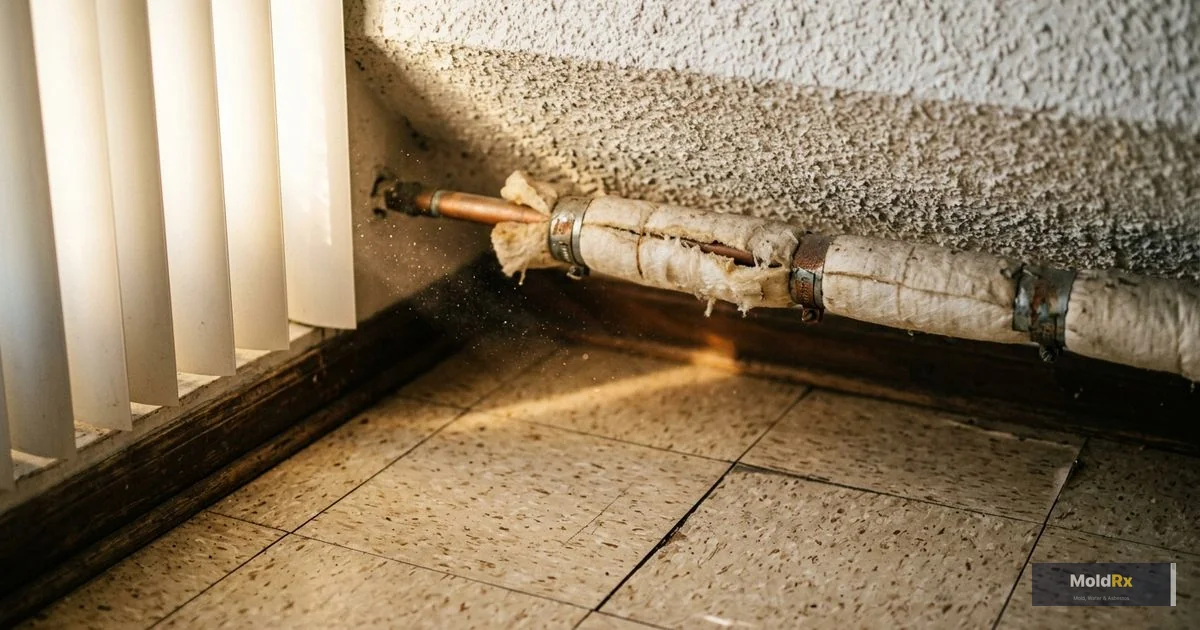
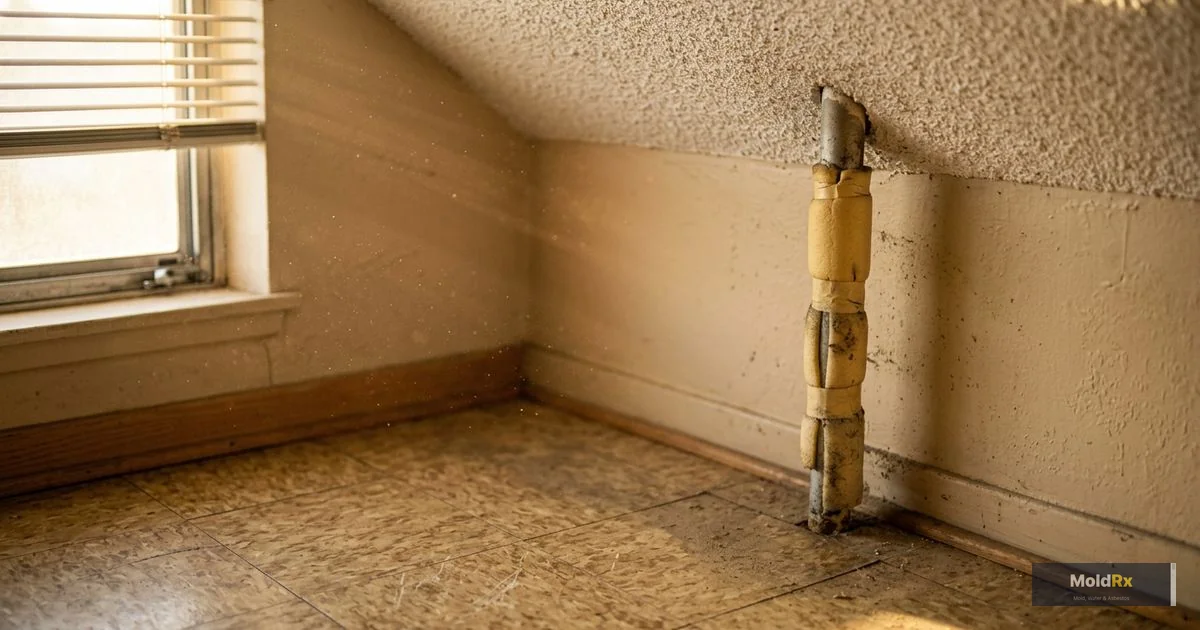
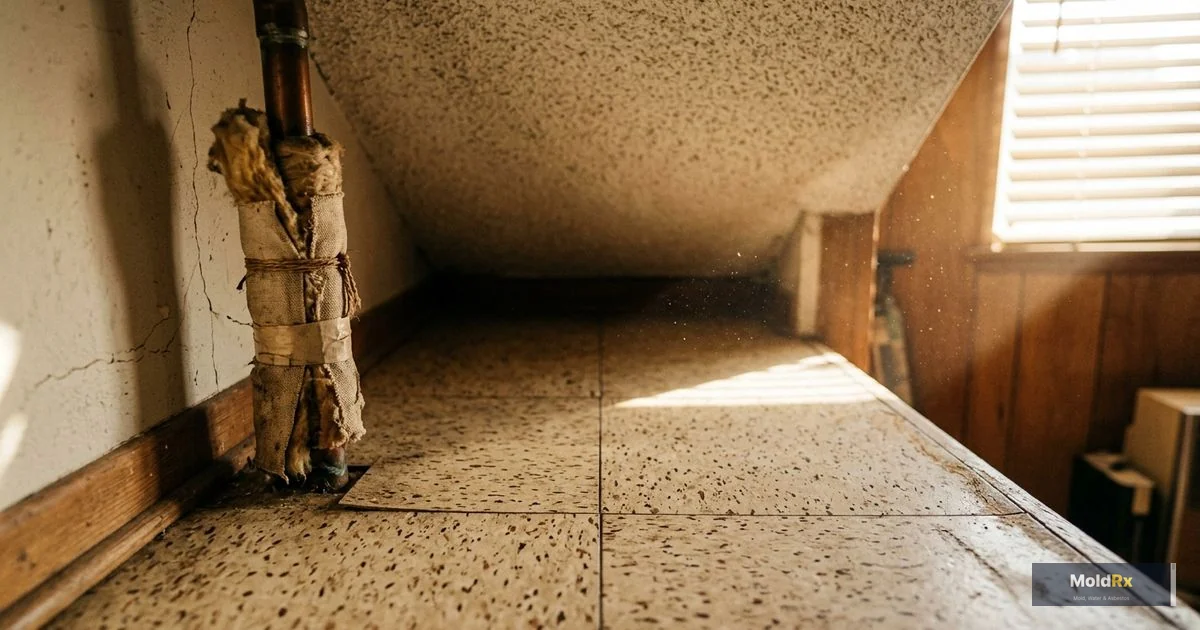
Pipe and duct insulation: Piping and HVAC ductwork in pre-1980 homes were commonly wrapped in asbestos-containing insulation. This material is often found in attics, crawl spaces, and utility closets.
-
Joint compound and plaster: The compounds used to finish drywall seams and patch plaster walls frequently contained asbestos through the 1970s. This means even wall surfaces can be an asbestos source.
-
Roofing materials: Asbestos cement shingles, felt underlayment, and roof coatings were all common. Seal Beach's coastal weather means roofing materials take a beating from salt air and UV exposure, making deterioration — and potential fiber release — a concern during re-roofing projects.
-
Exterior siding and stucco: Cement-asbestos siding was widely used on homes built from the 1920s through the 1970s. It looks like rigid cement board and was valued for its fire resistance and durability.
-
Vermiculite attic insulation: Loose-fill vermiculite insulation — the granular material that looks like pebbles — was commonly contaminated with tremolite asbestos. Approximately 70 percent of vermiculite sold in the U.S. between 1923 and 1990 came from the Libby, Montana mine, which was contaminated.
-
Electrical components: Panel backing boards, wire insulation, and components designed for fire resistance in electrical systems sometimes contained asbestos. This is particularly relevant in Leisure World's all-electric units.
-
Window glazing and caulking: Putty and caulk compounds used to seal windows in pre-1980 homes often contained asbestos fibers.
The key point: you cannot identify asbestos by looking at it. Materials that contain asbestos look identical to materials that do not. The only way to know is NVLAP-accredited laboratory analysis of a physical sample using PLM or TEM methods.
The Regulatory Framework: What Seal Beach Property Owners Must Know
Seal Beach falls within the jurisdiction of several overlapping asbestos regulations at the federal, state, and regional level. Here is the complete regulatory picture.
SCAQMD Rule 1403
The South Coast Air Quality Management District (SCAQMD) Rule 1403 governs asbestos emissions from demolition and renovation activities. This is not optional — it is a legal requirement with real consequences.
- Asbestos surveys are mandatory before any demolition or renovation, regardless of the building's age or the size of the project. The survey must be conducted by a Cal/OSHA-certified inspector or a professional holding an unexpired AHERA Building Inspector certificate from a Cal/OSHA-approved course.
- A written notification must be submitted to SCAQMD at least 10 working days before demolition or renovation work begins on projects involving regulated asbestos-containing materials. All notifications must be submitted through SCAQMD's online application. A copy must also be provided to the City of Seal Beach permitting department before a demolition or renovation permit will be issued.
- Violations carry fines upward of $20,000 per day, and negligence resulting in bodily or environmental harm can trigger criminal penalties under both SCAQMD and EPA regulations.
For Leisure World residents and mutual boards, this means that any renovation project — whether initiated by an individual unit owner or by the mutual itself — needs to include asbestos testing as part of the planning process. This applies to common area maintenance and unit-specific renovations alike.
Federal OSHA Standard 1926.1101
OSHA's Asbestos Standard for Construction (29 CFR 1926.1101) establishes four classes of asbestos work, sets permissible exposure limits at 0.1 fibers per cubic centimeter over an 8-hour workday and 1.0 fiber per cubic centimeter over any 30-minute period, and requires building owners to identify the presence, location, and quantity of asbestos-containing materials before renovation or demolition. A designated competent person with specific asbestos training must be present on every covered jobsite.
Cal/OSHA Section 1529
California's Title 8 CCR Section 1529 applies to all construction work where asbestos is present — demolition, salvage, removal, encapsulation, alteration, repair, maintenance, and renovation. Cal/OSHA defines asbestos-containing material (ACM) as anything exceeding 1 percent asbestos, and asbestos-containing construction material (ACCM) as anything exceeding one-tenth of 1 percent by weight. Contractors performing asbestos work involving 100 square feet or more must register with the Division of Occupational Safety and Health (DOSH), and all workers must complete AHERA-approved initial and annual refresher training courses.
AHERA Training and Inspection Standards
The Asbestos Hazard Emergency Response Act (AHERA), enacted in 1986, established the nationally recognized training and accreditation standards for asbestos inspectors and consultants. Inspectors holding current AHERA Building Inspector certification follow standardized protocols for sample collection, documentation, and analysis that courts, regulators, and NVLAP-accredited laboratories recognize as authoritative. All asbestos surveys conducted for Seal Beach properties should be performed by AHERA-certified professionals.
CSLB C-22 License
When asbestos is confirmed and removal is necessary, California requires the work be performed by a contractor holding a CSLB C-22 Asbestos Abatement license. The C-22 classification requires four years of documented asbestos abatement experience, passage of a specialized trade examination, and active DOSH registration. This ensures any contractor removing asbestos from your Seal Beach home — whether in Old Town, on the Hill, or in a Leisure World mutual — has demonstrated competence in containment, removal, and proper disposal.
Our Asbestos Testing Process in Seal Beach
Getting your Seal Beach property tested is straightforward. Here is what happens.
1. Initial Assessment
A vetted asbestos professional evaluates your property to identify suspect materials. In Seal Beach homes, this typically includes checking textured ceilings, vinyl floor tiles, pipe and duct insulation, joint compound, roofing materials, siding, and electrical components. The inspector holds current AHERA certification and will discuss your renovation plans or concerns so the assessment focuses on what matters most for your situation.
2. Sample Collection
Small samples are carefully collected following EPA and Cal/OSHA Section 1529 protocols. The goal is minimal disturbance — we are not tearing anything apart. Materials are wetted before cutting to prevent fiber release, barriers prevent fiber spread, and protective equipment is used throughout. Each sample is documented with its exact location, sealed, and labeled for chain-of-custody tracking. For a typical Seal Beach home, we may collect samples from multiple materials and locations to give you a complete picture.
3. NVLAP-Accredited Lab Analysis
All samples are sent to a laboratory accredited under the National Voluntary Laboratory Accreditation Program (NVLAP), administered by the National Institute of Standards and Technology (NIST). NVLAP accreditation ensures the laboratory meets ISO/IEC 17025 standards and has demonstrated competence through rigorous proficiency testing — conducted biannually for PLM and annually for TEM. Analysis methods include:
- Polarized Light Microscopy (PLM) — The standard method for most bulk building material samples. Identifies asbestos fibers by their optical properties, determines fiber type (chrysotile, amosite, crocidolite, or others), and measures concentration.
- Transmission Electron Microscopy (TEM) — Provides magnification thousands of times greater than PLM for precise identification at the individual fiber level. Used when PLM results are inconclusive or for tightly bound materials like vinyl floor tiles.
Materials at or above 1 percent asbestos are classified as asbestos-containing under OSHA 1926.1101, Cal/OSHA Section 1529, and SCAQMD Rule 1403. Results typically arrive within 3 to 5 business days.
4. Results and Guidance
You receive a clear, detailed report explaining what was found and where. If asbestos is detected, we explain your realistic options: leaving undisturbed materials in place with monitoring, encapsulation to seal fibers in, or professional removal by a CSLB C-22 licensed contractor before your renovation proceeds. If no asbestos is found, you have NVLAP-accredited documentation to move forward with confidence.
What to Expect
-
No Guesswork: Visual inspection cannot confirm or rule out asbestos. Only NVLAP-accredited lab testing using PLM or TEM provides definitive answers. That is exactly what you will get.
-
Clear Communication: You will understand what was tested, why, and what the results mean for your specific situation. If certain materials do not need testing, we will tell you that too — MoldRx only sends vetted professionals, and we are not here to run up sample counts.
-
Honest Recommendations: If asbestos is found, we explain the actual risk level based on material condition and your plans. Sometimes the right answer is to leave materials alone. Sometimes encapsulation makes sense. Sometimes removal by a CSLB C-22 licensed contractor is necessary. You will get a straight answer either way.
-
Proper Documentation: Every test produces documentation suitable for real estate transactions, building permits, contractor coordination, SCAQMD Rule 1403 compliance, and mutual association requirements. For Leisure World properties, this documentation is often needed for both the buyer/seller and the mutual board.
-
Reasonable Timeline: On-site sample collection typically takes one to two hours. NVLAP-accredited lab results arrive within 3 to 5 business days, with rush processing available for time-sensitive situations.
A Note for Leisure World Residents and Buyers
If you are purchasing a unit in Leisure World, asbestos testing should be part of your due diligence. California's Real Estate Transfer Disclosure Statement requires sellers of residential property to disclose known hazards, and for buildings constructed before 1979, the California Health and Safety Code mandates specific disclosure of asbestos-containing materials. But disclosure only covers what the seller knows. If no testing has been done, the seller may have nothing to disclose — and that does not mean there is nothing there.
Standard home inspections do not include asbestos testing. Most home inspection contracts explicitly state that they will not report on the presence or absence of asbestos. If you want to know whether the unit you are buying has asbestos in its ceiling texture, floor tiles, or pipe insulation, you need to request a separate asbestos inspection by an AHERA-certified inspector with samples analyzed at a NVLAP-accredited laboratory.
For current Leisure World residents, testing makes sense before any renovation project, before selling your unit (to avoid surprises during the buyer's inspection), or if you have noticed deteriorating materials like crumbling ceiling texture or cracking floor tiles.
Given the age demographics of the community and the documented vulnerability of older adults to asbestos-related disease — adults 65 and older account for more than 80 percent of mesothelioma diagnoses — erring on the side of testing is especially prudent here. The cost of a professional asbestos survey is trivial compared to the health risk of unknowing exposure.
Seal Beach Areas We Serve
Our vetted asbestos testing professionals serve all Seal Beach neighborhoods and communities, including Old Town, the Hill, Bridgeport, College Park East, College Park West, Leisure World (all mutuals, 1 through 17), and the Surfside Colony area. We cover both ZIP codes: 90740 and 90743.
We also serve nearby communities including Sunset Beach, Los Alamitos, Rossmoor, Huntington Beach to the south and east, and Long Beach to the north and west. Whether your property is a 1940s Old Town cottage, a 1960s Hill ranch home, a Leisure World cooperative unit, or a College Park family home, we are familiar with the construction styles, materials, and eras typical to this area.
Related Services in Seal Beach
In addition to asbestos testing, we also offer Mold Removal in Seal Beach, Asbestos Removal in Seal Beach, Water Damage Restoration in Seal Beach, and Mold Testing in Seal Beach services to Seal Beach property owners.
→ Learn more about remediation services in Seal Beach
Frequently Asked Questions
How do I get asbestos testing in Seal Beach?
Contact MoldRx by calling (888) 609-8907 or requesting a free estimate online. We will discuss your property, its age, and your plans, then connect you with a vetted asbestos testing specialist who serves Seal Beach. The specialist holds current AHERA certification, follows EPA and Cal/OSHA protocols for sample collection, and sends all samples to a NVLAP-accredited laboratory for PLM or TEM analysis. You receive a detailed report within three to five business days.
When is asbestos testing required in Seal Beach?
Under SCAQMD Rule 1403, an asbestos survey is required before any demolition or renovation that might disturb building materials — regardless of the building's age. Under Cal/OSHA Section 1529 and federal OSHA 1926.1101, asbestos-containing materials must be identified before construction work begins. Beyond the legal requirement, testing is strongly recommended before purchasing older properties, if you notice deteriorating materials (crumbling ceiling texture, cracking floor tiles, damaged pipe insulation), or before any work on a pre-1980 home. For Leisure World units, testing is particularly important before any renovation and during real estate transactions.
What materials in my Seal Beach home should be tested for asbestos?
The most common asbestos-containing materials in Seal Beach homes include popcorn ceilings, 9x9-inch vinyl floor tiles and their mastic adhesive, pipe and duct insulation, joint compound, textured wall coatings, roofing shingles and felt, exterior cement siding, vermiculite attic insulation, electrical panel backing boards, and window glazing compounds. In homes built before 1980, assume any original building material could contain asbestos until NVLAP-accredited laboratory testing using PLM or TEM proves otherwise.
How are asbestos samples collected safely?
AHERA-certified asbestos professionals wet the material to prevent fiber release, collect small samples using specialized tools, and immediately seal them in labeled containers for chain-of-custody tracking to the laboratory. The area is cleaned after sampling to prevent any residual contamination. Improper sample collection can release dangerous fibers into your living space — this is not a do-it-yourself job. California law requires that samples be collected by a Licensed Asbestos Consultant (CAC) or a Certified Site Surveillance Technician working under a CAC's direction.
What happens if asbestos is found in my Seal Beach home?
Finding asbestos does not automatically mean removal is required. Intact, undisturbed asbestos-containing materials in good condition often pose minimal risk and can be managed in place through a maintenance and monitoring plan. If materials are damaged, friable, or in the path of planned renovation, professional abatement by a CSLB C-22 licensed California contractor is required under Cal/OSHA Section 1529. Our report explains your specific options — monitoring, encapsulation, or removal — based on material condition, location, and your plans for the space. If you are not renovating and the material is in good shape, leaving it alone is often the safest and most cost-effective approach.
Is asbestos testing required before selling a Leisure World unit?
California law requires sellers of residential property to disclose known hazards, including asbestos, through the Real Estate Transfer Disclosure Statement. For buildings constructed before 1979 — which includes all Leisure World mutuals built before that date — the California Health and Safety Code mandates specific declaration of asbestos-containing materials. While testing is not technically required before listing, it is strongly recommended. Having a clean asbestos report from a NVLAP-accredited laboratory — or knowing about and disclosing any issues upfront — prevents surprises during the buyer's inspection that could delay or derail a sale.
Are elderly residents more at risk from asbestos exposure?
Yes — significantly so, and this is directly relevant to Leisure World and Seal Beach's broader senior population. Seniors face higher risk from asbestos exposure for several documented reasons.
First, immune function declines with age, which may reduce the body's ability to clear inhaled asbestos fibers and repair the cellular damage they cause. Second, many older adults had occupational or environmental asbestos exposure earlier in life — through military service, manufacturing, construction, or simply living in buildings with deteriorating asbestos materials — and additional exposure compounds that existing risk. Third, the latency period for mesothelioma ranges from 20 to 60 years, meaning past exposure may already be developing toward illness, and new exposure worsens the outlook.
The statistics are stark: nearly 80 percent of mesothelioma diagnoses occur in people 65 or older, with the median age at diagnosis being 78 years. People 65 and older face more than 44 times the mesothelioma risk compared to those 45 and younger. Adults 80 and older represent the single largest diagnostic group.
For Leisure World residents and seniors throughout Seal Beach, these numbers make the case clearly: minimizing any new asbestos exposure through professional testing, proper management of confirmed materials, and CSLB C-22 licensed abatement when removal is necessary is not an excess of caution. It is a basic health protection for a population that is disproportionately affected by this disease.
How long does the testing process take?
On-site sample collection typically takes one to two hours for a standard Seal Beach residential property or Leisure World unit. NVLAP-accredited laboratory results arrive within 3 to 5 business days, with rush processing available for time-sensitive situations like real estate closings, permit deadlines, or urgent renovation timelines.
Get Asbestos Testing in Seal Beach
Seal Beach's housing stock — from Old Town's pre-war cottages to the Hill's mid-century ranch homes to Leisure World's 6,600 cooperative units to the family homes of College Park — represents decades of construction during the era when asbestos was woven into nearly every building material on the market. The community's large senior population adds urgency to what is already a serious health concern, given that adults 65 and older account for the vast majority of mesothelioma diagnoses.
Whether you are a Leisure World resident planning a kitchen update, an Old Town homeowner restoring a 1940s bungalow, a College Park family remodeling before school starts, or a buyer conducting due diligence on any Seal Beach property, asbestos testing is the straightforward step that protects your health and keeps your project compliant with SCAQMD Rule 1403, Cal/OSHA Section 1529, and federal OSHA 1926.1101.
MoldRx only sends vetted asbestos testing professionals who know Seal Beach homes. They understand the construction eras, the common materials, the regulatory requirements, and the specific considerations that come with Leisure World's mutual structure. You will get honest answers about what is in your property and clear guidance on what comes next — backed by NVLAP-accredited laboratory results and AHERA-certified inspection protocols.
Request your free estimate today or call (888) 609-8907 to schedule asbestos testing for your Seal Beach property.