Asbestos Testing in San Juan Capistrano, CA — MoldRx
Vetted Asbestos Testing Specialists Serving San Juan Capistrano and South Orange County
San Juan Capistrano is one of the most historically layered communities in all of Southern California. The Los Rios Historic District contains the oldest continuously occupied residential street in the state, with adobe structures dating to 1794 and more than 40 homes spanning multiple centuries of California architecture. The city's first modern housing tract was completed in the early 1950s, and the decades that followed brought wave after wave of ranch homes, equestrian estates, and suburban developments through the 1960s, 1970s, and 1980s. That building timeline puts a large share of San Juan Capistrano's housing stock squarely within the era when asbestos was a standard ingredient in residential construction materials.
If you own a home here and you are thinking about a renovation, a purchase, or a sale, the question is not whether asbestos might be present. The question is where it is, what condition it is in, and what that means for whatever you are planning to do next. Professional asbestos testing — performed by vetted specialists using NVLAP-accredited laboratories — answers all three.
Ready to get answers before you start your project? Request a free estimate or call (888) 609-8907 to speak with a vetted asbestos testing specialist who understands San Juan Capistrano's unique building history.
Why San Juan Capistrano Properties Need Asbestos Testing
A Building History Shaped by Explosive Mid-Century Growth
San Juan Capistrano's population tells the story of its construction boom. In 1960, the city had roughly 1,120 residents. By 1980, that number had climbed to nearly 19,000. Today the population sits near 37,000 across approximately 12,000 housing units. That explosive mid-century growth means thousands of homes were built during the decades when asbestos was considered an ideal building material — cheap, fireproof, and remarkably durable.
The city was incorporated in 1961, right as suburban development was accelerating across South Orange County. Neighborhoods like Mission Hills, San Juan Hills, and the areas along Ortega Highway filled with single-story ranch homes and split-level designs throughout the 1960s and 1970s. The Forster Ranch and Capistrano Valley areas saw additional development into the early 1980s. The median construction year for San Juan Capistrano homes is 1979, which means half of the city's housing stock was built before that date — during the peak years of asbestos use in residential construction.
Many of these homes are now 45 to 65 years old, and a significant number still contain original building materials from their initial construction. The semi-arid climate that makes South Orange County so livable also preserves building materials that would have deteriorated and been replaced in wetter or colder regions. That preservation is simultaneously good news and a reason for caution.
What Asbestos Is and Why It Was Used
Asbestos is a naturally occurring mineral fiber that was mined and processed for commercial use throughout most of the twentieth century. Manufacturers added it to hundreds of residential products because of three properties that made it seem like a wonder material: it resisted heat and flame, it added structural strength to otherwise fragile products, and it was inexpensive to source.
Between the 1940s and late 1970s, asbestos appeared in virtually every category of building material. It was mixed into cement, woven into insulation, pressed into floor tiles, stirred into joint compound, and sprayed onto ceilings as textured coating. Chrysotile — white asbestos — accounted for roughly 95 percent of the asbestos used in American buildings, though amosite (brown asbestos) and crocidolite (blue asbestos) also appeared in certain products.
The danger was not recognized widely until medical research in the 1960s and 1970s linked asbestos fiber inhalation to serious diseases. The EPA began issuing bans and restrictions in the late 1970s, but existing stock continued to be installed into the early 1980s and sometimes beyond. California banned asbestos in new construction in 1977, but materials already manufactured and sitting in supply warehouses were still being used for years afterward.
Where Asbestos Hides in San Juan Capistrano Homes
In a typical pre-1980 San Juan Capistrano home, asbestos-containing materials may be present in any of the following locations:
- Popcorn ceilings and textured ceiling coatings — Spray-applied acoustic ceiling texture was one of the most common uses. Homes built or remodeled between 1950 and 1980 frequently have this material, which can contain 1 to 10 percent chrysotile asbestos.
- Vinyl floor tiles and sheet flooring — Standard 9-inch and 12-inch vinyl floor tiles from this era often contained asbestos, as did the adhesive (mastic) used to bond them to the subfloor. The black mastic is frequently one of the most asbestos-rich materials found in older homes.
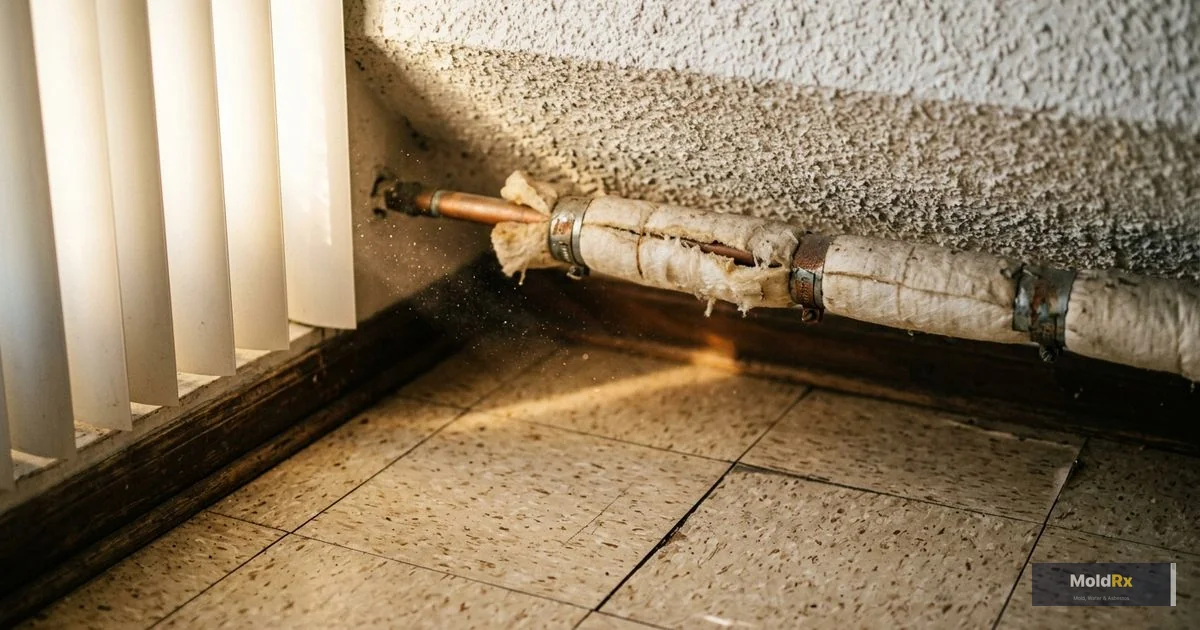
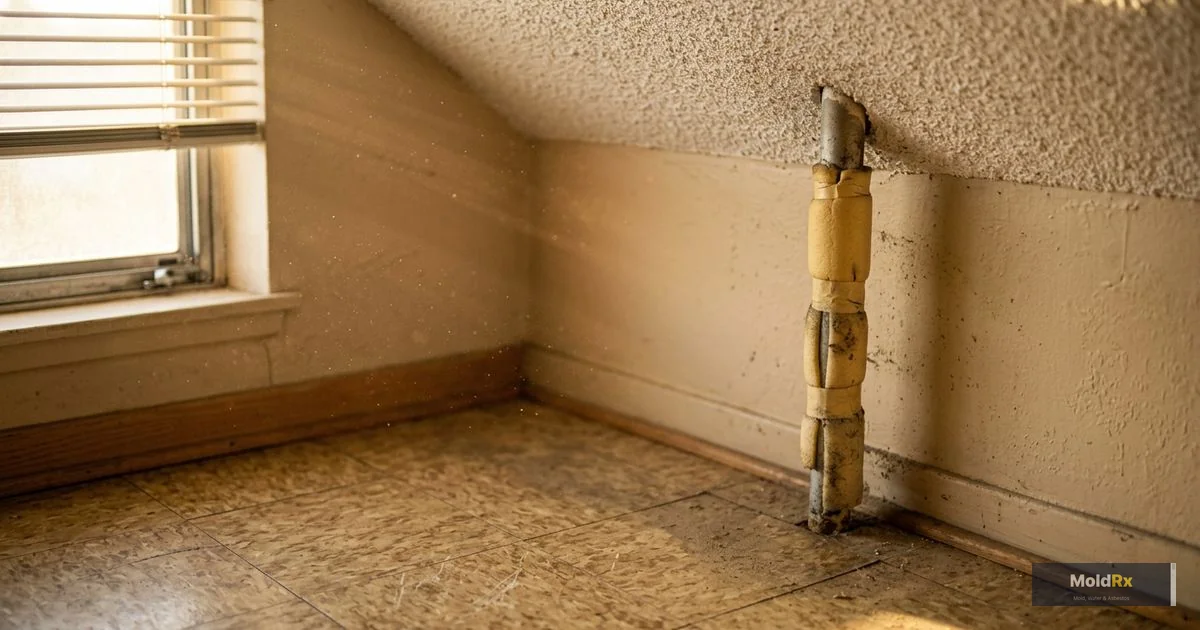
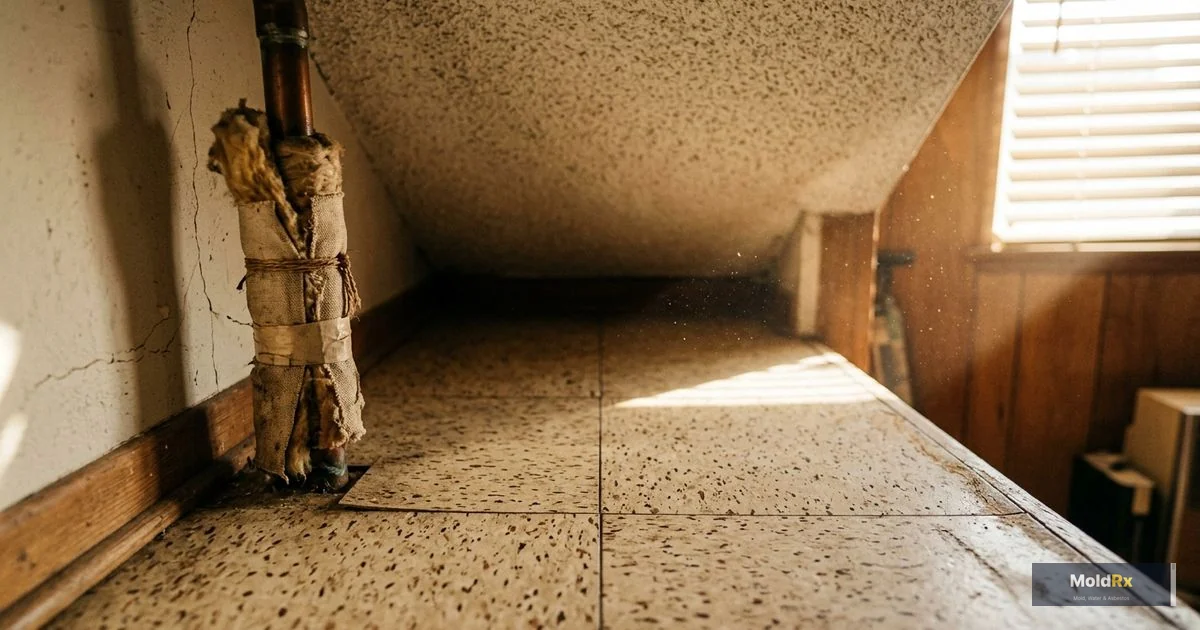
- Pipe insulation and boiler wrapping — Asbestos blankets and corrugated paper were wrapped around hot-water pipes, furnace ducts, and heating equipment.
- Joint compound and drywall tape — The mud used to finish drywall seams often contained asbestos fibers for added strength and workability.
- Roofing shingles and felt — Asbestos-cement roofing products were extremely common in Southern California ranch-style construction.
- Exterior siding and cement panels — Fiber-cement siding boards frequently contained asbestos for weather resistance and durability.
- Decorative wall paneling — Wood-grain and brick-patterned panels popular in 1960s and 1970s family rooms were often manufactured with asbestos fiber.
- Vermiculite attic insulation — Loose-fill vermiculite insulation, particularly the Zonolite brand sourced from the Libby, Montana mine, was frequently contaminated with tremolite asbestos. Approximately 70 percent of vermiculite sold in the U.S. between 1923 and 1990 came from that contaminated source.
- HVAC duct connectors and tape — Flexible connectors and sealing tape on older ductwork systems may contain asbestos.
- Window glazing and caulking — Putty and caulk compounds used to seal windows in pre-1980 homes often contained asbestos fibers.
The Climate Factor
San Juan Capistrano's semi-arid Mediterranean climate — summer highs in the mid-80s, mild winters, and only about 14 inches of annual rainfall — has a preservation effect on building materials. Homes here do not experience the freeze-thaw cycling that degrades materials in colder regions, and the low humidity reduces the kind of moisture damage that forces material replacement. The result is that many pre-1980 homes in San Juan Capistrano still have their original ceiling texture, original floor tiles, and original pipe insulation intact after half a century or more.
That is simultaneously good news and a reason for caution. The materials are not crumbling on their own, but they remain in place waiting to be disturbed by the next renovation project. And because Santa Ana winds can push dry, hot air through older structures, any asbestos-containing materials that have already begun to deteriorate may release fibers into indoor air without visible warning.
When Asbestos Becomes Dangerous
Asbestos materials in good condition generally do not pose an immediate health threat. The risk emerges when those materials are disturbed — cut, drilled, sanded, scraped, broken, or demolished. When that happens, microscopic fibers become airborne and can be inhaled deep into the lungs, where they may remain permanently lodged. Individual fibers are up to 700 times thinner than a human hair and invisible to the naked eye.
Prolonged or repeated exposure to asbestos fibers is linked to three serious conditions:
- Asbestosis — A chronic inflammatory condition of the lungs that causes progressive scarring, shortness of breath, and permanent reduction in lung function. There is no cure.
- Mesothelioma — A rare and aggressive cancer of the lining of the lungs, abdomen, or heart, with a latency period that can span 20 to 50 years after initial exposure. Median survival after diagnosis is 12 to 21 months.
- Lung cancer — Asbestos exposure significantly increases the risk of developing lung cancer, particularly in combination with smoking.
Research indicates that more than 60 percent of homeowners undertaking DIY renovations on older properties have been exposed to asbestos fibers without realizing it. Even brief, concentrated exposure during a weekend demolition project can introduce a health risk that does not manifest for decades. There is no safe level of asbestos exposure according to OSHA and the EPA.
Asbestos in San Juan Capistrano's Historic Properties
San Juan Capistrano has a density of historic and older properties that is unusual for Orange County. The Los Rios Historic District alone contains more than 40 homes, including three original adobe structures, and multiple buildings listed on the National Register of Historic Places. While the original 18th- and 19th-century adobe and board-and-batten structures in that district predate the asbestos era, many of them received maintenance, repairs, and additions during the mid-twentieth century using materials that were standard for the time — and those materials often contained asbestos.
Beyond Los Rios, the broader downtown area, Mission Hills, and neighborhoods adjacent to Mission San Juan Capistrano include homes and commercial structures dating from the 1930s through the 1970s. Some of these properties have been designated as local historic landmarks or fall within overlay zones that impose additional requirements for any exterior modifications.
If you own or are purchasing a historic property in San Juan Capistrano, asbestos testing serves a dual purpose. It protects your health and safety, and it provides the documentation needed to plan renovation work that satisfies both health regulations and historic preservation requirements. Understanding which materials contain asbestos before you begin allows you to coordinate with preservation authorities and abatement professionals simultaneously, avoiding costly surprises mid-project.
The Regulatory Framework: What San Juan Capistrano Property Owners Must Know
Asbestos testing and abatement in San Juan Capistrano is governed by an overlapping set of federal, state, and regional regulations. Understanding these requirements is important because non-compliance can result in significant fines, project shutdowns, and — most critically — preventable health exposure. Here is the regulatory framework that applies to your property.
SCAQMD Rule 1403
San Juan Capistrano falls within the jurisdiction of the South Coast Air Quality Management District (SCAQMD), and all renovation and demolition projects are subject to Rule 1403 — Asbestos Emissions from Demolition/Renovation Activities.
Rule 1403 requires:
- Asbestos survey before renovation or demolition. An asbestos survey report signed by a qualified asbestos consultant must be completed before work begins. This applies regardless of the building's size or age.
- Notification to SCAQMD. If more than 100 square feet of asbestos-containing material (greater than 1.0 percent asbestos) will be disturbed, an electronic notification must be submitted to SCAQMD at least 10 working days before work starts.
- All demolitions require notification. Even if no asbestos is expected, all full demolitions require SCAQMD notification to allow inspection and confirmation that no asbestos is present. Since November 2016, all Rule 1403 notifications must be submitted through SCAQMD's web-based application.
- Licensed abatement for removal. Asbestos-containing materials must be removed by licensed professionals using approved containment and disposal methods before general demolition can proceed.
The only narrow exception is renovation of a single-family dwelling involving less than 100 square feet of intact, undamaged material. Even in that scenario, professional testing is strongly recommended because there is no way to confirm asbestos content by visual inspection alone. Failure to comply with Rule 1403 can result in fines upward of $20,000 per day.
Federal OSHA Standard 1926.1101
The federal OSHA Asbestos Standard for Construction (29 CFR 1926.1101) classifies asbestos work into four classes based on the type and risk level of the activity. It establishes permissible exposure limits (PEL) of 0.1 fibers per cubic centimeter averaged over an 8-hour workday and an excursion limit of 1.0 fiber per cubic centimeter over any 30-minute period. The standard requires a designated competent person on every jobsite where asbestos-containing materials may be disturbed, and it mandates that building owners identify the presence, location, and quantity of asbestos-containing materials before any renovation or demolition work begins.
Cal/OSHA Section 1529
California's state-level asbestos standard, Title 8 CCR Section 1529, mirrors and in some areas exceeds the federal OSHA standard. Cal/OSHA Section 1529 applies to all construction work — demolition, salvage, removal, encapsulation, alteration, repair, maintenance, and renovation — where asbestos is present. It defines asbestos-containing material as anything with more than 1 percent asbestos, and asbestos-containing construction material (ACCM) as anything exceeding one-tenth of 1 percent asbestos by weight. Contractors performing asbestos work involving 100 square feet or more must register with the Division of Occupational Safety and Health (DOSH), and all workers must complete AHERA-approved training courses.
AHERA Training and Inspection Standards
The Asbestos Hazard Emergency Response Act (AHERA), enacted in 1986, established the training and accreditation standards for asbestos inspectors and consultants nationwide. While AHERA was originally focused on schools, its training and methodology standards have become the benchmark for all building inspections. Asbestos surveys conducted by inspectors holding current AHERA Building Inspector certification follow standardized protocols for sample collection, documentation, and analysis that courts, regulators, and laboratories recognize as authoritative.
CSLB C-22 License
When asbestos is confirmed and removal is necessary, California requires that the work be performed by a contractor holding a CSLB C-22 Asbestos Abatement license. The C-22 classification requires a minimum of four years of asbestos abatement experience, passage of a specialized trade examination, and active registration with DOSH. This ensures that anyone removing asbestos from your San Juan Capistrano home has demonstrated competence in containment, removal, and disposal procedures.
Our Asbestos Testing Process in San Juan Capistrano
1. Initial Consultation
When you contact MoldRx, we start by discussing your property — its approximate age, construction style, what you are planning to do, and which areas of the home will be affected. If you are renovating a 1968 ranch home near San Juan Hills, testing is almost certainly needed. If you are updating a home built in 2005 in one of the newer developments, we will tell you that testing is probably unnecessary. Honest assessment from the first conversation.
2. On-Site Inspection
A vetted asbestos testing specialist visits your property and conducts a systematic visual assessment. We examine construction methods, identify material types, and note the condition of suspect materials. In San Juan Capistrano, we pay particular attention to the building patterns and material choices common across different construction eras — the 1950s stucco and tile homes near the Mission area have different risk profiles than the 1970s tract homes in Capistrano Valley or the equestrian properties along Ortega Highway. The inspector holds current AHERA Building Inspector certification and follows EPA sampling protocols.
3. Sample Collection
Following EPA and Cal/OSHA Section 1529 protocols, we carefully collect small samples from each type of suspect material in the areas that will be disturbed. The process is methodical: materials are wetted to prevent fiber release, small sections are extracted using specialized tools, and each sample is sealed in a labeled container with its precise location documented for chain-of-custody tracking. We take enough samples to give you and your contractors a complete picture, but we do not over-sample areas that will not be affected by your project.
4. NVLAP-Accredited Laboratory Analysis
All samples are sent to a laboratory accredited under the National Voluntary Laboratory Accreditation Program (NVLAP), administered by the National Institute of Standards and Technology (NIST). NVLAP accreditation means the laboratory has demonstrated technical competence through rigorous proficiency testing conducted biannually for PLM and annually for TEM analysis. The two primary methods used are:
- Polarized Light Microscopy (PLM) — Identifies asbestos fibers by their optical properties under specialized lighting. This is the standard method for most bulk building material samples and determines both fiber type and concentration.
- Transmission Electron Microscopy (TEM) — Provides higher magnification and more precise identification at the individual fiber level. Used when PLM results are inconclusive or when analyzing materials like floor tiles where fibers may be tightly bound in a matrix.
Laboratory analysis determines not only whether asbestos is present, but the specific type of asbestos (chrysotile, amosite, crocidolite, or others) and its concentration in the material. Materials at or above 1 percent asbestos are classified as asbestos-containing under both OSHA and SCAQMD regulations.
5. Results, Report, and Guidance
You receive a detailed written report that includes the location of every sample taken, the laboratory findings for each sample, the type and concentration of any asbestos identified, and the assessed condition of each material. Beyond the raw data, we explain what the results mean in practical terms.
Not every positive finding requires the same response. Materials in good condition that will not be disturbed during your project may be safely managed in place with periodic monitoring. Materials that are damaged, deteriorating, or located in areas where renovation work will occur typically require professional abatement by a CSLB C-22 licensed contractor before work proceeds. We lay out your options clearly so you can make informed decisions — not so we can generate a follow-up project.
What to Expect
-
Honest Assessment: If testing is not necessary for your situation, we will say so. If certain areas of your home clearly fall outside the asbestos era based on construction records, we will not recommend unnecessary sampling.
-
Clear Communication: No jargon, no scare tactics. You will understand what was tested, what was found, and what it means for your specific plans. We explain results in plain language.
-
Actionable Documentation: Your report is suitable for contractor coordination, City of San Juan Capistrano permit applications, SCAQMD Rule 1403 compliance documentation, real estate transactions, and your own records.
-
Realistic Timelines: Sample collection typically takes one to three hours depending on the property size and scope. Laboratory results arrive within three to five business days, with rush processing available when deadlines require it.
-
Next-Step Guidance: If asbestos is confirmed, we explain the options based on your project scope — monitoring, encapsulation, or professional abatement by a CSLB C-22 licensed contractor. You will know which situations require licensed removal and which allow for alternative management approaches.
San Juan Capistrano Areas We Serve
Our vetted asbestos testing specialists serve all San Juan Capistrano neighborhoods and ZIP codes 92675 and 92693. We are familiar with the construction eras and building patterns across every part of the city, including:
- Downtown and Los Rios — Historic district properties with mixed-era construction and potential mid-century maintenance materials
- Mission Hills and Mission area — Mid-century homes near Mission San Juan Capistrano
- San Juan Hills and Ortega Highway corridor — Equestrian properties, ranch homes, and custom estates from the 1960s through 1980s
- Forster Ranch and Capistrano Valley — 1970s and 1980s tract developments
- Marbella and Marbella Country Club — Custom homes from the late 1980s and 1990s
- Hidden Mountain and Rancho Capistrano — Hillside custom homes on larger lots
- Los Corrales — Equestrian-oriented large-lot properties
We also serve neighboring South Orange County communities including Dana Point to the south, Laguna Niguel and Mission Viejo to the north, and San Clemente along the coast. Whether your property is a 1950s cottage near the train depot or a sprawling equestrian estate along the Ortega corridor, we understand what materials were commonly used and where to look.
Related Services in San Juan Capistrano
In addition to asbestos testing, we also offer Mold Removal in San Juan Capistrano, Asbestos Removal in San Juan Capistrano, Water Damage Restoration in San Juan Capistrano, and Mold Testing in San Juan Capistrano services to San Juan Capistrano property owners.
→ Learn more about remediation services in San Juan Capistrano
Frequently Asked Questions
How do I get asbestos testing in San Juan Capistrano?
Contact MoldRx by calling (888) 609-8907 or requesting a free estimate online. We will discuss your property, its age, and your project scope, then connect you with a vetted asbestos testing specialist who serves San Juan Capistrano. The specialist will schedule an on-site inspection, collect samples following EPA and Cal/OSHA protocols, and send them to a NVLAP-accredited laboratory for PLM or TEM analysis. You receive a detailed report within three to five business days.
When is asbestos testing required in San Juan Capistrano?
Under SCAQMD Rule 1403, an asbestos survey is required before any renovation or demolition project regardless of building age. Under Cal/OSHA Section 1529, employers and contractors must identify asbestos-containing materials before work that could disturb them begins. Testing is also strongly recommended before purchasing older properties, if you notice damaged or deteriorating building materials, or before any work that will disturb walls, ceilings, floors, or insulation in a home built before 1980. Even for single-family homes where the regulatory exception for small projects may apply, testing is the only way to confirm whether materials are safe to disturb.
What materials should be tested for asbestos?
In pre-1980 San Juan Capistrano homes, the most common asbestos-containing materials include popcorn ceilings and textured coatings, vinyl floor tiles and mastic adhesive, pipe and duct insulation, joint compound, roofing shingles, exterior siding, vermiculite attic insulation, and window glazing compounds. Decorative wall paneling from the 1960s and 1970s is another frequently overlooked material. The safest approach is to assume any material in a pre-1980 home might contain asbestos until NVLAP-accredited laboratory testing proves otherwise.
Can I collect asbestos samples myself?
This is not recommended. Improper sampling techniques can release asbestos fibers into your living space, creating the exact health hazard you are trying to identify. Professional sample collection involves wetting materials, using specialized cutting tools, maintaining containment, and following EPA and AHERA protocols designed to minimize fiber release. Under California law, asbestos samples should be collected by a Licensed or Certified Asbestos Consultant (CAC) or a Certified Site Surveillance Technician working under a CAC's direction. The few dollars saved by DIY sampling are not worth the exposure risk or the possibility of inaccurate results from improperly collected samples.
How are asbestos samples analyzed in the laboratory?
NVLAP-accredited laboratories use Polarized Light Microscopy (PLM) as the standard method for identifying asbestos fibers in bulk building material samples. PLM identifies asbestos by its distinctive optical properties under specialized lighting conditions and determines both fiber type and concentration. For materials where fibers are tightly bound — such as vinyl floor tiles — or when PLM results are inconclusive, Transmission Electron Microscopy (TEM) provides higher-magnification analysis at the individual fiber level. Both methods identify the specific type of asbestos present (chrysotile, amosite, crocidolite, or others) and its concentration. Materials at or above 1 percent asbestos are regulated under OSHA 1926.1101, Cal/OSHA Section 1529, and SCAQMD Rule 1403.
What happens if asbestos is found in my San Juan Capistrano home?
Finding asbestos does not automatically mean removal is necessary. The appropriate response depends on the material's condition, its location, and your plans for the property. Intact materials in good condition that will not be disturbed can often be managed in place through periodic monitoring. Materials that are damaged, deteriorating, or located in areas where renovation work is planned typically require professional abatement by a contractor holding a CSLB C-22 Asbestos Abatement license. Our report explains your specific options clearly — monitoring, encapsulation, or removal — so you can make an informed decision.
I own a historic property in San Juan Capistrano. Does that change the testing process?
The testing process itself is the same for historic and non-historic properties — sample collection and laboratory analysis follow identical EPA and AHERA protocols. However, historic properties often present unique considerations. Structures in or near the Los Rios Historic District, properties with local landmark designations, or homes within historic overlay zones may have received repairs and additions across multiple decades using different materials. A thorough assessment accounts for these layered construction histories. Additionally, if your renovation plans are subject to review by the city's Cultural Heritage Commission or must comply with preservation standards, having asbestos testing documentation in hand before that review process begins helps you plan work that satisfies both health regulations and preservation requirements simultaneously.
How long do asbestos test results take?
Standard laboratory turnaround is three to five business days from the time samples arrive at the NVLAP-accredited lab. Rush processing is available when project timelines, real estate closing dates, or permit deadlines require faster results. We will discuss turnaround options during your initial consultation so you can plan accordingly.
Get Asbestos Testing in San Juan Capistrano
San Juan Capistrano's building history spans more than two centuries, but the decades that matter most for asbestos risk are the 1940s through the early 1980s — exactly the period when much of the city's residential housing stock was constructed. Whether you are renovating a mid-century ranch home near the Mission, updating an equestrian property along Ortega Highway, purchasing a home in Forster Ranch, or maintaining a historic structure in the downtown area, knowing what is in your building materials before work begins protects your health and keeps your project on the right side of California regulations.
You cannot identify asbestos by looking at it. That textured ceiling might be harmless calcium carbonate, or it might release thousands of microscopic fibers the moment a scraper touches it. The floor tiles in your kitchen might be standard vinyl, or they might contain chrysotile asbestos locked in a matrix that becomes dangerous only when the tiles are cracked or pulled up. The only way to know with certainty is professional laboratory testing at a NVLAP-accredited facility using PLM or TEM analysis.
MoldRx only sends vetted asbestos testing specialists — professionals who understand the specific construction patterns found across San Juan Capistrano's diverse neighborhoods and eras, follow EPA and AHERA protocols, and provide clear, honest guidance based on what they actually find. No scare tactics. No unnecessary recommendations. Just accurate information so you can make informed decisions.
Request your free estimate today or call (888) 609-8907 to schedule asbestos testing for your San Juan Capistrano property.