Emergency Water Damage Restoration in San Jacinto, CA — MoldRx
24/7 Water Damage Restoration Specialists Serving San Jacinto and the San Jacinto Valley
Water does not wait. It does not negotiate. And in San Jacinto, it moves with a speed and force that most homeowners do not anticipate until they are standing in it. A burst supply line at 3 AM. A water heater that gives way after fifteen years of quiet service. Mountain runoff that overwhelms a drainage channel and pushes floodwater into your garage, your living room, your crawlspace. Whatever the source, the damage timeline is the same: within 24 hours, moisture begins saturating structural materials. Within 48 hours, mold colonization starts. Within 72 hours, what could have been a targeted extraction becomes a full-scale restoration project involving drywall demolition, subfloor removal, and thousands of additional dollars in damage.
If water has entered your San Jacinto home or business, stop reading and call MoldRx now. Every hour you wait compounds the damage exponentially.
Why San Jacinto Faces Extreme Water Damage Risk
San Jacinto sits at approximately 1,500 feet elevation at the base of the San Jacinto Mountains — one of the most dramatic vertical rises in the contiguous United States, climbing from roughly 800 feet to over 10,800 feet in under seven miles. That geographical reality is not just scenic. It is a water damage engine. When storms hit the San Jacinto range, massive volumes of rainfall and snowmelt funnel downslope through Bautista Creek and the San Jacinto River channel, converging directly on the valley floor where over 55,000 residents live.
This is not theoretical risk. On February 21, 1980, a section of the San Jacinto River Levee immediately downstream of the Bautista Creek junction collapsed under an estimated flow of 25,000 cubic feet per second. The torrent ripped through a mobile home park and flooded portions of the city, leaving floodwaters several feet deep and causing extensive damage. That flood was part of a broader event that killed at least ten people across western Riverside County and caused over $70 million in property damage — in 1980 dollars. Adjusted for inflation, that figure exceeds $270 million today.
San Jacinto's flood infrastructure has improved since 1980, but the underlying risk factors have not changed. The mountains still funnel water into this valley. The San Jacinto River still runs through the heart of the community. And the housing stock has aged considerably.
The Housing Stock Problem
San Jacinto's residential landscape spans multiple construction eras, and each one brings distinct water damage vulnerabilities:
1950s-1970s homes dominate established neighborhoods like San Jacinto Heights, Soboba Springs, and downtown San Jacinto. These properties are now 50 to 75 years old, with galvanized steel or early copper plumbing systems that have long exceeded their expected service life. Cast iron drain lines in homes from this era corrode from the inside out, developing pinhole leaks and full-line failures that can dump hundreds of gallons into wall cavities and subfloor assemblies before anyone notices. Many of these homes sit on raised foundations with crawlspaces — spaces that trap moisture, encourage wood rot, and create ideal conditions for mold growth when water enters.
Mobile and manufactured homes represent a significant portion of San Jacinto's housing inventory, including multiple manufactured home parks and age-restricted communities like Blue Fountain and Valley Sunrise. These structures are especially vulnerable to water damage because of their lightweight construction materials, particle board subflooring that disintegrates on contact with water, and supply line connections that loosen over time due to thermal expansion and contraction in the desert heat. A supply line failure in a manufactured home can destroy flooring throughout the entire structure in under an hour.
1990s-2010s tract homes in newer developments feature slab-on-grade foundations, copper supply lines, and stucco exteriors. While more modern, these homes are now reaching the 15 to 30-year mark where builder-grade water heaters, dishwasher supply hoses, washing machine connections, and toilet fill valves begin failing. Slab leaks are endemic in this construction era — copper lines embedded in concrete shift as the region's expansive clay soils heave and contract between wet and dry seasons, eventually developing pinhole leaks that can run undetected for weeks, saturating the slab and wicking moisture up through flooring.
Climate: The Hidden Amplifier
San Jacinto's semi-arid Mediterranean climate creates a dangerous paradox for water damage. With summer temperatures regularly hitting the mid-90s to low 100s and annual rainfall averaging only 12 to 14 inches, homeowners develop a false sense of security. Water damage feels like someone else's problem.
Then the rainy season arrives. From November through March, concentrated storms can drop inches of rain in hours. The hard-baked, clay-heavy soil — dried and contracted from months of extreme heat — cannot absorb the sudden influx. Water sheets across surfaces, pools against foundations, and finds every crack, gap, and vulnerable point in a home's exterior envelope.
The December 2025 atmospheric river events that triggered a state of emergency declaration across Riverside County are a recent reminder. Governor Newsom's emergency proclamation covered Riverside County alongside L.A., Orange, San Bernardino, San Diego, and Shasta counties as atmospheric rivers brought high-intensity rainfall to already saturated soils, heightening the risk of flooding, landslides, and debris flows.
But storms are only one vector. The extreme heat that dominates most of the year accelerates the deterioration of plumbing components, dries and cracks caulking and weatherstripping, and causes thermal expansion stress on pipe joints. The most common water damage in San Jacinto is not from flooding — it is from plumbing failures inside the home, often occurring during the hottest months when water pressure fluctuates and stressed components finally give way.
The IICRC S500 Standard: Why Proper Classification Matters
Not all water damage is equal, and treating it as such is one of the most expensive mistakes a homeowner can make. The ANSI/IICRC S500 Standard — the industry authority for water damage restoration — classifies water intrusion into three categories based on contamination level:
Category 1 (Clean Water): Originates from a sanitary source — broken supply lines, sink overflows, water heater failures. Does not initially pose a health risk from contact or inhalation. However, Category 1 water left unaddressed degrades to Category 2 within 24-48 hours as it picks up contaminants from building materials, carpet backing, and dust.
Category 2 (Gray Water): Contains significant contamination — dishwasher discharge, washing machine overflow, toilet overflow with urine but no feces. Contact can cause discomfort or illness. Requires more aggressive extraction and antimicrobial treatment.
Category 3 (Black Water): Grossly contaminated water harboring pathogens, bacteria, and toxins — sewer backups, toilet overflow with fecal matter, storm floodwater that has contacted soil and debris, and any standing water that has remained stagnant long enough to support bacterial growth. All porous materials contacted by Category 3 water typically require removal and replacement. This is not optional — it is a health and safety requirement.
In San Jacinto, storm-driven flooding is automatically classified as Category 3 because floodwater contacts soil, sewage systems, agricultural runoff, and debris as it travels. This means flood-damaged homes require a fundamentally different restoration protocol than a clean supply line break — more extensive demolition, full antimicrobial treatment, and in many cases, hazardous materials handling.
Many restoration companies fail to properly categorize water damage, treating a Category 3 event with Category 1 protocols because it is faster and cheaper. The result: contaminated materials left in place, hidden microbial growth, and health problems that emerge weeks or months later. Our vetted professionals classify correctly from the start.
Our Emergency Water Damage Restoration Process
When you call MoldRx for water damage in San Jacinto, our vetted specialists deploy a systematic, standards-compliant process designed to stop the damage, eliminate the moisture, and restore your property without cutting corners.
Phase 1: Emergency Response and Water Extraction
The first hours are the most critical. Our team arrives with commercial-grade extraction equipment capable of removing thousands of gallons per hour — truck-mounted extractors, submersible pumps for standing water, and weighted extraction tools that pull water from carpet and pad without destroying the carpet itself when salvage is possible.
For San Jacinto homes with slab foundations, extraction includes checking for water migration beneath flooring materials. Water on a slab does not just sit on the surface — it wicks along the concrete, migrates under baseboards, and saturates adjacent rooms that appear dry to the naked eye. For homes with raised foundations and crawlspaces, the extraction protocol includes crawlspace access, standing water removal, and assessment of floor joists and subflooring for saturation.
The water source is identified and stopped. If the source is a plumbing failure, our team coordinates emergency plumbing repair before extraction begins — otherwise, you are removing water while more water enters.
Phase 2: Moisture Detection and Damage Mapping
What you can see is never the full picture. Water travels through wall cavities via capillary action, wicks up drywall from the bottom, saturates insulation inside walls, and pools on vapor barriers in ceiling assemblies. Our professionals use:
- Thermal imaging cameras that detect temperature differentials caused by moisture behind walls, under flooring, and in ceiling assemblies
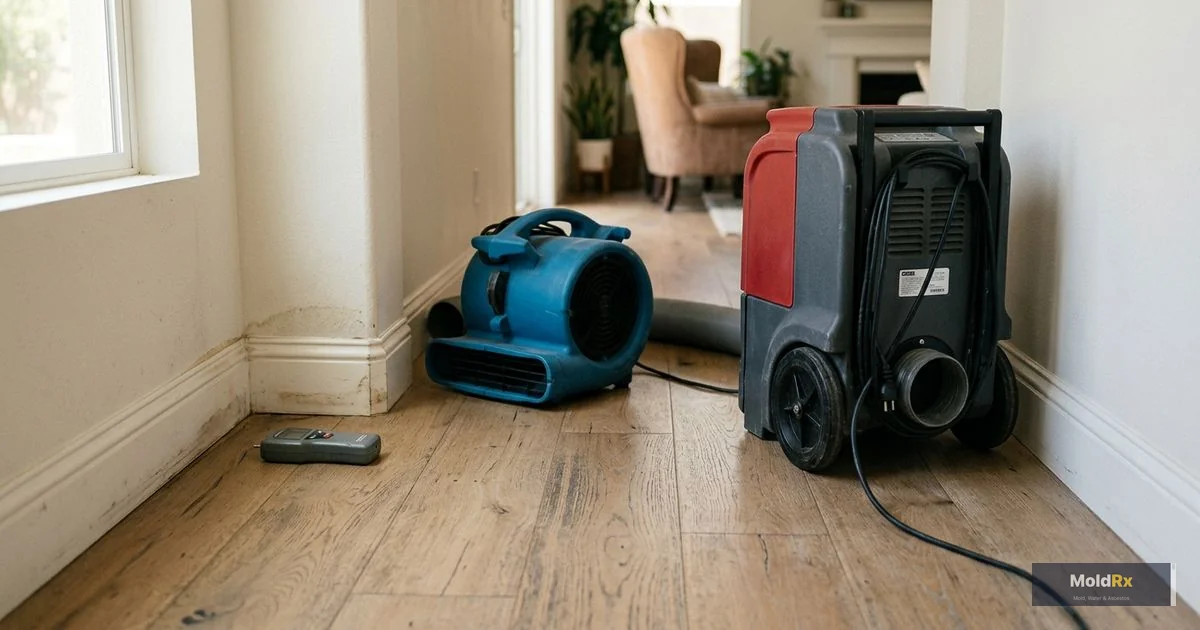
- Pin-type and pinless moisture meters that provide quantitative readings in wood, drywall, concrete, and other building materials
- Thermo-hygrometers that measure ambient temperature and relative humidity to calculate drying targets
Every affected area is mapped, documented, and photographed. This documentation serves two critical purposes: it guides the drying plan, and it provides the detailed evidence your insurance company requires to process your claim.
Phase 3: Structural Drying and Dehumidification
San Jacinto's low ambient humidity for most of the year actually aids the drying process — but only when proper equipment is deployed correctly. Our professionals position:
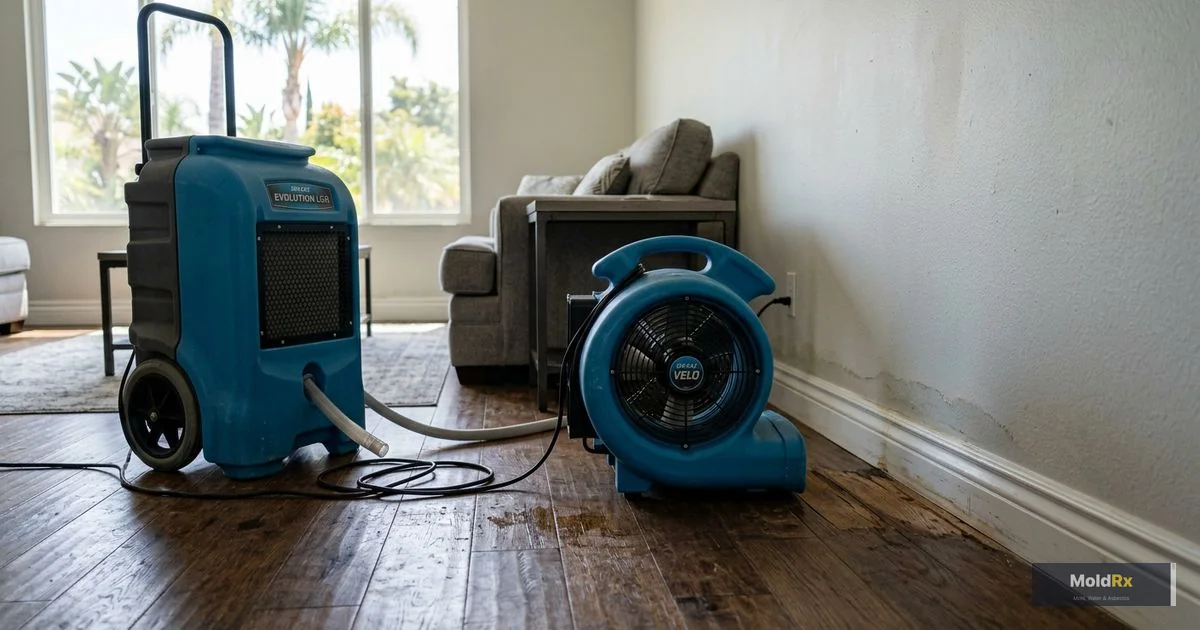
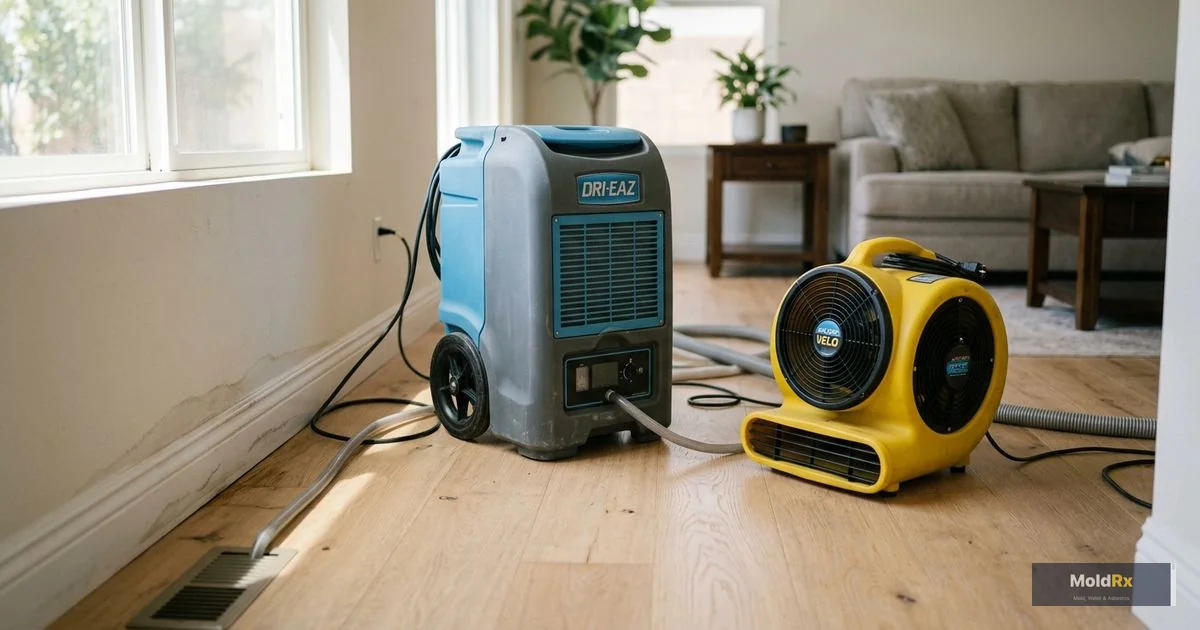
- Industrial air movers (not household fans — commercial units producing 2,500+ CFM) to create high-velocity airflow across wet surfaces
- Commercial desiccant or refrigerant dehumidifiers that pull moisture from the air as it evaporates from building materials
- Injectidry systems for wall cavities, allowing targeted drying behind intact drywall when demolition is not required
- Specialty floor drying systems for hardwood and engineered flooring, creating a sealed vacuum that draws moisture out without requiring floor removal
Daily moisture readings are taken at every monitored point. Drying is not complete when surfaces feel dry — it is complete when moisture content readings fall below the dry standard established by the IICRC S500 for each material type. Cutting this process short is the single most common cause of post-restoration mold growth.
Phase 4: Cleaning, Antimicrobial Treatment, and Air Quality
Once structural drying is verified, all affected surfaces are cleaned and treated with EPA-registered antimicrobial solutions. For Category 2 and Category 3 events, this phase includes:
- Removal and disposal of all non-salvageable porous materials (drywall, insulation, carpet pad, particleboard)
- HEPA vacuuming of all surfaces to capture particulate contamination
- Application of antimicrobial agents to structural framing, concrete, and any salvageable semi-porous materials
- Air scrubbing with HEPA filtration to remove airborne particulates and microbial spores
Phase 5: Restoration and Reconstruction
The final phase returns your home to pre-loss condition — or better. This includes replacing drywall, flooring, baseboards, cabinetry, and any other materials that were removed during the restoration process. Our vetted professionals ensure all reconstruction meets current building codes and matches existing finishes as closely as possible.
What You Should Expect From Any Water Damage Restoration Company
Not every company operating in San Jacinto meets the standard your property deserves. Here is what you should demand:
-
Immediate response. Water damage is a time-critical emergency. If a company cannot respond within hours — not days — find one that can.
-
Proper water categorization. Ask what category of water they are dealing with. If they cannot answer clearly or dismiss the question, they are not following IICRC standards.
-
Daily moisture documentation. You should receive moisture readings at every monitoring point, every day. If a company tells you the property is "dry enough" without showing you numbers, they are guessing.
-
Transparent communication. You should know exactly what is happening in your home, why each step is necessary, and how long each phase will take. No surprises. No vague timelines.
-
Insurance-grade documentation. Detailed photos, moisture maps, equipment logs, and progress reports that your insurance adjuster can use to process your claim without delays or disputes.
San Jacinto Areas We Serve
Our vetted water damage restoration specialists respond to emergencies across all San Jacinto neighborhoods and communities, including San Jacinto Heights, Soboba Springs, Park Hill, Seven Hills, downtown San Jacinto, the Soboba Casino area, manufactured home communities throughout the city, and commercial properties along Main Street and San Jacinto Avenue. We cover ZIP codes 92582, 92583, and 92581, and respond to water emergencies in neighboring Hemet to the south, Beaumont to the north, Moreno Valley to the west, and the unincorporated mountain communities to the east.
Whether your property is a 1960s ranch home with aging galvanized plumbing, a manufactured home with a supply line failure, or a newer slab-on-grade home with a hidden slab leak, our professionals understand the specific construction types and water damage scenarios common to this valley.
Related Services in San Jacinto
In addition to water damage restoration, we also offer Mold Removal in San Jacinto, Asbestos Removal in San Jacinto, Water Damage Restoration in San Jacinto, Mold Testing in San Jacinto, and Asbestos Testing in San Jacinto services to San Jacinto property owners.
Water damage and mold go hand in hand — especially in San Jacinto, where moisture driven into wall cavities during a water event can fuel hidden mold growth within days. If your property has experienced water intrusion of any kind, mold testing should be part of the restoration process, not an afterthought.
-> Learn more about remediation services in San Jacinto
Frequently Asked Questions
How quickly should I address water damage in San Jacinto?
Immediately. Not tomorrow. Not after you talk to your insurance company. Now. Within 24 hours, clean water begins degrading to gray water as it absorbs contaminants from building materials. Within 48 hours, mold spores — which are always present in the air — begin colonizing wet surfaces. Within 72 hours, mold growth can become visible and established. The difference between a $3,000 extraction and a $15,000 restoration often comes down to whether the homeowner acted in the first 12 hours or waited a day and a half. Our San Jacinto team responds to emergencies around the clock, every day of the year.
What are the most common causes of water damage in San Jacinto?
The leading causes we see in San Jacinto are slab leaks (especially in homes built on the region's expansive clay soils), water heater failures (most tank-style heaters last 8-12 years and the majority of San Jacinto homes have units older than that), supply line failures to washing machines, dishwashers, and ice makers, toilet and fixture failures, and storm-related flooding from mountain runoff and flash floods along the San Jacinto River corridor. Manufactured homes in the area are particularly vulnerable to supply line disconnections caused by thermal expansion stress.
Will my insurance cover water damage restoration in San Jacinto?
Most homeowner's insurance policies cover sudden and accidental water damage — a pipe that bursts, a water heater that fails, an appliance supply line that ruptures. What is typically not covered: gradual damage from a slow leak you knew about (or should have known about), flood damage from external sources (requires separate NFIP or private flood insurance), and damage caused by lack of maintenance. The critical factor is documentation. Our professionals provide detailed moisture readings, categorization reports, photo documentation, and daily progress logs that give your adjuster the evidence needed to process your claim without disputes. We work with insurance companies every day — we know what they need.
How long does water damage restoration take in San Jacinto?
Timeline depends on three factors: how much water, what category, and how quickly you called. A minor Category 1 supply line break caught within hours may require only 3-5 days of drying and minimal material replacement. A major Category 3 flood event with extensive structural saturation can take 2-3 weeks for complete drying, demolition of contaminated materials, antimicrobial treatment, and reconstruction. San Jacinto's low ambient humidity during dry months can actually accelerate the drying phase when proper equipment is deployed. We will give you a realistic timeline after assessment — not an optimistic guess designed to win your business.
Can water-damaged materials be saved?
It depends entirely on the material type, the water category, and how quickly restoration begins. Hardwood flooring can often be saved with specialty drying systems if addressed within 24-48 hours of a Category 1 event. Carpet can sometimes be saved if the pad is replaced and the carpet is properly extracted and treated. Drywall can be dried in place for Category 1 events if saturation has not exceeded approximately 24 inches up the wall. Beyond that height, or for any Category 2 or 3 event, removal is necessary. Insulation, carpet pad, particleboard, and any porous material contacted by Category 3 water must be removed — no exceptions. Our professionals will tell you honestly what can be saved and what cannot. We do not tear out materials unnecessarily, and we do not leave contaminated materials in place to save time.
What if I find water damage that has been there for a while?
If you discover water damage that is not fresh — staining on ceilings or walls, warped flooring, musty odors, visible mold — the situation likely involves both water damage restoration and mold remediation. Long-term moisture intrusion from a hidden slab leak, a slow roof leak, or a failed shower pan creates conditions for extensive mold colonization inside wall cavities and subfloor assemblies. Do not attempt to clean visible mold yourself — disturbing a mold colony without containment spreads spores throughout the home. Contact MoldRx for a professional assessment that addresses both the water source and the resulting mold growth.
Act Now: Get Emergency Water Damage Restoration in San Jacinto
Water damage in San Jacinto is not a situation that improves with time. It is not a problem that dries on its own. It is not something you can address next week. Every hour that water sits in your home's structure, the damage deepens — moisture migrates further, mold begins growing, and the cost of proper restoration climbs.
MoldRx coordinates emergency water damage restoration through vetted professionals who know San Jacinto's housing stock, understand the mountain-base flooding dynamics, and follow IICRC S500 standards without shortcuts. We will give you an honest assessment, a clear plan, and qualified execution. No runaround. No upselling. No guesswork.
If water has entered your San Jacinto property, contact MoldRx now. The clock is already running.