Asbestos Testing in San Jacinto, CA -- MoldRx
Vetted Asbestos Testing Specialists Serving San Jacinto and the San Jacinto Valley
San Jacinto is one of the oldest incorporated cities in Riverside County -- founded in 1870, incorporated on April 9, 1888, with roots stretching back to the Mission San Luis Rey cattle ranch in the 1820s. That long history means the city's housing stock covers an exceptionally wide range of construction eras: pre-war structures in the original townsite, mid-century ranch homes built during the 1950s through 1970s, a significant inventory of manufactured and mobile home communities, and the suburban tract developments that arrived during the 2000s building boom. Each of these eras brings different asbestos risks, and professional testing is the only reliable way to know what is actually inside your walls, ceilings, and floors.
SCAQMD Rule 1403 requires an asbestos survey before renovation or demolition, and Cal/OSHA Section 1529 presumes that thermal insulation, surfacing materials, and resilient flooring in pre-1980 buildings contain asbestos until laboratory analysis proves otherwise. MoldRx only sends vetted asbestos testing professionals who understand the range of construction types found in San Jacinto, follow EPA and OSHA 1926.1101 sampling protocols, and use NVLAP-accredited laboratories for every analysis.
Request your free estimate -- find out whether testing is needed for your project.
What Is Asbestos and How Did It End Up in Homes?
Asbestos is a naturally occurring mineral that forms in thin, durable fibers. Three types were commonly used in construction: chrysotile (white, most prevalent), amosite (brown), and crocidolite (blue). All are hazardous when inhaled.
Manufacturers incorporated asbestos into an estimated 3,000 to 5,000 building products from the 1920s through the late 1970s -- floor tiles, ceiling texture, pipe insulation, joint compound, roofing felt, cement siding, and more. The mineral resists heat, flame, and chemical exposure, adds strength to composites, and was cheap to process.
ACM is not dangerous while intact and undisturbed. The hazard arises when materials are cut, sanded, drilled, broken, or deteriorate to the point where fibers become airborne. Inhaled asbestos fibers lodge in lung tissue and can cause mesothelioma, lung cancer, and asbestosis. These diseases develop 10 to 40 years after exposure and are not curable.
The EPA began restricting asbestos in 1973 and issued a broader ban in 1989, though that ban was partially struck down in 1991. The result is a gradual phase-out, not a clean cutoff. Asbestos-containing materials were still installed through the late 1980s.
Why San Jacinto's Housing Stock Creates Particular Asbestos Concerns
A City with Unusually Deep Construction History
San Jacinto's origins predate most Riverside County neighbors by decades. The Mission San Luis Rey established a cattle ranch here around 1820. The Estudillo family began selling land in the late 1860s, the San Jacinto Land Association laid out the modern city at Five Points in 1883, and the Santa Fe Railroad arrived in 1888 -- the same year the city incorporated.
The valley economy shifted from cattle to horticulture (apricots, walnuts, citrus), then to turkey ranching and dairy farming. Tourism followed around 1900 when natural hot springs stimulated development of resort hotels, guest cabins, and bathhouses.
This matters for asbestos because San Jacinto has a layer of older construction that neighbors like Murrieta and Menifee lack. The city has structures from every decade of the twentieth century -- resort buildings, agricultural structures, and homes built long before the post-war housing booms.
Construction Eras and Asbestos Probability
Pre-1950s. San Jacinto's oldest surviving homes and commercial buildings may date to the early 1900s. Construction from this period commonly used asbestos in plaster, pipe insulation, boiler insulation, roofing products, and various specialty coatings. Some of these materials are now over a century old and may be in significantly deteriorated condition. Under Cal/OSHA Section 1529, all thermal system insulation in these buildings is presumed to contain asbestos until laboratory testing proves otherwise.
1950s through 1970s. This era represents the peak of asbestos use in American residential construction, and San Jacinto saw steady residential growth during these decades. Homes built during this period have a high probability of containing asbestos in multiple locations -- popcorn ceilings, 9-inch by 9-inch vinyl floor tiles, pipe wrap, furnace insulation, drywall joint compound, roofing felt, cement siding, and HVAC duct tape. The black mastic adhesive beneath vinyl tiles is another common source, often containing asbestos even when the tile itself does not. Only PLM analysis at an NVLAP-accredited laboratory can determine which specific materials in a home contain asbestos.
Manufactured and mobile homes. San Jacinto has a significant inventory of manufactured housing communities. The distinction between mobile homes and manufactured homes matters for asbestos:
- Pre-1976 mobile homes (built before the HUD Code) frequently contain asbestos in insulation, ceiling panels, flooring, duct systems, and underbelly barriers. Highest risk category.
- 1976-1990 manufactured homes were built under HUD Code but during years when ACM remained in supply chains. Ceiling panels, insulation, vinyl flooring, and duct systems may contain asbestos.
- Post-1990 manufactured homes carry significantly reduced risk but are not guaranteed asbestos-free.
If you own a manufactured home built before 1990, testing before any renovation or maintenance work is important.
1980s transitional period. The shift away from asbestos happened gradually. Homes built during this decade may contain asbestos in some materials but not others, depending on which products in a specific home came from manufacturers who had already switched to asbestos-free formulations. Without laboratory testing, there is no way to know.
2000s expansion. San Jacinto experienced its largest construction boom during the 2000s, with the population growing from roughly 23,000 in 2000 to over 44,000 by 2010 and continuing to approximately 55,000 residents today (53,898 in the 2020 census, with an estimated 55,515 as of July 2024). The majority of homes built during this period are generally considered low risk for asbestos. However, many homeowners in newer developments are now purchasing and renovating the older homes that dot the area -- homes that predate the 2000s boom and carry the asbestos risks associated with their original construction era.
Climate and Material Deterioration
San Jacinto sits at the base of the San Jacinto Mountains, where summer temperatures reach the mid-90s to low 100s and annual rainfall is only about 12 inches. These conditions stress building materials over decades: roof shingles crack, pipe insulation becomes brittle and friable, textured ceilings develop fractures, and adhesives crumble. When ACM deteriorates from age and climate, it can release fibers into indoor air without anyone actively disturbing it -- particularly relevant for homes with materials that are now 50 to 70 years old.
Materials That Commonly Contain Asbestos in San Jacinto Homes
Here is a detailed look at where asbestos hides in San Jacinto properties, covering both site-built homes and manufactured housing.
Ceilings
Popcorn (acoustic) ceiling texture is one of the most frequently positive materials in Southern California homes, popular from the 1950s through early 1980s. The EPA banned asbestos in spray-applied surfacing in 1978, but existing stock continued to be installed into the early 1980s. In manufactured homes, factory-installed ceiling panels may contain asbestos in the panel material or adhesive.
Floors
Vinyl floor tiles measuring 9 inches by 9 inches are a well-known asbestos indicator, with tiles containing 5 to 70 percent chrysotile. The black mastic adhesive beneath is another common source. In manufactured homes, factory-installed flooring may contain asbestos in both the surface and underlayment. Only PLM analysis at an NVLAP-accredited laboratory can distinguish asbestos-containing flooring from identical-looking asbestos-free products.
Walls
Drywall joint compound commonly contained asbestos through the early 1980s. Because it is applied at every seam and fastener hole, even a modest remodel disturbs substantial quantities. Some plaster, textured finishes, and stucco also test positive.
Insulation
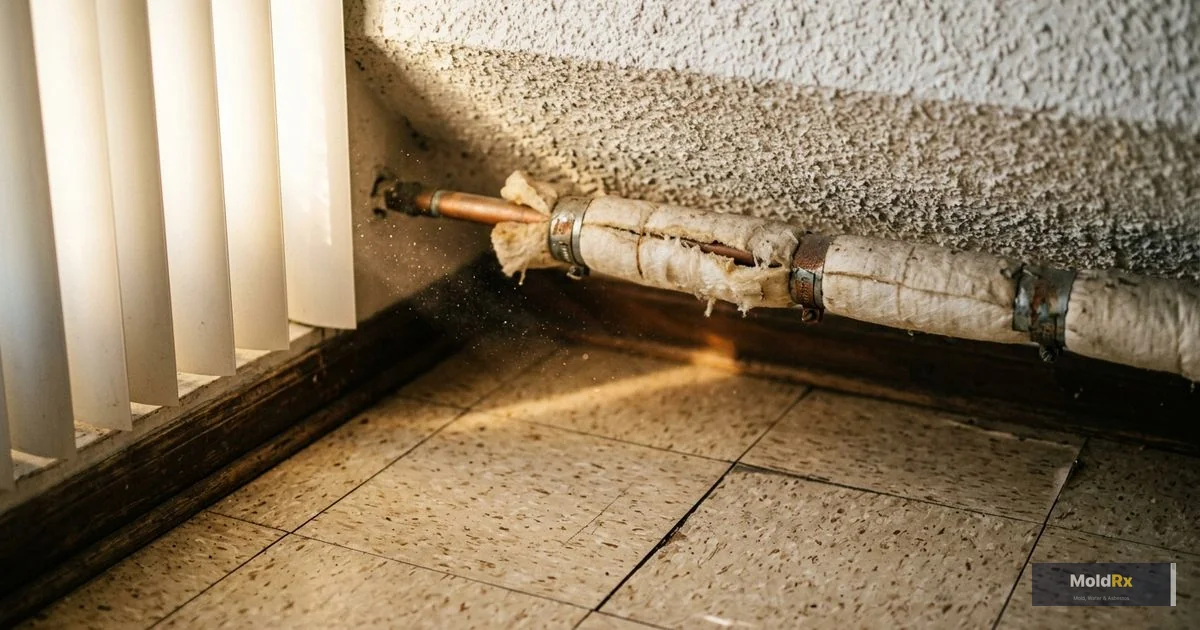
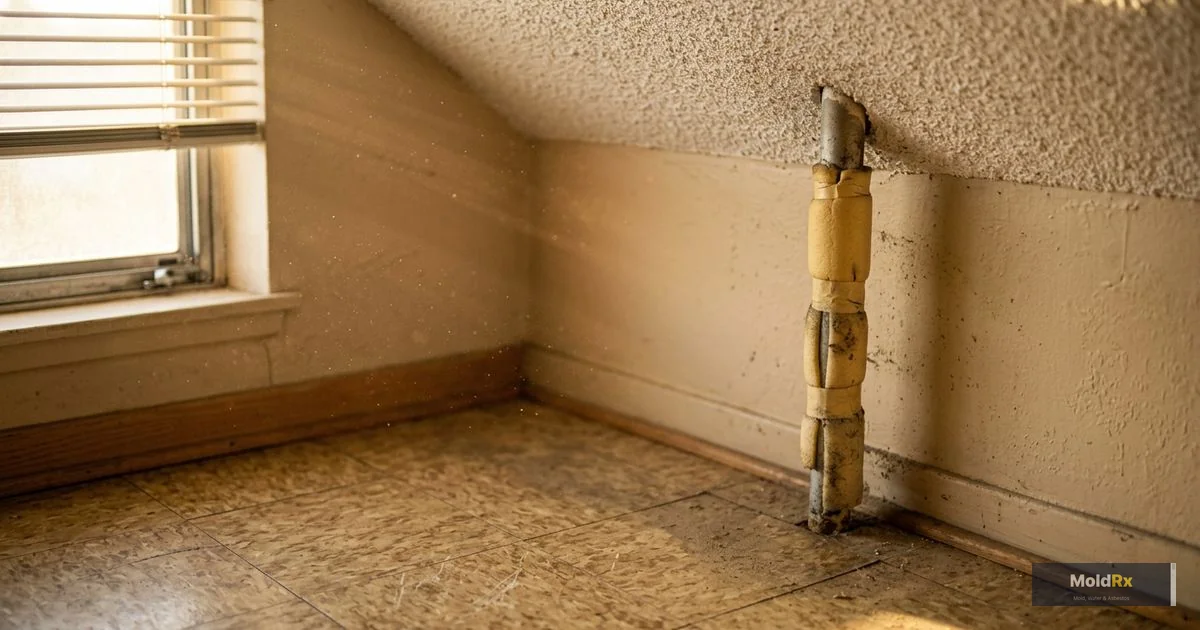
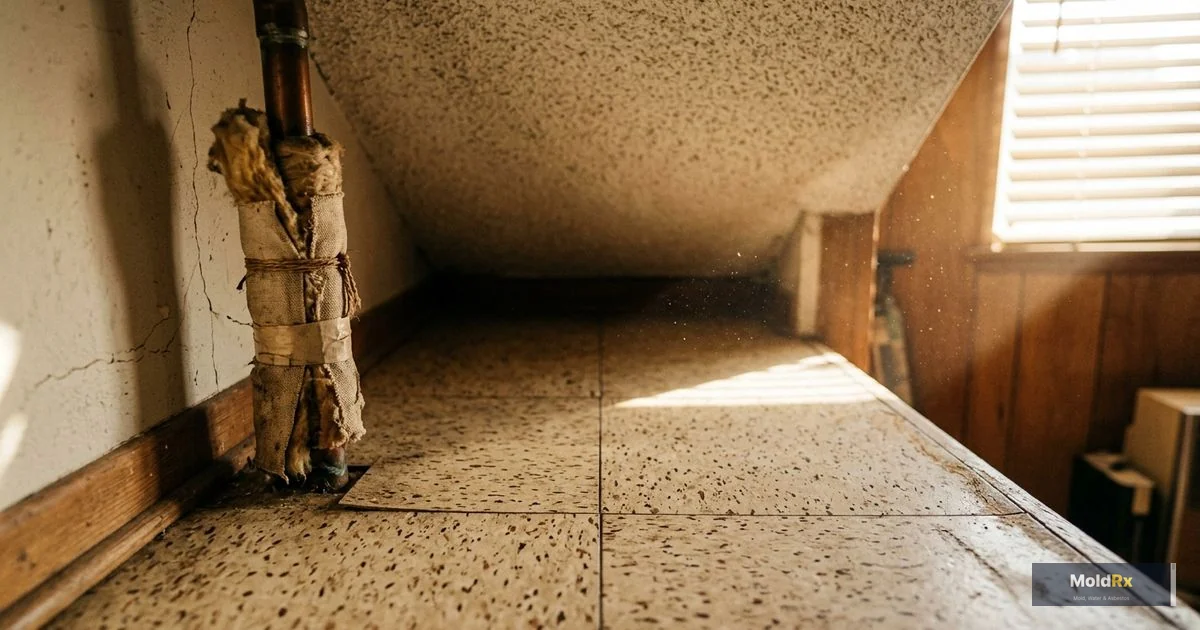
Pipe wrapping and boiler insulation from pre-1980 installations frequently contain asbestos. Under Cal/OSHA Section 1529, all thermal insulation in pre-1980 buildings is presumed to contain asbestos until tested. HVAC duct tape is another common source. Vermiculite attic insulation is a special concern -- much of the vermiculite sold in the U.S. came from the Libby, Montana mine, contaminated with tremolite asbestos.
Roofing and Exterior
Asphalt shingles, roof felt, roofing cement, and flashing from pre-1990 installations may contain asbestos. Transite siding -- a rigid cement-asbestos composite -- was widely used from the 1930s through 1970s. Some stucco and window glazing compounds also contain asbestos.
Manufactured Home Components
In older manufactured homes, asbestos may be present in ceiling panels, insulation wrapping, underbelly barriers, duct systems, and flooring. These homes require particular attention because factory construction uses asbestos in locations that do not match patterns in site-built homes.
None of these materials can be identified visually. NVLAP-accredited laboratory analysis using PLM or TEM is required for definitive determination.
Our Asbestos Testing Process in San Jacinto
Step 1: Property Assessment and Sample Planning
A vetted specialist evaluates your home's construction era, identifies suspect materials, notes their condition, and develops a sampling plan focused on materials your project will disturb. For manufactured homes, the specialist examines factory-specific components including underbelly materials, insulation, duct systems, ceiling panels, and flooring.
Step 2: Safe Sample Collection
Samples are collected following EPA and OSHA 1926.1101 protocols. Each material is wetted before sampling, placed in a sealed container for chain-of-custody transport, and documented with photographs. The sampling site is sealed after collection. Professional collection is essential -- cutting into dry ACM without proper technique can contaminate your home.
Step 3: NVLAP-Accredited Laboratory Analysis
Samples go to an NVLAP-accredited laboratory, as required by AHERA, using two methods:
- PLM (Polarized Light Microscopy): Standard method for bulk samples. Identifies fiber type (chrysotile, amosite, crocidolite) and concentration. Material at or above 1 percent asbestos is classified as ACM.
- TEM (Transmission Electron Microscopy): Higher resolution for detecting fibers PLM cannot resolve. Used when PLM is inconclusive, for air samples, or when greater precision is needed.
Standard turnaround is 3 to 5 business days. Rush processing (24 to 48 hours) is available.
Step 4: Results and Recommendations
We deliver results in plain language. For positive materials, your options include:
- Monitor in place. ACM in good condition that will not be disturbed can remain safely with periodic inspection.
- Encapsulation. Sealant applied over intact material to prevent fiber release.
- Professional removal. Damaged or soon-to-be-disturbed materials removed by a CSLB C-22 contractor with DOSH registration, complying with SCAQMD Rule 1403 and Cal/OSHA Section 1529.
Regulations San Jacinto Homeowners Need to Know
- SCAQMD Rule 1403 -- Requires an asbestos survey before any renovation or demolition, regardless of building age. Survey by a Cal/OSHA-certified inspector or AHERA-certified Building Inspector. Notification to SCAQMD at least 10 working days before demolition. Only exception: single-unit dwelling renovation disturbing less than 100 square feet of intact material. Fines exceed $20,000 per day.
- Cal/OSHA Title 8, Section 1529 -- In pre-1980 buildings, all thermal insulation, surfacing material, and resilient flooring is presumed to contain asbestos until testing proves otherwise. Regulated areas, exposure monitoring, and specific work practices mandatory for Class I through III asbestos work.
- OSHA 1926.1101 -- Federal asbestos construction standard. Permissible exposure limits, competent-person oversight, exposure monitoring, and work-class categories. Requires bulk sample analysis at NVLAP-proficient laboratories.
- AHERA -- Requires NVLAP accreditation for laboratories and establishes inspector certification standards.
- CSLB C-22 License -- Any asbestos abatement contractor must hold the C-22 classification and maintain current DOSH registration. Applies to both site-built and manufactured housing.
- Manufactured home considerations -- The same SCAQMD Rule 1403 and Cal/OSHA Section 1529 requirements that apply to site-built homes apply to manufactured housing. Pre-1990 manufactured homes may also trigger HUD regulatory requirements.
What to Expect When Working with MoldRx
- Honest evaluation. We do not push unnecessary testing. If your situation does not warrant sampling, we will tell you. If a material looks suspicious but your project will not disturb it, we will explain that too.
- NVLAP-accredited results. Every sample is analyzed at an NVLAP-accredited laboratory using PLM and, when warranted, TEM methods that meet EPA, OSHA 1926.1101, and Cal/OSHA Section 1529 standards.
- Fast turnaround. Standard laboratory results arrive within 3 to 5 business days. Rush analysis (24 to 48 hours) is available for urgent situations such as real estate closings or time-sensitive renovation projects.
- Thorough documentation. Your report includes sample locations, photographs, laboratory chain-of-custody records, and detailed results. This documentation supports real estate transactions, permit applications, contractor coordination, and regulatory compliance with SCAQMD Rule 1403.
- Vetted professionals only. MoldRx only sends asbestos testing specialists we have vetted and stand behind. No subcontractor roulette -- the people who show up are the people we trust with our own homes.
Get your free estimate -- no obligations, no pressure.
San Jacinto Areas We Serve
Our vetted asbestos testing specialists serve all of San Jacinto and surrounding communities. Whether your property is in the historic downtown area near Five Points with structures dating to the early 1900s, one of the manufactured home communities, the established residential neighborhoods near Esplanade Avenue or Main Street, the newer developments near the San Jacinto River, or anywhere else within the city limits, we cover it.
We serve ZIP codes 92582 and 92583 and the broader San Jacinto Valley. Specific areas include:
- Historic Downtown / Five Points -- The oldest part of the city, with some structures dating to the late 1800s and early 1900s. Highest probability of deteriorated asbestos-containing materials due to age.
- Manufactured Home Communities -- Multiple communities throughout San Jacinto with mobile homes and manufactured homes spanning the 1960s through the present. Pre-1990 units warrant testing before any renovation or maintenance work.
- Esplanade Avenue / Main Street Neighborhoods -- Established residential areas with homes from multiple construction eras, including 1950s-1970s ranch homes with high asbestos probability.
- Newer Developments (2000s-era) -- Generally low asbestos risk, but homeowners in these developments who purchase and renovate older properties elsewhere in the city should test those older homes before beginning work.
Nearby Communities
Nearby communities within our service area include Hemet to the west, Beaumont to the north, Banning to the northeast, Menifee to the southwest, and Perris to the west. If you are unsure whether we cover your location, just ask.
Related Services in San Jacinto
- Asbestos Removal in San Jacinto
- Mold Removal in San Jacinto
- Mold Testing in San Jacinto
- Water Damage Restoration in San Jacinto
-> Learn more about remediation services in San Jacinto
Frequently Asked Questions
Is asbestos testing required before renovation in San Jacinto?
Yes. SCAQMD Rule 1403 requires an asbestos survey before renovation or demolition in the South Coast district, which includes all of Riverside County. Cal/OSHA Section 1529 presumes all thermal insulation, surfacing material, and resilient flooring in pre-1980 buildings contains asbestos until testing proves otherwise. Testing is also recommended before buying older property, when you notice damaged materials, or before HVAC and plumbing work.
I live in a manufactured home. Should I get testing?
If your manufactured home was built before 1990, yes. Pre-1976 mobile homes are highest risk, but homes built through the mid-1980s frequently contain asbestos in ceiling panels, insulation, vinyl flooring, duct systems, and underbelly barriers. The same SCAQMD Rule 1403 and Cal/OSHA Section 1529 requirements apply to manufactured housing.
How many samples are typically needed?
EPA and OSHA 1926.1101 procedures require a minimum of three samples per homogeneous material in each distinct area. A typical inspection involves 6 to 15 samples. Manufactured homes may need sampling of factory-specific components. Your inspector determines the plan during assessment.
How long do results take?
Standard PLM analysis at an NVLAP-accredited laboratory takes 3 to 5 business days. Rush processing within 24 hours is available. TEM analysis typically requires 5 to 7 business days.
Can asbestos be present in a post-1980 home?
Yes. The phase-out was gradual, and ACM continued to be installed through the late 1980s. Homes built between 1980 and 1990 may contain asbestos in some materials. NVLAP-accredited testing using PLM or TEM is the only way to know.
What happens if asbestos is found?
A positive result does not automatically require removal. Intact, undisturbed ACM can remain in place with monitoring. Damaged or soon-to-be-disturbed materials need encapsulation or removal by a CSLB C-22 contractor with DOSH registration, complying with SCAQMD Rule 1403 and Cal/OSHA Section 1529.
Can I collect samples myself?
California does not prohibit it for single-family homeowners, but it is strongly discouraged. Samples from uncertified individuals may not be accepted for SCAQMD Rule 1403 compliance. Professional inspectors follow OSHA 1926.1101 protocols for safe collection.
What is the difference between PLM and TEM?
PLM is the standard method for bulk samples -- identifies fiber type and concentration. TEM provides higher resolution for detecting smaller fibers. TEM is used when PLM is inconclusive or for air monitoring. Both performed at NVLAP-accredited laboratories per AHERA standards.
Get Asbestos Testing in San Jacinto
San Jacinto's long construction history and diverse housing stock -- from century-old buildings in the original Five Points townsite to manufactured home communities and modern tract houses -- means there is no one-size-fits-all answer about asbestos risk. The only way to know what is in your home is to test.
Our vetted specialists understand the range of construction types found in San Jacinto and the San Jacinto Valley. They know where asbestos is most likely to hide in a 1960s ranch home, a pre-HUD mobile home, or a 1980s transitional-era house, and they follow every protocol required by SCAQMD Rule 1403, Cal/OSHA Section 1529, and OSHA 1926.1101 to give you accurate, documented results from NVLAP-accredited laboratories.
Asbestos-related diseases take years to develop, but they are not reversible. Testing is a straightforward step that tells you exactly what is in your property so you can make informed decisions about renovations, maintenance, real estate transactions, or simply your family's safety.
Call MoldRx to schedule your asbestos test -- (888) 609-8907. Know what is in your San Jacinto property before you start.