Asbestos Testing in San Bernardino, CA -- MoldRx
Vetted Asbestos Testing Specialists Serving San Bernardino and the Inland Empire
San Bernardino is one of California's oldest cities -- incorporated in 1854, with a construction timeline that stretches back to the mid-1800s. That long timeline means layers of residential and commercial building spanning more than a century, and for the thousands of homes built between roughly 1900 and 1980, a very real probability that asbestos is embedded in the building materials. Floor tiles, ceiling texture, pipe insulation, joint compound, roofing felt, duct tape, cement siding -- manufacturers used asbestos in an estimated 3,000 to 5,000 distinct products during those decades, and San Bernardino's largest construction booms landed squarely in the middle of that era.
If you own property in San Bernardino and you are planning renovations, purchasing an older home, or simply want to understand what is behind your walls, professional asbestos testing is the only way to get definitive answers. SCAQMD Rule 1403 requires an asbestos survey before renovation or demolition, and Cal/OSHA Section 1529 presumes that thermal insulation, surfacing materials, and resilient flooring in pre-1980 buildings contain asbestos until laboratory analysis proves otherwise.
MoldRx only sends vetted asbestos testing professionals who understand the Inland Empire's housing stock, follow EPA and OSHA 1926.1101 sampling protocols, and use NVLAP-accredited laboratories for every analysis.
Request your free estimate -- find out whether testing is needed for your project.
Why San Bernardino Properties Need Asbestos Testing
A City Built in Distinct Waves
San Bernardino's residential growth came in phases, each leaving behind different construction materials and different asbestos risks.
The city's history begins in 1810 when Father Francisco Dumetz named the area after Saint Bernardino of Siena. Mormon settlers purchased the rancho in 1852, and the community incorporated in 1854 with a population of 1,200. Growth was steady -- 6,150 residents by 1900, 12,779 by 1910.
The earliest homes in the downtown core date to the late 1800s and early 1900s. These structures contain asbestos in original plaster, pipe insulation, boiler wrapping, and exterior stucco -- materials now well over a century old.
The Post-War Construction Boom: Norton Air Force Base and Kaiser Steel
The largest concentration of asbestos-containing homes came from post-war construction booms fueled by two enormous employers: Norton Air Force Base (commissioned 1942, a 2,165-acre jet engine and aircraft repair center) and Kaiser Steel in nearby Fontana. These jobs drove construction of vast housing tracts through the 1940s, 1950s, 1960s, and 1970s.
The Del Rosa neighborhood -- just two miles east of downtown, home to over 27,000 residents today -- dates its residential development to 1948 and features Ranch and Mid-Century Modern homes built during the Norton AFB employment boom. North-central neighborhoods toward the foothills saw similar tract development. Thousands of homes used materials that routinely contained asbestos: popcorn ceilings, 9-inch by 9-inch vinyl floor tiles, pipe wrap, roof shingles, HVAC duct mastic, and drywall joint compound.
Norton AFB was later identified as a Superfund site with 22 restoration sites and 73 areas of concern before closing in 1994. The base's extensive asbestos use mirrors what went into surrounding residential construction during the same era.
With approximately 222,000 residents (18th-most populous city in California), a significant percentage of San Bernardino's housing stock is now 50 to 80 years old -- squarely in the highest-risk category for asbestos-containing materials.
Climate Factors That Accelerate Material Deterioration
San Bernardino's semi-arid Mediterranean climate creates specific conditions that stress older building materials over decades. Summer temperatures regularly reach the mid-90s to low 100s, the region receives only about 16 inches of annual rainfall, and daily temperature swings of 30 degrees or more between day and night are common. These conditions affect asbestos-containing materials in several ways:
- HVAC systems work overtime. Homes built in the 1950s and 1960s often still contain original ductwork, pipe insulation, and furnace components. Decades of thermal cycling cause these materials to crack, flake, and shed fibers into circulated air.
- Temperature swings cause mechanical stress. Repeated expansion and contraction in roofing, siding, and insulation over 50-plus years degrades asbestos-containing materials from stable to friable -- meaning they crumble when touched and release fibers without deliberate disturbance.
- Santa Ana winds create pressure differentials. When dry, hot winds sweep through the Inland Empire, they create negative pressure in older homes that can draw fibers from deteriorating materials in attics, wall cavities, and crawl spaces into living areas.
- Low humidity makes materials brittle. Unlike coastal homes where moisture keeps some materials pliable, San Bernardino's dry air causes older adhesives, caulking, pipe insulation, and textured coatings to become brittle and prone to crumbling.
Common Asbestos-Containing Materials in San Bernardino Homes
Understanding where asbestos hides is the first step toward protecting yourself. In San Bernardino homes built before 1980, the following materials frequently contain asbestos fibers:
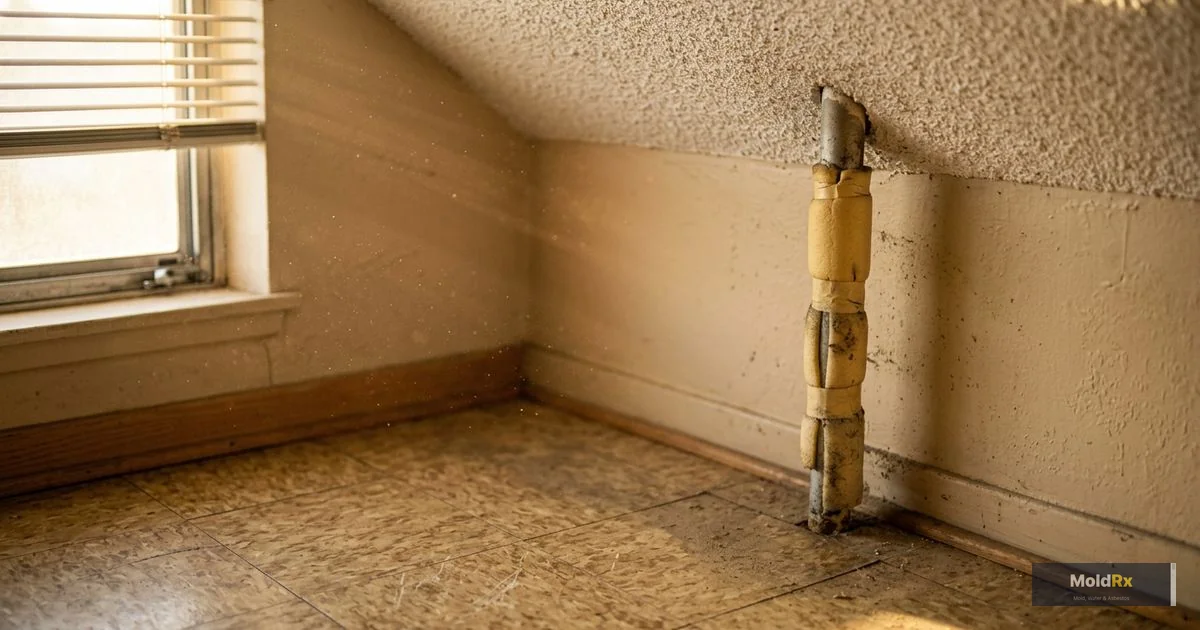
- 9-inch by 9-inch vinyl floor tiles and black mastic adhesive -- The single most common asbestos material found in Inland Empire homes. The tiles themselves contained 5 to 70 percent chrysotile, and the black cutback adhesive beneath them is often positive even when the tile is not. Only PLM laboratory analysis can distinguish asbestos-containing tiles from identical-looking asbestos-free tiles.
- Popcorn or acoustic ceiling texture -- Sprayed-on ceiling coatings applied from the 1950s through early 1980s. The EPA banned asbestos in spray-applied surfacing in 1978, but existing stock continued to be installed into the early 1980s.
- Vermiculite attic insulation -- Loose-fill insulation, often gray or brown accordion-shaped granules. A significant portion of vermiculite sold in the United States came from the Libby, Montana mine, contaminated with tremolite asbestos. The EPA recommends treating all vermiculite insulation as potentially contaminated until tested.
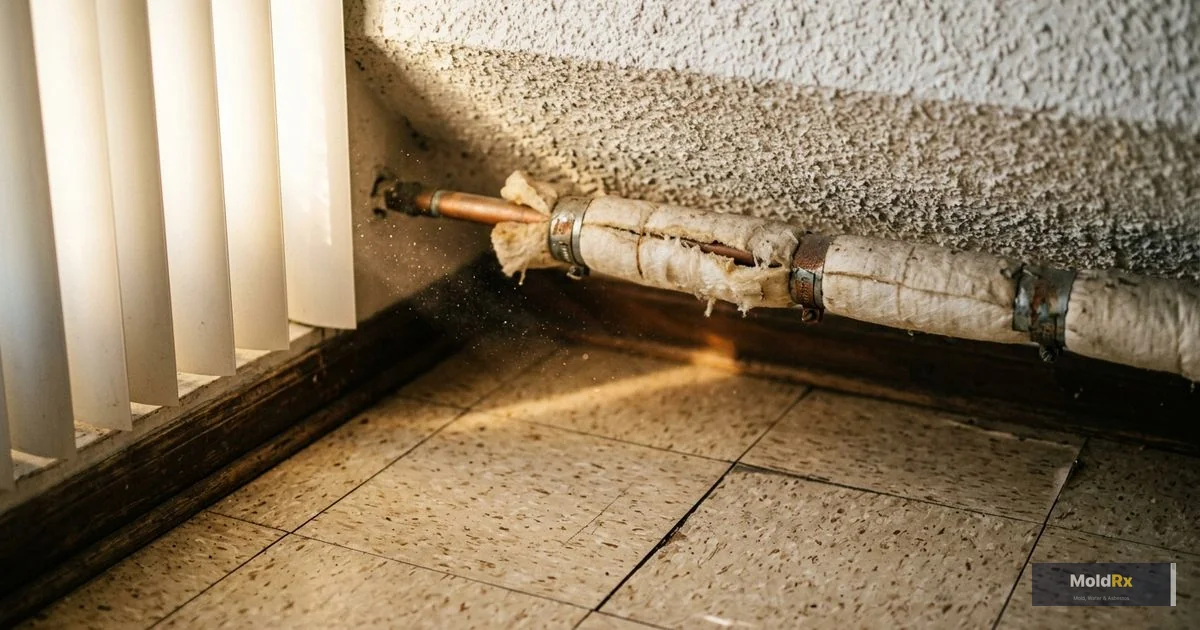
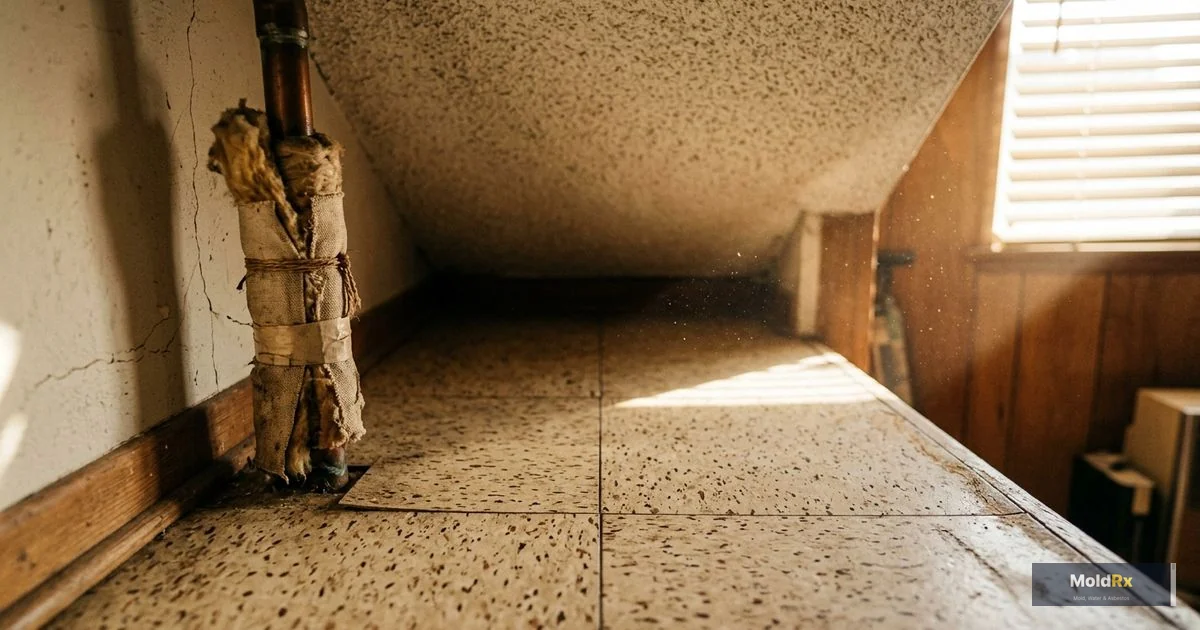
- Pipe and duct insulation -- White or gray wrapping around hot water pipes, boiler pipes, and HVAC ducts. Under Cal/OSHA Section 1529, all thermal system insulation in pre-1980 buildings is legally presumed to contain asbestos until testing proves otherwise.
- Cement siding and roofing shingles -- Fiber-cement products (sometimes called Transite) that were extremely durable precisely because of their asbestos content. Widely used from the 1930s through the 1970s.
- HVAC duct tape and insulation -- Cloth-like tape and paper-backed insulation in older heating and cooling systems. Decades of thermal cycling in San Bernardino's climate makes these materials particularly prone to deterioration.
- Drywall joint compound and textured wall coatings -- Mud and plaster compounds used to finish walls and create decorative textures. Because joint compound is applied at every seam, corner, and fastener hole, even a modest remodel can disturb substantial quantities across walls and ceilings.
- Window glazing putty and caulking -- Older sealants around windows and exterior joints.
- Roofing felt and flashing cement -- Tar paper and mastic used beneath shingles and around roof penetrations. Common positive results in homes from the 1940s through 1970s.
None of these materials can be identified as asbestos-containing through visual inspection alone. Laboratory analysis at an NVLAP-accredited facility is required for a definitive determination.
Understanding the Health Risks
Asbestos exposure is cumulative and delayed. When ACM is disturbed -- cut, sanded, scraped, drilled, or broken -- it releases microscopic fibers that penetrate deep into lung tissue where the body cannot expel them. Over time, embedded fibers cause inflammation and scarring leading to three serious conditions:
- Mesothelioma -- Aggressive cancer of the lining of the lungs, abdomen, or heart. Almost exclusively caused by asbestos. Latency period of 20 to 50 years.
- Asbestosis -- Progressive scarring of lung tissue. Develops over years of exposure but can also result from intense short-term exposure during a single renovation project.
- Lung cancer -- Risk increases significantly with asbestos exposure, especially combined with smoking.
The latency period is what makes testing before renovation non-negotiable. A homeowner who does a weekend demolition without testing can inhale a significant dose and not develop symptoms for decades.
Regulations San Bernardino Homeowners Need to Understand
Asbestos in San Bernardino falls under overlapping federal, state, and regional regulations.
- SCAQMD Rule 1403 -- Requires an asbestos survey before any renovation or demolition, regardless of building age. Survey by a Cal/OSHA-certified inspector or AHERA-certified Building Inspector. Notification to SCAQMD at least 10 working days before demolition. Only exception: single-unit dwelling renovation disturbing less than 100 square feet of intact material. Fines exceed $20,000 per day.
- Cal/OSHA Title 8, Section 1529 -- In pre-1980 buildings, all thermal system insulation, surfacing material, and resilient flooring is presumed to contain asbestos until testing proves otherwise. Regulated areas, exposure monitoring, and specific work practices mandatory for Class I through III asbestos work.
- OSHA 1926.1101 -- Federal asbestos construction standard. Permissible exposure limits, competent-person oversight, exposure monitoring, and work-class categories. Requires bulk sample analysis at NVLAP-proficient laboratories.
- AHERA -- Requires NVLAP accreditation for laboratories and establishes inspector certification standards. The baseline for professional asbestos work in California.
- CSLB C-22 License -- Any asbestos abatement contractor must hold the C-22 classification and maintain current DOSH registration.
- Real estate disclosure -- California law requires sellers to disclose known asbestos. Testing before selling protects both parties.
Our Asbestos Testing Process in San Bernardino
Getting your San Bernardino home tested for asbestos is straightforward when you work with vetted professionals who understand the local housing stock and know exactly where to look.
Step 1: Visual Assessment and Sample Planning
Our specialists evaluate your property based on age and construction type. In San Bernardino, this means close attention to original flooring in 1950s tract homes, ceiling textures from the 1960s-1970s, and insulation in Del Rosa and north-central neighborhoods built during the Norton AFB boom. We discuss your goals and develop a sampling plan covering every area of concern.
Step 2: Safe Sample Collection
Samples are collected following EPA and OSHA 1926.1101 protocols. The inspector wets each material before cutting, uses containment barriers and protective equipment, and seals each sample in a labeled container for chain-of-custody transport. Each suspect material type gets its own sample. The sampling site is sealed after collection.
Step 3: NVLAP-Accredited Laboratory Analysis
All samples go to an NVLAP-accredited laboratory. The primary method is PLM (Polarized Light Microscopy), which identifies asbestos fiber type (chrysotile, amosite, crocidolite), concentration, and fiber condition. Materials at or above 1 percent asbestos are classified as ACM. When higher sensitivity is needed, TEM (Transmission Electron Microscopy) detects fibers PLM cannot resolve. TEM is also the standard for air monitoring.
Standard turnaround is 3 to 5 business days. Rush processing (24 to 48 hours) is available.
Step 4: Clear Results and Recommendations
You receive a detailed report explaining what was found and what it means. If asbestos is present, your options include:
- Leave undisturbed -- Materials in good condition that will not be disturbed can remain in place with periodic monitoring.
- Encapsulation -- Sealing ACM so fibers cannot become airborne.
- Professional abatement -- Licensed removal by a CSLB C-22 contractor with current DOSH registration, complying with SCAQMD Rule 1403 and Cal/OSHA Section 1529.
San Bernardino Asbestos Risk by Construction Era
Pre-1920s (Downtown Core): Oldest structures may date to the late 1800s. Victorian-era buildings commonly contain asbestos in plaster, pipe insulation, boiler wrapping, and roofing -- materials now well over a century old.
1920s-1940s (Early Expansion): Neighborhoods expanded from downtown. Asbestos in plaster, pipe insulation, roofing, and early vinyl products. Accelerated construction during the 1940s as war-industry workers arrived.
1940s-1970s (The Post-War Boom): Peak era for both building and asbestos use. Norton AFB and Kaiser Steel drove construction of thousands of tract homes. Nearly every material category may contain asbestos. Highest probability of positive results.
1978-1985 (Transition Era): Gradual phase-out. Asbestos stock remained in supply chains into the mid-1980s. Testing is the only way to know which materials in a specific home are asbestos-free.
Post-1990: Significantly reduced risk. SCAQMD Rule 1403 still requires a survey before demolition regardless of building age.
What to Expect from MoldRx
- Honest assessment. If testing is unnecessary for your situation, we will tell you. If materials are clearly modern and post-date asbestos use, you will know that too. We do not push unnecessary testing.
- Clear communication. You will understand exactly what is being tested and why. No jargon, no confusing technical language -- just straight answers about what is in your home and what that means.
- Actionable results. Your report will not leave you guessing. If asbestos is found, you will know exactly what that means and what your options are. If it is not found, you will have documentation to proceed with your project confidently.
- Proper protocols. Every sample is collected following Cal/OSHA Section 1529 and EPA guidelines and analyzed at an NVLAP-accredited laboratory. This protects you during the testing process and ensures results are accurate and legally defensible for real estate transactions, permit applications, and contractor coordination.
- Vetted professionals only. MoldRx only sends asbestos testing specialists we have vetted and stand behind. No subcontractor roulette -- the people who show up are the people we trust.
San Bernardino Neighborhoods and Areas We Serve
Our asbestos testing services cover all of San Bernardino and surrounding communities. Whether your property is in the historic downtown core with turn-of-the-century construction, the Del Rosa neighborhood with its mid-century tract homes, the established communities near California State University San Bernardino, or the residential areas extending toward the San Bernardino National Forest foothills, we are equipped to help.
We serve all San Bernardino ZIP codes including 92401, 92404, 92405, 92407, 92408, 92410, 92411, and surrounding areas. Specific neighborhoods and communities include:
- Downtown San Bernardino -- Older commercial and residential buildings, some dating to the early 1900s. Victorian-era and Art Deco structures with potentially deteriorated original materials.
- Del Rosa -- Mid-century tract homes built during the 1940s through 1960s, many with original flooring, ceiling texture, and pipe insulation. One of the highest-probability neighborhoods for ACM due to construction era and volume.
- Muscoy and Verdemont -- Mix of construction eras with older ranch-style homes that warrant testing before renovation.
- North San Bernardino -- Post-war housing tracts built during the Norton AFB employment boom. High concentration of 1950s-1960s construction with standard asbestos-era materials.
- San Bernardino Foothills -- Properties ranging from 1950s ranch homes to later hillside developments. Older homes carry elevated asbestos risk.
- Arrowhead Springs and Kendall Hills -- Established residential areas with mixed construction vintages.
- University District -- Properties near CSUSB with varied construction dates.
Surrounding Communities
Our coverage extends to neighboring communities including Rialto to the west, Highland to the east, Colton to the south, Fontana to the northwest, Loma Linda to the south, and Redlands to the east.
From single-family homes to commercial properties downtown and multi-family buildings throughout the city, our vetted specialists handle asbestos testing for all property types.
When Should You Get Asbestos Testing in San Bernardino?
Before any renovation or remodeling project. If your home was built before 1980, SCAQMD Rule 1403 and Cal/OSHA Section 1529 require asbestos testing before any work that could disturb suspect materials. This includes kitchen and bathroom remodels, flooring replacement, ceiling scraping, wall demolition, and HVAC upgrades. The narrow exception -- single-unit dwelling renovation disturbing less than 100 square feet of intact material -- is a threshold most projects exceed immediately.
Before buying or selling a home. Buyers deserve to know what they are purchasing, and sellers benefit from having documentation. Testing before closing protects everyone and can prevent costly surprises after the sale. California disclosure laws require sellers to report known material defects.
If you notice damaged or deteriorating materials. Crumbling ceiling texture, cracked floor tiles, fraying pipe insulation, or peeling siding in a pre-1980 home should prompt testing. Damaged asbestos materials can actively release fibers into your living space without any renovation underway.
After water damage or natural disaster. Flooding, roof leaks, or earthquake damage can disturb previously stable asbestos materials. If your older San Bernardino home has experienced water intrusion or structural damage, testing ensures that secondary asbestos contamination has not occurred.
Before roof replacement or HVAC upgrades. Roofing felt, flashing cement, and HVAC duct insulation from the 1940s through 1970s commonly contain asbestos. Testing determines whether your roofing or mechanical contractor can proceed with standard methods or whether licensed CSLB C-22 abatement must happen first.
Schedule your free estimate -- no obligations, no pressure.
Related Services in San Bernardino
- Asbestos Removal in San Bernardino
- Mold Removal in San Bernardino
- Mold Testing in San Bernardino
- Water Damage Restoration in San Bernardino
-> Learn more about remediation services in San Bernardino
Frequently Asked Questions
Is asbestos testing required before renovation in San Bernardino?
Yes. SCAQMD Rule 1403 requires an asbestos survey before renovation or demolition in the South Coast district, which includes all of San Bernardino County. The survey must be conducted by a Cal/OSHA-certified inspector or an AHERA-certified Building Inspector. Cal/OSHA Section 1529 additionally presumes all thermal insulation, surfacing material, and resilient flooring in pre-1980 buildings contains asbestos until testing proves otherwise.
How many samples are typically needed?
EPA and OSHA 1926.1101 procedures require a minimum of three samples per homogeneous material in each distinct area. A typical renovation needs 8 to 20 samples across ceiling texture, floor tile, mastic, joint compound, pipe insulation, HVAC components, and roofing. Your inspector determines the plan during the initial assessment.
How long do results take?
Standard PLM analysis at an NVLAP-accredited laboratory takes 3 to 5 business days. Rush processing within 24 hours is available. TEM analysis typically requires 5 to 7 business days.
What materials should be tested in a pre-1980 home?
Common ACM includes popcorn ceilings, 9-inch by 9-inch floor tiles and black mastic, pipe and duct insulation, roofing shingles and felt, cement siding (Transite), textured wall coatings, joint compound, vermiculite attic insulation, HVAC duct tape, and window glazing putty. Under Cal/OSHA Section 1529, assume any original material might contain asbestos until NVLAP-accredited analysis proves otherwise.
Can I test for asbestos myself?
We strongly advise against DIY sampling. Improper techniques release the very fibers you are trying to identify. Samples collected by uncertified individuals may not be accepted for SCAQMD Rule 1403 compliance. Use professionals who follow OSHA 1926.1101 protocols.
What happens if asbestos is found?
Finding asbestos does not automatically mean removal. Intact, undisturbed materials can be managed in place. Damaged, friable, or soon-to-be-disturbed materials require professional abatement by a CSLB C-22 contractor with DOSH registration, complying with SCAQMD Rule 1403 notification and Cal/OSHA Section 1529 work-practice standards.
How long does the on-site visit take?
Typically one to two hours for a standard residential property. Laboratory results arrive within 3 to 5 business days, with rush processing available.
Does Norton Air Force Base proximity affect my home's asbestos risk?
Not directly, but Norton AFB and Kaiser Steel were the employment engines that drove construction of thousands of tract homes during peak asbestos decades. Homes built in the 1940s-1970s in Del Rosa, north-central San Bernardino, or the foothills used the same asbestos-containing materials standard across the industry.
Get Asbestos Testing in San Bernardino
If you are planning renovations on a pre-1980 San Bernardino home, buying or selling property, or simply want to know what is in your walls and ceilings, asbestos testing gives you the answers you need to make informed decisions. In a city where the housing boom coincided exactly with the peak decades of asbestos use -- and where Norton Air Force Base and Kaiser Steel drove the construction of thousands of tract homes across Del Rosa, the north-central neighborhoods, and the foothills -- the question is not whether asbestos exists in San Bernardino's housing stock. It is where, and how much.
MoldRx only sends vetted asbestos testing professionals who understand San Bernardino's layered construction history, know the specific materials used in Inland Empire homes during each era, and follow every protocol required by SCAQMD Rule 1403, Cal/OSHA Section 1529, and OSHA 1926.1101. No guesswork, no runaround -- just honest guidance and accurate results from NVLAP-accredited laboratories that let you move forward safely.
Call MoldRx to schedule your asbestos test -- (888) 609-8907. Know what is in your San Bernardino property before you start.