Emergency Water Damage Restoration in Riverside, CA — MoldRx
24/7 Vetted Water Damage Restoration Specialists Serving Riverside and Greater Riverside County — Call Now
Water is destroying your Riverside home right now and it will not stop on its own. A corroded supply line behind the wall of your 1920s Wood Streets Craftsman just let go. The Santa Ana River is pushing storm surge toward your Eastside foundation. A water heater in your Canyon Crest hillside home failed at 2 AM and 50 gallons of scalding water are soaking through the subfloor into the rooms below. A slab leak has been silently saturating your foundation for weeks, and now there is mold growing behind the baseboards.
It does not matter which scenario brought you here. What matters is this: mold colonization begins within 24 to 48 hours of water exposure. Structural damage accelerates by the hour. Materials that could be saved today will be destroyed by tomorrow. This is not a problem you can address with towels, a shop vac, or a box fan from the garage. This requires immediate, professional intervention by specialists who know exactly what they are doing.
MoldRx deploys vetted emergency water damage restoration professionals who know Riverside — a city of 320,000+ people spanning over 80 square miles of terrain that ranges from Santa Ana River floodplain to steep hillside canyons, containing architecture from the 1890s citrus boom through 2000s tract developments. We respond immediately. We work systematically. We restore your home properly.
Why Riverside Is Ground Zero for Water Damage in the Inland Empire
Riverside is the county seat and the largest city in the Inland Empire, and it carries water damage risk factors that are unique in their scope and severity. The combination of the city's age, its geography, its river systems, and its climate creates a threat matrix that few other cities in Southern California can match.
130 Years of Architecture — 130 Years of Plumbing Failure Risk
Riverside was incorporated in 1883 and became the epicenter of California's citrus industry. That history left behind one of the most architecturally diverse housing stocks in the Inland Empire — and one of the most vulnerable to catastrophic water damage.
1890s-1920s historic homes: The Wood Streets Historic District contains some of the most cohesive early 20th-century residential architecture in California — Craftsman bungalows, Spanish Colonial Revival, Tudor Revival, and Colonial Revival homes built after 1913 when the Tequesquite Arroyo was bridged and Magnolia Avenue connected this neighborhood to downtown. The Mile Square neighborhood surrounding the Mission Inn contains Victorian and early Craftsman homes dating to the 1890s. The Heritage House district and homes along Victoria Avenue — listed on the National Register of Historic Places — represent additional pockets of century-old residential construction.
These homes have plumbing systems that range from partially original to completely original. Cast iron drain lines installed before World War I. Galvanized steel supply pipes that have been corroding internally for a century. Lead-joint connections that have been slowly deteriorating since the Taft administration. When these systems fail — and after 100+ years of service, the question is when, not if — they fail catastrophically. A burst galvanized supply line inside a balloon-frame wall cavity can saturate an entire floor level in hours, and the water travels vertically through open wall cavities, horizontally along floor plates, and diagonally through every gap and seam in the original construction.
1940s-1960s post-war expansion: Riverside's massive growth during and after World War II — driven by nearby military installations including March Air Field — produced thousands of tract homes with copper supply lines, early ABS drain pipes, and concrete slab foundations. These homes are now 60 to 80+ years old. Copper pipes develop pinhole leaks from chloramine corrosion. Original water heaters were replaced decades ago, but their replacements are now failing. Slab foundations that were adequate for 1950s construction standards have shifted and cracked under decades of expansive clay soil movement.
1970s-1990s expansion: Neighborhoods in Orangecrest, Mission Grove, La Sierra, and Arlington contain homes built with polybutylene supply lines — the notoriously failure-prone flexible piping that was the subject of a $950 million class-action settlement. These pipes degrade from the inside out and fail without warning, often while homeowners are at work or on vacation, resulting in hours of uncontrolled water release.
2000s and newer: Even recent construction in developments around Sycamore Canyon and the Riverside Marketplace area is not immune. Builder-grade water heaters with 8-to-10-year lifespans, improperly graded lots, and insufficient drainage around foundations cause water intrusion in homes that are barely old enough to have a mortgage.
The Santa Ana River — Riverside's Existential Flood Threat
The Santa Ana River runs directly through Riverside, and it is not the gentle watercourse its seasonal trickle might suggest. During atmospheric river events, the Santa Ana River transforms into a powerful flood force that has shaped — and threatened — this city for over a century.
The scope of the threat is staggering. The Riverside Levees Rehabilitation Project — a multi-year collaboration between Riverside County Flood Control, the Army Corps of Engineers, and local agencies — exists specifically to protect more than 4,300 structures and approximately $1.5 billion in infrastructure from Santa Ana River flooding. More than 4,000 of those threatened structures are residential. The project was scheduled to restart construction in April 2025, with an estimated four-year timeline — meaning Riverside is currently in the middle of a prolonged period where levee protection is being actively upgraded because existing protections are insufficient.
During the February 2024 atmospheric river that triggered statewide emergency declarations, the Santa Ana River basin received extraordinary rainfall. Upstream, a bluff behind a stabilization project near Norco began eroding, requiring $4 million in emergency funding from the Army Corps and Riverside County. Throughout the Inland Empire, roads flooded, motorists were trapped, and storm drainage systems were overwhelmed.
The December 2024 atmospheric river compounded the damage, prompting Governor Newsom to declare a state of emergency across Riverside, San Bernardino, Los Angeles, Orange, San Diego, and Shasta counties. Torrential Christmas Eve rains turned roads into rivers and sent debris cascading down hillsides across Southern California.
Properties in Riverside's lower-elevation neighborhoods — including portions of Eastside, Casa Blanca, Northside, and areas near the Gage Canal — face direct flood risk during these events. But flood damage in Riverside extends far beyond the river corridor. Hillside runoff from Alessandro Heights, Canyon Crest, and Hawarden Hills channels water toward downslope foundations. Overtaxed storm drains in Downtown, University, and Magnolia Center back up and flood streets, parking areas, and ground-floor commercial and residential spaces.
Slab Leaks — The Invisible Emergency
Riverside's clay-heavy soil is among the most expansive in Southern California. It swells dramatically when wet and shrinks aggressively when dry, creating a constant cycle of movement beneath slab foundations. This movement grinds against copper supply lines running under the slab, producing pinhole leaks that release water into the soil beneath your home.
A slab leak in a Riverside home can run for weeks to months before producing visible symptoms. The water migrates outward through the soil, saturating a widening area and wicking upward through the concrete slab via capillary action. By the time a homeowner notices a warm spot on the floor, an unexplained jump in the water bill, or a musty smell suggesting mold — the damage radius has expanded far beyond the actual leak point. The flooring, subfloor, lower drywall, and baseboard across an entire section of the home may be compromised.
The Riverside Heat-Mold Catastrophe Cycle
Riverside averages over 280 sunny days per year with summer temperatures pushing into the high 90s and regularly exceeding 100 degrees. Annual rainfall averages only about 10 inches — but when it comes, it arrives in concentrated, overwhelming bursts between November and March.
This climate creates a devastating water damage dynamic. During dry months, pipes bake and stress under thermal cycling. When they fail, the extreme heat transforms wet building materials into mold incubators. Wall cavities in a Riverside home can exceed 110 degrees in summer — and at those temperatures, with moisture present, mold species including Aspergillus, Penicillium, and Cladosporium establish visible colonies within 24 hours. Stachybotrys (black mold) follows within 48 to 72 hours.
A pipe failure on a Friday afternoon in August that goes undiscovered until Monday morning does not result in just water damage. It results in water damage plus active mold growth across every wet surface in the house. The restoration scope — and cost — doubles or triples. Immediate response is not optional. It is the difference between a manageable restoration and a catastrophic remediation project.
Emergency Water Damage Restoration Process in Riverside
MoldRx deploys vetted specialists who follow IICRC S500 standards — the restoration industry's definitive protocol for professional water damage work. Every step is systematic, monitored, documented, and verified.
Step 1: Emergency Response, Source Control, and Assessment
Vetted specialists arrive at your Riverside property and immediately address three critical questions: Is the water source still active? What category is the water? How far has it migrated?
Category 1 (clean water from supply lines or faucets) allows the broadest range of materials to be saved. Category 2 (gray water from dishwashers, washing machines, or HVAC overflow) requires removal of porous materials that cannot be effectively cleaned. Category 3 (sewage backups, Santa Ana River flooding, storm drain overflow) requires immediate removal of all porous materials that contacted the water — no exceptions. Categorization errors are one of the most dangerous mistakes in water damage restoration, and our vetted specialists get it right the first time.
Thermal imaging cameras reveal moisture hiding behind walls and beneath flooring. Penetrating moisture meters provide exact measurements at multiple depths. In Riverside's historic homes — where balloon-frame construction allows unrestricted water migration through wall cavities — this assessment must be exhaustive. Missing a saturated wall cavity during assessment means missing it during drying, which means mold growth that does not reveal itself until weeks later.
Step 2: High-Volume Water Extraction
Commercial-grade truck-mounted extractors and portable submersible pumps remove standing water at rates that household equipment cannot approach. Weighted extraction tools pull water from carpet fibers and pad. Hard-surface extractors recover water from hardwood, concrete, and tile.
In Riverside's older homes, extraction presents unique challenges. Original hardwood floors in the Wood Streets and Mile Square require immediate, careful extraction to prevent irreversible cupping and buckling. Tile floors in Spanish Colonial Revival homes may sit on mud-set mortar beds that absorb and hold water. Hillside homes in Canyon Crest and Alessandro Heights may have below-grade rooms or stepped foundations where water collects by gravity and must be actively pumped.
Every hour that water remains in contact with building materials, the damage boundary expands. Drywall wicks moisture upward at approximately one inch per hour. Hardwood cupping begins within hours. Particleboard subfloor — the standard material in Riverside tract homes from the 1960s through 1990s — permanently decomposes when saturated. Speed during extraction directly determines how much of your home can be saved.
Step 3: Controlled Structural Drying and Dehumidification
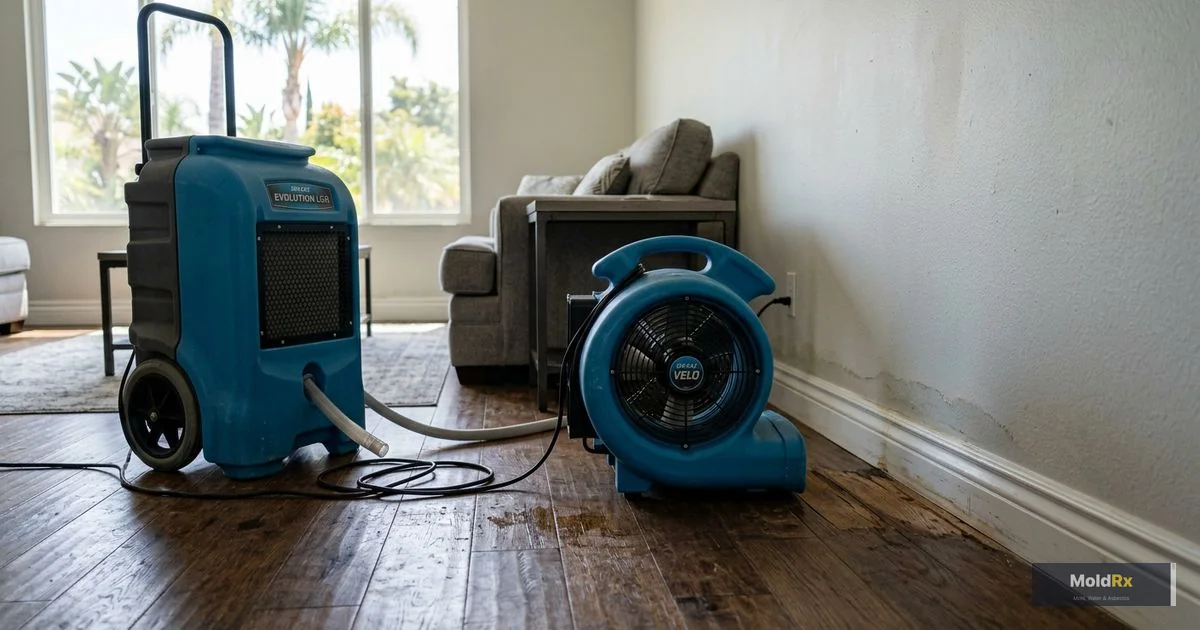
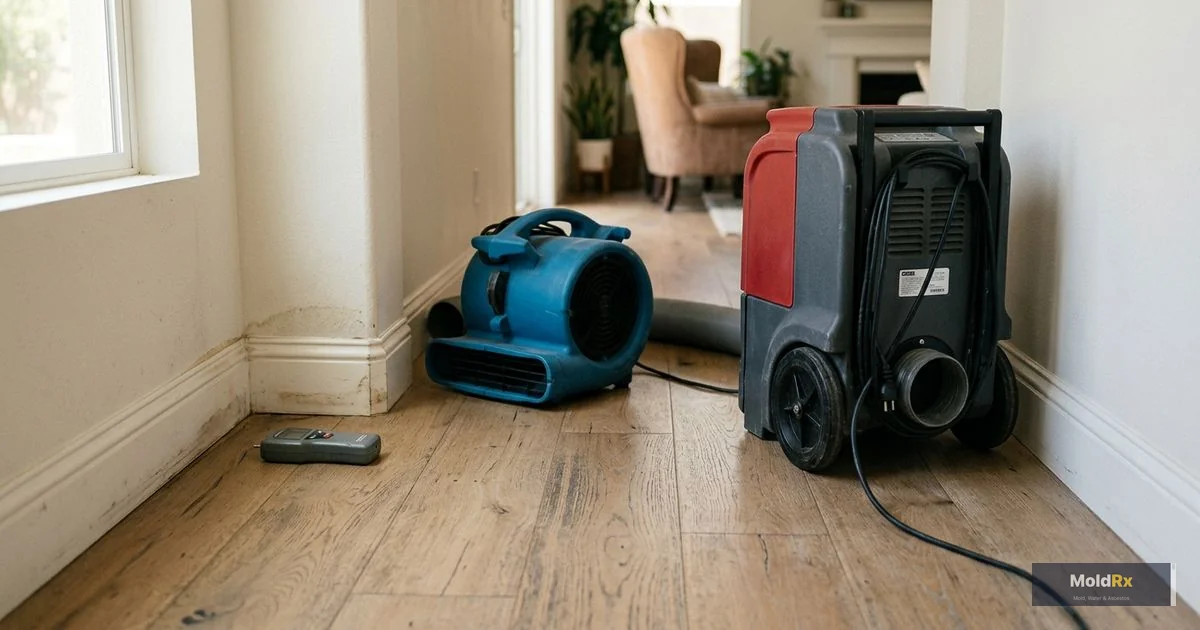
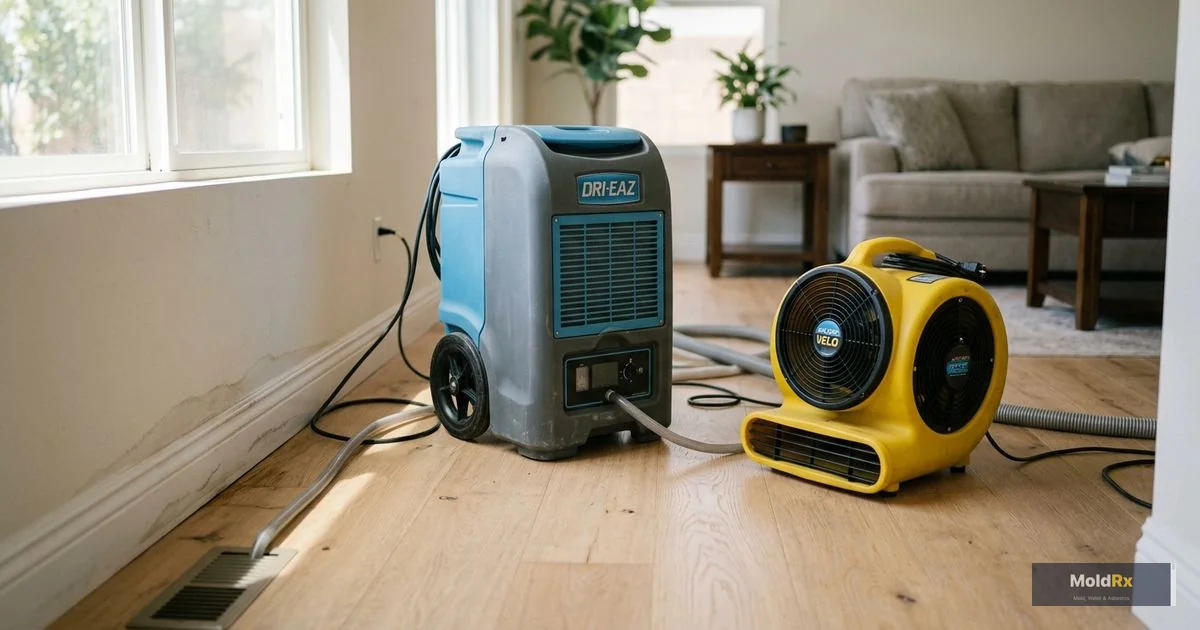
Industrial air movers create high-velocity airflow across wet surfaces, driving evaporation. Commercial dehumidifiers capture that evaporated moisture before it recondenses elsewhere. The combination creates a controlled drying environment that pulls moisture out of building materials systematically.
Riverside's climate is a double-edged sword during this phase. The typically low humidity and warm temperatures assist evaporation — but without proper dehumidification, that moisture simply migrates to cooler surfaces and unaffected areas, spreading the damage zone. Professional equipment and monitoring are essential.
Moisture readings are taken daily at multiple points throughout the affected area. Each material type has a specific dry standard — the equilibrium moisture content for that material in Riverside's climate. Drywall, framing lumber, hardwood flooring, concrete — each dries at a different rate and must be individually verified. Drying is not complete when surfaces feel dry. Drying is complete when every monitored point confirms return to dry standard.
In Riverside, structural drying typically takes 3 to 7 days for standard incidents. Historic homes with plaster walls, original hardwood, and complex structural configurations may require extended drying times with specialized equipment placement to avoid damaging irreplaceable materials.
Step 4: Antimicrobial Treatment, Cleaning, and Restoration
Once drying is verified, affected areas receive antimicrobial treatment appropriate to the water category and the materials involved. Salvageable contents are professionally cleaned. Unsalvageable materials — typically carpet pad, lower drywall sections, wet insulation, and any porous materials that contacted Category 2 or 3 water — are removed and properly disposed of.
Restoration in Riverside's historic homes often involves specialized work: matching original Craftsman trim profiles, preserving salvageable hardwood floors, protecting decorative plasterwork, and sourcing period-appropriate materials for repairs. In the Wood Streets, Mile Square, or along Victoria Avenue, restoration means more than making a house functional again — it means preserving architectural heritage that cannot be replicated.
What to Expect When You Call MoldRx
-
Immediate Deployment: Water damage does not operate on business hours, and neither do we. You will reach a real person, and vetted specialists will be dispatched to your Riverside property immediately — 24 hours a day, 7 days a week, 365 days a year.
-
Unvarnished Truth: You will know the full extent of the damage from the start. If half the house is affected, you will know. If only one room is involved, you will know that too. We do not inflate scope to increase billings, and we do not minimize damage to make you feel better. You need accurate information to make good decisions, and you will get it.
-
Constant Communication: Water damage restoration takes days, sometimes weeks. Throughout the process, you will understand what is happening, why it is necessary, what comes next, and when it will be complete. No jargon. No evasion. No being left to wonder what is going on in your own home.
-
Complete Documentation: Every phase of restoration is documented with photographs, moisture readings, material assessments, and scope-of-work details. This documentation is critical for insurance claims and protects you from disputes about the completeness of work.
-
Verified Completion: No equipment leaves your home until moisture meters confirm that every affected material has returned to its dry standard. This is the single most important step in preventing secondary mold growth — and it is the step that companies cutting corners skip first.
Riverside Neighborhoods and Areas We Serve
MoldRx deploys vetted water damage restoration specialists throughout Riverside and the greater Riverside metropolitan area. We serve the historic Wood Streets, Mile Square, Mission Inn Historic District, and Heritage House neighborhoods. We serve the hillside communities of Canyon Crest, Alessandro Heights, Hawarden Hills, and Victoria. We serve the established neighborhoods of Arlington Heights, La Sierra, Casa Blanca, Eastside, Northside, and Magnolia Center. We serve newer developments in Orangecrest, Mission Grove, Sycamore Canyon, and the communities near UC Riverside.
We cover all Riverside ZIP codes including 92501, 92502, 92503, 92504, 92505, 92506, 92507, 92508, and 92509.
We also respond to emergencies in neighboring communities including Corona to the west, Moreno Valley to the east, Norco to the northwest, Jurupa Valley to the north, Woodcrest to the southeast, and Lake Mathews to the south.
Related Services in Riverside
In addition to emergency water damage restoration, we also offer Mold Removal in Riverside, Asbestos Removal in Riverside, Water Damage Restoration in Riverside, Mold Testing in Riverside, and Asbestos Testing in Riverside services to Riverside property owners.
→ Learn more about remediation services in Riverside
Frequently Asked Questions
Water is flooding my Riverside home RIGHT NOW. What should I do?
If it is a plumbing failure: Shut off the main water valve immediately — typically located near the front of the house at the meter or where the supply line enters the structure. If it is storm flooding or sewage backup: Do not wade into standing water that may be electrically energized or contaminated. Shut off the electrical breaker if you can safely reach it. Move valuable items above water level if possible. Then call MoldRx immediately. Our specialists will walk you through additional safety steps while en route to your property.
My Riverside home is historic — a 1920s Craftsman in the Wood Streets. Can it be restored without destroying the original features?
Yes — but it requires specialists who understand historic construction and use appropriate techniques. Plaster-and-lath walls dry differently than modern drywall and require lower airflow to prevent cracking. Original hardwood floors need controlled drying to prevent crowning, cupping, or permanent gapping. Craftsman millwork, built-in cabinetry, and period fixtures require careful protection during any necessary demolition. Our vetted specialists work with these materials and construction methods regularly and understand how to save what can be saved.
How much does water damage restoration cost in Riverside?
Every situation is different. Costs depend on the water category, affected square footage, materials involved, duration of exposure, and whether secondary damage (mold, structural compromise) has already developed. A Category 1 pipe burst in one room caught within hours is a fundamentally different project than Category 3 Santa Ana River flooding that inundated an entire ground floor for 24 hours. We provide detailed, documented estimates after thorough on-site assessment. Contact us immediately — delay only increases cost.
Will my insurance cover this?
Most homeowner's policies cover sudden and accidental water damage — burst pipes, appliance failures, storm damage to the structure itself. Gradual damage from neglected maintenance, slab leaks that went unaddressed for months, and rising floodwater (including Santa Ana River overflow) typically require separate coverage. Riverside homeowners in flood-prone areas near the river, washes, or channels should verify their flood insurance status through NFIP or a private carrier. Our complete documentation supports your claim process regardless of insurer.
How long will the restoration take?
Contained incidents with immediate response — a single-room pipe burst caught within hours — may complete drying in 3 to 5 days with total restoration in 1 to 2 weeks. Major water intrusion involving multiple rooms, Category 2 or 3 water, historic materials requiring specialized treatment, or active mold growth can take 2 to 4 weeks for complete restoration. We provide honest timelines after assessment and keep you informed throughout.
I think I have a slab leak. How do I know for sure?
Warning signs include: unexplained increases in your water bill, warm or damp spots on floors (especially concrete or tile), the sound of running water when all fixtures are off, new cracks in flooring or baseboards, and a persistent musty smell. If you suspect a slab leak, do not wait for confirmation before calling. Slab leaks in Riverside's expansive clay soil spread continuously, and every day of delay expands the damage radius. Our specialists can confirm the presence and location of a slab leak and begin restoration immediately.
Your Riverside Home Is Under Attack Right Now — Stop the Damage Before It Doubles
This is the critical decision point. Water is inside your home's structure, and it is doing damage every single minute. Materials that are salvageable now will not be salvageable in 24 hours. Surfaces that are merely wet now will be growing mold by tomorrow. A restoration that could have been manageable today will be twice the scope and twice the cost by the end of the week.
Riverside is a city MoldRx knows intimately — from the 1890s Victorians near the Mission Inn to the post-war tract homes in La Sierra to the hillside estates in Canyon Crest. We know the Santa Ana River flood dynamics, the slab leak epidemic caused by expansive clay soil, the polybutylene pipe failures in 1980s developments, and the century-old plumbing that is actively failing in the city's historic districts. Every vetted specialist we deploy understands these challenges and follows IICRC S500 standards without exception.
Call MoldRx now. Not after you check your insurance policy. Not after you get a second opinion. Not after you see if the fans from the garage make a difference — they will not. The only thing that stops water damage from escalating is professional extraction, professional drying, and professional verification that the job is complete. We will give you an honest assessment, deploy immediately, and restore your Riverside home the right way.
Your home is the largest investment you own. Protect it now, or pay exponentially more to repair it later. The choice is that simple, and the window is closing.