Emergency Water Damage Restoration in Rialto, CA — MoldRx
24/7 Vetted Water Damage Restoration Specialists Serving Rialto and the Inland Empire — Call Now
There is water in your Rialto home and the clock is already running. A burst galvanized pipe in a 1960s wall cavity. Lytle Creek floodwater forcing its way through your garage. A slab leak that has been silently saturating your foundation for weeks. A washing machine supply line that let go while you were at work and dumped water across your entire first floor for eight straight hours. Whatever the source — the damage is compounding right now, and it will not stop on its own.
Mold begins colonizing wet building materials within 24 to 48 hours. Drywall wicks moisture upward at roughly one inch per hour. Particleboard subfloor — the material beneath the flooring in tens of thousands of Rialto homes built during the city's 1950s-1980s construction boom — begins swelling and delaminating the moment it gets wet. Once it saturates, it cannot be dried. It must be removed. Every hour you wait expands the scope of damage and drives the cost of restoration higher.
This is an emergency. Treat it like one.
MoldRx deploys vetted water damage restoration specialists who know Rialto — the aging plumbing infrastructure, the Lytle Creek flood patterns, the soil conditions that destroy foundations, and the construction methods used in the homes where 105,000+ Rialto residents live. We respond immediately, work systematically, and restore your home properly.
Why Rialto Is a Water Damage Crisis Zone
Rialto is not just vulnerable to water damage — it is uniquely, structurally predisposed to it. The city's history, geography, infrastructure, and housing stock create a convergence of risk factors that make water damage events here more frequent, more severe, and more expensive than homeowners expect.
The Aging Housing Stock Crisis
Rialto's major residential construction periods tell you everything you need to know about the plumbing time bombs ticking inside these homes.
1950s-1960s construction: Thousands of homes built during Rialto's first suburban expansion used galvanized steel supply lines and cast iron drain pipes. Galvanized pipes corrode from the inside out — mineral deposits accumulate, interior diameter shrinks, and the pipe walls thin until they perforate. After 50 to 70 years of service, these pipes are not approaching failure. They are past failure. When a galvanized supply line lets go inside a wall cavity, it can release water at full municipal pressure — flooding wall interiors, saturating insulation, and pooling beneath flooring for hours before any visible sign appears in the living space.
1970s-1980s construction: Homes built during Rialto's second growth wave frequently used polybutylene (PB) supply lines — the gray or blue flexible pipes that were marketed as the future of residential plumbing and turned out to be one of the most failure-prone materials ever used in home construction. Polybutylene degrades from contact with chlorine and other oxidizers in municipal water supplies, becoming brittle and prone to sudden, catastrophic failure. Class-action lawsuits have been settled, but the pipes remain in tens of thousands of Inland Empire homes. If your Rialto home was built between 1978 and 1995 and still has its original supply lines, you are living with a material that has a documented history of unexpected, total failure.
Renaissance and newer development: Even Rialto's newer construction near the former airport site and surrounding areas is not immune. Slab leaks, improperly graded lots that direct stormwater toward foundations, and builder-grade water heaters with 8-to-10-year lifespans that fail without warning — newer does not mean safe.
Neighborhoods throughout the city — Bel Air, Casa Blanca, Lytle Creek, Foothill, and the established communities along Baseline Road and Riverside Avenue — contain block after block of homes with plumbing systems that are decades past their intended service life. This is not speculation. This is the reality of a city where the median home age is 40 to 70 years old.
Lytle Creek — Rialto's Flood Engine
Rialto sits on the ancient alluvial fan created by Lytle Creek, a mountain drainage that has been depositing sediment and floodwater across this landscape for millennia. The city is literally built on flood deposits. And Lytle Creek has not stopped flooding.
During the February 2024 atmospheric river — the same event that triggered a statewide emergency declaration — extraordinary rainfall inundated the Rialto area, causing localized flooding and catastrophic damage to the Rialto Channel. After floodwaters receded, San Bernardino County Public Works found 2 to 3 feet of excess sediment deposited throughout the channel, along with major erosion on channel slopes. The county launched a full-scale Rialto Channel Restoration Project in response.
The underlying problem is getting worse, not better. With increased development over the last 10 years — including the 210 Freeway corridor — stormwater that once spread across open ground is now channelized into the Rialto Channel, causing maximum flows to be reached during major storms. Localized flooding now occurs during storm events that would not have caused flooding a decade ago. Several residential road culvert crossings are overwhelmed during peak flows.
In late 2024 and into 2025, authorities deployed hand crews along Lytle Creek in anticipation of additional storms. Burn scars from fall 2024 wildfires reduced the watershed's ability to absorb water, meaning even moderate rainfall events now carry elevated flood risk. Natural channels that previously handled storm runoff are overwhelmed faster and more frequently.
When Lytle Creek floodwater reaches residential areas, it carries sediment, debris, and contaminants — making it Category 3 (black water) that requires the most aggressive restoration protocols. Every porous material that contacts this water must be removed. There is no saving flood-soaked carpet, pad, or lower drywall when the water carries unknown biological and chemical contaminants.
Slab Leaks and Foundation Damage
The expansive clay soil beneath Rialto shifts dramatically with moisture changes — swelling when wet, shrinking and cracking when dry. This constant movement puts relentless pressure on concrete slab foundations and the copper supply lines running beneath them. Pinhole leaks develop at stress points, and because the leak is under the slab, there is no visible indication until damage has been spreading for weeks or months.
Signs of a slab leak in a Rialto home include: unexplained increases in your water bill, warm or damp spots on floors, the sound of running water when all fixtures are off, cracks in baseboards or flooring, and a musty smell that suggests mold growth. By the time these signs appear, water has typically migrated outward from the leak point, saturating soil and wicking upward through the slab across a wide area. The visible damage is the tip of the iceberg.
The Heat-Moisture Mold Accelerator
Rialto summer temperatures regularly climb into the high 90s and low 100s. When water intrusion occurs during these months — and pipe failures are actually more common in summer due to thermal expansion stress — the trapped moisture combined with extreme heat creates conditions for explosive mold growth. Species like Aspergillus, Penicillium, and Cladosporium can establish visible colonies within 24 hours under these conditions. Stachybotrys (black mold), while slower to establish, begins active growth within 48 to 72 hours in warm, saturated environments.
Behind the walls of a Rialto home in July, where temperatures inside wall cavities can exceed 110 degrees, a pipe failure creates a mold incubator. Every hour matters.
Emergency Water Damage Restoration Process in Rialto
MoldRx deploys vetted specialists who execute IICRC S500-compliant water damage restoration — the industry standard for professional water damage work. This is not "we'll put down some fans and come back in a few days." This is a systematic, monitored, verified process designed to stop damage and restore your home completely.
Step 1: Emergency Triage and Source Identification
The first priority is stopping active water sources. The second priority is classification. Category 1 (clean water from supply lines) requires different protocols than Category 2 (gray water from appliances, dishwashers, or HVAC condensate) or Category 3 (sewage, storm flooding, Lytle Creek overflow). The category determines what can be saved and what must be removed — and miscategorizing water is one of the most dangerous mistakes an unqualified company can make.
Thermal imaging and penetrating moisture meters map the full extent of water migration. In Rialto's 1950s-70s homes, water travels through wall cavities, along floor joists, and beneath flooring in patterns that are invisible from the surface. The assessment must find all of it — not just the obvious wet spots.
Step 2: Aggressive Water Extraction
Commercial-grade truck-mounted extractors remove standing water at rates that household equipment cannot approach. Weighted extraction tools pull water trapped in carpet fibers and pad. Hard-surface extractors recover water from concrete, tile, and hardwood. In homes with below-grade areas or depressed garages — common in the neighborhoods along Foothill Boulevard and the areas north of Baseline — submersible pumps handle standing water that gravity cannot reach.
The extraction phase is a race against absorption. Particleboard subfloor — used extensively in Rialto tract homes from the 1960s through the 1980s — absorbs water rapidly and permanently. Once particleboard reaches full saturation, it loses structural integrity and must be cut out and replaced. Fast extraction can save subfloor that slow extraction cannot.
Step 3: Monitored Structural Drying
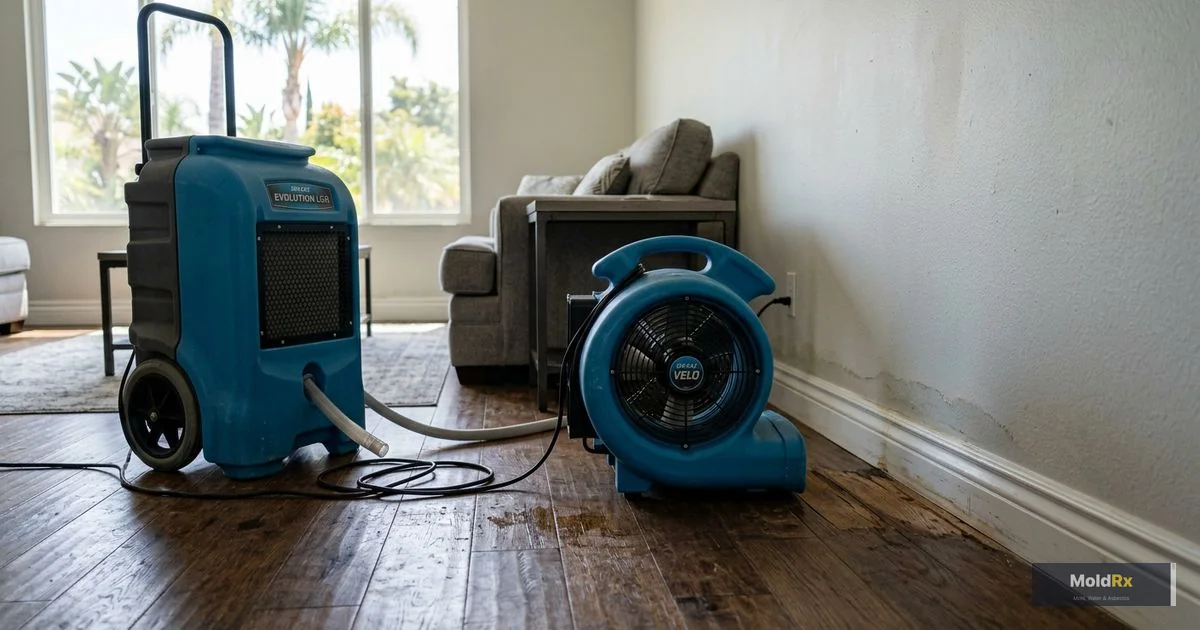
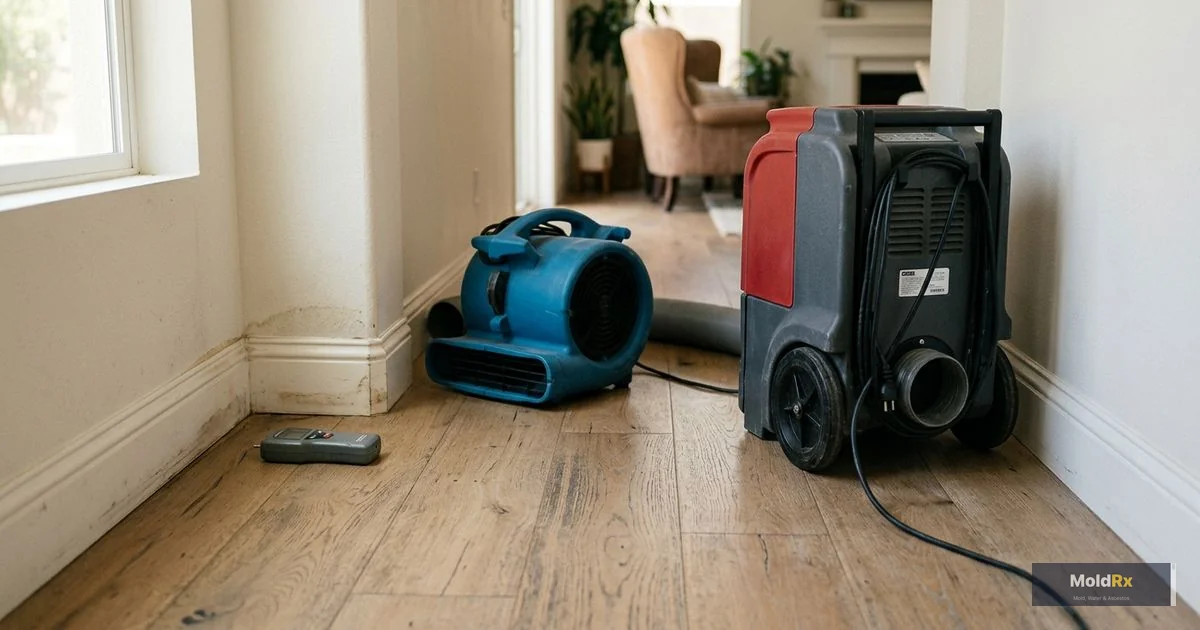
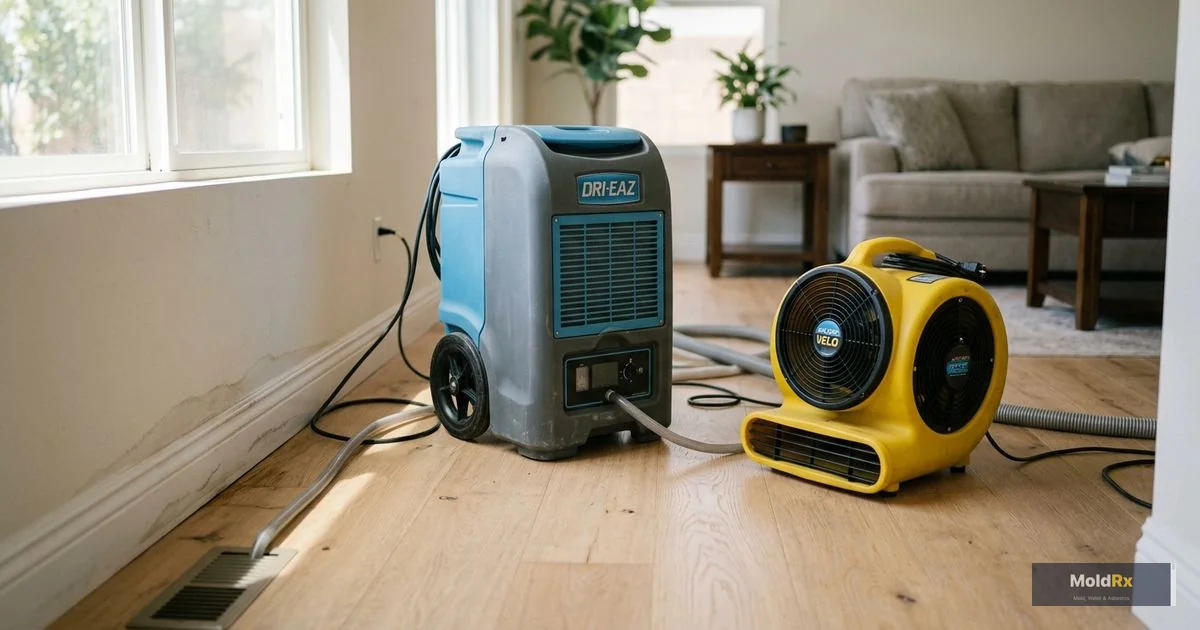
Industrial air movers and commercial dehumidifiers create a controlled drying environment that pulls moisture from building materials systematically. This is not guesswork. Moisture readings are taken daily at multiple points throughout the affected area, documenting the drying curve for each material type.
Structural drying in Rialto homes typically takes 3 to 7 days depending on the extent of saturation, the materials involved, and the ambient conditions. In summer, Rialto's low humidity and high temperatures actually assist the drying process — but only when combined with proper equipment placement and continuous dehumidification that prevents moisture from migrating to unaffected areas.
Drying is complete when moisture meters confirm that all affected materials have returned to their dry standard — the equilibrium moisture content for that material in Rialto's climate. Not when the surface feels dry. Not when the equipment has been running for a set number of days. When the measurements confirm it. This verification step is non-negotiable.
Step 4: Sanitization, Cleaning, and Restoration
Affected areas receive antimicrobial treatment appropriate to the water category. Salvageable contents are cleaned and restored. Materials that cannot be saved are removed, bagged, and properly disposed of. Depending on the extent of demolition required, restoration may include drywall replacement, flooring installation, baseboard and trim replacement, and painting.
For Rialto homeowners dealing with insurance claims, every step of this process is documented with photographs, moisture readings, material inventories, and detailed scope-of-work notes. This documentation is your protection during the claims process.
What to Expect When You Call MoldRx
-
Immediate Response: Water damage is an emergency, and we treat it as one. You will speak with a real person, and vetted specialists will be dispatched to your Rialto home immediately — day or night, weekday or weekend, holiday or not.
-
Complete Honesty: We will tell you exactly what we find — the full extent of damage, what can be saved, what cannot, and what the restoration will realistically involve. If the damage is less severe than you feared, you will hear that. If it is worse than it looks on the surface, you will hear that too. We do not inflate scope, and we do not minimize problems.
-
Clear Communication: You will understand every step of the process — what is happening, why it is necessary, and what comes next. Water damage restoration is stressful enough without being kept in the dark by the company you hired to help.
-
Verified Results: Equipment does not leave your home until moisture meters confirm that drying is complete. Period. This verification step is what separates professional restoration from the kind of half-finished work that leads to mold problems three weeks later.
Rialto Neighborhoods and Areas We Serve
MoldRx deploys vetted water damage restoration specialists to every neighborhood and community in Rialto, including Bel Air, Casa Blanca, Lytle Creek, Foothill, the established neighborhoods along Baseline Road, Riverside Avenue, and Ayala Drive, the Renaissance development area, and communities throughout the 92376 and 92377 ZIP code areas.
We also respond to water damage emergencies in neighboring cities including Fontana to the west, San Bernardino to the east, Colton to the south, Bloomington to the southeast, and Rancho Cucamonga to the northwest. Single-family homes, multi-family buildings, and commercial properties — we have the vetted specialists, the equipment, and the local expertise to handle it.
Related Services in Rialto
In addition to emergency water damage restoration, we also offer Mold Removal in Rialto, Asbestos Removal in Rialto, Water Damage Restoration in Rialto, Mold Testing in Rialto, and Asbestos Testing in Rialto services to Rialto property owners.
→ Learn more about remediation services in Rialto
Frequently Asked Questions
My Rialto home is flooding RIGHT NOW. What do I do first?
Shut off the water source if it is a plumbing failure — your main shutoff valve is typically near the front hose bib or where the supply line enters the house. If it is storm flooding, do not enter standing water that may be electrically energized from submerged outlets or appliances. Move to higher ground, shut off the electrical breaker if you can reach it safely, and call MoldRx immediately. Our specialists will guide you through additional safety steps while they are en route.
How bad is the water damage going to be in my 1960s Rialto home?
Homes built during Rialto's 1950s-1970s construction boom present specific challenges: galvanized pipes that corrode and rupture, particleboard subfloor that permanently decomposes when saturated, minimal insulation in wall cavities that allows unrestricted water migration, and original HVAC ductwork that traps moisture and breeds mold. The extent of damage depends entirely on the water source, duration of exposure, and how quickly professional restoration begins. Call now — every hour of delay allows water to penetrate deeper and damage more materials.
How much does water damage restoration cost in Rialto?
Costs are determined by the water category, affected square footage, materials involved, duration of exposure, and whether secondary damage has already developed. A contained Category 1 supply line break caught within hours is a fundamentally different project than a Category 3 sewage backup that sat for two days or Lytle Creek floodwater that inundated a ground floor. We provide detailed estimates after a thorough on-site assessment. Contact us to discuss your specific situation immediately.
Will my insurance cover water damage restoration in Rialto?
Most homeowner's policies cover sudden and accidental water damage — burst pipes, appliance failures, certain storm damage. Gradual damage from deferred maintenance, long-term slab leaks, and flood damage from rising water (including creek overflow) typically require separate coverage. Flood insurance through the NFIP or private carriers is especially important for Rialto properties in or near Lytle Creek flood zones. Our thorough documentation supports your claim regardless of carrier.
How long will the restoration take?
Minor, quickly-addressed incidents may complete in 3 to 5 days. Major water intrusion involving multiple rooms, Category 2 or 3 water, or extensive material replacement can take 1 to 3 weeks. We provide honest, realistic timelines after assessment. We do not rush the drying process — that is how mold problems develop — and we do not extend work unnecessarily.
I smell something musty but I do not see any water. Could it still be water damage?
Yes — and this is one of the most dangerous scenarios. A musty smell in a Rialto home often indicates a hidden water source that has been present long enough for mold to establish. Slab leaks, slow pipe failures inside wall cavities, and condensation issues in HVAC systems can all produce moisture that is invisible from the living space but actively growing mold behind walls, beneath flooring, or inside ductwork. Do not ignore a musty smell. Call MoldRx for an assessment before the hidden damage expands further.
Your Rialto Home Is Taking Damage Right Now — Every Hour Counts
Water does not negotiate. It does not pause while you compare quotes, read reviews, or wait for your insurance company to call back. Right now, in this moment, moisture is migrating deeper into your home's structure. Materials that could be saved today may be unsalvageable tomorrow. Mold spores that are dormant now will be active colonies within 24 to 48 hours.
MoldRx was built for exactly this situation — Rialto homeowners facing real water damage emergencies who need vetted professionals, not sales pitches. Every specialist we deploy knows the Inland Empire: the aging infrastructure that causes failures, the Lytle Creek drainage patterns that cause flooding, the soil conditions that cause slab leaks, and the climate that accelerates mold growth after every water intrusion event.
Call MoldRx now. Not after you eat dinner. Not after you sleep on it. Not after you "see if it dries." It will not dry on its own, and the damage is getting worse with every passing hour. We will assess your situation honestly, deploy vetted specialists immediately, and restore your Rialto home the right way — because your home, your health, and your investment deserve nothing less.