Emergency Water Damage Restoration in Rancho Santa Margarita, CA -- MoldRx
Vetted, IICRC S500-Certified Specialists Serving Rancho Santa Margarita and South Orange County -- 24/7
Water is inside your Rancho Santa Margarita home right now, and every minute it stays there it is destroying something. Subfloor warping. Drywall wicking moisture upward into the wall cavity. Cabinetry swelling. The adhesive under your engineered hardwood separating. Within 24 to 48 hours, mold colonization begins -- and at that point you are no longer dealing with a water damage emergency. You are dealing with two emergencies at once. If you are reading this because water has already entered your property, stop scrolling and call.
Call (888) 609-8907 now for emergency water damage response in Rancho Santa Margarita.
MoldRx does not perform restoration work ourselves. We vet the specialists who do. Every water damage professional we send to your Rancho Santa Margarita property has been screened for IICRC S500 certification, proper CSLB licensing, verified insurance, and documented experience handling the exact building types and water-damage scenarios found throughout this master-planned community. You get the right crew -- not whoever happens to answer the phone at 2 AM.
Why Water Damage in Rancho Santa Margarita Demands Immediate Action
Rancho Santa Margarita is not a generic suburb, and your water damage situation is not a generic problem. The city's geography, construction era, and proximity to the Santa Ana Mountains create a convergence of risk factors that make water intrusion here uniquely dangerous -- and uniquely time-sensitive.
Homes Built Fast During a Compressed Construction Window
The first homes in the Rancho Santa Margarita master-planned community went on sale in 1986. Growth exploded through the late 1980s and 1990s, fueled by the economic boom and the completion of Oso, Antonio, and Alicia Parkway extensions in 1992 that connected RSM to the rest of Orange County. Nearby Dove Canyon, Robinson Ranch, Wagon Wheel, and a handful of smaller developments followed in rapid succession. By the time residents voted to incorporate and the City of Rancho Santa Margarita became Orange County's 33rd city on January 1, 2000, the vast majority of the community's housing stock was already built.
That timeline matters for one reason: most homes in Rancho Santa Margarita are now 25 to 40 years old, and they share predictable failure points that are converging right now:
- Copper supply lines corroded by chloramine -- South Orange County's municipal water supply contains chloramine concentrations that have been documented to cause pinhole leaks in the copper pipes used extensively in RSM-era construction. Homes hitting the 30- to 40-year mark are in the peak failure window.
- Slab-on-grade foundations common throughout RSM, where supply-line leaks can run for weeks beneath the concrete before you detect any surface-level sign. By the time you see water, the damage footprint is already far larger than what is visible.
- Original water heaters long past their 10-15 year service life -- many replaced once, many now overdue for a second replacement
- Aging washing machine supply hoses and dishwasher connections -- the single most common source of catastrophic residential water damage in the United States
- Second-floor laundry rooms and bathrooms in RSM's common multi-story layouts, where a leak on the upper level travels through walls, ceilings, and floor assemblies before you notice anything on the ground floor
When any of these failure points activate, you are not dealing with a slow drip. You are dealing with water moving through building materials that have already been weakened by decades of thermal cycling, settling, and the hard-water mineral deposits endemic to South Orange County.
Mountain Runoff, Trabuco Canyon, and the Post-Fire Reality
Rancho Santa Margarita sits in the foothills of the Santa Ana Mountains. The Arroyo Trabuco and its major tributaries -- Trabuco Creek and Bell Creek -- originate in those mountains and flow directly through and adjacent to the community. The Arroyo Trabuco valley forms a large alluvial plain called "Plano Trabuco" in the northern part of the watershed, encompassing suburban Rancho Santa Margarita.
This geography creates real flood exposure. Urbanization has more than doubled peak flows through the watershed since the 1960s. In 2005, pumps had to be installed on Tick and Dove Creeks -- tributaries of Bell Canyon -- to remove urban runoff from 1,100 acres of residential areas in eastern Rancho Santa Margarita, diverting excess flow to storage basins. The 1996 and 2005 floods caused significant damage along the San Juan and Arroyo Trabuco corridors.
And now there is a new variable. On September 9, 2024, the Airport Fire ignited in Trabuco Canyon and burned 23,000+ acres of the Santa Ana Mountains directly above Rancho Santa Margarita, destroying over 110 homes across Orange and Riverside Counties. That burn scar has fundamentally altered the hydrology of every drainage that feeds into the RSM area. Fire-scorched soil develops a hydrophobic top layer that repels water instead of absorbing it, turning mountain slopes into chutes that channel mud, debris, and stormwater directly toward downhill communities.
The consequences have been immediate and ongoing. Orange County has issued mandatory evacuation orders for Trabuco Creek, Bell Canyon, and Hot Springs Canyon areas multiple times since the fire -- in October 2024, December 2024, February 2025, and March 2025 -- each time heavy rain threatened the burn scar. Properties in lower-elevation areas near creek corridors and storm-drain outfalls now face debris-flow and flash-flood risk that did not exist at this magnitude before September 2024.
If you live anywhere near the eastern foothills of RSM -- Dove Canyon, Trabuco Highlands, Robinson Ranch, or the Trabuco Canyon corridor -- your water damage risk profile has changed permanently. Storm-driven water intrusion in this area is no longer a theoretical concern. It is an active, documented, recurring emergency.
13,645 Homes Under One Master Association -- Shared Infrastructure, Shared Vulnerability
SAMLARC (Rancho Santa Margarita Landscape and Recreation Corporation) manages one of the largest master-planned communities in California, encompassing roughly 13,645 homes. The city's approximately 17,500 housing units include a significant percentage of attached housing -- condominiums, townhomes, and multi-unit structures that share walls, ceilings, and plumbing infrastructure.
In attached housing, water damage is almost never a single-unit problem. A burst supply line in one unit sends water through shared walls, down into the unit below, across common-area corridors. A single failure point can damage three, four, five units simultaneously. For HOA boards and property managers: the specialists we vet understand multi-unit triage, IICRC S500 protocols for shared structures, and the documentation requirements that HOA insurance carriers demand.
The IICRC S500 Restoration Process Our Vetted Specialists Follow
The professionals MoldRx sends to your Rancho Santa Margarita property do not improvise. They follow the IICRC S500 Standard and Reference Guide for Professional Water Damage Restoration -- the ANSI-accredited, industry-recognized protocol that defines how this work must be done. Here is what that looks like when it is done right.
Step 1: Emergency Response and Loss Assessment
When you call (888) 609-8907, we deploy a vetted specialist to your Rancho Santa Margarita property for immediate assessment. They will:
- Identify and stop the water source -- whether it is a corroded copper supply line, failed water heater, appliance malfunction, roof intrusion, storm runoff from the Trabuco Canyon watershed, or sewage backup
- Classify the water category per IICRC S500 standards:
- Category 1 (Clean Water): Originates from a sanitary source -- broken supply lines, sink overflows, toilet-tank cracks, melting ice. Lowest contamination risk but still demands rapid extraction because Category 1 water degrades to Category 2 and then Category 3 the longer it sits.
- Category 2 (Gray Water): Contains significant contamination that can cause illness -- dishwasher or washing machine discharge, toilet overflows with urine, HVAC condensate line failures, sump pump backups. Requires enhanced PPE and antimicrobial protocols.
- Category 3 (Black Water): Grossly contaminated water -- sewage backups, floodwater from Trabuco Creek or Arroyo Trabuco, storm-drain intrusion, post-fire debris-flow water, any Category 1 or 2 water that has been sitting long enough to degrade. Cal/OSHA hazmat protocols apply. This is the most dangerous and most expensive scenario, and it demands immediate professional intervention. With the Airport Fire burn scar actively channeling contaminated runoff into RSM-area drainages, Category 3 storm-water intrusion is now a front-of-mind risk for foothill properties.
- Determine the damage class per IICRC standards:
- Class 1: Least amount of water absorption -- small area, minimal material saturation
- Class 2: Significant absorption into carpets, cushions, and wicking up walls to 24 inches
- Class 3: Greatest absorption -- water from overhead, saturating ceilings, walls, insulation, carpet, and subfloor. Common in RSM's multi-story homes when an upstairs leak cascades downward.
- Class 4: Specialty drying situations involving hardwood, plaster, concrete, or stone -- materials with very low permeance that trap moisture. Extremely common in RSM's slab-on-grade construction where water migrates laterally beneath flooring in ways invisible to the eye.
- Map the full moisture footprint using infrared thermal imaging and penetrating moisture meters -- critical in Rancho Santa Margarita's slab-on-grade homes where the damage you can see is almost always smaller than the damage that actually exists
- Document everything with timestamped photography and written reports for insurance and, in multi-unit or HOA scenarios, association records
Step 2: Water Extraction
Standing water is removed immediately using truck-mounted and portable extraction units. For RSM condos and townhomes, where access constraints are common and shared-wall damage demands precision, our specialists use targeted extraction equipment that removes water without creating additional damage to adjacent units.
Speed is everything in this phase. Every hour water remains in contact with building materials increases the damage class, elevates the contamination category, and expands the scope and cost of restoration. Category 1 water degrades to Category 2, then Category 3 over time -- the clock is working against you from the moment water touches a surface. The specialists we vet understand that extraction must be thorough, not approximate.
Step 3: Structural Drying and Dehumidification
This phase separates competent restoration from the kind that generates a mold remediation project six weeks later.
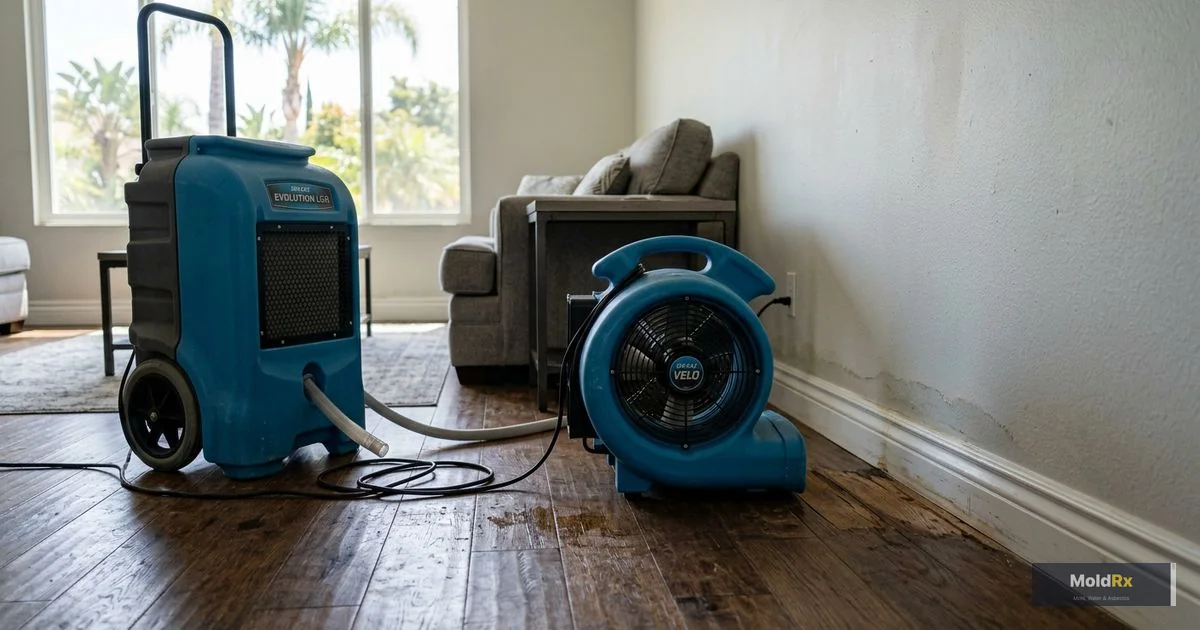
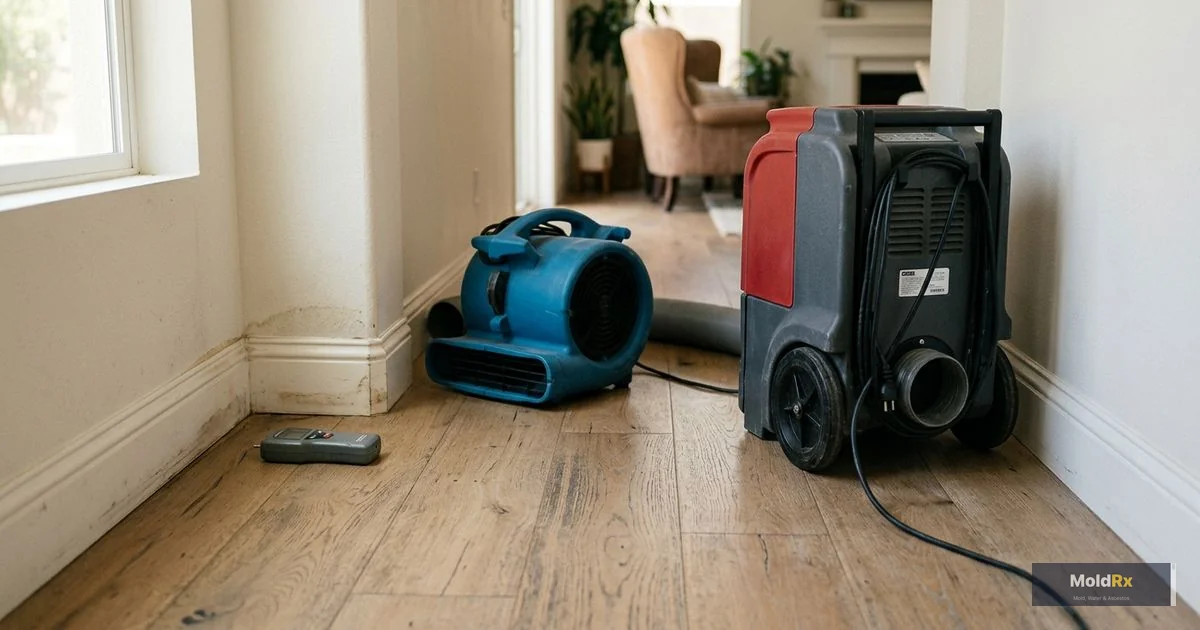
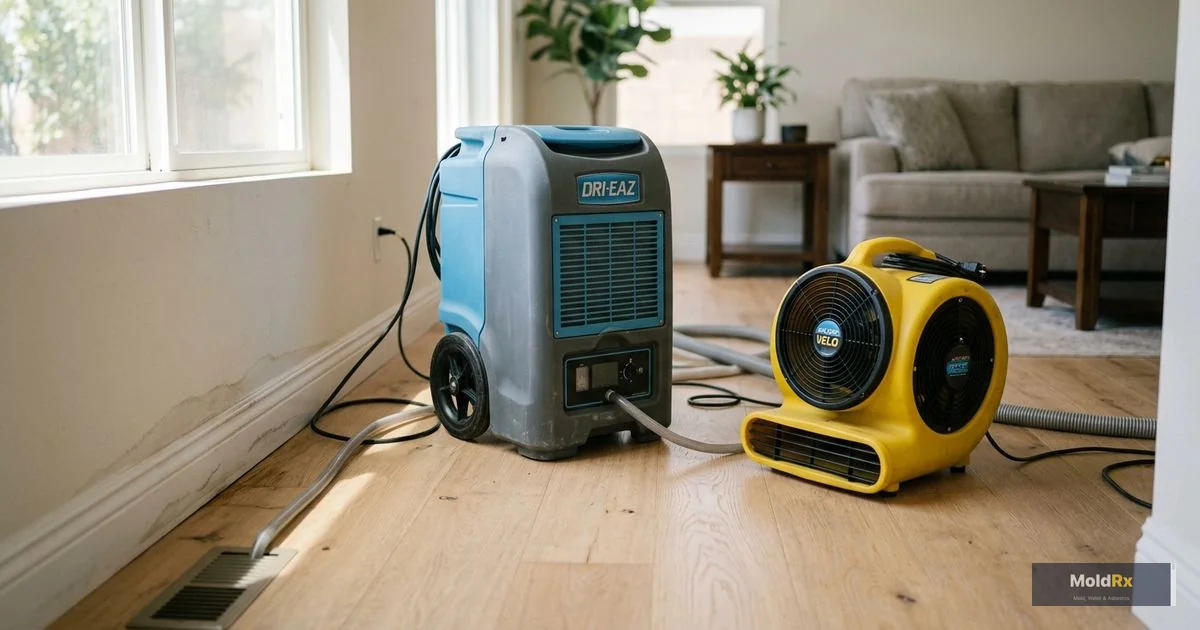
Our vetted specialists deploy commercial-grade LGR (low-grain refrigerant) dehumidifiers and high-velocity air movers in configurations calculated for each affected space. Rancho Santa Margarita's inland foothill location means temperatures swing significantly between day and night, and humidity levels can spike during winter storm cycles and marine-layer intrusions from the coast roughly 15 miles west. The drying protocol must account for these environmental variables. Standard residential dehumidifiers cannot do this work.
Drying is monitored daily with calibrated moisture meters and hygrometers. The specialists document psychrometric readings -- temperature, relative humidity, grain depression -- to verify that conditions are progressing toward the IICRC S500 drying goals for each material type. Drying is not complete when the carpet feels dry to the touch. It is complete when instrument readings confirm that all affected materials have returned to their normal equilibrium moisture content. In Class 4 situations involving RSM's common slab-on-grade construction, this may require specialty techniques like desiccant dehumidification or heat drying systems that force moisture out of concrete and hardwood from the inside out.
Step 4: Cleaning, Sanitization, and Antimicrobial Treatment
Once the structure is dry, the contamination level dictates what comes next:
- Category 1 losses: Cleaning and drying may be sufficient for salvageable materials
- Category 2 losses: All affected porous materials that cannot be adequately cleaned must be removed. Semi-porous materials require antimicrobial treatment. EPA-registered antimicrobial products are used per label instructions.
- Category 3 losses: All affected porous materials are removed and discarded -- no exceptions. This includes drywall, insulation, carpet, pad, and any organic material that contacted the contaminated water. Structural framing is cleaned, treated, and verified before reconstruction begins. In sewage-backup or post-fire-runoff scenarios, IICRC S520 mold remediation protocols may run concurrently if microbial growth is identified during the drying phase.
Step 5: Reconstruction and Restoration
The final phase returns your property to pre-loss condition: drywall replacement, flooring reinstallation, painting, trim work, and any structural repairs identified during the drying phase. Our vetted specialists coordinate this work to minimize disruption -- particularly important in multi-unit RSM properties where displaced residents and HOA timelines add pressure to an already stressful situation.
What Category and Class Mean for Your Rancho Santa Margarita Property
Understanding the IICRC classification system protects you from being oversold -- or undersold -- on restoration scope. Here is what each designation means in the context of damage scenarios common to RSM.
| Classification | What It Means | Common Rancho Santa Margarita Scenarios |
|---|---|---|
| Category 1 | Clean water from a sanitary source | Corroded copper supply line failure, ice-maker line burst, toilet-tank crack |
| Category 2 | Contaminated water causing potential illness | Washing machine overflow, dishwasher backup, HVAC condensate line failure |
| Category 3 | Grossly contaminated / black water | Sewage backup, Trabuco Creek floodwater intrusion, post-fire debris-flow runoff, any stagnant water 48+ hours |
| Class 1 | Minimal absorption, small area | Leak caught early, limited to one room with hard-surface flooring |
| Class 2 | Significant absorption, water wicking up walls | Burst supply line in a home with carpet, water reaching adjacent rooms or units |
| Class 3 | Greatest absorption, water from overhead | Second-floor leak saturating ceiling, walls, and flooring of ground level |
| Class 4 | Specialty drying -- low-permeance materials | Water trapped in slab-on-grade concrete, hardwood floors, plaster walls |
The higher the category and class, the more complex, time-consuming, and costly the restoration. But cutting corners on a Category 3 / Class 3 loss to save money in the short term virtually guarantees a mold remediation project within weeks -- which will cost significantly more than doing it correctly the first time.
Request your free estimate now -- or call (888) 609-8907 for immediate emergency response.](tel:8886098907)
Rancho Santa Margarita Neighborhoods We Serve
Our vetted water damage restoration specialists respond to emergencies throughout Rancho Santa Margarita and the surrounding foothill communities, including:
- Dove Canyon -- hillside homes with canyon-exposure drainage vulnerabilities and direct proximity to the Airport Fire burn scar
- Robinson Ranch -- family neighborhoods in the northeastern Trabuco Canyon corridor with large-lot single-family homes
- Melinda Heights -- northeastern RSM, mixed home styles, vulnerable to aging-plumbing failures typical of late-1980s construction
- Trabuco Highlands -- spacious mountain-view homes with elevated storm-runoff and debris-flow exposure
- Rancho Cielo -- hillside properties with slope-drainage challenges during heavy rain events
- Wagon Wheel and the Village area neighborhoods
- The neighborhoods surrounding Lago Santa Margarita and Central Park
- Properties along the Tijeras Creek and Arroyo Trabuco corridors
We cover ZIP codes 92688 and 92679, and we respond to water damage emergencies in neighboring South Orange County communities including Mission Viejo, Coto de Caza, Las Flores, Trabuco Canyon, Lake Forest, and Ladera Ranch.
Why MoldRx -- And Why "Vetted" Is Not a Marketing Word
There are dozens of restoration companies in Orange County that will answer the phone at 2 AM and promise to be at your Rancho Santa Margarita property within the hour. Some of them are excellent. Some of them are not licensed, not insured, not trained, and not accountable when they leave moisture behind your walls and you discover mold growth two months later.
MoldRx exists because we saw that problem firsthand and built a solution. We do not perform restoration ourselves. We vet the people who do, and we only send specialists who meet every one of these criteria:
- IICRC S500 certification for water damage restoration -- the ANSI-accredited standard that defines how professional water damage work must be performed
- IICRC S520 certification for mold remediation -- because water damage and mold overlap constantly, and the specialists responding to your RSM home need to recognize and address microbial amplification the moment it appears
- Active CSLB contractor's license in good standing with the California State License Board
- Verified general liability and workers' compensation insurance -- protecting you from liability if an accident occurs on your property
- Documented experience with the specific building types in Rancho Santa Margarita: slab-on-grade construction, multi-story layouts with second-floor plumbing, attached HOA properties, hillside homes with drainage challenges
- Cal/OSHA compliance for worker safety protocols, particularly critical in Category 3 / black-water scenarios and post-fire debris-flow contamination
- EPA-compliant antimicrobial treatment protocols -- especially important for Category 2 and Category 3 losses where contamination must be neutralized before reconstruction begins
When we say "vetted," we mean we have verified every credential, called references, and confirmed that these specialists do the work the right way -- per IICRC S500 and EPA guidelines, with proper documentation, honest communication, and accountability. We only send vetted professionals because sending anything less is not something we are willing to do.
Get your free estimate from a vetted specialist now -- or call (888) 609-8907 any time, day or night.](tel:8886098907)
Insurance and Documentation
Most Rancho Santa Margarita homeowner policies cover sudden and accidental water damage -- a burst pipe, a failed water heater, an appliance malfunction. What they typically do not cover is gradual damage from deferred maintenance, and standard policies almost never cover flood damage (which requires a separate NFIP or private flood policy -- increasingly relevant for RSM properties near the Trabuco Creek and Arroyo Trabuco corridors, especially post-Airport Fire).
Our vetted specialists understand what insurance adjusters need:
- Timestamped photo and video documentation of all affected areas before, during, and after restoration
- Moisture readings and psychrometric data supporting the drying protocol and confirming completion
- Itemized scope of work with IICRC-standard line items that adjusters can process without pushback
- Category and class determination documented per IICRC S500 standards -- this directly affects what your policy will cover and how much it will pay
- Cal/OSHA compliance records for Category 3 losses, demonstrating that hazmat protocols were followed
For Rancho Santa Margarita HOA and multi-unit situations, documentation requirements multiply. Our specialists know how to produce the records that HOA master policies, individual unit-owner policies, and liability carriers all require -- often for the same loss event involving multiple units and multiple policies.
Frequently Asked Questions
How fast can a vetted specialist reach my Rancho Santa Margarita property?
For active water emergencies, our goal is same-day deployment -- often within hours. Call (888) 609-8907 any time, day or night. Water damage does not wait for business hours and neither do we. The difference between a manageable restoration and a full reconstruction often comes down to hours, not days.
What is the difference between Category 1, 2, and 3 water damage?
Category 1 is clean water from a sanitary source (supply line break, toilet tank). Category 2 is contaminated water that can cause illness (appliance discharge, washing machine overflow). Category 3 is grossly contaminated black water (sewage, floodwater from Trabuco Creek, post-fire debris-flow runoff, any water stagnant for 48+ hours). The category determines the safety protocols, PPE requirements, and whether porous materials can be saved or must be removed. Categories 1-3 are defined by the IICRC S500 standard, and the category escalates the longer water sits untreated.
My home is near the Airport Fire burn scar area. Is storm-water intrusion treated differently?
Yes. Post-fire runoff carries ash, sediment, heavy metals, and other contaminants that classify it as Category 3 (black water) under IICRC S500 standards. This requires the most aggressive restoration protocol -- all affected porous materials must be removed, Cal/OSHA hazmat procedures apply, and EPA-registered antimicrobial treatments are mandatory. If your Rancho Santa Margarita property is in the Dove Canyon, Robinson Ranch, Trabuco Highlands, or Trabuco Canyon corridor, storm-water intrusion during heavy rain events should be treated as a Category 3 emergency until testing proves otherwise.
I have a slab leak -- how do I know before it causes major damage?
Slab leaks are extremely common in Rancho Santa Margarita due to the combination of slab-on-grade construction and chloramine concentrations in South Orange County's water supply that corrode copper pipes over time. Warning signs include unexplained increases in your water bill, warm spots on the floor, the sound of running water when all fixtures are off, cracks in flooring or baseboards, and a persistent musty smell. If you suspect a slab leak, do not wait. Call (888) 609-8907 -- early detection is the difference between a targeted repair and a Class 4 restoration involving specialty drying of concrete and structural materials.
My second-floor bathroom leaked into the downstairs. How bad is this?
A second-floor leak in an RSM multi-story home is typically a Class 3 loss -- water from overhead saturating ceilings, wall cavities, insulation, and flooring of the level below. The damage is almost always more extensive than what is visible, because water travels through framing and wall cavities before it shows on surfaces. Infrared thermal imaging and penetrating moisture meters are required to map the full extent. Do not assume that a dry-looking ceiling means the problem is contained.
Will my insurance cover water damage restoration?
Most homeowner policies cover sudden and accidental water damage -- burst pipes, appliance failures, water heater malfunctions. Gradual damage from deferred maintenance is typically excluded. Standard policies almost never cover flood damage, which requires a separate NFIP or private flood policy. Our vetted specialists document everything per IICRC S500 standards to give your adjuster exactly what they need to process your claim. If you have questions about coverage before you file, call us -- we can help you understand what to expect.
How long does water damage restoration take in Rancho Santa Margarita?
Timeline depends on the category and class of damage. A Category 1 / Class 1 or Class 2 loss may be dry in 3-5 days. A Category 3 / Class 3 loss involving contamination removal, structural drying, and reconstruction can take 1-3 weeks. Class 4 situations involving RSM's slab-on-grade concrete may require specialty drying techniques that extend the timeline further. You will receive a realistic timeline after the initial assessment -- not an optimistic guess designed to win the job.
Can water-damaged materials be saved?
Many materials can be saved if addressed within 24-48 hours and the water is Category 1 -- hardwood floors, drywall, and carpeting often survive when dried properly per IICRC S500 protocols. Porous materials exposed to Category 2 or Category 3 water generally must be removed. The longer water sits untreated, the fewer materials are salvageable. Time is the single most important variable in determining what can be saved versus what must be replaced.
Related Services in Rancho Santa Margarita
Water damage and mold are rarely isolated problems. When one appears, the other is usually close behind -- especially in Rancho Santa Margarita's foothill climate where moisture, warmth, and organic building materials create ideal conditions for microbial growth. MoldRx connects Rancho Santa Margarita property owners with vetted specialists for:
- Mold Removal in Rancho Santa Margarita
- Mold Testing in Rancho Santa Margarita
- Asbestos Removal in Rancho Santa Margarita
- Asbestos Testing in Rancho Santa Margarita
-> Learn more about remediation services in Rancho Santa Margarita
Water Is in Your Rancho Santa Margarita Home Right Now. Here Is What to Do.
Every hour you wait, the damage category escalates, the restoration scope expands, the cost increases, and mold gets closer to establishing a foothold that turns a water damage project into a full remediation. This is not a scare tactic. It is building science. It is what the IICRC S500 standard exists to address, and it is why the EPA identifies standing water as the single most preventable cause of indoor mold contamination.
You need a vetted, IICRC S500-certified specialist who knows Rancho Santa Margarita's slab-on-grade construction, chloramine-corroded copper pipes, multi-story layouts, hillside drainage patterns, the post-Airport Fire burn-scar reality, and the HOA dynamics that make multi-unit water events exponentially more complicated. MoldRx only sends professionals who meet that standard -- because sending anything less is not something we are willing to do.
Get your free estimate now -- or pick up the phone.
Call (888) 609-8907 for emergency water damage restoration in Rancho Santa Margarita.
No runaround. No upselling. Just vetted professionals, honest answers, and the urgency this situation demands.