Asbestos Testing in Rancho Mirage, CA -- MoldRx
Licensed Asbestos Testing Professionals Serving Rancho Mirage and the Coachella Valley
Rancho Mirage is one of the most architecturally significant communities in the California desert. Mid-century estates designed by William F. Cody, Donald Wexler, William Krisel, and E. Stewart Williams line the fairways of legendary country clubs that invented the golf-course-adjacent lifestyle Americans now take for granted. It is also a community where the vast majority of residential construction occurred during the exact decades when asbestos was a standard building material -- mixed into floor tiles, ceiling texture, pipe insulation, joint compound, roofing felt, and cement siding by manufacturers who valued its fire resistance, tensile strength, and durability in extreme desert heat.
If you are planning a renovation, preparing a property for sale, or updating a home you intend to keep for years, asbestos testing is not an optional line item. It determines whether your project proceeds with standard methods or requires licensed abatement by a CSLB C-22 certified contractor before anyone picks up a hammer. SCAQMD Rule 1403 requires an asbestos survey before disturbing building materials in any structure slated for renovation or demolition. In Rancho Mirage -- where housing dates to the 1950s through 1980s and many properties have never been significantly remodeled -- the probability of finding asbestos-containing materials is high.
MoldRx only sends vetted asbestos testing professionals who understand Coachella Valley construction history, follow EPA and Cal/OSHA Section 1529 sampling protocols, and use NVLAP-accredited laboratories for every analysis.
Request your free estimate -- we will help you determine whether testing is needed for your project.
Why Rancho Mirage Properties Carry Elevated Asbestos Risk
Rancho Mirage's development history is inseparable from the era of asbestos use in American construction. Understanding that connection is the foundation of responsible pre-project planning.
The Country Club Capital of the World
Rancho Mirage's residential history begins with two country clubs. Thunderbird Country Club opened in 1951 after architect William F. Cody converted the Thunderbird Dude Ranch into the world's first housing development facing a golf course. Tamarisk Country Club followed in 1952, founded by the Marx Brothers and entertainment-industry investors including Jack Benny and George Burns. When Frank Sinatra relocated to Tamarisk in 1954, the community's trajectory was set.
Through the 1960s, homebuilders expanded rapidly. Cody designed more than a dozen residences and multi-unit communities around Thunderbird and Tamarisk. Sunnylands -- the Annenberg estate designed by A. Quincy Jones -- was completed in 1966. By the early 1970s, thousands of condominiums were under construction at Mission Hills, The Springs, and Sunrise. A 1974 Desert Sun article labeled Rancho Mirage "The Country Club Capital of the World," with 5,000 dwelling units in progress that year.
Every phase of this growth -- 1950s estates, 1960s residences along Frank Sinatra Drive and Bob Hope Drive, 1970s condominium booms -- coincides with peak asbestos use. The mineral was incorporated into an estimated 3,000 to 5,000 distinct building products, valued for fire resistance and durability in desert construction where extreme heat and year-round HVAC demand were constant.
An Affluent Community with Preserved Original Materials
Rancho Mirage has approximately 18,000 permanent residents with a median age of 65 -- nearly half the population is 65 or older. More than 40 percent of housing units sit vacant at any given time, reflecting the city's large seasonal and snowbird population. Owner-occupied homes account for over 80 percent of occupied units.
This combination means many homes have been gently used and carefully preserved rather than stripped and remodeled. Original 1960s floor tiles remain beneath area rugs. Popcorn ceilings from the 1970s are still intact in guest bedrooms. Pipe insulation installed decades ago wraps ductwork that has run without interruption. The materials look fine -- and that is precisely the problem. They contain the same asbestos concentrations as the day they were installed, and renovation is the event that disturbs them.
Desert Climate and Material Preservation
The Coachella Valley's extreme climate creates a paradox. Summer temperatures routinely reach 110 to 118 degrees, annual rainfall averages under five inches, and humidity drops below 20 percent. These conditions preserve ACM far longer than humid climates -- no moisture-driven deterioration, no freeze-thaw cycling, no biological decay. That preservation becomes hazardous at renovation time: a well-preserved popcorn ceiling in a 1968 estate releases substantial fiber when scraped because the material has not degraded. Low humidity means airborne fibers travel farther and remain suspended longer. Materials in unconditioned spaces -- attics, garages, exterior roofing -- endure thermal cycling that makes them friable even when interior materials remain solid.
When Asbestos Testing Is Necessary in Rancho Mirage
Not every project requires testing, but in a community with Rancho Mirage's construction vintage, more situations call for it than most homeowners expect.
Before Any Renovation or Demolition (California Law)
SCAQMD Rule 1403 requires an asbestos survey before renovation or demolition in the South Coast district, which includes all of Riverside County. The survey must be completed by a California State Certified Asbestos Consultant (CAC) who holds a current AHERA Building Inspector certificate from a Cal/OSHA-approved course before the City of Rancho Mirage will issue a permit. The only narrow exception is single-unit dwelling renovation disturbing less than 100 square feet of intact material -- a threshold most kitchen remodels, bathroom updates, and flooring projects exceed on day one.
Notification must be submitted to SCAQMD at least 10 working days before any demolition project begins, regardless of whether asbestos was found. Non-compliance penalties can exceed $20,000 per day.
Before Purchasing or Selling a Property
In Rancho Mirage's luxury market -- where mid-century estates and country club villas regularly trade in the seven figures -- pre-transaction testing is a planning essential. California disclosure laws require sellers to report known hazards. A pre-purchase test gives buyers a clear picture of what renovation will actually cost after closing, and sellers who test proactively avoid renegotiations during escrow.
When Materials Show Visible Damage
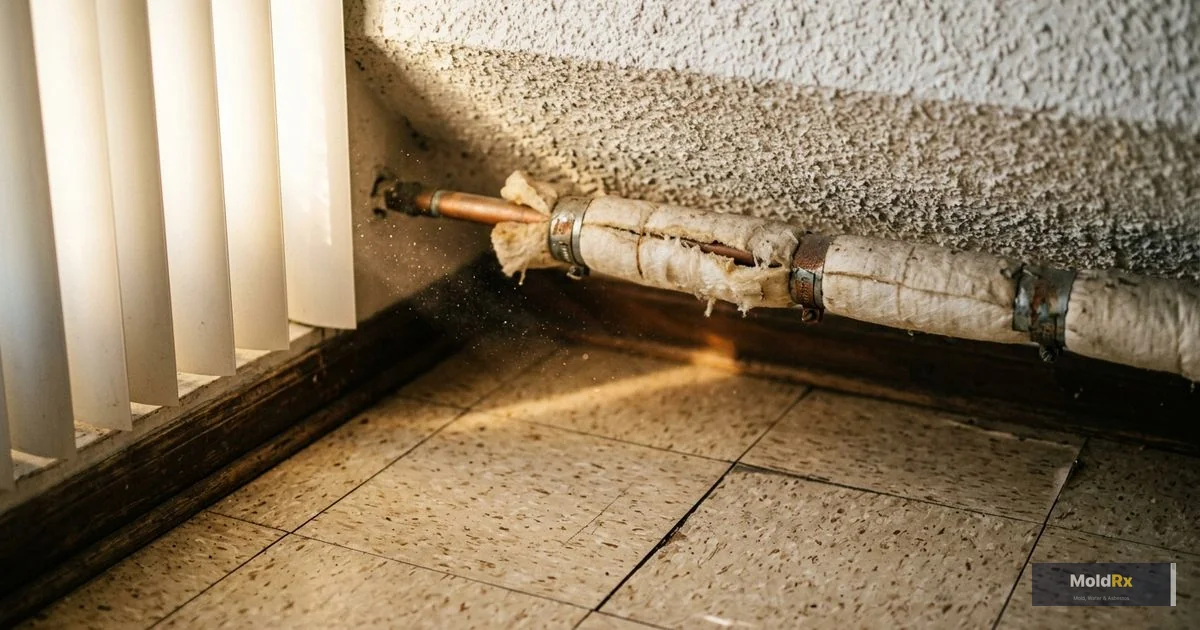
Crumbling pipe insulation in a garage, flaking ceiling texture in a pool house, cracked floor tiles pulling away from substrate -- damaged ACM can release fibers during normal daily activity without any renovation underway. Testing identifies whether the damaged material contains asbestos so you can make informed decisions about repair, encapsulation, or removal.
Before Roof Replacement, HVAC Upgrades, or Whole-Home Remodels
Roofing felt and flashing cement from the 1960s and 1970s commonly contain asbestos. HVAC ductwork insulation and pipe wrapping are among the most likely ACM in local homes. Vinyl floor tiles and their black mastic adhesive test positive at high rates. Testing determines whether standard construction methods apply or whether licensed abatement by a CSLB C-22 contractor must happen first.
For Seasonal Residents Planning Off-Season Work
Many Rancho Mirage homeowners schedule renovations during summer months when they are not occupying the property. Contractors working in your absence still need a completed asbestos survey before disturbing materials, and SCAQMD notifications must be filed if ACM is found. Planning testing during your winter visit ensures results are in hand before summer construction begins.
Common Asbestos-Containing Materials in Rancho Mirage Homes
Rancho Mirage's housing stock spans distinct construction eras, each with its own asbestos profile. Knowing what to expect based on your home's age and style helps set realistic expectations before testing begins.
Floor Tiles and Mastic (9-inch by 9-inch Vinyl)
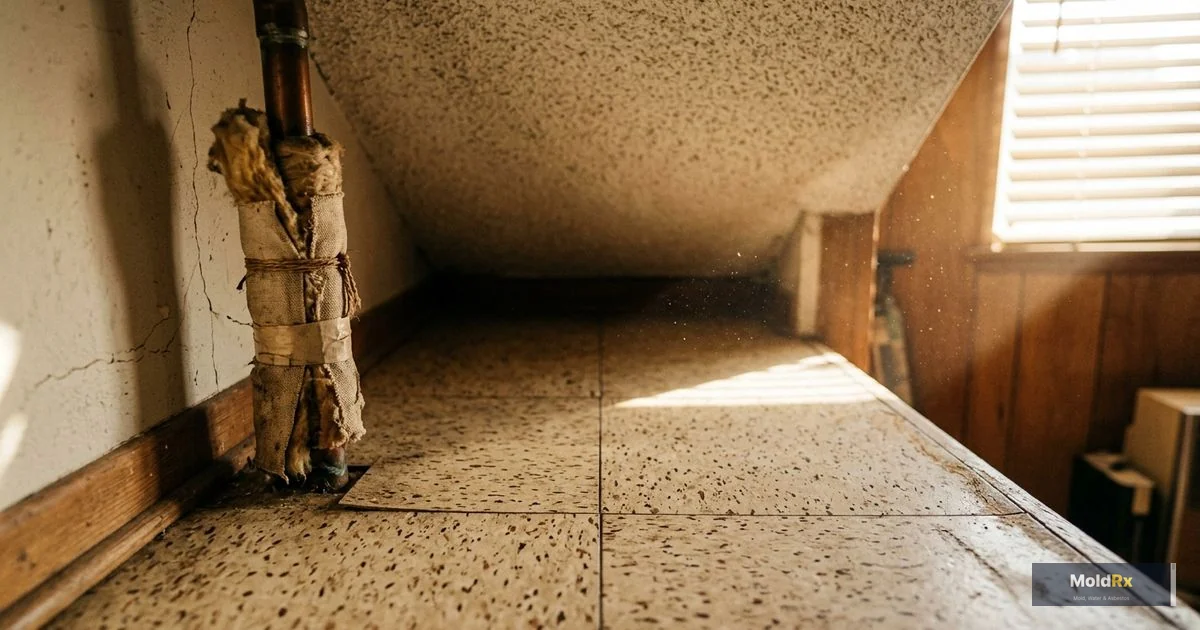
The signature 9-inch by 9-inch vinyl floor tile -- manufactured from the 1950s through the early 1980s -- contained 5 to 70 percent chrysotile asbestos. The black cutback adhesive (mastic) beneath frequently contains asbestos as well. In Rancho Mirage estates around Thunderbird and Tamarisk, these tiles are commonly hidden beneath newer carpet, hardwood, or tile installations. Intact tiles pose low risk while undisturbed, but sanding, scraping, or breaking them during removal releases fibers into your living space. Only laboratory analysis using PLM (Polarized Light Microscopy) can determine whether a specific tile contains asbestos.
Popcorn and Textured Ceilings
Spray-applied textured ceilings were standard practice from the mid-1960s through 1980. The EPA banned asbestos in spray-applied surfacing in 1978, but existing inventory continued to be installed into the early 1980s. Condominiums at Mission Hills, The Springs, and Sunrise from this era frequently have popcorn or stippled ceilings containing chrysotile asbestos. Scraping textured ceilings without testing is one of the most common sources of residential asbestos exposure -- and one of the most avoidable.
Pipe and Duct Insulation
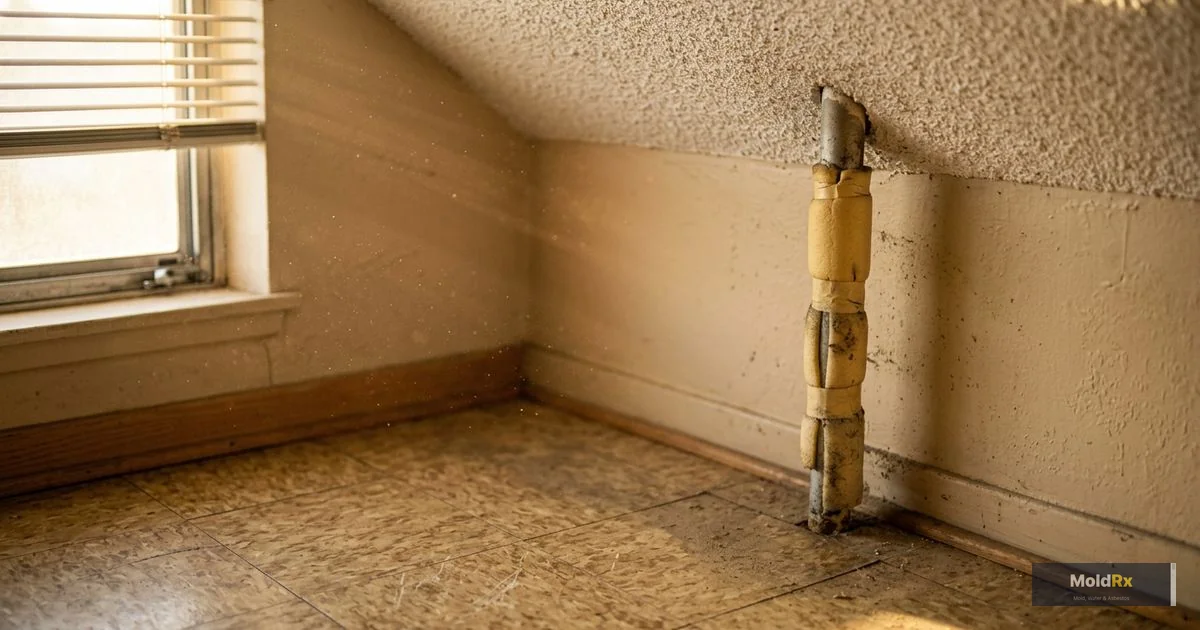
Corrugated paper wrap, calcium-silicate blocks, and air-cell insulation on HVAC components in pre-1980 homes commonly contain asbestos. Under Cal/OSHA Section 1529, all thermal system insulation in pre-1980 buildings is legally presumed to contain asbestos until testing proves otherwise -- your contractor is required to treat it that way. In Rancho Mirage, where systems run year-round against summer temperatures exceeding 115 degrees, these materials were essential and ubiquitous. They often sit in garages, utility closets, and attic spaces where extreme temperatures accelerate deterioration over decades.
Roofing Materials and Cement Siding
Asbestos-cement roofing shingles, roofing felt, and siding panels were widely used in desert construction through the 1970s. Many remain on original properties, looking serviceable while still containing asbestos. Low-risk while intact, they become a testing and abatement concern at roof replacement or exterior renovation.
Joint Compound, Plaster, and Caulking
Pre-1980 joint compound frequently contained asbestos for workability and crack resistance. Because it is applied at every seam, corner, and fastener hole, even a modest remodel can disturb a significant quantity of material across walls and ceilings.
Vermiculite Attic Insulation
A significant portion of vermiculite insulation sold in the United States came from the Libby, Montana mine, contaminated with tremolite asbestos. It appears as small, accordion-shaped granules in attic spaces. Vermiculite was a common retrofit during the 1970s energy crisis in Coachella Valley homes. The EPA recommends treating all vermiculite insulation as potentially contaminated until tested.
How Asbestos Testing Works
Step 1: Pre-Testing Consultation
Testing begins with a conversation about your property -- when it was built, what materials you plan to disturb, and whether you have noticed damage. This determines which areas need sampling and how many samples are required.
Step 2: Bulk Sample Collection
A certified inspector collects bulk samples following EPA and OSHA 1926.1101 procedures. Each suspected material is sampled separately -- the inspector wets the material to suppress fiber release, removes a small section, and seals it in a labeled container. Homogeneous materials require a minimum of three samples per distinct area.
Step 3: NVLAP-Accredited Laboratory Analysis
Samples go to an NVLAP-accredited laboratory -- accredited through the NIST program required by AHERA (Asbestos Hazard Emergency Response Act) to ensure analytical competence for asbestos fiber analysis.
The primary method is PLM (Polarized Light Microscopy), which identifies asbestos fiber type (chrysotile, amosite, crocidolite) and estimates concentration. Any material at or above 1 percent asbestos is classified as ACM under federal and California regulations. When PLM results are negative but low-level asbestos is suspected, TEM (Transmission Electron Microscopy) provides higher sensitivity. TEM is also the standard for air monitoring samples.
Standard turnaround is 3 to 5 business days; rush service (24 to 48 hours) is available.
Step 4: Results Interpretation and Recommendations
You receive a written report identifying each material sampled, whether asbestos was detected, the fiber type, and the estimated concentration. We walk you through what each result means: which materials require licensed abatement, which can be managed in place, and which areas are clear for standard construction.
Can You Identify Asbestos by Looking at It?
No. Asbestos fibers are microscopic -- invisible to the naked eye and mixed into materials during manufacturing. A 1965 floor tile containing 30 percent chrysotile looks identical to one containing zero asbestos. The only way to confirm or rule out asbestos is PLM or TEM analysis at an NVLAP-accredited laboratory.
What Happens If Asbestos Is Found?
A positive test result does not mean your home is dangerous or that expensive removal is your only option. The appropriate response depends on the condition of the material, your project scope, and applicable regulations.
When Removal Is Required
Removal is required when renovation or demolition will physically disturb ACM. SCAQMD Rule 1403 requires notification at least 10 working days before removal begins, and all abatement must be performed by a CSLB C-22 licensed contractor with current DOSH registration. Under OSHA 1926.1101 and Cal/OSHA Section 1529, abatement work must be conducted within regulated areas with proper containment, air monitoring, and worker protection. There are no exemptions for homeowner self-abatement on multi-unit properties -- a detail that applies to many Rancho Mirage country club condominiums and attached villas.
When Encapsulation or Management in Place Is Appropriate
Not every positive result means removal. Encapsulation -- applying a sealant over intact ACM -- works for materials in good condition that will remain undisturbed. If ACM is in good condition and your renovation will not touch it, leaving it in place with a documented management plan is often safest. This is common in Rancho Mirage, where homeowners renovate specific rooms while leaving other areas of a large estate undisturbed.
Regulations That Apply in Rancho Mirage
Asbestos in Rancho Mirage falls under overlapping federal, state, and regional rules.
- SCAQMD Rule 1403 -- Requires an asbestos survey by a Certified Asbestos Consultant (CAC) before any renovation or demolition, regardless of building age. Written notification to SCAQMD at least 10 working days before removal. Penalties exceed $20,000 per day.
- Cal/OSHA Title 8, Section 1529 -- In pre-1980 buildings, all thermal system insulation, surfacing material, and resilient flooring is presumed to contain asbestos until testing proves otherwise. Regulated areas, air monitoring, and specific work practices are mandatory for Class I through Class III asbestos work.
- OSHA 1926.1101 -- Federal asbestos standard for construction. Establishes permissible exposure limits, competent-person oversight, exposure monitoring, and work-class categories. California adopts parallel requirements through Cal/OSHA.
- AHERA -- Requires NVLAP accreditation for laboratories analyzing asbestos samples and establishes inspector certification requirements. The baseline for professional asbestos work in California.
- CSLB C-22 License -- Any contractor performing asbestos abatement must hold the C-22 classification and maintain current DOSH registration.
- EPA NESHAP (40 CFR Part 61) -- Federal emission standards for demolition and renovation. SCAQMD Rule 1403 incorporates and extends these requirements.
Rancho Mirage Asbestos Risk by Construction Era
Rancho Mirage's growth happened in distinct waves tied to its country club development, and each era brought different asbestos risks. Knowing when your home was built helps set expectations before testing.
1950s (Thunderbird and Tamarisk Estates): Custom estates from peak asbestos use. Nearly every material category may contain asbestos. Properties designed by Cody, Wexler, and Williams deserve careful assessment before any restoration.
1960s (Mid-Century Expansion): Rapid growth as Rancho Mirage's celebrity reputation drew development. Homes along Frank Sinatra Drive, Bob Hope Drive, Thunderbird Heights, and Magnesia Falls Cove carry high asbestos likelihood in floor tiles, ceilings, insulation, and roofing.
1970s (The Country Club Boom): Explosive growth -- 5,000 dwelling units in 1974. Mission Hills, The Springs, and Sunrise used asbestos-containing ceiling texture, vinyl tiles, pipe insulation, and joint compound. Pre-1980 units carry high risk; early-1980s moderate risk.
1980s (Transition Era): Asbestos use declined but pre-ban products remained in supply chains. Early 1980s carries moderate risk; later 1980s lower but non-zero. Rule 1403 still requires a survey.
1990s and Later: Significantly reduced risk. SCAQMD still requires a survey before demolition.
What Sets MoldRx Apart
- Honest assessment. If testing is not necessary for your project, we will tell you. We have no financial incentive to recommend testing or abatement you do not need.
- NVLAP-accredited lab partners. Every sample is analyzed by a nationally accredited laboratory using PLM and, when warranted, TEM methods that meet EPA, OSHA 1926.1101, and Cal/OSHA Section 1529 standards.
- Clear, actionable results. No jargon-filled reports that leave you guessing. Plain language, specific recommendations, and a clear path forward for your Rancho Mirage project.
- Family-owned accountability. MoldRx only sends vetted asbestos testing professionals we stand behind. No subcontractor roulette -- the people who show up are the people we trust with our own homes.
Get your free estimate -- no obligations.
Rancho Mirage Neighborhoods and Communities We Serve
Our asbestos testing services cover all residential and commercial properties in Rancho Mirage, including:
- Thunderbird Heights / Thunderbird Country Club -- 1950s custom estates by William F. Cody. Highest-probability neighborhood for ACM.
- Tamarisk Country Club -- Established 1952, homes spanning 1950s-1970s. Elevated risk in flooring, ceilings, insulation.
- Mission Hills Country Club -- 1,760-acre community, primarily 1970s-1980s. Earlier phases carry moderate to high risk.
- The Springs Country Club -- Early 1970s resort community. Pre-1980 units commonly contain ACM.
- Magnesia Falls Cove -- Mid-century modern homes, 1960s-1970s. High asbestos likelihood.
- Rancho Mirage Country Club -- 1970s-1980s. Pre-1980 properties warrant testing.
- Sunrise Country Club -- 1970s country club boom. Earlier phases carry elevated risk.
- Frank Sinatra Drive / Bob Hope Drive Corridor -- Mixed-era properties. 1960s-1970s homes carry highest ACM probability.
Nearby Communities
We also serve neighboring Coachella Valley communities including Palm Desert, Indian Wells, Cathedral City, Palm Springs, La Quinta, Desert Hot Springs, Thousand Palms, Indio, and Coachella. ZIP code 92270 is within our primary service area.
Related Services in Rancho Mirage
-> All services
Frequently Asked Questions
Is asbestos testing required before renovation in Rancho Mirage?
Yes. SCAQMD Rule 1403 requires an asbestos survey before renovation or demolition in the South Coast district, which includes Rancho Mirage and all of Riverside County. The survey must be performed by a Certified Asbestos Consultant holding a current AHERA Building Inspector certificate. The only exception is single-unit dwelling renovation disturbing less than 100 square feet of intact material.
How many samples need to be collected?
EPA and OSHA 1926.1101 procedures require a minimum of three samples per homogeneous material in each distinct area. A typical Rancho Mirage renovation needs 10 to 25 samples across ceiling texture, floor tile, mastic, joint compound, insulation, and roofing. Your inspector determines the exact number based on your property and scope.
How long do results take?
Standard PLM analysis at an NVLAP-accredited laboratory takes 3 to 5 business days. Rush service is available within 24 hours. TEM analysis typically requires 5 to 7 business days.
Can I collect asbestos samples myself?
California does not prohibit homeowners from collecting samples in their own single-family home, but the practice is strongly discouraged. Samples collected by uncertified individuals may not be accepted for SCAQMD Rule 1403 compliance or Cal/OSHA Section 1529 requirements.
What does a positive test mean for my renovation?
Any material exceeding 1 percent asbestos is classified as ACM. Intact, undisturbed ACM does not release fibers. But if your renovation will disturb that material, licensed abatement by a CSLB C-22 contractor must be completed first, with SCAQMD notification and DOSH-registered oversight.
Do all pre-1980 Rancho Mirage homes contain asbestos?
No, but industry data suggests 80 percent or more of pre-1980 buildings contain at least one ACM. PLM or TEM testing at an NVLAP-accredited lab is the only way to know.
What is the difference between friable and non-friable asbestos?
Friable ACM can be crumbled by hand pressure -- pipe insulation, spray-applied texture, deteriorated insulation. Non-friable ACM is bound in a solid matrix -- floor tiles, cement siding, roofing. Non-friable materials can become friable through cutting, grinding, or sanding. Cal/OSHA Section 1529 and SCAQMD Rule 1403 regulate both categories.
I own a condo in a Rancho Mirage country club. Does this apply?
Yes. Multi-unit properties do not qualify for the single-family exemption under Rule 1403, meaning any renovation involving ACM requires SCAQMD notification and licensed abatement by a CSLB C-22 contractor. Projects disturbing shared walls may require HOA coordination.
Will my contractor handle asbestos testing?
Some do, but many do not. Getting testing done independently is the most reliable approach. Under Cal/OSHA Section 1529, your contractor is legally required to survey for asbestos before disturbing suspect materials in pre-1980 buildings.
Get Asbestos Testing in Rancho Mirage
Planning a remodel on a mid-century estate, updating a country club villa before next season, or buying a property you intend to renovate -- testing gives you the information you need before the first wall comes down.
In a community where the architecture is the identity, knowing what is inside your walls is not just a regulatory formality. It is how you protect the people in your home, the workers on your project, and the investment you have made in one of the Coachella Valley's most distinctive addresses.
Call MoldRx to schedule your asbestos test -- (888) 609-8907. Know before you start.