Asbestos Testing in Perris, CA
Vetted Asbestos Testing Professionals Serving Perris and Surrounding Riverside County Communities
Perris has a housing story spanning more than a century -- from its 1885 founding as a railroad town through decades shaped by March Air Force Base and into the massive 2000s suburban expansion that more than doubled the population. Today, approximately 80,000 residents live across housing stock that includes early-twentieth-century farmhouses, 1950s-1970s homes built during peak asbestos-use decades, 1980s subdivisions, and modern tract developments. That diversity means asbestos risk varies dramatically from one Perris neighborhood to the next.
If you are planning renovations, purchasing or selling a home, managing deteriorating materials, or preparing for demolition, laboratory-confirmed asbestos testing is the only way to know what you are dealing with. This page explains where asbestos is found in Perris homes, how the city's history creates specific risk patterns, what the testing process involves, and what your options are.
Request a free estimate for asbestos testing in Perris or call (888) 609-8907 to speak with our team today.
Understanding Asbestos in Residential Construction
Asbestos refers to a group of six naturally occurring fibrous minerals -- chrysotile, amosite, crocidolite, tremolite, anthophyllite, and actinolite -- that were manufactured into building products throughout most of the twentieth century. The construction industry valued asbestos for its heat resistance, fireproofing capability, tensile strength, and low cost. Manufacturers incorporated asbestos fibers into hundreds of products, from floor tiles and roofing shingles to pipe insulation, drywall joint compound, and textured ceiling coatings.
The health dangers -- mesothelioma, lung cancer, and asbestosis -- were recognized by researchers as early as the 1930s, but regulatory action lagged. The EPA did not begin restricting asbestos until 1973, federal OSHA 1926.1101 standards followed in the late 1970s, and California's Cal/OSHA Section 1529 (Title 8, CCR SS1529) paralleled those restrictions. The phase-out stretched through the 1980s. Some asbestos-containing products continued to be installed into the early 1990s as existing inventory moved through supply chains. Critically, asbestos was never fully banned in the United States.
For homeowners, the practical takeaway is direct: if your home was built before 1990, there is a real possibility that some materials contain asbestos. If built before 1980, the probability is high. Laboratory analysis of physical samples collected by a certified inspector is the only way to know.
Why Perris Properties Carry Specific Asbestos Risk
A Century of Construction Eras
Perris was incorporated in 1911, but the community dates to 1885, when residents relocated from nearby Pinacate to a site along the California Southern Railroad. The city was named after Fred T. Perris, the railroad's chief engineer. For decades, Perris remained a small, quiet agricultural community. The population was approximately 300 at incorporation and had grown to only 499 by the 1920 Census. Growth came in distinct waves, each creating a different layer of housing stock with different asbestos risk profiles.
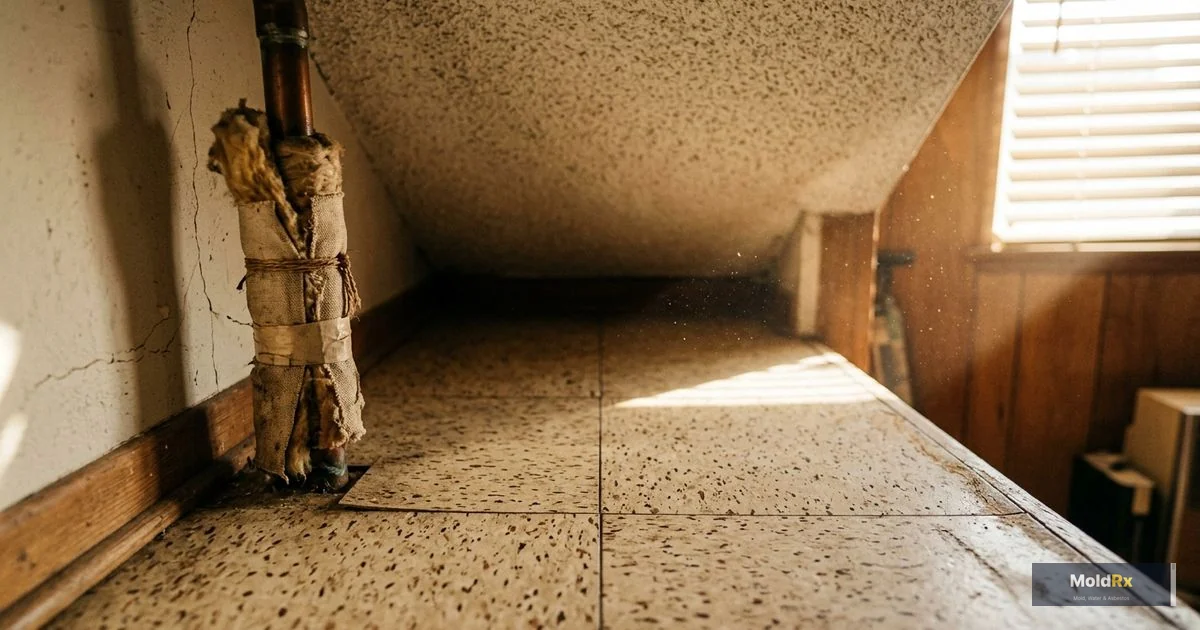
Pre-1950s agricultural era. Early Perris was farming country -- alfalfa, grain, poultry, and dairy operations on scattered parcels along older roads. Homes from this period tend to be found on agricultural parcels throughout the community, built with materials that predate modern building codes. Construction from this era frequently includes asbestos-containing plaster, pipe insulation (woven asbestos cloth and corrugated asbestos paper), boiler and furnace components, and roofing products. These early asbestos materials often look different from mid-century products, requiring an experienced inspector to identify.
1950s through 1970s -- peak asbestos era. The arrival of water from the Eastern Municipal Water District in the early 1950s opened the Perris Valley to broader development, and the sustained presence of March Air Force Base drove housing demand for military families and base personnel. Homes built during this period represent the highest risk for asbestos-containing materials. Floor tiles, popcorn ceilings, pipe wrap, furnace insulation, roofing felt, duct tape, joint compound, and textured wall coatings from these decades have a high probability of containing asbestos -- particularly chrysotile, the most commonly used form in American residential construction.
1980s transitional period. As Perris began transitioning from agricultural community to suburban city, new subdivisions started appearing on former farmland. Homes from this decade were built during the regulatory transition away from asbestos. Federal restrictions under OSHA 1926.1101 and state standards under Cal/OSHA SS1529 were taking effect, but products manufactured before the rules changed remained in supply chains. This creates an unpredictable mix where some materials in a 1980s Perris home contain asbestos and others do not. Assumptions are dangerous in either direction -- testing is the only reliable approach.
2000s suburban expansion. The most dramatic growth came in the 2000s, when Perris became one of Southern California's fastest-growing cities. Between 2000 and 2010, the population grew from roughly 36,000 to over 68,000 -- an increase of nearly 90 percent in a single decade. Thousands of new tract homes were built with modern materials and are unlikely to contain asbestos. However, certain imported products, specialty coatings, and materials of unknown origin have occasionally tested positive even in relatively recent construction. For most post-2000 homes, testing is not necessary unless specific concerns exist.
March Air Reserve Base: A Direct Influence on Local Asbestos Risk
March Air Reserve Base sits immediately north of Perris and has shaped the area's development for more than a century. Established in 1918 as Alessandro Flying Training Field, the installation operated as a major Air Force base through the Korean War, Vietnam War, and Cold War eras before being downsized to an air reserve base in 1996. The transition released approximately 4,500 acres of surplus land to the March Joint Powers Authority for civilian redevelopment.
This history matters directly for asbestos testing:
- Military construction used asbestos extensively. Barracks, family housing, and maintenance buildings from the 1940s through 1970s incorporated asbestos as standard practice. The Green Acres Military Family Housing Area (130 houses) was specifically identified as containing asbestos-containing materials, and the Air Force removed friable asbestos from those structures.
- Surplus land redevelopment. The 3,500+ acres transferred to civilian control now host roughly 90 businesses. Some redevelopment involved renovating older military structures that may still contain residual asbestos-era materials.
- Ancillary residential development. The base attracted housing construction in nearby Perris neighborhoods for military families during the 1950s through 1980s -- the peak asbestos-use decades. These properties should be considered higher priority for testing.
Warehouse and Industrial Corridor
Perris has become a major logistics hub along the Interstate 215 corridor. If you own or manage commercial or industrial property constructed before the 1990s, asbestos testing is a regulatory requirement under SCAQMD Rule 1403 before renovation or demolition. Older industrial buildings may contain asbestos in forms not typical of residential construction, including fireproofing spray, industrial pipe insulation, and equipment gaskets.
Climate and Material Deterioration
Perris's semi-arid climate -- summer temperatures in the mid-90s to low 100s, mild winters, and under 12 inches of annual rainfall -- stresses building materials over decades. Roof shingles crack, pipe insulation becomes friable, textured coatings fracture, and caulking crumbles. When asbestos-containing materials deteriorate this way, they can release fibers into indoor air even without active renovation work. Older Perris homes with visibly deteriorating materials should be evaluated even if no renovation is planned.
Common Asbestos-Containing Materials in Perris Homes
The following materials are frequently found to contain asbestos in Riverside County homes built before 1990. You cannot identify asbestos by looking at a material -- two identical-looking floor tiles from the same era may come from different manufacturers with entirely different formulations. Laboratory analysis of a physical sample is the only definitive determination.
Ceilings. Popcorn (acoustic) texture is one of the most commonly confirmed ACMs in Southern California. Spray-on textured finishes and some ceiling tiles also test positive.
Floors. 9x9-inch vinyl floor tiles are a well-known indicator. The black mastic adhesive beneath tiles frequently contains asbestos even when tiles do not -- both must be tested separately. Sheet vinyl backing is another common finding.
Walls. Drywall joint compound used through the early 1980s commonly contained chrysotile asbestos. Some plaster, stucco, and textured wall finishes also test positive.
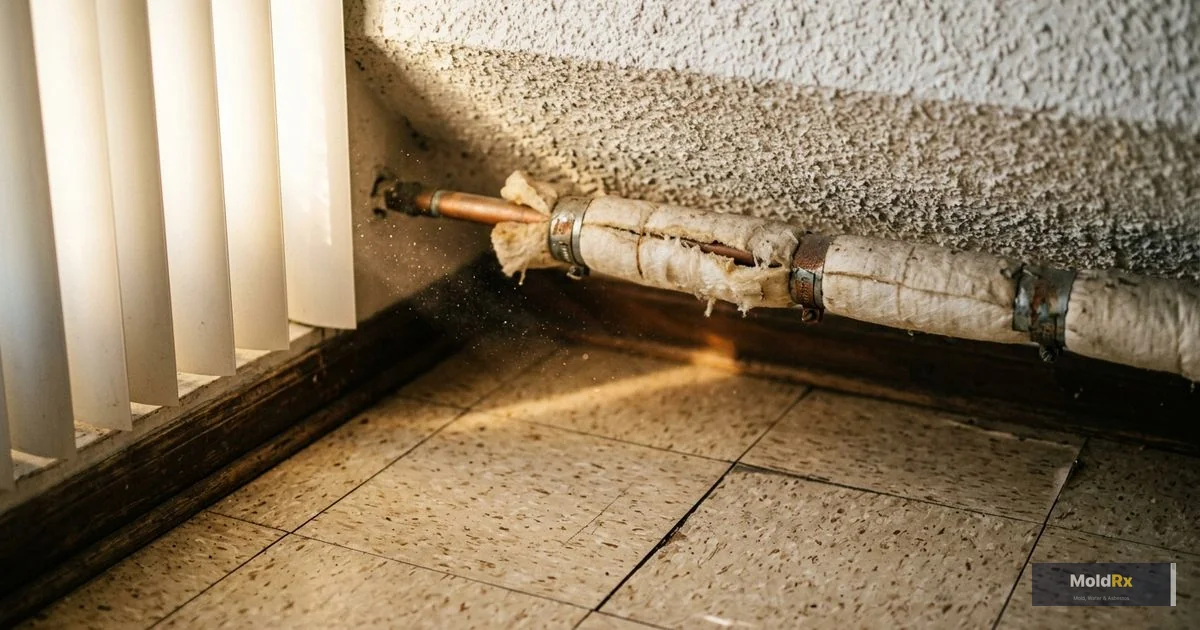
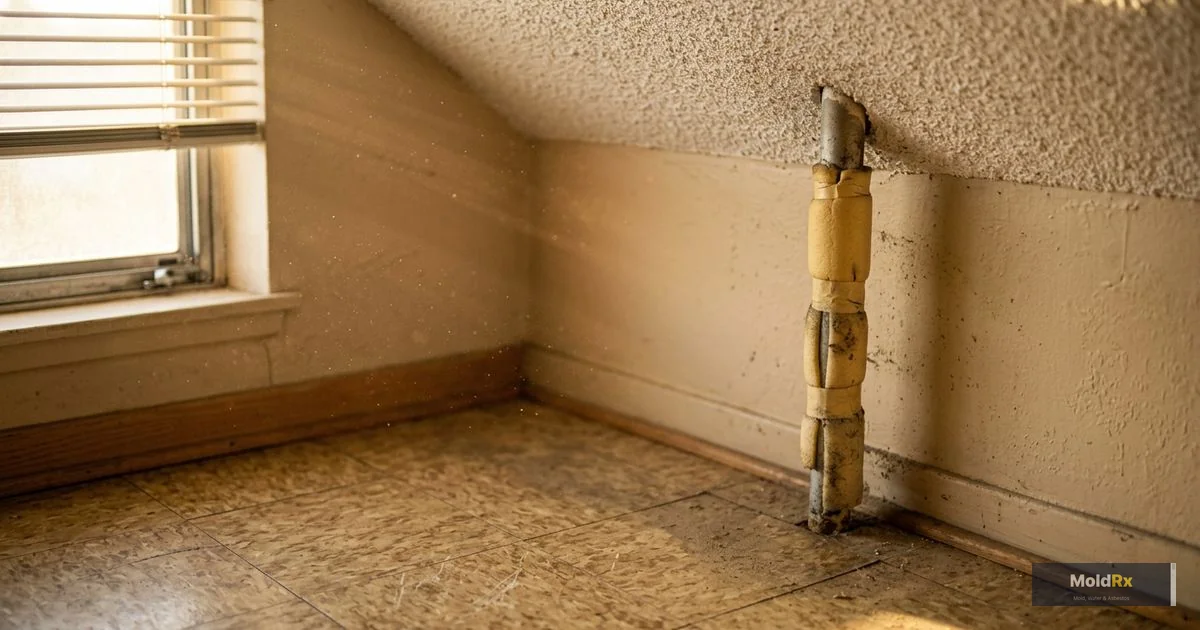
Insulation. Pipe wrapping, boiler/furnace insulation, duct wrapping, and HVAC duct tape are common positive findings. Vermiculite attic insulation deserves special attention because much U.S. vermiculite came from the Libby, Montana mine contaminated with tremolite asbestos.
Roofing. Asphalt shingles, roof felt, roofing cement, and some flashing materials from pre-1990 installations may contain asbestos.
Exterior. Transite siding (rigid cement-asbestos composite), certain stucco formulations, cement board, and window glazing compound have tested positive in Inland Empire homes.
Mechanical systems. Furnace flue connectors, HVAC duct insulation/tape, water heater components, and gaskets on older equipment frequently contain asbestos.
The Regulatory Framework: What Perris Homeowners Must Know
Asbestos is regulated at the federal, state, and regional levels, with overlapping requirements that Perris property owners must navigate before renovation or demolition work.
Federal Standards
OSHA 1926.1101 is the federal standard for asbestos in construction. It classifies asbestos work into four categories (Class I through Class IV), sets permissible exposure limits at 0.1 fibers per cubic centimeter over an 8-hour workday, requires designated competent persons on work sites, and mandates engineering controls, containment measures, worker training, and medical monitoring. Building owners must identify thermal system insulation and surfacing materials as asbestos-containing unless testing proves otherwise.
AHERA (Asbestos Hazard Emergency Response Act) established the inspector certification framework. AHERA-accredited building inspectors must complete initial certification training covering identification, sampling, condition assessment, and management planning, and maintain certification through annual refresher training. The AHERA standard has become the baseline qualification for asbestos inspectors across all building types.
California State Standards
Cal/OSHA Section 1529 (Title 8, CCR SS1529) is California's asbestos-in-construction standard. Key requirements:
- Asbestos surveys are mandatory for pre-1980 structures before renovation or demolition
- All thermal system insulation and surfacing materials in pre-1980 buildings are legally presumed to contain asbestos until laboratory analysis proves otherwise
- Disturbances of 100 square feet or more of material containing more than 0.1 percent asbestos must be performed by a CSLB C-22 licensed asbestos abatement contractor
- The C-22 classification, issued by the California Contractors State License Board, requires four years of documented asbestos abatement experience, registration with DOSH (Division of Occupational Safety and Health), and passage of a specialized trade examination
- Workers performing asbestos-related construction work must have specific asbestos training and medical monitoring
South Coast AQMD Rule 1403
Perris falls within SCAQMD jurisdiction. Rule 1403 requires an asbestos survey before any demolition (no exceptions for building type or age) and before renovation disturbing 100+ square feet of suspect material. Surveys must identify and quantify all friable and non-friable asbestos-containing materials. Written notification must be submitted at least 10 working days before removal or demolition begins via the district's online system. Fines for non-compliance can exceed $20,000 per day.
Real Estate Disclosure and Contractor Requirements
California sellers must disclose known material defects, including asbestos. A professional test report from an AHERA-certified inspector with NVLAP-accredited lab results provides defensible documentation for both parties. Licensed contractors performing renovation on pre-1980 properties typically require laboratory test results per OSHA 1926.1101 and Cal/OSHA SS1529 before beginning work.
How MoldRx Asbestos Testing Works in Perris
MoldRx only sends vetted, certified professionals to your property. Every inspector holds current AHERA building inspector accreditation. Every sample is analyzed at an NVLAP-accredited laboratory. Here is what the process looks like.
Step 1: Property Assessment and Sample Planning
A vetted asbestos specialist visits your property and conducts a thorough assessment. The specialist identifies suspect materials based on the home's construction date, material appearance, condition, and location. Your specific project plans inform the sampling strategy. If you are renovating a kitchen, the specialist focuses on materials in that area while also flagging any concerns observed elsewhere. If you are planning a complete remodel or demolition, the scope expands to cover all suspect materials throughout the structure.
For homes with additions from different decades -- common in Perris, where a 1960s core structure may have a 1980s addition and a 2000s-era kitchen update -- each construction phase is evaluated independently.
Step 2: Safe Sample Collection
Samples are collected following EPA and Cal/OSHA protocols: each material is wetted before sampling, small sections are removed with specialized tools and containment measures, every sample is sealed in a labeled container and documented by exact location with photographs, and sample points are patched after collection. Personal protective equipment is worn throughout.
This is not a do-it-yourself job. Cutting into dry asbestos-containing material without proper containment can contaminate your home. Professional sampling costs a fraction of what contamination cleanup would.
Step 3: NVLAP-Accredited Laboratory Analysis
Samples go to a laboratory holding NVLAP (National Voluntary Laboratory Accreditation Program) accreditation from NIST -- confirming independent evaluation of competence, mandatory proficiency testing, and ISO/IEC 17025 quality standards. Two methods are used:
Polarized Light Microscopy (PLM) is the standard method for bulk building material samples. PLM identifies asbestos fiber type and approximate concentration and is the EPA-specified method for most building material analyses.
Transmission Electron Microscopy (TEM) provides higher resolution and sensitivity for inconclusive PLM results, very low fiber concentrations, or air monitoring samples. TEM identifies individual fibers at the nanometer scale and is the definitive method when PLM findings need confirmation.
Each sample receives a formal laboratory report specifying whether asbestos was detected, the fiber type, and approximate concentration. Standard turnaround is three to five business days. Rush analysis (24-hour and 48-hour) is available for time-sensitive situations.
Step 4: Results and Guidance
Every material gets a clear determination: asbestos detected or not detected. For positive results, we explain your options:
- Monitor in place -- Intact materials that will not be disturbed can remain safely with periodic monitoring.
- Encapsulation -- A specialized coating prevents fiber release from materials in reasonable condition.
- Professional removal -- Damaged or renovation-path materials require a CSLB C-22 licensed contractor following Cal/OSHA SS1529 and SCAQMD Rule 1403 requirements.
Schedule your free asbestos testing estimate in Perris or call (888) 609-8907.
Common Triggers for Asbestos Testing in Perris
Home renovation and remodeling -- Kitchen and bathroom updates, flooring replacement, popcorn ceiling removal, room additions, window replacement, and any work that disturbs original building materials in homes built before 1990.
Property purchase or sale -- Buyers want to understand what is in the home they are purchasing. Sellers benefit from proactive testing that provides laboratory-confirmed documentation for the disclosure process. Real estate agents handling pre-1980 Perris properties increasingly recommend testing as standard practice.
March ARB-adjacent housing -- Properties in neighborhoods that developed in connection with military base operations during the 1950s through 1980s are higher priority for testing due to the era of construction and the military construction practices of the period.
Demolition of any structure -- SCAQMD Rule 1403 requires an asbestos survey before demolition of any building 100 square feet or larger, regardless of type, age, or condition. No exceptions.
Damaged or deteriorating materials -- Visible crumbling, cracking, flaking, or water damage in materials from the asbestos era warrants evaluation even if no renovation is planned, because passive fiber release from damaged materials represents an ongoing exposure risk.
Commercial and warehouse property renovation -- Perris's growing logistics and industrial sector includes older commercial buildings that may contain asbestos in construction materials and specialized industrial applications. Testing is required before renovation or demolition work.
Insurance and restoration claims -- Following fires, water damage, or other insurable events, documentation of all building materials is required before repair work begins.
Perris Neighborhoods and Areas We Serve
MoldRx provides asbestos testing throughout Perris and surrounding Riverside County communities. We serve all Perris neighborhoods and property types, including:
- Established neighborhoods near Downtown Perris and along Perris Boulevard
- Properties near March Air Reserve Base and in neighborhoods that developed in connection with base operations
- Newer developments in May Ranch, Paragon, and other 2000s-era communities (where testing of older pre-development structures may be needed)
- Rural parcels along the eastern and southern edges of the city
- Properties near Lake Perris and the surrounding recreational area
- Commercial and industrial buildings along the Interstate 215 corridor
We serve ZIP codes 92570, 92571, and 92572, including single-family homes, multi-family properties, and commercial and industrial buildings. Our coverage extends to neighboring communities including Moreno Valley to the north, Menifee to the south, Lake Elsinore to the west, San Jacinto and Hemet to the east, and the unincorporated areas of Riverside County surrounding Perris.
Related Services in Perris
In addition to asbestos testing, we also offer Mold Removal in Perris, Asbestos Removal in Perris, Water Damage Restoration in Perris, and Mold Testing in Perris services to Perris property owners.
Learn more about remediation services in Perris
Frequently Asked Questions About Asbestos Testing in Perris
My Perris home was built in 2005. Do I still need asbestos testing?
Homes built after the mid-1990s are generally low risk for asbestos-containing materials. If your home was built as part of the 2000s suburban expansion in Perris, asbestos testing is not typically necessary unless you have concerns about specific materials -- such as imported tiles, specialty coatings, or products of unknown origin. For most post-2000 homes, testing is not warranted unless there are specific reasons for concern.
What is the difference between friable and non-friable asbestos?
Friable asbestos-containing materials can be crumbled, pulverized, or reduced to powder by hand pressure. They pose a higher immediate risk because fibers are more easily released into the air during normal contact. Examples include deteriorating pipe insulation, spray-on fireproofing, and damaged popcorn ceiling texture. Non-friable materials -- such as intact vinyl floor tiles, cement siding, and roofing shingles -- are harder and denser, releasing fibers primarily when mechanically disturbed through cutting, sanding, drilling, or demolition. Both types are regulated under OSHA 1926.1101, Cal/OSHA SS1529, and SCAQMD Rule 1403, but friable materials demand more stringent containment and abatement procedures.
What happens if asbestos is found in my Perris home?
A positive result does not automatically mean expensive removal. The appropriate response depends on the material's condition and your plans. Intact, undamaged materials that will not be disturbed can be monitored in place -- this is often the safest and most cost-effective option. Materials that are damaged, deteriorating, or in the direct path of renovation work typically need to be addressed through encapsulation or professional removal by a CSLB C-22 licensed abatement contractor. Your report explains your specific options clearly, with recommendations tailored to each material and location.
How are asbestos samples collected safely?
AHERA-certified professionals wet each material to suppress fibers, extract a small sample using specialized tools with containment, and seal it in a tamper-evident container for the NVLAP-accredited lab. Each collection point is patched afterward. Improper sampling can contaminate your home -- this is not a DIY task.
What does NVLAP accreditation mean for laboratory results?
NVLAP (National Voluntary Laboratory Accreditation Program) is administered by NIST. An NVLAP-accredited lab has been independently evaluated for technical competence, participates in mandatory proficiency testing (biannual for PLM, annual for TEM), and operates under ISO/IEC 17025 quality standards. NVLAP accreditation is required by AHERA for school asbestos analysis and has become the accepted standard for all building material testing. Results from non-accredited laboratories may not be accepted for regulatory compliance.
I live near March ARB. Does that affect my asbestos risk?
If your property is in a neighborhood that developed during the 1950s through 1980s in connection with March Air Force Base operations, it was likely built during peak asbestos-use decades using construction practices common to that era. Military family housing and base-adjacent residential development from this period have a high probability of containing asbestos in floor tiles, popcorn ceilings, pipe insulation, joint compound, and roofing materials. These properties should be considered higher priority for testing before any renovation or demolition work.
Schedule Asbestos Testing for Your Perris Property
Whether you are renovating a 1970s ranch home near Downtown Perris, purchasing property in one of the newer developments, dealing with deteriorating materials in a commercial building, preparing an older warehouse for renovation, or simply want to know what is behind your walls, professional asbestos testing provides the answers you need to move forward safely and in compliance with OSHA 1926.1101, Cal/OSHA SS1529, and SCAQMD Rule 1403.
MoldRx only sends vetted, certified specialists who understand the Perris area's unique construction history -- from the agricultural-era farmhouses to the March ARB-adjacent housing of the 1960s to the 2000s suburban expansion -- and who know where to look for potential asbestos-containing materials in each type of property. Every inspector holds AHERA certification. Every sample goes to an NVLAP-accredited laboratory for PLM or TEM analysis. Every report gives you clear, honest, actionable answers.
Asbestos-related diseases develop silently over decades but are never reversible. A straightforward test now protects your family, your workers, and anyone who lives in or works on your property in the future.
Get your free estimate for Perris asbestos testing or call (888) 609-8907 to schedule an inspection.