Mold Removal in Palm Springs, CA — MoldRx
IICRC-Certified Mold Removal Professionals Serving Palm Springs and the Coachella Valley
Palm Springs sits at 487 feet elevation on the western edge of the Coachella Valley, with 10,831-foot Mt. San Jacinto rising directly behind downtown. The city's population of approximately 48,000 swells each winter and empties every summer — a cycle that makes it one of the most mold-vulnerable communities in the Inland Empire. With a median age near 58 and a housing stock dominated by mid-century modern architecture from the 1950s through 1970s, Palm Springs combines aging construction, extreme HVAC dependence, seasonal vacancy, and near-universal pool ownership into mold risk factors found nowhere else in Southern California. Annual rainfall averages only five to six inches, but desert living produces concentrated indoor moisture that colonizes within 24 to 48 hours, the window documented by IICRC S520 and EPA publication 402-K-01-001. MoldRx only sends vetted, IICRC-certified mold removal professionals who follow IICRC S520/R520 remediation standards and EPA federal mold guidance.
Request your free estimate — we will assess your property and give you straight answers.
Why Mold Grows in Palm Springs Homes
Mid-Century Construction, Flat Roofs, and Original Plumbing
Palm Springs is the mid-century modern capital of the United States. The Alexander Construction Company and architect William Krisel built more than 2,500 homes here between 1957 and the mid-1960s, with other developers adding thousands more. These post-and-beam homes — butterfly roofs, flat rooflines, walls of glass, breeze-block details — were innovative but introduced construction characteristics that create persistent mold risk today. Flat roofs pond water after intense rainstorms. Original copper and galvanized plumbing in homes now 60 to 70 years old develops pinhole leaks behind walls and under slabs. Floor-to-ceiling windows generate condensation when cold desert nights meet cooled interior air. Most of these homes lack modern vapor barriers, and open floor plans allow moisture to migrate quickly through interconnected spaces.
HVAC Condensation in a Climate That Demands Year-Round Cooling
Summer temperatures routinely exceed 110 degrees, and the city records more than 350 sunny days per year. Air conditioning runs roughly eight months annually, pulling moisture into condensate drip pans and drain lines every cycle. When those components clog or overflow — common in systems 50 to 70 years old — water seeps into wall cavities, ceiling plenums, and ductwork insulation. Indoor humidity can spike well above the EPA's recommended 30 to 50 percent range when HVAC maintenance lapses, producing hidden mold behind drywall and inside ductwork.
Seasonal Vacancy and the Snowbird Cycle
Palm Springs is a premier snowbird destination — from November through March the population roughly triples. When seasonal residents leave each May, tens of thousands of homes sit unoccupied through a summer that regularly exceeds 105 degrees. If the thermostat is set too high or the AC is turned off, indoor humidity climbs sharply during the July-through-September monsoon window. A slow plumbing leak or clogged condensate drain can go undetected for months. By the time the owner returns in autumn, mold has colonized wall cavities, bathrooms, and HVAC systems — often extensively.
Pool and Spa Moisture Combined with Monsoon Flash Flooding
Nearly every residential property in Palm Springs has a pool, a spa, or both. Equipment rooms, pump enclosures, and adjacent soil create persistent moisture zones. Splash-out, backwash drainage, and over-irrigated landscaping push water against foundations. Add the North American Monsoon — sudden thunderstorms and flash flooding from Chino Canyon, Tahquitz Creek wash, and Palm Canyon Wash between July and September — and the risk compounds. Desert hardpan does not absorb water efficiently, and the city's wash-channel network can overflow with little warning. Any structure that takes on water during these events can develop mold within the 24-to-48-hour colonization window cited by IICRC S520.
Signs You Need Professional Mold Removal
Visible Growth Beyond a Small Area
EPA publication 402-K-01-001 sets a practical threshold: if mold covers more than about ten square feet, professional remediation is recommended. In Palm Springs' arid climate, visible mold that extensive almost always signals a larger hidden colony behind the surface, particularly in mid-century homes where wall cavities lack modern moisture barriers.
Persistent Musty Odor Without Visible Mold
A stale, earthy smell that persists after cleaning often indicates mold inside wall cavities, beneath flooring, or within HVAC ductwork. Because Palm Springs homes are sealed tightly for air-conditioning efficiency, these odors concentrate indoors and are one of the earliest reliable indicators of a concealed problem.
Recurring Mold After Previous Cleanup
If you have cleaned mold off a surface and it returns within weeks, the underlying moisture source has not been resolved. Surface cleaning does not address colonies embedded in porous materials like drywall, insulation, or wood framing. Recurring growth — particularly in bathrooms, HVAC closets, or along slab edges — means professional assessment and source correction are needed.
Water Damage History
Any property that has experienced a plumbing failure, roof leak, appliance overflow, or flood event — including monsoon wash-channel flooding — should be evaluated for mold if drying did not occur within the 24-to-48-hour window established by IICRC S520. Moisture trapped behind finished surfaces in a mid-century home can sustain mold growth indefinitely.
Health Symptoms That Worsen Indoors
The CDC notes that mold exposure can trigger nasal congestion, throat irritation, coughing, wheezing, and eye irritation. If household members notice symptoms improving when they leave the home and returning when they come back, indoor mold may be a contributing factor — especially during Palm Springs' long cooling season, when windows stay closed for months and recirculated air passes over contaminated surfaces continuously.
Health Risks of Mold Exposure
Prolonged mold exposure is a recognized indoor air quality concern. The EPA, CDC, and the World Health Organization's Guidelines for Indoor Air Quality: Dampness and Mould document respiratory effects ranging from nasal irritation to more serious conditions in susceptible individuals. Mold produces allergens, irritants, and in some species mycotoxins that become airborne during normal breathing. In a sealed Palm Springs home running recirculated AC for eight consecutive months, spore concentrations can build well above outdoor baselines undetected.
Populations at Higher Risk
Palm Springs' median age is approximately 58 — one of the highest in California — and roughly one-third of residents are 65 or older, a group the CDC identifies as more vulnerable to respiratory effects of mold exposure. Individuals with compromised immune systems, chronic lung disease, or asthma face greater risk as well. Riverside County carries one of the highest asthma burdens in California. These are factual public health observations — not reasons to panic, but reasons to address confirmed mold promptly.
When DIY Mold Removal Isn't Enough
The EPA acknowledges that small mold problems on hard surfaces can often be handled by homeowners. Professional remediation is the appropriate path when any of the following apply:
- Affected area exceeds ten square feet — the threshold in EPA 402-K-01-001 above which professional methods and containment are recommended.
- Mold is inside HVAC systems or ductwork — NADCA recommends certified professionals for any contamination within air-handling equipment to prevent whole-house spore distribution.
- Growth involves structural materials — mold in wall framing, subfloor sheathing, or roof decking requires controlled removal. Especially relevant in Palm Springs' post-and-beam homes where exposed framing is part of the architecture.
- Stachybotrys or other toxigenic species are suspected — dark, slimy growth on chronically wet materials warrants the containment protocols in IICRC S520.
- Water damage involves Category 2 or Category 3 water — sewage backups, wash-channel floodwater, or contaminated discharge require decontamination procedures in IICRC S500.
- Documentation is needed for insurance or real estate — professional remediation provides inspection reports, lab results, and clearance testing that insurers and buyers require.
If any of these situations describe your Palm Springs property, request a free estimate and get a clear picture of what you are dealing with.
How We Remove Mold in Palm Springs Properties
Every MoldRx project follows IICRC S520/R520 protocols and Cal/OSHA Title 8 worker safety requirements.
1. Inspection and Moisture Mapping
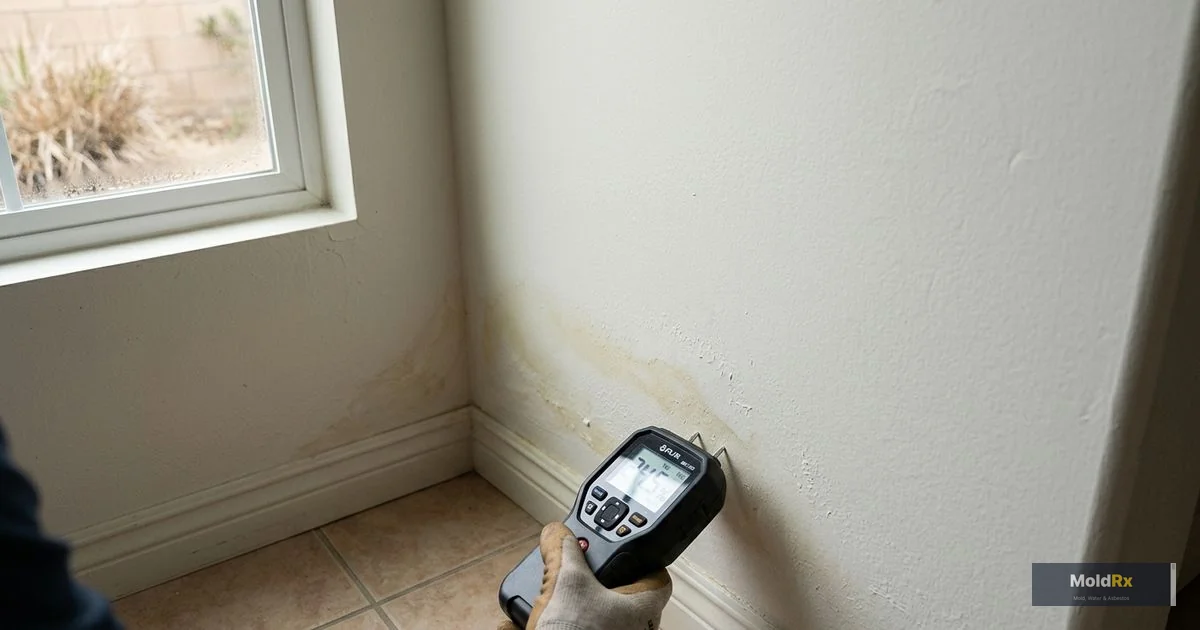
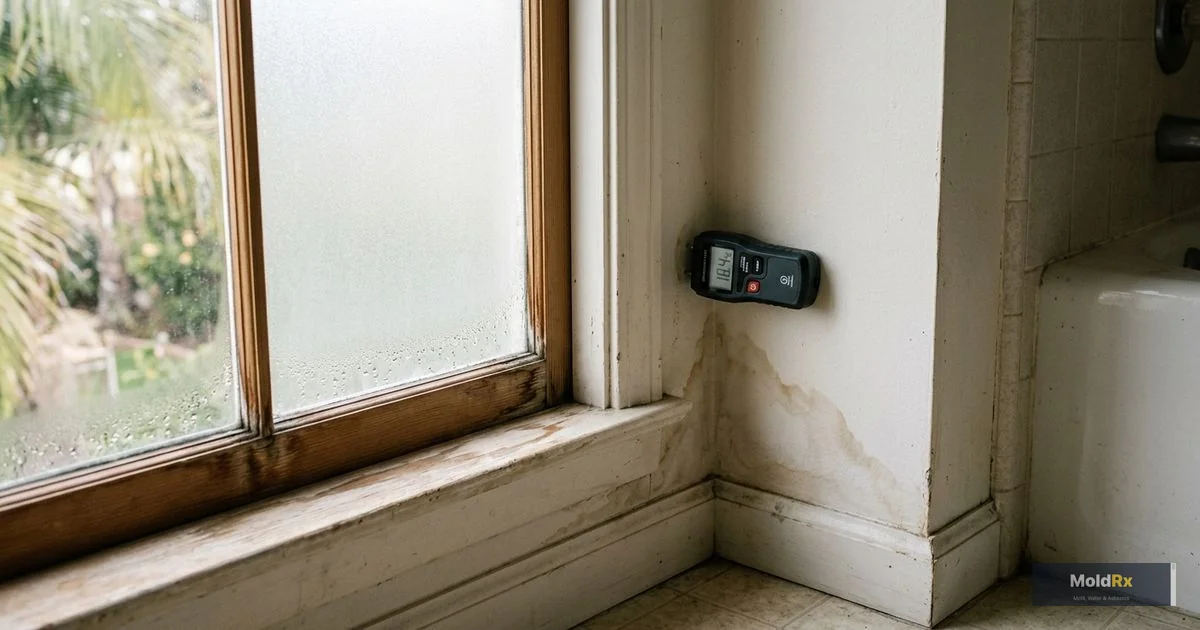
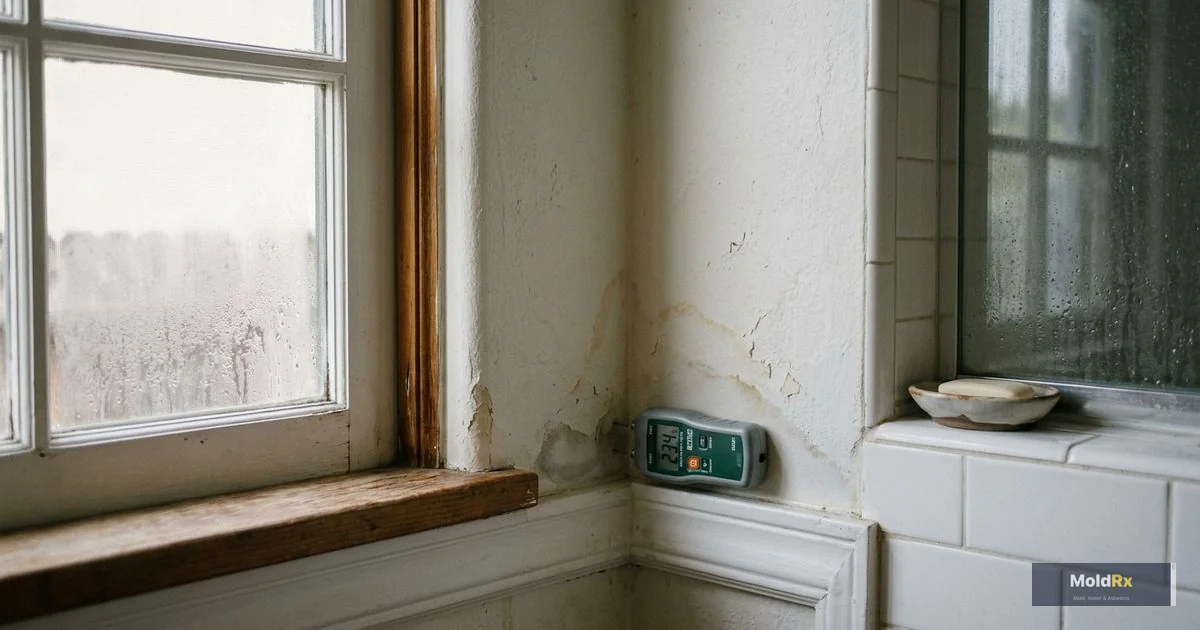
A thorough inspection identifies all visible and suspected mold growth. Moisture meters and thermal imaging pinpoint water sources behind walls, under flooring, and within ceiling assemblies. For Palm Springs' mid-century homes, our professionals pay particular attention to flat-roof drainage points, original plumbing runs, HVAC condensate systems, and areas around pools. This step follows the assessment framework in EPA 402-K-01-001 and gives you a documented scope before any remediation begins.
2. Containment
Affected areas are isolated using polyethylene sheeting and negative air pressure to prevent spore migration. For Condition 2 and Condition 3 environments — as defined by IICRC S520 — HEPA-filtered air scrubbers run continuously throughout the work zone. This approach aligns with CDC guidance (cdc.gov/mold), EPA recommendations (epa.gov/mold), and WHO Guidelines for Indoor Air Quality for controlling indoor bioaerosol exposure. In Palm Springs homes with open floor plans and walls of glass, containment is especially critical because airflow carries spores rapidly across interconnected spaces.
3. Removal and Treatment
Contaminated porous materials — drywall, insulation, carpet, and ceiling tile — are removed under containment and double-bagged for disposal. Non-porous surfaces are cleaned and treated with EPA-registered antimicrobial products. All work follows Cal/OSHA Title 8 Section 5155 exposure limits and IICRC S520 procedures. In Palm Springs' mid-century construction, our professionals take particular care with textured ceilings, exposed beam assemblies, and slab-edge intrusion points common in 1950s- and 1960s-era homes.
4. Moisture Correction
Removing mold without resolving the moisture source guarantees recurrence. In Palm Springs, moisture correction typically involves clearing HVAC condensate drain lines, repairing aged plumbing, improving exhaust ventilation, regrading irrigation away from foundations, addressing flat-roof ponding, and sealing slab penetrations. For properties near Tahquitz Creek, Chino Canyon, or Palm Canyon wash channels, we recommend moisture barriers and drainage improvements where appropriate.
5. Post-Remediation Verification
After remediation, clearance testing confirms that airborne spore counts have returned to Condition 1 (normal fungal ecology) as defined by IICRC S520. You receive a complete documentation package: inspection report, moisture mapping, lab analysis, scope of work, photos, and clearance results. This package supports your records, insurance claims, and real estate transactions — important in Palm Springs' active mid-century home market.
Mold Removal vs. Mold Remediation: What's the Difference?
The terms are often used interchangeably but describe different scopes. Mold removal means physically taking away contaminated materials. Mold remediation, as defined by IICRC S520, is the full process: assessment, containment, removal, antimicrobial treatment, moisture correction, and verification. The goal is to return the indoor environment to Condition 1 — normal fungal ecology — where spore concentrations are consistent with outdoor levels. Removal alone does not address conditions that allowed mold to grow. MoldRx performs full remediation on every project because the goal is to resolve the problem permanently.
Preventing Mold After Remediation
Once your Palm Springs property has been properly remediated, these desert- and mid-century-specific practices will help keep mold from returning.
Mid-Century Home Maintenance and Moisture Barriers
Schedule a plumbing inspection to identify aging supply lines and drain pipes developing pinhole leaks. Evaluate whether modern vapor barriers can be retrofitted into wall cavities without compromising architectural character. Inspect floor-to-ceiling window assemblies for seal failures and condensation tracks. These steps are especially important for post-and-beam homes in Twin Palms, Racquet Club Estates, Vista Las Palmas, and other neighborhoods with original 1950s and 1960s construction.
Seasonal Closure Protocol
If you leave your Palm Springs home unoccupied during summer, do not turn the air conditioning off. Set the thermostat to 82 to 85 degrees to manage indoor humidity during monsoon season. Shut off the main water supply or install a leak-detection shutoff system. Arrange for someone to check the property at least twice a month for plumbing leaks, HVAC drain-line clogs, and signs of moisture. These precautions are far simpler than a full remediation after months of undetected water damage.
HVAC Maintenance
Have condensate drain lines flushed and inspected at least twice a year — once before cooling season in April and once at midseason in July. Replace air filters monthly during peak cooling months. Inspect drip pans for standing water, algae, or biofilm. Have ductwork inspected for moisture and insulation degradation every two to three years. Keep indoor relative humidity between 30 and 50 percent, consistent with EPA guidance, and use a hygrometer to monitor levels.
Pool and Spa Moisture Management
Inspect pool and spa equipment enclosures regularly for leaks, condensation, and standing water. Ensure splash-out and backwash drainage flow away from the structure. If your pool deck abuts an exterior wall — common in Palm Springs' courtyard-oriented mid-century designs — check the wall's lower course for moisture wicking or efflorescence. Cover the pool and spa when not in use to reduce ambient humidity around the structure.
Flat Roof Drainage and Storm Preparedness
Flat and low-slope roofs define Palm Springs architecture but require more maintenance than pitched roofs. Clear roof drains and scuppers before monsoon season begins in July. After any rainstorm, inspect for ponding water — standing water can penetrate seams and membranes within hours, sending moisture into ceiling assemblies below. Ensure downspouts and surface drainage direct water away from the foundation and that landscape grading does not channel runoff toward the home.
What Sets MoldRx Apart
- Straight talk, not sales talk. If your problem is minor, we will tell you. If it is extensive, you will understand exactly why before any work begins.
- Licensed, insured, IICRC-certified. Every professional we send holds current IICRC certification, carries proper insurance, and operates under California Contractors State License Board (CSLB) and Riverside County licensing requirements.
- Full documentation on every job. Inspection reports, lab results, scope of work, photographic records, and clearance testing — all provided to you in a complete package.
- Family-owned accountability. We only send vetted remediation professionals we stand behind. No subcontracting to the cheapest available crew.
Get your free estimate — no obligations, no pressure.
Palm Springs Neighborhoods We Serve
Twin Palms
Where the Alexander-Krisel partnership began in 1957, Twin Palms contains roughly 1,200 mid-century tract homes with butterfly roofs, post-and-beam construction, and walls of glass — now approaching 70 years old. Original plumbing, flat-roof drainage challenges, and minimal vapor barriers make Twin Palms one of the neighborhoods where we see the highest volume of concealed mold growth.
Vista Las Palmas
Home to the largest Alexander houses in Palm Springs and some of the city's most architecturally significant estates, Vista Las Palmas features homes by Krisel, Palmer, Donald Wexler, and other modernist architects. Many have been carefully restored, but original plumbing, flat-roof assemblies, and single-pane window systems still create moisture vulnerabilities. Mature landscaping and irrigated yards add ground moisture near foundations.
Movie Colony
One of Palm Springs' oldest neighborhoods, the Movie Colony features homes dating to the 1930s alongside later mid-century construction. Spanish Colonial Revival estates with plaster walls, older drain systems, and large lots with pools create a combination of aging infrastructure and persistent moisture that makes proactive mold monitoring essential.
Deepwell Estates
Deepwell sits close to downtown and features larger lots, desert landscaping, and midcentury bungalows from the late 1950s and 1960s. Slab-on-grade foundations, original bathroom ventilation, and pool equipment rooms are the most common mold triggers here.
Racquet Club Estates
Adjacent to the historic Palm Springs Racquet Club, this neighborhood features Alexander tract homes with Krisel floor plans — open layouts, clerestory windows, and low-slope roofs. Common moisture vulnerabilities include condensation at clerestory window headers, flat-roof ponding, and aging supply lines under slab foundations.
Tahquitz River Estates
First developed in the 1930s and expanded in the late 1940s by developer Paul Trousdale, Tahquitz River Estates contains roughly 1,100 homes ranging from Spanish Revival cottages to mid-century designs. Palm-lined streets and mature landscaping create a lush environment, but the irrigation required to sustain it generates persistent soil moisture near foundations. Older homes here are among the most likely in Palm Springs to experience slab-edge moisture intrusion.
Desert Highland Gateway Estates
Established in 1959, Desert Highland Gateway Estates is a historic neighborhood with primarily 1960s midcentury modern homes alongside some 1990s ranch-style construction. Many properties have been remodeled, but original plumbing and HVAC systems remain common. The neighborhood's lower elevation places some homes closer to wash-channel flood zones, making post-storm inspections especially important.
Nearby Communities: Cathedral City, Desert Hot Springs, Rancho Mirage, Palm Desert, and Indian Wells. We cover ZIP codes 92262, 92263, and 92264 and the entire Coachella Valley.
Related Services in Palm Springs
→ All remediation services in Palm Springs
Frequently Asked Questions
How quickly can MoldRx respond to a mold problem in Palm Springs?
We typically schedule an initial inspection within one to two business days. If you are dealing with active water damage — particularly during monsoon season or after a wash-channel flooding event — let us know so we can prioritize your assessment within the critical 24-to-48-hour window.
How long does mold remediation take in a typical Palm Springs home?
Most projects take two to five days. Smaller issues may wrap up in a single day, while larger projects involving multiple rooms can take a week or more — common in mid-century homes where open floor plans allow moisture to spread. We provide a realistic timeline during the initial assessment.
Do I need mold testing before remediation begins?
If mold is clearly visible, testing is not always necessary — the priority is containment and removal. However, testing is valuable when you suspect hidden mold, need documentation for insurance or real estate, or want species identification. Palm Springs' active mid-century real estate market makes pre-sale mold clearance documentation particularly useful.
Can I stay in my home during the remediation process?
In most cases, yes. Containment barriers and negative air pressure keep the work zone isolated from living areas. For larger projects or if anyone in the household has respiratory sensitivities, we may recommend temporary relocation during the most intensive phases.
Is mold really a problem in desert homes like those in Palm Springs?
More common than almost anyone expects. Year-round air conditioning, near-universal pool ownership, irrigated landscaping, and a mid-century housing stock with original plumbing and flat roofs introduce substantial moisture. Add seasonal vacancy during the hottest months and periodic monsoon flooding, and the valley creates conditions where mold thrives in concealed spaces even while the outdoor climate feels bone-dry.
What types of mold do you typically find in Palm Springs homes?
The most frequent species include Cladosporium, Aspergillus, and Penicillium — common indoor molds associated with moisture intrusion and HVAC condensation. Stachybotrys chartarum is less common but appears in homes with prolonged water damage. Laboratory testing identifies the specific species when needed.
Are mid-century modern homes more susceptible to mold than newer construction?
The construction methods that define mid-century homes — flat roofs, post-and-beam framing, minimal vapor barriers, original plumbing, walls of glass — create moisture vulnerabilities newer homes avoid. That does not mean every mid-century home has a mold problem, but proactive maintenance of plumbing, roof drainage, and HVAC systems is more important than in modern construction.
Will my homeowner's insurance cover mold remediation?
Coverage depends on the cause. Mold from a sudden covered event — a burst pipe or appliance failure — may be covered. Mold from deferred maintenance or gradual leaks is typically excluded. Our documentation supports legitimate claims.
I leave my Palm Springs home vacant during the summer. What should I do to prevent mold?
Do not turn off the air conditioning. Set the thermostat to 82 to 85 degrees to manage humidity during monsoon season. Shut off the main water supply or install a leak-detection shutoff system. Arrange for property checks at least twice a month. These steps address the most common causes of mold in seasonally vacant homes: undetected leaks, HVAC drain-line clogs, and humidity buildup in sealed spaces.
What is the difference between mold testing and mold remediation?
Mold testing identifies what is present — species, spore counts, and locations. Remediation is the full process: assessment, containment, removal, treatment, moisture correction, and verification. We offer both through our mold testing and mold removal services.
Get Mold Removal in Palm Springs
Palm Springs' desert setting does not make it immune to mold — it makes it vulnerable in ways most homeowners never anticipate. Mid-century construction with original plumbing and flat roofs, year-round HVAC dependence, seasonal vacancy, near-universal pool ownership, and monsoon-driven wash flooding create conditions where mold establishes itself behind walls long before anyone sees it.
MoldRx exists to give Palm Springs homeowners a remediation partner they can trust. Every professional we send is vetted and IICRC-certified. Every project follows S520/R520 protocols. Every conversation starts with honest answers — not a sales pitch.
Call MoldRx for your free estimate — (888) 609-8907. Request your estimate online. Clear answers. Honest guidance. Work done right.