Mold Removal in Palm Desert, CA — MoldRx
IICRC-Certified Mold Removal Professionals Serving Palm Desert and the Coachella Valley
Palm Desert sits at the heart of the Coachella Valley in Riverside County — roughly 53,000 year-round residents at 224 feet elevation, flanked by the Santa Rosa Mountains, Rancho Mirage, and Indian Wells. The arid climate makes mold seem impossible — until HVAC condensation drips into a wall cavity during a 115-degree afternoon, a snowbird's home sits sealed and unmonitored for six months, or monsoon runoff finds a crack in a 1980s slab foundation. Once moisture reaches a concealed surface, mold can colonize within 24 to 48 hours per IICRC S520/R520 standards and EPA 402-K-01-001 federal guidance. MoldRx only sends vetted, IICRC-certified mold removal professionals who understand the specific moisture vectors Palm Desert properties face.
Request your free estimate — we'll assess your property and give you straight answers.
Why Mold Grows in Palm Desert Homes
Palm Desert was incorporated in 1973 along the Highway 111 corridor — home to El Paseo, College of the Desert, and The Living Desert Zoo. Annual rainfall averages five inches, summer highs top 110 degrees, and the climate is subtropical desert (Koppen BWh). Average humidity sits around 39 percent but drops below 29 percent in summer and rises above 47 percent in winter. None of that suggests mold. But Palm Desert's housing conditions, seasonal occupancy, and cooling infrastructure create hidden moisture traps.
Seasonal Vacancy and Closed-Up Homes
Palm Desert's median age is 57 — among the highest in California — and roughly 37 percent of residents are 65 or older. About 34 percent of housing units sit vacant at any given time, representing seasonal and snowbird homes sealed for four to six months without climate control. When a home is closed up, small moisture events compound: a slow plumbing drip saturates drywall undetected, condensation collects on interior surfaces during swings between 115-degree days and 70-degree nights, and pool or spa equipment humidity migrates through shared walls. Per EPA 402-K-01-001, mold colonizes within 24 to 48 hours of adequate moisture. A vacant Palm Desert home with an undetected pinhole leak can develop extensive hidden growth over an entire off-season before the owner returns in October.
HVAC Condensation in Extreme Heat
Air conditioning runs nearly continuously from May through October. When a system cools indoor air to 76 degrees while exterior walls exceed 140 degrees, condensation forms at supply registers, ductwork joints, air handlers, and wall cavities. A clogged condensate drain, cracked drip pan, or uninsulated attic ductwork turns normal cooling into a steady moisture source. Older homes retaining evaporative coolers push moisture-laden air indoors and raise humidity above the EPA's 30-to-50-percent safe range when pads go uncleaned or float valves stick.
Pool, Spa, and Landscape Moisture
Palm Desert has one of the highest residential pool and spa concentrations in California. Enclosed equipment rooms generate constant humidity from pump seals and filter housings. Spa covers that fail to seal release steam into garages and patios. Landscape irrigation with drip lines near foundations can saturate soil and wick moisture through slab-on-grade construction. Country club communities with shared irrigation add another vector when mainline leaks go unreported.
Housing Stock and Aging Infrastructure
Development spans distinct eras: late-1940s/1950s homes near Shadow Mountain, major 1970s-1980s expansion in Palm Desert Country Club, Portola, and tracts along Monterey Avenue, then 1990s-2000s master-planned communities like Desert Willow. Homes built before the mid-1990s commonly have 30-to-50-year-old plumbing, deteriorated HVAC condensate systems, and no vapor barriers. These older properties produce the majority of hidden mold — pinhole supply-line leaks, failed toilet seals, crumbling shower pans, and corroded water heater fittings dripping for months unnoticed.
Signs You Need Professional Mold Removal
Visible Growth Beyond a Small Area
EPA 402-K-01-001 sets ten square feet as the professional-remediation threshold. In Palm Desert homes, colonies commonly appear along exterior wall bases, inside HVAC air handlers, behind bathroom tile on failed shower pans, and on subfloor materials in pool equipment rooms. Growth larger than a three-by-three-foot patch, or in multiple locations, warrants professional containment.
Persistent Musty Odor Without Visible Mold
A musty smell you cannot trace often means concealed growth — wall cavities near plumbing, HVAC ductwork interiors, beneath slab-wicked flooring, or pool equipment enclosures. If the odor intensifies when the AC cycles on or when you first open a home that has been closed for weeks, hidden mold is likely.
Recurring Mold After Previous Cleanup
Mold returning to the same location signals an unresolved moisture source. A leaking condensate line, failing pool fitting, or persistent HVAC condensation will recolonize any surface treatment. Professional moisture mapping and source correction are required.
Water Damage History
IICRC S520 and EPA 402-K-01-001 document colonization within 24 to 48 hours of exposure. Properties with monsoon flooding, water heater failure, or irrigation breaks should be evaluated even if areas appear dry — moisture trapped in wall cavities sustains hidden growth for months.
Health Symptoms That Worsen Indoors
The CDC links mold exposure to nasal stuffiness, coughing, wheezing, and eye irritation. If symptoms improve when you leave and return when you come back, indoor mold warrants investigation — especially in homes sealed during seasonal absence.
Health Risks of Mold Exposure
The EPA, CDC, and WHO Guidelines for Indoor Air Quality: Dampness and Mould document that prolonged exposure to elevated indoor mold is associated with respiratory symptoms, allergic reactions, and asthma aggravation. This is not cause for panic — mold is everywhere in nature. The concern arises when indoor colonies release spores continuously into living spaces at concentrations well above normal outdoor baselines.
Populations at Higher Risk
- Elderly residents — With 37 percent of Palm Desert over 65, this is the city's largest at-risk group. The WHO Guidelines for Indoor Air Quality specifically identify older adults as a priority population. Many Palm Desert seniors spend extended hours indoors during extreme summer heat, increasing exposure duration.
- Children — Developing respiratory systems are more susceptible to irritants. The WHO identifies children as a priority population in its dampness and mold guidelines.
- Adults with asthma or allergies — The CDC reports mold can trigger asthma attacks. Desert dust already stresses respiratory systems; indoor mold compounds the burden.
- Immunocompromised individuals — Chemotherapy patients, transplant recipients, and those with chronic immune conditions face elevated risk from species like Aspergillus.
The goal of remediation is Condition 1 — normal fungal ecology per IICRC S520. A measurable outcome, not a marketing claim.
When DIY Mold Removal Isn't Enough
- Affected area exceeds ten square feet — EPA 402-K-01-001 threshold for professional remediation.
- Mold inside HVAC ductwork — NADCA recommends professional cleaning; improper handling distributes spores throughout the structure.
- Growth has penetrated structural materials — Wall framing, subfloor sheathing, or roof decking requires containment and professional drying.
- Suspected Stachybotrys (black mold) — IICRC S520 requires specific containment protocols; species ID requires lab analysis.
- Category 2 or 3 water source — IICRC S500 classifies sewage and flood water with additional biohazard protocols.
- Documentation needed for insurance or real estate — DIY cleanup does not produce the reports carriers and buyers require.
If any apply, request a free estimate — we will tell you what you actually need.
How We Remove Mold in Palm Desert Properties
Every project follows IICRC S520/ANSI R520 and applicable Cal/OSHA Title 8 regulations.
1. Inspection and Moisture Mapping
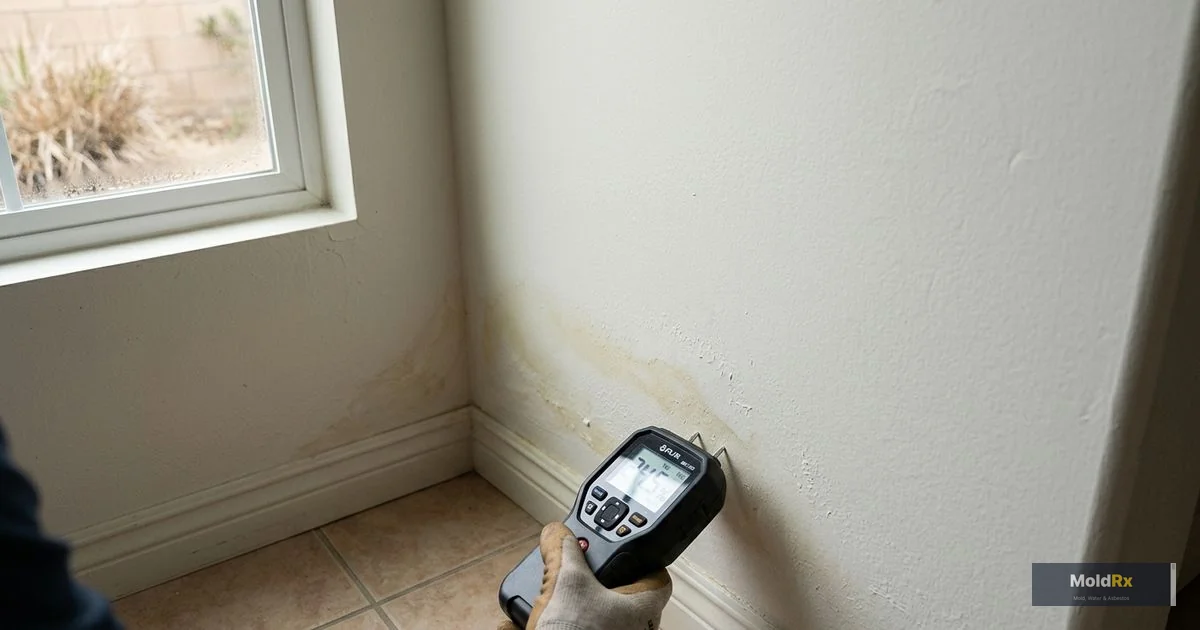
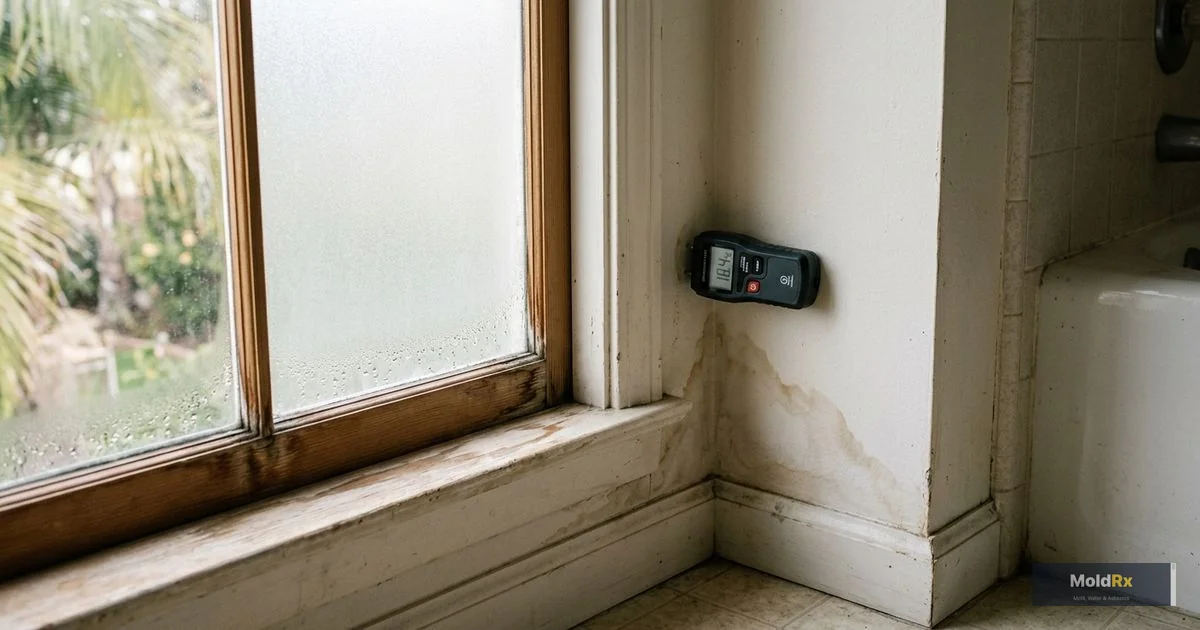
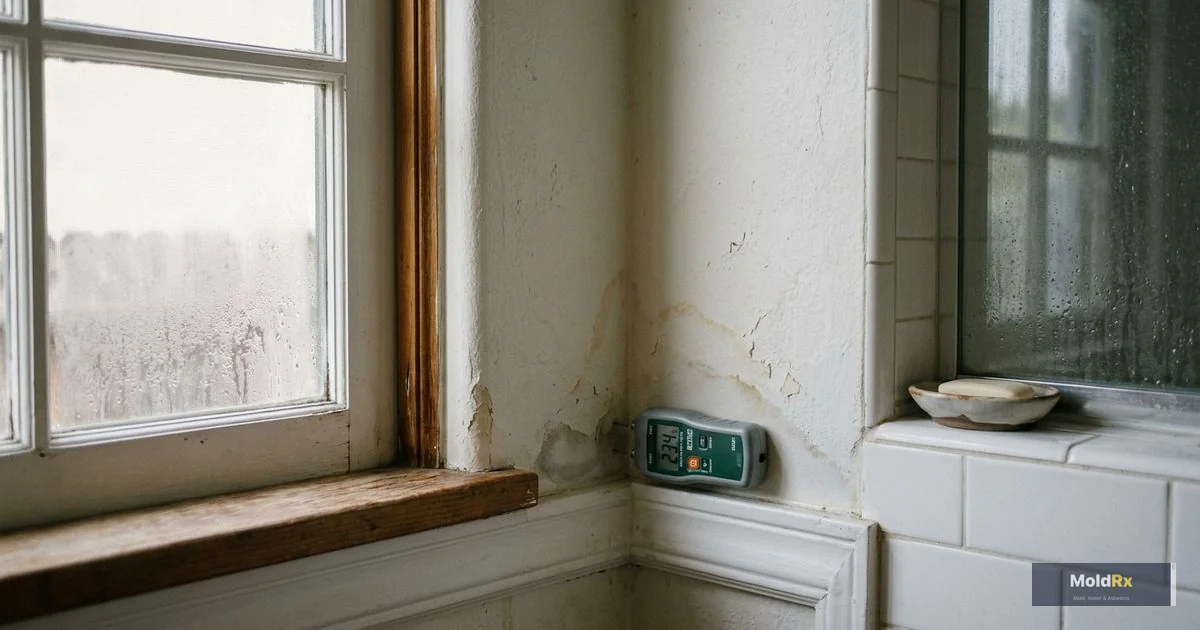
Comprehensive assessment aligned with EPA 402-K-01-001: infrared thermal imaging, pin and pinless moisture meters, and targeted checks for Palm Desert vectors — HVAC condensate lines, aging plumbing, pool equipment enclosures, slab edges near irrigation, and monsoon wash exposure. You receive a clear scope of work in plain language before removal begins.
2. Containment
The work zone is sealed under IICRC S520 Condition 2 or 3 containment. Polyethylene sheeting creates a physical barrier; HEPA-filtered negative-air machines capture particles to 0.3 microns. The CDC and EPA both emphasize containment. WHO Guidelines for Indoor Air Quality highlight limiting exposure for elderly residents and those with respiratory conditions — critical given Palm Desert's demographics.
3. Removal and Treatment
Colonized porous materials are cut out and double-bagged per IICRC S520. Salvageable surfaces are cleaned and treated with EPA-registered antimicrobials. Air monitoring confirms concentrations remain within Cal/OSHA Title 8 Section 5155 permissible exposure limits throughout.
4. Moisture Correction
Our team traces the water to its origin — corroded supply line, clogged condensate drain, failed pool fitting, irrigation saturation, or monsoon grading — and coordinates repair. For seasonally vacant properties, we recommend monitoring protocols to catch leaks during extended absence.
5. Post-Remediation Verification
The project closes at IICRC S520 Condition 1. Verification includes visual confirmation, moisture readings, and when warranted, third-party air or surface sampling. You receive a complete documentation package: scope, photos, moisture logs, containment records, waste manifests, and clearance results.
Mold Removal vs. Mold Remediation: What's the Difference?
Mold removal is the physical elimination of colonized materials. Mold remediation is the full IICRC S520 protocol: assessment, containment, removal, moisture correction, structural drying, and Condition 1 verification. Removal without remediation is incomplete — without fixing the moisture source, mold returns; without containment, spores migrate; without verification, there is no confirmation the space is safe. MoldRx coordinates full remediation on every Palm Desert project.
Preventing Mold After Remediation
Seasonal Closure Protocol
Before leaving for an extended period: set the thermostat to 82-85 degrees, shut off the main water supply, drain or vacation-mode the water heater, run the HVAC fan on a timed cycle, ensure pool/spa equipment rooms are ventilated, and arrange monthly walk-throughs to check for odors and moisture. A failed supply line in an empty Coachella Valley home during summer produces extensive mold in weeks.
HVAC Maintenance and Condensation Control
Service HVAC twice yearly — before cooling season in April and heating season in November. Flush the condensate drain line, inspect drip pans, and insulate all attic ductwork with vapor-barrier wrap. If retaining an evaporative cooler, drain, flush, and replace pads before each cooling season.
Pool, Spa, and Landscape Moisture
Inspect equipment enclosures monthly for pump seal leaks and humidity. Ventilate sealed equipment rooms. Replace waterlogged spa covers. Direct irrigation away from foundations and report shared HOA mainline leaks promptly.
Address Water Intrusion Immediately
Colonization begins within 24 to 48 hours. Whether the source is monsoon flooding, a water heater failure, or condensate overflow, dry affected materials immediately with fans, dehumidifiers, or professional extraction.
Schedule Periodic Inspections
For homes over 20 years old or with seasonal vacancy history, annual thermal imaging and moisture meter scans identify developing problems before colonization begins. Inspect before reoccupying after extended absence.
What Sets MoldRx Apart
- Straight talk, not sales talk. We tell you what you need — and what you do not.
- Licensed, insured, IICRC-certified. Every professional holds CSLB-verified credentials and is insured to work in Riverside County.
- Full documentation on every job. Scope, photos, moisture logs, containment records, clearance results.
- Family-owned accountability. We only send vetted mold removal professionals we stand behind.
Get your free estimate — no obligations, no pressure.
Palm Desert Neighborhoods We Serve
MoldRx serves all of Palm Desert — ZIP codes 92260, 92211, and 92255 — residential, commercial, and multi-family.
- Palm Desert Country Club — One of the city's original planned communities, developed in the early 1970s with single-family homes and condominiums surrounding a golf course. Housing stock here is now 50-plus years old, with original copper plumbing, aging HVAC systems, and construction that predates modern moisture management standards. Pinhole leaks and HVAC condensation are the most frequent mold triggers in this neighborhood.
- The Cove — Nestled against the Santa Rosa Mountains in south Palm Desert. Higher elevation lots experience greater temperature differentials that intensify condensation. Some homes date to the 1960s with original materials.
- Desert Willow — Late-1990s/2000s master-planned community around Desert Willow Golf Resort. Newer construction reduces plumbing-age risk, but extensive pool and irrigation infrastructure creates moisture vectors near foundations.
- Portola — 55-plus community of roughly 499 manufactured homes off Portola Avenue. Manufactured housing has specific vulnerabilities: flexible supply lines that degrade faster, belly-board insulation that traps moisture, and seasonal vacancy compounding the risk.
- South Palm Desert / Bighorn — Hillside luxury communities south of Fred Waring Drive. Grading directs monsoon wash water downhill, hardscape limits absorption, and enclosed pool/spa equipment rooms are common moisture sources.
- El Paseo District / Highway 111 — Commercial and mixed-use corridor. Older buildings may have 1970s-1980s plumbing and roofing; commercial HVAC develops condensation at duct transitions.
- Shadow Mountain / Sun City Palm Desert — Northern Palm Desert near I-10. Sun City's 1990s active-adult homes see heavy seasonal vacancy, creating closed-up conditions where small leaks escalate undetected.
Nearby Communities We Also Serve
Related Services in Palm Desert
- Water Damage Restoration in Palm Desert
- Mold Testing in Palm Desert
- Asbestos Removal in Palm Desert
- Asbestos Testing in Palm Desert
→ All remediation services in Palm Desert
Frequently Asked Questions
How does a desert climate produce mold problems?
While outdoor humidity is low, conditions inside Palm Desert homes tell a different story. Central air conditioning running nearly year-round creates condensation at duct joints and wall cavities. Pool and spa equipment generates constant humidity in enclosed spaces. Landscape irrigation saturates soil near foundations. And the city's significant seasonal vacancy rate means small moisture events — a slow drip, a condensate overflow, a stuck float valve — go undetected for months. The EPA documents colonization within 24 to 48 hours of adequate moisture. In a sealed, unoccupied Palm Desert home during summer, those conditions persist indefinitely.
I leave my Palm Desert home vacant for the summer. How do I prevent mold?
Before leaving, shut off the main water supply to eliminate leak risk. Set the thermostat to 82-85 degrees to maintain air circulation without extreme energy use. Run the HVAC fan on a timed cycle. Drain the water heater or set it to vacation mode. Ensure pool and spa equipment rooms are ventilated and covers seal properly. Arrange for someone to walk through the property monthly, checking for musty odors, visible moisture, or water stains. These steps address the most common mold triggers in seasonally vacant Coachella Valley homes.
How do I know if I have hidden mold?
The most common sign is a persistent musty odor without a visible source. In Palm Desert, hidden mold grows in wall cavities near plumbing, under slab-wicked flooring, behind failed shower pans, inside HVAC ductwork, and in pool equipment enclosures. Professional thermal imaging and moisture mapping confirm or rule out concealed growth.
Can pool or spa equipment cause mold inside my home?
Yes. Enclosed equipment rooms generate continuous humidity from pump seals and filter housings. That moisture migrates into adjacent walls and can reach living spaces through shared cavities or the HVAC return. Proper ventilation and regular inspection are essential.
How long does mold removal take?
Most Palm Desert projects take two to five days. Smaller issues may finish in a day; larger projects involving multiple rooms or structural repair can take a week or more. We provide a realistic timeline during assessment.
Do I need testing before remediation?
Not always. If mold is visible, the priority is containment, removal, and moisture correction. Testing is most valuable for suspected hidden mold, insurance documentation, real estate transactions, or post-remediation verification.
What is the difference between removal and remediation?
Removal is eliminating colonized materials. Remediation is the full IICRC S520 protocol through Condition 1 verification. MoldRx coordinates full remediation because removal without moisture correction leads to recurrence.
Is black mold more dangerous than other types?
Stachybotrys chartarum — commonly called black mold — produces mycotoxins that can affect health, and the IICRC S520 standard requires specific containment protocols during its removal. However, the CDC notes that mold color alone is not a reliable indicator of species or toxicity. Many common molds appear black, and many harmful species do not. Any colony exceeding the EPA's ten-square-foot threshold warrants professional remediation regardless of color. Laboratory analysis is the only reliable way to identify the species present.
Will insurance cover mold removal?
Coverage depends on the cause. Mold from a covered event like a sudden pipe burst may be covered; long-term maintenance neglect typically is not. Our documentation package supports legitimate claims.
Does MoldRx provide emergency service in Palm Desert?
Yes. Call (888) 609-8907 for time-sensitive situations — burst pipes, water heater failures, monsoon flooding, condensate overflows. We coordinate rapid assessment and containment to limit colonization.
Get Mold Removal in Palm Desert
Discovering mold in a desert home catches most Palm Desert homeowners off guard — the assumption has always been that arid climate means no mold risk. But aging plumbing, year-round HVAC condensation, pool and spa moisture, and months of seasonal vacancy create conditions tailor-made for hidden growth. Once a colony establishes behind drywall or under flooring, it does not resolve on its own.
MoldRx only sends vetted, IICRC-certified professionals who follow documented remediation standards, explain what they find without jargon, and do the work correctly the first time. Whether you are dealing with visible growth, a suspicious smell after returning from an extended absence, or a property changing hands in Palm Desert's active real estate market, the process starts with a straightforward assessment. We will tell you what you actually need.
Call MoldRx for your free estimate — (888) 609-8907. Clear answers. Honest guidance. Work done right.