Asbestos Testing in Ontario, CA
Vetted Asbestos Testing Professionals Serving Ontario and Western San Bernardino County
Ontario is one of the most historically layered cities in the Inland Empire -- a place where 1910s Craftsman bungalows, mid-century tract houses, 1980s subdivisions, and brand-new Ontario Ranch developments all exist within the same municipal boundary. With approximately 180,000 residents spread across nearly 50 square miles of western San Bernardino County, Ontario's housing stock represents more than a century of continuous development, and that century-long timeline creates an asbestos risk profile that is unusually complex. Different neighborhoods contain different eras of construction, and different eras used different asbestos-containing materials.
If you own property in Ontario -- whether it is a century-old Craftsman on Euclid Avenue, a 1960s ranch home near the airport, a 1980s house in the southern neighborhoods, or a commercial building along Holt Boulevard -- understanding what materials are present before renovation or demolition work begins is both a health necessity and a regulatory requirement. This page covers Ontario's development history and how it shapes asbestos risk, the testing process, applicable federal, state, and regional regulations, and what your options are once you have results.
Request a free estimate for asbestos testing in Ontario or call (888) 609-8907 to speak with our team today.
Ontario's Development Eras and Asbestos Risk by Neighborhood
Asbestos risk in Ontario is not uniform across the city. It varies dramatically by neighborhood and construction decade. Understanding Ontario's multi-era development is the key to understanding where asbestos is likely to be found and in what forms.
The Founding and Citrus Era (1880s-1930s)
Ontario was founded in 1882 by Canadian-born engineer George Chaffey and his brother William, who purchased land at the base of the San Gabriel Mountains and established the Ontario Model Colony -- an innovative planned agricultural community built around an engineered irrigation system that channeled water from San Antonio Canyon to the flat, tillable land below. They named the settlement after their home province of Ontario, Canada. The colony was incorporated as a city in 1891, and by 1903 it had been proclaimed a Model Irrigation Colony by an Act of Congress.
By the late 1880s, over 2,000 acres of citrus orchards had been planted, and Ontario developed as one of California's premier citrus communities. This agricultural foundation shaped the city through the first half of the twentieth century. Residential neighborhoods grew outward from the original downtown core along Euclid Avenue -- the grand, tree-lined boulevard that the Chaffey brothers designed as the city's central spine and that was added to the National Register of Historic Places as a historic district in 2005.
Pre-1940 Historic Core: Unique Asbestos Concerns
Ontario's northern section and downtown area feature pre-war homes in Craftsman, Victorian, Mission Revival, Mediterranean, and early Spanish Colonial styles. These houses line the gridded streets north of the 10 freeway, many shaded by mature trees dating to the citrus era. Properties from this period may contain early asbestos products that differ significantly from the mid-century materials most people associate with asbestos:
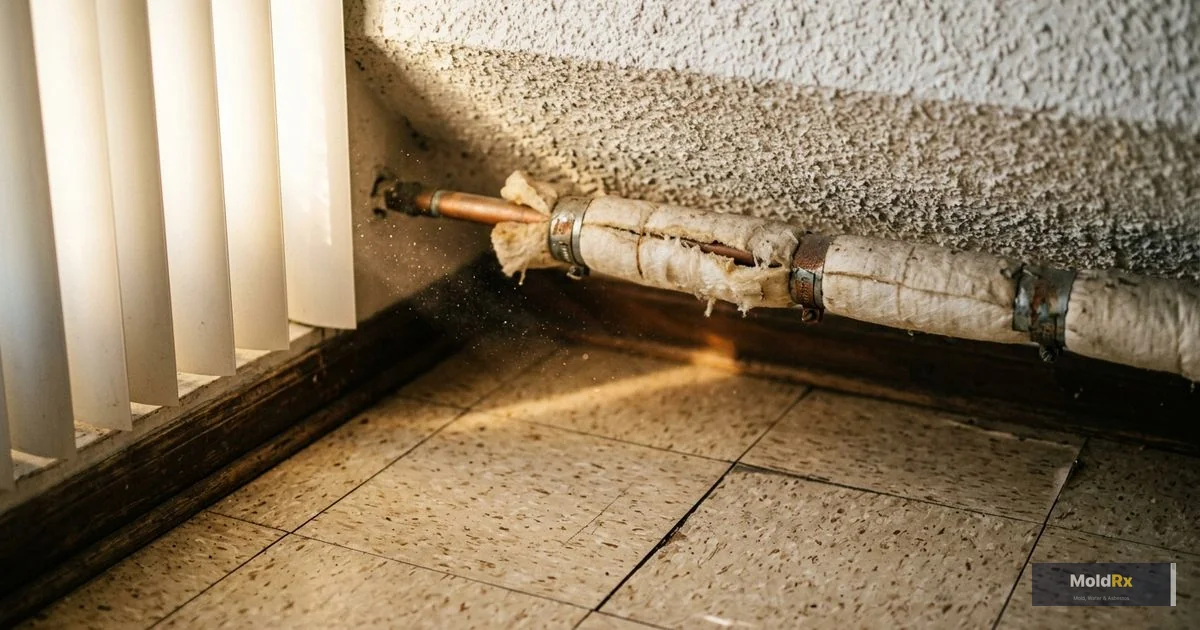
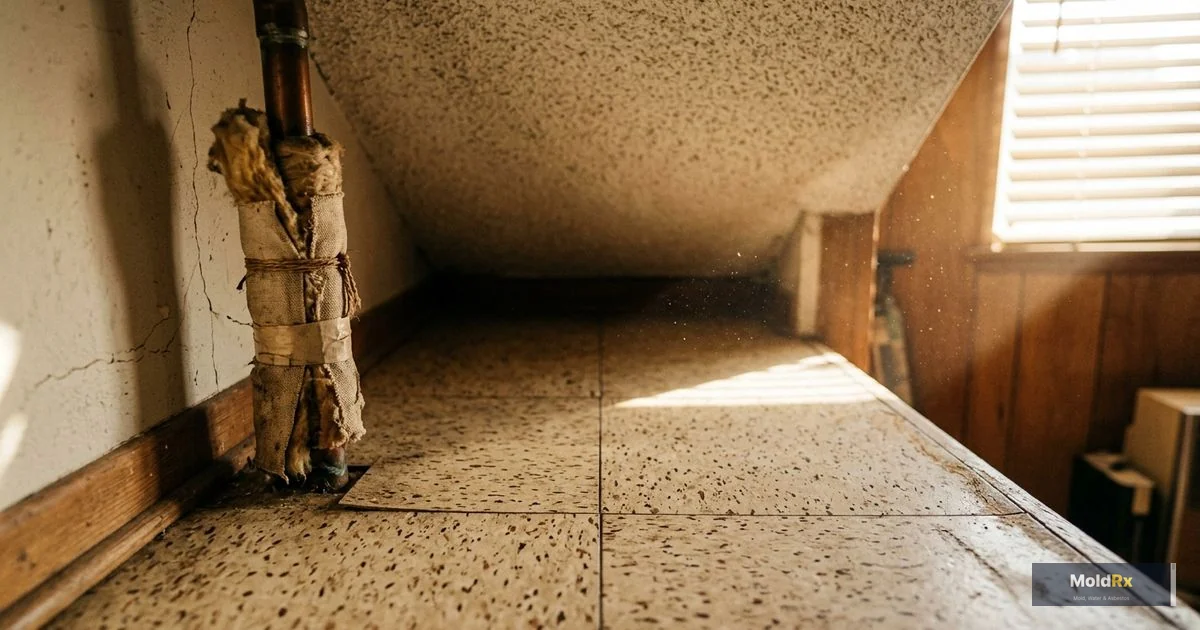
- Pipe insulation and boiler wrapping using woven asbestos cloth or corrugated asbestos paper -- distinctly different in appearance from later fiberglass or foam products
- Knob-and-tube wiring insulated with asbestos fabric -- the cloth sheathing around early electrical wiring was often asbestos-based
- Plaster applied over asbestos-containing lath -- early lath-and-plaster systems sometimes incorporated asbestos fibers for fire resistance
- Coal or oil furnace components insulated with asbestos blanket wrapping, gaskets, and rope seals
- Roofing materials including asbestos-cement shingles, hexagonal asbestos shingles, and felt
- Original window glazing putty that has been in place for 80 to 100 years
These older asbestos products require an inspector experienced with pre-war building practices to identify during sampling. A specialist accustomed only to mid-century materials may not recognize early-twentieth-century asbestos in its different forms.
Mid-Century Expansion (1940s-1970s): The Highest-Risk Era
Ontario expanded significantly during and after World War II, driven by the nearby Ontario Army Air Field (later Ontario International Airport), military-related industry, and the broader suburbanization of the Inland Empire. Neighborhoods from this era feature ranch-style homes, tract development, and the full range of mid-century building materials. This is the highest-risk period for asbestos, with common materials including:
- Popcorn ceilings and acoustic spray textures on ceilings throughout homes
- Vinyl floor tiles in 9x9-inch and 12x12-inch formats with black mastic adhesive
- Sheet vinyl flooring with asbestos-containing backing
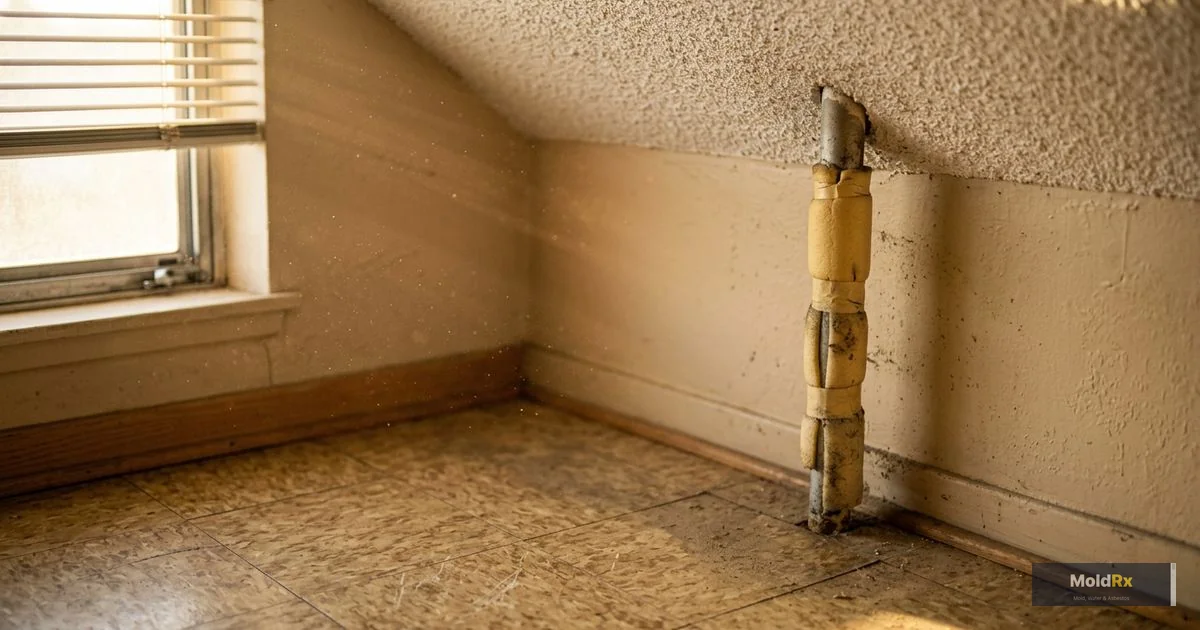
- Pipe insulation and HVAC duct wrapping in forced-air heating and cooling systems
- HVAC duct tape, connectors, and gaskets -- the cloth-like sealing tape used at duct joints
- Roofing shingles, felt underlayment, and built-up roofing
- Drywall joint compound at wallboard seams -- one of the most frequently confirmed ACMs in the Inland Empire
- Vermiculite attic insulation potentially contaminated with tremolite asbestos
- Cement siding, stucco, and exterior coatings reinforced with chrysotile fibers
- Window glazing putty and exterior caulking
Homes in established Ontario neighborhoods between Fourth Street and the 60 freeway, along Euclid Avenue, in the areas surrounding Ontario International Airport, and in the residential corridors along Mountain Avenue and Grove Avenue frequently date to this period.
Transitional Growth (1980s-Early 2000s): Moderate Risk
Ontario continued developing through the 1980s and 1990s, filling in remaining agricultural areas and extending southward. Homes from this transitional period carry moderate asbestos risk. Federal regulations under OSHA 1926.1101 began restricting asbestos in the late 1970s, and California followed with Cal/OSHA Section 1529 (Title 8, CCR SS1529). However, the phase-out was gradual, not instantaneous. Building products manufactured before restrictions took effect continued flowing through supply chains and being installed into the mid-1980s. Materials including roofing products, vinyl flooring, cement siding, and certain formulations of joint compound could still contain asbestos during this period. Testing is warranted when renovation work will disturb original materials from 1980s-era Ontario homes.
Ontario Ranch (2010s-Present): Modern Construction
The Ontario Ranch master-planned community on the city's southern edge represents over 8,000 acres and 13 square miles of new development transforming former agricultural land into the largest master-planned community in Southern California. Construction began around 2014, and Ontario Ranch homes are built with modern materials that do not carry asbestos risk. However, the broader Ontario Ranch area includes some older structures that predated the development -- agricultural buildings, ranch houses, irrigation infrastructure, and outbuildings that may contain asbestos-era materials. If an older structure exists on or adjacent to a newer Ontario Ranch property, it should be evaluated before renovation or demolition.
Understanding the Health Risk
Asbestos fibers are microscopic and become dangerous when released into the air during cutting, drilling, sanding, or demolition of materials that contain them. Once inhaled, the fibers embed permanently in lung tissue, causing diseases that develop silently over decades: mesothelioma (an aggressive, nearly always fatal cancer with a 20-to-50-year latency period), asbestosis (irreversible progressive lung scarring), and lung cancer (with risk multiplied dramatically in smokers). Exposure today may not produce symptoms for 20 or 30 years. Identifying and properly managing asbestos-containing materials before they are disturbed eliminates the exposure pathway entirely.
Ontario's Industrial History and Climate
Ontario's history includes significant industrial development alongside residential growth. Residential properties near industrial zones or on former industrial land may encounter asbestos in unexpected forms -- contaminated fill, remnant infrastructure, and non-residential building products.
Ontario's semi-arid climate -- summers in the mid-90s to low 100s and under 15 inches of annual rainfall -- causes materials to dry out and become brittle over decades. In Craftsman-era homes that have endured a century of these conditions, original materials may be in significantly worse condition than surface appearances suggest. Laboratory analysis is the only reliable evaluation method.
The Regulatory Framework for Ontario Properties
Federal Standards
OSHA 1926.1101 is the federal standard governing asbestos in construction work. It classifies asbestos activities into four classes (I through IV) based on the type and risk level of the material being disturbed, establishes permissible exposure limits of 0.1 fibers per cubic centimeter over an 8-hour workday, requires a designated competent person on every asbestos work site, and mandates specific engineering controls, work practices, and worker training for each class.
AHERA (Asbestos Hazard Emergency Response Act) established the inspector certification framework that has become the industry standard. AHERA-accredited building inspectors must complete a three-day accreditation course covering identification, sampling, assessment, and management of asbestos-containing materials, and must maintain certification through annual refresher training. All bulk asbestos samples from publicly accessed buildings must be collected by an AHERA-certified inspector.
California State Standards
Cal/OSHA Section 1529 (Title 8, CCR SS1529) is California's asbestos-in-construction standard. It requires asbestos surveys for pre-1980 structures before renovation or demolition, presumes all thermal system insulation and surfacing materials in pre-1980 buildings contain asbestos until testing proves otherwise, and requires a CSLB C-22 licensed asbestos abatement contractor for disturbances of 100 square feet or more of material containing more than 0.1 percent asbestos. The C-22 classification requires four years of documented asbestos abatement experience, registration with the Division of Occupational Safety and Health (DOSH), and passage of a specialized trade examination.
South Coast AQMD Rule 1403
Ontario falls within the South Coast Air Quality Management District (SCAQMD) jurisdiction. Rule 1403 governs asbestos emissions from demolition and renovation:
- An asbestos survey is required before any demolition -- no exceptions for building type, age, or size
- A survey is required before renovation projects disturbing 100 square feet or more of suspect material
- Surveys must be conducted by Cal/OSHA-certified or AHERA-certified inspectors
- Written notification to the SCAQMD must be submitted at least 10 working days before asbestos removal begins
- Specific work practices for wetting, containment, removal, transport, and disposal must be followed
- Fines for non-compliance can exceed $20,000 per day
What This Means by Property Era in Ontario
Because Ontario's housing stock spans more than a century, regulatory implications vary by property:
- Pre-1940 historic homes require inspection by a professional experienced with early-twentieth-century building materials. AHERA-certified inspectors with knowledge of older asbestos products are essential.
- 1940s through 1970s properties should include asbestos testing as a standard part of any renovation plan. This is the highest-risk era.
- 1980s through early 2000s properties warrant testing when renovations will disturb original flooring, roofing, or mechanical systems.
- Ontario Ranch and other post-2010 construction generally does not require testing unless older pre-development structures are present on or near the property.
Licensed contractors working on older Ontario properties will typically require laboratory test results before beginning renovation or demolition work. Real estate professionals handling transactions involving pre-1980 homes increasingly expect asbestos documentation as part of the disclosure process.
How MoldRx Asbestos Testing Works in Ontario
MoldRx only sends vetted, certified professionals to your property. Every inspector holds current AHERA building inspector accreditation and follows EPA and Cal/OSHA sampling protocols. Every sample is analyzed at an NVLAP-accredited laboratory. Here is what the process looks like for Ontario properties.
Step 1: Property-Specific Assessment
Ontario's wide range of construction eras means that testing needs vary considerably. A 1920s Craftsman bungalow near downtown requires different sampling strategies than a 1960s ranch home near the airport or a 1985 tract house in the southern neighborhoods. We start by understanding:
- Your property's age and construction type
- Whether additions or renovations from different decades have created multiple material layers
- The scope of your planned work
- Which materials need testing and which do not
If testing is unnecessary for your situation, we will tell you directly.
Step 2: Professional Sample Collection
A vetted asbestos specialist visits your Ontario property to collect samples following EPA protocols:
- Suspect materials are misted with amended water to minimize fiber release during sampling
- Small sections (one to two square inches) are carefully removed using specialized tools
- Each sample is sealed in a labeled, tamper-evident container and documented by exact location
- Multiple samples may be collected from the same material type -- especially in Ontario homes where additions or renovations from different decades mean that the same material (joint compound, for example) in different rooms may have different compositions
- For historic properties, the specialist evaluates materials specific to the construction era, including plaster, older insulation types, original mechanical components, and early roofing products
On-site collection for a typical Ontario residential property takes one to two hours. Properties with additions from multiple eras or with complex material layers may require additional time.
Step 3: NVLAP-Accredited Laboratory Analysis
Samples are submitted to a laboratory holding NVLAP (National Voluntary Laboratory Accreditation Program) accreditation, ensuring independent evaluation of technical competence, mandatory proficiency testing, and compliance with ISO/IEC 17025 quality management standards.
Polarized Light Microscopy (PLM) is the standard analysis method for bulk building material samples. PLM identifies asbestos fiber type (chrysotile, amosite, crocidolite, tremolite, anthophyllite, or actinolite), determines approximate concentration, and distinguishes asbestos from other fibrous materials. PLM meets EPA requirements for most regulatory compliance situations.
Transmission Electron Microscopy (TEM) provides higher resolution and sensitivity for inconclusive PLM results, very low fiber concentrations, or air monitoring samples. TEM identifies individual fibers at the nanometer scale and is the definitive analytical method when PLM findings need confirmation.
Standard turnaround is three to five business days. Rush analysis (24-hour and 48-hour) is available for urgent projects and real estate transactions.
Step 4: Detailed Reporting and Guidance
Your report identifies each sample, its location, the laboratory findings, and what the results mean for your specific project. For positive findings, the report explains your options:
- Management in place for intact materials that will remain undisturbed -- with recommendations for periodic condition monitoring
- Encapsulation for materials in fair condition that benefit from a protective sealant or barrier
- Professional removal by a CSLB C-22 licensed contractor for materials that must be demolished, are deteriorating, or are in the direct path of renovation work
The report provides complete documentation for real estate disclosures, permit applications, contractor coordination, and SCAQMD Rule 1403 notification.
Materials to Test by Property Era in Ontario
Pre-1940 Historic Homes (Craftsman, Mission Revival, Spanish Colonial)
Pipe insulation (woven asbestos cloth or corrugated asbestos paper), plaster and lath, coal or oil furnace components, boiler insulation, knob-and-tube wiring sheathing, roofing materials (asbestos-cement shingles, felt), and original window glazing putty. These early asbestos products look different from mid-century materials and require an inspector familiar with pre-war construction practices.
1940s Through 1970s Homes (Ranch, Tract, Mid-Century)
The full range of mid-century asbestos materials: vinyl floor tiles and adhesive, popcorn ceilings and acoustic textures, pipe and duct insulation, HVAC duct tape and gaskets, roofing shingles and felt, drywall joint compound, vermiculite attic insulation, cement siding, stucco, and exterior caulking.
1980s Through Early 2000s Homes
Roofing materials, vinyl flooring, cement siding, and certain mechanical components. Testing is most important when these specific original materials will be cut, removed, or otherwise disturbed during renovation.
Schedule your free asbestos testing estimate in Ontario or call (888) 609-8907.
Common Reasons for Asbestos Testing in Ontario
Historic home renovation in downtown Ontario and the Euclid Avenue corridor. Restoring or updating a Craftsman bungalow, Mission Revival home, or early-twentieth-century property involves encountering original materials that may be 80 to 100 years old.
Mid-century home remodeling including kitchen and bathroom updates, flooring replacement, popcorn ceiling removal, and room additions in the city's 1950s through 1970s neighborhoods.
Real estate transactions for pre-1980 homes where buyers and sellers benefit from laboratory-confirmed documentation. Proactive testing by sellers can streamline the disclosure process and prevent transaction delays.
Commercial and industrial property renovation in Ontario's significant business corridors, where older buildings may contain asbestos in both standard construction materials and specialized industrial applications.
Demolition projects of any structure, regardless of age, require an asbestos survey under SCAQMD Rule 1403 before work begins.
Properties with multi-era additions where rooms from the 1950s, 1970s, and 1990s may each contain different materials. Each era must be sampled independently because the same product type may contain asbestos in one decade and not another.
Damaged or deteriorating materials discovered during routine maintenance, after weather events, or during other work should be tested before further disturbance.
Ontario Neighborhoods and Areas We Serve
MoldRx provides asbestos testing throughout Ontario and the surrounding western San Bernardino County area. We serve all Ontario neighborhoods and construction eras, including:
- Historic downtown core along Euclid Avenue and the surrounding Craftsman-era streets
- Mid-century neighborhoods near Ontario International Airport, along Fourth Street, Holt Boulevard, Mountain Avenue, and Grove Avenue
- 1980s and 1990s developments in the central and southern portions of the city
- Ontario Ranch -- for evaluation of any older pre-development structures that may remain in the area
- Commercial and industrial properties along the 10 and 60 freeway corridors
Our service area extends to neighboring communities including Upland, Montclair, Rancho Cucamonga, Fontana, Chino, and Pomona. Whether you own a century-old bungalow, a mid-century ranch, a commercial building, or a property with additions from multiple decades, we evaluate all materials and provide the documentation you need.
Related Services in Ontario
In addition to asbestos testing, we also offer Mold Removal in Ontario, Asbestos Removal in Ontario, Water Damage Restoration in Ontario, and Mold Testing in Ontario services to Ontario property owners.
Learn more about remediation services in Ontario
Frequently Asked Questions About Asbestos Testing in Ontario
My Ontario home is a 1920s Craftsman. Is asbestos likely?
Yes. Homes from the 1910s and 1920s can contain early asbestos products that look different from mid-century materials. Pipe insulation in these homes may be woven asbestos cloth rather than the molded fiberglass common in later decades. Plaster may contain asbestos fibers. Original furnace components, boiler insulation, and roofing products from this era frequently test positive. It is essential to work with an AHERA-certified inspector who has experience with pre-war building materials and can identify asbestos products that a less experienced inspector might miss.
I live in Ontario Ranch. Do I need asbestos testing?
If your home was built as part of the Ontario Ranch development (generally 2014 and later), asbestos testing is not typically necessary for the home itself. However, if older structures exist on or adjacent to your property -- agricultural buildings, ranch infrastructure, irrigation pump houses, or other pre-development structures -- those should be evaluated before renovation or demolition, as they may contain asbestos-era materials.
What if my Ontario home has additions from different decades?
This is common in Ontario, where a home may have original construction from the 1940s or 1950s with additions from the 1970s, 1980s, or later. Each era of construction must be sampled separately because the same material type -- joint compound, floor tile, roofing -- may contain asbestos in one decade and not another. Different rooms, additions, and building phases get independent samples. Your report will clearly distinguish results by location and construction era.
What is the difference between asbestos testing and an asbestos survey?
The terms are often used interchangeably in practice. Both involve collecting physical samples of suspect building materials and submitting them to an NVLAP-accredited laboratory for PLM or TEM analysis. A comprehensive asbestos survey may also include a written assessment of the condition of materials found to contain asbestos and recommendations for management, encapsulation, or removal. MoldRx reports include this condition assessment and recommendation as standard practice.
How long does asbestos testing take for an Ontario property?
On-site sample collection typically takes one to two hours for a standard residential property. Properties with additions from multiple eras or complex material layers may require additional time. Laboratory results from the NVLAP-accredited lab are available within three to five business days, with rush options (24-hour and 48-hour) for urgent situations. The complete process from initial contact to report delivery is usually about one week.
What regulations apply to asbestos work on my Ontario property?
Multiple overlapping regulations apply. OSHA 1926.1101 sets federal standards for asbestos in construction. Cal/OSHA SS1529 adds California-specific requirements including mandatory surveys for pre-1980 structures. SCAQMD Rule 1403 requires asbestos surveys before any demolition and before renovation disturbing 100+ square feet of suspect material, with notification to the air district at least 10 working days before removal begins. If asbestos removal is needed, it must be performed by a CSLB C-22 licensed contractor. AHERA certification is the standard for inspectors collecting samples.
Schedule Asbestos Testing for Your Ontario Property
Ontario's century-plus development history means the city contains every era of asbestos-containing materials -- from early-twentieth-century industrial products in Craftsman homes to mid-century residential staples in tract housing to the transitional materials of the 1980s. Whatever the age of your property and whatever the scope of your project, understanding what materials are present before work begins protects your health, satisfies regulatory requirements under OSHA 1926.1101, Cal/OSHA SS1529, and SCAQMD Rule 1403, and prevents costly surprises.
MoldRx only sends vetted, certified specialists who have experience with properties from every era of Ontario's development. Every inspector holds AHERA certification. Every sample goes to an NVLAP-accredited laboratory for PLM or TEM analysis. Every report gives you clear, honest answers and actionable guidance.
Get your free estimate for Ontario asbestos testing or call (888) 609-8907 to schedule an inspection.