Asbestos Testing in Norco, CA
Vetted Asbestos Testing Professionals Serving Norco and Western Riverside County
Norco sits in western Riverside County, home to roughly 27,000 residents and known across Southern California as "Horsetown USA" for its deep equestrian heritage, half-acre minimum lot sizes, and 140 miles of horse trails threading through the community. The city's rural character and large-lot zoning make it distinct from the dense suburban development found in neighboring Corona and Eastvale, but its housing stock shares the same asbestos timeline that affects the broader Inland Empire. The majority of Norco's residential construction occurred between the mid-1960s and the early 1980s -- the peak era for asbestos-containing building materials in American homes.
If you are renovating a ranch home, converting an outbuilding, purchasing property with multiple structures, or simply concerned about aging materials in a house built during these decades, laboratory-confirmed asbestos testing is the only way to know what is present. Visual inspection cannot identify asbestos. Two floor tiles that look identical may have entirely different compositions depending on the manufacturer and production year. This page explains why Norco properties carry particular asbestos risk, how the testing process works, what state and federal regulations require, and what your options are once results come back.
Request a free estimate for asbestos testing in Norco or call (888) 609-8907 to speak with our team today.
How Norco's History Created Today's Asbestos Risk
Understanding how a city was built -- and when -- is the first step in understanding where asbestos might be hiding. Norco's development timeline maps directly onto the decades when asbestos was used most heavily in residential construction.
From Ranch Colony to Horsetown USA
In 1920, businessman Rex B. Clark purchased roughly 15 square miles of struggling farmland north of Corona through his North Corona Land Company and renamed the area "Norco." Clark envisioned a self-sustaining community of small farms and ranches, and he held a grand opening on Mother's Day 1923, marketing the area as a place where working families could live on the land. Growth was slow through the Depression years. The area's trajectory changed dramatically in 1941 when the U.S. Navy acquired the Norconian Resort -- Clark's lavish 900-acre retreat that had opened in 1929, just months before the stock market crash -- and converted it into Naval Hospital Number 1. By 1945, the facility housed 4,500 servicemen and functioned as the Navy's national tuberculosis, malaria, and polio treatment center, bringing economic activity that sustained the community through the war years and beyond.
The hospital closed in 1957, and portions of the grounds later became the California Rehabilitation Center. Meanwhile, a different kind of growth was taking shape. Through the 1960s and 1970s, equestrians being priced out of urbanizing Orange County discovered Norco's large lots, open spaces, and horse-friendly zoning. They moved in, brought their animals, and fought to preserve the rural character. Norco incorporated as a city on December 28, 1964, largely as a defensive measure to protect the equestrian lifestyle from encroaching suburban development. The decades that followed saw steady residential construction -- ranch-style homes on half-acre or larger parcels, built to accommodate horses, barns, and the outdoor lifestyle that defines the community.
In 2006, Norco received a federal trademark for "Horsetown U.S.A." The city maintains some of the most distinctive zoning in Southern California: few sidewalks (replaced by horse trails), hitching posts at local businesses, and minimum lot sizes designed to support animal keeping.
The Construction Timeline and Asbestos
Norco's primary residential build-out occurred during the 1960s through early 1980s. This period coincides precisely with the peak of asbestos use in American building materials. Asbestos was prized by manufacturers for its heat resistance, fireproofing capability, tensile strength, and low cost. Builders used it without restriction because federal regulations under OSHA 1926.1101 did not begin limiting asbestos in construction until the late 1970s, and California's own Cal/OSHA Title 8, Section 1529 (Cal/OSHA SS1529) standards followed a similar timeline. Even after restrictions began, products manufactured before the rules took effect continued flowing through supply chains and being installed in new homes well into the mid-1980s.
Materials commonly found in Norco-era construction include:
- Popcorn ceilings and spray-on acoustic textures -- Standard in homes built between the mid-1960s and early 1980s, these textured finishes frequently contain chrysotile asbestos fibers.
- Vinyl floor tiles (9x9-inch format) and black mastic adhesive -- The adhesive often contains asbestos even when the tile itself does not.
- Sheet vinyl flooring with asbestos-containing backing -- The backing material rather than the visible surface layer is the concern.
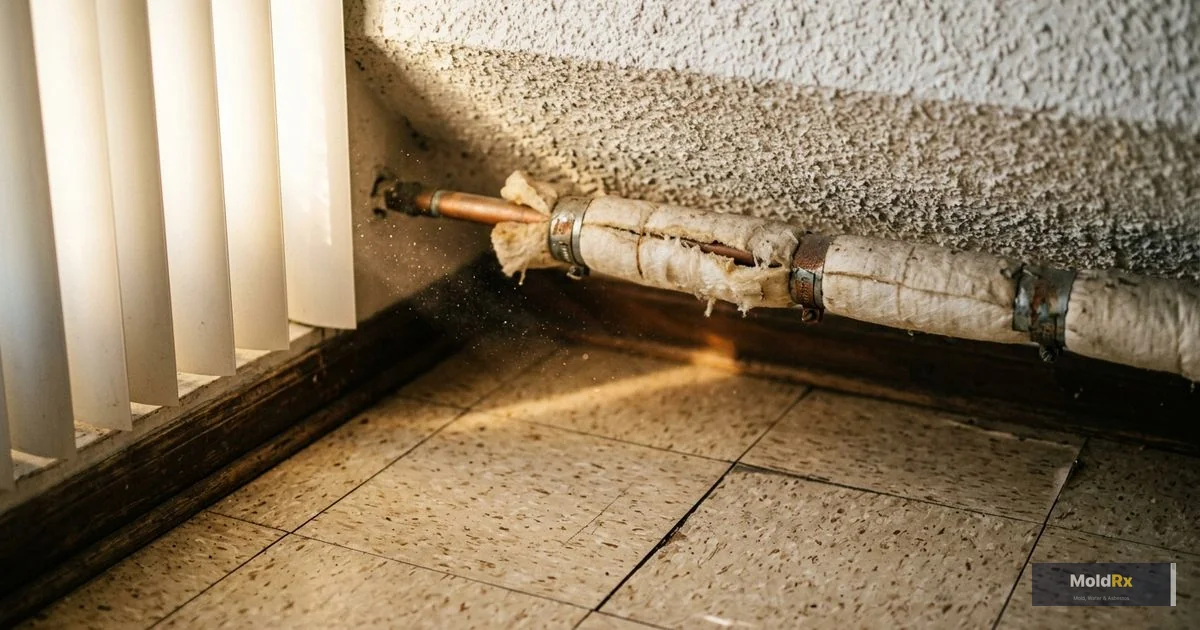
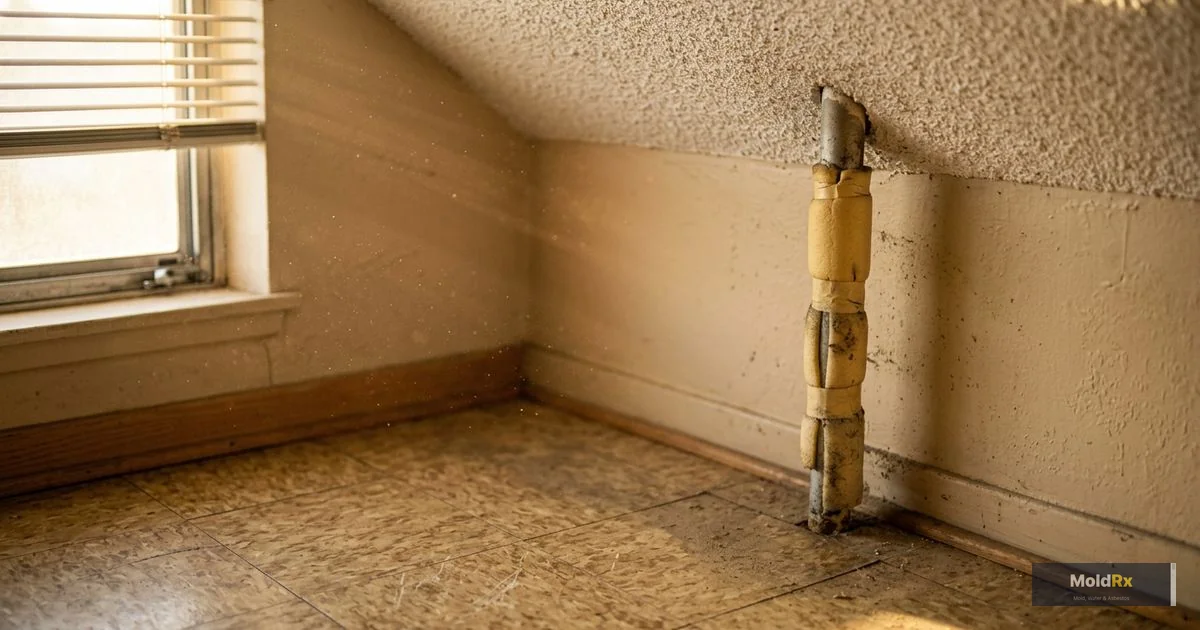
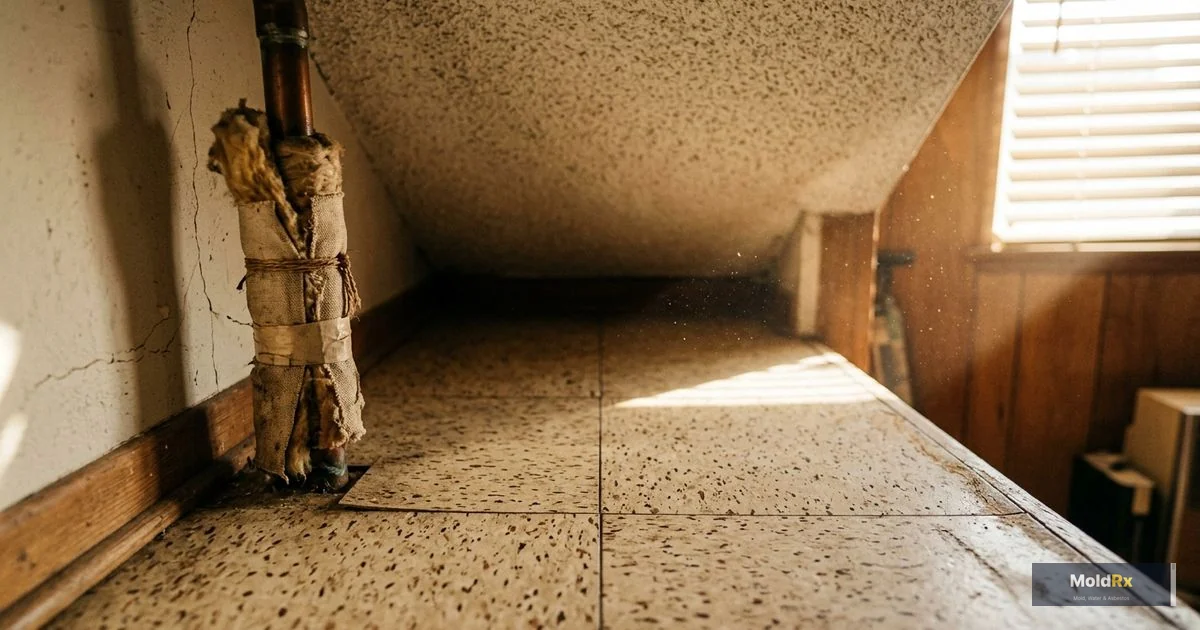
- Pipe insulation and HVAC duct wrapping -- Chrysotile or amosite asbestos was used to insulate hot water pipes, heating ducts, and forced-air system components.
- HVAC duct tape, connectors, and gaskets -- The cloth-like tape used to seal duct joints is a common positive finding.
- Roofing shingles, felt underlayment, and flashing cement -- Composition roofing products from this era regularly test positive.
- Drywall joint compound -- Used to finish seams between wallboard panels; one of the most frequently confirmed asbestos-containing materials in Inland Empire homes.
- Cement siding and stucco -- Exterior cladding reinforced with chrysotile fibers for durability and fire resistance.
- Vermiculite attic insulation -- The loose, pebble-like material sold under brand names like Zonolite; a significant percentage came from the Libby, Montana mine contaminated with tremolite asbestos.
- Window glazing putty and exterior caulking -- Applied around window frames and exterior joints, these materials become brittle and crumble with age.
What Makes Norco Properties Different
Norco's equestrian character creates testing considerations that do not apply in typical suburban communities. Many Norco properties include:
- Outbuildings, barns, tack rooms, and covered arenas built during the same era as the main residence, often using industrial-grade materials such as corrugated cement siding, heavy-duty pipe insulation, and commercial-grade built-up roofing that may contain higher asbestos concentrations than residential products.
- Workshop and storage structures constructed with less finish attention, where materials like transite panels (rigid asbestos-cement board) and unfinished insulation are more common.
- Mechanical systems in equestrian facilities -- Water well equipment, irrigation pump housings, wash rack heating components, and tack room heaters may incorporate asbestos-containing gaskets, seals, and insulation.
When planning asbestos testing for a Norco property, it is important to evaluate every structure on the parcel -- not just the main house. SCAQMD Rule 1403 requires an asbestos survey before demolition of any structure, regardless of its type, and the same logic applies to renovation planning: if you are converting a barn, replacing a workshop roof, or demolishing an aging outbuilding, the materials in that structure must be assessed.
Why Asbestos Testing Matters: The Health Science
Asbestos-containing materials that are intact and undisturbed generally pose minimal risk. The danger arises when fibers become airborne -- during renovation, demolition, sanding, drilling, or because materials have deteriorated enough to release fibers on their own. Asbestos fibers are microscopic, invisible, and odorless.
Once inhaled, asbestos fibers lodge permanently in lung tissue and cannot be expelled. Over decades, they cause serious diseases: mesothelioma (an aggressive, almost always fatal cancer of the lung or abdominal lining with a 20-to-50-year latency period), asbestosis (irreversible progressive scarring of the lungs), and lung cancer (with risk compounded dramatically in smokers). All of these diseases are preventable through identification and proper management of asbestos-containing materials before disturbance.
Norco's Climate and Material Deterioration
Norco's semi-arid Mediterranean climate -- hot, dry summers in the mid-90s to low 100s, mild winters, and roughly 10 to 12 inches of annual rainfall -- stresses building materials over decades. Prolonged heat causes pipe insulation to crack, roofing felt to curl, duct tape to separate, and caulking to shrink and crumble. When these materials contain asbestos, deterioration means potential fiber release even without active renovation.
Norco properties face additional exposure because outbuildings, barns, and covered arenas have materials directly exposed to sun and thermal cycling without climate-controlled protection. Corrugated cement siding on a south-facing barn wall that has endured 40-plus years of Riverside County summers may be in significantly worse condition than similar material inside the home. Properties with visible material deterioration should be evaluated even if no renovation is planned.
The Regulatory Framework: What Norco Property Owners Need to Know
Asbestos is one of the most heavily regulated substances in construction. Multiple federal, state, and regional agencies impose overlapping requirements that Norco property owners must understand before undertaking renovation or demolition work.
Federal Standards
OSHA 1926.1101 is the federal Occupational Safety and Health Administration standard governing asbestos in construction. It classifies asbestos work into four categories (Class I through Class IV) based on the type of material being disturbed, establishes permissible exposure limits (0.1 fibers per cubic centimeter of air over an 8-hour time-weighted average), requires designated competent persons on asbestos work sites, and mandates specific work practices, engineering controls, and worker training for each class of work. Any construction activity that may disturb asbestos-containing material falls under this standard.
AHERA (Asbestos Hazard Emergency Response Act) established the certification framework for asbestos inspectors and requires that all bulk asbestos samples from publicly accessed buildings be collected by an AHERA-accredited building inspector. The AHERA certification standard has become the baseline qualification for asbestos inspectors across all building types, not just the schools it originally targeted.
California State Standards
Cal/OSHA Section 1529 (Title 8, CCR SS1529) is California's asbestos-in-construction standard, which parallels federal OSHA 1926.1101 but includes additional California-specific requirements. Cal/OSHA mandates asbestos surveys for pre-1980 structures before renovation or demolition. All thermal system insulation and surfacing materials in pre-1980 buildings are legally presumed to contain asbestos until laboratory testing proves otherwise. Disturbances of 100 square feet or more of material containing more than 0.1 percent asbestos require a CSLB C-22 licensed asbestos abatement contractor. The C-22 classification, issued by the California Contractors State License Board, requires a minimum of four years of asbestos abatement experience, DOSH registration, and passage of a specialized trade examination.
South Coast AQMD Rule 1403
Norco falls within the jurisdiction of the South Coast Air Quality Management District (SCAQMD). Rule 1403 is the regional regulation governing asbestos emissions from demolition and renovation activities:
- An asbestos survey by a Cal/OSHA-certified or AHERA-certified inspector is required before any demolition, with no exceptions for structure type, age, or size.
- Renovation projects disturbing 100 square feet or more of suspect material require a pre-renovation asbestos survey.
- Written notification to the SCAQMD must be submitted at least 10 working days before asbestos removal begins, using the district's online notification system.
- Specific work practices for wetting, containment, removal, bagging, transport, and disposal must be followed.
- Penalties for non-compliance can reach $20,000 or more per day, with potential criminal liability if negligence leads to bodily harm or environmental damage.
Application to Multi-Structure Norco Properties
For Norco property owners, these regulations apply to every structure on a parcel -- not just the main residence. Demolishing an old barn, re-roofing a workshop, renovating a tack room, or replacing siding on a storage building all trigger the same survey and notification requirements as work on the primary home. Given that Norco properties routinely include multiple structures built during the asbestos era, comprehensive testing that addresses all buildings provides the most complete protection -- both for your health and for regulatory compliance.
How MoldRx Asbestos Testing Works in Norco
MoldRx only sends vetted, certified professionals to your property. Every inspector in our network holds current AHERA building inspector accreditation and follows EPA and Cal/OSHA sampling protocols. Every sample is analyzed at an NVLAP-accredited laboratory. Here is what the process looks like.
Step 1: Property Evaluation and Scope Planning
We start with a conversation about your property and your plans. For Norco properties, this means understanding not just the main residence but any outbuildings, barns, workshops, or equestrian structures that may be part of your project. We discuss:
- The age and construction history of each structure on the parcel
- The materials present and their visible condition
- The scope of planned renovation, demolition, or repair work
- Which structures and materials actually need testing and which do not
If testing is unnecessary for your situation, we will tell you. We do not recommend sampling that serves no purpose.
Step 2: On-Site Sample Collection
A vetted asbestos specialist visits your Norco property to collect physical samples following EPA protocols:
- Each suspect material is misted with amended water to suppress fiber release before sampling
- Small sections (one to two square inches) are removed using specialized cutting tools
- Every sample is sealed in a labeled, tamper-evident container and documented by exact location, structure, and material type
- Multiple samples are collected from the same material type when different structures or rooms may have materials from different manufacturers or construction dates
- The specialist minimizes property disruption and seals or patches each sample point
For a Norco property with a main residence and one or two outbuildings, on-site collection typically takes one to three hours depending on the number of structures and materials involved.
Step 3: NVLAP-Accredited Laboratory Analysis
All samples go to a laboratory holding NVLAP (National Voluntary Laboratory Accreditation Program) accreditation from NIST -- meaning independent evaluation of technical competence, mandatory proficiency testing, and ISO/IEC 17025 quality management. Two methods are used:
Polarized Light Microscopy (PLM) is the standard method for bulk samples. PLM identifies asbestos fiber type and concentration and is the EPA-specified method for most building material analyses.
Transmission Electron Microscopy (TEM) provides higher resolution for inconclusive PLM results, very low fiber concentrations, or air monitoring samples. TEM is the definitive method when PLM findings need confirmation.
Standard turnaround is three to five business days. Rush analysis (24-hour and 48-hour) is available for urgent timelines.
Step 4: Comprehensive Reporting and Guidance
Your report covers every structure and material sampled on your property. Results are organized by building, location, and material type. Each sample receives a clear determination: asbestos detected or asbestos not detected. For positive findings, the report explains:
- Management in place -- When materials are intact, in good condition, and will not be disturbed by planned work. Periodic monitoring ensures the materials remain stable.
- Encapsulation -- When a protective sealant or barrier is appropriate for materials in fair condition that need an added layer of protection against fiber release.
- Professional removal -- When materials must be demolished, are actively deteriorating, or are in the direct path of renovation work. Removal must be performed by a CSLB C-22 licensed asbestos abatement contractor following Cal/OSHA and SCAQMD work practice requirements.
The report provides the documentation needed for real estate transactions, permit applications, contractor coordination, and SCAQMD Rule 1403 compliance.
Schedule your free asbestos testing estimate in Norco or call (888) 609-8907.
Common Triggers for Asbestos Testing in Norco
Home renovation and remodeling -- Kitchen and bathroom updates, flooring replacement, popcorn ceiling removal, room additions, and any work that cuts into, scrapes, sands, or demolishes original building materials.
Barn and outbuilding renovation -- Converting equestrian structures to new uses, updating facilities, or replacing aging roofing and siding on barns, workshops, and covered arenas.
Property purchase or sale -- Buyers want to understand the condition of all structures on a Norco parcel. Sellers benefit from proactive testing that provides documentation and streamlines the transaction. Real estate professionals handling pre-1990 properties increasingly expect asbestos test results.
Demolition of aging structures -- Removing old sheds, workshops, or storage buildings that have reached the end of their useful life. SCAQMD Rule 1403 requires an asbestos survey before any demolition, with no exceptions.
Damaged or deteriorating materials -- Storm damage, age-related deterioration, water intrusion, or physical wear that has compromised the integrity of suspect materials. Visible crumbling, flaking, or cracking in materials from the asbestos era warrants evaluation.
Insurance and restoration claims -- Following fires, water damage, or other insurable events, documentation of all building materials is required before repair or restoration work can begin.
Norco Neighborhoods and Areas We Serve
MoldRx provides asbestos testing throughout Norco (ZIP code 92860) and the surrounding western Riverside County area. We serve all Norco neighborhoods and property types, including:
- Properties along Sixth Street, Hamner Avenue, River Road, and Sierra Avenue
- The Norco Hills area and elevated parcels throughout the city
- Equestrian properties of all sizes, from standard half-acre lots to multi-acre parcels with multiple structures
- Homes near the historic Lake Norconian / California Rehabilitation Center grounds
- Properties adjacent to SilverLakes Equestrian and Sports Park
Our coverage extends to neighboring communities including Corona, Eastvale, Jurupa Valley, Riverside, and Mira Loma. Whether you own a single-family home, a multi-acre equestrian property with barns and outbuildings, or a commercial building in Norco, we evaluate all materials across your entire parcel.
Related Services in Norco
In addition to asbestos testing, we also offer Mold Removal in Norco, Asbestos Removal in Norco, Water Damage Restoration in Norco, and Mold Testing in Norco services to Norco property owners.
Learn more about remediation services in Norco
Frequently Asked Questions About Asbestos Testing in Norco
Do I need to test my barn or outbuildings for asbestos?
If you are planning renovation, demolition, or significant repair work on any structure built before 1990, testing is recommended and may be legally required. SCAQMD Rule 1403 mandates an asbestos survey before demolition of any structure, regardless of type or size. Even for partial renovations, testing the specific materials you plan to disturb protects the health of everyone on the property and ensures compliance with Cal/OSHA and SCAQMD regulations.
My Norco home was built in the late 1970s. How likely is it to contain asbestos?
Very likely, in at least some materials. The late 1970s represent the tail end of peak asbestos use. While regulatory restrictions under OSHA 1926.1101 and Cal/OSHA SS1529 were beginning at this time, the transition was gradual. Products manufactured before the restrictions took effect continued to be installed. Popcorn ceilings, vinyl floor tiles, pipe insulation, joint compound, and roofing materials from this period frequently test positive. Laboratory analysis is the only way to confirm which specific materials in your home contain asbestos and which do not.
Can I collect asbestos samples myself?
DIY sampling is not recommended. Improper sampling can release asbestos fibers into your home, creating contamination that is expensive to remediate. Samples collected outside of EPA and AHERA protocols may not be accepted by NVLAP-accredited laboratories, and results from non-accredited labs are not accepted for regulatory compliance under SCAQMD Rule 1403 or Cal/OSHA SS1529.
What happens if asbestos is found on my property?
Discovering asbestos does not automatically require removal. If the material is intact, in good condition, and will not be disturbed by planned work, management in place is often the safest and most practical approach. If the material must be removed -- because it is deteriorating, in the path of renovation work, or otherwise compromised -- removal must be performed by a contractor holding a CSLB C-22 asbestos abatement license, following Cal/OSHA and SCAQMD work practice requirements. Your report will outline all options based on the specific materials found, their condition, and your project plans.
How long does testing take on a Norco property with multiple structures?
On-site sample collection for a property with a main residence and one or two outbuildings typically takes one to three hours. Laboratory results from the NVLAP-accredited lab are available in three to five business days, with rush options (24-hour and 48-hour) for time-sensitive situations. The complete process from initial contact to final report is typically about one week under standard turnaround.
What is the difference between PLM and TEM analysis?
PLM (Polarized Light Microscopy) is the standard method for bulk building materials -- it identifies asbestos fiber type and concentration and is accepted for regulatory compliance in most situations. TEM (Transmission Electron Microscopy) provides higher resolution for inconclusive PLM results, very low fiber concentrations, or air monitoring samples. Your report specifies which method was used for each sample.
Schedule Asbestos Testing for Your Norco Property
Norco's equestrian heritage, large-lot parcels, and multi-structure properties make it a distinctive community -- but the homes and outbuildings built during the 1960s through 1980s share the same asbestos history as the rest of the Inland Empire. Whether you are updating a 1970s ranch home, converting an old barn, demolishing an aging workshop, or purchasing a property with multiple structures, understanding what materials are present is the responsible first step.
MoldRx only sends vetted, certified specialists who understand the unique characteristics of Norco properties -- including multi-structure layouts, equestrian facility materials, and outbuilding considerations that are not typical in other communities. Every inspection follows EPA and Cal/OSHA protocols. Every sample goes to an NVLAP-accredited laboratory. Every report gives you clear, honest answers.
Get your free estimate for Norco asbestos testing or call (888) 609-8907 to schedule an inspection.