Asbestos Testing in Newport Beach, CA — MoldRx
Licensed Asbestos Testing Professionals Serving Newport Beach and Coastal Orange County
Planning a kitchen renovation in your Balboa Island cottage, modernizing a mid-century home along the Peninsula, or replacing the roof on a 1960s hillside estate in Newport Heights? Before any of that work begins, you need laboratory confirmation of what is inside your walls, ceilings, and floors. Newport Beach is one of Southern California's most coveted coastal communities — and one of its oldest. The city's residential development stretches from the 1920s beach shacks that lined the Balboa Peninsula to the luxury estates of today, with a substantial share of housing built during the peak decades of asbestos use in American construction. The mineral is invisible to the naked eye, impossible to identify without laboratory analysis, and hazardous only when disturbed — which is precisely what renovation does. California law and SCAQMD Rule 1403 require testing before disturbing building materials in pre-1980 structures, and Rule 1403 extends the survey requirement to structures of any age before demolition. MoldRx only sends vetted asbestos testing professionals — inspectors who understand the regulatory landscape and the construction patterns found across Newport Beach and the greater Orange County coast.
Request your free consultation — we'll help you determine if testing is needed for your project.
Why Newport Beach Properties Carry Asbestos Risk
Newport Beach is not a typical Orange County suburb. It is an affluent coastal city of roughly 85,000 residents with a housing stock that spans more than a century of Southern California development — from rustic 1920s beach cottages to contemporary waterfront estates. That broad construction timeline creates a specific asbestos risk profile that demands attention before any renovation begins.
A Coastal Community Built Across the Asbestos Era
Newport Beach's transformation from a small working harbor to one of California's premier residential enclaves unfolded in distinct phases, nearly all coinciding with the era of widespread asbestos use.
The Pacific Electric Railway's Red Cars connected Newport to Los Angeles in 1906, and the Balboa Pavilion anchored the Peninsula as a recreation destination the same year. Simple cottages and bungalows sprang up along the Balboa Peninsula and around the harbor during the 1910s and 1920s. Balboa Island, created through hydraulic dredging beginning in 1908, saw its first homes rise in the 1910s with lots selling for as little as $25. The 1920s and 1930s brought wealthier Angelenos seeking seaside retreats — the Crystal Cove area saw 46 beachfront cottages built in modest Cape Cod, Craftsman, and Vernacular styles (now a National Historic Landmark). Corona del Mar, annexed in 1923, developed its character as an upscale coastal village. The Lovell Beach House, designed by Rudolf Schindler in 1926, became one of the earliest International Style residences in America.
The post-World War II era brought explosive growth. The Santa Ana Freeway connected Newport Beach to the region in the 1950s. Lido Isle — a man-made island dredged from Newport Harbor — filled with Mediterranean-style residences during the 1950s and 1960s. Newport Heights, Eastbluff, and Harbor View Hills saw rapid development through the 1960s and 1970s. The Irvine Company's master-planned communities added thousands of homes during the 1970s.
That timeline matters because asbestos was a standard building material from the 1930s into the early 1980s — mixed into floor tiles, ceiling texture, joint compound, pipe insulation, roofing felt, and cement siding. The EPA began regulating asbestos in spray-applied products in 1978, but existing inventory continued to be installed into the early 1980s. The practical consequence: homes in Newport Beach built before the mid-1980s — on Balboa Island, the Peninsula, Corona del Mar, Lido Isle, Newport Heights, West Newport, Eastbluff, and throughout the harbor area — have a moderate to high probability of containing asbestos-containing materials.
Coastal Climate, Salt Air, and Material Degradation
Newport Beach's marine environment actively accelerates the deterioration of building materials, including those containing asbestos. Salt-laden air penetrates every structure within miles of the shoreline. A copper pipe that might last 50 years in Riverside could fail in 20 to 30 years in Newport Beach. The combination of salt, moisture, and thermal cycling causes older roofing felt, cement siding, pipe insulation, and exterior stucco to become friable — crumbly and prone to releasing microscopic asbestos fibers — faster than identical materials in drier inland environments.
This is the opposite of the desert preservation dynamic seen in communities like Palm Springs. In Newport Beach, decades of salt exposure mean that asbestos-containing materials in homes built during the 1940s through 1970s may have degraded to the point where they release fibers without anyone swinging a hammer. Properties on the Peninsula, Balboa Island, Lido Isle, and waterfront Corona del Mar face the most direct exposure. Marine fog, winter storms, and ambient humidity also penetrate wall cavities, attic spaces, and subfloor areas, causing asbestos-containing materials to lose structural cohesion through repeated moisture cycles over 50 or 60 years.
High-Value Renovations on High-Value Properties
Newport Beach is among the most expensive real estate markets in the United States, with median home values routinely exceeding $3 million. Owners of older properties regularly undertake full-gut remodels of Peninsula cottages, whole-house modernizations of Corona del Mar homes, and teardown-rebuilds on undersized lots. Many buyers purchase older properties specifically to renovate or rebuild, making pre-purchase asbestos testing a critical part of the transaction. The cost of testing is negligible compared to the consequences of discovering asbestos mid-project, which stops all work until licensed abatement is complete.
When Asbestos Testing Is Necessary in Newport Beach
Before Any Renovation or Demolition (California Law)
SCAQMD Rule 1403 requires an asbestos survey before renovation or demolition — residential and commercial, regardless of building age. The only narrow exception is single-unit dwelling renovation disturbing less than 100 square feet of intact material. Kitchen tearouts, flooring replacement, popcorn ceiling removal, bathroom remodels, roof replacements — all require testing first. Non-compliance fines can exceed $20,000 per day. Newport Beach's high volume of renovation and teardown-rebuild activity means SCAQMD notifications are a routine part of the permitting process here.
When Buying or Selling a Property
California disclosure laws require sellers to report known hazards. In Newport Beach — where 1930s cottages, 1950s bungalows, and 1970s hillside estates make up a significant share of inventory, and where many buyers plan renovations immediately after purchase — pre-purchase asbestos testing directly affects negotiations and budgeting. At Newport Beach price points, the cost of testing is a rounding error against the transaction value.
When Materials Are Visibly Damaged or Deteriorating
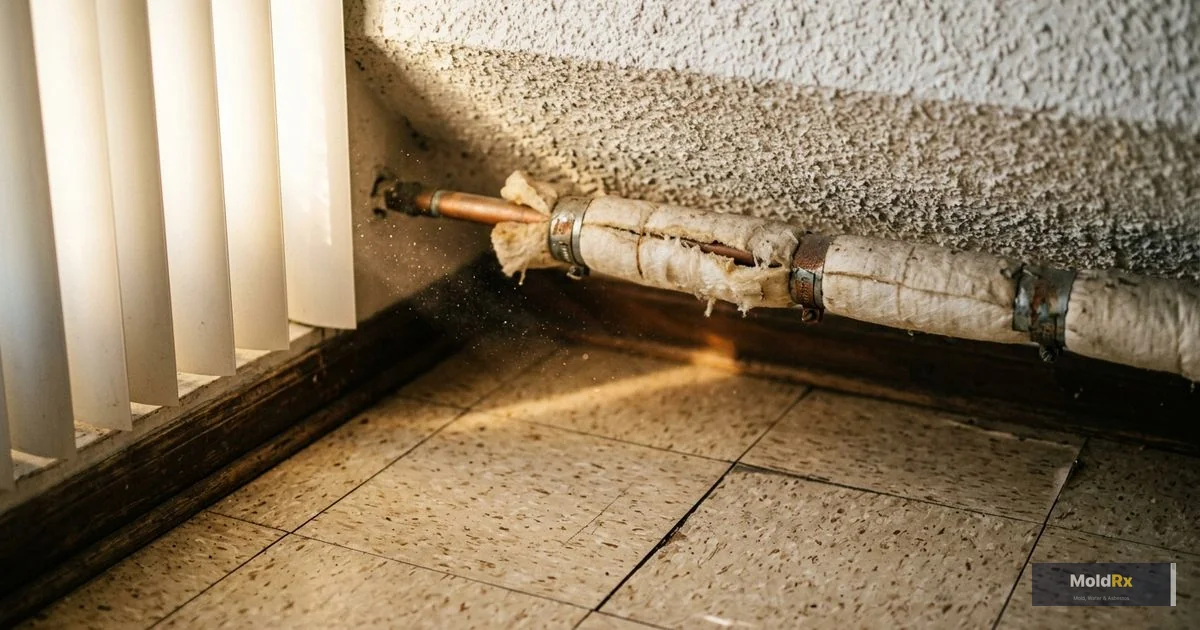
Crumbling pipe insulation under a Peninsula cottage, flaking ceiling texture in a Corona del Mar ranch, cracked floor tiles lifting in a Balboa Island bungalow — if materials in a pre-1980 home show visible deterioration, the risk of fiber release increases substantially. Newport Beach's salt air and marine humidity accelerate this type of deterioration, making inspection and testing especially important in homes closest to the water.
When Preparing a Historic Cottage for Renovation
This situation is particularly relevant in Newport Beach. The city has a significant inventory of homes from the 1920s through 1940s — small beach cottages on the Peninsula, harbor-side bungalows on Balboa Island, and early Corona del Mar residences. Many have been renovated multiple times, with newer materials layered over original construction. Removing modern flooring can reveal 1940s-era tiles and adhesives underneath. Opening walls can expose original plaster and ductwork that predates asbestos regulation by decades. Testing before any disturbance is the only way to know what you are working with.
Common Asbestos-Containing Materials in Newport Beach Homes
Floor Tiles and Mastic: 9"x9" vinyl floor tiles manufactured from the 1930s through the early 1980s contained 5% to 70% chrysotile asbestos. The black cutback adhesive beneath them frequently contains asbestos as well. In older Peninsula cottages, Balboa Island bungalows, and mid-century Corona del Mar residences, these tiles are commonly hidden beneath newer flooring layers.
Popcorn and Textured Ceilings: Standard in residential construction from the mid-1960s through 1980. Newport Beach homes from this period — ranch-style residences in Newport Heights, hillside homes in Harbor View, condominiums throughout the city — frequently have asbestos-containing popcorn ceilings. Scraping without testing is one of the most common sources of residential asbestos exposure.
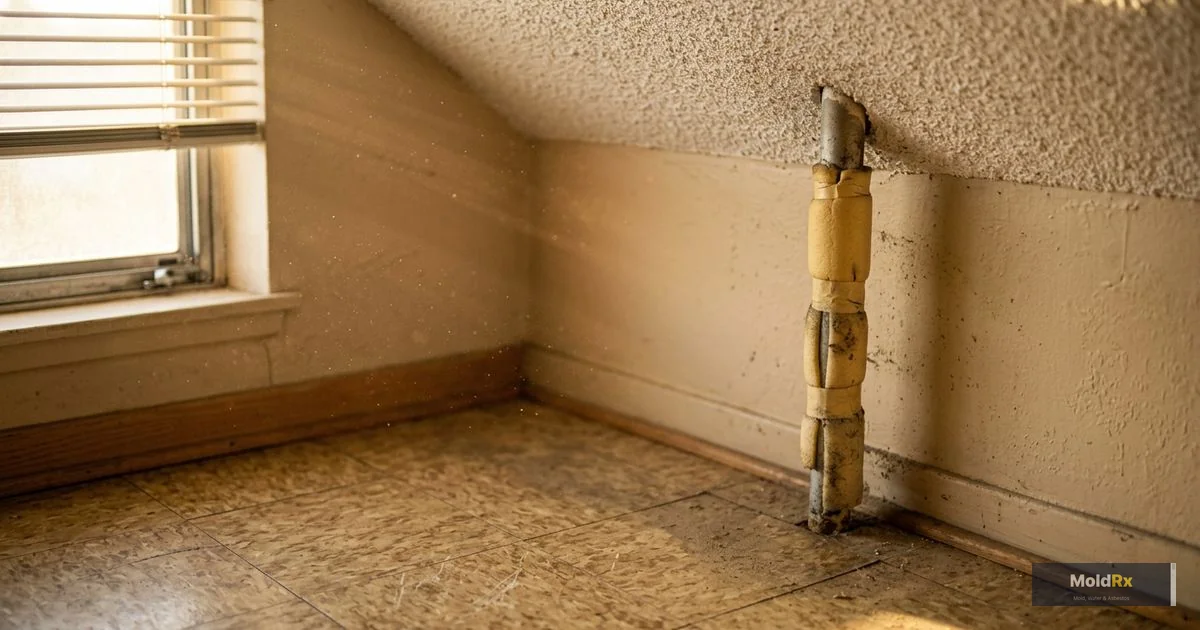
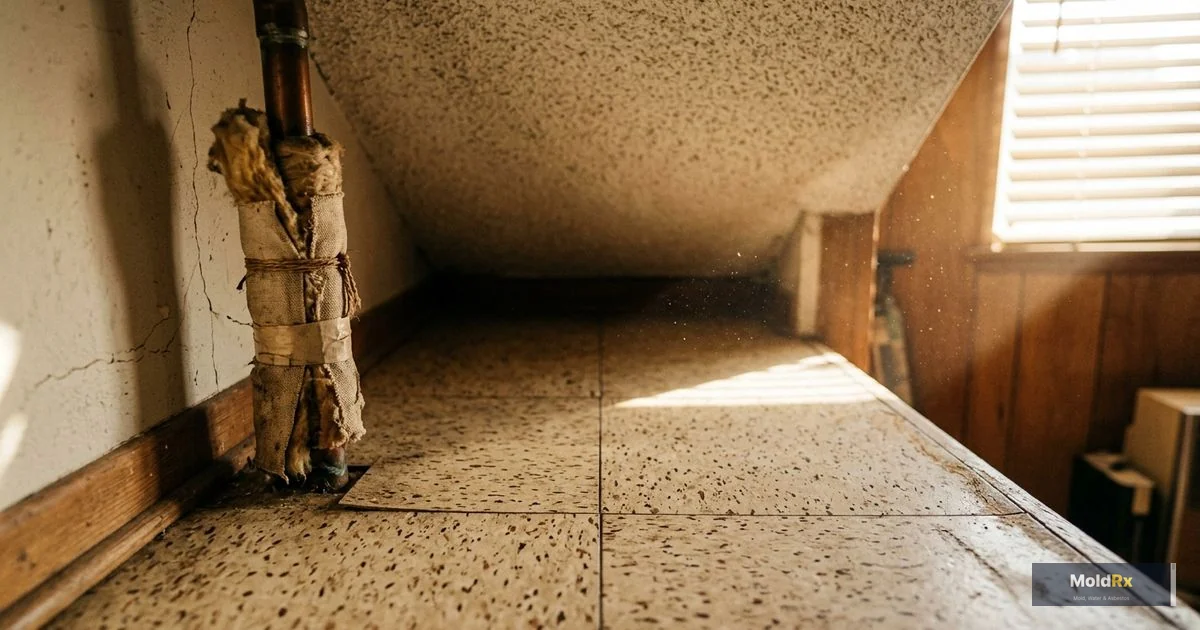
Pipe and Duct Insulation: Corrugated paper wrap, calcium-silicate blocks, and air-cell insulation in pre-1980 homes commonly contain asbestos. In Newport Beach, these materials are often in the worst condition because they sit in crawl spaces and utility closets where marine moisture has accelerated deterioration over decades.
Roofing Materials and Siding: Asbestos-cement shingles, roofing felt, and siding panels were widely used from the 1920s through the 1970s and were considered ideal for coastal construction. Many older Newport Beach homes were built with or re-roofed using these materials.
Joint Compound, Plaster, and Caulking: Drywall joint compound manufactured before 1980 frequently contained asbestos. Because it is applied at every seam and screw hole, even a small remodel can disturb a surprising quantity of material.
Original Plaster and Stucco in Pre-War Homes: Newport Beach's 1920s through 1940s cottages and bungalows introduce a material category newer cities do not face. Original lime-based plaster and exterior stucco from this era can contain asbestos fibers added for reinforcement. Because many of these homes have been renovated multiple times, asbestos-containing plaster may be hidden behind modern drywall or beneath layers of paint and texture.
How Asbestos Testing Works
1. Pre-Testing Consultation
Testing begins with a conversation about your property — when it was built, what materials you plan to disturb, and whether you have noticed damage or deterioration. This determines which areas need sampling and how many samples are required. For a straightforward Newport Beach renovation, the inspector can usually scope the work during a brief phone consultation.
2. Bulk Sample Collection
A certified inspector collects bulk samples following EPA procedures. Each suspected material is sampled separately — the inspector wets the material to suppress fiber release, removes a small section, and seals it in a labeled container. Homogeneous materials like floor tiles require a minimum of three samples per distinct area. The process is minimally invasive, and each collection point is sealed after sampling.
3. NVLAP-Accredited Laboratory Analysis
Samples go to an NVLAP-accredited laboratory for PLM (Polarized Light Microscopy) analysis, which identifies asbestos fiber type and concentration. When PLM results are negative but low-level asbestos is suspected, TEM (Transmission Electron Microscopy) provides higher sensitivity. Standard turnaround is 3 to 5 business days; rush service (24 to 48 hours) is available.
4. Results Interpretation and Recommendations
You receive a written report identifying each material sampled, whether asbestos was detected, the fiber type, and the estimated concentration. We walk you through what each result means for your project: which materials require licensed abatement, which can be managed in place, and which areas are clear for standard construction work.
What Happens If Asbestos Is Found?
A positive test result does not automatically mean your home is dangerous or that expensive removal is your only option.
When removal is required: If your renovation will physically disturb ACM, licensed abatement must be performed. SCAQMD Rule 1403 requires notification at least 10 working days before removal begins, and all abatement must be performed by a DOSH-registered contractor. There are no exemptions for homeowner self-abatement on multi-unit residential properties.
When encapsulation may work: Encapsulation applies a sealant over intact ACM to prevent fiber release without physical removal. It is appropriate for undamaged materials that will remain in place — a practical option for materials outside the renovation footprint.
When leaving it undisturbed is acceptable: If ACM is in good condition and will not be disturbed, leaving it in place is often the safest and most cost-effective option. A management plan documenting the location and condition of ACM is the standard approach.
Newport Beach Asbestos Risk by Construction Era
1920s-1940s (Early Cottages and Beach Bungalows): The Peninsula beach shacks, Balboa Island cottages, Crystal Cove-era bungalows, and early Corona del Mar homes were built before asbestos regulation existed. Original plaster, stucco, and roofing can contain asbestos fibers. These homes have been renovated repeatedly, creating layers of old and newer materials. Highest testing complexity in Newport Beach.
1950s-1960s (Post-War Boom): Lido Isle, Newport Heights, Cliff Haven, and the Harbor area saw rapid development. Tract homes from this era contain the full complement of ACM: vinyl floor tiles, popcorn ceilings, pipe insulation, roofing felt, joint compound, and cement siding. Testing is essential before any renovation.
1970s (Continued Expansion): Eastbluff, Harbor View Hills, and other neighborhoods built out. Homes commonly contain asbestos in popcorn ceilings, vinyl floor tiles, pipe insulation, and joint compound. Testing is essential for any renovation.
1980s (Transition Era): Early 1980s homes may still contain ACM from existing product inventory. Testing is recommended before interior renovation involving ceiling texture, flooring, or insulation.
1990s-Present: Asbestos risk is significantly lower, but SCAQMD Rule 1403 still requires a survey before demolition regardless of building age — relevant for Newport Beach's ongoing teardown-rebuild cycle.
What Sets MoldRx Apart
- Honest assessment. If testing is not necessary for your project, we will tell you.
- NVLAP-accredited lab partners. Every sample analyzed by a nationally accredited laboratory using PLM and, when warranted, TEM methods meeting EPA and Cal/OSHA standards.
- Clear, actionable results. Plain language, specific recommendations, and a clear path forward.
- Family-owned accountability. We only send vetted professionals we stand behind.
Get your free consultation — no obligations.
Newport Beach Neighborhoods We Serve
- Balboa Peninsula — Homes from the 1920s through the present. The oldest structures carry the highest asbestos risk. The ongoing teardown-rebuild cycle makes pre-demolition surveys routine.
- Balboa Island — Created by harbor dredging beginning in 1908. Iconic small-lot cottages from the 1920s through 1950s require careful attention to original materials beneath decades of updates.
- Corona del Mar — Annexed in 1923. Homes range from 1920s originals to contemporary luxury. Older homes in the village core carry significant asbestos risk.
- Lido Isle — Man-made island developed in the 1950s and 1960s. High probability of ACM in floor tiles, ceiling texture, pipe insulation, and joint compound.
- Newport Heights — Established in the 1950s and 1960s on the harbor bluffs. Classic mid-century homes with strong asbestos risk profiles.
- Eastbluff — Developed in the 1960s and 1970s as part of the Irvine Company's master-planned communities. Multiple ACM categories likely.
- Harbor View Hills — 1960s and 1970s hillside homes. Similar risk profile to Eastbluff and Newport Heights.
- West Newport — Older beach cottages and mid-century homes near the Santa Ana River mouth. Significant asbestos risk in older properties.
- Newport Center — Commercial and residential development from the 1960s onward. Older condominiums and offices may contain ACM.
- Cliff Haven — 1950s and 1960s residential neighborhood. Standard mid-century asbestos risk.
ZIP codes served: 92660, 92661, 92662, and 92663.
Nearby Communities
We also serve Huntington Beach, Costa Mesa, Irvine, Laguna Beach, Laguna Hills, Laguna Niguel, Dana Point, and San Clemente.
Related Services in Newport Beach
-> All services
Frequently Asked Questions
Is asbestos testing required before renovation in Newport Beach?
Yes. SCAQMD Rule 1403 requires an asbestos survey before renovation or demolition in the South Coast Air Quality Management District, which includes all of Newport Beach and Orange County. The only exception is single-unit dwelling renovation involving less than 100 square feet of intact material. Most residential projects exceed that threshold and require testing.
How many samples need to be collected?
EPA procedures require a minimum of three samples per homogeneous material in each distinct area. A typical Newport Beach renovation might need 10 to 20 samples across ceiling texture, floor tile, mastic, joint compound, insulation, and roofing material. Larger properties or those with multiple structures may require more.
How long do results take?
Standard PLM analysis takes 3 to 5 business days. Rush service is available with turnaround as fast as 24 hours. TEM analysis, if needed, typically requires 5 to 7 business days.
I'm renovating a 1920s or 1930s beach cottage on the Peninsula — what should I expect?
Newport Beach's oldest residential structures present unique testing challenges. These homes have typically been renovated multiple times over the past century, creating layers of materials from different eras. Original plaster, stucco, and flooring may contain asbestos, hidden beneath decades of updates — newer drywall over original plaster, modern flooring over vintage tiles and adhesives. A thorough inspection accounts for these layers and samples both visible surfaces and underlying original construction. Budget extra time and potentially more samples for properties in this age range.
Does the salt air in Newport Beach affect asbestos risk?
Salt air does not create asbestos where none exists, but it accelerates material deterioration. Decades of salt exposure cause roofing materials, siding, pipe insulation, and stucco to become friable — crumbly and prone to releasing fibers — faster than identical materials inland. Homes on the Peninsula, Balboa Island, Lido Isle, and waterfront Corona del Mar face the most direct salt exposure. If your home is near the water and built before 1980, the combination of age and environmental exposure makes testing particularly important.
What does a positive asbestos test mean for my renovation?
A positive result means asbestos fibers were detected in the sampled material. Any material exceeding 1% asbestos is classified as ACM. A positive result does not mean immediate danger — intact, undisturbed ACM does not release fibers. But if your renovation will disturb that material, licensed abatement must be performed first.
My Newport Beach home has been renovated before — do I still need testing?
Previous renovations do not eliminate asbestos risk. A 1970s kitchen remodel may have covered 1950s floor tiles with new vinyl rather than removing them. A 1990s bathroom update may have installed new drywall over original plaster. Unless you have documentation confirming asbestos abatement was performed during prior renovations, the original materials may still be in place beneath updated surfaces.
Will my contractor handle asbestos testing?
Some general contractors coordinate testing as part of pre-construction planning, but many do not. Getting testing done independently before your contractor starts is the most reliable approach — if asbestos is discovered mid-project, all work stops until abatement is complete.
Get Asbestos Testing in Newport Beach
Planning a remodel on a Balboa Island cottage, replacing the roof on a Corona del Mar hillside home, or buying a mid-century property in Newport Heights — testing gives you the information you need before the first wall comes down. Whether your home is a 1920s beach bungalow on the Peninsula, a 1960s ranch in Eastbluff, or a 1970s estate in Harbor View Hills, the process is straightforward and the results are definitive.
In a community where properties represent significant investments and the coastal environment adds complexity, asbestos testing is not an obstacle to your renovation — it is the first step in doing it right. A few days of testing and a few hundred dollars in lab fees protect your health, your property value, and your project timeline.
Call MoldRx to schedule your asbestos test — (888) 609-8907. Know before you start.