Emergency Water Damage Restoration in Needles, CA — Act Now or Lose Your Property
MoldRx Only Sends Vetted, IICRC-Certified Water Damage Restoration Professionals to Needles Properties
There is water inside your Needles home right now, and every minute you spend reading this instead of calling is a minute the damage compounds. Not gradually — exponentially. You live in the hottest city in the United States. A city that has recorded 125 degrees Fahrenheit. A city where the overnight low has failed to drop below 100 degrees. A city where the hottest rain in world history fell at an air temperature of 115 degrees. That extreme heat is not drying your home. It is destroying it from the inside out — superheating trapped moisture behind drywall, beneath your slab, and inside wall cavities where mold germinates in as little as 12 to 18 hours while surfaces look and feel completely dry.
This is a structural emergency. Treat it like one.
MoldRx only connects Needles property owners with restoration professionals who hold active IICRC S500 (water damage restoration) and IICRC S520 (mold remediation) certifications, carry proper CSLB licensing for California, and follow EPA and Cal/OSHA guidelines for contaminated water handling. That vetting is non-negotiable — because in a city where the housing stock averages nearly 50 years old and extreme heat transforms any moisture event into a mold crisis within hours, the margin for error is zero.
Call (888) 609-8907 right now. Or request your free emergency estimate immediately. We dispatch IICRC S500-certified teams to Needles 24/7/365. Do not wait until morning. Do not wait for your insurance company to call back.
Why Water Damage in Needles Is a Catastrophic Emergency
Needles sits on the west bank of the Colorado River at California's far eastern border in San Bernardino County, population approximately 4,900. It is one of the most extreme climatic environments any residential structure in the United States has to endure — and that extremity turns every water intrusion event into a race against physics that homeowners lose when they hesitate.
The Heat Acceleration Crisis
The IICRC S500 standard and the EPA identify 24 to 48 hours as the critical mold colonization threshold on saturated materials under normal conditions. Needles does not have normal conditions:
- 125 degrees Fahrenheit recorded June 20, 2017 — the highest continental U.S. temperature that year.
- 100-degree overnight low on July 22, 2006, with daytime highs exceeding 120 degrees — one of only a handful of locations on Earth where the nighttime minimum has stayed above triple digits.
- Hottest rain in world history — 115-degree air temperature during precipitation on August 13, 2012.
- 119 days per year at or above 100 degrees. One-third of the entire year above triple digits.
- July 2024 average temperature of 103.2 degrees, surpassing even Phoenix's record of 102.7 degrees.
Interior wall cavities in Needles homes reach 90 to 100+ degrees during summer. When a burst pipe, slab leak, or swamp cooler failure saturates drywall and framing in those cavities, you have created a biological incubator. Stachybotrys chartarum (toxic black mold) establishes colonies on saturated cellulose within 48 to 72 hours at these temperatures. Aspergillus and Penicillium germinate faster.
The dangerous illusion: surfaces dry in Needles' desert air. Annual rainfall averages only 4 to 5 inches, so exposed water evaporates in hours. Floors feel dry. Walls look fine. But water has migrated — wicking into cavities, beneath flooring, along framing channels. Needles' extreme diurnal temperature swings of 40 to 50 degrees create condensation cycles inside enclosed assemblies that sustain hidden moisture for weeks. By the time you smell mold or see discoloration, a Category 1 clean-water event has degraded to a Category 2 or Category 3 contamination requiring demolition.
This is why IICRC S500 mandates professional moisture mapping with thermal imaging and penetrating moisture meters — not the touch test.
Aging Housing Stock: 40 to 80 Years Old and Failing
The median construction year for Needles homes is 1977. The majority of the city's 2,848 housing units were built between the 1940s and 1980s during Needles' era as a critical Santa Fe Railway junction and major Route 66 stop. That plumbing is now 40 to 80+ years old:
- Galvanized steel and copper supply lines past their 40-to-50-year design life. Colorado River water — among the hardest municipal water in California — accelerates internal corrosion. Pinhole leaks, joint failures, and catastrophic pipe bursts are happening in homes across ZIP code 92363 regularly.
- Orangeburg sewer pipes from the 1950s-60s — brittle fiber pipe that collapses under Needles' extreme thermal cycling, backing raw sewage into homes as Category 3 black water events.
- Slab-on-grade foundations throughout established neighborhoods. Slab leaks go undetected for weeks, silently saturating concrete and wicking into walls.
- Evaporative coolers (swamp coolers) running nonstop May through October. Supply line failures, stuck float valves, and cracked overflow pans from UV and thermal cycling create hidden water intrusion homeowners miss until extensive damage and mold growth have occurred.
- Aging water heaters in garages exceeding 130 degrees during summer. Hard water accelerates tank corrosion. A 40-to-50-gallon failure floods in minutes.
In April 2025, Needles completed a $14 million water system replacement through the state SAFER program, replacing catastrophically failing 80-year-old asbestos-cement mains. But new municipal mains connect to the same 40-to-80-year-old service laterals and interior plumbing inside these homes. The infrastructure crisis has shifted from the street to the structure.
Colorado River and Monsoon Flash Flood Exposure
During monsoon season (July through September), violent thunderstorms dump one to two inches of rain in under an hour across desert hardpan with near-zero absorption. Runoff channels directly through Needles' residential areas toward the river. This floodwater carries sediment, road contaminants, and potentially septic overflow — Category 3 (black water) requiring full professional extraction per IICRC S500, EPA, and Cal/OSHA standards.
If you have standing water, active leaking, or sewage backup right now, call (888) 609-8907 or request your free emergency estimate.
Water Damage Categories and Classes
The IICRC S500 standard classifies every water event by contamination (Category) and saturation extent (Class). Classification determines safety protocols, material removal scope, and whether your home can be dried in place or requires demolition.
Category 1 — Clean Water: Supply line breaks, sink overflows, toilet tank failures. In Needles' heat, Category 1 degrades to Category 2 within 24 to 48 hours — faster than virtually anywhere else in California.
Category 2 — Gray Water: Dishwasher discharge, washing machine overflow, swamp cooler failures, degraded Category 1. Requires antimicrobial treatment and removal of contacted porous materials.
Category 3 — Black Water: Sewage backups, monsoon floodwater, standing water older than 72 hours. Requires full PPE, containment, removal of all affected porous materials, HEPA air filtration, and antimicrobial application per IICRC S500, EPA, and Cal/OSHA standards. Category 3 events in Needles are far more common than homeowners realize — monsoon flooding almost always qualifies.
Class 1 — Minimal absorption, part of a room. Class 2 — Significant absorption, water wicking up walls — common in Needles slab leak scenarios. Class 3 — Extensive saturation of walls, ceilings, subfloor from overhead or flooding sources. Class 4 — Specialty drying of low-permeance materials (concrete slabs, plaster walls) — extremely common in Needles' mid-century housing stock.
MoldRx only sends IICRC S500-certified professionals who classify the event correctly the first time. Misclassification in Needles' climate guarantees mold colonization.
MoldRx Emergency Restoration Process for Needles Properties
Step 1: Emergency Triage and Dispatch
Your call to (888) 609-8907 connects you immediately with our coordination team. We dispatch the nearest vetted, IICRC S500-certified restoration team to your Needles property. Active emergencies receive 24/7/365 response. Pipe bursts and sewage backups do not wait for business hours.
Step 2: On-Site Assessment and Moisture Mapping
The team arrives with thermal imaging cameras, penetrating and pin-type moisture meters, and hygrometers. They identify the source, classify the Category (1-3) and Class (1-4), and map the full moisture extent — including hidden damage behind walls and beneath flooring. In Needles' older homes, this assessment routinely reveals damage extending two to three times beyond the visible waterline. All findings are documented for your insurance claim.
Step 3: Rapid Water Extraction
Standing water is removed immediately using truck-mounted and portable extraction units. Every hour water remains in contact with materials in 100-to-125-degree conditions accelerates damage exponentially. For Category 3 events, extraction occurs under full containment with HEPA-filtered negative air pressure per EPA and Cal/OSHA requirements.
Step 4: Structural Drying and Dehumidification
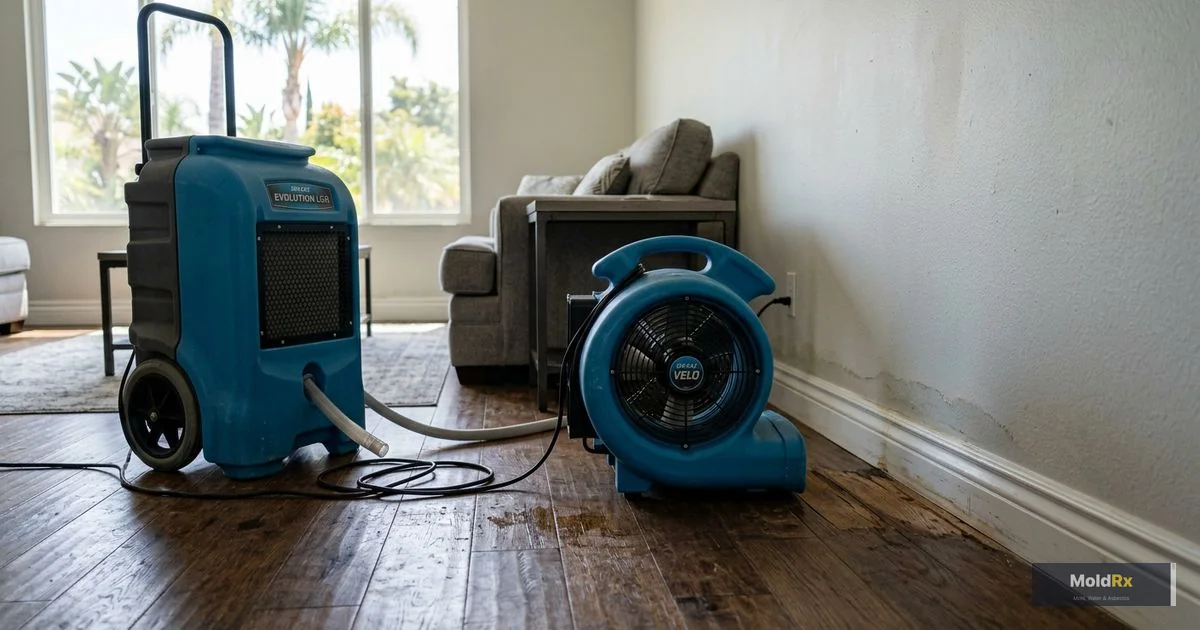
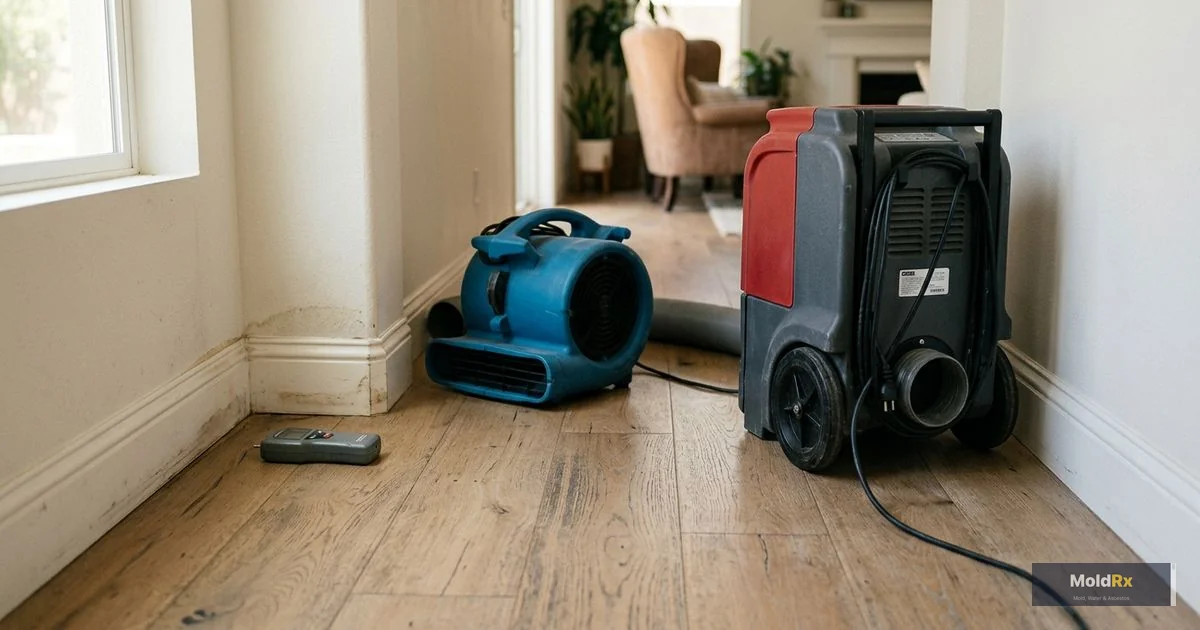
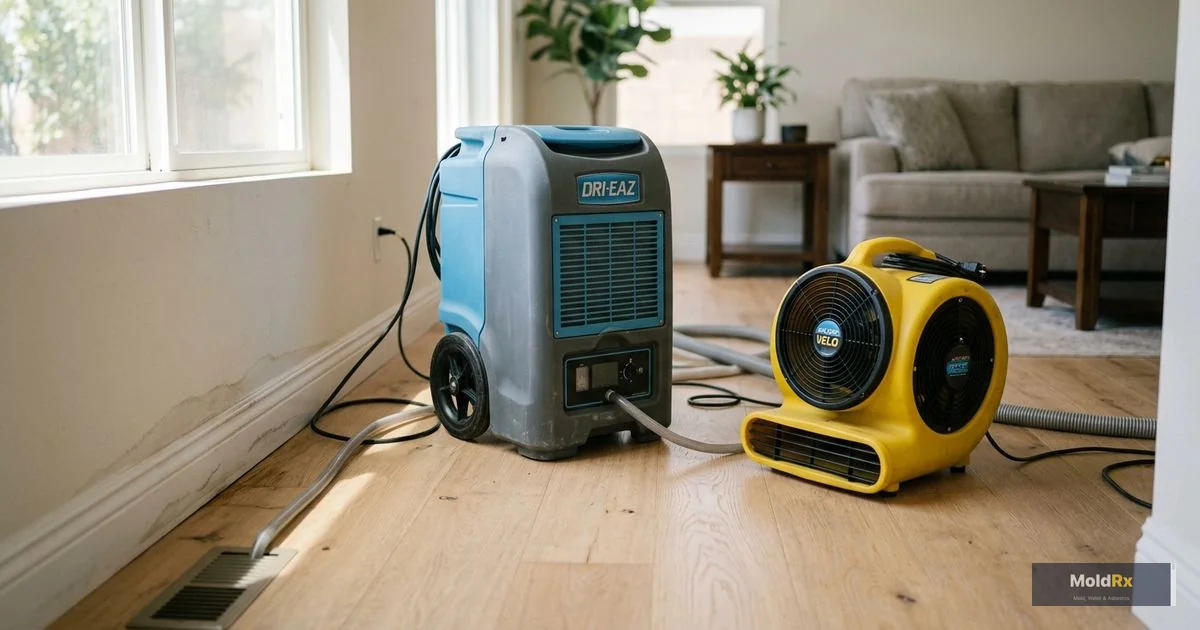
Do not open windows. Opening windows when it is 110 to 120 degrees outside drives superheated air into saturated materials — accelerating mold germination, not preventing it. Professional drying deploys industrial air movers and low-grain refrigerant (LGR) dehumidifiers in targeted configurations. Equipment runs continuously with daily moisture monitoring until calibrated meter readings confirm all materials meet IICRC S500 dry standard. For Class 4 situations — concrete slabs, plaster walls — desiccant dehumidifiers and directed heat drying systems extend the protocol.
Step 5: Antimicrobial Treatment and Mold Prevention
All affected areas receive antimicrobial treatment per IICRC S520 protocols. In Needles' climate, prevention requires verifying zero residual moisture inside any assembly before materials are sealed behind new drywall or flooring. If colonization has already begun, the scope expands to full IICRC S520 remediation with containment, HEPA filtration, and post-remediation verification.
Step 6: Documentation and Restoration
Complete documentation — moisture maps, daily drying logs, verification readings, photos, and itemized scope of work — supports your insurance claim. Critical for pre-1980 Needles homes: any demolition should include asbestos testing first. The same construction era that produced Needles' asbestos-cement water mains used asbestos-containing materials in residential floor tiles, joint compound, ceiling texture, and pipe insulation. Disturbing these without testing violates Cal/OSHA and EPA regulations.
What to Do Right Now
- Shut off the water supply if the source is plumbing.
- Turn off electrical power to affected areas. Do not walk through standing water to reach a breaker.
- Do not extract water yourself with a shop vac or household fans — you will dry the surface and leave the structure saturated.
- Do not open windows or run fans in summer. In Needles' heat, you are accelerating mold, not drying.
- Do not demolish wet materials before professional assessment. Pre-1980 homes may contain asbestos.
- Document everything with photos and video before moving anything.
- Call (888) 609-8907 or request your free emergency estimate. We dispatch vetted teams 24/7/365.
Common Water Damage Scenarios in Needles
Slab Leaks: The Silent Destroyer
Needles' slab-on-grade construction and aging copper supply lines — many original to homes built in the 1950s through 1970s — make slab leaks one of the most frequent and most destructive water events in the city. Colorado River water is extremely hard, loaded with dissolved calcium and magnesium that accelerates internal pipe corrosion from the inside out. Copper lines that might last 50 years in a soft-water region fail in 30 to 40 in Needles. The failure point is often beneath the slab, where the leak saturates concrete for days or weeks before any visible sign reaches the surface.
By the time homeowners notice warm floor spots, unexplained water bill increases, running water sounds with fixtures off, or moisture along baseboards, structural damage may be extensive. Slab leak restoration in Needles almost always involves Class 2 or Class 4 drying protocols — and when detection was delayed during summer months, the probability of active mold growth in adjacent wall cavities approaches certainty.
Water Heater Failures: 50 Gallons in Minutes
In Needles, ambient temperatures in garages and utility closets regularly exceed 130 degrees during summer. Combined with some of the hardest municipal water in California, these conditions dramatically shorten water heater service life below the manufacturer's rated lifespan. Anode rods corrode faster. Tank linings fail sooner. Sediment accumulates more aggressively.
A catastrophic tank rupture releases 40 to 50 gallons in minutes, flooding the immediate area and sending water into adjacent rooms, wall cavities, and beneath flooring. Typically classified as Category 1, Class 2 or Class 3 at the time of failure — but in Needles' heat, the window before degradation to Category 2 is measured in hours, not days.
Swamp Cooler Failures: The Hidden Flood
Rooftop-mounted evaporative coolers are still the primary cooling system in a significant percentage of Needles homes, running continuously from May through October — six months of nonstop operation in the most thermally punishing environment in the country. Supply lines corrode from hard water mineral deposits. Float valves stick in the open position. Overflow pans crack from relentless UV exposure and thermal cycling between 125-degree daytime surface temperatures and rapid nighttime cooling.
When a swamp cooler fails, water enters the ceiling cavity first — flowing along roof decking, soaking insulation, and penetrating into interior walls. The homeowner does not see it. By the time visible staining appears on a ceiling or wall, weeks of hidden water intrusion may have occurred. These events typically present as Class 3 with active mold growth already established in insulation, ceiling drywall backing, and wall cavity framing.
Monsoon Flash Flood Intrusion
During July through September, monsoon thunderstorms channel floodwater through Needles' residential areas with virtually no warning. Water enters through garage doors, foundation cracks, window wells, and any deteriorated point in the building envelope. This water has traveled across desert hardpan, roadways, and potentially through compromised septic systems.
Monsoon flood intrusion is classified as Category 3 (black water) from the moment of contact. There is no drying it in place. Full material removal to structural framing, antimicrobial treatment, HEPA air scrubbing, and verification testing are required per IICRC S500 and Cal/OSHA biohazard safety standards. The longer contaminated floodwater sits in Needles' heat, the more dangerous and costly the remediation becomes.
Supply Line and Fixture Failures
Ice maker lines. Toilet supply valves. Dishwasher connections. Washing machine hoses. These are the small failures that produce large consequences in old homes. A braided stainless steel supply line has a service life of 8 to 12 years. A rubber washing machine hose should be replaced every 3 to 5 years. In a Needles home with original plumbing fixtures from the 1960s or 1970s, these connections are catastrophic failures waiting for their day — and in this heat, even a slow leak produces full mold colonization inside wall cavities within days.
Needles Areas We Serve
MoldRx coordinates emergency restoration across all of Needles and the Colorado River corridor:
- Historic Downtown Needles — Broadway (Route 66), Front Street, and the El Garces Harvey House area. Structures dating to the early 1900s-1950s.
- Broadway Corridor — The original Route 66 alignment. Mixed-age residential and commercial properties.
- Residential neighborhoods near Needles High School — Mid-century slab-on-grade housing with original plumbing.
- Colorado River properties — Elevated humidity, irrigation failures, and direct monsoon runoff exposure.
- Railroad corridor neighborhoods — 1940s-50s ATSF Railway-era homes with galvanized and orangeburg piping.
- I-40 corridor commercial properties — Motels, restaurants, and retail serving interstate and Route 66 tourism.
- Manufactured home communities — Approximately 15% of Needles housing stock with unique floor system and supply line vulnerabilities.
All properties within ZIP code 92363 plus Havasu Lake, Big River, and the California-Arizona border corridor.
Related Services in Needles
- Mold Removal in Needles — IICRC S520 remediation when the mold window has passed.
- Mold Testing in Needles — Air quality and surface sampling to confirm colonization.
- Asbestos Testing in Needles — Pre-1980 homes require testing before material removal.
- Asbestos Removal in Needles — Licensed abatement under Cal/OSHA and EPA regulations.
- Water Damage Restoration in Needles
-> Learn more about remediation services in Needles
Frequently Asked Questions
How quickly do I need to act on water damage in Needles?
Immediately. The IICRC S500 standard identifies 24-48 hours as the critical mold window under normal conditions. In Needles — where interior wall cavities reach 90-100+ degrees during summer — that window compresses to 12-18 hours. Category 1 water degrades to Category 2 within 48 hours and can reach Category 3 within 72 hours. Every hour of delay increases scope, cost, and structural risk.
What is the difference between Category 1, 2, and 3 water damage?
Category 1 is clean water from a sanitary source. Category 2 is gray water containing contaminants. Category 3 is black water — sewage, floodwater, or any standing water over 72 hours old. Monsoon flooding in Needles is almost always Category 3. The Category determines safety protocols, PPE, and material removal scope. Our IICRC S500-certified professionals classify the water correctly during initial assessment.
How do I know if my home has a slab leak?
Common signs: unexplained water bill increases, running water sounds with all fixtures off, warm floor spots, moisture along baseboards, cracked tile. In Needles homes with original copper plumbing and hard Colorado River water, slab leaks are extremely common. Request a professional assessment — thermal imaging locates the leak without destructive investigation.
Will my insurance cover water damage restoration?
Most policies cover sudden, accidental water damage — burst pipes, appliance failures. Gradual damage from deferred maintenance is typically excluded. Flood damage from monsoons requires separate flood insurance. Our professionals provide complete documentation — moisture readings, drying logs, photos, scope of work — structured to support claims. Request a free estimate before filing.
Why can I not let the desert air handle it?
This misconception destroys Needles homes every year. Desert air dries exposed surfaces — but water trapped inside wall cavities, beneath slabs, and within ceiling assemblies is sealed behind materials that block airflow. Opening windows in 110-125-degree heat drives superheated air into saturated assemblies, accelerating mold germination rather than drying. Professional equipment targets moisture inside the structure using controlled airflow and calibrated dehumidification.
What certifications should a restoration company have?
Active IICRC S500 and IICRC S520 certifications, proper CSLB licensing, and adequate liability and workers' compensation insurance. For Category 3 events, Cal/OSHA and EPA compliance is mandatory. MoldRx verifies all credentials before adding any professional to our network.
How long does water damage restoration take in Needles?
Timeline depends entirely on Category, Class, and extent. A contained Class 1/Category 1 event caught quickly may require 3 to 5 days of drying and treatment. A Class 3/Category 3 event involving demolition, antimicrobial treatment, and reconstruction — common in delayed-response scenarios in Needles' heat — can require 2 to 4 weeks or longer. You will receive a realistic timeline after the on-site assessment.
My water damage happened days ago — is it too late?
It is not too late to restore your property — but the scope and cost increase with every day of delay. In Needles' climate, secondary mold damage is almost certain after 48 to 72 hours of untreated saturation. If your water event occurred more than 24 hours ago during summer months, assume mold colonization has begun and plan accordingly. Call (888) 609-8907 immediately — the longer you wait, the more extensive the restoration becomes.
Stop the Damage Now. Every Hour Costs You More.
Water damage in Needles does not plateau. It does not stabilize. It compounds — hour by hour — in the hottest city in the United States. Where 119 days per year exceed 100 degrees. Where the housing stock averages nearly 50 years old with plumbing past its design life. Where hard Colorado River water corrodes pipes from the inside. Where monsoon floods carry Category 3 contamination through residential neighborhoods. Where 115-degree heat turns trapped moisture into a mold incubator faster than anywhere else in California.
MoldRx connects Needles property owners with vetted, IICRC S500- and IICRC S520-certified restoration professionals who follow EPA and Cal/OSHA standards, classify damage correctly, deploy professional-grade equipment immediately, monitor until instruments verify completion, and document everything for your insurance claim. No upselling. No unlicensed subcontractors. No guesswork.
Call (888) 609-8907 now for emergency water damage restoration in Needles. Or request your free estimate online — we respond 24/7/365. The damage is getting worse right now. Stop it.