Asbestos Testing in Moreno Valley, CA
Vetted Asbestos Testing Specialists Serving Moreno Valley and Riverside County
Moreno Valley is the second-largest city in Riverside County, home to approximately 215,000 residents spread across a sprawling expanse of neighborhoods, commercial corridors, and master-planned communities in the western Inland Empire. Unlike many Southern California cities that grew gradually over the course of the twentieth century, Moreno Valley experienced one of the most dramatic population explosions in California history. In 1970, the three unincorporated communities that would later merge — Edgemont, Sunnymead, and Moreno — held a combined population of roughly 18,871. By 1984, when voters consolidated those communities into the newly incorporated City of Moreno Valley, the population had already reached approximately 49,700. Six years later, it had surged past 118,000, a growth rate exceeding 300 percent in a single decade.
That unique growth pattern creates a specific asbestos risk profile that Moreno Valley homeowners need to understand. The city's housing stock spans multiple construction eras, and a significant share of it was built during a transitional period when asbestos-containing materials were still circulating through construction supply chains despite evolving regulations. Whether you are planning renovations in a 1960s ranch house near March Air Reserve Base, updating a 1980s tract home in Sunnymead, or replacing the roof on a 1990s house in Rancho Belago, professional asbestos testing provides the only reliable way to know what is in those materials before work begins.
Request your free consultation — we will help you determine if testing is needed for your Moreno Valley project.
How Moreno Valley's Growth History Shapes Asbestos Risk
Moreno Valley's asbestos risk is different from older Inland Empire communities, and understanding why requires a look at the city's unusual development timeline.
The Pre-Suburban Era (Before 1980)
Before the 1980s boom, the area was a patchwork of agricultural land, scattered homes, and the military presence of March Air Force Base (established 1918). The surrounding communities of Edgemont, Sunnymead, and Moreno grew slowly around the base. Homes from this era were built during the peak of asbestos use in American construction — materials were used freely because regulations did not yet exist.
The Population Explosion (1980 to 1990)
The state economic boom of the 1980s fueled the construction of thousands of new houses and businesses across the valley. Below-market home prices attracted families seeking affordable alternatives to coastal and urban areas, and developers built subdivisions at a pace that was nearly unprecedented in California. By 1990, Moreno Valley had become the fastest-growing city in the state.
This decade represents the majority of Moreno Valley's current housing stock, and it coincides with a critical transitional period for building materials. Federal regulations began restricting asbestos in the late 1970s, but the phase-out was gradual. Products manufactured before the restrictions took effect remained on store shelves and in supply warehouses. Some manufacturers received exemptions or were slow to reformulate. Materials such as vinyl floor tiles, roofing products, cement siding, and certain formulations of joint compound could still contain asbestos in homes built through the mid-to-late 1980s. You cannot determine the asbestos content of these materials by looking at them. Only laboratory analysis provides a definitive answer.
Continued Growth (1990 to Present)
Growth slowed during the early 1990s downturn but continued through the 2000s, bringing Moreno Valley to its current population. Post-1990 homes have substantially lower asbestos risk, though it is not zero — asbestos was never fully banned in the United States.
What This Means in Practice
Moreno Valley's asbestos risk breaks into three categories:
Pre-1980 homes (high risk): Properties in the original Edgemont, Sunnymead, and Moreno communities dating from the 1950s through 1970s have a high likelihood of containing asbestos in multiple materials — floor tiles, popcorn ceilings, pipe insulation, roofing materials, duct tape, and joint compound.
1980 to 1990 homes (moderate risk): The homes built during Moreno Valley's explosive growth represent the city's largest housing segment and fall within the transitional manufacturing period. Testing before renovation is recommended for any project that will disturb original flooring, ceiling textures, roofing, or mechanical systems.
Post-1990 homes (low but not zero risk): Generally lower risk, but testing is warranted if you have specific concerns about materials of unknown origin or if you plan to disturb original roofing, textured coatings, or imported products.
Materials That Commonly Contain Asbestos in Moreno Valley Homes
In Moreno Valley homes built before 1990, the following materials frequently test positive:
- Popcorn ceilings and acoustic textures sprayed onto ceilings for decoration and sound dampening
- Vinyl floor tiles in both 9-by-9-inch and 12-by-12-inch formats, along with the black mastic adhesive beneath them
- Sheet vinyl flooring with asbestos-containing backing layers
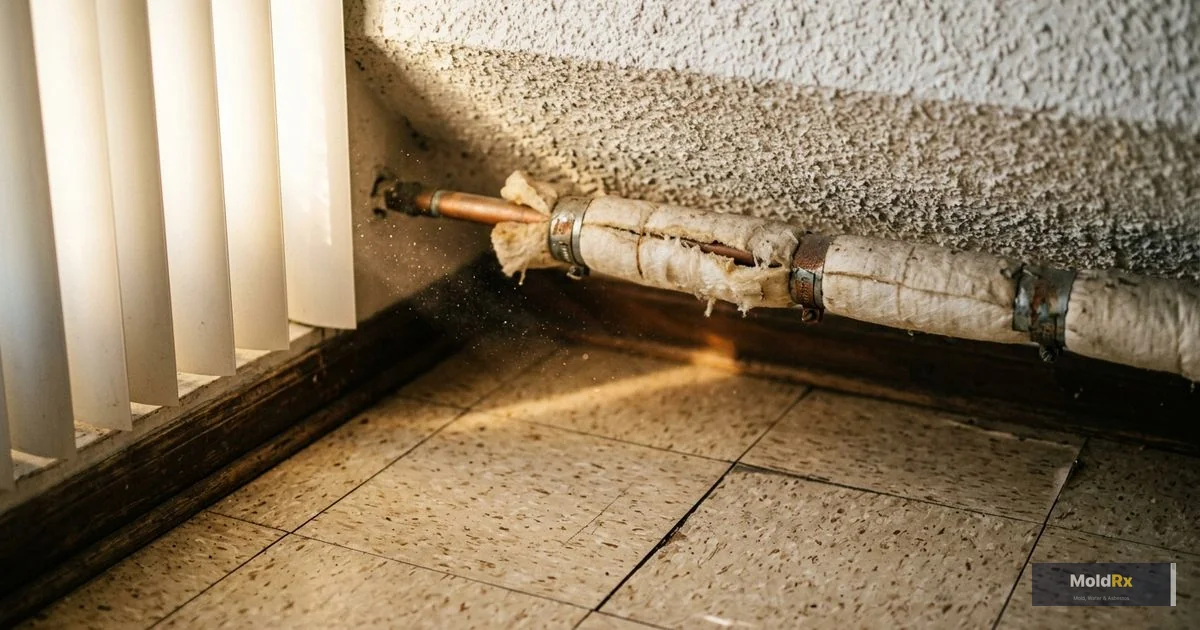
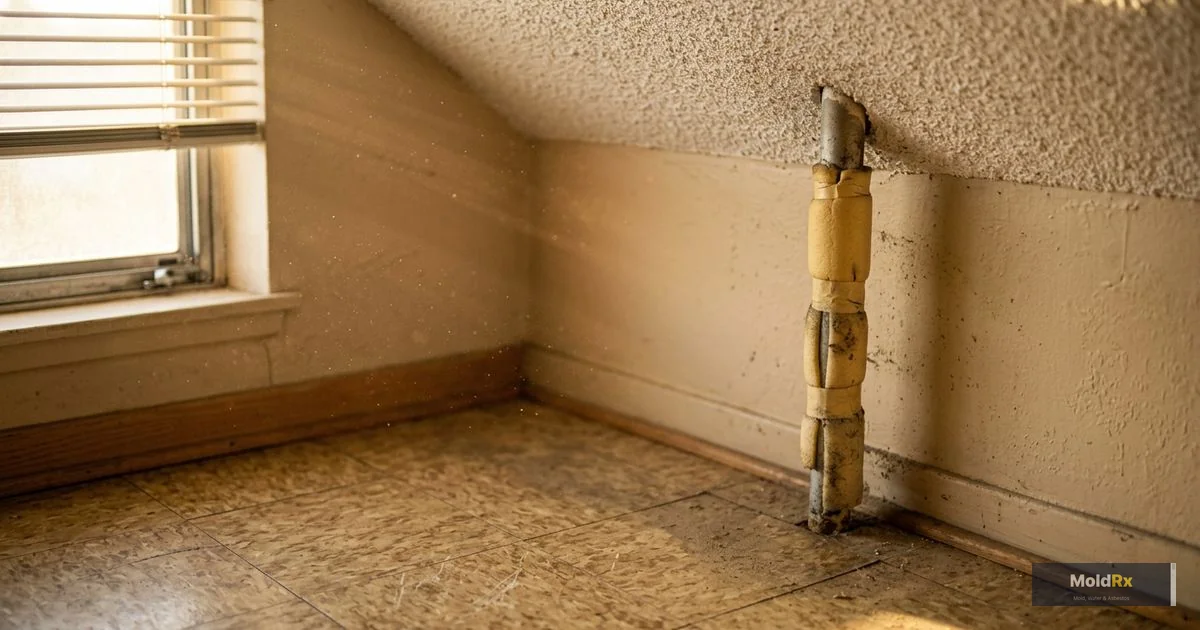
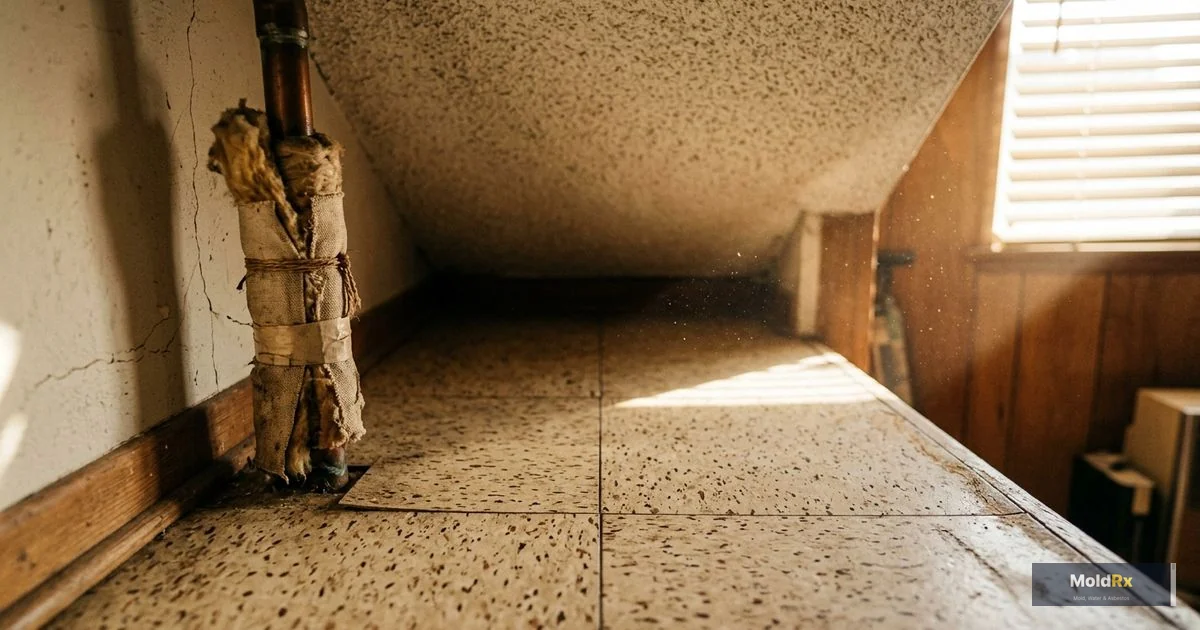
- Pipe insulation, duct wrapping, and HVAC duct tape on heating and cooling systems, water heaters, and plumbing
- Roofing shingles, felt underlayment, roofing cement, and flashing on both composition and flat roof systems
- Drywall joint compound (mud or tape compound) used to finish seams between wallboard panels
- Cement siding, stucco, and exterior coatings reinforced with chrysotile fibers
- Vermiculite attic insulation potentially contaminated with tremolite asbestos from the Libby, Montana mine
- Window glazing compounds and exterior caulking used to seal openings
- Transite panels — a cement-asbestos composite used for siding, duct material, and utility applications
- Furnace flue pipes, gaskets, and fireproofing around heating equipment
Visual inspection alone cannot determine whether any of these materials contain asbestos. Two identical-looking floor tiles from the same era may have come from different manufacturers — one using asbestos, one not. Laboratory analysis is the only definitive answer.
Health Risks of Asbestos Exposure
Asbestos is dangerous only when its fibers become airborne. Intact, undisturbed materials pose minimal risk. But when asbestos-containing materials are cut, drilled, sanded, or demolished, microscopic fibers are released. These fibers are far too small to see — up to 700 times thinner than a human hair — and once inhaled, they lodge permanently in lung tissue.
Mesothelioma is an aggressive cancer of the membrane lining the lungs or abdomen, caused almost exclusively by asbestos. The latency period is 20 to 50 years. There is no cure.
Asbestosis is a progressive, irreversible scarring disease of the lungs that worsens over time, causing shortness of breath and reduced lung function.
Lung cancer risk increases significantly with asbestos exposure, particularly among smokers, with a typical latency of 15 to 35 years.
There is no established safe threshold for mesothelioma. All three diseases are preventable through proper identification and handling of asbestos-containing materials before disturbance.
Moreno Valley's Climate and Material Deterioration
Moreno Valley sits in the western Inland Empire, experiencing a semi-arid Mediterranean climate (Koppen Csa) with summer temperatures regularly reaching the low-to-mid 90s and only about 12 inches of annual rainfall. August is typically the warmest month, with average highs around 91 degrees Fahrenheit, while December is the coolest with highs near 61 degrees.
This climate has specific implications for aging building materials. Prolonged heat and aridity cause materials to lose internal moisture over decades, becoming dry and brittle. This is directly relevant to asbestos because friable (easily crumbled) materials release fibers far more readily than materials in good condition. Pipe insulation, duct tape, roofing materials, and floor tile adhesive all deteriorate under decades of thermal cycling — expanding during hot days, contracting during cooler nights — eventually becoming fragile enough to release fibers without any deliberate disturbance.
Moreno Valley's heavy reliance on HVAC systems adds another concern. Homes in the area run air conditioning extensively during the long, hot summer months, meaning ductwork, insulation, and mechanical components experience significant thermal stress and airflow vibration over the years. Before upgrading, repairing, or replacing any HVAC components in an older Moreno Valley home, testing the existing materials is essential.
Regulations Governing Asbestos in Moreno Valley
Multiple overlapping regulations at the federal, state, and regional level govern how asbestos must be handled in Moreno Valley. Understanding these requirements helps you plan renovation projects correctly.
SCAQMD Rule 1403 — Asbestos Emissions from Demolition and Renovation
Moreno Valley falls within the South Coast Air Quality Management District's jurisdiction. Rule 1403 requires:
- A mandatory asbestos survey before any demolition of any structure, without exception and regardless of building age
- A survey before renovation projects that will disturb 100 square feet or more of suspect material
- Surveys conducted by AHERA-certified building inspectors — professionals who have completed the EPA Model Accreditation Plan training program and maintain current certification through annual refresher courses
- Written notification to SCAQMD at least 10 working days before asbestos removal begins
- Specific work practices for containment, wet methods, removal, and disposal of asbestos-containing materials
- Violations carry fines of up to $20,000 per day and potential criminal penalties
OSHA 1926.1101 — Federal Asbestos Standard for Construction
The federal standard establishes baseline requirements for all asbestos-related construction work:
- A permissible exposure limit (PEL) of 0.1 fibers per cubic centimeter of air averaged over an 8-hour workday
- An excursion limit of 1.0 fiber per cubic centimeter averaged over any 30-minute period
- Classification of asbestos work into four classes (I through IV) with escalating requirements for containment, worker protection, and air monitoring
- A designated competent person on every worksite where asbestos may be disturbed
- Requirements for regulated areas, decontamination, medical surveillance, and record-keeping
Cal/OSHA Section 1529 — California's Asbestos Construction Standard
California's standard mirrors and in some cases exceeds the federal requirements:
- Mandatory asbestos surveys for all structures built before 1980 prior to renovation or demolition
- Materials in pre-1980 buildings are presumed to contain asbestos (PACM) until laboratory testing proves otherwise
- Disturbances exceeding 100 square feet of material containing more than 0.1 percent asbestos must be performed by a contractor holding a CSLB C-22 asbestos abatement license
- Registration with Cal/OSHA's Division of Occupational Safety and Health (DOSH) is mandatory for asbestos removal contractors
- Workers must receive asbestos-specific training and ongoing medical monitoring
- Exposure records and medical records must be maintained for at least 30 years
Practical Application for Moreno Valley Properties
Given the size and diversity of Moreno Valley's housing stock, the practical application of these regulations varies:
- Pre-1980 properties in the Edgemont, Sunnymead, and Moreno areas should plan for testing as a standard part of any renovation project — Cal/OSHA presumes all materials contain asbestos until proven otherwise
- 1980s-era properties — the largest segment of Moreno Valley homes — should be tested when renovations will disturb original flooring, ceilings, roofing, or mechanical systems
- Post-1990 properties typically do not trigger regulatory testing requirements unless there is specific reason to suspect asbestos-containing materials
Licensed contractors working in Moreno Valley will generally ask for test results before starting work on pre-1990 properties. Real estate professionals are increasingly requesting asbestos documentation for older homes as part of the transaction process.
Get your free consultation — no obligations, just honest answers about your Moreno Valley property.
The MoldRx Asbestos Testing Process
Step 1: Project Assessment
We begin with a conversation about your specific situation. The age of your Moreno Valley property, the scope of your planned project, and the types of materials involved determine what needs to be tested. For homes built during the 1980s boom, we focus on materials most likely to have contained asbestos during that transitional manufacturing period. For pre-1980 properties, a more comprehensive assessment is typically appropriate. If testing is not warranted for your situation, we will tell you and save you the expense.
Step 2: On-Site Inspection and Sample Collection
A vetted asbestos specialist visits your Moreno Valley property to conduct a visual assessment and collect samples using EPA and Cal/OSHA protocols:
- Suspect materials are misted with water to suppress fiber release during sampling
- Small sections — typically one to two square inches — are carefully removed with specialized tools
- Each sample is placed in a sealed, labeled container and documented by exact location
- Multiple samples may be collected from each material type, as asbestos content can vary between manufacturing batches and installation areas
- Personal protective equipment is worn throughout, and collection sites are sealed after sampling
For a typical Moreno Valley single-family home, on-site collection takes one to two hours.
Step 3: NVLAP-Accredited Laboratory Analysis
Samples are submitted to an NVLAP-accredited laboratory for analysis. NVLAP — the National Voluntary Laboratory Accreditation Program, administered by the National Institute of Standards and Technology (NIST) — certifies that the laboratory meets rigorous quality control standards, participates in biannual proficiency testing, and maintains error rates below established thresholds. This accreditation is required under the Asbestos Hazard Emergency Response Act (AHERA) and ensures your results are legally defensible and scientifically reliable.
Two primary analytical methods are used:
Polarized Light Microscopy (PLM) is the standard method for bulk building material samples. PLM identifies asbestos fiber type — chrysotile, amosite, crocidolite, tremolite, actinolite, or anthophyllite — and estimates the concentration in the material. PLM is cost-effective, well-established, and sufficient for the vast majority of residential testing situations.
Transmission Electron Microscopy (TEM) provides significantly higher resolution and sensitivity. TEM can detect fibers at the nanometer scale and is used when PLM results are inconclusive, when trace-level detection is needed, or for air monitoring samples after abatement. TEM is also the method specified for clearance testing to confirm that airborne fiber levels meet safety thresholds after asbestos removal.
Standard turnaround is three to five business days, with rush options available for urgent situations including real estate closings and time-sensitive renovation schedules.
Step 4: Clear Results and Next Steps
Your report identifies every sample location, the laboratory findings for each, and a plain-language explanation of what the results mean for your project. If asbestos is detected, the report explains your options:
- Management in place for intact materials that will not be disturbed — often the most practical approach for materials in good condition
- Encapsulation for materials in fair condition that benefit from a protective barrier to prevent future fiber release
- Professional abatement by a contractor holding a California CSLB C-22 asbestos abatement license for materials that must be removed, are deteriorating, or are in the direct path of renovation work
MoldRx only sends vetted testing professionals. We do not perform abatement. If removal is needed, we connect you with licensed C-22 contractors, but the decision and the selection are yours.
Common Reasons for Testing in Moreno Valley
Home renovations are the primary driver. Kitchen remodels, bathroom updates, flooring replacement, room additions, and whole-house renovations all involve disturbing materials that may contain asbestos, particularly in homes built before 1990.
HVAC system upgrades are especially relevant in Moreno Valley, where the climate demands effective cooling for at least five months of the year. Replacing ductwork, upgrading insulation, or installing new systems in older homes can disturb asbestos-containing duct tape, pipe insulation, and mechanical gaskets.
Real estate transactions for pre-1990 homes increasingly involve asbestos testing as part of the buyer's due diligence. In a competitive Inland Empire real estate market, sellers who provide testing results proactively demonstrate transparency and avoid last-minute complications that can delay or derail closings.
March Air Reserve Base proximity means some Moreno Valley properties were originally built to military housing standards of their era. Homes and buildings associated with the base that date to the 1950s through 1970s carry the same elevated asbestos risk as other structures from that period.
Damaged or aging materials discovered during routine maintenance, after storms, or during other repairs should be tested before further disturbance. Crumbling pipe insulation, cracked floor tiles, peeling textured ceilings, and deteriorating roofing materials all warrant professional evaluation.
Moreno Valley Neighborhoods and Areas We Serve
MoldRx provides asbestos testing throughout Moreno Valley (ZIP codes 92551, 92553, 92555, 92557) and the surrounding Riverside County area. We serve all Moreno Valley neighborhoods, including the original Edgemont, Sunnymead, and Moreno communities, the neighborhoods east of the 215 freeway, the Rancho Belago district, properties along Alessandro Boulevard and Sunnymead Boulevard, and homes near Moreno Valley College and March Air Reserve Base.
Our service area extends to neighboring communities including Riverside, Perris, San Jacinto, Beaumont, and Hemet. Whether you own a pre-1980 home in one of the original communities, a home from the 1980s building boom, or a newer property with specific concerns, we can evaluate your materials and provide the documentation you need.
Related Services in Moreno Valley
In addition to asbestos testing, we also offer Mold Removal in Moreno Valley, Asbestos Removal in Moreno Valley, Water Damage Restoration in Moreno Valley, and Mold Testing in Moreno Valley services to Moreno Valley property owners.
-> Learn more about remediation services in Moreno Valley
Frequently Asked Questions
My Moreno Valley home was built in 1986. Does it need asbestos testing before renovation?
Homes built in the mid-1980s fall squarely within the transitional period when asbestos-containing materials were being phased out but had not yet disappeared from the supply chain. Products manufactured before the late-1970s restrictions took effect continued to be sold and installed for years afterward. Testing is strongly recommended before any renovation that will disturb original flooring, ceiling textures, roofing materials, or mechanical systems. The cost of testing is minimal compared to the health risk of unknowing exposure or the regulatory fines for noncompliance.
Is there a difference in asbestos risk between older and newer parts of Moreno Valley?
Yes, and it is significant. Properties in the original Edgemont, Sunnymead, and Moreno communities dating from the 1950s through 1970s have a high probability of containing asbestos in multiple materials. Homes built during the 1980s boom carry moderate risk due to transitional-era materials. Properties built after the early 1990s have substantially lower risk, though not zero. The age of your specific home determines the appropriate testing approach and scope.
What regulations require asbestos testing in Moreno Valley?
Three overlapping frameworks apply. SCAQMD Rule 1403 requires a survey before any demolition and before renovation disturbing 100 square feet or more of suspect material. OSHA 1926.1101 sets federal permissible exposure limits and work-practice requirements for construction involving asbestos. Cal/OSHA Section 1529 adds California-specific requirements, including mandatory surveys for pre-1980 buildings and the presumption that all materials in those buildings contain asbestos until tested. Removal work must be performed by a CSLB C-22 licensed contractor.
What is the difference between PLM and TEM testing?
PLM (Polarized Light Microscopy) is the standard method for analyzing bulk building material samples. It identifies asbestos fiber type and estimates concentration, and it is appropriate for the vast majority of residential testing. TEM (Transmission Electron Microscopy) provides much higher resolution and can detect fibers at the nanometer scale. TEM is used when PLM results are inconclusive, for air monitoring after abatement, or when regulatory requirements demand higher sensitivity. Both are performed at NVLAP-accredited laboratories.
What should I do if I find damaged materials in my home?
Do not attempt to clean up, repair, or remove materials you suspect may contain asbestos. Avoid disturbing them further, limit access to the area, and contact a professional for evaluation and testing. If the material is crumbling, flaking, or releasing dust, keep the area sealed and avoid running HVAC systems that could circulate fibers until the material has been assessed.
How long does asbestos testing take from start to finish?
On-site sample collection takes one to two hours. NVLAP-accredited laboratory results arrive within three to five business days, with rush options available. From initial contact to report delivery, most projects are completed within about one week.
Schedule Asbestos Testing in Moreno Valley
Moreno Valley's rapid growth during the 1980s means the city's asbestos risk profile is different from older Inland Empire communities, but no less real. The homes built during that explosive decade used materials from a transitional era when asbestos was being phased out but had not disappeared. The older homes in Edgemont, Sunnymead, and Moreno carry the elevated risk of any pre-1980 construction. And even newer properties occasionally test positive for specific materials.
Understanding what is inside your walls, ceilings, and floors before you start any renovation work protects your family's health, keeps your project on the right side of SCAQMD Rule 1403 and Cal/OSHA Section 1529, and gives your contractor the documentation needed to proceed safely and legally.
MoldRx only sends vetted specialists who understand the construction patterns and material choices common to each era of Moreno Valley's development. We follow EPA and Cal/OSHA protocols, submit samples to NVLAP-accredited laboratories, and provide clear, honest reports. If testing is not needed for your situation, we will say so.
Call MoldRx to schedule your asbestos test — (888) 609-8907. Know before you start.