Emergency Water Damage Restoration in Montclair, CA — MoldRx
MoldRx Only Sends Vetted, IICRC S500-Certified Restoration Professionals to Montclair Properties — 24/7 Emergency Response
Water is inside your Montclair home right now, and every minute you wait it is causing damage that compounds exponentially. It is wicking up behind your drywall, saturating the subfloor above your slab foundation, soaking into wall cavities that will never dry on their own, and creating the warm, enclosed, moisture-rich environment that mold spores need to begin colonizing your home. You are not dealing with a mess that needs cleaning up. You are dealing with an active structural emergency that is getting worse every single hour. According to IICRC S500 standards — the definitive protocol governing professional water damage restoration — microbial amplification can begin within 24 to 48 hours of water intrusion. In Montclair's Inland Empire climate, where summer temperatures routinely push into the mid-90s to low 100s and heat trapped inside wall cavities can exceed 100 degrees, that timeline is not a worst-case scenario — it is the baseline.
This is not a fan-and-towel situation. Montclair's post-war housing stock — predominantly built during the 1950s through 1970s — contains building materials that absorb and hold water in ways that modern construction does not. Your 1960s drywall, your original subfloor, your slab foundation — they are holding moisture right now that will not release without professional intervention. You need certified restoration specialists who follow IICRC S500 and IICRC S520 protocols, who classify damage by Categories 1 through 3 and Classes 1 through 4, and who bring commercial-grade extraction and dehumidification equipment to your property. Not tomorrow. Now.
Get your free emergency estimate now or call (888) 609-8907 immediately. MoldRx only connects Montclair homeowners with vetted, certified restoration specialists — never random contractors, never unlicensed crews.
Why Montclair Is a High-Risk City for Water Damage
Montclair sits at the western edge of San Bernardino County's Inland Empire, a working-class city of approximately 40,000 residents packed into just over five square miles. Its housing stock, climate conditions, water quality, and infrastructure age create a convergence of water damage risk factors that every homeowner needs to understand.
A City Built on Post-War Suburban Expansion — Now Decades Past Its Prime
Montclair's history explains its current vulnerability. The area was originally agricultural — citrus orchards stretching across what was then the unincorporated Monte Vista tract. After World War II, Southern California's suburban explosion reached Monte Vista. During the 1950s, the San Bernardino County Planning Commission processed wave after wave of requests to rezone agricultural land for residential subdivisions. The stretch of Interstate 10 that passes through the city opened in 1958, accelerating development. The community incorporated as the City of Monte Vista, then renamed itself Montclair in 1958 after a postal conflict with a Northern California community of the same name.
By the late 1970s, Montclair's residential buildout was largely complete. The city had transformed from citrus groves to a dense grid of single-family homes, duplexes, and apartment complexes — almost all constructed within a 20- to 30-year window from the early 1950s through the late 1970s.
Today, that means the majority of Montclair's residential properties are 45 to 75 years old. And they are carrying plumbing, foundations, and building assemblies that are at or well past their engineered lifespans:
- Galvanized steel supply lines from the 1950s and 1960s have been corroding internally for over half a century. San Bernardino County's hard water — laden with calcium, magnesium, and mineral deposits — accelerates this corrosion dramatically, building up scale inside pipes that restricts flow, increases pressure on aging joints, and causes sudden failures that send water flooding into walls and living spaces without warning.
- Original copper piping from the 1960s and 1970s develops pitting corrosion, erosion at bends and joints, and mineral buildup from hard water. These pipes are now 50-70 years old — well past the point where failure becomes a matter of "when," not "if."
- Polybutylene piping — the notorious failure-prone plastic pipe installed in homes built or remodeled between 1978 and 1995 — may be present in Montclair properties from this era. Polybutylene reacts with oxidants in public water systems and degrades from the inside out, often failing catastrophically.
- Cast iron drain lines from 1950s-1970s construction crack, corrode internally, and develop root intrusion from Montclair's mature residential landscaping. When cast iron drains fail, they introduce Category 2 and Category 3 contaminated water into the home.
- Water heaters — original installations long since replaced, but current units sitting in the same garage or closet locations with aging supply connections, deteriorating drain pans, and compromised T&P relief valve discharge lines. In Montclair's extreme summer heat, thermal stress on water heater tanks accelerates sediment buildup, lining fatigue, and eventual tank rupture.
Inland Empire Heat: The Mold Accelerator
Montclair's position in the western Inland Empire means summers are punishing. Average highs reach the mid-90s in July and August, with multiple days each summer exceeding 100 degrees. Even in spring and fall, daytime temperatures frequently climb into the 80s and low 90s.
This heat is the single most dangerous factor in Montclair water damage emergencies, because it accelerates mold colonization. When water enters a Montclair home during warm months, the interior of wall cavities, under-floor spaces, and attic assemblies can exceed 100 degrees. At those temperatures, with moisture present, mold spores do not need 48 hours to begin growing. They can begin colonizing within hours. The IICRC S500 standard exists specifically because of environments like this — where the convergence of heat, moisture, and organic building materials creates conditions for explosive microbial growth that only professional-grade intervention can stop.
During winter months, the risk shifts but does not disappear. Montclair receives approximately 15 to 18 inches of annual rainfall, almost entirely between November and March. After months of dry conditions, the sun-baked, compacted soil cannot absorb sudden rainfall. Water pools on the surface, overwhelms aging storm drainage systems installed during original 1950s-1960s development, and finds its way into homes through foundation cracks, garage door thresholds, and failed weatherproofing around windows and doors. In Montclair's low-lying areas and neighborhoods near major drainage corridors, winter storms create genuine flooding risk.
Hard Water: The Silent Infrastructure Killer
San Bernardino County water is among the hardest in Southern California. The mineral content — primarily calcium and magnesium — builds up inside pipes, water heater tanks, and appliance connections at rates far exceeding coastal areas. This mineral accumulation restricts pipe diameter, increases system pressure, creates hot spots inside water heater tanks that accelerate lining failure, and deposits scale on valves and fittings that prevents them from sealing properly.
For Montclair homeowners, hard water means plumbing systems that were already aging are deteriorating faster than their engineered lifespan would suggest. A galvanized supply line rated for 50 years in a soft-water environment may fail at 35-40 years in Montclair. A water heater rated for 12 years may develop a cracked lining at 8. This accelerated deterioration is a primary driver of the frequency of plumbing-related water damage in the city.
Water Damage Categories and Classes — What Is Happening Inside Your Montclair Home Right Now
The IICRC S500 Standard classifies water damage by contamination level (Category) and saturation extent (Class). This classification system determines everything about how your water damage must be handled — the urgency, the safety protocols, the equipment required, and whether your property can be saved.
Water Damage Categories (Contamination Level)
Category 1 — Clean Water. Water from a sanitary source — a burst supply line, a water heater feed, a broken ice maker line. Least hazardous at the moment of occurrence, but Category 1 water does not stay Category 1. In Montclair's heat, clean water sitting on carpet, drywall, and subfloor materials absorbs contaminants and degrades toward Category 2 or 3 within hours — not days. The clean water from your burst pipe this morning will not be clean water tonight.
Category 2 — Gray Water. Water containing significant contamination — washing machine overflows, dishwasher discharge, toilet overflows with urine but no fecal matter. Requires enhanced safety protocols, antimicrobial treatment, and aggressive extraction. Continues degrading toward Category 3 with every hour it sits untreated.
Category 3 — Black Water. Grossly contaminated water from sewage backups, toilet overflows with fecal matter, external floodwater, or any standing water that has supported bacterial growth. Category 3 is a health emergency. Requires full PPE per Cal/OSHA, complete removal of all affected porous materials, and thorough antimicrobial treatment with EPA-registered agents. There is no saving materials exposed to Category 3 water — they are demolished and replaced.
Water Damage Classes (Extent of Saturation)
Class 1 — Least Amount of Water. Partial room, minimal structural absorption. Least complex restoration.
Class 2 — Significant Amount of Water. Entire room affected, water wicked up walls 24+ inches, substantial structural moisture absorption. Significant dehumidification required.
Class 3 — Greatest Amount of Water. Overhead source or total saturation — walls, ceilings, insulation, carpet, subfloor all saturated. Maximum evaporation load. Aggressive dehumidification and airflow management essential.
Class 4 — Specialty Drying. Water has penetrated low-permeance materials — concrete slabs, hardwood floors, plaster walls, stone. Requires specialized equipment, extended timelines, and precise humidity control. Extremely common in Montclair due to the prevalence of slab-on-grade foundations and dense building materials from the 1950s-1970s construction era.
MoldRx Emergency Water Damage Restoration Process in Montclair
MoldRx only sends vetted, IICRC S500 and IICRC S520 certified restoration professionals to Montclair properties. Every specialist follows the complete IICRC protocol. Here is exactly what happens when you call.
Step 1: Immediate Emergency Response and Assessment
When you call (888) 609-8907 or request your free estimate, a vetted restoration team deploys to your Montclair property on an emergency basis:
- Source identification and mitigation — locating and stopping the water at its origin
- Safety assessment — electrical hazards, structural compromise, contamination exposure, and slip/fall risks per IICRC S500 safety protocols
- Water category determination — Category 1, 2, or 3, which drives every subsequent decision about PPE, Cal/OSHA compliance, material salvageability, antimicrobial protocols, and scope of demolition
- Water class determination — measuring saturation extent to calculate evaporation load and required dehumidification capacity
- Comprehensive moisture mapping — professional-grade pin-type and pinless moisture meters, hygrometers, and thermal imaging cameras identifying every area of intrusion including hidden water behind walls, under slab foundations, and inside ceiling assemblies
- Full documentation — photographs, moisture readings, and written assessments from the first moment on-site, providing the complete record required for insurance claims
Step 2: Emergency Water Extraction
Standing water is removed immediately using truck-mounted and portable extraction units. This is the most time-critical phase of restoration. In Montclair's heat, every hour of standing water accelerates category degradation, expands moisture migration, and shortens the window before mold colonization begins.
In Montclair's slab-on-grade homes — the dominant foundation type for the city's 1950s-1970s housing stock — water that penetrates beneath flooring and reaches the concrete slab creates a Class 4 specialty drying situation that dramatically increases complexity, cost, and timeline.
Extraction includes:
- All accessible surfaces, cavities, and confined spaces
- Carpet, pad, and subfloor assemblies
- Wall cavities via extraction ports where necessary
- Cabinets, closets, and utility areas
- HVAC ductwork — essential in Montclair, where extensive air conditioning use can distribute moisture and contaminants throughout the entire home if the system is not isolated
Step 3: Structural Drying and Dehumidification
Structural drying in Montclair requires precise calibration for the Inland Empire's unique conditions. While ambient outdoor air may be dry during summer, the environment inside a water-damaged Montclair home is humid, enclosed, and extremely hot — the worst combination for moisture retention and mold risk. Our vetted professionals deploy drying systems engineered for these conditions:
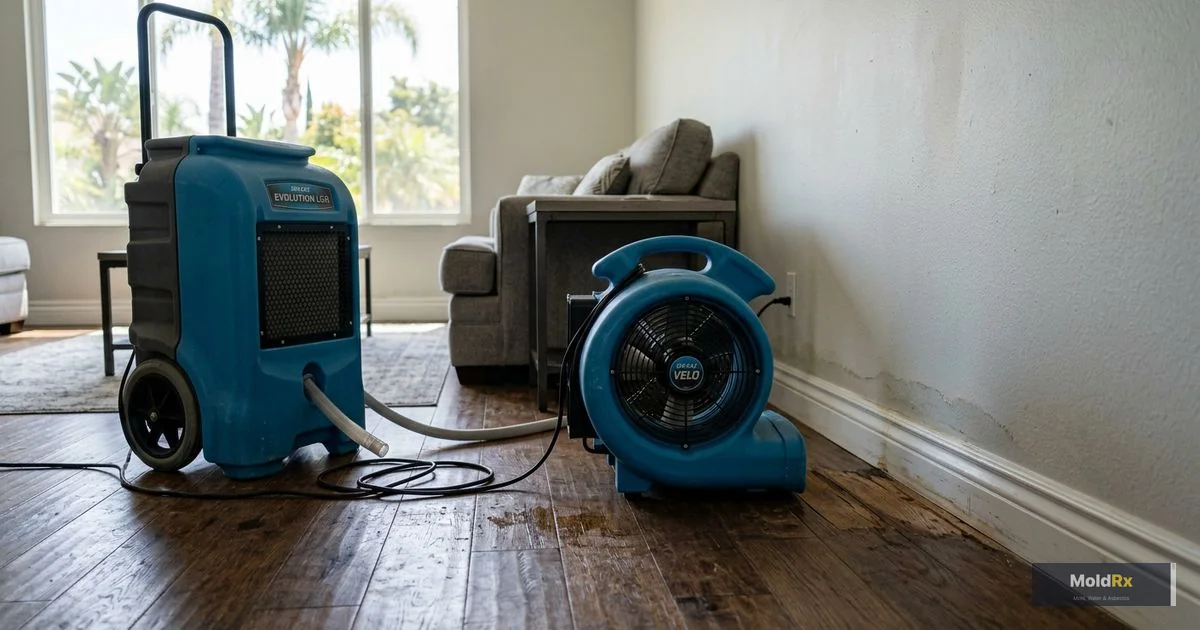
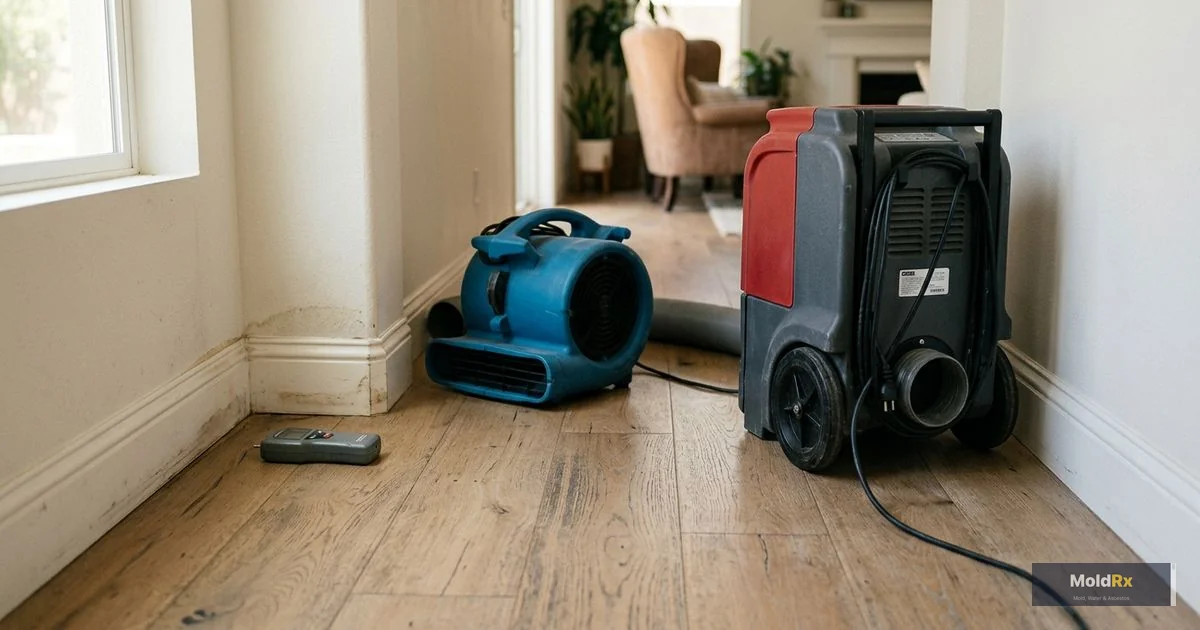
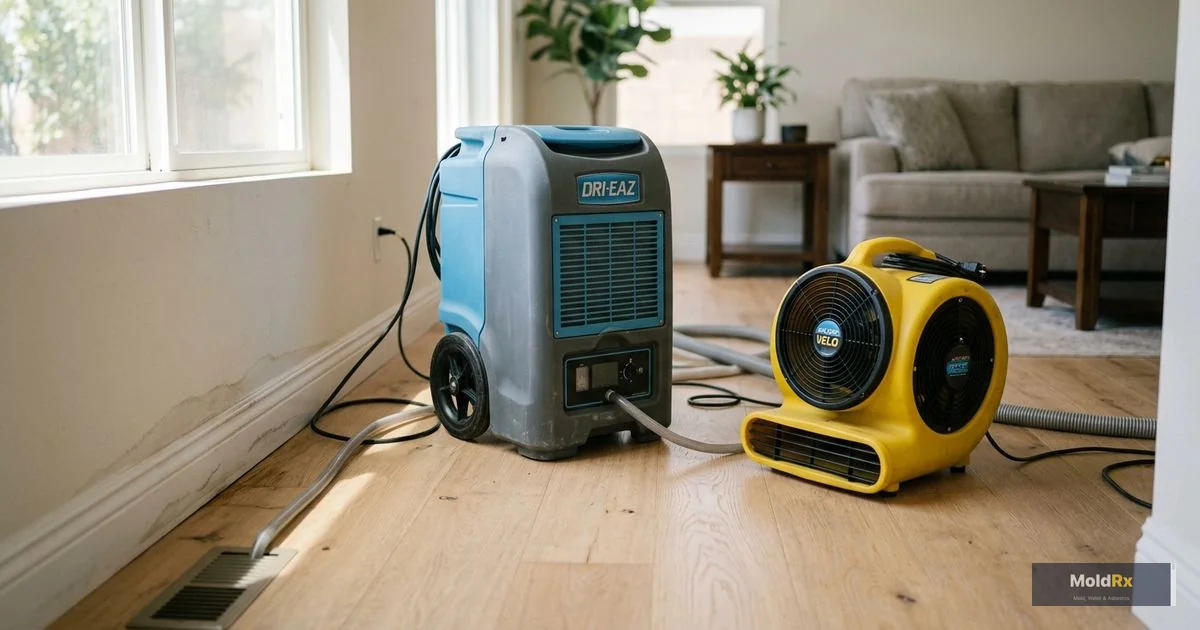
- Industrial dehumidifiers — commercial LGR or desiccant units that pull moisture from interior air and maintain conditions that force saturated building materials to release trapped water
- High-velocity air movers — strategically positioned across all wet surfaces to maximize evaporation into the controlled air stream
- Continuous monitoring — daily or more frequent moisture readings using professional meters, tracking drying progress in every affected material against the calculated drying plan
- Temperature management — in Montclair's extreme heat, indoor temperature during drying must be managed for optimal dehumidifier performance; our teams coordinate HVAC or supplemental climate control
- HVAC isolation — preventing distribution of moisture and microbial contaminants to unaffected rooms
Per IICRC S500, drying is verified complete only when instrument readings confirm all materials have returned to their dry standard — a measured number, not a guess. In Montclair, structural drying typically takes 3 to 7 days, with Class 4 situations involving slabs and dense materials potentially extending longer.
Step 4: Contamination Control and Antimicrobial Treatment
For Category 2 and Category 3 water events — which are common in Montclair due to aging sewer laterals, appliance overflows, and storm water intrusion:
- Application of EPA-registered antimicrobial agents to all affected surfaces
- Removal and proper disposal of porous materials that cannot be decontaminated — carpet, pad, insulation, drywall below the flood cut line
- HEPA air filtration to capture airborne particulates, microbial spores, and contamination
- Containment barriers preventing cross-contamination of unaffected areas
- Full Cal/OSHA compliance for worker safety
- Proper waste disposal per local and state regulations
Step 5: Damage Assessment, Repair, and Full Restoration
Once drying is verified and contamination control is finalized:
- Drywall and insulation — removed below flood cut for Category 2/3 events; assessed for integrity in Category 1
- Flooring — hardwood, laminate, tile, vinyl, and carpet individually evaluated; warped, delaminated, or contaminated materials replaced
- Structural framing — studs, joists, sill plates, and headers checked for moisture retention, softening, and fungal growth
- Cabinetry and built-ins — particle board construction from the 1950s-1970s is particularly vulnerable and may require replacement
- Electrical and mechanical — all water-exposed components evaluated by licensed professionals per current code requirements
Request your free emergency estimate now — or call (888) 609-8907 to get a vetted restoration team to your Montclair property immediately.
The Most Common Water Damage Emergencies in Montclair
Based on Montclair's specific housing stock, climate, water quality, and infrastructure, these are the water damage emergencies our vetted professionals respond to most frequently.
Plumbing Failures Driven by Hard Water Corrosion
This is the number one cause of residential water damage in Montclair. San Bernardino County's hard water has been depositing mineral scale inside galvanized and copper supply lines for over half a century. Pipes that were already approaching the end of their lifespan are failing prematurely due to accelerated internal corrosion. When a corroded supply line ruptures inside a wall or under a slab, it releases water continuously — often for hours before detection. A single burst pipe can release hundreds of gallons per hour, flooding an entire Montclair home in the time it takes to drive to work and back.
Slab Leaks
Montclair's slab-on-grade foundations — standard in the city's 1950s-1970s construction — are a primary site of water damage origination. Under-slab supply and drain lines endure soil movement, thermal expansion from extreme surface heat, chemical interaction with surrounding soil, and decades of hard water corrosion. Pinhole leaks beneath the slab seep water upward through concrete and into flooring materials, going undetected for days or weeks until visible signs appear — warm spots on the floor, unexplained water bill increases, dampness at baseboards, or the sound of running water when fixtures are off. Slab leaks create Class 4 specialty drying conditions requiring restoration professionals with expertise in concrete and dense material drying.
Water Heater Failures
Montclair's extreme summer heat and hard water are a devastating combination for water heater longevity. Thermal stress accelerates tank fatigue. Hard water deposits sediment at the bottom of tanks, creating hot spots that crack interior linings. A ruptured 40- or 50-gallon tank in a Montclair garage sends water cascading across the floor and into the living space through the shared wall. Many Montclair homes have water heaters in locations where a failure can flood multiple rooms before anyone realizes what has happened.
Storm Water Intrusion and Surface Flooding
When winter storms hit Montclair between November and March, the compacted, sun-baked soil cannot absorb the sudden rainfall. Water pools in low-lying areas, overwhelms the 1950s-1960s-era storm drainage infrastructure, and enters homes through foundation cracks, garage door thresholds, window wells, and deteriorated weatherproofing. Low-lying neighborhoods and areas near drainage corridors along San Antonio Creek (Mills Avenue) and other historical waterways are particularly vulnerable. External floodwater is immediately classified as Category 3 black water, triggering the most complex and costly restoration protocols.
Sewage Backups
Aging cast iron sewer laterals in Montclair's older neighborhoods are prone to root intrusion from mature trees, joint separation, and internal corrosion that creates partial or complete blockages. When a sewer lateral fails, Category 3 black water enters the home through toilets, floor drains, and shower drains — a health emergency requiring immediate professional response with full Cal/OSHA safety protocols and complete removal of all affected porous materials.
Appliance Failures
Washing machines, dishwashers, and refrigerators with ice maker supply lines fail regularly in Montclair's aging homes. Hard water deposits weaken supply hose connections and valve seals. Rubber hoses deteriorate and burst behind appliances where the failure goes unnoticed. Dishwashers send Category 2 gray water across kitchen floors and beneath cabinets where particle board construction from the original build era absorbs water and disintegrates rapidly.
Why MoldRx Only Sends Vetted Restoration Professionals to Montclair
Montclair's combination of extreme heat, hard water, aging post-war construction, and dense residential development creates conditions that demand specialized restoration knowledge. An improperly dried Montclair home does not just risk mold — in summer conditions, mold colonization can begin within hours, not days, turning a manageable water damage situation into a full remediation crisis.
What "vetted" means at MoldRx:
- IICRC S500 certification — current certification in the IICRC S500 Standard for Professional Water Damage Restoration
- IICRC S520 compliance — adherence to mold remediation assessment standards, because in Montclair's climate, water damage and mold risk are inseparable
- Proper licensing — valid CSLB licenses as required by California law
- Cal/OSHA compliance — full adherence to worker safety requirements for contaminated environments
- EPA-registered products — all antimicrobial and treatment products registered with the U.S. Environmental Protection Agency
- Complete documentation — every step photographed, measured, and recorded for insurance claim support
MoldRx does not perform restoration directly. We connect Montclair homeowners in crisis with the vetted, certified professionals who handle the job correctly. We do not send whoever is available. We send whoever is qualified, certified, and right for your situation.
Montclair Neighborhoods and Areas We Serve
Our vetted water damage restoration specialists respond to emergencies across every Montclair neighborhood and commercial area:
- Central Avenue corridor — established residential areas with 1950s-1960s single-family homes and original plumbing infrastructure
- Holt Boulevard area — properties along the city's primary commercial artery with mixed residential and commercial uses
- Arrow Highway neighborhoods — residential properties along the northern boundary with aging slab foundations and galvanized supply lines
- Monte Vista Avenue area — homes from the original Monte Vista tract development era
- Kingsley Street and Orion Street neighborhoods — dense single-family residential areas with the same mid-century construction vulnerabilities as the rest of the city
- Properties near Montclair Place — residential and commercial properties in the city's commercial center
- Moreno Street and Fremont Avenue areas — established neighborhoods with original 1950s-1970s construction
- Properties throughout ZIP code 91763
We also provide emergency water damage response to neighboring Inland Empire and Pomona Valley communities including Ontario to the east, Upland to the north, Pomona to the west, Claremont to the northwest, and Chino to the south.
Related Emergency Services in Montclair
Water damage rarely exists in isolation. When water enters a Montclair home, it frequently triggers secondary conditions requiring specialized assessment and remediation. MoldRx coordinates vetted professionals across all related services:
- Mold Removal in Montclair — in Montclair's Inland Empire heat, mold colonization can begin within hours of water intrusion, not just the 24-48 hour standard; mold assessment after any water event is urgent, not optional
- Mold Testing in Montclair — professional air and surface sampling to determine whether microbial amplification has begun
- Asbestos Testing in Montclair — homes built before 1980 may contain asbestos in drywall compound, floor tiles, insulation, popcorn ceilings, and pipe wrap; water damage restoration requiring material demolition in pre-1980 homes must include asbestos assessment per Cal/OSHA and EPA regulations
- Asbestos Removal in Montclair — licensed abatement if asbestos-containing materials are identified
This is critically important in Montclair, where the vast majority of the housing stock was built during the peak decades of asbestos-containing building material use (1950s-1970s). Any restoration project requiring demolition of drywall, flooring, insulation, or ceiling materials in a pre-1980 Montclair home must address asbestos risk.
-> Learn more about all remediation services in Montclair
Frequently Asked Questions — Water Damage Restoration in Montclair
How quickly do I need to act on water damage in my Montclair home?
Immediately. Per IICRC S500, microbial growth can begin within 24 to 48 hours of water intrusion. In Montclair's Inland Empire climate — where interior wall temperatures can exceed 100 degrees during summer — that timeline compresses significantly. Clean water (Category 1) degrades toward contaminated water (Category 2/3) faster in warm environments. The difference between a same-day response and a next-day response can determine whether your flooring is saved or demolished, and whether you face a water damage bill or a water damage bill plus a mold remediation bill. Call (888) 609-8907 or request your free estimate now.
Does Montclair's hard water really cause more water damage?
Yes. San Bernardino County has some of the hardest water in Southern California. Calcium and magnesium deposits build up inside pipes, water heater tanks, and appliance connections at accelerated rates, causing internal corrosion, flow restriction, and premature failure. Plumbing systems that might last 50 years in a soft-water area can fail at 35-40 years in Montclair. This mineral buildup is a primary reason why plumbing failure is the number one cause of residential water damage in the city.
Will my homeowner's insurance cover water damage restoration in Montclair?
Most homeowner's policies cover sudden and accidental water damage — burst pipes, water heater failures, appliance malfunctions. External flooding from storm events typically requires separate flood insurance. Gradual damage from long-term maintenance neglect may not be covered. Our vetted professionals document every aspect of restoration — moisture readings, photographs, category/class determinations, material assessments — to provide your insurance adjuster with the professional-grade documentation needed to support your claim.
How long does water damage restoration take in Montclair?
A contained Category 1, Class 1 event may be dried and restored in 3 to 5 days. A major Category 2 or 3, Class 3 or 4 event — a significant pipe burst, sewage backup, slab leak, or storm flooding — can require 7 to 14 days or more for complete drying, demolition, antimicrobial treatment, and reconstruction. Montclair's summer heat can assist evaporation when professionally managed, but it simultaneously accelerates mold risk, making continuous monitoring essential. Our team provides an honest, realistic timeline after the initial assessment.
What should I do right now while waiting for the restoration team?
If safe to do so: shut off the water source at the main valve, appliance valve, or fixture valve. Turn off electrical breakers to areas with standing water or moisture near electrical components. Do not walk through standing water if contamination is unknown. Do not use household fans or HVAC — this spreads moisture and contaminants to unaffected areas. Move valuables to dry areas if safe. Then call (888) 609-8907 or request your free estimate for immediate guidance while a vetted team is dispatched.
Do Montclair homes contain asbestos that could be disturbed during restoration?
Almost certainly. Montclair's housing stock was built during the 1950s through 1970s — the peak era for asbestos-containing building materials. Asbestos may be present in drywall joint compound, floor tiles and adhesives, popcorn ceilings, pipe insulation, HVAC duct connections, and roofing materials. Any water damage restoration requiring cutting, removing, or demolishing building materials in a pre-1980 Montclair home must include asbestos testing per Cal/OSHA and EPA regulations before any materials are disturbed. Our vetted professionals coordinate asbestos assessment as a standard component of the restoration process.
Your Montclair Home Is Taking Damage Right Now — Call Immediately
Every minute water remains in your Montclair home, it is migrating deeper into aging 1950s-1970s building materials, escalating in contamination level, and generating the conditions for mold colonization at rates amplified by the Inland Empire's extreme heat. The hard water that has been corroding your plumbing for decades created this crisis. The water trapped inside your walls will not dry on its own. And in a city where interior wall temperatures regularly exceed 90 degrees for half the year, mold does not wait for your schedule — it colonizes on its own timeline, and that timeline is measured in hours, not days.
MoldRx exists for exactly this moment. We only send vetted, IICRC S500 and IICRC S520 certified restoration professionals who hold valid CSLB licenses, follow Cal/OSHA safety requirements, and use EPA-registered products. No guesswork. No unlicensed crews. No shortcuts that leave hidden moisture festering behind your walls.
Request your free emergency estimate now or call (888) 609-8907 — 24 hours a day, 7 days a week. A vetted Montclair restoration specialist will be on the way.