Asbestos Testing in Mission Viejo, CA — MoldRx
Vetted Asbestos Testing Professionals Serving Mission Viejo and South Orange County
Mission Viejo is one of the largest master-planned communities ever built under a single project in the United States, and the overwhelming majority of its roughly 34,000 housing units went up between 1966 and the late 1980s. That construction window sits directly on top of the peak era of asbestos use in American residential building materials. If you own property here — whether it is one of the original Deane Homes, a 1970s ranch-style home overlooking Lake Mission Viejo, or a hillside property in Casta del Sol — there is a statistical probability that asbestos-containing materials are somewhere inside your walls, ceilings, or floors. You cannot see asbestos. You cannot smell it. The only way to confirm its presence is professional testing verified through NVLAP-accredited laboratory analysis.
MoldRx only sends vetted asbestos testing professionals — inspectors who hold current AHERA certifications, follow EPA sampling protocols, and understand both the federal regulatory framework under OSHA 1926.1101 and the stricter California requirements under Cal/OSHA Section 1529 and SCAQMD Rule 1403.
Request your free estimate — we will scope your project and explain exactly what testing involves.
Why Mission Viejo Properties Carry Elevated Asbestos Risk
Understanding Mission Viejo's development history is the single most reliable predictor of which building materials are likely to contain asbestos and at what concentrations.
The Construction Timeline That Defines Risk
The Mission Viejo Company was organized in 1963 to develop a massive tract of former Rancho Mission Viejo land. Urban planner Donald Bren and architect James Toepfer drafted the original master plan, placing roads in valleys and homes on hillsides contoured to the natural geography. The first homes — the Deane Homes — broke ground in 1966.
Development accelerated through the late 1960s and 1970s. In 1970, Philip Morris acquired the Mission Viejo Company, fueling a housing boom that continued into the 1980s. Demand was so intense that tracts routinely sold out before construction began. Lake Mission Viejo opened to residents in June 1978, triggering another wave of development. By 1980, much of the city was complete. Mission Viejo incorporated in 1988.
This timeline directly overlaps with peak asbestos use. The EPA did not begin restricting asbestos in spray-applied products until 1978, and existing inventory continued to be installed well into the mid-1980s. The median construction year for Mission Viejo homes falls around 1979 — squarely in the highest-risk window.
What the Numbers Mean
Mission Viejo's approximately 96,000 residents live across roughly 34,285 housing units. Over 71 percent are detached single-family homes, and fewer than 8 percent were built after 2000. Industry data shows that 80 percent or more of pre-1980 buildings contain at least one asbestos-containing material. The practical assumption for any pre-1985 Mission Viejo home: asbestos is present until laboratory analysis proves otherwise.
The homes are almost uniformly designed in a Spanish Mission style — stucco walls, barrel-tile roofs, Mediterranean-influenced interiors. These construction patterns mean specific asbestos-containing materials appear with remarkable consistency across neighborhoods. A 1974 home near Marguerite Parkway and a 1979 home in the Aegean Hills were built with the same categories of products during the same supply-chain era.
Climate and Material Preservation
Mission Viejo sits in the Saddleback Valley with a Mediterranean climate — warm dry summers, mild winters, roughly 14 inches of annual rainfall. Unlike regions with freeze-thaw cycles, these conditions have preserved original building materials in remarkably good condition. A popcorn ceiling from 1973 may look virtually unchanged after five decades — but it still contains asbestos at the same concentrations as the day it was installed. Santa Ana wind events compound the risk: humidity below 10 percent means airborne fibers from deteriorating materials stay suspended longer than in normal coastal conditions.
Where Asbestos Hides in Mission Viejo Homes
Asbestos was woven into dozens of building materials valued for fire resistance, tensile strength, and low cost. Here is where it appears most frequently in homes from Mission Viejo's construction era.
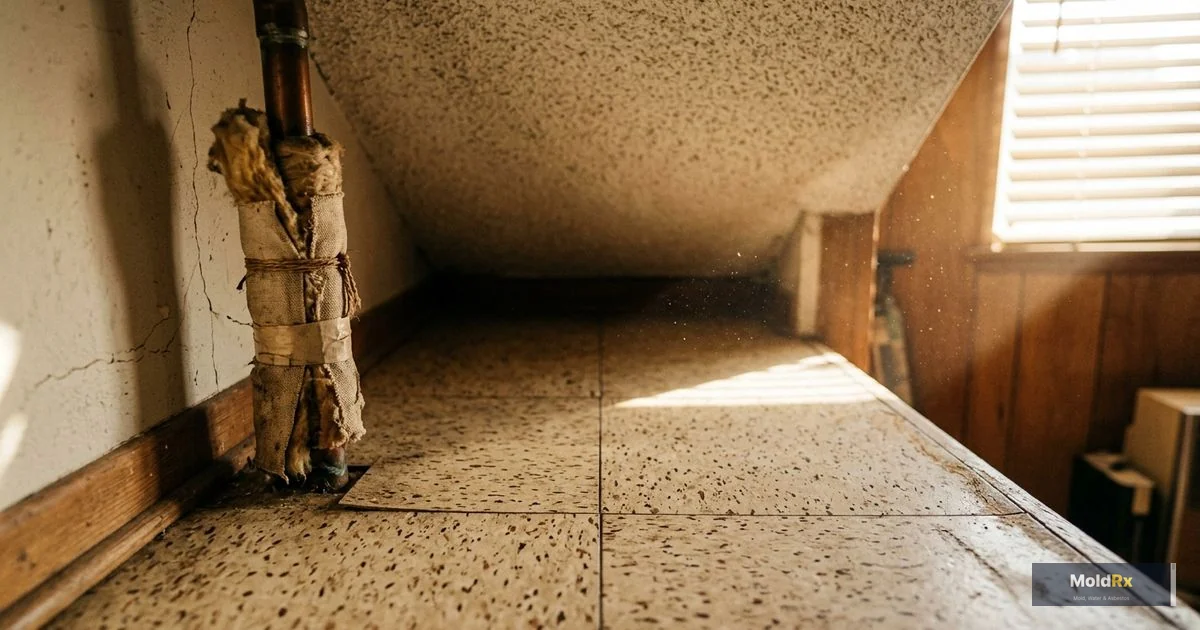
Popcorn ceilings and textured coatings. Sprayed-on acoustic ceiling texture applied throughout the 1960s and 1970s could contain 1 to 10 percent chrysotile asbestos. Because builders used remaining inventory after restrictions took effect, ceilings installed as late as 1987 have tested positive. The material is friable — scraping it without testing can release millions of microscopic fibers.
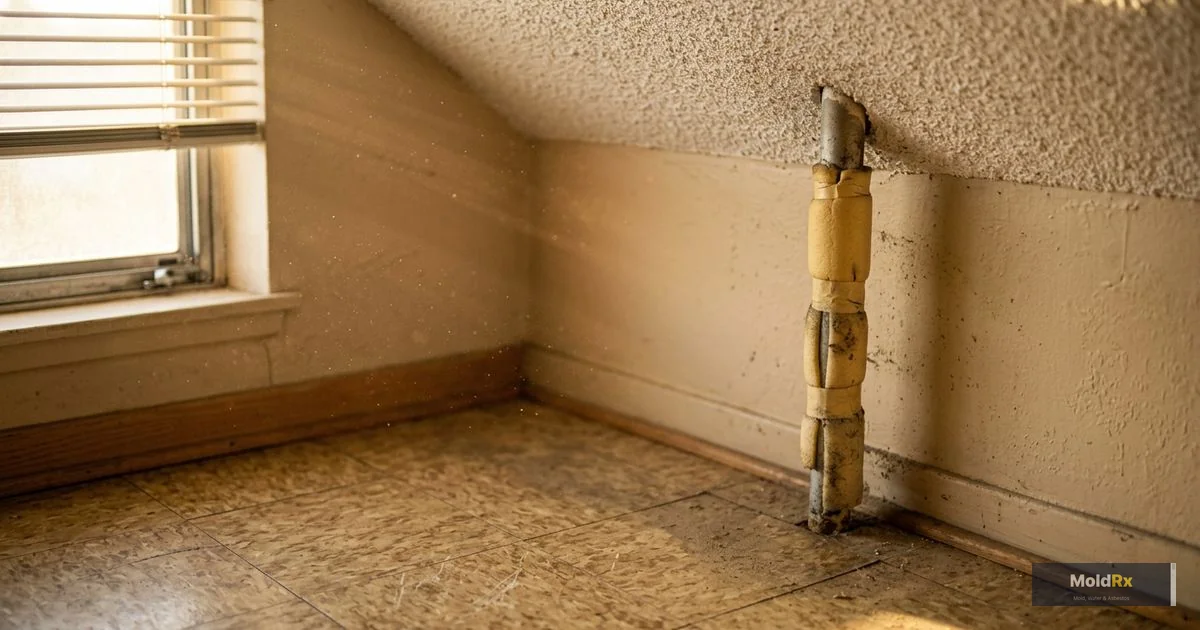
Vinyl floor tiles and black mastic adhesive. Nine-inch and twelve-inch tiles manufactured before 1980 frequently contain 5 to 70 percent chrysotile. The black cutback adhesive beneath them is also a common source. Many Mission Viejo homes still have original vinyl beneath carpeting or newer flooring.
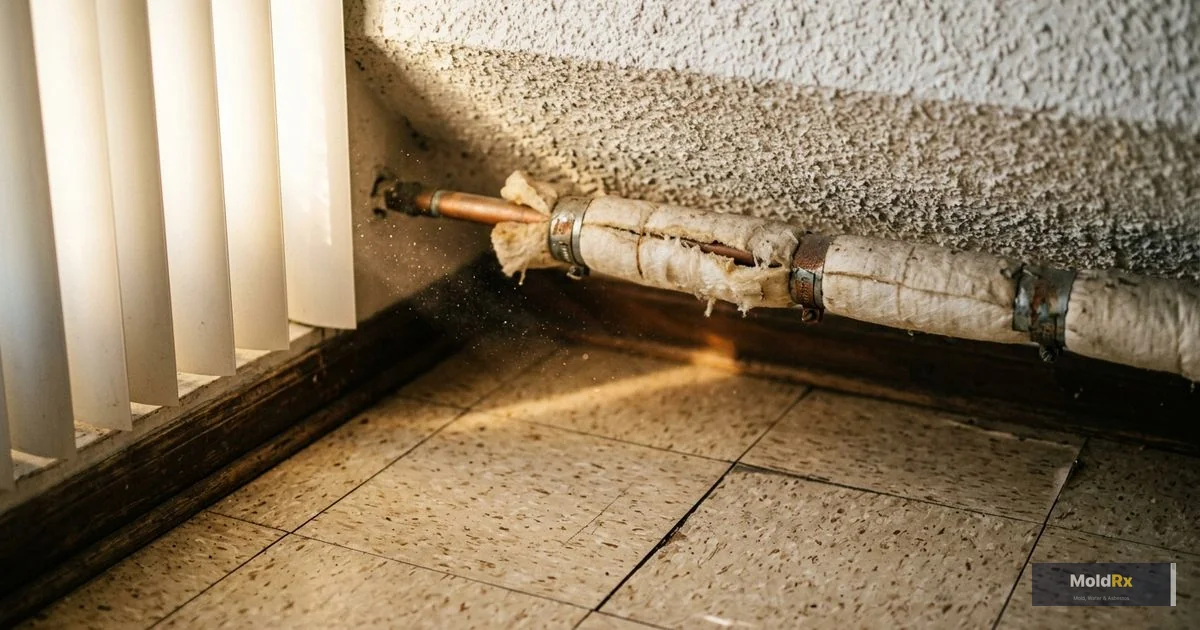
Pipe insulation and duct wrapping. Asbestos insulation on hot water pipes, heating ducts, and HVAC components is commonly found in garages, utility areas, crawl spaces, and attics. When disturbed during plumbing or HVAC replacement, it releases fibers directly into confined spaces.
Roofing materials and underlayment. Roof shingles, felt underlayment, and flashing from before 1980 frequently contain asbestos. These materials are non-friable when intact but become hazardous during re-roof tear-off if not handled by a licensed CSLB C-22 abatement contractor.
Joint compound, drywall tape, and wall texture. Pre-1980s drywall compound sometimes contained asbestos. Because it is applied at every seam and screw hole, even a small remodel involving sanding or cutting walls can disturb a surprising quantity.
Stucco exterior coatings. The Spanish Mission stucco that defines Mission Viejo's character sometimes contained asbestos fibers. Grinding, chipping, or power-washing during renovation can release fibers.
Less obvious locations. Window glazing putty, caulking, electrical panel backing, vermiculite attic insulation (often from the Libby, Montana mine contaminated with tremolite asbestos), and gaskets in older furnaces and water heaters.
The Regulatory Framework
Asbestos testing in Mission Viejo is governed by overlapping federal, state, and regional regulations with serious consequences for non-compliance.
SCAQMD Rule 1403 requires a pre-project asbestos survey before any renovation or demolition, regardless of building age. The survey must be conducted by a Cal/OSHA-certified inspector or an individual holding a current AHERA Building Inspector certificate. Written notification to SCAQMD is required at least 10 working days before demolition, even if no asbestos was found. The only narrow exception is single-unit dwelling renovation involving less than 100 square feet of intact material. Fines for non-compliance can exceed $20,000 per day, with criminal prosecution possible if negligence leads to harm.
OSHA 1926.1101 — the federal asbestos standard for construction — classifies asbestos work into four tiers, establishes permissible exposure limits of 0.1 fibers per cubic centimeter averaged over an 8-hour workday, and mandates that building owners identify and document all asbestos-containing materials before work begins.
Cal/OSHA Section 1529 mirrors the federal standard but goes further. California regulates asbestos at concentrations as low as 0.1 percent — ten times stricter than many states. Any contractor performing asbestos-related work involving 100 square feet or more must register with Cal/OSHA's Division of Occupational Safety and Health (DOSH), and workers must complete Cal/OSHA-approved AHERA training courses.
AHERA (Asbestos Hazard Emergency Response Act) established the inspector certification framework used industry-wide. Inspectors must complete a minimum 3-day, 24-hour EPA-accredited initial course and maintain certification through annual refresher training. This certification is the baseline credential for surveys under both SCAQMD Rule 1403 and Cal/OSHA Section 1529.
CSLB C-22 — if asbestos is found and removal is required, California law mandates abatement by a contractor holding a C-22 Asbestos Abatement classification from the Contractors State License Board. C-22 applicants must demonstrate four years of journey-level abatement experience and register with DOSH.
Call (888) 609-8907 or request your free estimate online — we will tell you whether testing is needed for your specific situation.
When You Need Asbestos Testing
Before any renovation or remodel. If your project involves cutting, sanding, drilling, or demolishing building materials in a pre-1990 Mission Viejo home, testing must happen before the first contractor visit. SCAQMD Rule 1403 requires it by law, and responsible renovation companies will require asbestos clearance before starting work.
Before purchasing a home. Standard home inspections do not include asbestos testing. Only laboratory analysis using PLM or TEM methods can confirm asbestos presence. Knowing the status before closing gives you negotiating leverage and prevents expensive surprises.
When you notice damaged materials. Crumbling pipe insulation, water-stained ceiling texture, peeling floor tiles, or deteriorating stucco in a pre-1985 home can indicate asbestos-containing materials are breaking down. Do not attempt to clean up or patch — have them tested first.
Before roof replacement. Many Mission Viejo homes still carry original or second-generation roofing from the 1970s and 1980s. Roofing felt and shingles from that era frequently contain asbestos and must be tested before tear-off.
How Our Asbestos Testing Process Works
Step 1: Consultation and Scope
We start by understanding your situation — renovating a 1975 ranch home near Lake Mission Viejo, buying a Casta del Sol property, replacing a roof in the Aegean Hills, or investigating suspicious insulation. The reason for testing shapes the scope: which materials need sampling, how many samples EPA protocols require, and your timeline. If testing is not necessary, we will tell you.
Step 2: Certified Sample Collection
A trained inspector evaluates your property and collects samples following strict EPA and Cal/OSHA protocols — wetting the material to suppress fiber release, removing small sections with specialized tools, and sealing each sample in a labeled container with chain-of-custody documentation. EPA procedures require a minimum of three samples per homogeneous material in each distinct area. A typical renovation might require 10 to 20 samples across ceiling texture, floor tile, mastic, joint compound, insulation, and roofing.
Step 3: NVLAP-Accredited Laboratory Analysis
Samples go to an NVLAP-accredited laboratory — accredited through the National Voluntary Laboratory Accreditation Program administered by NIST, meeting ISO/IEC 17025:2017 standards with biannual proficiency testing and error rates below 1 percent.
The primary method is PLM (Polarized Light Microscopy), which identifies asbestos fiber types by optical properties and estimates concentration. When PLM results are negative but low-level asbestos is suspected, or for air sample analysis, TEM (Transmission Electron Microscopy) provides higher resolution and sensitivity. Both methods are EPA-approved and identify the specific fiber type (chrysotile, amosite, crocidolite, tremolite, anthophyllite, or actinolite) and its concentration. Standard PLM turnaround is 3 to 5 business days; rush service is available within 24 to 48 hours.
Step 4: Results and Guidance
You receive a formal written report plus a plain-language conversation about what results mean for your project. If asbestos was found in materials you plan to disturb, we explain whether abatement by a CSLB C-22 licensed contractor is necessary, whether encapsulation works, or whether the material can be monitored in place. If results are negative, you have documented clearance to proceed. Every report includes laboratory documentation, chain-of-custody records, and paperwork required for permits, SCAQMD compliance, real estate transactions, and insurance claims.
Mission Viejo Neighborhoods and Construction Eras
Our vetted asbestos testing specialists serve every neighborhood in Mission Viejo. Construction era determines asbestos risk.
1960s — First Phase (Highest Risk). The original Deane Homes and earliest lake-eligible properties built from 1966 through the late 1960s carry the highest asbestos probability. Materials from this era routinely contained chrysotile asbestos in virtually every category — ceiling texture, floor tile, pipe insulation, joint compound, and roofing. These homes are now approaching 60 years old, and many homeowners are undertaking their first major renovation. Testing is essential before any work begins.
1970s — Primary Development Boom (High Risk). Mission Viejo's defining construction decade. Neighborhoods built during this period include Cordova, Madrid Del Lago, El Dorado, Alicia, Montevideo, La Paz, Kalinda, Canyon Crest, Lakeshore, and the communities surrounding Lake Mission Viejo after its 1978 opening. Casta del Sol — the guard-gated 55-plus community with approximately 1,927 homes spanning 480 acres — was also built primarily during the 1970s and into the 1980s. These homes typically feature popcorn ceilings, 9-inch vinyl floor tiles, asbestos pipe insulation, and joint compound with high rates of asbestos content. Many Casta del Sol homeowners are now updating kitchens and bathrooms that have not been touched since original construction — every one of those projects should begin with asbestos testing.
1980s — Growth Through Incorporation (Moderate Risk). Hillside communities and later development phases including Aegean Hills, Aegean Heights, Pacific Hills, Melinda Heights, Finisterra, and portions of the eastern hills. Early 1980s construction still carries meaningful asbestos risk from supply-chain inventory — popcorn ceilings and floor tiles installed as late as 1987 have tested positive in PLM analysis. Mid-to-late 1980s homes carry lower but non-negligible risk, particularly for flooring and roofing materials where asbestos persisted longest.
1990s and Later — Infill Development (Lower Risk). Robinson Ranch, Trabuco Highlands, Auburn Ridge, and other later additions use contemporary materials with negligible asbestos risk. However, SCAQMD Rule 1403 still requires a survey before demolition regardless of building age, and any renovation involving demolition of pre-existing structural elements should be evaluated.
We serve all three Mission Viejo ZIP codes — 92691, 92692, and 92694 — and every neighborhood within city limits. Whether your home is one of the original 1966 builds, a 1970s tract home near Marguerite Parkway, a lakefront property along Lake Mission Viejo, or a later addition in the eastern hills, we understand the construction patterns and materials standard during each phase of Mission Viejo's buildout.
What Sets MoldRx Apart
- We only send vetted professionals. No subcontractor roulette. AHERA-certified inspectors trained in EPA protocols and experienced with South Orange County construction patterns.
- NVLAP-accredited lab partners. Every sample analyzed by a nationally accredited laboratory using PLM and, when warranted, TEM methods meeting EPA, Cal/OSHA, and SCAQMD requirements.
- Honest assessment. If testing is not necessary for your project, we will tell you.
- Clear, actionable results. Plain language, specific recommendations, and a clear path forward — whether that means CSLB C-22 abatement, encapsulation, monitoring, or documented clearance.
- No conflicts of interest. Testing and abatement remain separate. Our role is accurate information — not selling removal services you may not need.
Related Services in Mission Viejo
- Asbestos Removal in Mission Viejo
- Mold Removal in Mission Viejo
- Mold Testing in Mission Viejo
- Water Damage Restoration in Mission Viejo
-> All services in Mission Viejo
Frequently Asked Questions
Is asbestos testing required before renovation in Mission Viejo?
Yes. SCAQMD Rule 1403 requires an asbestos survey before renovation or demolition in the South Coast Air Quality Management District, which includes all of Orange County. The survey must be performed by a Cal/OSHA-certified inspector or an individual holding a current AHERA Building Inspector certificate. The only exception is single-unit dwelling renovation involving less than 100 square feet of intact material. Non-compliance fines can exceed $20,000 per day.
What materials should be tested in a Mission Viejo home?
In homes built during Mission Viejo's primary development era (1966 through the late 1980s), common asbestos-containing materials include popcorn ceilings, vinyl floor tiles and black mastic adhesive, pipe insulation, duct wrapping, joint compound, drywall tape, textured wall coatings, roof shingles, roofing felt, stucco exterior coatings, and vermiculite attic insulation. Every material that will be cut, sanded, drilled, or demolished should be tested. Assume nothing is safe until PLM or TEM laboratory results confirm it.
How many samples are needed?
EPA procedures require a minimum of three bulk samples per homogeneous material in each distinct area. A typical Mission Viejo renovation might need 10 to 20 samples across ceiling texture, floor tile, mastic, joint compound, pipe insulation, and roofing. Your inspector determines the exact number based on your property and project scope.
How long do results take?
Standard PLM analysis at an NVLAP-accredited laboratory takes 3 to 5 business days. Rush service is available within 24 hours. TEM analysis, when needed, typically requires 5 to 7 business days.
Can I collect asbestos samples myself?
California does not prohibit homeowners from sampling in their own single-family residence, but it is not recommended. Improper technique can release fibers, cause cross-contamination, and produce unreliable results. Samples collected by uncertified individuals may not be accepted for SCAQMD Rule 1403 compliance, building permits, or real estate transactions.
What happens if asbestos is found?
Finding asbestos does not automatically mean your home is unsafe or that removal is your only option. Intact, undisturbed materials in good condition often pose minimal risk and can be monitored. If the material is damaged or located where you plan to renovate, professional abatement by a CSLB C-22 licensed contractor is necessary. Your options fall into three categories — monitoring, encapsulation, or removal — and our report explains which applies to your specific situation.
What is the difference between PLM and TEM?
PLM (Polarized Light Microscopy) identifies asbestos fibers by optical properties and is the standard method for bulk building material samples. TEM (Transmission Electron Microscopy) provides higher magnification and sensitivity — required for air samples and for confirming inconclusive PLM results. Both are EPA-approved and performed at NVLAP-accredited laboratories.
Do all pre-1980 Mission Viejo homes contain asbestos?
No, but industry data indicates that 80 percent or more of pre-1980 buildings contain at least one asbestos-containing material. Some homes may have had asbestos removed during previous renovations. Laboratory testing using PLM or TEM analysis is the only way to determine what your specific home contains — visual inspection cannot confirm or rule out asbestos in any material.
Is asbestos dangerous if I do not disturb it?
Intact asbestos-containing materials in good condition generally do not release fibers and pose minimal health risk. The danger arises when these materials are damaged or disturbed through cutting, sanding, drilling, demolition, or aggressive cleaning. This is precisely why testing before any renovation is essential — you need to know which materials contain asbestos so you can avoid disturbing them accidentally or plan for proper abatement if disturbance is unavoidable.
Get Asbestos Testing in Mission Viejo
Mission Viejo was built to last — well-constructed homes designed for decades of Southern California living. But the building materials that went into these homes between 1966 and the late 1980s reflect the standards of their era, and asbestos was part of those standards. Whether you are remodeling a kitchen, scraping ceilings, replacing a roof, buying a property, or simply want documented knowledge of what is inside your walls, professional asbestos testing gives you the facts you need to make safe, informed decisions.
Our vetted specialists understand Mission Viejo's construction history, know the materials typical to each development phase, and deliver honest results backed by NVLAP-accredited laboratory analysis — not a sales pitch. No guesswork. No unnecessary alarm. Just accurate testing and clear answers.
Schedule your free estimate today — call (888) 609-8907 or request online. We will get back to you within one business day.