Water Damage Restoration in Menifee, CA -- Emergency 24/7 Response
Water is in your Menifee home right now and the damage is spreading. Every minute counts. You need vetted water damage restoration professionals who understand Menifee's unique housing stock -- from 1960s Sun City retirement homes to brand-new Audie Murphy Ranch builds -- and can respond immediately.
A burst pipe at 3 AM does not care that you just remodeled your kitchen. A water heater failure does not wait for a convenient time. Flash flooding from Salt Creek or the San Jacinto River does not check whether your homeowner's insurance covers flood damage before it pours into your garage. In Menifee -- a city of over 110,000 residents that has exploded in growth since its 2008 incorporation -- water damage is one of the most common and most destructive emergencies homeowners face. And the window between a manageable problem and a catastrophic one is measured in hours, not days.
If water is actively flooding your Menifee home, call MoldRx now. We coordinate emergency response with vetted restoration professionals 24/7. Do not wait until morning. Do not wait to see if it gets worse. It will get worse.
Why Water Damage in Menifee Demands Immediate Action
Menifee is not a city where you can take a wait-and-see approach to water damage. The climate, the geography, the housing stock, and the drainage infrastructure all create conditions where water damage escalates faster and penetrates deeper than homeowners expect.
A City of Two Housing Eras -- Both at Risk
Menifee's housing stock spans roughly six decades, and this diversity creates a wide spectrum of water damage vulnerabilities that restoration professionals must understand.
Sun City and Quail Valley (1960s-1980s construction): The Sun City retirement community, developed by Del Webb beginning in the 1960s, represents Menifee's oldest significant housing stock. These four square miles of predominantly single-story homes were built for affordability and comfort, not for the demands they face 50 to 60 years later. Properties in Sun City and the surrounding Quail Valley area commonly feature:
- Galvanized steel or copper plumbing systems that have been corroding for decades. Galvanized pipes develop internal rust buildup that restricts flow, increases pressure on joints, and eventually fails -- often catastrophically
- Original water heaters that have been replaced multiple times, sometimes with improper connections or inadequate overflow drainage
- Slab foundations that have shifted and settled over decades in Menifee's expansive clay soils, stressing drain lines and supply pipes beneath the concrete
- Single-pane windows and aging weatherproofing that allow storm water intrusion during heavy rain events
- Outdated HVAC systems that create chronic condensation issues, particularly during temperature swings between hot days and cool nights
The Quail Valley area carries an additional, specific flood vulnerability. The original street layout from the 1950s superimposed a grid pattern onto the natural, irregular drainage network. This means natural water channels run directly through residential areas without adequate infrastructure to contain them. During intense rainstorms, road crossings that were never designed to handle major storm flows become overwhelmed, resulting in road closures and residential flooding.
Newer developments (2000s-present) including Audie Murphy Ranch, Menifee Lakes, Heritage Lake, and Countryside: Since incorporation in 2008, Menifee has experienced explosive growth. Audie Murphy Ranch alone contains over 2,000 homes built starting in 2012. These newer communities were built on what was recently agricultural and undeveloped land. While modern construction codes address many of the issues that plague older homes, these properties face their own water damage risks:
- Homes built during periods of rapid development, when construction timelines were aggressive and quality control sometimes suffered under production pressure
- Slab foundations on recently graded land that is still settling, creating stress fractures in foundation slabs that allow groundwater intrusion
- Water heaters and appliances that are now 10 to 15 years old in the earliest developments -- approaching the end of their expected lifespan
- Supply line connections at sinks, toilets, washing machines, and refrigerators that degrade over time. These are among the most common sources of residential water damage
- Landscaping irrigation systems installed close to foundations, saturating perimeter soil and creating conditions for slab leaks and foundation movement
The San Jacinto River Basin: Flooding Is Not Hypothetical
Menifee sits in the lower part of the San Jacinto River basin. Most flooding in the city results from flows along the San Jacinto River, Salt Creek, and several smaller drainage channels including Ethanac Wash, the creek through Quail Valley, Paloma Wash, and Warm Springs Creek.
This is not theoretical risk. Twenty percent of Menifee's evacuation road network -- 13 miles of streets -- lies within designated flood hazard zones. When winter storms deliver concentrated rainfall between November and March, these channels can overwhelm their banks and send water into residential neighborhoods with little warning. Adequate bridges and culverts are lacking where many roads cross natural drainage channels, meaning road closures are common during intense rainstorms -- and the water that cannot pass through infrastructure goes somewhere. Often, that somewhere is into homes.
Menifee's Climate: The Perfect Storm for Water Damage
Menifee's semi-arid Mediterranean climate creates a dangerous cycle for water damage:
Hot, dry summers (mid-90s to low 100s):
- Air conditioning runs constantly, stressing plumbing systems and creating condensation
- Hot summers and dry soil cause ground shrinkage that shifts foundations and stresses underground pipes
- Water heaters work harder, accelerating wear and increasing failure risk
- When water damage does occur, extreme heat creates ideal conditions for rapid mold growth -- sometimes within 24 hours rather than the typical 48-hour window
Concentrated winter rainfall (12-14 inches annually, most falling November through March):
- When rain arrives after months of dry conditions, hardened soil cannot absorb water, creating rapid runoff
- Storm systems deliver intense bursts of rainfall that overwhelm drainage infrastructure
- Wind-driven rain exploits every gap in roofing, window seals, and exterior weatherproofing
- Roof leaks that were invisible during dry months suddenly flood attic spaces and interior walls
The dangerous transition between seasons:
- Temperature swings create condensation in wall cavities, attic spaces, and around HVAC components
- Humidity spikes during certain weather patterns push indoor moisture levels into the danger zone for mold growth
- Soils expand when wet after months of contraction, placing enormous stress on slab foundations and underground plumbing
Emergency Water Damage Restoration: The MoldRx Process in Menifee
When you call MoldRx about water damage in your Menifee home, we do not put you on hold, we do not schedule a consultation for next week, and we do not send a salesperson. We coordinate immediate response with vetted restoration professionals who follow a proven, systematic protocol.
Phase 1: Emergency Response, Assessment, and Extraction
The first priority is stopping the damage from spreading. A vetted water damage specialist arrives equipped to work immediately:
- Source control -- Identifying and stopping the water source if active. Shutting off supply valves, isolating failed appliances, or coordinating with plumbers for pipe repairs
- Water category determination -- Classifying the water as Category 1 (clean -- from a supply line), Category 2 (gray -- from appliances, dishwashers, or washing machines), or Category 3 (black -- from sewage, floodwater, or river overflow). This classification dictates every protocol that follows
- Immediate extraction -- Commercial-grade pumps and truck-mounted extraction units remove standing water as rapidly as possible. For Menifee homes on slab foundations -- which is the majority -- crews focus on water trapped between flooring and concrete, along slab edges, and in the gap between baseboards and drywall where water migrates invisibly
- Damage assessment and documentation -- Thermal imaging cameras and professional moisture meters map the full extent of water penetration, including areas behind walls, under cabinets, and within ceiling cavities. Every finding is documented with photos and readings for insurance purposes
Phase 2: Moisture Detection and Comprehensive Mapping
Water travels through homes in ways that defy intuition. It wicks up drywall at approximately one inch per hour. It migrates through subfloor materials laterally, reaching areas far from the visible damage. It saturates insulation inside wall cavities, creating hidden pockets of moisture that will breed mold if missed.
Using thermal imaging and calibrated moisture meters, our professionals create a comprehensive moisture map of your Menifee home. This map identifies:
- All areas where moisture levels exceed safe thresholds
- The specific materials affected (drywall, framing, insulation, flooring, subfloor)
- Hidden moisture pockets in wall cavities, under cabinets, and inside ceiling assemblies
- The baseline readings that will be used to track drying progress and verify completion
This step is where inexperienced restoration companies fail. Missing a moisture pocket behind a kitchen cabinet or inside a wall cavity does not just delay the problem -- it creates a mold colony that can spread through your home for months before symptoms appear.
Phase 3: Structural Drying and Dehumidification
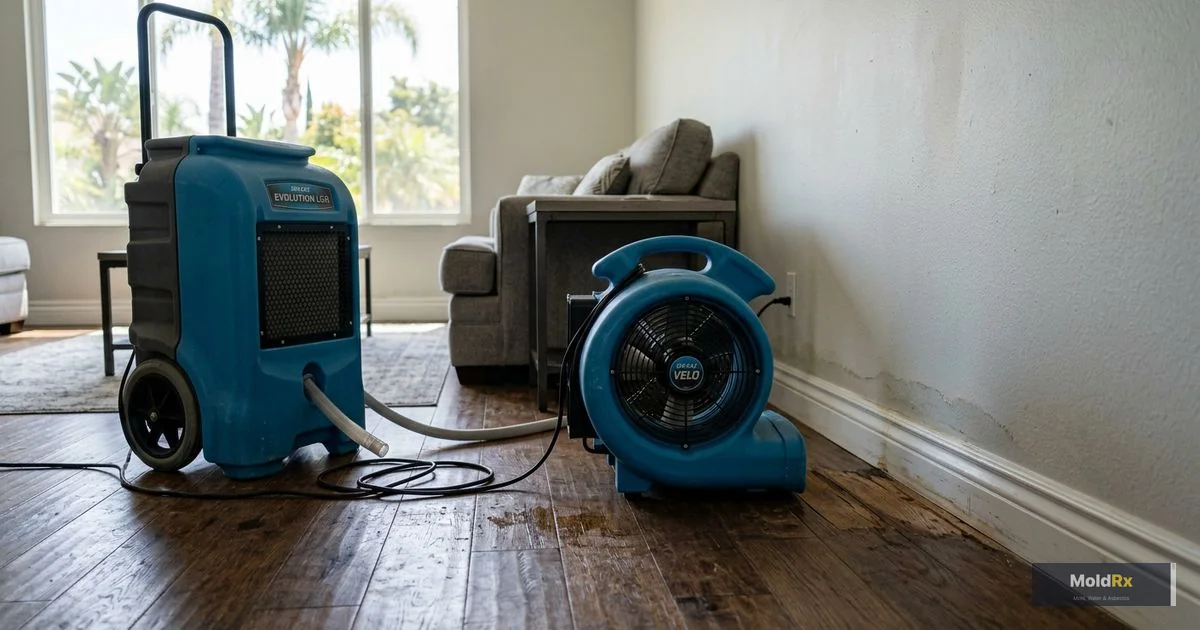
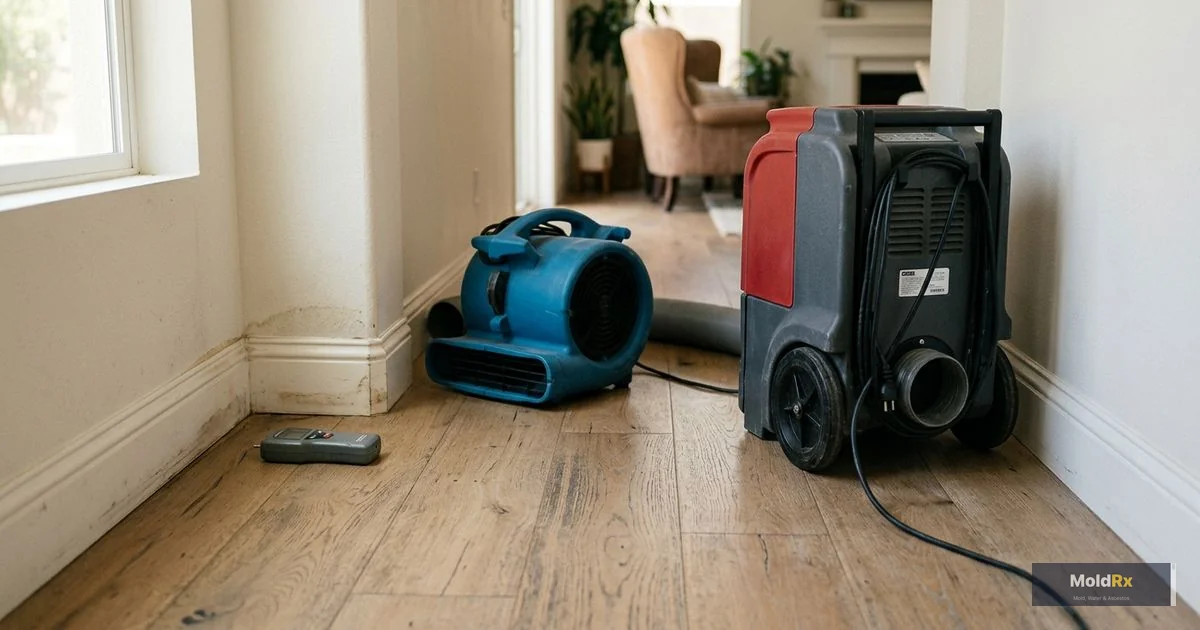
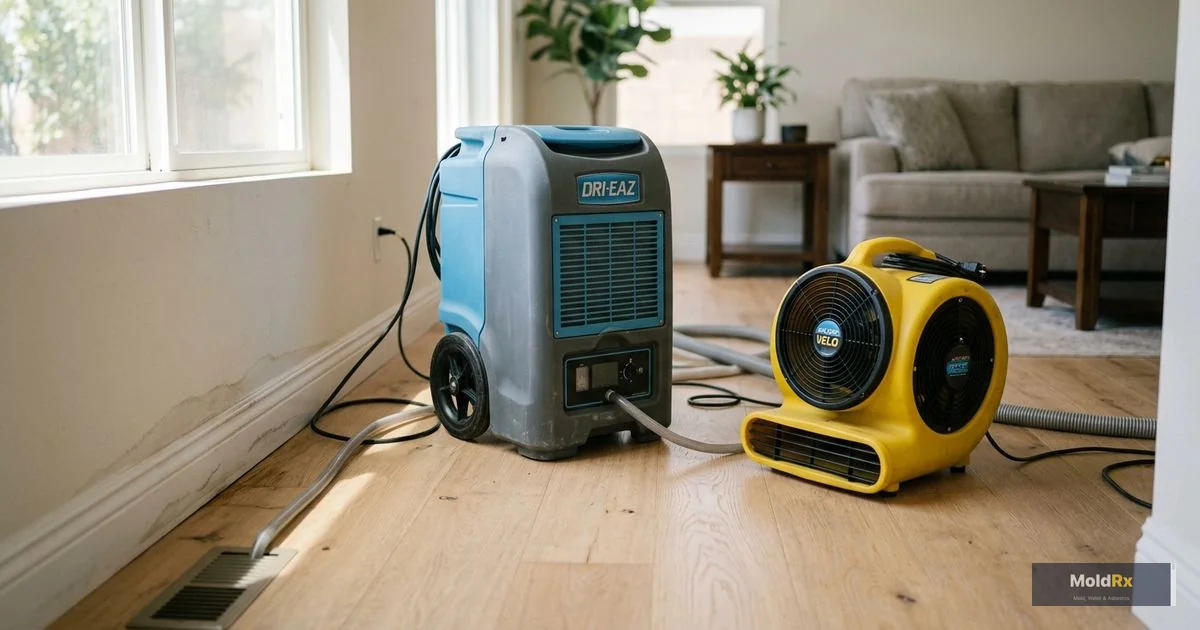
Industrial air movers and commercial dehumidifiers work in concert to systematically pull moisture from structural materials and the air. This is a calibrated, monitored process -- not a matter of pointing fans at wet areas and hoping for the best.
For Menifee properties, the drying strategy must account for local climate conditions. During summer, low ambient humidity allows aggressive dehumidification that can accelerate drying timelines. During winter -- when water damage from storms is most common -- higher ambient moisture levels require different equipment configurations and longer drying cycles.
Daily moisture monitoring is non-negotiable. Technicians check readings throughout affected areas every day, adjusting equipment placement and airflow patterns as materials dry at different rates. The process is complete only when every monitored point falls within IICRC S500 acceptable moisture ranges. Not when surfaces feel dry. Not when a certain number of days have passed. When the meters say it is done.
Phase 4: Cleaning, Sanitization, and Antimicrobial Treatment
Once structural drying is verified, affected areas receive cleaning and treatment appropriate to the water category:
- Category 1 events require antimicrobial treatment of affected surfaces to prevent mold colonization in the days following restoration
- Category 2 events require thorough cleaning, sanitization, and antimicrobial treatment. Porous materials like carpet padding that contacted gray water are typically removed and replaced
- Category 3 events demand aggressive removal of all contaminated porous materials, comprehensive sanitization of structural components, and thorough antimicrobial treatment. This is especially critical in Menifee homes affected by floodwater from Salt Creek or other drainage channels, where water carries soil contaminants, bacteria, and debris
Phase 5: Restoration and Reconstruction
The final phase returns your home to pre-damage condition. Depending on the extent of damage, this may include drywall replacement, flooring repair or replacement, baseboard and trim reinstallation, paint and texture matching, cabinet repair, and any structural work identified during assessment. Our goal is making it impossible to tell that water damage ever occurred.
What to Expect from MoldRx in Menifee
-
Speed When It Matters: Water damage is a time-critical emergency. We coordinate response immediately, not when it fits someone's schedule.
-
Honest Assessment, Not a Sales Pitch: We will tell you exactly what is damaged, what can be saved, and what must be replaced. If the damage is smaller than you feared, you will know. If it is worse, you will understand why and what needs to happen.
-
Relentless Communication: You will know what is happening at every step. Questions get answered immediately, not dodged. Complications get reported as they arise, not buried in a final invoice.
-
Documentation That Actually Helps: For insurance claims, you need detailed records -- photos, moisture readings, itemized work descriptions, and progress reports. Our documentation is built specifically to give adjusters what they need to process your claim.
-
No Shortcuts, Period: Drying takes as long as it takes. Rushing the process to close a job faster is how hidden moisture turns into mold six months later. We do it right or we do not do it at all.
Menifee Neighborhoods and Areas We Serve
Our vetted water damage restoration specialists respond to emergencies throughout all Menifee communities:
- Audie Murphy Ranch -- Over 2,000 homes built since 2012, now reaching the age where supply line failures and water heater issues become common
- Menifee Lakes -- Established community with mixed-age housing stock
- Sun City -- 1960s Del Webb retirement community with aging plumbing systems requiring specialized restoration approaches
- Quail Valley -- Unique flood vulnerability due to original street layout conflicting with natural drainage patterns
- Paloma Valley -- Residential area near Paloma Wash flood channel
- Heritage Lake and Countryside -- Growing communities with newer construction
- Areas along Newport Road and Haun Road -- Commercial and residential corridors
We cover ZIP codes 92584, 92585, 92586, and 92587 and respond to water damage emergencies in neighboring communities including Murrieta, Perris, Lake Elsinore, Hemet, and Sun City.
Related Services in Menifee
Water damage left unaddressed becomes mold damage -- especially in Menifee's climate. In addition to water damage restoration, we also offer Mold Removal in Menifee, Asbestos Removal in Menifee, Water Damage Restoration in Menifee, Mold Testing in Menifee, and Asbestos Testing in Menifee services to Menifee property owners.
→ Learn more about remediation services in Menifee
Frequently Asked Questions
How quickly should I address water damage in my Menifee home?
Right now. Not tomorrow morning. Not after you Google more restoration companies. Right now. In Menifee's climate, mold can begin colonizing wet surfaces within 24 hours during warm weather. Drywall absorbs water continuously until it is either extracted or the drywall disintegrates. Subfloor swells, warps, and delaminates. Every hour of delay means more material that cannot be saved and must be replaced instead. Our Menifee team coordinates emergency response 24 hours a day, 7 days a week because water damage is always an emergency -- even when it does not look like one yet.
How much does water damage restoration cost in Menifee?
There is no honest answer to this question without seeing your specific situation. Costs depend on the water category, the square footage affected, which materials are involved, whether structural components are compromised, and whether mold growth has already begun. A small supply line leak caught within hours is a fundamentally different scope of work than a water heater failure that saturated 800 square feet of flooring overnight, which is a different job from storm flooding with contaminated water. Contact MoldRx for an honest, no-obligation assessment of your Menifee property. We will tell you exactly what you are dealing with and what it requires.
Does insurance cover water damage restoration in Menifee?
Most homeowner's policies cover sudden and accidental water damage -- a pipe that bursts, an appliance that fails, a water heater that ruptures. What is typically not covered: gradual damage from slow leaks you knew about and did not fix, damage from deferred maintenance, and flooding from storms or rising water. Flood damage usually requires separate flood insurance -- which is worth considering given Menifee's position in the San Jacinto River basin and the documented flood risks along Salt Creek, Paloma Wash, and Quail Valley drainage channels. Our detailed documentation supports your insurance claim with the photos, readings, and records adjusters need.
How long does the restoration process take in Menifee?
Minor water damage caught quickly -- a small leak affecting one room -- typically takes 3 to 5 days including drying time. Moderate damage involving multiple rooms or significant material saturation runs 7 to 10 days. Major events involving extensive flooding, Category 3 water, or mold growth can take 2 weeks or more. The structural drying phase is the part that cannot be compressed without creating bigger problems. We provide realistic timelines after assessment and communicate any changes as the process unfolds.
Can water-damaged materials in my Menifee home be saved?
Speed determines what survives. Hardwood flooring, drywall, and carpet can often be dried and saved if professional restoration begins within 24 to 48 hours of clean water exposure. Once materials have been saturated beyond their structural capacity, or once mold growth has begun, salvage becomes impossible and replacement is the only option. Materials exposed to Category 2 or Category 3 water face stricter thresholds -- porous materials that absorbed contaminated water are almost always replaced regardless of timing. The bottom line: the faster you act, the more you save, and the less the entire process costs.
Why is Menifee particularly vulnerable to water damage?
Menifee faces a combination of factors that most cities do not. The collision of 1960s housing stock with aging plumbing and newer rapid-development construction creates diverse failure points across the city. The city's position in the San Jacinto River basin with multiple flood-prone drainage channels creates storm flooding risk. Quail Valley's grid street layout superimposed on natural drainage patterns creates neighborhood-specific flood vulnerability. Extreme summer heat accelerates mold growth when water damage occurs. And the concentrated winter rainy season delivers intense storms that exploit every weakness in aging roofing, weatherproofing, and drainage infrastructure simultaneously.
Water Damage in Your Menifee Home Will Not Fix Itself -- Act Now
Here is the reality that every Menifee homeowner facing water damage needs to hear: it does not get better on its own. It gets worse. Every hour. Water is actively damaging your home right now -- saturating materials, compromising structural integrity, and creating the warm, wet conditions that mold needs to colonize and spread through wall cavities where you cannot see it.
The difference between calling today and calling next week is often the difference between drying out existing materials and gutting entire rooms. It is the difference between a restoration project and a reconstruction project. It is the difference between thousands of dollars and tens of thousands of dollars.
MoldRx coordinates vetted water damage restoration professionals who know Menifee. They understand the difference between restoring a 1960s Sun City home with galvanized plumbing and addressing water heater failure in a 2015 Audie Murphy Ranch build. They know the flood risks along Salt Creek and Quail Valley. They respond fast, they dry thoroughly, and they tell you the truth about what your home needs.
Contact MoldRx now for emergency water damage restoration in Menifee. Every hour matters.