Asbestos Testing in Menifee, CA — MoldRx
Vetted Asbestos Testing Specialists Serving Menifee, Sun City, and the Greater Temecula Valley
Menifee sits at the intersection of two completely different construction timelines. On one side is the original Sun City retirement community — 4,762 homes built by Del Webb and the Presley Company between 1962 and 1981, during the peak decades of asbestos use in American residential construction. On the other side are the master-planned neighborhoods that drove Menifee from roughly 43,000 residents in 2000 to an estimated 124,000 in 2026, nearly all of them built with modern, asbestos-free materials.
That split means asbestos risk in Menifee is concentrated, specific, and predictable — but only if you test. Visual inspection cannot identify asbestos. Age-based assumptions miss the nuances of transitional-era materials. And disturbing asbestos-containing materials without knowing they are there creates health consequences that do not show up for decades.
MoldRx only sends vetted, AHERA-certified inspectors who understand Menifee's housing stock from original Sun City ranch homes to the newest Audie Murphy Ranch builds. Every sample goes to an NVLAP-accredited laboratory for analysis by polarized light microscopy (PLM) or transmission electron microscopy (TEM). The result is a clear, legally compliant picture of what is in your property — and exactly what to do about it.
Get a free estimate for asbestos testing in Menifee or call (888) 609-8907 to speak with a specialist today.
Why Menifee's Construction History Demands Professional Asbestos Testing
Sun City: The Epicenter of Residential Asbestos Risk in Western Riverside County
In 1959, Del Webb purchased 14,000 acres of Menifee Valley ranchland at prices between $500 and $900 per acre. Grading began in December 1961, and when model homes opened in June 1962, 272 sold within the first three days. Over the next two decades, Del Webb and subsequently the Presley Company completed 4,762 residences along with recreation centers, golf courses, swimming pools, and a commercial center. Sun City became one of the first purpose-built retirement communities in Southern California.
Those two decades of construction overlap almost perfectly with the peak era of asbestos use in residential building products. The materials that went into Sun City homes were standard for their time: spray-applied acoustic ceiling textures containing chrysotile asbestos, vinyl floor tiles bonded with asbestos-laden black mastic, joint compound on every drywall surface, asbestos pipe insulation and duct wrapping, and asbestos-cement roofing. This was not negligence — asbestos was a valued construction ingredient prized for fire resistance, thermal insulation, and tensile strength. The EPA did not begin restricting asbestos products until 1973, and those restrictions expanded slowly through the 1980s. By the time regulatory action caught up with the science, Sun City was fully built.
Several factors make Sun City one of the most concentrated residential asbestos risk zones in Riverside County:
Density. Nearly 5,000 homes occupy a four-square-mile footprint — a geographically tight cluster of properties with a high probability of containing asbestos in multiple building materials simultaneously.
Age and thermal stress. The oldest Sun City homes are now over 60 years old. Menifee's semi-arid climate pushes summer temperatures into the mid-90s to low 100s, with attic spaces regularly exceeding 130 degrees. Decades of thermal cycling stress roofing materials, ceiling textures, and pipe insulation, accelerating deterioration and fiber release.
Ownership turnover. Many original residents have passed away or moved to assisted living. Their homes are entering the resale market at prices that attract both retirees and younger families seeking affordability relative to coastal counties. New buyers frequently purchase Sun City homes specifically to renovate them — kitchen remodels, bathroom updates, HVAC upgrades, and room additions that convert compact retirement layouts into family-sized living spaces. Every one of these projects can disturb materials containing asbestos.
Scope of planned work. Some Sun City properties are undergoing substantial remodels — walls moved, rooms added, entire mechanical systems replaced. The more materials a renovation touches, the higher the probability of encountering asbestos if testing has not been performed.
Quail Valley, Romoland, and Other Pre-1980 Areas
Sun City is the largest concentration of older housing in Menifee, but not the only one. When Menifee incorporated on October 1, 2008, it unified Sun City with Quail Valley, Romoland, and the broader Menifee Valley area. Homes built in these communities during the 1960s and 1970s carry the same asbestos risk profile as Sun City properties.
Properties from the early 1980s occupy a transitional zone. The regulatory phase-out of asbestos was underway but not complete. Materials manufactured between 1980 and approximately 1985 may still contain asbestos, and testing before renovation remains prudent and, depending on scope of work, legally required.
The New Menifee: Post-2000 Master-Planned Communities
Menifee's population explosion since 2000 has produced thousands of homes in master-planned communities built well after asbestos disappeared from mainstream residential products — Audie Murphy Ranch, Menifee Lakes, Countryside, and developments along Newport Road, Scott Road, and Bradley Road. For these post-2000 properties, asbestos testing is generally not necessary unless renovations involve materials of uncertain age or origin.
Asbestos-Containing Materials Found in Menifee's Older Homes
For properties built before 1980 in Sun City, Quail Valley, Romoland, and other established Menifee neighborhoods, the following materials are priority testing targets:
Popcorn and textured ceiling coatings. Spray-applied acoustic ceiling textures were among the most common applications of chrysotile asbestos in 1960s and 1970s residential construction. In Sun City homes, these textures were applied throughout living areas, bedrooms, and hallways. Scraping, sanding, or water damage can release millions of microscopic fibers into indoor air.
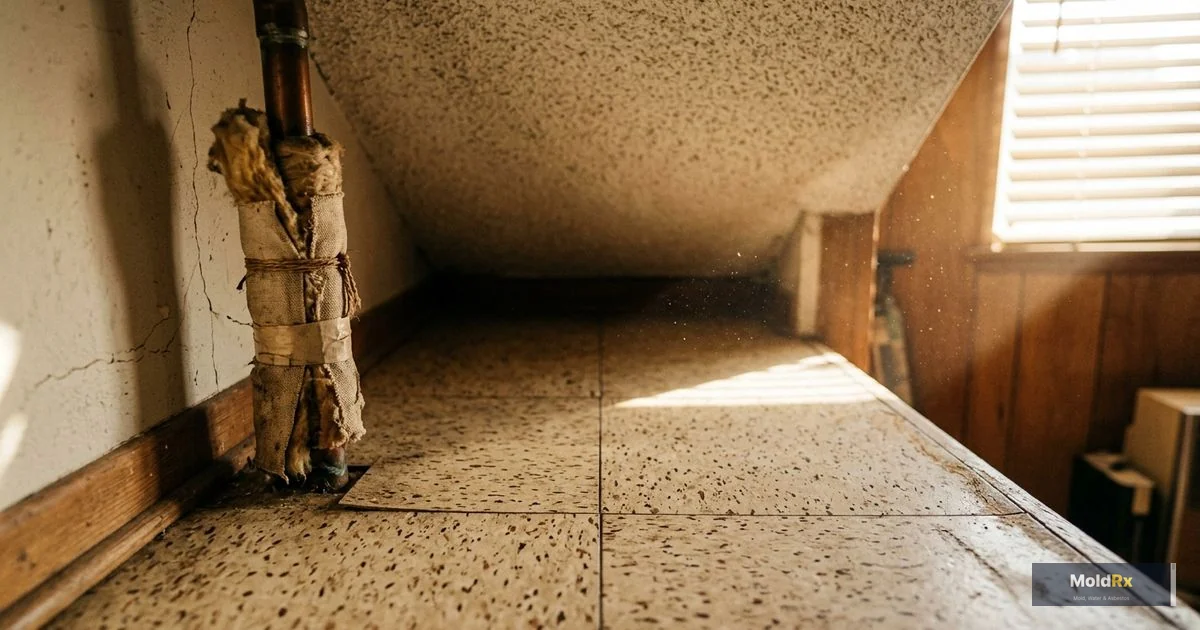
Vinyl floor tiles and mastic adhesive. Both the tiles — particularly 9-inch-by-9-inch tiles, though 12-inch tiles from this era can also test positive — and the black adhesive bonding them to the subfloor are common asbestos sources. Sun City homes with original flooring are frequent testing candidates before kitchen or bathroom remodels.
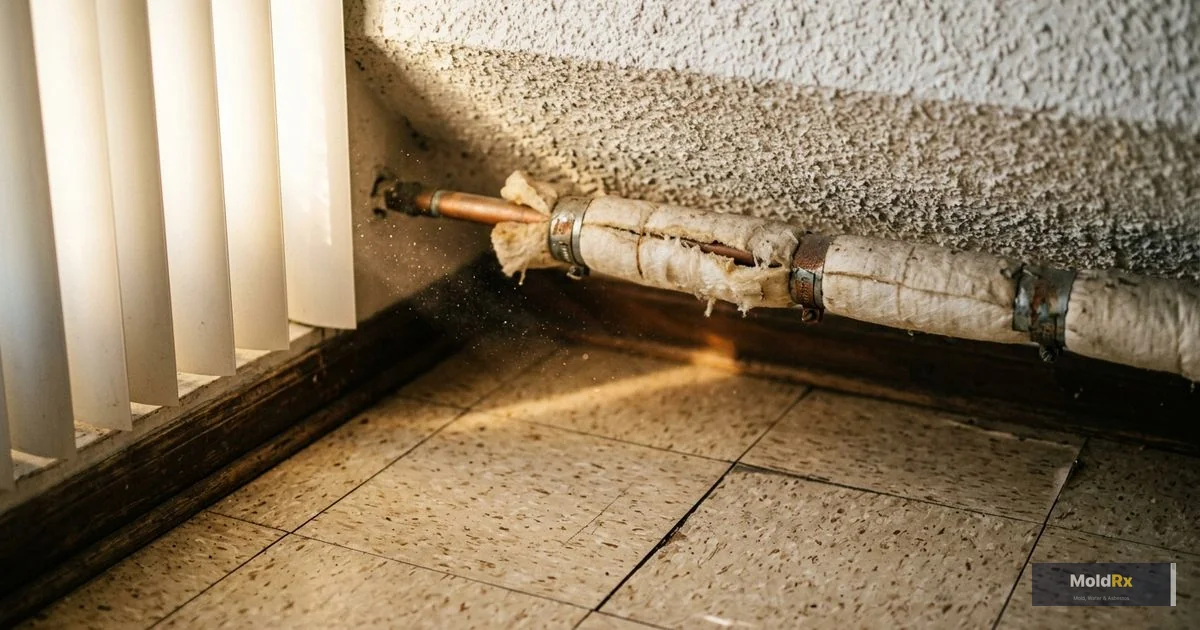
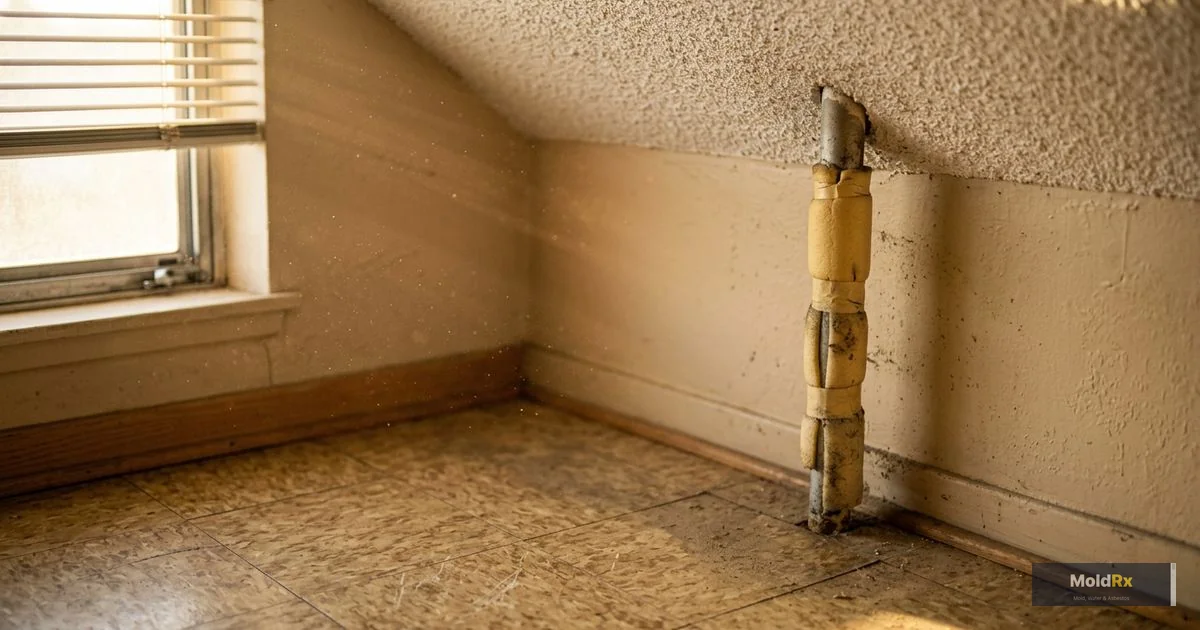
Pipe insulation and mechanical wrapping. Insulation on hot water pipes, water heater connections, and heating plumbing in pre-1980 homes often contained asbestos. In Sun City's compact layouts, mechanical components are concentrated in small utility closets where deteriorating insulation can affect air quality throughout the house.
HVAC duct insulation and duct tape. The insulation wrapping forced-air ductwork and the tape sealing duct joints frequently contained asbestos. In homes with original HVAC systems, these materials may have been deteriorating undisturbed for decades.
Joint compound and drywall mud. Joint compound was a widespread asbestos carrier through the 1970s. Because it is present on virtually every wall and ceiling surface, a positive result has implications for any renovation involving drywall in any room.
Roofing materials. Cement-asbestos shingles, felt underlayment, and ridge flashing were standard during the Sun City construction era. Menifee's intense sun and wide daily temperature swings have subjected these materials to extreme thermal stress, increasing the likelihood of friability.
Vermiculite attic insulation. Loose-fill vermiculite — particularly products from the Libby, Montana mine sold under the Zonolite brand — may contain tremolite asbestos. Test before any attic work, insulation replacement, or HVAC modification.
Cement-asbestos siding (transite). Asbestos-reinforced cement exterior cladding was common on mid-century homes. Extremely durable, many original installations remain in service — intact but hazardous if cut, drilled, or broken during exterior work.
Window glazing, caulking, and putty. Sealants around original windows, bathtubs, sinks, and fixtures in pre-1980 homes can contain asbestos. Easily overlooked, these materials are disturbed during even minor repair and replacement work.
Health Consequences of Asbestos Exposure
Asbestos is not hazardous when it remains contained within intact, undisturbed building materials. The danger arises when materials are cut, drilled, sanded, scraped, broken, or allowed to deteriorate to the point where microscopic fibers become airborne. Once airborne, asbestos fibers remain suspended in indoor air for hours — invisible, odorless, and tasteless. There is no sensory warning of exposure.
When inhaled, asbestos fibers embed permanently in lung tissue and the lining of the chest and abdominal cavities. The body cannot dissolve, break down, or expel them. Over 10 to 50 years, they cause progressive inflammation, scarring, and genetic damage leading to three serious conditions:
- Mesothelioma — an aggressive cancer caused almost exclusively by asbestos exposure, with poor survival rates
- Asbestosis — chronic, irreversible lung scarring that progressively reduces breathing capacity
- Lung cancer — significantly elevated risk, especially in combination with smoking
The decades-long latency period makes asbestos uniquely dangerous for homeowners. A weekend spent scraping a popcorn ceiling or demolishing original flooring produces no immediate symptoms. By the time disease manifests, the exposure cannot be undone. Professional testing before the project begins is the only reliable way to prevent it.
Regulatory Framework: What the Law Requires in Menifee
Asbestos testing and management for Menifee properties is governed by an interlocking set of federal, state, and regional regulations. Understanding these requirements matters because they define when testing is mandatory, who can perform it, and what happens if you skip it.
Federal: OSHA 1926.1101 and AHERA
OSHA 1926.1101 regulates asbestos exposure during demolition, renovation, and construction. It sets permissible exposure limits (0.1 fibers per cubic centimeter as an 8-hour TWA, 1.0 f/cc as a 30-minute excursion limit) and requires building owners to identify the presence, location, and quantity of ACM and PACM before work begins. A designated competent person must be present on any worksite where asbestos exposure is possible.
AHERA (Asbestos Hazard Emergency Response Act) created the accreditation standards for asbestos building inspectors, management planners, and project designers. An AHERA Building Inspector certification requires a 24-hour initial training course from a Cal/OSHA-approved provider, plus annual refresher courses to maintain accreditation. This is the baseline credential for anyone collecting asbestos samples in California.
State: Cal/OSHA Title 8, Section 1529
Cal/OSHA §1529 is California's asbestos standard for construction and is more specific than its federal counterpart. It requires identification of asbestos-containing materials before any renovation or demolition of pre-1980 structures. The survey must be conducted by a Cal/OSHA-certified inspector or an individual holding a current AHERA Building Inspector certificate from a Cal/OSHA-approved course. Cal/OSHA also requires DOSH registration for any employer removing ACM exceeding 0.1 percent asbestos content and 100 square feet of surface area.
Regional: SCAQMD Rule 1403
South Coast Air Quality Management District Rule 1403 applies to all structures within the South Coast Air Basin — which includes all of Riverside County west of the Coachella Valley, encompassing the entirety of Menifee. Rule 1403 requires a thorough asbestos survey before any renovation or demolition activity, regardless of building age. This is stricter than Cal/OSHA's pre-1980 threshold: even if your Menifee home was built in 1995, SCAQMD Rule 1403 technically requires an asbestos survey before renovation or demolition work.
Key Rule 1403 provisions include:
- Survey scope: All friable and Class I and Class II non-friable asbestos-containing materials must be identified, quantified, and documented
- Laboratory analysis: All asbestos analyses performed for Rule 1403 compliance must be conducted by NVLAP-accredited laboratories
- Notification: The SCAQMD must receive written notification at least 14 calendar days before any asbestos removal of 100 square feet or greater, or before any demolition project
- Limited exemption: Renovation of a single residential dwelling involving less than 100 square feet of intact (undamaged) material is exempt from the survey requirement — but the exemption is narrow and does not apply if materials are damaged or if the work qualifies as demolition
Contractor Licensing: CSLB C-22
When asbestos must be removed, California requires a contractor holding a CSLB C-22 Asbestos Abatement classification — a minimum of four years of journey-level experience, trade and law-and-business examinations, and active DOSH registration. MoldRx only connects Menifee homeowners with inspectors and abatement contractors who hold verified AHERA accreditation, NVLAP laboratory accreditation, DOSH registration, and CSLB C-22 licensing.
How Asbestos Testing Works in Menifee: Our Process
Step 1: Property-Specific Consultation and Scope
We begin with your property's details — its age, its community, its construction type, and your planned project. A Sun City homeowner preparing for a full kitchen-and-bath renovation has very different testing needs than a buyer evaluating a 2018 Audie Murphy Ranch home before purchase. We scope the inspection to your actual circumstances so testing resources are directed where they will yield meaningful results.
Step 2: AHERA-Certified Sample Collection
Our vetted inspectors hold current AHERA Building Inspector certifications and follow EPA and Cal/OSHA sampling protocols. Each suspect material is wetted to suppress fiber release before a representative sample is extracted using specialized cutting and coring tools. Samples are sealed in individually labeled containers with complete chain-of-custody documentation.
For Sun City homes, inspectors focus on Del Webb-era materials — ceiling textures, floor tiles, pipe insulation, duct wrapping, joint compound, and roofing — while also evaluating caulking, window glazing, under-floor adhesives, and vermiculite attic insulation.
Step 3: NVLAP-Accredited Laboratory Analysis
Every sample is submitted to a laboratory accredited by the National Voluntary Laboratory Accreditation Program (NVLAP), administered by the National Institute of Standards and Technology (NIST). This is not optional — SCAQMD Rule 1403 and OSHA 1926.1101 both require NVLAP accreditation for asbestos analyses.
The primary analytical method is polarized light microscopy (PLM), which identifies asbestos presence, fiber type (chrysotile, amosite, crocidolite, tremolite, actinolite, or anthophyllite), and concentration percentage with laboratory precision. PLM is the standard method for bulk material analysis and provides definitive identification for most building materials.
Transmission electron microscopy (TEM) is available when higher analytical sensitivity is required — for instance, when PLM results are inconclusive or for post-abatement air clearance testing to confirm a space is safe to reoccupy after removal.
NVLAP accreditation means the laboratory participates in biannual proficiency testing (PLM) and annual proficiency testing (TEM), maintains ISO/IEC 17025:2017 compliance, and undergoes periodic NIST on-site assessment. Your results are accurate and legally defensible.
Step 4: Results, Interpretation, and Actionable Guidance
Your report identifies each tested material by location, documents asbestos presence or absence, and provides fiber type and concentration data for all positive results. We translate those findings into actionable guidance: which materials require removal by a CSLB C-22 licensed contractor, which can remain in place with monitoring or encapsulation, what SCAQMD Rule 1403 notification is needed, and how results affect your project timeline and sequencing.
What to Expect
Timeline. On-site sample collection is completed in a single visit, typically lasting a few hours depending on scope. Standard laboratory results arrive within 3 to 5 business days. Rush processing is available for time-sensitive situations including real estate closings, scheduled renovation starts, and contractor coordination deadlines.
Minimal disruption. Sampling involves removing small pieces of material — no larger than a square inch per sample — and does not require preparation beyond normal access to the areas being tested. You do not need to vacate your home during the process.
Comprehensive documentation. Reports satisfy Cal/OSHA §1529, SCAQMD Rule 1403, and OSHA 1926.1101 compliance requirements and provide the specific documentation needed for contractor coordination, regulatory filings, real estate transactions, and personal records.
Honest assessment. If your Menifee home was built after 2000 and contains only original materials, we will tell you that testing is likely unnecessary. If you are renovating a 1965 Sun City home, we will make sure the testing covers every material that matters. The goal is accurate information, not unnecessary scope.
Request your free estimate now — or call (888) 609-8907 to discuss your Menifee property with a specialist.
Menifee Neighborhoods and Areas We Serve
MoldRx provides asbestos testing throughout Menifee, including Sun City, Menifee Lakes, Audie Murphy Ranch, Countryside, Paloma Valley, Quail Valley, Romoland, and the growing developments along Scott Road, Newport Road, Bradley Road, and Ethanac Road. We serve ZIP codes 92584, 92585, 92586, and 92587.
Our coverage extends to neighboring communities including Murrieta to the south, Perris to the north, Lake Elsinore to the west, Canyon Lake to the southwest, Wildomar to the south-southwest, and Hemet and San Jacinto to the east.
Related Services in Menifee
In addition to asbestos testing, we also connect Menifee property owners with vetted specialists for Mold Removal in Menifee, Asbestos Removal in Menifee, Water Damage Restoration in Menifee, and Mold Testing in Menifee.
Learn more about remediation services in Menifee
Frequently Asked Questions About Asbestos Testing in Menifee
Is every Sun City home going to have asbestos?
Not every material in every Sun City home contains asbestos, but the probability of finding asbestos in at least some materials is high for homes built during the 1960s and 1970s. The construction products of that era routinely included asbestos fibers — ceiling textures, floor tiles, pipe insulation, joint compound, and roofing materials were all common carriers. Testing is the only way to determine which specific materials in your individual home contain asbestos and which do not. That distinction matters for planning your renovation safely and in compliance with Cal/OSHA §1529 and SCAQMD Rule 1403.
My Menifee home was built in 2012. Do I need testing?
For homes built after 2000 with only original materials, asbestos testing is generally not necessary. However, SCAQMD Rule 1403 technically requires a survey before renovation or demolition regardless of building age. A brief consultation can determine whether the regulatory requirement applies to your project.
When is asbestos testing legally required in Menifee?
Cal/OSHA §1529 requires an asbestos survey before renovation or demolition of pre-1980 structures. SCAQMD Rule 1403 extends that requirement to structures of any age before renovation or demolition within the South Coast Air Basin, which includes all of Menifee. Federal OSHA 1926.1101 requires building owners to identify ACM and PACM before construction activities that may disturb them. For practical purposes, any renovation work on a Sun City home or other pre-1980 Menifee property should be preceded by professional testing. The requirement protects both the workers performing the renovation and the occupants of the home and surrounding properties.
What happens if asbestos is found?
Intact materials in good condition that will not be disturbed by your project can be managed in place with periodic monitoring or encapsulation. Materials that your planned renovation will disturb must be professionally removed by a contractor holding a CSLB C-22 Asbestos Abatement license before other work begins. Materials that are already damaged, deteriorating, or releasing fibers should be addressed promptly regardless of renovation plans. Your testing report provides material-specific guidance so you know exactly what requires action, what can remain in place, and what SCAQMD notification steps are needed for any removal work.
What is the difference between PLM and TEM analysis?
Polarized light microscopy (PLM) is the standard method for identifying asbestos in bulk building material samples. It determines whether asbestos is present, identifies the fiber type, and measures the concentration percentage. PLM is appropriate for the vast majority of pre-renovation and pre-demolition testing. Transmission electron microscopy (TEM) provides higher analytical sensitivity and can detect fibers at lower concentrations than PLM. TEM is primarily used for air monitoring and post-abatement clearance testing — confirming that a space is safe to reoccupy after asbestos removal has been completed. Both methods are performed by NVLAP-accredited laboratories.
Can I collect asbestos samples myself?
California law technically permits homeowners to collect samples from their own residential property, but we strongly advise against it. Improper technique can release fibers into your home — exactly the hazard you are trying to evaluate. Professional collection uses wetting procedures, specialized tools, and personal protective equipment that minimize fiber release to virtually zero, and results from professionally collected samples carry more weight with contractors, buyers, and regulators.
What makes Sun City homes different from other Menifee properties?
Sun City concentrates nearly 5,000 homes into a four-square-mile area, all built between 1962 and 1981 with the standard construction materials of that era. This density creates a community-level asbestos concern rather than a scattered, property-by-property issue — compounded by the current wave of ownership turnover and renovation activity as these homes are purchased by a new generation of residents.
How long does the entire process take?
From consultation to final report, the typical timeline is 5 to 8 business days. The on-site inspection is completed in a single visit of a few hours. Standard NVLAP lab analysis takes 3 to 5 business days. Rush processing is available for real estate closings, contractor start dates, and permit deadlines.
Schedule Your Menifee Asbestos Testing
Menifee's unique history — from a 1960s Del Webb retirement community to one of Riverside County's fastest-growing cities — has produced a housing market where homes from the peak asbestos era sit directly alongside brand-new construction. For the thousands of Sun City-era properties now being bought, renovated, and repurposed by a new generation of owners, professional asbestos testing provides the factual foundation for safe, legal, and fully informed decisions about what is in those walls, floors, and ceilings.
MoldRx only sends vetted specialists who know Menifee's housing stock — from original Sun City ranch homes to established neighborhoods in Quail Valley and Romoland to the newest master-planned communities. AHERA-certified inspectors, NVLAP-accredited laboratory analysis, full compliance with OSHA 1926.1101, Cal/OSHA §1529, and SCAQMD Rule 1403. No guesswork, no unnecessary scope, no surprises.
Get your free estimate today or call (888) 609-8907 to schedule asbestos testing for your Menifee property.