Asbestos Testing in Los Alamitos, CA — MoldRx
Vetted Asbestos Testing Professionals Serving Los Alamitos and Northwestern Orange County
Los Alamitos is roughly 12,000 people packed into 4.3 square miles of tree-lined streets in northwestern Orange County. It is also a city built almost entirely between the mid-1940s and the early 1970s — the exact decades when asbestos was a default ingredient in American construction materials. If you own property here and you are planning a renovation, closing on a home purchase, or managing a building that needs work, the question is not whether asbestos might be present. The question is which materials contain it and how much. Only laboratory analysis can answer that.
Visual inspection cannot identify asbestos. The fibers are microscopic and invisible. Accredited laboratory analysis using Polarized Light Microscopy (PLM) or Transmission Electron Microscopy (TEM) is the only method that confirms whether asbestos is present, identifies the mineral type, and measures concentration. MoldRx only sends vetted asbestos testing professionals who understand the construction history specific to Los Alamitos and the regulatory requirements that govern renovation and demolition work in the South Coast Air Quality Management District.
Request your free asbestos testing consultation or call (888) 609-8907 — we will help you determine if testing is needed before your project begins.
Why Los Alamitos Has an Elevated Asbestos Risk Profile
Los Alamitos was not built gradually over many decades. It was built in a concentrated burst of postwar construction that aligns almost perfectly with peak asbestos use in the United States.
Military Roots and Postwar Settlement
The town traces its origins to the Los Alamitos Sugar Company, founded in 1896 on Bixby family land — the first sugar beet factory in Orange County. For the first half of the twentieth century, Los Alamitos was agriculture and open ranch land. World War II changed everything. In 1942, the U.S. Navy commissioned Naval Air Station Los Alamitos to train fighter pilots, bringing thousands of military personnel to the area. When the war ended, many stayed. Carrier Row — streets named for WWII aircraft carriers like Saratoga, Yorktown, and Enterprise — was built in three phases between 1947 and 1955. Old Town East and Old Town West saw modest homes dating from this same period. These late-1940s and 1950s homes carry asbestos risk in pipe insulation, boiler wrapping, vinyl tiles, roofing, and cement-asbestos siding.
The Rossmoor Transformation: 1956 to 1961
Developer Ross W. Cortese purchased approximately 1,200 acres from the Fred Bixby Ranch Company and began building Rossmoor — the largest single residential development in Orange County and the first walled community in the United States. First homeowners moved in by June 1957, purchasing homes designed by architect Earle G. Kaltenbach (designer of Disneyland's original Tomorrowland) and later by Chris Choate, a frequent collaborator with California ranch-home pioneer Cliff May. By 1961, over 3,500 homes housed more than 10,000 residents. Every one was constructed during peak asbestos years — popcorn ceilings, vinyl floor tiles, pipe insulation, joint compound, roofing felt, and HVAC duct tape were standard materials of the era.
The 1960s Building Surge
Rossmoor's success triggered a wave of subdivisions. The city incorporated on March 1, 1960, and growth continued:
- Dutch Haven (1960) — Built by Luxury Homes and William G. Lyon
- Rossmoor Highlands (1961) — Extending the Cortese development
- Suburbia Estates, New Dutch Haven, Greenbrook, and College Park North (1967)
The median construction year for homes in Los Alamitos is approximately 1970 — the overwhelming majority built during years when U.S. asbestos consumption was at or near its 1973 peak. The probability that asbestos-containing materials exist somewhere in any pre-1980 Los Alamitos home is statistically near-certain.
Understanding the Health Risk
Asbestos fibers are invisible to the naked eye. When inhaled, they lodge in lung tissue permanently — the body cannot break them down or expel them. Over time, accumulated fibers cause scarring, inflammation, and cellular damage that leads to severe disease.
Mesothelioma is an aggressive cancer of the lining of the lungs, abdomen, or heart. It is caused almost exclusively by asbestos exposure and has a latency period of 20 to 60 years — meaning someone exposed during a 1970s Los Alamitos home renovation might not develop symptoms until the 2030s or beyond.
Asbestosis causes progressive scarring of lung tissue, leading to shortness of breath and reduced lung function. Lung cancer risk increases significantly with asbestos exposure, particularly combined with smoking.
There is no established safe threshold of asbestos exposure. Even short-duration exposures have been documented to cause mesothelioma. This is why testing before disturbing any suspect material is the medically and legally sound approach.
Where Asbestos Hides in Los Alamitos Homes
Asbestos was not a single product. It was an additive mixed into dozens of building materials because it was fireproof, chemically resistant, and cheap. In a typical Los Alamitos home built between the late 1940s and 1980, any of the following may contain asbestos:
-
Popcorn ceilings and spray-applied acoustic texture. Chrysotile asbestos was mixed into ceiling spray textures starting in the 1950s. These coatings could contain 1 to 10 percent asbestos. Scraping without testing is one of the most common ways homeowners unknowingly release fibers. Rossmoor ranch homes, Dutch Haven tracts, and College Park North split-levels all feature these textured ceilings.
-
Vinyl floor tiles and mastic adhesive. The classic 9x9-inch vinyl floor tile has a high probability of containing asbestos — sometimes exceeding 50 percent by weight. The black mastic adhesive beneath is often asbestos-bearing as well, meaning pulling up old flooring can release fibers even if the tile itself tests negative.
-
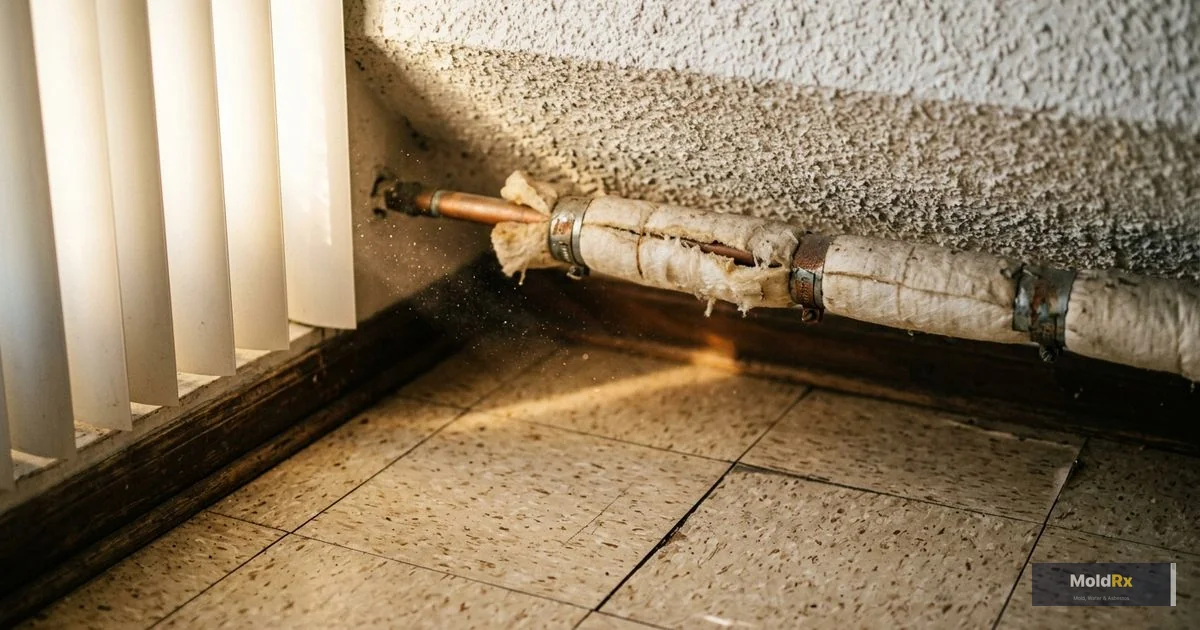
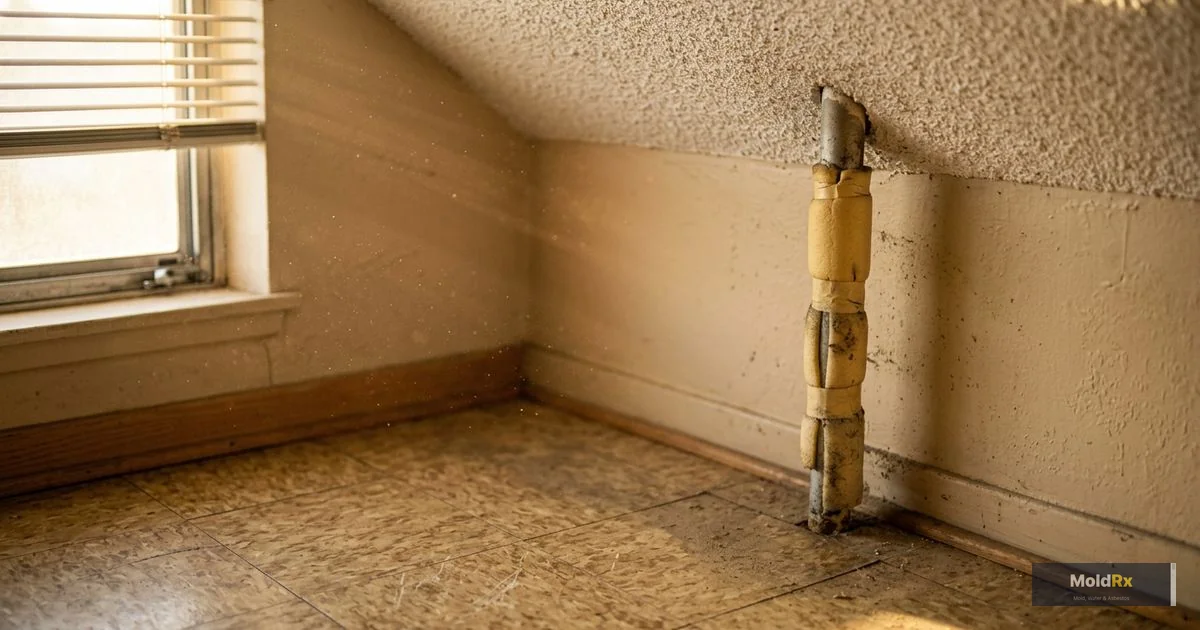
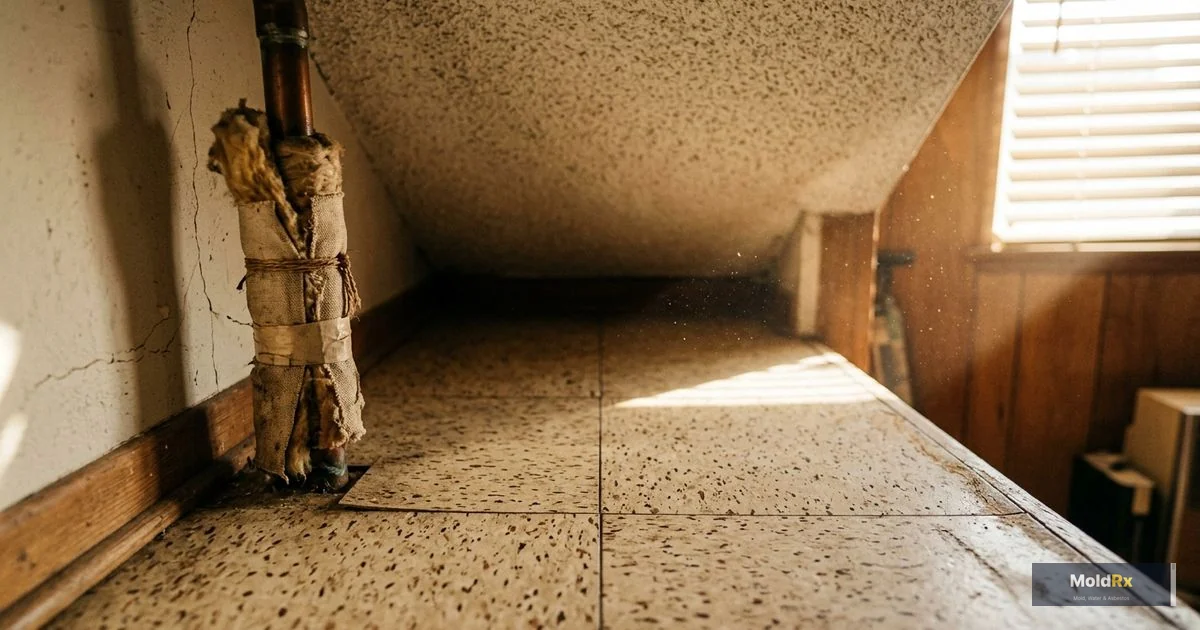
Pipe insulation and duct wrapping. The whitish, cloth-like wrapping around hot water pipes and HVAC ductwork is one of the most hazardous asbestos materials when disturbed. Amosite asbestos is commonly identified in these applications, typically found in attics, crawl spaces, and garages.
-
Drywall joint compound and wall texture. Joint compound manufactured before 1980 frequently contained chrysotile. Sanding or scraping walls releases fibers from material that appears completely benign.
-
Roofing and exterior siding. Cement-asbestos shingles and siding (transite) were widely installed on 1950s and 1960s homes. Durable when intact, they release fibers when cut, broken, or removed.
-
Vermiculite attic insulation. Loose-fill insulation resembling gray-brown pebbles may be contaminated with tremolite asbestos. Over 70 percent of vermiculite sold in the U.S. between 1923 and 1990 came from a contaminated mine in Libby, Montana.
-
HVAC components, furnace insulation, electrical panel backing, window glazing putty, and behind bathroom tiles — all less obvious but documented asbestos locations in homes of this era.
The Joint Forces Training Base Factor
The Joint Forces Training Base (formerly Naval Air Station Los Alamitos) occupies a significant portion of the city's footprint. Commissioned in 1942, the base today contains more than 160 buildings encompassing approximately 1.5 million square feet — much of it original 1940s construction when asbestos was used extensively in military facilities for fireproofing, insulation, and structural materials. The base transitioned to Army property in 1973 and is now licensed to the California National Guard.
While the base is federal property with its own environmental protocols, surrounding residential neighborhoods — Carrier Row, Old Town East, Old Town West — were built by the same contractors using the same asbestos-era materials. Some Los Alamitos residents, particularly veterans and their families, may also carry prior occupational asbestos exposure from military service, making additional residential exposure from disturbed building materials a compounding concern.
What California Law and Regional Regulations Require
Los Alamitos falls under one of the most regulated asbestos compliance environments in the country. Three overlapping frameworks govern renovation and demolition work.
SCAQMD Rule 1403 — Asbestos Emissions From Demolition and Renovation
The South Coast Air Quality Management District enforces SCAQMD Rule 1403 across Orange, Los Angeles, Riverside, and San Bernardino counties. The rule requires:
-
A pre-project asbestos survey before any demolition or renovation, regardless of building size or age. The survey must be conducted by a California-certified asbestos consultant or a person holding a current AHERA (Asbestos Hazard Emergency Response Act) Building Inspector certificate from a Cal/OSHA-approved course.
-
Written notification to SCAQMD at least 10 working days before demolition — even if no asbestos was found. Renovation projects disturbing asbestos-containing materials exceeding 100 square feet also require notification.
-
Proper abatement procedures when asbestos is identified. A registered removal contractor must complete abatement before general construction proceeds.
The only narrow exception is renovation of a single-unit dwelling where less than 100 square feet of intact material is removed. This exception does not apply to demolition, multi-unit properties, or already-damaged material. Non-compliance fines can exceed $20,000 per day.
Cal/OSHA Title 8 Section 1529 — Asbestos in Construction
Cal/OSHA Title 8 §1529 regulates asbestos exposure in all construction work. Key requirements include:
-
Pre-work asbestos surveys for pre-1980 construction, conducted by a consultant with U.S. EPA-approved building inspection training.
-
Exposure classification and limits. The standard classifies asbestos work into four hazard classes (I through IV), each with specific training, monitoring, and containment requirements. Permissible exposure may not exceed 0.1 fibers per cubic centimeter over an 8-hour workday.
-
Registration requirement. Any contractor engaged in asbestos work involving 100 square feet or more must register with DOSH. Supervisors must hold current AHERA training certification.
OSHA 1926.1101 — Federal Asbestos Standard for Construction
The federal OSHA 1926.1101 standard establishes baseline requirements for asbestos exposure during construction activities nationwide. California's Cal/OSHA §1529 meets or exceeds these federal requirements, meaning compliance with Cal/OSHA satisfies the federal standard. Contractors working in Los Alamitos must comply with whichever standard is more protective — in practice, that is always California's.
Permits and Real Estate
When you pull a building permit from the City of Los Alamitos for work on a pre-1980 property, inspectors may require asbestos survey documentation. Having results before applying prevents delays. For real estate transactions, California law requires sellers to disclose known hazards — asbestos testing provides documentation that protects both buyer and seller.
How Professional Asbestos Testing Works
Step 1 — Pre-Inspection Scope Discussion
We discuss your project first. Kitchen remodel in a 1960 Dutch Haven tract? Flooring throughout a Rossmoor ranch? Popcorn ceiling removal in College Park North? Buying a Carrier Row cottage? The scope of your project determines the scope of testing. Not every material needs to be tested — we focus on what will actually be disturbed or shows signs of damage.
Step 2 — On-Site Assessment and EPA-Protocol Sample Collection
A vetted asbestos testing professional inspects your property and identifies suspect materials based on age, type, condition, and location. Samples are collected following EPA-approved protocols — each material is wetted to suppress fibers, a small section is extracted, and the sample is sealed in a labeled container documented with its exact location. Sample collection for a typical Los Alamitos home takes one to two hours and involves 3 to 10 samples.
Step 3 — NVLAP-Accredited Laboratory Analysis
All samples go to a laboratory accredited by the National Voluntary Laboratory Accreditation Program (NVLAP), administered by NIST. NVLAP accreditation ensures the lab meets rigorous proficiency testing requirements — the same standard mandated by AHERA for schools and public buildings. Two methods are used:
-
Polarized Light Microscopy (PLM) — The standard method for bulk material analysis. PLM identifies asbestos fiber type (chrysotile, amosite, crocidolite, tremolite, actinolite, or anthophyllite) and determines the concentration in each sample.
-
Transmission Electron Microscopy (TEM) — Higher sensitivity for low-concentration materials or inconclusive PLM results. TEM detects asbestos below 1 percent concentration and is the standard for air sample analysis.
Standard turnaround is three to five business days. Rush processing is available.
Step 4 — Results Report and Project Guidance
You receive a detailed report in plain language explaining which materials tested positive, which tested negative, and what it means for your project. If asbestos is confirmed:
- Leave in place. Intact materials outside your renovation footprint can remain safely undisturbed.
- Encapsulation. Sealing certain materials prevents fiber release without full removal.
- Professional abatement. A DOSH-registered, CSLB C-22 licensed abatement contractor handles removal under strict containment. Your report provides documentation for removal scoping and SCAQMD Rule 1403 notification.
- Ongoing monitoring. Materials remaining in place receive periodic condition assessments.
Schedule your Los Alamitos asbestos testing or call (888) 609-8907 — get results before your project timeline starts.
Common Projects That Require Asbestos Testing
Kitchen and bathroom remodels almost always involve disturbing materials with asbestos potential — floor tiles, ceilings, pipe insulation around plumbing. Under SCAQMD Rule 1403, testing must happen before demolition begins.
Popcorn ceiling removal — Dry-scraping an asbestos-containing ceiling can contaminate a house with airborne fibers in minutes. Always test first.
Flooring replacement — Removing carpet in a 1960s Dutch Haven home may reveal 9-inch vinyl tiles and black mastic underneath. Both are common asbestos carriers.
Whole-house renovation or room addition — Opening walls, rerouting plumbing, replacing ductwork, or adding square footage requires a comprehensive survey under SCAQMD Rule 1403 and Cal/OSHA §1529.
Roof replacement — Cement-asbestos shingles are common on 1950s and 1960s Los Alamitos homes. SCAQMD notification is required if they test positive.
HVAC system upgrades — Disturbing insulated ducts, pipe wrapping, and furnace components is one of the most overlooked testing triggers.
Garage conversions — Converting a garage into living space means disturbing original walls, ceilings, and flooring, all of which may contain asbestos in homes from the 1950s through 1970s.
Real estate transactions — Buyers of pre-1980 properties increasingly request testing during due diligence. A documented report protects both parties. If you are selling, having results available streamlines the process and prevents surprises during the buyer's inspection.
Damaged materials — Crumbling pipe insulation, water-damaged ceiling texture, cracked floor tiles, or deteriorating siding should be tested promptly. Damaged asbestos-containing materials can release fibers into indoor air without any renovation activity.
Los Alamitos Neighborhoods We Serve
Our vetted asbestos testing professionals serve every Los Alamitos neighborhood: Carrier Row (late 1940s-1950s postwar homes), Old Town East and West (1940s-1950s), Rossmoor (1957-1961 ranch homes), Dutch Haven and New Dutch Haven (1960), Rossmoor Highlands (1961), Suburbia Estates (1967), Greenbrook and College Park North (late 1960s), Rossmoor Park, Rossmoor Chateau, Old Ranch, Bridgecreek Villas, Royal Oak, Los Alamitos Estates, and Los Alamitos Courtyard.
Full coverage spans ZIP codes 90720 and 90721, plus the adjacent unincorporated community of Rossmoor and nearby Cypress, Seal Beach, Garden Grove, and Long Beach.
What to Expect Working With MoldRx
-
Honest scope. If materials are clearly modern or outside your project footprint, we tell you they do not need testing.
-
Plain-language communication. You will understand what was tested, what the lab found, and what your options are. When we reference SCAQMD Rule 1403 or Cal/OSHA §1529, we explain what it means in practical terms.
-
Regulatory-compliant documentation. Your report satisfies SCAQMD, Cal/OSHA, City of Los Alamitos permits, real estate disclosures, and contractor scoping — one report for multiple regulatory frameworks.
-
No conflict of interest. Testing and abatement are separate services. Our job is accurate information, not generating removal work.
Frequently Asked Questions
Is asbestos testing legally required before renovating in Los Alamitos?
In most cases, yes. SCAQMD Rule 1403 requires a survey before renovation or demolition on any building in Orange County, regardless of age or size. Cal/OSHA Title 8 §1529 adds further requirements for pre-1980 construction. The federal OSHA 1926.1101 standard establishes additional baseline requirements. Skipping this step exposes you to fines exceeding $20,000 per day and potential criminal liability.
What materials are most likely to contain asbestos?
In homes from the 1950s through 1970s, the most commonly confirmed materials are popcorn ceilings, 9-inch vinyl floor tiles and black mastic adhesive, pipe and duct insulation, drywall joint compound, roofing shingles and felt, cement-asbestos siding, and vermiculite attic insulation. The only way to confirm asbestos content is NVLAP-accredited laboratory analysis using PLM or TEM.
Can I collect asbestos samples myself?
California allows owner-occupants of four-or-fewer-unit residences to collect their own samples under the homeowner exception in Cal/OSHA §1529. However, samples must still be analyzed by a NVLAP-accredited laboratory, and improper collection can release fibers. SCAQMD Rule 1403 requires formal pre-project surveys be conducted by a Cal/OSHA-certified inspector or AHERA-certified Building Inspector.
What happens if asbestos is found?
Finding asbestos does not automatically mean removal. Intact materials in good condition can remain in place and be monitored. If removal is necessary, a DOSH-registered, CSLB C-22 licensed abatement contractor performs the work under strict containment. Your report provides documentation for removal scoping and SCAQMD Rule 1403 notification.
How long does testing take?
On-site sample collection requires one to two hours. NVLAP-accredited lab analysis takes three to five business days with standard turnaround. Rush processing is available for time-sensitive schedules.
Related Services in Los Alamitos
In addition to asbestos testing, we also offer Mold Removal in Los Alamitos, Asbestos Removal in Los Alamitos, Water Damage Restoration in Los Alamitos, and Mold Testing in Los Alamitos services to Los Alamitos property owners.
→ Learn more about remediation services in Los Alamitos
Get Asbestos Testing in Los Alamitos
Los Alamitos is a city built during the asbestos era. From the Carrier Row cottages of the late 1940s through the Rossmoor ranches of the late 1950s to the College Park North split-levels of 1967, nearly every neighborhood was constructed during the exact decades when asbestos was woven into standard building materials. That is not an indictment of the homes here — they are well-built and highly desirable. But the materials reflect the standards of their time, and those standards included products that carry serious health risks when disturbed.
Our vetted professionals know Los Alamitos construction patterns. They understand the overlapping requirements of SCAQMD Rule 1403, Cal/OSHA §1529, and OSHA 1926.1101, and they give you straight answers about what is in your property and what to do about it.
No scare tactics. No unnecessary sampling. Just accurate, NVLAP-accredited laboratory results so you can plan your project with confidence.
Get your free asbestos testing estimate or call (888) 609-8907 — vetted Los Alamitos specialists ready to help you plan safely.