Asbestos Testing in Loma Linda, CA
Vetted Asbestos Testing Professionals Serving Loma Linda, San Bernardino County, and the Inland Empire
Loma Linda is a city of roughly 25,000 residents in San Bernardino County, recognized worldwide as the only Blue Zone in the United States — a place where people live measurably longer, healthier lives than the national average. That distinction grew out of decades of research into the Seventh-day Adventist community's emphasis on clean living, plant-based nutrition, and preventive health. It also creates a reasonable expectation: if you live in a community defined by longevity, you should know what materials are inside the walls of your home.
A large share of Loma Linda's residential housing stock was built during the 1950s through 1970s, the peak decades for asbestos use in American construction. Popcorn ceilings, vinyl floor tiles, pipe insulation, roofing felt, joint compound, and dozens of other everyday building products from that era routinely contained chrysotile, amosite, or crocidolite asbestos. These materials are safe when intact and undisturbed. The moment you cut into a wall, scrape a ceiling, tear up flooring, or replace a roof, fibers can become airborne — and once airborne, they are invisible, odorless, and permanently damaging to lung tissue.
Professional asbestos testing eliminates the guesswork. MoldRx connects Loma Linda property owners with vetted, AHERA-certified inspectors who collect samples under EPA protocols and route them to NVLAP-accredited laboratories for analysis by Polarized Light Microscopy (PLM) or Transmission Electron Microscopy (TEM). The result is a clear, defensible report that tells you exactly what you are dealing with before you start any project.
Request a free estimate for your Loma Linda property or call (888) 609-8907 to speak with a specialist today.
Why Loma Linda Properties Carry Elevated Asbestos Risk
A Construction Timeline Built on Asbestos-Era Materials
Loma Linda's origins trace to the late 1800s, when the area known as Mound City was developed as a resort community along the Southern Pacific rail line. The project failed, and the property sat largely vacant until 1905, when Seventh-day Adventist Church co-founder Ellen G. White described it as "the most desirable place I have ever seen for a sanitarium." Church elder John Burden purchased the former Mound City Hotel and 76 acres for $38,900, incorporating the Loma Linda Sanitarium on August 26, 1905.
For four decades the community grew slowly around the sanitarium and the educational institutions that followed — what would become Loma Linda University and Loma Linda University Medical Center. Then the postwar housing boom changed everything. Between the late 1940s and early 1970s, subdivisions spread north and south of the university campus — ranch-style homes, tract houses, and small apartment complexes built rapidly for families affiliated with the growing medical center and the broader Inland Empire economy. By the time Loma Linda incorporated as a city in 1970, the majority of its residential fabric was already in place.
This timeline matters because virtually every building product used during those decades could contain asbestos. Federal restrictions on asbestos in building materials did not begin until the late 1970s, and many asbestos-containing products remained commercially available into the mid-1980s. A home built in Loma Linda in 1958 or 1967 was constructed entirely without regulatory guardrails against asbestos use.
Materials Most Likely to Contain Asbestos in Loma Linda Homes
Based on the construction practices of the 1950s through 1970s, the following materials in Loma Linda homes should be considered suspect until tested:
- Popcorn (acoustic) ceilings and spray-on texture coatings — Nearly universal in homes from this era. Chrysotile asbestos was the primary binding agent in most formulations.
- Vinyl floor tiles (especially 9x9-inch format) and black mastic adhesive — Both the tile body and the adhesive beneath it frequently contain asbestos. The 12x12-inch tiles from this period are also suspect.
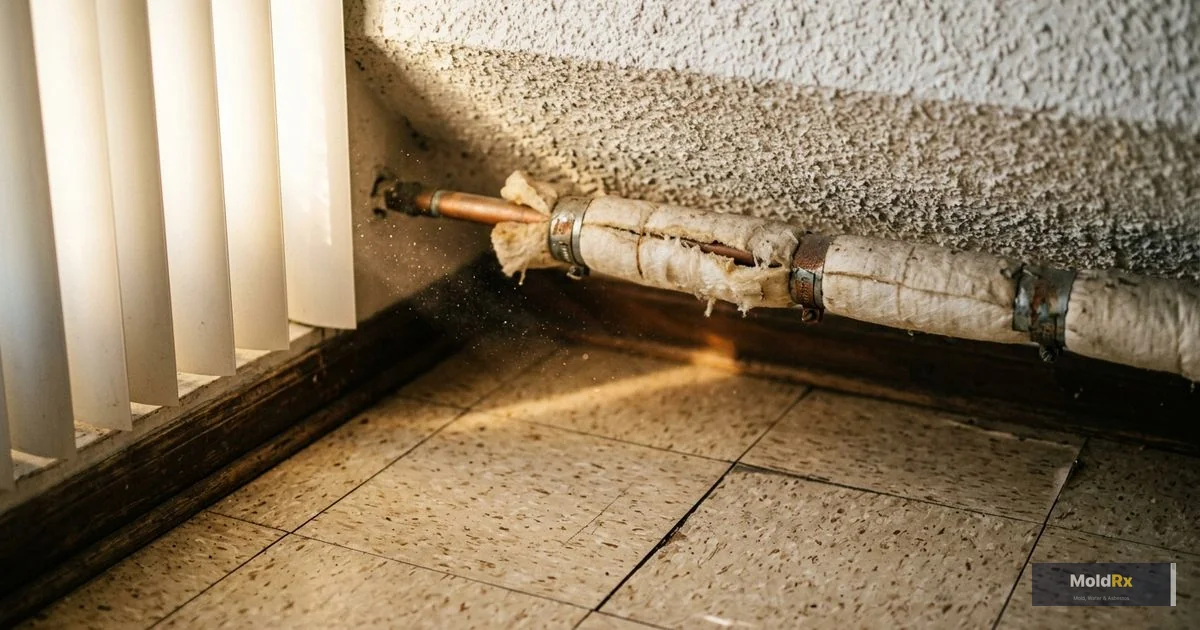
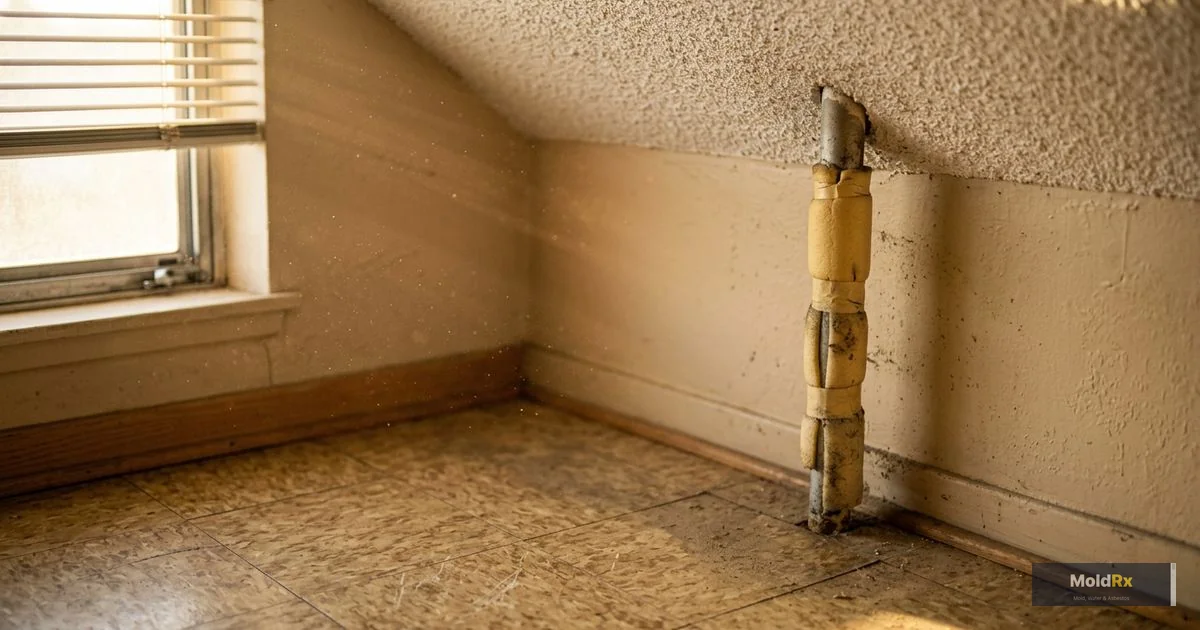
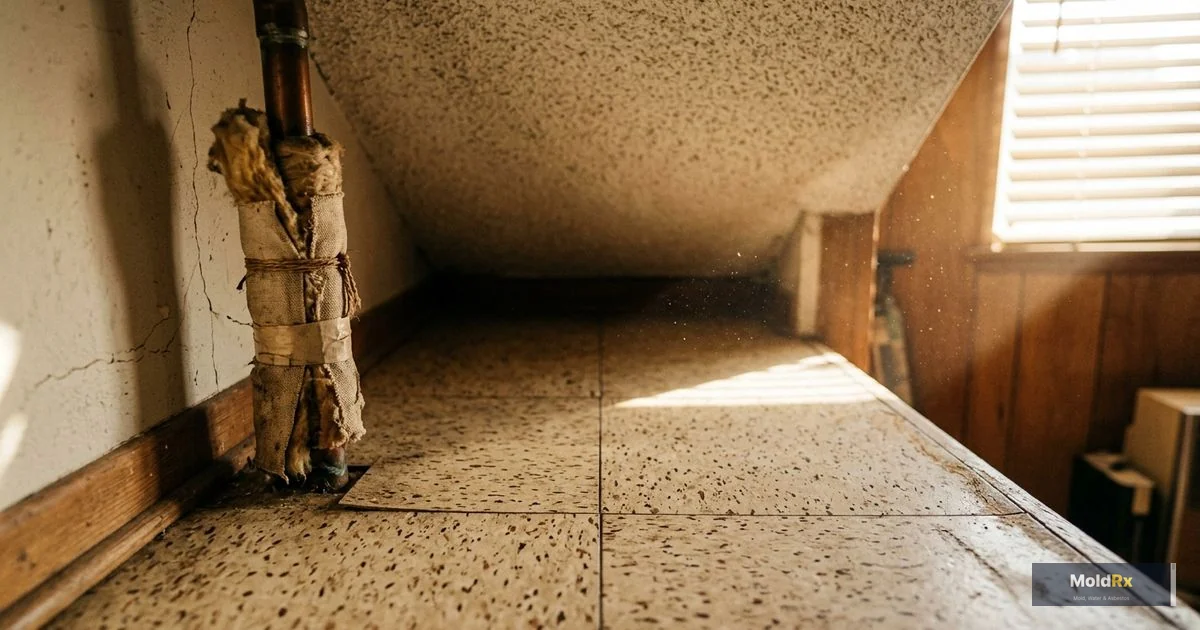
- Pipe insulation and duct wrapping — White or gray fibrous material on hot water pipes, heating ducts, and HVAC connections. Often the highest-concentration asbestos product in a home.
- Drywall joint compound (mud) — Used to finish every seam between wallboard panels. Asbestos was added for workability and crack resistance.
- Roofing materials — Composition shingles, built-up roofing layers, felt underlayment, and flashing cement from this era commonly contain asbestos.
- Vermiculite attic insulation — Loose-fill insulation that resembles small accordion-shaped pebbles. A significant percentage of vermiculite sold in the U.S. came from the Libby, Montana mine, which was contaminated with tremolite asbestos.
- Cement siding, stucco, and exterior finishes — Chrysotile fibers were added to cement-based products for tensile strength and weather resistance.
- Window glazing compounds, caulking, and putty — Exterior sealants around windows and doors routinely contained asbestos through the 1970s.
- Furnace components and fireproofing — Gaskets, cement, and insulating boards in and around heating equipment.
- Electrical panel backing and wiring insulation — Older electrical panels sometimes used asbestos millboard as a fire barrier.
The Inland Empire Climate Factor
Loma Linda sits in the western Inland Empire, where summer temperatures routinely exceed 95 degrees and winters are mild and dry. This semi-arid climate subjects building materials to decades of thermal expansion and contraction — a cycle that degrades adhesives, dries out sealants, and makes fibrous materials brittle. Pipe insulation that looks intact may crumble at a touch. Ceiling texture that appears solid may release fibers when bumped. Roof felt baked through 60 Inland Empire summers becomes friable — breaking apart easily and releasing fibers.
This does not mean every older material is actively dangerous. It means visual inspection alone cannot determine whether a material is safe to disturb, which is why laboratory analysis is the only reliable path forward.
Asbestos Testing and the Blue Zone Ethos
Loma Linda earned its Blue Zone designation through research by Dan Buettner and the National Geographic Society. The Adventist Health Studies — conducted by Loma Linda University — followed more than 96,000 participants and found that Adventists in the community live seven to eleven years longer than the general population, attributable to plant-based diet, regular exercise, strong social bonds, weekly Sabbath rest, and abstinence from tobacco and alcohol.
The connection to asbestos testing is straightforward. Mesothelioma, asbestosis, and asbestos-related lung cancer are preventable diseases that develop silently over decades. In a community that has structured its way of life around protecting health, allowing a preventable carcinogen to remain unidentified inside a home is inconsistent with the values that make Loma Linda exceptional.
Testing is not about fear. It is about the same principle that drives a Loma Linda resident to choose whole foods over processed ones — informed choices lead to longer, healthier lives. Knowing what is in your walls is no different from knowing what is in your food.
The Regulatory Framework: What Loma Linda Property Owners Must Know
Asbestos in Loma Linda is governed by overlapping federal, state, and regional regulations. Non-compliance carries real consequences — fines exceeding $20,000 per day, project shutdowns, personal liability, and criminal penalties.
SCAQMD Rule 1403 — Asbestos Emissions from Demolition and Renovation
The South Coast Air Quality Management District enforces Rule 1403 across Los Angeles, Orange, San Bernardino, and Riverside Counties — the regulation most directly relevant to Loma Linda property owners planning construction work.
Key requirements:
- An asbestos survey is mandatory before any demolition, regardless of building age, size, or type. No exceptions.
- Renovation disturbing 100+ square feet of suspect material requires a pre-renovation survey.
- Surveys must be conducted by a Cal/OSHA-certified inspector or holder of a current AHERA Building Inspector certificate.
- When regulated ACM is found, written notification to the SCAQMD is required at least 10 working days before removal begins.
- Removal must follow specific containment, engineering control, and disposal procedures.
Cal/OSHA Section 1529 — Asbestos in Construction
California's OSHA enforces Title 8, Section 1529 (Cal/OSHA §1529), which governs all construction work involving asbestos.
Key provisions:
- ACM is defined as material containing more than 0.1 percent asbestos — ten times stricter than the federal 1 percent threshold.
- The permissible exposure limit is 0.1 fibers per cubic centimeter averaged over an 8-hour workday.
- Disturbances exceeding 100 square feet of ACM require a CSLB C-22 Asbestos Abatement licensed contractor.
- Contractors must register with the Division of Occupational Safety and Health (DOSH) and provide workers with specialized training, medical surveillance, and respiratory protection.
- A 24-hour advance notification to the nearest Cal/OSHA district office is required before asbestos work begins.
Federal OSHA Standard 1926.1101 — Asbestos in Construction
The federal OSHA standard 29 CFR 1926.1101 establishes the baseline requirements that Cal/OSHA expands upon. It classifies asbestos work into four categories:
- Class I — Removal of thermal system insulation (TSI) and surfacing ACM. Highest risk, strictest controls.
- Class II — Removal of other ACM such as floor tiles, wallboard, roofing, and siding.
- Class III — Repair and maintenance operations where ACM is likely to be disturbed.
- Class IV — Custodial activities involving contact with ACM or cleanup of debris from Classes I through III.
Each class carries escalating requirements for engineering controls, personal protective equipment, air monitoring, and medical surveillance. A designated competent person is required at every worksite.
AHERA — Asbestos Hazard Emergency Response Act
AHERA is the federal law administered by the EPA that establishes accreditation requirements for asbestos professionals. Anyone collecting samples from publicly accessed buildings must hold a current AHERA Building Inspector accreditation from an EPA- or Cal/OSHA-approved training program, with annual refresher training required to maintain certification. MoldRx only sends inspectors who hold current AHERA accreditation.
CSLB C-22 License — Asbestos Abatement Contractors
When testing reveals asbestos requiring removal, California law mandates the work be performed by a contractor holding a C-22 Asbestos Abatement classification from the Contractors State License Board (CSLB). C-22 licensees must demonstrate four years of journey-level experience, pass a trade examination, and maintain current DOSH registration. MoldRx does not perform abatement — we perform testing and connect you with properly licensed C-22 contractors when removal is needed.
How the MoldRx Asbestos Testing Process Works
Step 1 — Consultation and Scope
Every engagement begins with a conversation about your specific situation. Are you remodeling a kitchen? Replacing a roof? Selling the property? Concerned about a crumbling material in the garage? We determine which materials need to be sampled based on what will actually be disturbed or what has raised your concern. We do not recommend unnecessary sampling, and if testing is not warranted for your situation, we will tell you directly.
Step 2 — On-Site Sample Collection by a Vetted Inspector
A vetted asbestos inspector — holding current AHERA Building Inspector accreditation — visits your Loma Linda property to collect bulk samples in accordance with EPA protocols. Each suspect material is lightly misted with amended water to suppress fiber release, then a small section (typically one to two square inches) is carefully excised with specialized tools. Samples are sealed in labeled containers and documented by precise location within the structure.
Multiple samples are often collected from the same material type across different rooms, because asbestos content can vary between production batches. A textured ceiling in a 1962 bedroom may test positive while an identical-looking ceiling in the adjacent hallway tests negative. The on-site visit typically takes one to two hours and is minimally invasive.
Step 3 — NVLAP-Accredited Laboratory Analysis
All samples are submitted to a laboratory accredited by the National Voluntary Laboratory Accreditation Program (NVLAP), which is administered by the National Institute of Standards and Technology (NIST). NVLAP accreditation is not optional — AHERA requires it for both PLM and TEM asbestos analysis laboratories. Accredited labs must participate in biannual proficiency testing and maintain rigorous quality control protocols.
Two primary analytical methods are used:
Polarized Light Microscopy (PLM) — The standard method for bulk building material samples. PLM identifies the asbestos type present (chrysotile, amosite, crocidolite, tremolite, actinolite, or anthophyllite) and estimates its concentration, following EPA Method 600/R-93/116.
Transmission Electron Microscopy (TEM) — A higher-sensitivity method used when PLM results are inconclusive, for air samples, very low-concentration materials, or litigation-grade documentation. TEM is also the required method for AHERA school clearance testing.
Standard turnaround is three to five business days. Rush analysis (24- and 48-hour) is available for time-sensitive situations.
Step 4 — Clear Reporting and Actionable Guidance
Your report identifies each sample location, the laboratory findings, and a clear explanation of what the results mean for your project.
If no asbestos is found: You receive documentation confirming negative results that satisfies SCAQMD Rule 1403 and Cal/OSHA §1529 requirements. Proceed with confidence.
If asbestos is found, three options exist depending on condition and project scope:
- Management in place — For intact ACM that will not be disturbed. An operations and maintenance plan defines inspection intervals and handling procedures.
- Encapsulation — A protective sealant barrier for materials in fair condition. Less disruptive than removal.
- Professional removal — For materials that must be demolished or are actively deteriorating. Removal must be performed by a CSLB C-22 licensed abatement contractor following full containment, HEPA filtration, and proper disposal.
We walk you through these options and connect you with vetted C-22 contractors when removal is needed. We do not perform abatement ourselves — our testing recommendations are never influenced by a financial incentive to find more asbestos than exists.
When Loma Linda Property Owners Need Asbestos Testing
Before Renovation or Remodeling
Kitchen remodels, bathroom updates, flooring replacement, popcorn ceiling removal, room additions, and re-roofing all involve disturbing materials that may contain asbestos. Under SCAQMD Rule 1403, a pre-renovation survey is required — and responsible contractors will ask for results before starting work.
Before Buying or Selling a Home
California disclosure laws require sellers to report known hazards. A pre-transaction asbestos test gives buyers critical information about renovation costs and gives sellers documentation supporting a clean transaction. Properties near the university campus, along Anderson Street, Barton Road, and Mountain View Avenue frequently change hands — buyers planning updates need testing results to budget accurately.
When Materials Are Visibly Damaged
Crumbling pipe insulation, flaking ceiling texture, cracked vinyl tiles, deteriorating roof felt — if materials in a pre-1980 Loma Linda home show visible damage, the risk of active fiber release increases. Damaged ACM can release fibers during normal daily activity. Testing determines whether the damaged material contains asbestos so you can respond appropriately.
Institutional and Campus-Adjacent Properties
Loma Linda University Health's campus has expanded continuously since 1905, from the 1967 main tower through the 2021 Troesh Medical Campus. Older campus-adjacent buildings may carry compliance obligations under AHERA, OSHA 1926.1101, and Cal/OSHA. Converted residential properties and older multi-unit housing near the university warrant thorough evaluation.
After Water Damage, Fire, or Natural Events
Insurance and restoration claims following water intrusion, fire, or earthquake often require asbestos documentation before repair work begins. Testing must be completed before restoration contractors disturb suspect materials.
Schedule your free estimate now — tell us about your property and we will outline the testing scope and timeline.
Understanding the Health Risk
Asbestos fibers are microscopic — roughly 1,200 times thinner than a human hair — invisible, odorless, and permanently damaging once inhaled. The three primary diseases caused by asbestos exposure are:
- Mesothelioma — A cancer of the pleural or peritoneal lining caused almost exclusively by asbestos exposure. Latency period of 20 to 50 years. No cure exists, and median survival after diagnosis is 12 to 21 months.
- Asbestosis — A progressive fibrotic lung disease. The immune response to embedded fibers creates scar tissue that gradually reduces lung capacity, causing worsening shortness of breath over years.
- Lung cancer — Asbestos exposure elevates risk independent of smoking. In individuals who both smoke and have asbestos exposure history, the combined risk is roughly 50 to 90 times greater than baseline.
Every one of these conditions begins with disturbing a material without knowing what it contains. Testing eliminates the unknown — it is the simplest, least expensive, and most effective intervention in the entire chain of asbestos-related disease.
Loma Linda Neighborhoods and Areas We Serve
MoldRx provides asbestos testing throughout all of Loma Linda (ZIP codes 92350, 92354, 92357) and the surrounding Inland Empire communities. We serve every neighborhood and area within the city, including:
- University/Campus Area — The historic core surrounding Loma Linda University and LLUMC, where many of the oldest structures in the city are located
- North Central Loma Linda — Residential neighborhoods north of Barton Road with significant 1950s and 1960s housing stock
- Anderson Street and Mountain View Avenue corridors — Established neighborhoods with mid-century homes that are frequent renovation candidates
- Bryn Mawr — The eastern portion of the city, originally a separate unincorporated community annexed in 2008, with its own distinct construction history
- South Hills — The rugged, hilly area at the northwestern end of the Badlands, primarily a protected open space reserve but with residential properties along its edges
- South Pointe and southern residential areas — Including both older homes and newer development
- Barton Road commercial corridor — Retail, office, and mixed-use properties that may contain legacy asbestos materials
Our service area extends to all neighboring San Bernardino County communities, including Redlands, San Bernardino, Colton, Highland, Grand Terrace, Yucaipa, and Mentone.
Frequently Asked Questions
Is asbestos testing legally required before renovating a Loma Linda home?
Under SCAQMD Rule 1403, an asbestos survey is mandatory before demolition of any structure in San Bernardino County and before renovation disturbing 100+ square feet of suspect material. Cal/OSHA §1529 adds worker protection requirements for pre-1980 structures. Even below the regulatory threshold, testing protects your family from accidental exposure and shields you from liability.
Can I tell if a material contains asbestos just by looking at it?
No. Asbestos fibers are microscopic, and asbestos-containing materials are visually identical to their non-asbestos counterparts. A 1962 popcorn ceiling with 5 percent chrysotile looks exactly like one with zero asbestos. A 9x9 vinyl floor tile with asbestos looks, feels, and weighs the same as one without. Laboratory analysis of a physical sample — via PLM or TEM at an NVLAP-accredited lab — is the only reliable identification method.
My home was built in the 1960s. What are the chances it contains asbestos?
Homes built during the 1960s have a high probability of containing asbestos in multiple materials. The most common locations are ceiling texture, vinyl flooring and mastic, pipe and duct insulation, joint compound, and roofing materials. Testing is the only way to determine which specific materials in your home are affected and whether they need management, encapsulation, or removal.
What happens if I accidentally disturb asbestos during a DIY project?
Stop work immediately. Leave the area. Do not attempt to clean up the material — sweeping or vacuuming with a standard vacuum spreads fibers throughout the home. Close the door to the affected room, turn off HVAC systems to prevent fiber circulation, and call a professional. Air monitoring may be needed to determine whether fiber concentrations in the home are elevated above safe levels.
How long does the testing process take from start to finish?
On-site sample collection takes one to two hours for a typical residential property. Standard laboratory turnaround is three to five business days. Rush analysis is available for urgent situations. The complete process — from initial contact to receiving your final report — is typically about one week.
Does MoldRx perform asbestos removal?
No. MoldRx performs testing and delivers clear reports. If removal is needed, we connect you with vetted CSLB C-22 licensed abatement contractors. Separating testing from abatement ensures our findings are objective.
What is the difference between PLM and TEM testing?
PLM (Polarized Light Microscopy) is the standard method for bulk material samples — it identifies asbestos type and estimates concentration. TEM (Transmission Electron Microscopy) provides higher sensitivity for inconclusive PLM results, air samples, and litigation-quality documentation. Your inspector recommends the appropriate method based on your situation.
Related Services in Loma Linda
In addition to asbestos testing, MoldRx also connects Loma Linda property owners with vetted professionals for Mold Removal in Loma Linda, Asbestos Removal in Loma Linda, Water Damage Restoration in Loma Linda, and Mold Testing in Loma Linda.
Learn more about remediation services in Loma Linda
Get Asbestos Testing for Your Loma Linda Property
In a community built around health and longevity, knowing what is inside your walls is not an extravagance — it is a baseline. Asbestos testing takes less than a week and gives you the facts you need to renovate safely, transact confidently, and protect everyone who lives in your home.
MoldRx only sends vetted, AHERA-certified inspectors. Samples go to NVLAP-accredited laboratories. Reports are plain language with clear options. If testing is not needed, we will tell you. If it is, you will know exactly what was found and what to do next.
Get your free estimate or call (888) 609-8907 to schedule asbestos testing for your Loma Linda property today.