Asbestos Testing in Laguna Woods, CA
MoldRx Only Sends Vetted, Certified Asbestos Testing Professionals to Your Laguna Woods Home
Laguna Woods is a community built almost entirely during the peak era of asbestos use in American construction. The numbers are straightforward: more than 12,700 housing units constructed between 1964 and the late 1970s, a population where roughly 83 percent of residents are 65 or older, and building materials that have sat largely undisturbed for half a century in the mild South Orange County climate. If you are planning a renovation, preparing to sell, or simply want to understand what is in the walls and ceilings of your home, professional asbestos testing is the only way to replace uncertainty with facts.
MoldRx does not employ inspectors directly. We vet asbestos testing specialists for credentials, experience, and professionalism, then connect you with qualified professionals who follow EPA, AHERA, and OSHA protocols. Every sample is analyzed at an NVLAP-accredited laboratory. You get accurate results, clear reporting, and honest guidance — nothing more, nothing less.
Request your free estimate or call (888) 609-8907 to schedule asbestos testing in Laguna Woods.
Why Laguna Woods Has One of the Highest Asbestos Risk Profiles in Orange County
Roughly 90 percent of Laguna Woods consists of Laguna Woods Village, the private gated 55-plus retirement community that developer Ross Cortese began building in the spring of 1963 on 3,500 acres of former Moulton Ranch land in southern Orange County. The first ten homeowners moved in on September 10, 1964. Construction continued in phases for nearly two decades, producing the largest senior community in California.
That timeline matters because asbestos was a standard ingredient in dozens of common building products from the 1940s through the late 1970s. Every original structure in Laguna Woods Village was erected during the period of heaviest asbestos use in residential construction.
The Three Mutuals and Their Construction Windows
Laguna Woods Village is governed by three nonprofit mutual benefit housing corporations:
- United Laguna Woods Mutual — 6,323 cooperative housing units built from 1964 through the early part of 1969. In a cooperative, the mutual corporation owns the real property, and members hold shares granting exclusive occupancy rights.
- Third Laguna Hills Mutual — 6,102 condominium units built from 1969 through the late 1970s. Individual owners hold title to their units, while the mutual manages common areas and building exteriors.
- Mutual No. Fifty (The Towers) — 311 condominium units in the high-rise at 24055 Paseo Del Lago.
A fourth corporation, the Golden Rain Foundation (GRF), manages shared community amenities but does not oversee individual housing. Every construction period predates the federal restrictions on asbestos that began taking effect in the late 1970s.
Where Asbestos Hides in Laguna Woods Homes
In a typical Laguna Woods Village unit, suspect materials include:
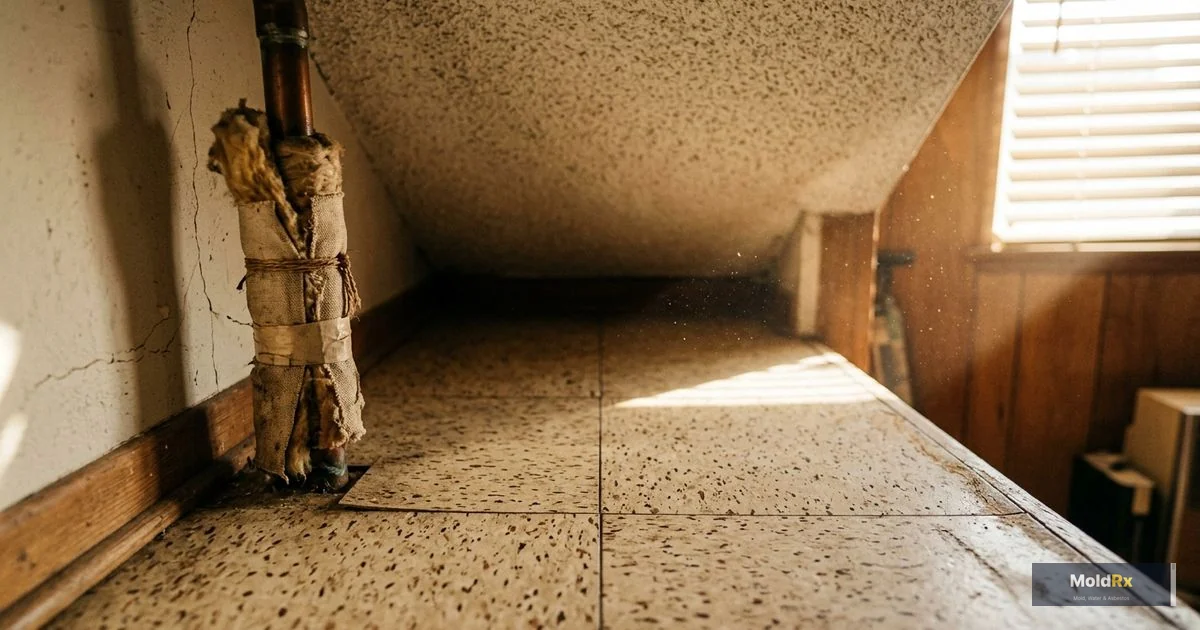
- Popcorn (acoustic) ceiling texture — The single most common asbestos-positive finding in Laguna Woods properties. Sprayed-on coatings applied before 1978 frequently contain chrysotile asbestos.
- 9-inch vinyl floor tiles and black mastic adhesive — The adhesive beneath original tiles is among the most asbestos-rich materials found in homes from this era.
- Joint compound and drywall mud — Applied at every seam and corner, often containing asbestos fiber as a reinforcing additive.
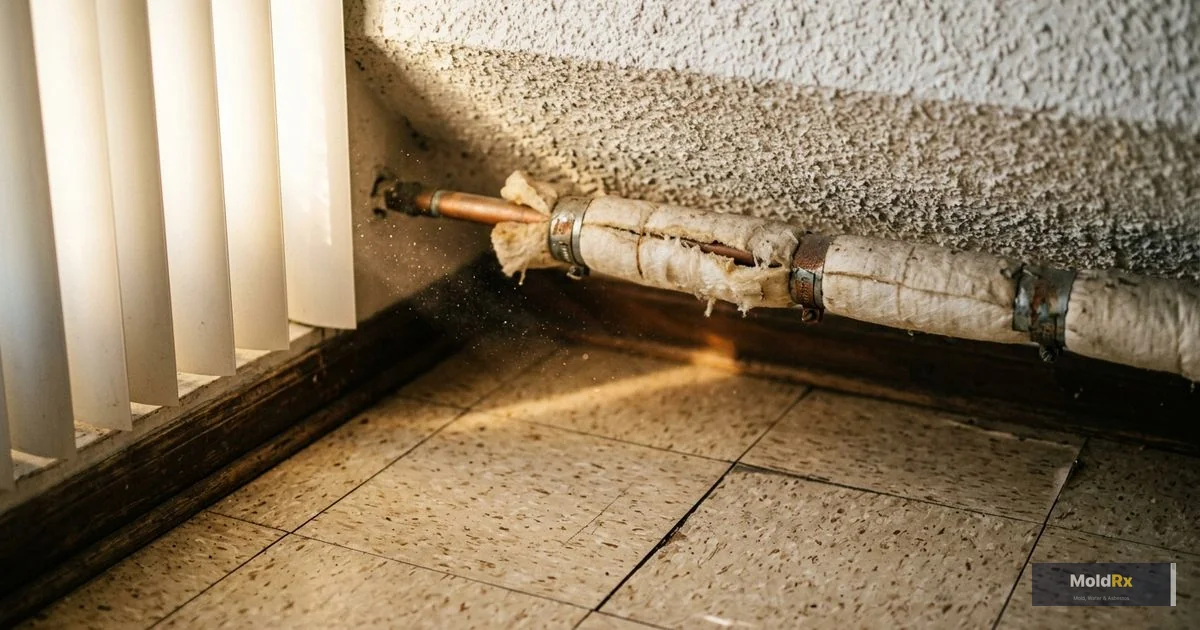
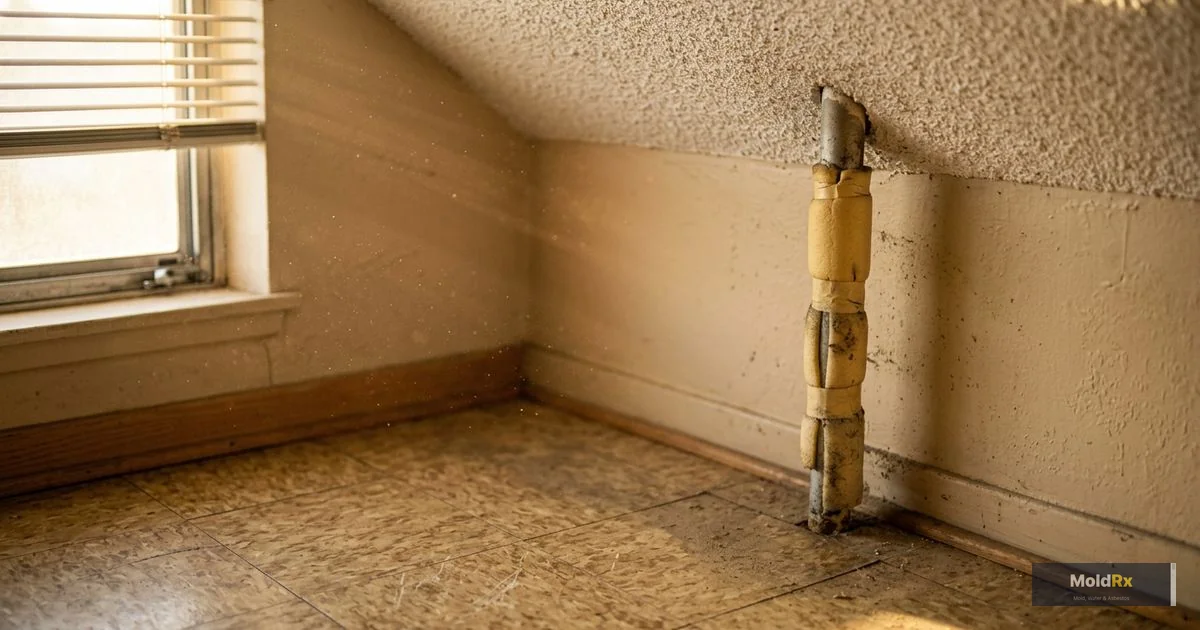
- Pipe insulation and HVAC duct wrap — Especially around hot water lines, boiler connections, and shared utility chases.
- Roofing materials — Shingles, felt paper, and flashing compounds from this period commonly contained asbestos.
- Textured wall coatings and window glazing putty — Wall finishes and sealant compounds frequently contained asbestos fibers.
- Vermiculite attic insulation — Loose-fill insulation from the Zonolite mine era may contain tremolite asbestos.
The semi-arid climate of South Orange County has preserved many of these materials in intact condition for more than 50 years. Intact, undisturbed asbestos-containing materials pose minimal risk during normal daily life. The danger begins when renovation, repair, or deterioration breaks the material's surface and releases microscopic fibers into the air.
Why Asbestos Awareness Matters More in a Senior Community
Laguna Woods has a median age of approximately 74.9 years. About 83 percent of the city's roughly 17,000 residents are 65 or older. This demographic intersects with asbestos risk in ways that deserve plain discussion.
Research consistently shows that nearly 80 percent of mesothelioma diagnoses occur in people 65 and older, with an average age at diagnosis of 72. Adults 65 and older face more than 44 times the mesothelioma risk compared to those under 45. Contributing factors include declining immune function that reduces the body's ability to clear inhaled fibers, cumulative exposure from decades of living and working when asbestos was ubiquitous, and evidence that the latency period between exposure and diagnosis compresses with age.
None of this should alarm anyone about simply living in their home — intact materials do not release fibers during normal activities like cooking, cleaning, or walking across a floor. The overwhelming majority of Laguna Woods residents have lived safely in their homes for years or decades with asbestos-containing materials present.
The practical takeaway is this: any project that involves cutting, scraping, sanding, drilling, or demolishing building materials in a Laguna Woods unit should start with professional testing. For a community where the average resident falls squarely within the highest-risk demographic for asbestos-related disease, skipping that step is not worth the gamble.
The Regulatory Framework: What the Law Requires
Asbestos testing in Laguna Woods falls under overlapping layers of federal, state, and regional regulation.
SCAQMD Rule 1403
South Coast Air Quality Management District Rule 1403 requires a thorough asbestos survey before any demolition or renovation — residential properties included. The survey must be conducted by a Certified Asbestos Consultant (CAC) or Certified Site Surveillance Technician (CSST). If regulated asbestos is found and more than 100 square feet of material will be disturbed, a 14-day advance notification to SCAQMD is required. The limited single-unit residential exception does not apply to the multi-unit attached housing that comprises most of Laguna Woods Village.
OSHA 1926.1101 and Cal/OSHA Section 1529
Federal OSHA standard 29 CFR 1926.1101 governs asbestos safety in all construction work, establishing a permissible exposure limit of 0.1 fibers per cubic centimeter (f/cc) as an 8-hour average and a Class I through Class IV work classification system with specific protective requirements for each.
Cal/OSHA §1529 (California Code of Regulations, Title 8, Section 1529) is California's parallel standard and is more stringent in several areas. It requires mandatory exposure assessments, DOSH registration for contractors handling 100 or more square feet of asbestos-containing material, Cal/OSHA-approved AHERA training for all workers, and documented medical surveillance.
AHERA and CSLB C-22
The Asbestos Hazard Emergency Response Act (AHERA) established the accreditation standards that define who is qualified to inspect buildings for asbestos. An AHERA-accredited inspector has completed specialized coursework in building inspection, sample collection, and asbestos identification — the baseline qualification for anyone collecting samples in your home.
If testing reveals asbestos that needs removal, California requires a CSLB C-22 Asbestos Abatement licensed contractor — a specialty classification requiring four years of journey-level experience, a trade examination, and active DOSH registration. MoldRx only only sends abatement contractors who hold valid C-22 licenses. No exceptions.
How NVLAP-Accredited Laboratory Analysis Works
Every sample collected through MoldRx goes to a laboratory accredited under the National Voluntary Laboratory Accreditation Program (NVLAP), administered by the National Institute of Standards and Technology (NIST).
PLM (Polarized Light Microscopy) is the standard method for pre-renovation surveys. A trained microscopist examines sample material under polarized light, identifying asbestos fiber types — chrysotile, amosite, crocidolite, tremolite, actinolite, or anthophyllite — and determining the percentage by volume. Any material containing more than one percent asbestos is classified as asbestos-containing material (ACM).
TEM (Transmission Electron Microscopy) provides higher-resolution analysis at magnifications up to 100,000 times. TEM is used when PLM results are inconclusive, when air clearance monitoring is needed after abatement, or when litigation-grade fiber speciation is required. For most Laguna Woods residential testing, PLM is sufficient.
NVLAP-accredited laboratories must pass rigorous proficiency testing — biannually for PLM, annually for TEM — and comply with ISO/IEC 17025:2017 quality management standards. When you receive your lab report, you can be confident the analysis meets the highest national standard.
The Testing Process in Your Laguna Woods Home
Step 1: Initial Consultation
We discuss your unit — its location within the Village, approximate construction year, housing type (cooperative, condo, Tower unit, or single-family), and what project you are planning. If you are renovating a 1966 co-op unit and plan to remove popcorn ceilings and replace flooring, testing is almost certainly needed. If you are only repainting walls with no surface disturbance, it may not be. We give you straightforward guidance from the start so you know exactly what to expect.
Step 2: Professional Sample Collection
A vetted specialist visits your unit and collects samples from suspect materials in your project area. Following EPA and AHERA protocols, each sample is wetted before collection, sealed in a labeled container with chain-of-custody documentation, and handled without creating dust or disruption. Most inspections take 45 minutes to one hour. We coordinate with the Village's work-hour guidelines — non-noise work is permitted Monday through Saturday, 7 a.m. to 5 p.m.
Step 3: Laboratory Analysis
Samples go to an NVLAP-accredited lab for PLM analysis, with TEM used when needed. Standard turnaround is 3 to 5 business days. Rush processing is available for real estate deadlines or contractor schedules.
Step 4: Clear Reporting
You receive a written report in plain language explaining exactly what was tested, what was found, and what it means for your project:
- Leave in place and manage — If the material is in good condition and your project can avoid disturbing it, encapsulation or monitoring may be the best approach.
- Professional abatement before renovation — If the material must be disturbed, licensed removal by a DOSH-registered, CSLB C-22-licensed abatement contractor is required before your renovation contractor begins work.
- Ongoing monitoring — For materials showing early deterioration but outside your current project scope.
The report includes all documentation needed for your mutual's alteration records, contractor coordination, city permits, and SCAQMD Rule 1403 compliance.
Asbestos Testing and the Laguna Woods Village HOA Process
The Alteration Approval Workflow
Before renovation work begins, you typically submit plans to the Alterations Division through the Village Community Center. Non-standard alterations or projects generating neighbor objections go to the Architectural Control and Standards Committee, which meets monthly.
Asbestos testing should happen before you finalize renovation plans. If asbestos is found in areas you plan to disturb, that changes your project scope and timeline. Discovering this at the planning stage — not after you have hired a contractor — prevents delays and regulatory problems.
Cooperative vs. Condominium Responsibilities
Cooperative units (United Mutual): The mutual corporation owns the building structure. Asbestos in shared structural components — walls between units, common plumbing chases, building exteriors, roofing — may fall under the mutual's maintenance responsibility. Your test results help clarify the boundary between your obligations and the mutual's.
Condominium units (Third Mutual and Mutual No. Fifty): You own your unit individually. Asbestos within your boundaries is your responsibility; asbestos in common-area components is the mutual's concern.
Shared Walls and Adjacent Units
Most Laguna Woods Village housing shares walls, ceilings, or floor assemblies with neighboring units. Renovation work that involves cutting or removing shared wall materials can disturb asbestos on both sides of the partition. Shared HVAC ductwork and plumbing chases can become pathways for airborne fiber migration between units. Professional testing identifies which materials contain asbestos so your contractor and mutual can plan work that protects both your household and your neighbors.
What Sets the Professionals We Send Apart
Every specialist MoldRx sends to your Laguna Woods home carries current AHERA accreditation for building inspection and sample collection. We verify credentials before connecting any professional with a homeowner. Beyond credentials, we select for professionals who understand the Village environment — the community's access protocols, the importance of clear communication with residents, and the minimal-disruption approach that a senior community requires. If testing is not necessary for your situation, we tell you. We are not in the business of creating unnecessary work.
Get your free estimate for asbestos testing in Laguna Woods or call (888) 609-8907.
Laguna Woods Areas We Serve
Our services cover all of Laguna Woods, including every gate and housing type within Laguna Woods Village — cooperative, condo, Towers, and single-family homes. All properties in ZIP code 92637 are within our service area. We also serve Laguna Hills, Aliso Viejo, Mission Viejo, Laguna Niguel, Irvine, and surrounding South Orange County communities.
Related Services in Laguna Woods
We also offer Mold Removal in Laguna Woods, Asbestos Removal in Laguna Woods, Water Damage Restoration in Laguna Woods, and Mold Testing in Laguna Woods.
Learn more about remediation services in Laguna Woods
Frequently Asked Questions
When is asbestos testing legally required in Laguna Woods?
Under SCAQMD Rule 1403, an asbestos survey is required before any renovation or demolition — regardless of building age or project size. Cal/OSHA §1529 adds requirements for any construction work that may disturb asbestos-containing materials, and OSHA 1926.1101 imposes federal obligations on contractors. Any renovation in a Laguna Woods home built between 1964 and the early 1980s should begin with testing.
What is the difference between PLM and TEM analysis?
PLM identifies asbestos fiber types and concentration in bulk building material samples — the standard for pre-renovation surveys. TEM provides magnification up to 100,000 times and is used when PLM is inconclusive, for post-abatement air clearance, or for litigation-grade documentation. For most Laguna Woods surveys, PLM at an NVLAP-accredited lab is sufficient.
I live in a co-op — is the mutual responsible for asbestos testing?
In United Mutual, the corporation owns the building structure. Asbestos in shared structural components may fall under the mutual's responsibility. However, if you are initiating a renovation, the pre-renovation survey is typically your responsibility as the project initiator. Your results also help the mutual determine whether shared elements need attention.
Can my renovation affect my neighbor through shared walls?
Yes. Renovation that cuts into shared wall or ceiling assemblies can release fibers that migrate to adjacent units through wall cavities, gaps around penetrations, and shared HVAC ductwork. Testing before your renovation identifies which materials contain asbestos so proper containment can be planned — protecting both your household and your neighbors.
Do I need mutual approval before getting testing done?
Asbestos testing is non-destructive and does not typically require mutual consent. However, any renovation or abatement that follows a positive finding will require approval through your mutual's alteration process. The smart sequence: test first, then submit renovation plans with results in hand.
What materials should be tested in a Laguna Woods Village unit?
Any original building material your project will disturb. The most common asbestos-containing materials include popcorn ceiling texture, 9-inch vinyl floor tiles and black mastic, joint compound, pipe insulation, HVAC duct wrap, roofing materials, window glazing compound, textured wall coatings, and vermiculite insulation.
How are samples collected safely?
AHERA-accredited professionals wet the material before collection, remove a small section with specialized tools, and seal each sample in a labeled container with chain-of-custody documentation. No dust, no disruption, and most visits take under an hour. DIY sampling can release fibers into your living space and neighboring units — this is never a do-it-yourself job.
What happens if asbestos is found?
Finding asbestos does not automatically mean removal. Intact materials in good condition can often be managed in place. If the material must be disturbed for your renovation, licensed abatement by a DOSH-registered, CSLB C-22-licensed contractor is required before construction proceeds. Your report details your specific options.
I am selling my unit — should I get testing?
Not legally required for California real estate transactions, but increasingly common and frequently requested by buyers in Laguna Woods. A recent test report speeds up the sale, reduces buyer concerns, and prevents last-minute renegotiations.
Is it safe to live in a home with asbestos?
Yes, in the vast majority of cases. Intact materials in good condition do not release fibers during normal daily activities. The risk arises when materials are damaged, deteriorating, or disturbed through renovation or demolition. Testing tells you what is there and what condition it is in.
My unit was previously renovated — do I still need testing?
Very likely. Previous renovations may have addressed some materials while leaving others in place. New flooring over old asbestos tiles, updated kitchens with original popcorn ceilings elsewhere, bathrooms refreshed while original joint compound in adjacent rooms goes untouched — these are common findings. Testing evaluates the current materials in the specific areas your project will disturb, regardless of what previous owners or contractors may have addressed.
How does the SCAQMD Rule 1403 notification process work?
After your asbestos survey is complete, if regulated asbestos-containing material will be disturbed and the project involves more than 100 square feet of ACM, a notification must be filed with the South Coast Air Quality Management District at least 14 days before work begins. For demolition projects, notification is required even if no asbestos was found. Your test report from MoldRx provides the documentation foundation for this notification, and the vetted abatement contractors we connect you with handle the filing as part of their scope of work.
Schedule Asbestos Testing in Laguna Woods
If you are planning any renovation in your Laguna Woods Village unit, professional testing is the responsible first step. For real estate transactions, testing prevents delays at closing. For peace of mind, testing replaces uncertainty with facts.
MoldRx only sends vetted, credentialed professionals who understand Laguna Woods Village — the construction timeline, the building materials, the mutual approval process, and the needs of a community where clear communication and honest guidance matter more than a hard sell.
No guesswork. No unnecessary alarm. Just accurate information about what is in your home and what it means for your plans.
Request your free estimate today or call (888) 609-8907 to get started.