Emergency Water Damage Restoration in Laguna Niguel, CA -- MoldRx
Vetted, IICRC S500-Certified Specialists Serving Laguna Niguel and South Orange County -- 24/7
Water is inside your Laguna Niguel home right now, and it is actively destroying everything it touches. Subfloor. Drywall. Insulation. The adhesive under your hardwood. The cabinetry you had custom-built. Within 24 to 48 hours, mold colonization begins -- and then you are not dealing with one emergency anymore; you are dealing with two. If you are reading this because water has already entered your property, stop reading and call.
Call (888) 609-8907 now for emergency water damage response in Laguna Niguel.
MoldRx does not perform restoration work ourselves. We vet the specialists who do. Every water damage professional we send to your Laguna Niguel property has been screened for IICRC S500 certification, proper CSLB licensing, verified insurance, and documented experience handling the exact building types and water-damage scenarios common across South Orange County's hillside communities. You get the right crew -- not whoever happens to answer the phone.
Why Water Damage in Laguna Niguel Demands Immediate Action
Laguna Niguel is not a flat suburban grid. It is 14.8 square miles of rolling hills, canyon edges, and graded slopes built out over three decades -- and those topographic realities make water damage here fundamentally different from what a restoration crew encounters in a flatland community like Garden Grove or Anaheim. Understanding why requires understanding what makes this city's housing stock and terrain uniquely dangerous when water gets where it does not belong.
A Hillside Community Built Across Three Decades of Construction Standards
The Laguna Niguel Corporation began planning this master-planned community in 1959. The first homes went up in the early 1960s in Monarch Bay and Niguel Terrace. Avco Community Developers acquired the plan in 1971 and accelerated construction through the 1970s and 1980s. The city incorporated on December 7, 1989, and the 1990s brought upscale construction in Bear Brand Ranch and Ocean Ranch.
That timeline matters because your plumbing, your foundation, and your roof all have an age -- and in Laguna Niguel, that age varies wildly by neighborhood:
- Crown Valley Highlands homes built in the late 1960s and early 1970s have plumbing systems approaching 55+ years old -- well past the expected lifespan of copper, galvanized steel, and early plastic supply lines
- Beacon Hill and El Niguel Heights properties from the 1970s and early 1980s share the same aging infrastructure: supply-line fittings corroded by decades of hard water and slab-on-grade foundations where leaks run undetected beneath concrete for weeks
- Kite Hill homes built primarily in the 1980s are now 40+ years old, with polybutylene and early CPVC supply lines reaching end-of-life failure points
- Monarch Summit townhomes built in 1976-1977 -- 190 units with shared plumbing infrastructure -- represent the exact profile where a single supply-line failure cascades across multiple units
- Bear Brand Ranch and Crest de Ville homes from the 1980s and 1990s, while newer, are still approaching or past the 30-year threshold where water heaters, dishwasher connections, and washing-machine hoses fail without warning
Only about 23 percent of Laguna Niguel's housing units were constructed before 1980. But every decade of construction in this city has homes now old enough for the plumbing to fail -- and when plumbing fails on a hillside, gravity works against you.
The Hillside Problem: Gravity Turns Every Leak Into a Cascade
This is what separates Laguna Niguel water damage from water damage in a flat community. When a supply line bursts in a hillside home in Niguel Summit or a slope-adjacent property near Laguna Niguel Regional Park, the water does not pool in one place. It follows gravity. It runs downslope through wall cavities. It saturates the subfloor of upper levels and drains into lower-level rooms, garages, and crawlspaces. A burst pipe on the second floor of a hillside home can put water into every level of the structure before you realize what is happening.
For homes built into cut-and-fill slopes -- common throughout Laguna Niguel -- the structural interaction between water and the graded terrain creates additional risk. The 1998 Via Estoril landslide proved this in the most dramatic terms possible: heavy rains beginning in December 1997 destabilized the hillside in the Niguel Summit area, ultimately destroying or condemning over 50 homes and condominiums when two homes on Via Estoril slid into the Crown Cove condominium complex below. Nobody was injured, but the property destruction was catastrophic -- and it was triggered by water saturation of hillside soils.
You do not need a landslide to experience the consequences of water on a slope. You need a burst supply line, a failed water heater, or a storm-drain backup that sends water flowing downhill through your home's structural envelope. The damage compounds faster here because gravity is always working.
Salt Creek, Aliso Creek, and the Drainage Reality
Laguna Niguel straddles two watersheds. The Salt Creek watershed -- 6.1 square miles, about two-thirds of it within Laguna Niguel -- drains the southern portion of the city through a creek that runs roughly 4 miles before emptying into the Pacific at Salt Creek County Beach in Dana Point. The Aliso Creek watershed borders Salt Creek to the north and drains the northern portions of the city through a 19.8-mile urban waterway that has a documented history of flash flooding.
Both watersheds have been fundamentally altered by development. Salt Creek's original marshy wetland source no longer exists after 1990s channelization. Aliso Creek's tributaries -- Dairy Fork, Aliso Hills Channel, Munger Creek -- have been replaced by storm drains. With over 70 percent of the original land surface now under impervious pavement and buildings, far more runoff enters these systems during storms than the terrain was designed to handle.
Laguna Niguel averages roughly 12.9 inches of annual rainfall, concentrated between November and March. When atmospheric rivers hit -- fourteen in the winter of 2022-2023 alone -- the storm-drain systems can be overwhelmed in hours. About 10 percent of buildings in Laguna Niguel are at risk of flooding, with approximately 1,087 properties facing documented flood risk over the next 30 years. Standard homeowner insurance does not cover flood damage -- you need a separate NFIP or private flood policy, and if you do not have one, the financial exposure is entirely yours.
Marine Layer, Coastal Humidity, and the Mold Clock
Laguna Niguel sits roughly five miles inland from the coast -- close enough to catch persistent marine-layer influence. Morning fog and elevated humidity regularly exceeding 70 percent during the May-June marine-layer season create conditions where water-damaged materials cannot dry naturally. In drier inland communities, a minor leak might take a week to generate visible mold. In Laguna Niguel, that timeline compresses significantly. The ambient moisture in the air feeds the problem instead of helping resolve it.
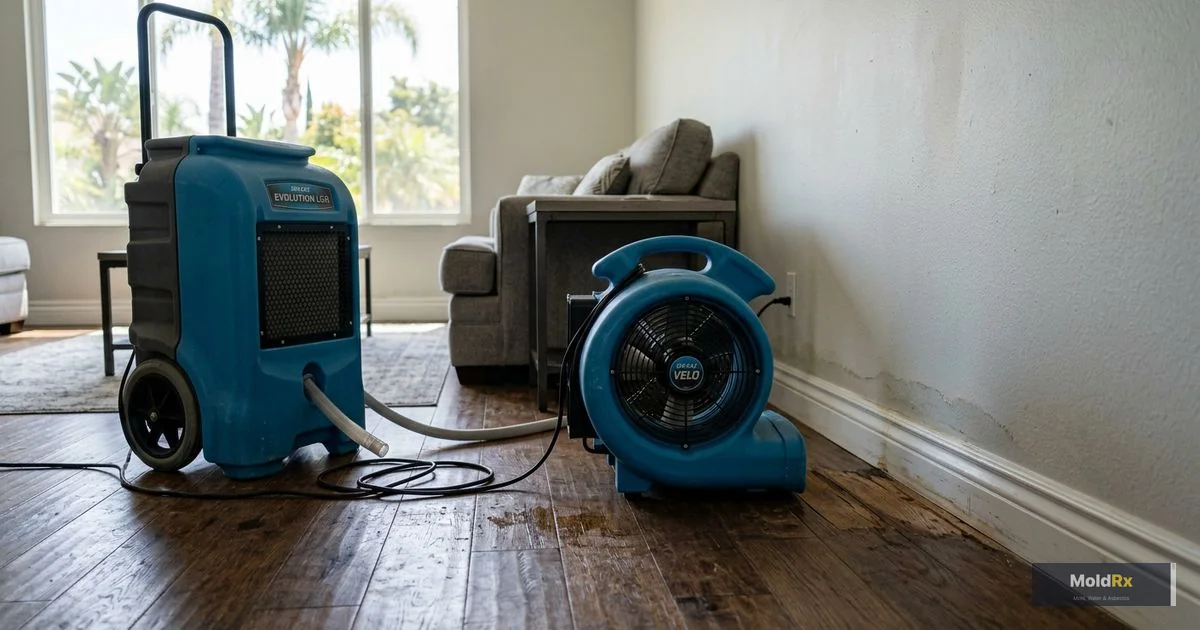
This is why professional structural drying with commercial-grade equipment calibrated for coastal-adjacent humidity is not optional in Laguna Niguel. Opening windows will not save you. Running household fans will not save you. You need LGR dehumidifiers and high-velocity air movers operated by someone who understands psychrometric science -- not guesswork.
Request your free estimate now -- or call (888) 609-8907 for immediate emergency response.](tel:8886098907)
The IICRC S500 Restoration Process Our Vetted Specialists Follow
The professionals MoldRx sends to your Laguna Niguel property do not freelance the process. They follow the IICRC S500 Standard and Reference Guide for Professional Water Damage Restoration -- the ANSI-accredited, industry-recognized protocol that defines how this work must be done. Here is what that looks like in practice.
Step 1: Emergency Response and Loss Assessment
When you call (888) 609-8907, we deploy a vetted specialist to your Laguna Niguel property for immediate assessment. They will:
- Identify and stop the water source -- burst supply line, failed water heater, appliance malfunction, roof intrusion, hillside drainage failure, or sewage backup
- Classify the water category per IICRC S500 standards:
- Category 1 (Clean Water): Sanitary source -- broken supply lines, sink overflows, toilet-tank cracks. Lowest contamination risk, but demands rapid extraction before it degrades.
- Category 2 (Gray Water): Significant contamination -- dishwasher or washing machine discharge, HVAC condensate failures, sump pump backups. Requires enhanced PPE and antimicrobial protocols.
- Category 3 (Black Water): Grossly contaminated -- sewage backups, storm-drain intrusion, floodwater from Salt Creek or Aliso Creek, any standing water 48+ hours. Cal/OSHA hazmat protocols apply.
- Determine the damage class per IICRC standards:
- Class 1: Minimal absorption, small area, leak caught early
- Class 2: Significant absorption, water wicking up walls to 24 inches
- Class 3: Greatest absorption -- water from overhead saturating ceilings, walls, and subfloor. Common in hillside homes where upper-level failures drain into every level below.
- Class 4: Specialty drying -- hardwood, plaster, concrete, stone. Laguna Niguel's slab-on-grade foundations frequently create Class 4 conditions.
- Map the full moisture footprint using infrared thermal imaging and penetrating moisture meters -- critical in hillside construction where water migrates far from the visible damage
- Document everything with timestamped photography and written reports for insurance and HOA records
Step 2: Water Extraction
Standing water is removed immediately using truck-mounted and portable extraction units. In Laguna Niguel's hillside homes, extraction must be systematic -- starting at the highest affected point and working down, because water continues migrating downslope even after the source is stopped. For attached units in communities like Monarch Summit or Marina Hills, our specialists use targeted equipment that removes water without damaging adjacent units.
Speed is everything. Every hour water remains in contact with building materials increases the damage class and elevates the contamination category (Category 1 degrades to Category 2, then Category 3 over time per IICRC S500). Extraction must be thorough -- not "mostly right."
Step 3: Structural Drying and Dehumidification
This phase separates competent restoration from the kind that creates mold problems six weeks later.
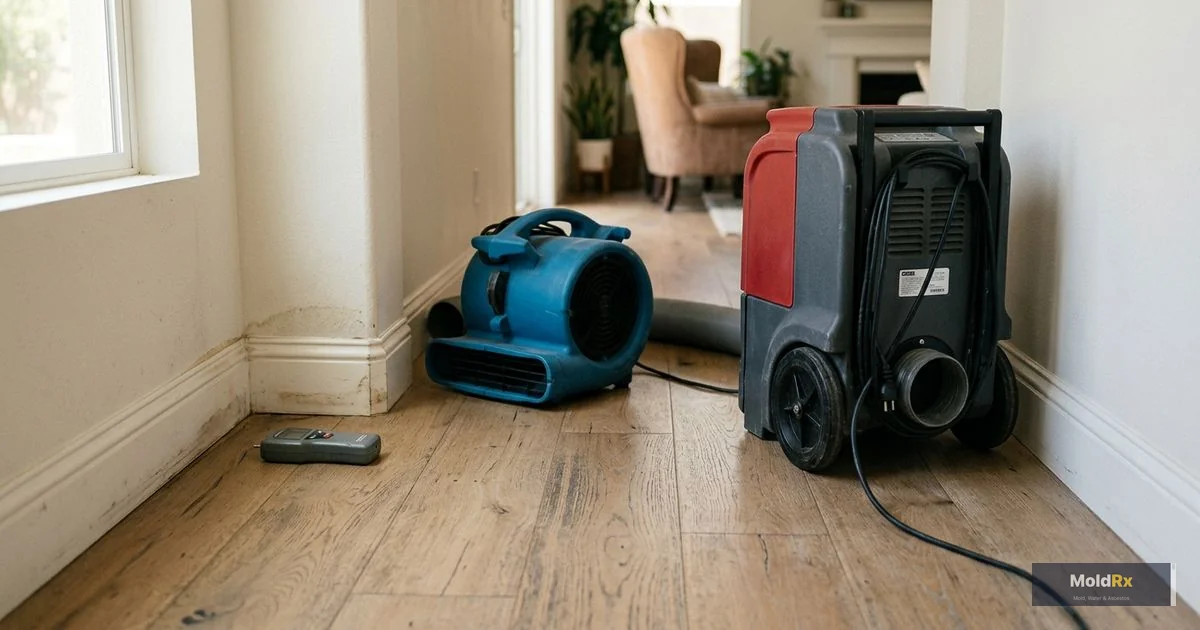
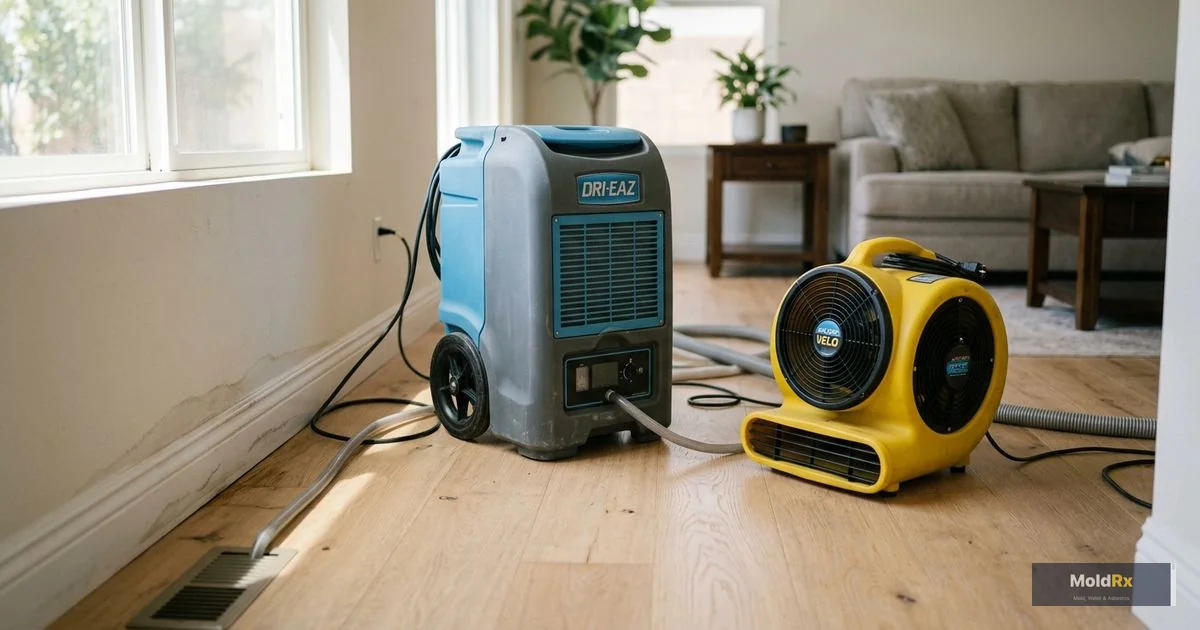
Our vetted specialists deploy commercial-grade LGR (low-grain refrigerant) dehumidifiers and high-velocity air movers calculated for each affected space. In Laguna Niguel, where marine-layer humidity elevates ambient moisture, the drying protocol must compensate for conditions that actively work against you. Standard residential dehumidifiers cannot do this work.
Drying is monitored daily with calibrated moisture meters and hygrometers, documenting psychrometric readings to verify progress toward IICRC S500 drying goals. Drying is complete when instrument readings confirm all affected materials have returned to equilibrium moisture content -- not when the carpet feels dry. In Class 4 situations involving concrete slab or hardwood floors, this may require desiccant dehumidification or heat drying systems.
Step 4: Cleaning, Sanitization, and Antimicrobial Treatment
Once the structure is dry, the contamination level dictates what comes next:
- Category 1 losses: Cleaning and drying may be sufficient for salvageable materials
- Category 2 losses: All affected porous materials that cannot be adequately cleaned must be removed. Semi-porous materials require antimicrobial treatment. EPA-registered antimicrobial products are used per label instructions.
- Category 3 losses: All affected porous materials are removed and discarded -- no exceptions. This includes drywall, insulation, carpet, pad, and any organic material that contacted the contaminated water. Structural framing is cleaned, treated, and verified before reconstruction begins. In sewage-backup or flood-intrusion scenarios, IICRC S520 mold remediation protocols may run concurrently if microbial growth is identified.
Step 5: Reconstruction and Restoration
The final phase returns your property to pre-loss condition: drywall replacement, flooring reinstallation, painting, trim work, and any structural repairs identified during the drying phase. For hillside properties where water migration may have affected structural elements in ways not immediately visible, our vetted specialists perform verification inspections to confirm that no hidden damage remains before closing up walls and completing finish work.
What Category and Class Mean for Your Laguna Niguel Property
Understanding the IICRC classification system protects you from being oversold or undersold on restoration scope. These are not arbitrary labels -- they determine the protocols, the timeline, the equipment, and ultimately the cost of doing the work correctly.
| Classification | What It Means | Common Laguna Niguel Scenarios |
|---|---|---|
| Category 1 | Clean water from a sanitary source | Broken supply line, ice-maker line failure, toilet-tank crack |
| Category 2 | Contaminated water causing potential illness | Washing machine overflow, dishwasher backup, HVAC condensate failure |
| Category 3 | Grossly contaminated / black water | Sewage backup, Salt Creek or Aliso Creek floodwater intrusion, storm-drain overflow, any stagnant water 48+ hours |
| Class 1 | Minimal absorption, small area | Leak caught early, limited to one room with hard-surface flooring |
| Class 2 | Significant absorption, water wicking up walls | Burst supply line with carpet, water reaching 24 inches up walls |
| Class 3 | Greatest absorption, water from overhead | Upper-level failure in hillside home saturating every level below; upstairs unit leak in attached housing |
| Class 4 | Specialty drying -- low-permeance materials | Water trapped in concrete slab, hardwood floors, plaster walls, stone tile |
The higher the category and class, the more complex, time-consuming, and costly the restoration. But cutting corners on a Category 3 / Class 3 loss to save money in the short term virtually guarantees a mold remediation project within weeks -- and that will cost significantly more than doing it right the first time.
Laguna Niguel Neighborhoods We Serve -- 24/7 Emergency Response
Our vetted water damage restoration specialists respond to emergencies throughout Laguna Niguel, including:
- Beacon Hill and Niguel West -- among the city's earliest developments, with plumbing infrastructure now 50+ years old
- Bear Brand Ranch and Ocean Ranch -- luxury hillside estates with complex multi-level construction
- Kite Hill -- hilltop Spanish-style homes from the 1980s with aging supply lines and hillside drainage exposure
- Monarch Summit I and II -- 1970s townhome communities with shared plumbing and slope-adjacent siting
- Niguel Summit -- hillside properties with documented geological sensitivity
- Crown Valley Highlands -- some of Laguna Niguel's oldest single-level homes, built in the late 1960s and early 1970s
- Crest de Ville -- gated hillside community with Mediterranean-style homes from the 1980s and 1990s
- Marina Hills -- newer luxury construction with larger footprints and resort-level buildout
- El Niguel Heights -- 1970s and 1980s homes ranging from 2,000 to over 6,000 square feet
- Moulton Meadows, Colinas de Capistrano, and properties along the Crown Valley Parkway corridor
We cover ZIP code 92677 -- from the hilltop communities overlooking the coast to the canyon-adjacent properties near Laguna Niguel Regional Park. We also respond to water damage emergencies in neighboring South Orange County communities, including Dana Point, Laguna Hills, Mission Viejo, Aliso Viejo, and Laguna Beach.
Why MoldRx -- And Why "Vetted" Is Not a Marketing Word
There are dozens of restoration companies in Orange County that will answer the phone at 2 AM. Some of them are excellent. Some of them are unlicensed, uninsured, undertrained, and unaccountable when they leave moisture behind your walls and you discover mold two months later.
MoldRx exists because Tyler and Adrian -- co-founders with over 40 years of combined remediation and business experience -- saw that problem firsthand and built a solution. We do not perform restoration ourselves. We vet the people who do, and we only send specialists who meet every one of these criteria:
- IICRC S500 certification for water damage restoration -- the ANSI-accredited industry standard
- IICRC S520 certification for mold remediation -- because water damage and mold are inseparable in practice, especially in Laguna Niguel's coastal-adjacent humidity
- Active CSLB contractor's license in good standing with the California State License Board
- Verified general liability and workers' compensation insurance -- protecting you from liability if an accident occurs on your property
- Documented experience with Laguna Niguel's specific challenges: hillside construction, multi-level water migration, slab-on-grade foundations, attached housing with shared walls, and HOA-governed communities requiring coordinated multi-unit response
- Cal/OSHA compliance for worker safety protocols, particularly critical in Category 3 / black-water scenarios and post-flood environments
- EPA guideline adherence for antimicrobial application and contaminated-material handling
When we say "vetted," we mean we have verified every credential, called references, and confirmed these specialists do the work the right way -- per IICRC S500 and EPA guidelines, with proper documentation, honest communication, and accountability.
Insurance and Documentation
Most Laguna Niguel homeowner policies cover sudden and accidental water damage -- burst pipes, failed water heaters, appliance malfunctions. What they typically do not cover: gradual damage from deferred maintenance, and standard policies almost never cover flood damage (requiring a separate NFIP or private flood policy).
Our vetted specialists understand what insurance adjusters need:
- Timestamped photo and video documentation of all affected areas before, during, and after restoration
- Moisture readings and psychrometric data confirming completion per IICRC S500 drying goals
- Itemized scope of work with IICRC-standard line items that adjusters can process without pushback
- Category and class determination documented per IICRC S500 standards
- Multi-unit coordination records for HOA-governed properties where master policies, individual unit-owner policies, and liability carriers may all be triggered by the same event
For Laguna Niguel's attached-housing communities -- Monarch Summit, Marina Hills, and the numerous condo and townhome associations throughout the city -- a supply-line failure in one unit that damages three adjacent units triggers multiple policies, multiple adjusters, and multiple timelines. Our specialists know how to produce records that satisfy every carrier involved.
Frequently Asked Questions
How fast can a vetted specialist reach my Laguna Niguel property?
For active water emergencies, our goal is same-day deployment -- often within hours. Call (888) 609-8907 any time, day or night. Water damage does not wait for business hours and neither do we. Every hour standing water remains in your home increases the damage class, elevates the contamination category, and accelerates the mold clock.
My home is on a hillside. Does that change the restoration approach?
Yes, significantly. In hillside construction, water follows gravity through the building envelope in ways it does not in flat-lot homes. Upper-level failures can saturate every level below. Water migrates through wall cavities along slope lines. Moisture can accumulate in lower-level spaces -- garages, downhill bedrooms, crawlspaces -- that appear unrelated to the original source. Our vetted specialists use infrared thermal imaging to map the full moisture footprint, which in hillside homes is often much larger than the visible damage suggests. Restoration proceeds top-down, and drying equipment placement must account for gravitational moisture migration that continues even after extraction is complete.
What is the difference between Category 1, 2, and 3 water damage?
Category 1 is clean water from a sanitary source (supply line break, toilet tank crack). Category 2 is contaminated water that can cause illness (appliance discharge, washing machine overflow, HVAC condensate failure). Category 3 is grossly contaminated black water (sewage backup, floodwater from Salt Creek or Aliso Creek, storm-drain overflow, any water stagnant for 48+ hours). The category determines safety protocols, PPE requirements, and whether porous materials can be saved or must be removed. Categories are defined by the IICRC S500 standard, and they escalate over time -- Category 1 water left untreated degrades to Category 2, then Category 3.
Will my homeowner's insurance cover this?
Most policies cover sudden and accidental water damage -- burst pipes, appliance failures, water heater malfunctions. What they typically exclude: gradual damage from deferred maintenance, flood damage from external water sources (which requires separate NFIP or private flood coverage), and damage caused by negligence. Our vetted specialists provide the detailed documentation -- moisture readings, timestamped photos, category and class determinations, itemized scope of work -- that insurance adjusters require. Proper documentation per IICRC S500 standards is often the difference between a smooth claim and a denied one.
How long does structural drying take, and how do I know it is actually complete?
Drying duration depends on the damage class, materials involved, and ambient humidity. Class 1 and 2 losses typically require 3-5 days. Class 3 losses with overhead saturation can take 5-10 days. Class 4 losses -- concrete slab, hardwood, plaster -- may require 7-14 days with specialty equipment. Laguna Niguel's marine-layer humidity can extend drying times compared to inland areas, which is why our specialists use commercial-grade LGR dehumidifiers calibrated for coastal conditions.
Drying is complete only when calibrated moisture meter readings confirm all materials have returned to equilibrium moisture content -- not when it "feels dry." Our vetted specialists provide these documented readings to you. If any contractor tells you "it feels dry" or wants to pull equipment after two days without showing you instrument data, that is a red flag. Incomplete drying is the number-one cause of post-restoration mold growth.
Is mold already growing?
If you can see standing water or feel dampness and it has been more than 24-48 hours, microbial amplification has likely begun -- even if you cannot see it. Mold colonizes behind walls, under flooring, and inside wall cavities where you will not detect it without moisture meters and visual inspection. Laguna Niguel's coastal humidity accelerates this timeline compared to drier inland areas. Our vetted specialists are dual-certified in IICRC S500 (water damage) and IICRC S520 (mold remediation) specifically because these two problems are inseparable in practice. Addressing water damage without simultaneously preventing mold is not restoration -- it is half the job.
Related Services in Laguna Niguel
Water damage and mold are rarely isolated problems. When one appears, the other is usually close behind -- especially in Laguna Niguel's coastal-influenced climate where humidity fuels microbial growth. MoldRx connects Laguna Niguel property owners with vetted specialists for:
- Mold Removal in Laguna Niguel
- Mold Testing in Laguna Niguel
- Asbestos Removal in Laguna Niguel
- Asbestos Testing in Laguna Niguel
-> Learn more about remediation services in Laguna Niguel
Water Is in Your Laguna Niguel Home Right Now. Here Is What to Do.
Every hour you wait, the damage class escalates, the restoration scope expands, the cost increases, and mold gets closer to establishing a foothold that turns a water damage project into a full remediation. This is not a scare tactic. It is building science -- and in a hillside community like Laguna Niguel, gravity makes every hour count double.
You need a vetted, IICRC S500-certified specialist who knows Laguna Niguel's hillside construction, aging plumbing infrastructure, multi-level water migration patterns, marine-layer humidity, and the drainage realities of the Salt Creek and Aliso Creek watersheds. MoldRx only sends professionals who meet that standard -- because sending anything less is not something we are willing to do.
Get your free estimate now -- or pick up the phone.
Call (888) 609-8907 for emergency water damage restoration in Laguna Niguel.
No runaround. No upselling. Just vetted professionals, honest answers, and the urgency this situation demands.