Asbestos Testing in Laguna Niguel, CA — MoldRx
Licensed Asbestos Testing Professionals Serving Laguna Niguel and South Orange County
Planning a kitchen remodel in a hillside home off Crown Valley Parkway, buying a 1970s split-level in Marina Hills, or tearing out original flooring in a Bear Brand Ranch property? Before any of that work begins, you need to know what is inside your walls, ceilings, and floors. Laguna Niguel is one of California's earliest master-planned communities — its development blueprint dates to 1959, and the vast majority of its housing stock was built during the 1970s and 1980s, the exact decades when asbestos was a standard ingredient in residential construction materials. The mineral is invisible without laboratory analysis, harmless when undisturbed, and hazardous when renovation breaks it loose — which is precisely what remodeling, demolition, and repair work does. California law and SCAQMD Rule 1403 require testing before disturbing building materials in pre-1980 structures, and Rule 1403 extends the survey requirement to structures of any age before demolition. MoldRx only sends vetted asbestos testing professionals — inspectors who understand the regulatory landscape and the construction patterns found across Laguna Niguel and the South Orange County corridor.
Request your free consultation — we'll help you determine if testing is needed for your project.
Why Laguna Niguel Properties Carry Asbestos Risk
Laguna Niguel's development timeline maps directly onto the peak era of asbestos use in American residential construction. Understanding that history is the first step in planning a safe renovation.
From Rancho to Master-Planned Community
The land that became Laguna Niguel was part of the Rancho Niguel Mexican land grant, named for "Niguili," a Native American village once located near Aliso Creek. In 1959, the Laguna Niguel Corporation — formed by the Boston-based firm Cabot, Cabot, and Forbes — purchased 7,100 acres of hillside terrain in the San Joaquin Hills and commissioned the Viennese architect Victor Gruen to design one of California's first master-planned communities. Gruen's plan preserved over one-third of the land as public open space, establishing the parks, trails, and canyon green belts that define the city today.
Land sales began in 1961 in the Laguna Terrace and Monarch Bay subdivisions near the coast. Development accelerated after 1971 when AVCO Community Developers acquired the Laguna Niguel Corporation and expanded the original master plan, opening large-scale residential construction across the hillsides and ridgelines. Through the 1970s and 1980s, subdivision after subdivision went in — ranch-style and Mediterranean-influenced homes on spacious lots, built for the growing middle class drawn to South Orange County by coastal proximity, expanding Irvine employment centers, and the appeal of a planned community. By the time Laguna Niguel incorporated as a city on December 1, 1989, its population had already reached nearly 50,000.
That construction timeline matters because asbestos was a standard building material throughout this entire period. Chrysotile asbestos was mixed into floor tiles, ceiling texture, joint compound, pipe insulation, roofing felt, and cement siding — valued for fire resistance, tensile strength, and low cost. The EPA began regulating asbestos in spray-applied products in 1978, but existing inventory continued to be installed into the early 1980s, and asbestos persisted in some building products well beyond that date.
The practical consequence: homes built during the primary construction boom from the early 1970s through the mid-1980s — in neighborhoods from Beacon Hill and Niguel Summit to Marina Hills and Monarch Summit — were built with materials that may contain asbestos. These homes are now 40 to 55 years old and reaching the age where major renovations become necessary. Every one of those projects has the potential to disturb asbestos-containing materials.
Climate and Material Preservation
Laguna Niguel sits at an average elevation of 400 feet in the San Joaquin Hills, with a mild Mediterranean climate — temperatures between 55 and 75 degrees year-round, roughly 14 inches of annual rainfall, and persistent ocean influence. Unlike desert communities where thermal cycling accelerates material breakdown, Laguna Niguel's temperate conditions have preserved original building materials in remarkably good condition.
That preservation cuts both ways. Well-preserved materials still contain asbestos at the same concentrations as the day they were installed. When a homeowner scrapes a 50-year-old popcorn ceiling that looks "just fine," they can release a dense cloud of fibers. The mild climate has also meant less urgency for the repairs — roof replacement, insulation upgrades, HVAC overhauls — that would have triggered testing in harsher environments. Many homes still contain original 1970s-era materials precisely because the climate has not forced earlier replacement.
Santa Ana wind events present an additional concern. During these dry, hot offshore wind conditions, humidity can drop below 10 percent, and dust disturbed during renovation remains airborne longer than it would in normal coastal humidity.
When Asbestos Testing Is Necessary
Laguna Niguel's housing stock is concentrated in the 1970s and 1980s, so the question is less about whether your home is old enough and more about what you plan to do with it.
Before any renovation or demolition: SCAQMD Rule 1403 requires an asbestos survey before renovation or demolition — residential and commercial, regardless of building age. A certified consultant must complete the survey before you pull a permit. The only narrow exception is single-unit dwelling renovation disturbing less than 100 square feet of intact material. Non-compliance fines can exceed $20,000 per day.
When buying or selling a property: In Laguna Niguel's market — where the median home value exceeds $1 million and the housing stock is overwhelmingly 1970s and 1980s construction — pre-purchase asbestos testing directly affects negotiations and post-purchase budgeting. Many buyers plan immediate renovations to update interiors untouched since original construction.
When materials are visibly damaged: Crumbling pipe insulation, flaking ceiling texture, cracked floor tiles — if materials in a pre-1980 home show deterioration, the risk of fiber release increases. Water damage from aging plumbing can saturate and weaken materials that were previously stable. Testing identifies whether damaged material contains asbestos so you can make informed decisions.
Before roof replacement, flooring updates, or remodeling: Roofing felt from the 1970s often contains asbestos. Vinyl floor tiles and their black mastic are among the most common ACM. Textured ceilings applied before 1980 regularly test positive. Testing determines whether your contractor can proceed with standard methods or whether licensed abatement must come first.
Common Asbestos-Containing Materials in Laguna Niguel Homes
The bulk of Laguna Niguel's construction occurred within a 15-year window using tract-building methods standard to Southern California master-planned communities. Certain materials appear with high frequency across neighborhoods.
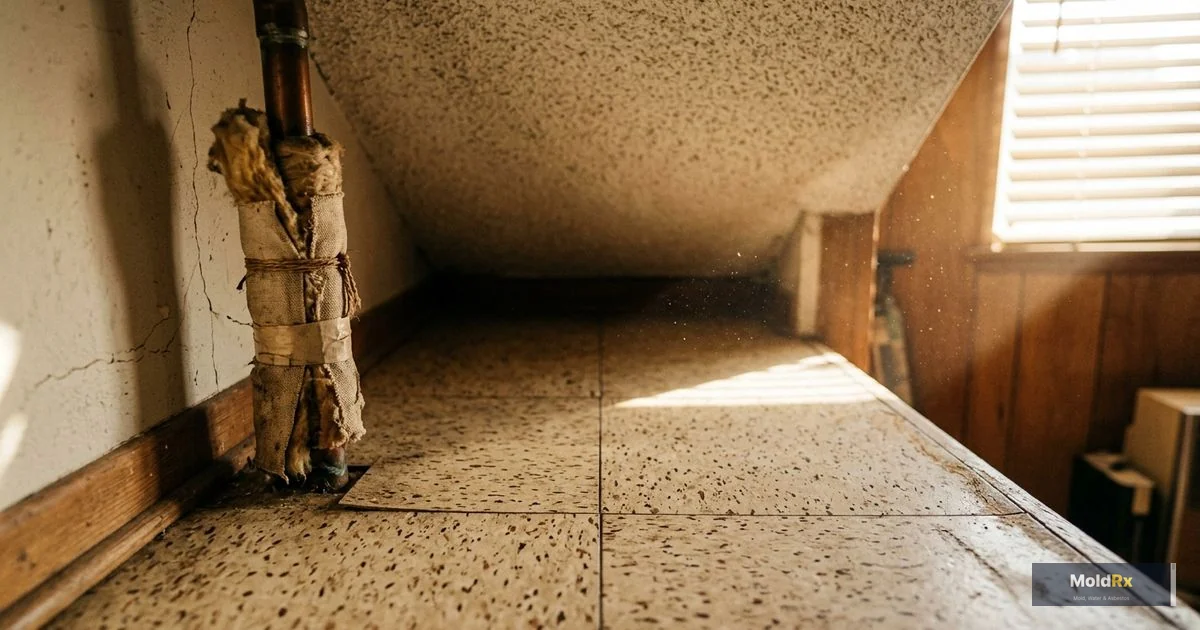
Floor tiles and mastic: 9"x9" vinyl floor tiles manufactured through the early 1980s contained 5% to 70% chrysotile asbestos. The black cutback adhesive beneath them frequently contains asbestos as well. In 1970s-era Laguna Niguel homes, these tiles are commonly found beneath newer flooring layers — carpet laid directly over original vinyl tile is one of the most frequent discoveries during renovation.
Popcorn and textured ceilings: Spray-applied textured ceilings were standard in the tract homes built during Laguna Niguel's development phase. The EPA banned asbestos in spray-applied surfacing in 1978, but existing stock continued to be applied into the early 1980s. If your home was built before 1982 and still has its original ceiling texture, assume it needs testing before anyone touches it.
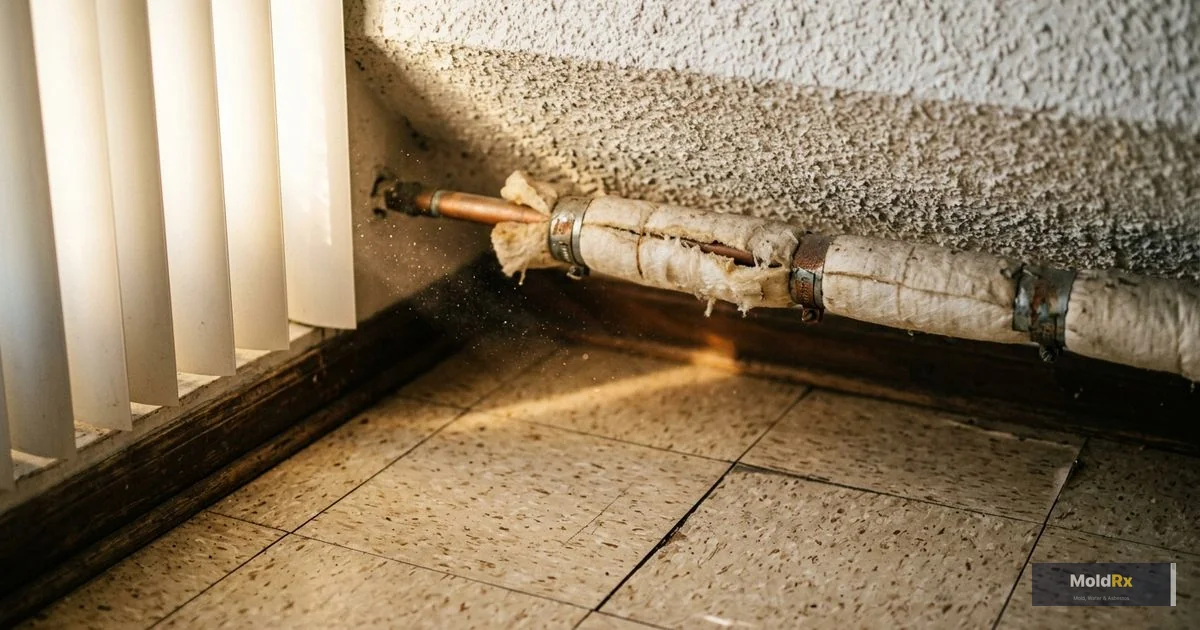
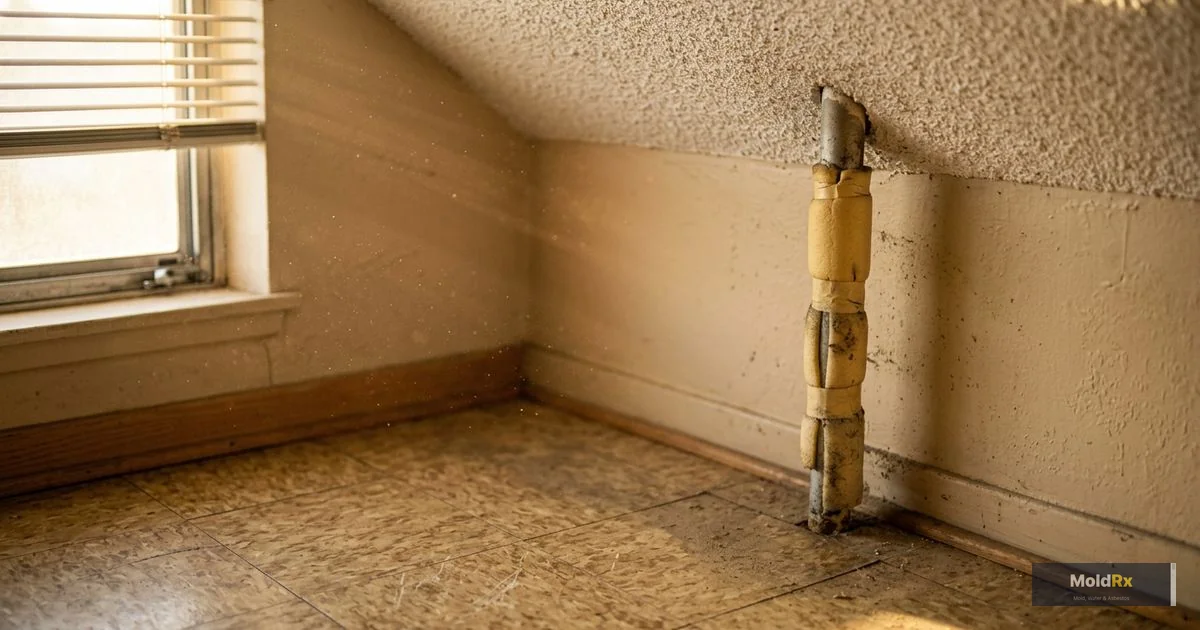
Pipe and duct insulation: Corrugated paper wrap, calcium-silicate blocks, and air-cell insulation on HVAC components in pre-1980 homes commonly contain asbestos. Pipe insulation in garages and utility closets is often the most overlooked ACM — out of sight, rarely inspected, and frequently encountered only when an HVAC replacement triggers removal of old ductwork.
Roofing materials and siding: Asbestos-cement roofing shingles, roofing felt, and siding panels performed well in Laguna Niguel's coastal-adjacent climate and remain present on many properties. These materials are low-risk while intact but become a concern at roof replacement time. Many original roofs are now well past their expected service life.
Joint compound and drywall mud: Drywall joint compound manufactured before 1980 frequently contained asbestos. Because it is applied at every seam and screw hole, even a small remodel can disturb a surprising quantity of material.
Stucco exterior coatings: Stucco formulations from before 1980 sometimes contained asbestos fibers. The material is non-friable while intact, but grinding, chipping, or power-washing during renovation can release fibers.
Vermiculite attic insulation: A significant portion of vermiculite insulation came from the Libby, Montana mine, contaminated with tremolite asbestos. During the late 1970s energy crisis, many homeowners retrofitted with vermiculite. If your home has loose-fill attic insulation of unknown age, test before disturbing it.
How Asbestos Testing Works
1. Pre-Testing Consultation
Testing begins with a conversation about your property — when the home was built, what materials you plan to disturb, and whether you have noticed damage. For a straightforward renovation, the inspector can usually scope the work during a brief phone consultation.
2. Bulk Sample Collection
A certified inspector collects samples following EPA procedures. Each suspected material is sampled separately — the inspector wets the material to suppress fiber release, removes a small section, and seals it in a labeled container. Homogeneous materials like floor tiles require a minimum of three samples per distinct area. The process is minimally invasive and each collection point is sealed after sampling.
3. NVLAP-Accredited Laboratory Analysis
Samples go to an NVLAP-accredited laboratory. The primary method is PLM (Polarized Light Microscopy), which identifies asbestos fiber type and estimates concentration. When PLM results are negative but low-level asbestos is suspected, TEM (Transmission Electron Microscopy) provides higher sensitivity. Standard PLM turnaround is 3 to 5 business days; rush service (24 to 48 hours) is available when your timeline is tight.
4. Results and Recommendations
You receive a written report identifying each material sampled, whether asbestos was detected, the fiber type, and the estimated concentration. We walk you through what each result means for your project: which materials require licensed abatement, which can be managed in place, and which areas are clear for standard work.
What Happens If Asbestos Is Found?
A positive result does not automatically mean your home is dangerous or that expensive removal is your only option.
When removal is required: If your renovation will physically disturb ACM, licensed abatement must happen first. SCAQMD Rule 1403 requires notification at least 10 working days before removal, and all abatement must be performed by a DOSH-registered contractor. Laguna Niguel has a high concentration of condominiums and townhomes where multi-unit abatement rules apply directly.
When encapsulation works: Encapsulation seals intact ACM to prevent fiber release without removal. It is appropriate for undamaged materials that will remain in place — siding on a wall not being renovated, or intact floor tiles being covered rather than torn out. Laguna Niguel's mild climate means encapsulation products generally perform well long-term.
When leaving it alone is best: Intact, undisturbed ACM does not release fibers. A management plan documenting the location and condition of ACM is the standard approach. Many homeowners discover asbestos during testing for one project and manage materials in unaffected areas — keeping costs proportionate to actual risk.
What Sets MoldRx Apart
- Honest assessment. If testing is not necessary for your project, we will tell you. We have no financial incentive to recommend testing or abatement you do not need.
- NVLAP-accredited lab partners. Every sample is analyzed by a nationally accredited laboratory using PLM and, when warranted, TEM methods that meet EPA and Cal/OSHA standards.
- Clear, actionable results. No jargon-filled reports that leave you guessing. Plain language, specific recommendations, and a clear path forward for your Laguna Niguel project.
- Family-owned accountability. We only send vetted asbestos testing professionals we stand behind. No subcontractor roulette — the people who show up are the people we trust with our own homes.
Get your free consultation — no obligations.
Laguna Niguel Asbestos Risk by Construction Era
1960s (Early Subdivisions): The Laguna Terrace and Monarch Bay subdivisions (land sales began 1961) and Niguel Shores (developed from 1965) carry the highest asbestos risk. Materials from this era routinely contained chrysotile asbestos in virtually every category. Testing is essential before any renovation.
1970s (Primary Development Boom): Laguna Niguel's defining construction decade. After AVCO acquired the master plan in 1971, neighborhoods including Beacon Hill, Marina Hills, Niguel Summit, Kite Hill, Moulton Ranch, and portions of Bear Brand Ranch were built. These homes typically feature popcorn ceilings, 9"x9" vinyl floor tiles, pipe insulation, and drywall compound — all with high rates of asbestos content. Testing is essential.
1980s (Growth Through Incorporation): Ocean Ranch, portions of Crown Valley Highlands, and later phases of existing communities. Early 1980s construction still carries meaningful asbestos risk from supply-chain inventory. Mid-to-late 1980s homes carry lower risk, but testing is recommended before major renovation — particularly for flooring and roofing materials.
1990s-Present (Infill and Renovation): After incorporation, development shifted from large-scale tract building to infill projects and renovation of existing properties. Newer construction uses contemporary materials with negligible asbestos risk. However, if newer properties involve demolition of pre-existing structures, testing of those original materials is still required. SCAQMD Rule 1403 requires a survey before demolition regardless of building age.
Laguna Niguel Neighborhoods We Serve
Our asbestos testing services cover all of Laguna Niguel, including:
- Bear Brand Ranch — Salt Creek area, late 1970s-1980s custom and semi-custom homes on generous lots. Moderate-to-high asbestos risk in ceiling texture, floor tile, joint compound, and original roofing.
- Monarch Summit — Northern Laguna Niguel at higher San Joaquin Hills elevations, late 1970s-early 1980s. Standard asbestos-era materials throughout.
- Niguel Summit — Mid-1970s through early 1980s ridgeline properties. Many homes now undergoing significant remodels after decades without renovation.
- Marina Hills — Central Laguna Niguel near Aliso Creek, late 1970s-1980s. Mix of single-family homes and townhome communities — multi-unit properties face stricter abatement regulations.
- Beacon Hill — Signature planned community, mid-to-late 1970s. Uniform construction era means consistent asbestos risk across properties.
- Kite Hill — Eastern Laguna Niguel, late 1970s-early 1980s. Desirable neighborhood near Laguna Niguel Regional Park where homeowners frequently invest in renovations.
- Ocean Ranch — Primarily 1980s-early 1990s, lower risk than 1970s neighborhoods but not negligible for early-1980s homes.
- Moulton Ranch — Northern portion, late 1970s-1980s. Standard construction profile of the primary development era.
- Crown Valley Highlands — Along the Crown Valley Parkway corridor, late 1970s-mid 1980s.
- Village Niguel / Rancho Niguel — Condos, townhomes, and smaller single-family homes from the 1970s-1980s. Multi-unit properties face stricter abatement regulations.
ZIP Code Coverage
We serve all properties within ZIP code 92677 and surrounding areas in South Orange County.
Nearby Communities
We also serve neighboring South Orange County communities including Dana Point to the south, Laguna Hills to the north, Laguna Beach to the west, Mission Viejo to the northeast, Aliso Viejo to the northwest, and San Juan Capistrano to the southeast. Laguna Niguel's central position within South Orange County means our inspectors are typically within a short drive of any property in the area.
Related Services in Laguna Niguel
-> All services
Frequently Asked Questions
Is asbestos testing required before renovation in Laguna Niguel?
Yes. SCAQMD Rule 1403 requires an asbestos survey before renovation or demolition in the South Coast Air Quality Management District, which includes all of Orange County. The survey must be performed by a certified consultant. The only exception is single-unit dwelling renovation involving less than 100 square feet of intact material. Most residential projects exceed that threshold.
How many samples are needed?
EPA procedures require a minimum of three samples per homogeneous material in each distinct area. A typical Laguna Niguel home undergoing renovation might need 10 to 20 samples across ceiling texture, floor tile, mastic, joint compound, insulation, and roofing material. Your inspector determines the exact number based on your property and project scope.
How long do results take?
Standard PLM analysis takes 3 to 5 business days. Rush service is available with turnaround as fast as 24 hours. TEM analysis, if needed, typically requires 5 to 7 business days.
Can I collect samples myself?
California does not prohibit homeowners from sampling in their own single-family home, but improper technique can release fibers into your living space. Samples collected by uncertified individuals may not be accepted for regulatory compliance — building permits, SCAQMD notification, or real estate transactions all require certified testing.
What does a positive result mean for my renovation?
A positive result means the sampled material exceeds 1% asbestos and is classified as ACM. It does not mean immediate danger — intact, undisturbed ACM does not release fibers. But if your renovation will disturb that material, licensed abatement must be performed before construction can proceed.
Do all pre-1980 Laguna Niguel homes contain asbestos?
No, but industry data suggests 80% or more of pre-1980 buildings contain at least one asbestos-containing material. Some homes may have had asbestos removed during previous renovations. Laboratory testing is the only way to determine what your specific home contains.
Do I need testing if my home was built after 1985?
SCAQMD Rule 1403 requires a survey before demolition regardless of building age. For renovation, asbestos risk is significantly lower in post-1985 homes but not zero — some products contained asbestos after initial EPA bans. Ocean Ranch and similar late-1980s neighborhoods carry lower risk, while early-1980s construction warrants closer assessment.
Does the coastal climate affect asbestos risk?
Laguna Niguel's mild climate has preserved building materials well — original 1970s materials are often remarkably intact, which means asbestos content has not diminished. Salt air can accelerate corrosion on exterior fasteners, potentially loosening asbestos-cement siding or roofing over decades. The net effect: materials tend to be well-preserved but should still be professionally assessed before any disturbance.
Get Asbestos Testing in Laguna Niguel
Planning a remodel, replacing a roof, updating a rental property, or buying a home in Laguna Niguel — testing gives you the information you need before the first wall comes down. Whether you own a 1970s hillside home in Beacon Hill, a Bear Brand Ranch property approaching its 50th year, a townhome in Marina Hills, or a later-build in Ocean Ranch, the process is straightforward and the results are definitive.
Call MoldRx to schedule your asbestos test — (888) 609-8907. Know before you start.