Asbestos Testing in Laguna Hills, CA — MoldRx
Vetted Asbestos Testing Specialists Serving Laguna Hills and South Orange County
Thinking about scraping popcorn ceilings in a Nellie Gail Ranch estate, pulling up original vinyl tile in a Moulton Ranch family home, or gutting a kitchen in one of the attached units along the El Toro Road corridor? Before any of that work starts, you need laboratory confirmation of what is inside the materials you plan to disturb. Laguna Hills is a South Orange County community of roughly 31,000 residents sitting on a housing stock built overwhelmingly during the 1970s and 1980s — the exact decades when asbestos was a standard ingredient in residential construction products across Southern California. The mineral is invisible without lab analysis, stable when left alone, and dangerous when renovation work breaks it loose. SCAQMD Rule 1403, Cal/OSHA Section 1529, and federal OSHA standard 29 CFR 1926.1101 all govern how asbestos must be identified, handled, and removed. MoldRx only sends vetted asbestos testing professionals — AHERA-certified inspectors who understand the regulatory landscape, the construction patterns specific to South Orange County tract development, and the laboratory chain of custody that produces defensible results.
Request your free estimate — we will help you determine whether testing is needed for your Laguna Hills project.
Why Laguna Hills Properties Carry Asbestos Risk
The land beneath Laguna Hills was once part of the vast Moulton Ranch, a 22,000-acre agricultural holding assembled by Lewis Moulton beginning in 1895 when he and his partner Jonathan Bacon purchased Rancho Niguel. The Moulton family held the property through the mid-twentieth century until postwar Southern California's appetite for suburban housing made the land more valuable as homesites than as pasture.
Subdivision began in the early 1960s. The first residential tracts appeared in the late 1960s and early 1970s, and development accelerated through the late 1970s and 1980s as the Mission Viejo Company and other builders carved out the neighborhoods that define the city today — thousands of homes on tight schedules using the standardized tract-building methods that characterized Southern California suburban expansion. When Laguna Hills officially incorporated on December 20, 1991, it already had a population of approximately 30,000.
That construction timeline is the core issue. Chrysotile asbestos was a standard additive in dozens of residential building products throughout the 1970s and into the 1980s — floor tiles, ceiling texture, drywall joint compound, pipe insulation, roofing felt, cement siding, and duct sealant. The EPA began restricting asbestos in spray-applied products in 1978, but existing inventory continued to be installed into the early 1980s. Some products, particularly floor tiles, roofing materials, and adhesives, contained asbestos even later.
The median construction year for Laguna Hills housing is approximately 1980. That single data point places the majority of the city's roughly 12,261 housing units squarely in the highest-probability category for asbestos-containing materials. About 55% are detached single-family homes — concentrated in neighborhoods like Nellie Gail Ranch, Laguna Hills Estates, and Alicia Park — which typically contain asbestos in popcorn ceilings, vinyl tiles, pipe insulation, and joint compound. Approximately 18% are attached units — townhomes, duplexes, and condominiums — which carry additional exposure points in shared party walls, fire-rated assemblies, and common-area HVAC systems. Multi-family complexes account for the balance, with asbestos frequently present in mechanical rooms, elevator shafts, and centralized heating systems.
These homes are now 35 to 55 years old, reaching the age where kitchen remodels, flooring replacement, roof replacement, and HVAC upgrades become necessary. Every one of those projects has the potential to disturb materials that contain asbestos.
Laguna Hills' mild Mediterranean climate — year-round temperatures between 55 and 78 degrees, roughly 14 inches of annual rainfall — has preserved original building materials in remarkably intact condition. That preservation is a double-edged sword: a popcorn ceiling undisturbed for 50 years still contains asbestos at the same concentration as the day it was sprayed. The climate has also reduced the urgency for repairs that would have triggered surveys earlier in harsher environments.
Ready to find out what is in your Laguna Hills home? Get a free estimate or call (888) 609-8907.
The Regulatory Framework
Asbestos testing and abatement in Laguna Hills is governed by overlapping federal, state, and regional regulations. These carry enforcement teeth — non-compliance can result in work stoppages, fines exceeding $20,000 per day, and personal liability.
Federal: OSHA 1926.1101
The federal Occupational Safety and Health Administration regulates asbestos in construction through 29 CFR 1926.1101. The standard sets a permissible exposure limit of 0.1 fibers per cubic centimeter averaged over an 8-hour workday, requires a designated competent person at every worksite where asbestos may be present, and mandates that building owners identify ACM and presumed ACM before allowing work that could disturb them. The standard classifies asbestos work into four classes (I through IV), each with specific training, containment, and monitoring requirements.
Federal: AHERA
The Asbestos Hazard Emergency Response Act (AHERA) established the training and certification standards for asbestos building inspectors now referenced across all sectors. An "AHERA-certified inspector" has completed a Cal/OSHA-approved training course — a minimum of three days of initial training plus annual refresher courses — covering asbestos identification, sampling techniques, risk assessment, and regulatory compliance. AHERA certification is the baseline professional credential for anyone conducting asbestos surveys in California.
State: Cal/OSHA Section 1529
California's Title 8, Section 1529 mirrors and in several areas exceeds federal OSHA 1926.1101. Key provisions: any contractor removing more than 100 square feet of ACM must be registered with Cal/OSHA's Asbestos and Carcinogen Registration Unit; surveys for regulatory compliance must be conducted by a Cal/OSHA-certified consultant or current AHERA Building Inspector certificate holder; and 24-hour advance notification to the nearest District Enforcement Office is required before asbestos work begins.
Regional: SCAQMD Rule 1403
Laguna Hills falls within the South Coast Air Quality Management District (SCAQMD). Rule 1403 requires a thorough asbestos survey before any renovation or demolition — regardless of building age or project size. The survey must be performed by a certified inspector, and all laboratory analyses must be conducted by an NVLAP-accredited laboratory (National Voluntary Laboratory Accreditation Program, administered by NIST). If ACM will be disturbed, written notification to SCAQMD is required at least 10 working days before removal begins. The residential single-unit dwelling exception is narrow — it applies only when renovation disturbs less than 100 square feet of intact material, a threshold most kitchen-and-bathroom remodels exceed.
Contractor Licensing: CSLB C-22
If asbestos must be removed, California law requires a contractor holding the CSLB C-22 Asbestos Abatement classification — a specialized license requiring four years of journey-level abatement experience, trade and law examinations, and active Cal/OSHA DOSH registration.
The regulatory chain is clear: survey first, then plan. A certified inspector collects samples. An NVLAP-accredited lab analyzes them. If ACM is confirmed in materials that will be disturbed, a CSLB C-22-licensed abatement contractor removes it under Cal/OSHA protocols, with SCAQMD notification filed in advance. Completing the survey early — before permits, before contractor bids — avoids the delays that catch unprepared homeowners off guard.
Where Asbestos Hides in Laguna Hills Homes
In a typical home built between 1970 and 1990, asbestos may be present in any of the following materials.
Ceilings and walls. Popcorn ceiling texture applied before 1980 has a very high probability of containing chrysotile asbestos (1% to 10% by weight) — the single most common ACM in Laguna Hills homes. Drywall joint compound at every seam and screw hole often contained asbestos. Trowel-applied and spray-applied wall textures from the 1970s frequently included asbestos fibers.
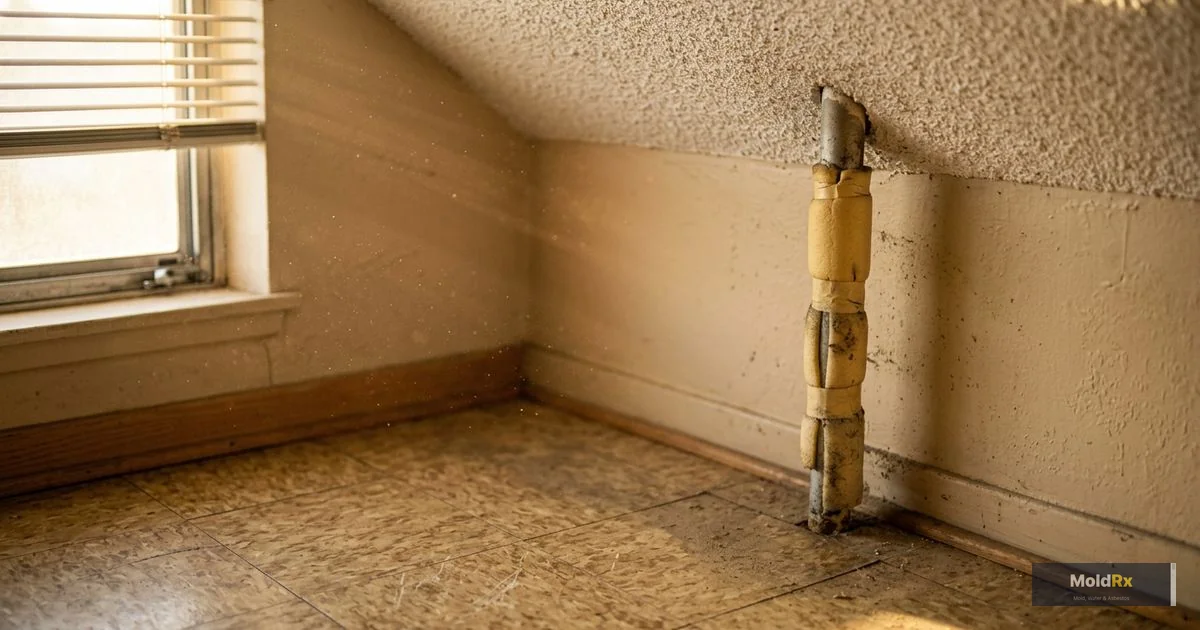
Flooring. 9x9 vinyl floor tiles are one of the most reliable visual indicators — asbestos content ranged from 5% to 70%. Sheet vinyl backing regularly contained asbestos even when the wear layer did not. Black mastic adhesive, the dark cutback used to bond tiles to the subfloor, is one of the most frequently confirmed ACM in Southern California.
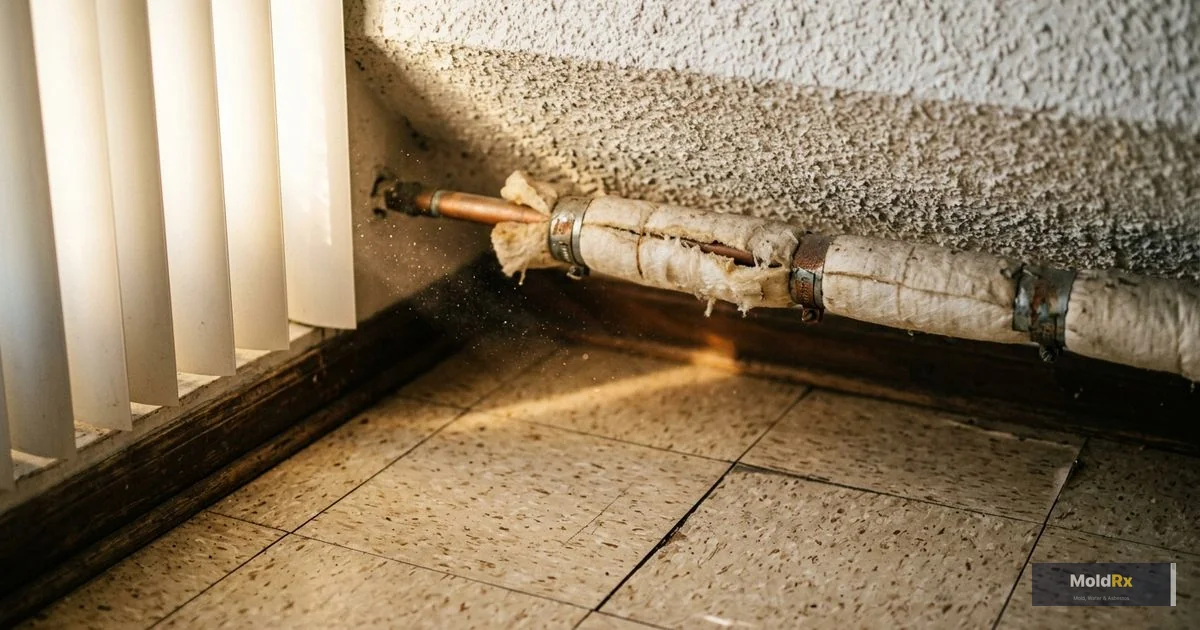
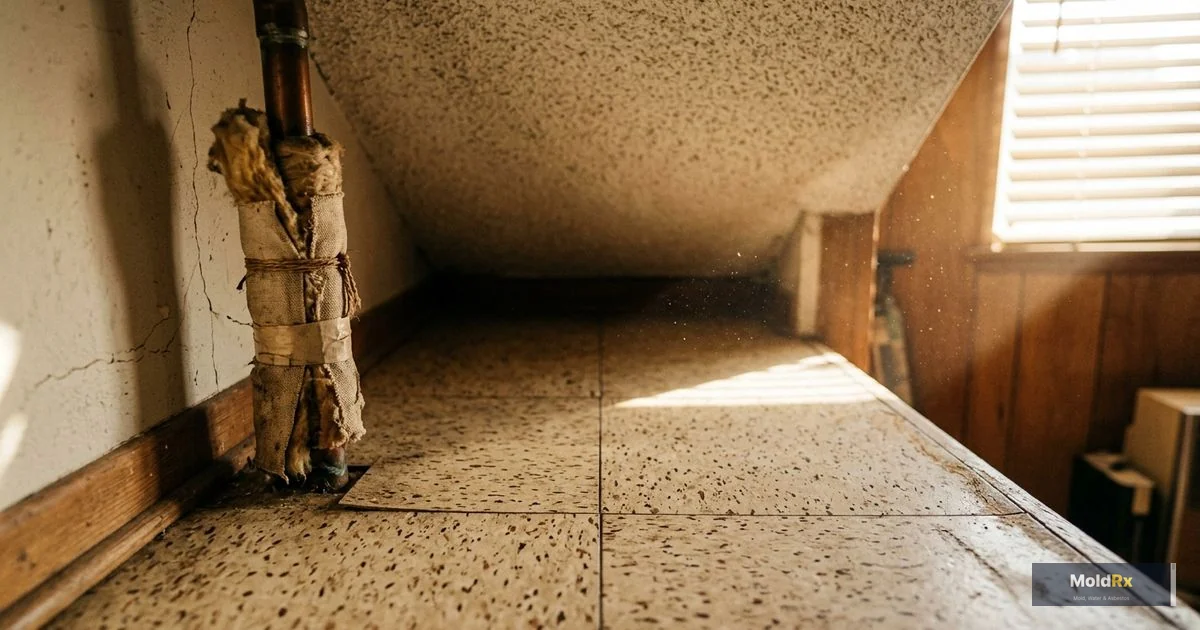
Insulation and mechanical systems. Hot water pipes, heating pipes, and ductwork were commonly wrapped with asbestos-containing insulation. HVAC duct tape and sealant often contained asbestos. Boiler and furnace insulation is particularly common in multi-unit buildings along El Toro Road and Moulton Parkway.
Exterior materials. Asbestos-cement roofing products were standard through the 1980s. Some stucco formulations and cement siding included asbestos fibers. Window glazing compound and exterior caulking frequently contained asbestos.
Vermiculite attic insulation. During the late 1970s energy crisis, many homeowners retrofitted with loose-fill vermiculite. A significant portion came from the Libby, Montana mine, contaminated with tremolite asbestos.
The critical principle: asbestos-containing materials that are intact and undisturbed pose minimal health risk. The danger begins when materials are cut, sanded, scraped, or demolished — exactly what renovation does. A contractor who scrapes a popcorn ceiling without testing can release millions of microscopic fibers in minutes. Those fibers are invisible, odorless, and linked to mesothelioma, asbestosis, and lung cancer with a latency period of 20 to 50 years. There is no safe level of exposure according to OSHA and the EPA.
How Asbestos Testing Works
Step 1: Pre-Inspection Consultation. We understand your situation — full remodel, single-room flooring replacement, pre-purchase assessment, or water damage response. The scope of your project determines the scope of testing. If testing is not warranted, we tell you upfront.
Step 2: On-Site Assessment. A vetted, AHERA-certified inspector conducts a systematic visual assessment, identifying suspect materials based on age, appearance, condition, and knowledge of South Orange County tract construction from the 1970s and 1980s.
Step 3: Sample Collection. Using EPA-approved protocols, the inspector collects bulk samples from each suspect material. Areas are wetted to suppress fiber release. Samples are sealed in tamper-evident containers with documented chain of custody. A single floor system may require separate samples of the tile, adhesive, and underlayment.
Step 4: NVLAP-Accredited Lab Analysis. All samples go to an NVLAP-accredited laboratory. The primary method is Polarized Light Microscopy (PLM), which identifies asbestos fiber types (chrysotile, amosite, crocidolite, tremolite, actinolite, anthophyllite) and quantifies concentration by weight. When PLM results are inconclusive, fiber concentrations are near the 1% threshold, or greater sensitivity is needed — such as post-abatement clearance — Transmission Electron Microscopy (TEM) is used. TEM detects fibers at concentrations well below what PLM can resolve and is also required for AHERA school clearance testing and litigation-grade documentation.
Step 5: Results Report. You receive a documented report identifying every material sampled, whether asbestos was detected, the fiber type, and the concentration. The report satisfies SCAQMD Rule 1403, Cal/OSHA Section 1529, and OSHA 1926.1101 documentation requirements. Guidance is tailored to your project: proceed with renovation if clear, coordinate CSLB C-22-licensed abatement if ACM will be disturbed, or manage in place if asbestos-containing materials will remain untouched.
Laguna Hills Neighborhoods We Serve
Nellie Gail Ranch — Named after Nellie Gail Moulton, this equestrian community encompasses 1,350 acres with roughly 1,400 homes built from the 1970s through the 1980s. Larger homes mean more material to evaluate and more samples for a comprehensive survey.
Moulton Ranch — Homes built between approximately 1987 and 1993, placing them at the tail end of the asbestos era. Lower probability than 1970s construction, but flooring adhesives and roofing materials may still contain asbestos.
Alicia Park, Lomas Laguna, and Indian Creek — Single-family homes and attached units from the core 1970s-1980s development period. Standardized tract-building methods mean consistent asbestos risk across the full range of materials. Attached units carry additional considerations for shared walls and common-area materials under HOA jurisdiction.
Shadow Run and Laguna Village — Centrally located near El Toro Road with a mix of housing types. Multi-family buildings frequently contain asbestos in boiler rooms, mechanical closets, and common-area ceiling treatments.
Laguna Hills Estates — Classic South Orange County tract homes from the peak construction era, representing the median Laguna Hills property.
We cover both ZIP codes: 92653 and 92654, plus surrounding communities including Laguna Niguel, Mission Viejo, Aliso Viejo, Laguna Woods, Lake Forest, and the Aliso Creek corridor.
Condominiums and Attached Units
With 18% of Laguna Hills housing classified as attached dwellings, testing in these properties involves additional considerations. Party walls, fire-rated assemblies, and common-area mechanical systems may contain asbestos. Your HOA may need to be involved in testing and abatement decisions. Asbestos fibers can migrate between units through shared HVAC plenums and wall cavities — which is why OSHA 1926.1101 and Cal/OSHA Section 1529 require engineering controls during abatement. Many Laguna Hills HOAs require asbestos survey documentation before approving renovation permits. Start early and loop in your HOA from the beginning.
When to Schedule Asbestos Testing
Before any renovation or remodel. This is the most common trigger. If your project will disturb walls, ceilings, floors, insulation, or any other building material in a home built before 1990, test first. Kitchen remodels, bathroom updates, flooring replacement, ceiling scraping, window replacement, room additions, garage conversions — all require testing under SCAQMD Rule 1403 if suspect materials are present. Complete the survey before you apply for permits, solicit contractor bids, or commit to a project timeline.
Before buying a home. If you are purchasing a Laguna Hills property built during the 1970s or 1980s — which describes the vast majority of available inventory — an asbestos survey during your inspection contingency gives you critical information for negotiation and post-purchase budgeting. Many buyers plan immediate renovations to update interiors that have remained largely untouched since original construction. Knowing the asbestos status before you close eliminates surprises that can add weeks to your renovation timeline.
When damaged materials are discovered. Crumbling pipe insulation, flaking ceiling texture, cracked floor tiles, deteriorating roofing felt — if materials in a pre-1990 home show visible deterioration, the risk of fiber release increases. Water damage from aging plumbing or increasingly intense Southern California rainstorms can saturate and weaken materials that were previously stable. Testing determines whether the damage involves asbestos so you can respond appropriately.
Before selling a home. California law requires sellers to disclose known material facts about a property. While the state does not mandate asbestos testing, a clean report facilitates a smoother transaction. If asbestos is found, documenting it before listing avoids the discovery during a buyer's inspection that can derail a sale or trigger renegotiation.
After water damage or natural disaster. Water intrusion, seismic events, or fire can compromise previously intact asbestos-containing materials. The material may crack, crumble, or delaminate, releasing fibers that were safely bound within the matrix. Test affected areas before cleanup or repair work begins — it is both a safety necessity and a regulatory requirement under Cal/OSHA Section 1529.
What to Expect Working with MoldRx
We only send vetted professionals. Every inspector holds current AHERA Building Inspector certification from a Cal/OSHA-approved provider. They understand SCAQMD Rule 1403, Cal/OSHA Section 1529, and the construction patterns specific to South Orange County tract housing.
Scope-appropriate testing. We test what your project requires — not a one-size-fits-all checklist. Replacing flooring in one room does not mean testing every ceiling.
NVLAP-accredited lab analysis. Every sample goes to a lab with current NVLAP accreditation for asbestos fiber analysis, using PLM, TEM, or both as the situation requires.
Honest communication. If testing is unnecessary for your situation, we say so. If it is non-negotiable, we say that too.
Documented results. Reports satisfy SCAQMD Rule 1403, Cal/OSHA Section 1529, OSHA 1926.1101, and contractor requirements — accepted by permitting agencies, HOAs, and real estate professionals.
No pressure on next steps. If asbestos is found, we explain options: manage in place, encapsulate, or coordinate CSLB C-22-licensed abatement. We do not perform removal, so our recommendations are not influenced by a financial interest in the outcome.
Timely turnaround. Standard PLM results in 3 to 5 business days. TEM may take longer. Rush available. Most Laguna Hills homeowners have complete results within one week.
Frequently Asked Questions
When is asbestos testing legally required in Laguna Hills?
Under SCAQMD Rule 1403, an asbestos survey is required before any renovation or demolition, regardless of building age. Cal/OSHA Section 1529 requires certified professionals for compliance surveys. Federal OSHA 1926.1101 requires building owners to identify ACM before allowing work that could disturb it.
What is the difference between PLM and TEM?
PLM (Polarized Light Microscopy) identifies asbestos fiber types and quantifies concentration in bulk materials — the standard for pre-renovation surveys. TEM (Transmission Electron Microscopy) detects fibers at much lower concentrations, used when PLM is inconclusive, for post-abatement clearance, or for litigation-grade documentation. Both must be performed by an NVLAP-accredited laboratory under Rule 1403.
Can I collect samples myself?
California permits homeowners to sample their own single-family residence. However, improper technique can release fibers, and self-collected results may not satisfy Rule 1403 or Cal/OSHA 1529 compliance requirements. Professional collection by an AHERA-certified inspector is strongly recommended.
How long does asbestos testing take?
On-site inspection takes one to three hours. Standard PLM lab analysis takes 3 to 5 business days. From scheduling to receiving your report, most homeowners have results within one week.
What happens if asbestos is found?
It depends on your project. If ACM is in good condition and will not be disturbed, it can be managed in place. If it will be disturbed, professional abatement by a CSLB C-22-licensed contractor is required, with SCAQMD notification at least 10 working days before removal. After abatement, clearance testing — often using TEM — confirms the area is safe.
My home was built in the late 1980s. Does it still need testing?
Yes. Asbestos continued to appear in flooring products, roofing materials, and adhesives into the early 1990s. The Moulton Ranch neighborhood (1987-1993) falls into this category. The only way to know is to test.
What is NVLAP accreditation?
The National Voluntary Laboratory Accreditation Program is administered by NIST. NVLAP accreditation means the laboratory has demonstrated competence in PLM and/or TEM methods through proficiency testing and quality audits. SCAQMD Rule 1403 requires NVLAP-accredited labs — results from non-accredited labs will not satisfy compliance requirements.
Related Services in Laguna Hills
In addition to asbestos testing, we connect Laguna Hills property owners with vetted professionals for Mold Removal in Laguna Hills, Asbestos Removal in Laguna Hills, Water Damage Restoration in Laguna Hills, and Mold Testing in Laguna Hills.
Learn more about remediation services in Laguna Hills
Get Asbestos Testing in Laguna Hills
Every renovation project in Laguna Hills starts with one question: what is in this building? For a community where the median home was built around 1980, where over 12,000 housing units sit on construction from the peak asbestos era, and where residents live in homes now 35 to 55 years old, the answer directly affects your health, your budget, and your legal compliance.
You cannot identify asbestos by looking at it. The only way to know is professional testing — AHERA-certified inspectors collecting samples under EPA protocols, NVLAP-accredited laboratories analyzing them using PLM or TEM, and clear documentation that satisfies SCAQMD Rule 1403, Cal/OSHA Section 1529, and OSHA 1926.1101.
Whether you are remodeling your Nellie Gail Ranch home, replacing flooring in a Moulton Ranch kitchen, updating an attached unit before selling, or simply want to know what your family has been living with for the last four decades — testing gives you facts instead of assumptions.
Request your free estimate or call (888) 609-8907 to schedule asbestos testing for your Laguna Hills property.