Asbestos Testing in Laguna Beach, CA — MoldRx
Licensed Asbestos Testing Professionals Serving Laguna Beach and Coastal South Orange County
Planning a kitchen renovation in a 1940s artist cottage near the Village, buying a mid-century hillside home off Laguna Canyon Road, or updating a 1960s bungalow in Bluebird Canyon? Before any of that work begins, you need to know what is inside your walls, ceilings, and floors. Laguna Beach is one of the oldest continuously developed communities in Orange County — artists began settling here in the early 1900s, and the city's eclectic housing stock spans more than a century of construction, with a large share built during the exact decades when asbestos was a standard ingredient in residential building materials. The mineral is invisible without laboratory analysis, harmless when undisturbed, and hazardous when renovation breaks it loose — which is precisely what remodeling, demolition, and repair work does. California law and SCAQMD Rule 1403 require testing before disturbing building materials in pre-1980 structures, and Rule 1403 extends the survey requirement to structures of any age before demolition. MoldRx only sends vetted asbestos testing professionals — inspectors who understand the regulatory landscape and the construction patterns found across Laguna Beach's canyons, hillsides, and coastal bluffs.
Request your free consultation — we'll help you determine if testing is needed for your project.
Why Laguna Beach Properties Carry Elevated Asbestos Risk
Laguna Beach is not like most Orange County cities. While neighboring communities experienced their building booms in the 1970s through 1990s, Laguna Beach's development tells a much older story. The city's median home construction year is 1964, and roughly 46% of all housing was built between the 1950s and 1969. Another 15% predates the 1940s entirely. Of the city's approximately 12,900 housing units, the overwhelming majority were constructed during the peak era of asbestos use in American building materials. That history — combined with the city's strong preservation ethic, steep topography, and tradition of retaining original building character — means Laguna Beach has one of the highest concentrations of potentially asbestos-containing homes in South Orange County.
An Artist Colony Built During the Asbestos Era
The story of Laguna Beach real estate begins with artists. Norman St. Clair arrived in 1903 as the first of many painters drawn to the coastal light and dramatic landscape. By the 1920s, Laguna Beach had become a genuine artist colony, with cottages, bungalows, and small studios appearing in the canyons and along the bluffs. The Laguna Beach Art Association opened its purpose-built gallery in 1929 — the first venue in Southern California built solely for exhibiting painting and sculpture. Hotel Laguna followed in 1930. La Casa del Camino opened in the same era. These were the formative years that established the city's architectural character: small-scale, eclectic, handcrafted.
Through the 1930s and 1940s, Spanish Colonial Revival, Mediterranean, and Craftsman-style homes joined the original cottages. Charles A. Hunter brought Spanish Colonial Revival design to the area in the late 1920s, and many of his structures still stand. The postwar era brought a second wave: mid-century modern homes clustered in the canyon and hillside areas during the 1940s through 1960s, built for a growing population of artists, bohemians, vacation-home owners, and early real estate speculators drawn by the coastal lifestyle.
That entire construction timeline — from the 1920s through the late 1970s — overlaps almost perfectly with the peak era of asbestos use in American construction. Chrysotile asbestos was mixed into floor tiles, ceiling texture, joint compound, pipe insulation, roofing felt, plaster, and cement siding. It was valued for fire resistance, tensile strength, and durability — qualities that made it appealing across every construction era and every architectural style found in Laguna Beach. The EPA began regulating asbestos in spray-applied products in 1978, but existing inventory continued to be installed into the early 1980s, and asbestos persisted in some building products well beyond that date.
The practical consequence: an unusually high proportion of Laguna Beach homes were built with materials that may contain asbestos — and unlike cities where postwar tract housing has been steadily demolished and replaced, Laguna Beach's preservation culture has kept many of those original materials in place for 60, 70, even 100 years.
Coastal Climate and Material Condition
Laguna Beach's mild coastal climate — average temperatures between 55 and 75 degrees year-round, ocean fog, and moderate humidity — creates a mixed picture for asbestos-containing materials. The temperate conditions mean building materials avoid the extreme thermal cycling that accelerates deterioration in inland desert communities. Original 1950s materials in a well-maintained Laguna Beach home can remain remarkably intact.
However, salt air and coastal moisture introduce their own challenges. Salt-laden fog penetrates building envelopes over decades, corroding metal fasteners, degrading adhesives, and causing delamination in composite materials. Homes on blufftop lots and along Coast Highway face the most direct marine exposure. Canyon homes contend with seasonal moisture, runoff, and vegetation encroachment that can trap humidity against exterior surfaces. Hillside homes on steep lots often have crawl spaces, retaining walls, and foundation systems that are difficult to inspect and maintain — places where pipe insulation, duct wrap, and cementitious materials may have deteriorated without anyone noticing.
The net effect is that asbestos-containing materials in Laguna Beach homes tend to remain structurally intact but may show surface degradation, edge deterioration, or adhesive failure in areas exposed to marine conditions. Professional inspection matters because these subtle changes can mean the difference between materials that are safely undisturbed and materials that are releasing fibers during normal daily activity.
Over 300 Designated Historic Properties
Laguna Beach maintains a Historic Register with more than 300 designated properties. The city commissioned a Historic Resource Inventory in 1981 that identified over 800 historic properties developed before 1940 — 42 of those were found eligible for the National Register of Historic Places. In 2017, the National Park Service recognized Laguna Beach as a Historic American Landscape.
This is relevant to asbestos testing for a direct reason: historic properties often contain the oldest and most varied building materials, and their owners are rightly invested in preserving original character. Renovating a designated historic home requires balancing preservation goals with safety requirements. Asbestos testing identifies which original materials contain hazardous fibers so that preservation plans can account for proper handling — removing what must be removed, encapsulating where appropriate, and documenting what remains in place. Testing is the foundation of any responsible renovation plan for a historic Laguna Beach property.
The 1993 Fire and Rebuilding Context
On October 27, 1993, a wildfire swept through Laguna Beach and destroyed 286 homes, with 441 structures lost countywide. The fire caused approximately $528 million in damage and forced nearly 25,000 evacuations. Emerald Bay, Skyline Drive, Canyon Acres, and the Laguna Skyline area were particularly affected.
The rebuilding effort extended through the mid-to-late 1990s — by 1996, 46% of destroyed homes had been rebuilt, and by 1997, 231 homes were rebuilt or under construction. Strengthened building codes required fire-resistant tile roofs, stucco exteriors, covered eaves, double-pane windows, and automatic sprinkler systems.
For asbestos testing purposes, this creates a split in Laguna Beach's housing stock. Homes rebuilt after the 1993 fire used modern materials and carry minimal asbestos risk. But neighboring homes on the same streets that survived the fire may retain original 1950s or 1960s materials. Block by block — sometimes lot by lot — asbestos risk varies dramatically in fire-affected neighborhoods. If you own a home in Emerald Bay, Canyon Acres, or the Skyline area, the construction date of your specific structure determines whether testing is necessary, not the general age of the neighborhood.
When Asbestos Testing Is Necessary in Laguna Beach
Not every project requires asbestos testing, but more situations call for it than most homeowners expect. Laguna Beach's mix of pre-war artist cottages, mid-century hillside homes, 1970s condominiums, and post-fire rebuilds means the answer depends on what you own and what you plan to do with it.
Before Any Renovation or Demolition (California Law)
SCAQMD Rule 1403 requires an asbestos survey before renovation or demolition — residential and commercial, regardless of building age. A certified consultant must complete the survey before you pull a permit with the City of Laguna Beach. The only narrow exception is single-unit dwelling renovation disturbing less than 100 square feet of intact material. Kitchen tearouts, flooring replacement, popcorn ceiling removal, bathroom remodels — all require testing first. Non-compliance fines can exceed $20,000 per day, and the South Coast AQMD actively enforces in Orange County.
Given the City of Laguna Beach's rigorous permitting process — which includes design review, coastal development considerations, and potentially Heritage Committee review for historic properties — asbestos documentation is frequently needed as part of the overall approval package. Having test results in hand before you begin the permit process avoids delays and demonstrates due diligence to city reviewers.
When Buying or Selling a Property
California disclosure laws require sellers to report known hazards. A pre-purchase asbestos test gives buyers a clear picture of what they are acquiring and what renovation costs will look like after closing. In Laguna Beach's market — where a substantial share of available inventory consists of homes built before 1980, many with original materials intact — this information directly affects negotiations and post-purchase budgeting. Lenders and insurance companies may also require documentation for properties of a certain age. Given median home values in Laguna Beach, an asbestos test costing a few hundred dollars provides material information on a transaction involving millions.
When Materials Are Visibly Damaged or Deteriorating
Crumbling pipe insulation in a crawl space, flaking ceiling texture in a guest room, cracked floor tiles lifting at the edges — if materials in a pre-1980 Laguna Beach home show visible deterioration, the risk of fiber release increases substantially. Coastal conditions — salt air, marine fog, seasonal moisture from canyon drainage — can accelerate material breakdown, particularly on exterior surfaces, in poorly ventilated spaces, and in areas exposed to water intrusion. Damaged ACM (asbestos-containing material) can release fibers during normal daily activity without anyone swinging a hammer. Testing identifies whether the damaged material contains asbestos so you can make informed decisions about repair, encapsulation, or removal.
Before Remodeling a Historic or Character Home
This is the situation unique to Laguna Beach. You've fallen in love with a 1930s artist cottage, a 1950s canyon bungalow, or a mid-century modern gem in the hills — and you want to update it without destroying what makes it special. The original plaster walls, the built-in cabinetry, the character ceilings, the terrazzo or tile floors — some of these materials may contain asbestos, and some may not. Testing tells you which elements can be safely preserved, which require careful handling during renovation, and which need professional abatement before work begins. It is the first step in a responsible preservation-minded remodel, and it prevents the worst outcome: accidentally contaminating a beautiful historic home by disturbing materials you did not know were hazardous.
Common Asbestos-Containing Materials in Laguna Beach Homes
Laguna Beach's housing stock spans several distinct construction eras — artist colony cottages from the 1920s and 1930s, Spanish Revival and Mediterranean homes from the same period, mid-century modern hillside residences, 1960s and 1970s coastal condominiums, and post-1993-fire rebuilds. Each era brought different asbestos risks, and each requires a different level of attention before renovation.
Plaster Walls and Original Finishes
Many pre-1950 Laguna Beach homes feature original plaster walls rather than drywall. Plaster from this era sometimes contained asbestos fibers to improve crack resistance and workability, and the base coat, finish coat, and patching compounds may each have different compositions. In artist cottages, Spanish Revival homes, and early Craftsman bungalows, the plaster walls are often the defining architectural feature — thick, hand-troweled, with character that drywall cannot replicate. Testing identifies whether the plaster contains asbestos before anyone begins repair work, installs new fixtures that require drilling, or patches damaged sections.
Floor Tiles and Mastic (9"x9" Vinyl)
Manufactured from the 1950s through the early 1980s, 9"x9" vinyl floor tiles contained anywhere from 5% to 70% chrysotile asbestos. The black cutback adhesive (mastic) beneath them frequently contains asbestos as well. In older Laguna Beach homes — particularly mid-century bungalows and 1960s condominiums — these tiles are commonly hidden beneath newer flooring layers: carpet, hardwood, or modern vinyl sheeting installed during later updates. Intact tiles are low-risk, but sanding, scraping, or breaking them during removal releases fibers into the air.
Popcorn and Textured Ceilings
Spray-applied textured ceilings were standard in affordable residential construction from the mid-1960s through 1980. Laguna Beach homes and condominiums from this period frequently have popcorn or stippled ceilings containing chrysotile asbestos. The EPA banned asbestos in spray-applied surfacing in 1978, but existing stock continued to be applied into the early 1980s. Scraping textured ceilings without testing is one of the most common sources of residential asbestos exposure — and one of the most common renovation projects homeowners attempt without understanding the risk.
Pipe and Duct Insulation
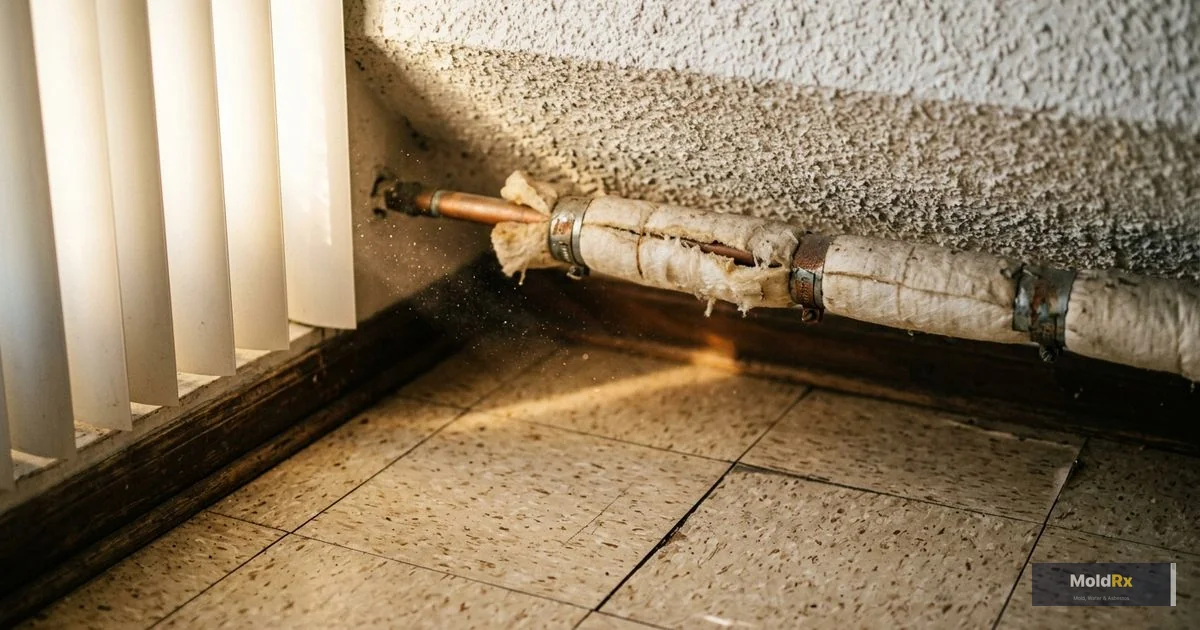
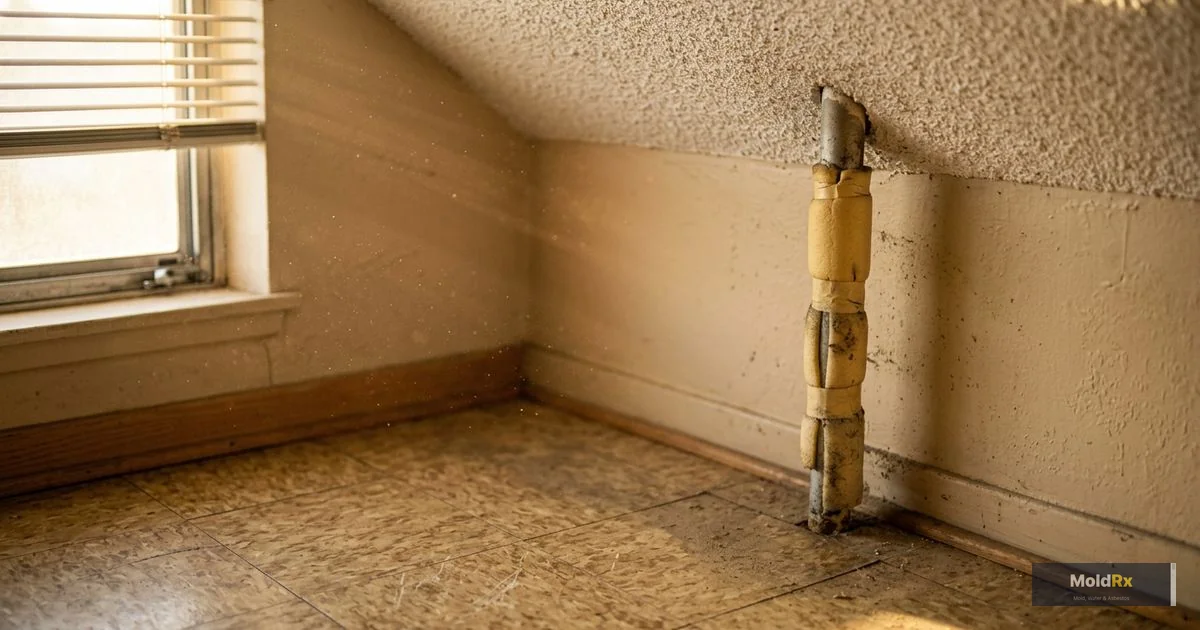
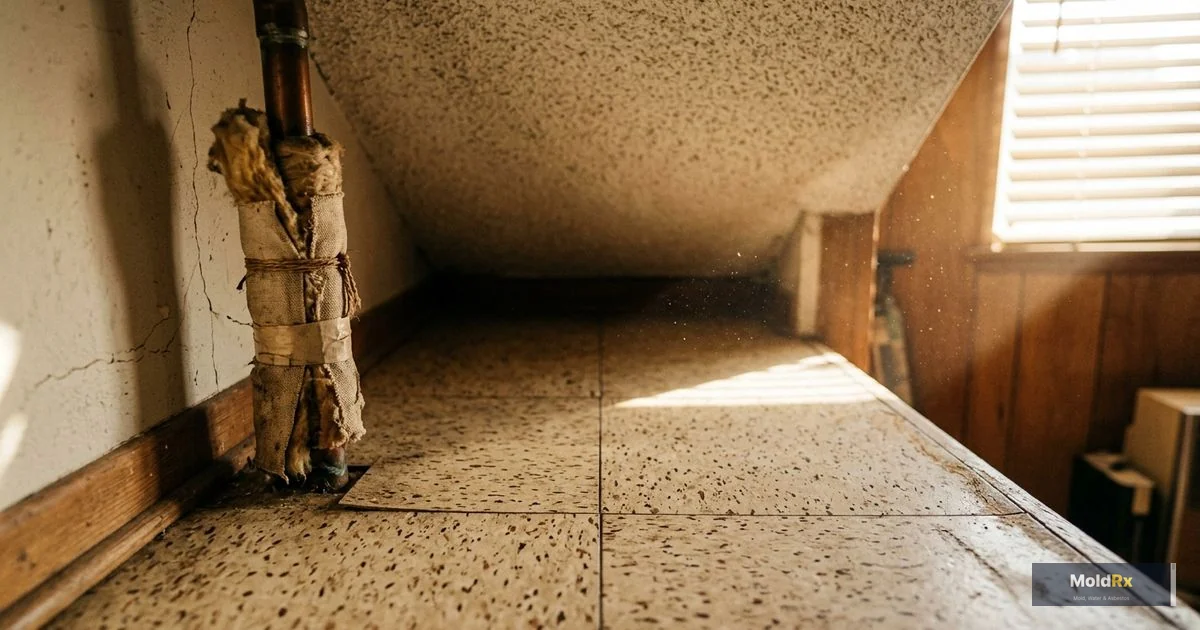
Corrugated paper wrap, calcium-silicate blocks, and air-cell insulation on heating system components in pre-1980 homes commonly contain asbestos. In Laguna Beach's canyon and hillside homes, plumbing and HVAC runs often follow unconventional paths through crawl spaces cut into hillsides, basement-level mechanical rooms, and enclosed chases beneath stairways. These are the areas where insulation deteriorates fastest and receives the least inspection — out of sight, often in damp conditions where coastal moisture accelerates degradation.
Roofing Materials and Siding
Asbestos-cement roofing shingles, roofing felt, and siding panels were widely used in California construction through the 1970s. In Laguna Beach, the coastal environment tested these materials relentlessly — salt air, morning marine layer, afternoon sun exposure on south-facing slopes. Many older homes retain original cement-asbestos siding beneath later stucco or wood treatments. These materials are low-risk while intact but become a testing and abatement concern at roof replacement time or when exterior walls are being modified.
Joint Compound, Caulking, and Window Glazing
Drywall joint compound manufactured before 1980 frequently contained asbestos to improve workability and crack resistance. Caulking and window glazing from this era also tested positive at high rates. In Laguna Beach homes with original single-pane windows — common in pre-1970 construction — the glazing compound holding glass to the frame may contain asbestos. This becomes relevant during window replacement projects, which are common upgrades in older coastal homes seeking improved energy performance and sound insulation from Coast Highway traffic.
Stucco and Exterior Coatings
Stucco is one of the most common exterior finishes in Laguna Beach, spanning every construction era from the 1920s Spanish Revival period through the present. Stucco formulations manufactured before 1980 sometimes contained asbestos fibers for crack resistance and durability. Any renovation involving exterior wall modification, window replacement, or re-stuccoing should include testing of the existing exterior coating. Grinding, chipping, or power-washing stucco during renovation can release fibers.
Vermiculite Attic Insulation
A significant portion of vermiculite insulation sold in the United States came from the Libby, Montana mine, contaminated with tremolite asbestos. It appears as small, accordion-shaped granules — gray-brown or gold — in attic spaces. The EPA recommends treating all vermiculite insulation as potentially contaminated until tested. In Laguna Beach, energy-efficiency retrofits during the 1970s energy crisis led some homeowners to add attic insulation to older homes, and vermiculite was one of the most popular retrofit products available.
How Asbestos Testing Works
Understanding the testing process helps you plan your project timeline and know what to expect at each stage.
1. Pre-Testing Consultation
Testing begins with a conversation about your property and your project — when the home was built, what materials you plan to disturb, and whether you have noticed any damage or deterioration. This information determines which areas need sampling and how many samples are required. For a straightforward renovation in a Laguna Beach home, the inspector can usually scope the work during a brief phone consultation. For larger or more complex properties — hillside homes with multiple levels, historic cottages with layered construction, or multi-unit buildings — a walk-through may be scheduled first.
2. Bulk Sample Collection
A certified inspector collects bulk samples following EPA procedures. Each suspected material is sampled separately — the inspector wets the material to suppress fiber release, removes a small section (about the size of a half-dollar), and seals it in a labeled container. Homogeneous materials like floor tiles require a minimum of three samples per distinct area. Non-homogeneous materials may need additional samples. The process is minimally invasive, and each collection point is sealed after sampling to prevent any ongoing fiber release.
In Laguna Beach's older homes, inspectors pay particular attention to layered construction — a floor may have original 1940s tile beneath a 1960s vinyl layer beneath modern carpet, each with its own adhesive. Original plaster may have been patched with different compounds over the decades. Hillside homes sometimes reveal different construction methods on different levels, reflecting additions built across several eras. These layers require individual sampling because each may have a different asbestos profile.
3. NVLAP-Accredited Laboratory Analysis
Samples are sent to an NVLAP-accredited laboratory (National Voluntary Laboratory Accreditation Program). The primary method is PLM (Polarized Light Microscopy), which identifies asbestos fiber type and estimates concentration above approximately 1%. When PLM results are negative but low-level asbestos is suspected, TEM (Transmission Electron Microscopy) provides higher sensitivity. Standard PLM turnaround is 3 to 5 business days; rush service (24 to 48 hours) is available when your project timeline is tight.
4. Results Interpretation and Recommendations
You receive a written report identifying each material sampled, whether asbestos was detected, the fiber type (chrysotile, amosite, crocidolite, or others), and the estimated concentration. We walk you through what each result means for your specific project: which materials require licensed abatement before renovation can proceed, which can be safely managed in place, and which areas are clear for standard construction work.
For historic home projects, this step is particularly important — the results directly inform your preservation strategy. If original plaster walls test negative, they can be repaired and preserved using standard methods. If they test positive, specific handling protocols are needed. Testing transforms uncertainty into a clear project plan.
Types of Asbestos Analysis
Different analytical methods serve different purposes. The method used depends on the material type, regulatory context, and level of certainty required.
PLM (Polarized Light Microscopy)
PLM is the standard method for bulk building material samples. The analyst identifies asbestos fibers based on optical properties — refractive index, birefringence, color, and morphology — and can detect all six regulated fiber types. PLM estimates concentration as a percentage of total material and is accepted by EPA, OSHA, and Cal/OSHA for compliance purposes. Most residential testing in Laguna Beach uses PLM as the primary method, following EPA Method 600/R-93/116.
TEM (Transmission Electron Microscopy)
TEM provides higher magnification than PLM, detecting fibers too small for light microscopy. It is used when PLM results are negative but asbestos is still suspected — for example, when floor tile matrix material masks fibers, or when testing vermiculite insulation where fibers may be embedded in the mineral structure. TEM is also the required method for air monitoring samples after abatement. It provides the highest level of analytical certainty available.
Point Counting
Point counting is a supplemental PLM technique used when visual estimation detects between 1% and 10% asbestos. The analyst superimposes a grid on the sample and counts grid points falling on asbestos versus non-asbestos material, producing a statistically valid concentration estimate. EPA specifies point counting for regulatory determinations near the 1% threshold — the dividing line between ACM and non-ACM under NESHAP.
Can You Identify Asbestos by Looking at It?
No. Asbestos fibers are microscopic — 0.1 to 10 micrometers in diameter, invisible to the naked eye and mixed into the matrix of building materials during manufacturing. A floor tile containing 30% chrysotile looks identical to one containing zero asbestos. Popcorn ceiling texture with asbestos is visually indistinguishable from texture without it. Even experienced inspectors cannot determine asbestos content by visual examination alone.
This matters especially in Laguna Beach, where architectural character and patina are valued. That beautiful original plaster, those vintage floor tiles, the hand-applied stucco on a 1930s courtyard wall — none of these can be assessed by appearance. An inspector who tells you a material is "probably fine" based on how it looks is guessing. The only way to confirm or rule out asbestos is laboratory analysis of a physical sample.
What Happens If Asbestos Is Found?
A positive test result does not automatically mean your home is dangerous or that expensive removal is your only option. The appropriate response depends on the condition of the material, your project scope, and applicable regulations.
When Removal Is Required
Removal is required when your renovation or demolition will physically disturb ACM — tearing out positive-testing flooring, removing a wall with ACM joint compound, or scraping an asbestos-containing ceiling. SCAQMD Rule 1403 requires notification at least 10 working days before removal begins, and all abatement must be performed by a DOSH-registered contractor. California law is strict on this point — there are no exemptions for homeowner self-abatement on multi-unit residential properties.
When Encapsulation May Be an Option
Encapsulation applies a sealant over intact ACM to prevent fiber release without physical removal. It is appropriate for materials in good condition that will remain in place — asbestos-cement siding on a wall that is not being renovated, or intact floor tiles being covered with new flooring rather than torn out. Encapsulation is only viable when the material is undamaged and will not be disturbed by future work. In Laguna Beach's coastal environment, encapsulation products must be rated for moisture and marine-air exposure to remain effective long term.
When Leaving It Undisturbed Is Acceptable
If ACM is in good condition and will not be disturbed by renovation or normal use, leaving it in place is often the safest and most cost-effective option. Intact asbestos materials do not release fibers. A management plan documenting the location and condition of ACM is the standard approach. Many Laguna Beach homeowners discover asbestos during testing for one project and manage materials in unaffected areas rather than removing everything at once — a sensible strategy that keeps costs proportionate to actual risk and minimizes disruption to a home's original character.
Regulations That Require Asbestos Testing in California
Multiple overlapping federal and state regulations govern asbestos testing in Laguna Beach. Understanding which apply to your project helps you plan timelines and avoid costly compliance issues.
SCAQMD Rule 1403 (Pre-Renovation/Demolition Survey)
The regulation most directly relevant to Laguna Beach property owners. Requires an asbestos survey by a certified consultant before any renovation or demolition, regardless of building age. If asbestos is found, SCAQMD must be notified at least 10 working days before removal begins. A copy of the notification must be submitted to the permitting department before a permit is issued. Penalties for non-compliance can exceed $20,000 per day.
Cal/OSHA Title 8 Section 1529
California's construction-industry asbestos standard requires determining the presence and quantity of ACM or presumed ACM (PACM) before any construction, alteration, repair, or renovation. In pre-1980 buildings, all thermal system insulation, surfacing material, and resilient flooring is presumed to contain asbestos until testing proves otherwise. This regulation applies to contractors, but it affects homeowners directly — your contractor is legally required to comply before starting work on your Laguna Beach home.
EPA AHERA
Establishes inspection and management requirements for asbestos in public and commercial buildings. While AHERA does not directly regulate single-family homes, its protocols and accreditation requirements form the foundation for residential testing practices across California. Inspectors performing residential surveys hold AHERA-accredited certifications, and sampling procedures are derived from AHERA protocols.
California Health and Safety Code
Establishes pre-renovation testing requirements, contractor licensing standards, and notification obligations. Any person performing asbestos-related work must be registered with the Division of Occupational Safety and Health (DOSH). For Laguna Beach homeowners, the practical impact is that testing, abatement, and disposal must be performed by certified, registered professionals — not general handymen or unlicensed contractors.
Coastal Development Considerations
Laguna Beach falls within the California Coastal Zone. Renovation projects near the coast may require Coastal Development Permits in addition to standard building permits. Asbestos documentation becomes part of the overall permit package. Planning for testing early in the project timeline prevents delays when you are coordinating with both the City of Laguna Beach planning department and the Coastal Commission.
Laguna Beach Asbestos Risk by Construction Era
Laguna Beach's development happened in overlapping waves — from an early artist colony to a mid-century coastal community to a preservation-focused city — and each era brought different asbestos risks. Knowing when your home was built helps set expectations before testing.
1900s-1930s (Artist Colony and Early Development): Laguna Beach's oldest homes — concentrated in the Village, North Laguna's Tree Streets neighborhood, along the canyon edges, and near the original artist studios — were built during the early years of asbestos use in residential construction. Cottages, bungalows, and Spanish Revival homes from this era may contain asbestos in plaster, caulking, roofing materials, and insulation. Many of these structures have been renovated multiple times over nearly a century, creating layered construction where original materials sit beneath later additions — each layer potentially containing different hazardous materials. With over 800 pre-1940 properties identified in the city's 1981 inventory, this is a significant portion of Laguna Beach's housing stock. Testing is essential before any renovation.
1940s-1960s (Mid-Century Expansion): The postwar era brought Laguna Beach's most intense residential development. Mid-century modern homes spread across the canyon and hillside areas. Ranch-style and contemporary homes filled out neighborhoods in Bluebird Canyon, Temple Hills, Arch Beach Heights, and along the ridgelines. This was the peak period of asbestos use in American construction, and homes from this era commonly contain asbestos in virtually every material category: popcorn ceilings, 9"x9" vinyl floor tiles, pipe insulation, HVAC duct wrap, drywall joint compound, roofing felt, and cement siding. The city's median home construction year — 1964 — falls squarely in this period. Testing is essential for any renovation in this age range.
1960s-1970s (Condominium and Multi-Family Construction): The late 1960s and 1970s brought condominium and multi-family development to portions of Laguna Beach, particularly along Coast Highway and in South Laguna. These buildings used standard construction materials of the era — textured ceilings, vinyl flooring, pipe insulation, and joint compound that frequently contain asbestos. Multi-unit buildings present additional complexity because common-area materials may differ from unit interiors, and abatement in one unit can affect neighboring units if containment is not properly managed.
Post-1993 Fire Rebuilds (1994-2000): Homes rebuilt after the October 1993 wildfire — primarily in Emerald Bay, Canyon Acres, Skyline Drive, and surrounding areas — used modern materials with negligible asbestos risk. Updated building codes required fire-resistant construction including tile roofs, stucco exteriors, and sprinkler systems. If your home was rebuilt after the fire, asbestos testing is generally not needed for interior renovation. However, SCAQMD Rule 1403 still requires a survey before demolition regardless of building age, and any pre-fire structures or foundations that were retained and built upon should be assessed individually.
2000s-Present (Limited New Construction): Laguna Beach is largely built out, with new construction limited to teardown-rebuilds on existing lots and occasional infill projects. Modern materials carry negligible asbestos risk. However, teardown projects that involve demolishing a pre-1980 structure require a full asbestos survey before demolition begins, even if the goal is complete replacement.
Special Considerations for Historic Home Renovations in Laguna Beach
What If My Home Is on the Laguna Beach Historic Register?
If your property is among the more than 300 homes on the Laguna Beach Historic Register, renovation requires Heritage Committee review in addition to standard building permits. Asbestos testing fits naturally into this process and should happen early in your planning timeline — ideally before you finalize architectural plans.
Historic designation does not exempt you from asbestos regulations. It does, however, create an additional incentive to test thoroughly. Properties on the register may qualify for the Mills Act (reduced property taxes in exchange for preservation commitments), parking and setback exemptions, and other benefits. Maintaining that designation while navigating asbestos requirements requires a thoughtful plan. Testing identifies exactly which original materials contain asbestos, allowing you and your architect to design around those materials — preserving what can be preserved, properly removing what must be removed, and documenting everything for the Heritage Committee review.
Can Original Materials Be Preserved If They Contain Asbestos?
In some cases, yes. If an original feature tests positive for asbestos but will not be disturbed during renovation — for example, intact plaster walls in a room that is not being modified, or original stucco on an exterior wall that will be left as-is — the material can remain safely in place with a documented management plan. The key is "undisturbed." If your renovation plan requires cutting, drilling, sanding, or otherwise breaking into ACM, proper abatement must happen first regardless of the material's historic or architectural significance.
For materials that test positive and must be disturbed, encapsulation may be appropriate in some situations as an alternative to full removal. This decision depends on the material's condition, location, and whether it will be subject to future disturbance. Your inspector and your architect should coordinate on these decisions — asbestos testing results directly inform what your architect can and cannot propose to the Heritage Committee.
How Does Asbestos Testing Affect Project Timelines for Historic Homes?
Add two to four weeks to your pre-construction timeline for asbestos testing and any required SCAQMD notification. The testing process itself is fast — sample collection takes a few hours, and standard lab results return in 3 to 5 business days. But if asbestos is found and your project will disturb it, SCAQMD requires 10 working days' notice before abatement begins. Factor this into your overall timeline, especially if your project also requires Heritage Committee review, design review, or Coastal Development Permit approval. Testing early prevents the most common delay: discovering asbestos after permits are issued and construction is supposed to begin.
What Sets MoldRx Apart
- Honest assessment. If testing is not necessary for your project, we will tell you. We have no financial incentive to recommend testing or abatement you do not need.
- NVLAP-accredited lab partners. Every sample is analyzed by a nationally accredited laboratory using PLM and, when warranted, TEM methods that meet EPA and Cal/OSHA standards.
- Clear, actionable results. No jargon-filled reports that leave you guessing. Plain language, specific recommendations, and a clear path forward for your Laguna Beach project.
- Family-owned accountability. We only send vetted asbestos testing professionals we stand behind. No subcontractor roulette — the people who show up are the people we trust with our own homes.
Get your free consultation — no obligations.
Laguna Beach Neighborhoods We Serve
Our asbestos testing services cover all residential and commercial properties in Laguna Beach, including:
- The Village (Downtown Laguna) — The historic heart of Laguna Beach, home to the city's oldest structures. Artist cottages, commercial buildings, and mixed-use properties dating from the 1920s through the 1950s. The Village contains the highest concentration of pre-war construction in the city, and many properties have been renovated multiple times, creating layered construction that requires careful sampling of each distinct era. Testing is essential for virtually any renovation in the Village.
- North Laguna / Tree Streets — One of the city's most historically significant residential areas. The Tree Streets neighborhood contains homes dating to the 1920s and 1930s, including traditional houses and large cottage homes. Properties along Cliff Drive, the coastal bluffs, and the streets between Broadway and Crescent Bay feature some of Laguna Beach's oldest and most architecturally diverse homes. High asbestos risk in original materials.
- South Laguna — Stretching south along Coast Highway toward Dana Point, South Laguna's housing stock includes 1950s and 1960s beach cottages, mid-century homes, and later condominium developments. Original homes that survived subsequent development carry standard asbestos-era risks in flooring, ceilings, and insulation.
- Bluebird Canyon — A diverse neighborhood featuring architectural styles from Craftsman to mid-century modern. Canyon-floor homes may have moisture-related material deterioration from seasonal drainage, making inspection of crawl spaces and lower-level materials particularly important.
- Top of the World — Hilltop residential area with sweeping coastal views, featuring homes primarily from the 1950s through 1970s. Higher elevation and exposure to wind-driven marine air can accelerate exterior material degradation. Standard asbestos-era risks in homes built before 1980.
- Temple Hills — Residential neighborhood on the slopes above downtown, with homes dating from the 1940s through the 1970s. Steep, winding access means many homes were built with unconventional layouts — split-levels, hillside foundations, and stacked construction — that can complicate both inspection and abatement.
- Arch Beach Heights — Established neighborhood between downtown and South Laguna. Homes from the 1950s and 1960s are common. Standard asbestos-era materials in flooring, ceilings, insulation, and exterior finishes.
- Woods Cove / Victoria Beach — Coastal neighborhoods with an eclectic mix of architectural styles — Normandy Chateau, Spanish Mediterranean, charming cottages, and contemporary designs — spanning several construction eras. Properties on or near the bluffs face direct marine exposure that can accelerate material deterioration.
- Emerald Bay — Gated community founded in 1929, with many lots originally developed in the 1930s and 1940s. However, the 1993 fire destroyed 63 homes in Emerald Bay, and most were rebuilt by the late 1990s with modern materials. Homes that survived the fire retain original materials and carry standard asbestos-era risks. Pre-fire versus post-fire construction is the critical distinction in this neighborhood.
- Three Arch Bay — Gated coastal community with homes ranging from mid-century originals to contemporary rebuilds. Older homes carry standard asbestos-era risks; newer construction is low-risk.
- Laguna Canyon — Residential areas along Laguna Canyon Road, blending homes with the natural landscape of the Laguna Coast Wilderness Park. Canyon homes from the 1950s and 1960s may have moisture-related material concerns due to canyon drainage and vegetation encroachment. Testing should include attention to exterior materials and crawl-space insulation.
ZIP Code Coverage
We serve all properties within ZIP codes 92651 and 92652 and the surrounding South Orange County coastal communities.
Nearby Communities
We also serve neighboring communities including Dana Point to the south, Newport Beach and Corona del Mar to the north, Laguna Hills and Aliso Viejo inland, Laguna Niguel to the southeast, and Laguna Woods to the northeast. Whether your property is a 1920s artist cottage in the Village or a mid-century hillside home in Temple Hills, our vetted specialists can help.
Related Services in Laguna Beach
-> All services
Frequently Asked Questions
Is asbestos testing required before renovation in Laguna Beach?
Yes. SCAQMD Rule 1403 requires an asbestos survey before renovation or demolition in the South Coast Air Quality Management District, which includes all of Laguna Beach and Orange County. The survey must be performed by a certified consultant. The only exception is single-unit dwelling renovation involving less than 100 square feet of intact material. Most residential projects — kitchens, bathrooms, flooring, ceilings — exceed that threshold and require testing.
How many samples need to be collected?
EPA procedures require a minimum of three samples per homogeneous material in each distinct area. A typical Laguna Beach home undergoing full renovation might need 10 to 25 samples across ceiling texture, floor tile, mastic, joint compound, plaster, insulation, stucco, and roofing material. Older homes with layered construction from multiple renovation eras may require additional samples. Your inspector determines the exact number based on your property's age, construction, and project scope.
How long do asbestos test results take?
Standard PLM analysis through an NVLAP-accredited laboratory takes 3 to 5 business days from the time samples arrive at the lab. Rush service is available with turnaround as fast as 24 hours when your project timeline demands it. TEM analysis, if needed, typically requires 5 to 7 business days for standard service. Your inspector can advise on which turnaround option fits your schedule.
Can I collect asbestos samples myself?
California does not prohibit homeowners from collecting samples in their own single-family home, but the practice is strongly discouraged. Improper technique can release fibers into your living space — the very hazard you are trying to assess. Additionally, samples collected by uncertified individuals may not be accepted for regulatory compliance. If you need results for a building permit, SCAQMD notification, or real estate transaction, use a certified inspector.
What does a positive asbestos test mean for my renovation?
A positive result means asbestos fibers were detected in the sampled material. Any material exceeding 1% asbestos is classified as ACM under federal and California regulations. A positive result does not mean immediate danger — intact, undisturbed ACM does not release fibers. But if your renovation will disturb that material, licensed abatement must be performed before construction work can proceed in that area.
My Laguna Beach home is on the Historic Register. Does that change the testing process?
The testing process itself is the same — EPA sampling protocols and NVLAP-accredited lab analysis apply regardless of historic designation. What changes is how results are used in your project planning. Historic properties require Heritage Committee review for exterior alterations and significant interior changes. Asbestos test results inform which original materials can be preserved in place, which require special handling, and which need professional abatement. Having results before you finalize architectural plans allows your architect to design around hazardous materials rather than discovering them mid-construction.
My home was rebuilt after the 1993 fire. Do I still need testing?
If your home was fully demolished and rebuilt after the fire using new materials, asbestos testing is generally not necessary for interior renovation. The rebuilt homes used modern, post-1993 materials with negligible asbestos risk. However, if any pre-fire structural elements — foundations, retaining walls, original utility runs — were retained and incorporated into the rebuild, those elements should be tested before disturbance. SCAQMD Rule 1403 still requires a survey before full demolition regardless of building age.
How accurate is PLM analysis?
PLM is the EPA-accepted standard method and is highly accurate for identifying asbestos type and estimating concentration. Its limitation is sensitivity at very low concentrations — PLM has a detection limit of approximately 1%, which is also the regulatory threshold. For materials suspected of containing less than 1% asbestos, or materials with complex matrices like floor tile, TEM provides higher sensitivity and is used as a confirmatory method.
Do all pre-1980 Laguna Beach homes contain asbestos?
No, but the probability is high enough that testing is the only responsible approach. Industry data suggests 80% or more of pre-1980 buildings contain at least one asbestos-containing material. Some homes may have had asbestos removed during previous renovations; others were built with non-asbestos alternatives that were available alongside asbestos products. Given Laguna Beach's median construction year of 1964, a substantial majority of the city's housing stock falls within the high-probability range. Laboratory testing is the only way to determine what your specific home contains.
What is the difference between friable and non-friable asbestos?
Friable ACM can be crumbled or reduced to powder by hand pressure — pipe insulation, spray-applied ceiling texture, deteriorated thermal insulation. Friable materials release fibers more readily and are considered higher risk. Non-friable ACM is bound into a solid matrix — floor tiles, cement siding, roofing shingles. Non-friable materials can become friable through cutting, grinding, or sanding, which is why renovation triggers testing requirements regardless of the material's current condition.
Does Laguna Beach's coastal climate affect asbestos risk?
Yes. The mild, fog-influenced climate preserves building materials in a way that extreme heat or humidity do not — original 1950s materials in well-maintained Laguna Beach homes often remain intact. That is good because intact materials do not release fibers. However, salt air and marine moisture cause gradual surface degradation, adhesive breakdown, and corrosion of surrounding components over decades. Exterior materials and those in poorly ventilated spaces near the coast are most affected. The practical impact is that materials may appear sound on the surface but show micro-deterioration upon closer inspection. Professional assessment identifies these conditions before renovation creates a larger exposure event.
Get Asbestos Testing in Laguna Beach
Planning a remodel, updating a historic cottage, replacing a roof, or buying a home in Laguna Beach — testing gives you the information you need before the first wall comes down. Whether you own a 1930s artist cottage in the Village, a mid-century hillside home in Temple Hills, a 1960s bungalow in Bluebird Canyon, or a condominium along Coast Highway, the process is straightforward and the results are definitive.
Call MoldRx to schedule your asbestos test — (888) 609-8907. Know before you start.