Asbestos Testing in La Palma, CA — MoldRx
Vetted Asbestos Testing Professionals Serving La Palma and North Orange County
Thinking about tearing out a popcorn ceiling in a 1960s ranch home near Central Park, replacing flooring in a tract house off Walker Street, or remodeling a kitchen in one of La Palma's original subdivisions along Orangethorpe Avenue? Before a single tile is pried up or a scraper touches that textured ceiling, you need laboratory confirmation of what those materials contain. La Palma is not just an older city — it is a city that was built almost entirely within a single compressed window of construction that coincides precisely with the heaviest years of asbestos use in American building history. The mineral is invisible to the naked eye, impossible to identify without a microscope, and harmless while undisturbed — but renovation is, by definition, disturbance. California law and SCAQMD Rule 1403 require testing before disturbing building materials in pre-1980 structures. MoldRx only sends vetted asbestos testing professionals who understand the specific construction patterns found across La Palma and North Orange County.
Request your free consultation — we will help you determine if testing is needed for your project.
Why La Palma Has One of the Highest Asbestos Risk Profiles in Orange County
Most Southern California cities grew over many decades, producing housing stocks that span multiple construction eras. La Palma did not. This city went from dairy farmland to a fully developed residential community in roughly ten to fifteen years — and every one of those years falls within the peak asbestos era.
From Dairyland to Suburb — A Construction Timeline Unlike Any Other
Through the early 1960s, the 1.8 square miles that are now La Palma were occupied by dairy farms — operations that had been here since the 1940s when farmers displaced by Los Angeles County's suburban expansion relocated east. Local dairy farmers incorporated the community as the City of Dairyland on October 26, 1955, making it one of three dairy cities in the region alongside Dairy Valley (now Cerritos) and Dairy City (now Cypress).
La Palma holds a distinction no other Orange County city can claim: it went straight from farmland to incorporated city. Before 1955 there was no town center, no commercial district, no schools, and no post office. In 1964, city leaders drafted a new master plan envisioning a residential community of 18,000 people. Voters approved the plan in February 1965 and simultaneously renamed the city La Palma, after the region's Spanish heritage and its main thoroughfare. The first subdivisions broke ground that fall. By 1973, only a single dairy remained.
What This Means for Asbestos
La Palma's entire residential infrastructure — every tract home, every apartment building, every commercial structure — was constructed between approximately 1965 and 1978. This window falls squarely within the period when asbestos was used most heavily in American construction. Federal regulation did not begin until the EPA banned spray-applied asbestos surfacing in 1978, and existing inventory continued to be installed into the early 1980s. By that point, La Palma was already fully built.
Unlike cities with mixed-era housing where only some neighborhoods carry high asbestos risk, La Palma's risk is citywide and uniform. Whether your property sits along Walker Street, La Palma Avenue, Valley View Street, or Orangethorpe Avenue — the materials are from the same era, installed using the same practices, carrying the same probability of containing asbestos.
Climate, Hidden Layers, and the Renovation Window
Orange County's Mediterranean climate preserves building materials far longer than wetter regions would. A popcorn ceiling that appears "perfectly fine" after 60 years releases the same microscopic fibers when scraped as it would have on the day it was sprayed. Many La Palma homes have been updated at least once, and those renovations often covered older materials rather than removing them — new vinyl over original 1960s tiles, fresh drywall over textured plaster, carpet stapled over asbestos-containing sheet flooring. Each renovation created a hidden layer that the next renovation may disturb.
La Palma has approximately 15,100 residents across roughly 5,400 housing units in ZIP code 90623. Those homes are now 50 to 60 years old — the age at which kitchens, bathrooms, roofing, HVAC, and plumbing need replacement. Every one of these projects can disturb asbestos-containing materials. In a city where the entire housing stock falls within the peak asbestos era, testing is the expected first step.
Regulations That Govern Asbestos Testing in La Palma
Asbestos testing is governed by overlapping federal, state, and regional requirements. Understanding the framework explains why testing is often a legal obligation, not just a recommendation.
Federal: OSHA 1926.1101 and AHERA
OSHA standard 29 CFR 1926.1101 governs asbestos exposure in all construction work. Any material containing more than one percent asbestos is classified as asbestos-containing material (ACM). The permissible exposure limit is 0.1 fibers per cubic centimeter averaged over eight hours, with an excursion limit of 1.0 f/cc over 30 minutes. General contractors bear supervisory responsibility for asbestos compliance on their projects.
The Asbestos Hazard Emergency Response Act (AHERA) established the accreditation framework that underpins modern asbestos testing — requiring AHERA Building Inspector certification for inspectors and NVLAP accreditation for laboratories. These AHERA-derived standards are the baseline credentials for any asbestos testing service.
California: Cal/OSHA Section 1529 and CSLB C-22
Cal/OSHA Section 1529 mirrors and in several areas exceeds federal OSHA 1926.1101. It regulates all construction-related asbestos exposure, establishes the same PEL thresholds, and adds California-specific requirements: any contractor performing asbestos work involving 100 square feet or more of ACM must register with DOSH and provide 24-hour advance notification before work begins.
On the licensing side, only contractors holding an active CSLB C-22 Asbestos Abatement license may perform abatement work — containment, encapsulation, removal, and disposal of ACM. C-22 applicants must demonstrate four years of journey-level experience, pass trade and law examinations, and maintain active DOSH registration. When testing results indicate abatement is necessary, a C-22-licensed contractor is a legal requirement.
Regional: SCAQMD Rule 1403
The South Coast Air Quality Management District enforces Rule 1403 across Orange, Los Angeles, San Bernardino, and Riverside counties. Key requirements for La Palma properties:
- Pre-work survey mandate. A thorough survey must be completed before any demolition — no exceptions. Renovations disturbing 100 square feet or more of suspect material also require a survey.
- Inspector qualifications. Surveys must be conducted by a Cal/OSHA-certified inspector or AHERA Building Inspector certificate holder.
- NVLAP laboratory requirement. All analyses must be performed by an NVLAP-accredited laboratory.
- Notification timeline. Written notification to SCAQMD at least 10 working days before asbestos removal begins.
The only narrow exception is single-unit dwelling renovation involving less than 100 square feet of intact material. Most La Palma renovation projects exceed that threshold. Non-compliance fines can exceed $20,000 per day.
Common Asbestos-Containing Materials in La Palma Homes
La Palma's narrow construction window — almost exclusively mid-1960s through mid-1970s — produces a remarkably consistent asbestos risk profile across the city.
Floor Tiles and Mastic
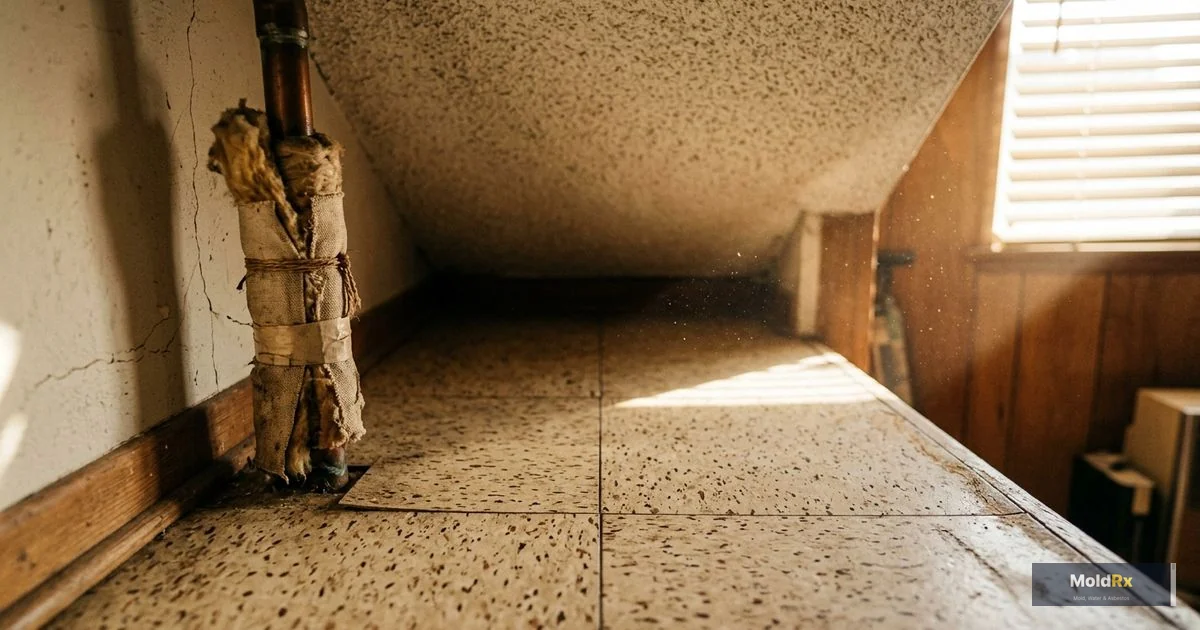
The 9-inch by 9-inch vinyl floor tile is one of the most recognizable asbestos-era products. These tiles contained 5 to 70 percent chrysotile asbestos, and the black cutback adhesive beneath them frequently contains asbestos as well. Many La Palma homeowners have never seen these tiles because they are buried under newer flooring. Intact tiles are low-risk, but sanding, scraping, or breaking them during removal releases fibers. Even pulling up carpet stapled through old vinyl can crack the underlying tile.
Popcorn and Textured Ceilings
Spray-applied acoustic ceiling texture was standard in California tract-home construction from the mid-1960s through 1980. La Palma homes were built during the exact peak of this product's use. Popcorn ceiling removal is one of the most common cosmetic upgrades — and scraping without testing is one of the most frequent sources of residential asbestos exposure in Southern California. A single afternoon of unprotected scraping can produce exposure levels far exceeding Cal/OSHA limits.
Pipe and Duct Insulation
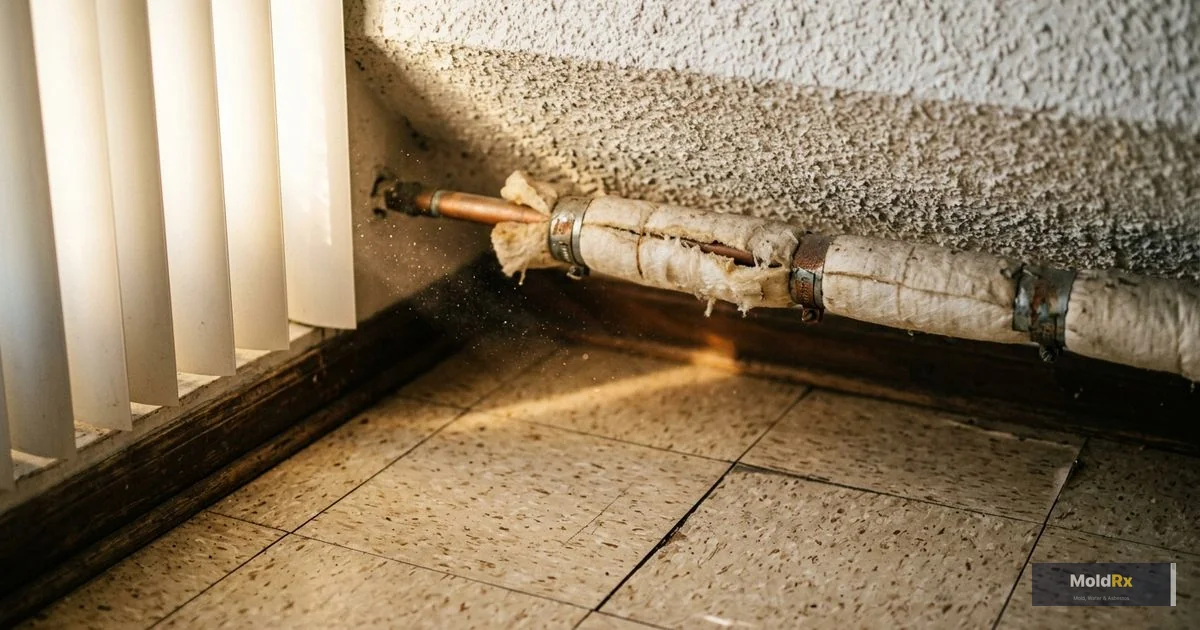
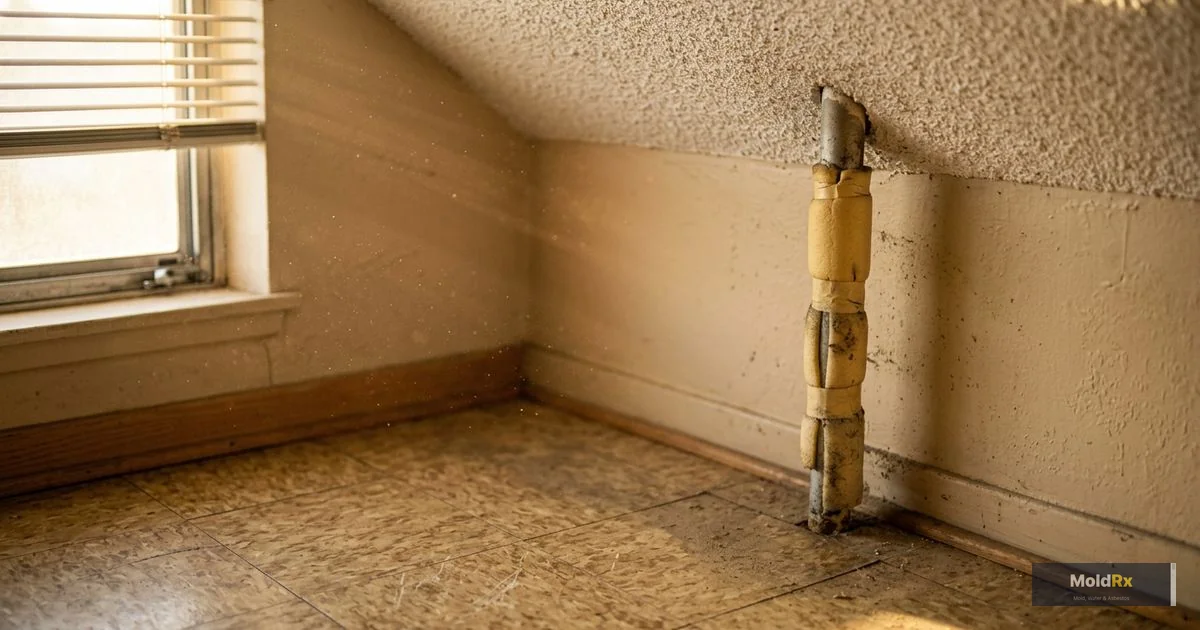
Corrugated paper wrap, calcium-silicate blocks, and air-cell insulation on hot-water pipes, heating systems, and HVAC ductwork commonly contain asbestos. These materials sit in garages, attics, and utility closets where they are frequently bumped over decades. Test before replacing HVAC systems, upgrading ductwork, or converting a garage.
Drywall Joint Compound and Wall Textures
Joint compound manufactured before 1980 frequently contained chrysotile asbestos. Because it is applied at every seam and screw hole, even a small remodel can disturb a surprising quantity. Sanding drywall joints is a particularly high-exposure activity when the compound contains asbestos.
Roofing Materials
Asbestos-cement roofing shingles and felt underlayment were widely used in 1960s-1970s tract construction. Orange County's low rainfall means many La Palma homes still carry original roofing that may contain asbestos. Test before your contractor tears off old shingles and felt.
Vermiculite Attic Insulation
Over 70 percent of vermiculite insulation sold in the U.S. between 1923 and 1990 came from the Libby, Montana mine, contaminated with tremolite asbestos. During the 1970s energy crisis, vermiculite was a popular attic retrofit. The EPA recommends treating all vermiculite as potentially contaminated until tested.
Exterior Cement Siding and Stucco
Some La Palma homes include asbestos-cement siding or chrysotile-reinforced stucco. These materials are low-risk while intact but become a concern when siding is replaced, stucco removed, or new windows require cutting through exterior walls.
How Asbestos Testing Works — The MoldRx Process
Step 1: Pre-Testing Consultation
We start with a conversation about your property and project. For La Palma homes in the 90623 ZIP code, the question is which materials to sample, not whether sampling is needed. If testing is not necessary for your situation, we will tell you directly.
Step 2: On-Site Bulk Sample Collection
A vetted asbestos specialist collects samples following EPA protocols and AHERA inspection standards — misting suspect materials to suppress fiber release, removing small sections with specialized tools, sealing each sample in a labeled container, and documenting exact locations. EPA procedures require a minimum of three samples per homogeneous material in each distinct area. For a typical La Palma tract home, expect 10 to 20 samples. Collection takes one to two hours.
Step 3: NVLAP-Accredited Laboratory Analysis
Samples go to an NVLAP-accredited laboratory. Two methods are used:
Polarized Light Microscopy (PLM) is the standard method for bulk materials. It identifies fiber type — chrysotile, amosite, crocidolite, tremolite, actinolite, or anthophyllite — and estimates concentration above the one-percent ACM threshold.
Transmission Electron Microscopy (TEM) provides higher sensitivity for detecting fibers too small for PLM. TEM is used when PLM results are inconclusive, for air clearance monitoring after abatement, or when project specifications require enhanced sensitivity.
Standard turnaround is three to five business days. Rush analysis (24 to 48 hours) is available.
Step 4: Results and Recommendations
You receive a written report identifying each material, whether asbestos was detected, fiber type, and concentration. If asbestos is found, we outline your options: leave intact ACM in place with a management plan, encapsulate materials in fair condition that will not be disturbed, or arrange professional removal by a CSLB C-22-licensed contractor following Cal/OSHA Section 1529 and SCAQMD Rule 1403 requirements.
When Asbestos Testing Is Necessary in La Palma
Before any renovation or demolition. SCAQMD Rule 1403 requires a survey before renovation or demolition. In La Palma, where effectively every home predates 1980, this applies to nearly every project.
When buying or selling a property. A pre-purchase test gives buyers a clear picture and directly affects negotiations. In La Palma, a home built in 1968 is the norm.
When materials are visibly damaged. Crumbling pipe insulation, flaking ceiling texture, cracked floor tiles — damaged ACM can release fibers during normal daily activity.
After water damage or fire. Insurance claims frequently require testing before restoration work can begin.
For baseline knowledge. Some homeowners want to understand what is in their home for future planning — especially families with young children or members with respiratory concerns.
Schedule your asbestos test today — call (888) 609-8907 for a free consultation.
Understanding the Health Risk
Asbestos is not dangerous inside your walls. It becomes hazardous when fibers are released into the air and inhaled. The fibers are microscopic — invisible, undetectable by any household method, and impossible to confirm without laboratory analysis.
When ACM is cut, scraped, sanded, or demolished, it releases fibers that lodge deep in lung tissue and cannot be expelled. Over decades, embedded fibers cause scarring, inflammation, and genetic damage leading to serious diseases:
Mesothelioma is an aggressive cancer of the lining of the lungs, abdomen, or heart. It is caused almost exclusively by asbestos exposure, with a latency period averaging 30 to 40 years — meaning symptoms may not appear until decades after the initial exposure. By the time it is diagnosed, the disease is typically advanced.
Asbestosis is a chronic lung disease that produces progressive scarring of lung tissue, leading to increasing shortness of breath, persistent cough, and reduced lung function that worsens over time and does not reverse.
Lung cancer risk increases significantly with asbestos exposure, particularly in combination with smoking. The two factors together multiply risk far beyond the additive effect of either alone.
No safe threshold of asbestos exposure has been established. This is why both federal and California regulatory frameworks require identifying ACM before disturbance and managing or removing it under controlled conditions — rather than accepting any level of uncontrolled exposure.
La Palma Neighborhoods and Areas We Serve
Our testing services cover all properties throughout La Palma (ZIP code 90623):
- Central Park Area and Walker Street — The city's heart, anchored by Central Park at 7821 Walker Street. Late-1960s and early-1970s homes with high asbestos risk across multiple material categories.
- Orangethorpe Avenue Neighborhoods — Residential tracts on the city's northern boundary, developed during the same peak-era window.
- La Palma Avenue Corridor — The main east-west thoroughfare with residential and commercial properties from the original development era.
- Valley View Street Area — Western-edge neighborhoods built concurrently with the rest of La Palma. Same era, same materials, same risk.
- El Rancho Verde Park and Denni Street — Quiet southern residential areas, part of the original tract development.
- Landmark Tract — One of La Palma's most desirable neighborhoods. Well-maintained does not mean asbestos-free — original materials remain behind updated surfaces.
Nearby Communities
We also serve Buena Park, Cypress, Cerritos, Anaheim, Los Alamitos, Stanton, Garden Grove, and Seal Beach.
What Sets MoldRx Apart
- Honest assessment. If testing is not necessary, we will tell you. We do not recommend work you do not need.
- NVLAP-accredited lab partners. Every sample analyzed using PLM and, when warranted, TEM methods meeting EPA, AHERA, and Cal/OSHA standards.
- Clear, actionable reports. Plain language, specific recommendations tied to your project, and a clear path forward.
- Vetted professionals only. We only send specialists we have personally vetted and stand behind.
- Regulatory knowledge. Our inspectors understand SCAQMD Rule 1403, Cal/OSHA Section 1529, OSHA 1926.1101, and CSLB C-22 requirements.
Related Services in La Palma
- Asbestos Removal in La Palma
- Mold Removal in La Palma
- Mold Testing in La Palma
- Water Damage Restoration in La Palma
Frequently Asked Questions
Is asbestos testing legally required before renovating a La Palma home?
Yes, in most cases. SCAQMD Rule 1403 requires a survey before renovation or demolition throughout the South Coast district, which includes all of La Palma. The only exception is single-unit dwelling renovation involving less than 100 square feet of intact material — a threshold most projects exceed. Cal/OSHA Section 1529 and federal OSHA 1926.1101 add further requirements.
How many samples need to be collected?
EPA procedures require at least three samples per homogeneous material per area. A comprehensive La Palma renovation may need 10 to 20 samples. Smaller projects require fewer — our inspector determines the appropriate number based on your scope.
How long does testing take?
On-site collection takes one to two hours. Standard PLM lab analysis takes three to five business days. Rush service is available in 24 hours. TEM analysis requires five to seven business days.
Can I collect samples myself?
California does not prohibit homeowners from collecting samples in their own single-family home, but the practice is strongly discouraged. Improper sampling technique can release fibers into your living space, and samples collected by uncertified individuals may not be accepted for SCAQMD Rule 1403 compliance, building permits, or real estate transactions. The risk and regulatory complications of improper handling far outweigh the modest savings.
What happens if asbestos is found?
A positive result does not mean immediate danger — intact ACM does not release fibers. If your renovation will disturb the material, licensed abatement by a CSLB C-22 contractor is required, following Cal/OSHA Section 1529 work practices and SCAQMD Rule 1403 notification (10 working days advance notice).
My La Palma home was built in the late 1960s. Should I assume it contains asbestos?
You should assume the probability is high, but you should not assume certainty. Not every home from this era contains asbestos in every material, and not every material that does contain it requires the same response. Laboratory analysis of physical samples is the only way to know. What you can confidently assume is that a La Palma home from the late 1960s was built during the absolute peak of asbestos use in American construction, making professional testing the responsible first step before any renovation work.
My La Palma home has been remodeled before — do I still need testing?
Yes. Previous renovations frequently covered asbestos-containing materials rather than removing them — new flooring over old tiles, new drywall over textured plaster, carpet over sheet vinyl. Unless the previous owner provided laboratory documentation confirming that asbestos was tested for and either not detected or professionally abated, you should test before disturbing any materials. Each hidden layer is a potential asbestos source.
What is the difference between PLM and TEM?
PLM (Polarized Light Microscopy) identifies fiber type and concentration above the one-percent ACM threshold. TEM (Transmission Electron Microscopy) provides higher sensitivity for fibers too small for PLM. Both are performed at NVLAP-accredited laboratories.
Get Asbestos Testing in La Palma
La Palma's compressed 1960s-1970s construction history means asbestos testing is relevant to virtually every property in the city. Whether you are updating a family home near Central Park, purchasing a tract home along La Palma Avenue, or preparing a commercial space for improvements — knowing what materials are present is the responsible and legally required first step.
A few days of testing protect your health, your family, your project timeline, and your compliance with SCAQMD Rule 1403 and Cal/OSHA requirements. The alternative — discovering asbestos mid-renovation and stopping all work — is entirely preventable.
Call MoldRx to schedule your asbestos test — (888) 609-8907. Know before you start.