Asbestos Testing in La Habra, CA — MoldRx
Vetted Asbestos Testing Professionals Serving La Habra and North Orange County
La Habra sits at the northernmost edge of Orange County — approximately 63,000 residents, incorporated in 1925, and built almost entirely during the peak decades of asbestos use in American construction. The median home construction year here is roughly 1968, which places the typical La Habra residence squarely within the window when asbestos was a routine ingredient in ceiling texture, floor tiles, pipe insulation, drywall compound, and dozens of other building products. That construction history creates one of the strongest asbestos risk profiles in North Orange County.
MoldRx only sends vetted asbestos testing professionals who follow EPA sampling protocols, use NVLAP-accredited laboratories for PLM and TEM analysis, and deliver results that meet SCAQMD Rule 1403 and Cal/OSHA Section 1529 documentation standards. We test and report. We do not perform abatement, so there is no financial incentive to find problems where none exist.
Request your free estimate — we will help you determine what testing your La Habra property needs.
Why La Habra Carries Elevated Asbestos Risk
A City Built During the Asbestos Era
La Habra's story begins as a small agricultural settlement in the late 1800s. A U.S. Post Office was established in 1896, and the Pacific Electric Railroad reached town in 1908. The next transformation came through oil — in 1912, the Standard Oil Company established the Coyote Hills District and built a pipeline to El Segundo. By 1913, La Habra had become a "tent city" as petroleum and citrus workers flooded in. The West Coyote oil field, active from 1903 through 1996, produced roughly 250 million barrels and left a lasting industrial footprint on the city's southern edge.
But the real residential boom came after World War II. Like much of Orange County, La Habra experienced explosive tract housing development between the late 1940s and the mid-1970s. Census data tells the story: about 3.4 percent of the housing stock predates 1940, another 2.9 percent went up in the 1940s, and the overwhelming majority was built during the 1950s, 1960s, and 1970s.
Asbestos was used in residential construction from the early 1900s through the late 1970s, with the heaviest use during the 1950s and 1960s. Federal regulations began restricting asbestos in the late 1970s, though some products remained available into the mid-1980s. La Habra's housing stock maps almost perfectly onto this peak-use window — and unlike cities with significant newer development that dilutes the overall picture, La Habra's residential character is overwhelmingly defined by a single construction era.
Four Compounding Factors
Age concentration without dilution. With the exception of the Westridge development (built around 1999-2000) and scattered infill, La Habra's residential fabric is overwhelmingly from the 1950s through 1970s. The proportion of homes from the peak asbestos era is higher here than in most Orange County communities.
Dominant ranch construction. The typical La Habra home is a single-story ranch featuring popcorn ceilings, 9x9-inch vinyl floor tiles, pipe insulation, and textured wall coatings — all materials with high asbestos-positive rates from this era.
Accelerating renovation pressure. As the housing stock passes the 50-year mark and the city's median household income holds near $98,000, renovation activity is increasing steadily. Every kitchen remodel, ceiling scrape, and flooring replacement has the potential to disturb asbestos-containing materials.
Oil-era industrial proximity. Properties near the former West Coyote oil field and Coyote Hills corridor may carry additional asbestos considerations from mid-century commercial and industrial structures that used asbestos far more extensively than homes.
Where Asbestos Hides in La Habra Homes
In a typical 1950s-1970s La Habra residence, asbestos-containing materials can appear in virtually every major building system:
- Popcorn (acoustic) ceiling texture — the most frequently tested material in La Habra. The stippled "cottage cheese" finish standard in mid-century construction often contained chrysotile asbestos at 1 to 10 percent concentration. Scraping dry popcorn texture can release millions of fibers within minutes.
- 9x9-inch vinyl floor tiles and black mastic adhesive — found in kitchens, bathrooms, hallways, and utility areas. The tiles often contain asbestos, and the adhesive beneath them tests positive even more frequently. Many La Habra homeowners discover these tiles beneath newer flooring layers during renovation.
- Drywall joint compound — pre-1975 compound commonly contained asbestos fibers. Invisible once painted, it is present at every seam, corner, and nail point. Any sanding, cutting, or demolishing of drywall can release it.
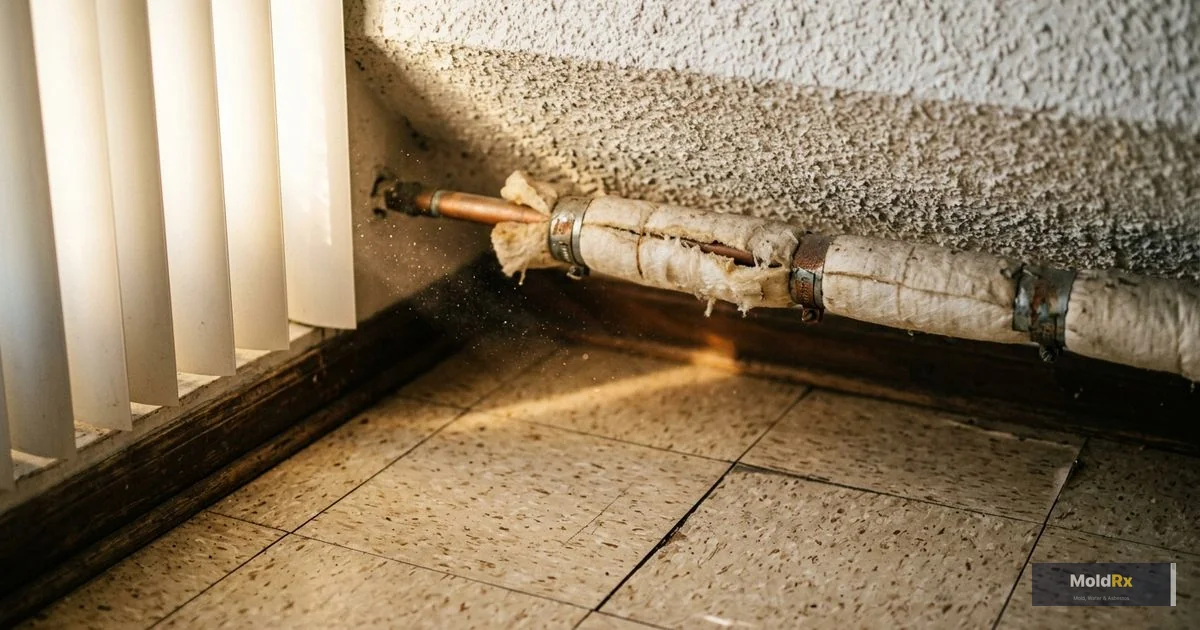
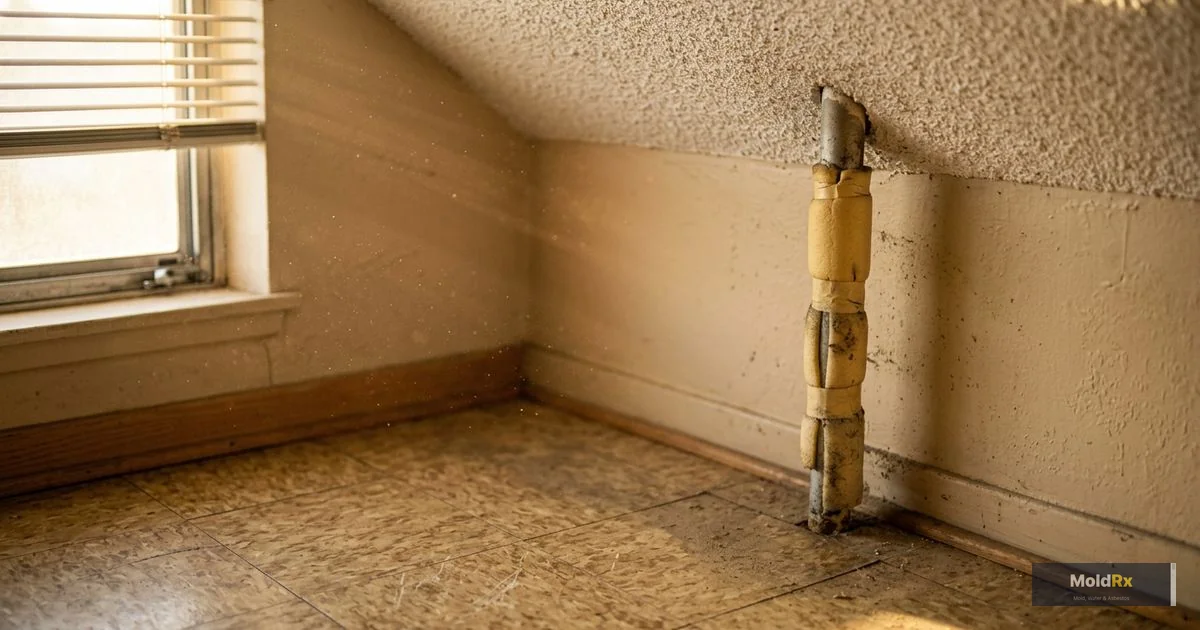
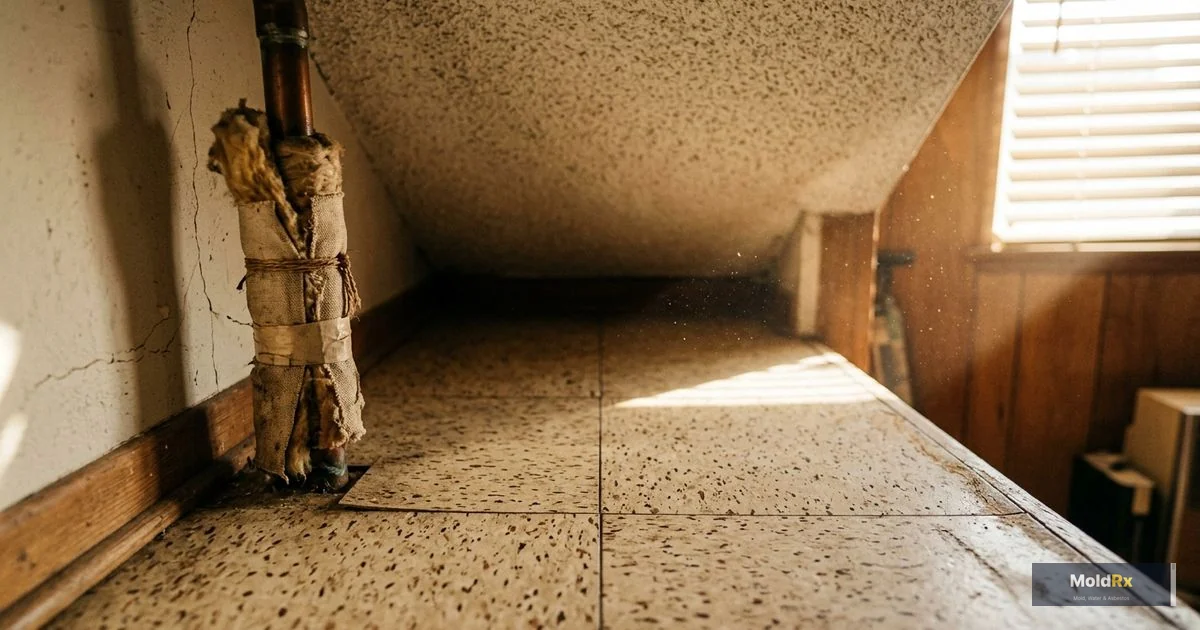
- Pipe insulation and duct wrapping — corrugated paper, felt, and plaster-type insulation on hot water pipes, heating supply lines, and HVAC components. Common in garages, crawlspaces, and utility areas.
- HVAC duct tape, mastic, and insulation — original 1960s ductwork frequently contains asbestos-bearing components.
- Roofing materials — asbestos cement shingles, rolled roofing, and felt underlayment. Original underlayment sometimes remains beneath newer layers after re-roofing.
- Exterior cement siding — valued for durability and fire resistance. Many homes retain original siding beneath later paint or stucco.
- Vermiculite attic insulation — some mid-century vermiculite was contaminated with naturally occurring asbestos from the Libby, Montana mine (marketed as Zonolite).
- Textured wall coatings, window glazing putty, electrical panel backing, and furnace components — all may test positive in homes from this era.
In a pre-1980 La Habra home, any original building material should be treated as potentially asbestos-containing until laboratory analysis demonstrates otherwise.
The Health Stakes: Why Testing Exists
Asbestos is classified as a known human carcinogen by the EPA, OSHA, the World Health Organization, and the International Agency for Research on Cancer. When asbestos-containing materials are intact and undisturbed, fibers remain bound within the material matrix and present no immediate airborne hazard. The danger begins at the moment of disturbance — scraping, sanding, sawing, drilling, breaking, or demolishing material releases microscopic fibers into the air. These fibers are invisible to the naked eye and can remain suspended for hours, traveling through HVAC systems and settling on surfaces throughout a home.
Once inhaled, asbestos fibers lodge deep in lung tissue and the body cannot expel them. Over years and decades, they can cause:
- Mesothelioma — an aggressive, incurable cancer of the pleural lining (lungs), peritoneum (abdomen), or pericardium (heart). Mesothelioma is caused almost exclusively by asbestos exposure.
- Asbestosis — progressive, irreversible scarring of the lung tissue that reduces breathing capacity over time. There is no cure.
- Lung cancer — asbestos exposure significantly elevates lung cancer risk, and the risk multiplies when combined with smoking.
The defining characteristic of asbestos-related disease is latency — typically 10 to 50 years between exposure and symptom onset. A La Habra homeowner who scrapes a popcorn ceiling this year without testing may not develop symptoms until the 2040s or 2060s. By then, the connection between the exposure and the disease is nearly impossible to trace.
This is precisely why testing exists. It eliminates the uncertainty. You learn what your home contains before you create the conditions that make asbestos dangerous.
The Regulatory Framework Governing Asbestos in La Habra
Federal: OSHA 1926.1101
The federal construction industry asbestos standard — 29 CFR 1926.1101 — classifies asbestos work into four tiers (Class I through IV), sets a permissible exposure limit of 0.1 fibers per cubic centimeter (8-hour TWA), and requires a competent person on every asbestos worksite. It defines "asbestos-containing material" as anything exceeding 1 percent asbestos by weight and treats thermal system insulation and surfacing materials in pre-1981 buildings as "presumed asbestos-containing material" (PACM) until proven otherwise by laboratory testing.
State: Cal/OSHA Section 1529
California's asbestos in construction standard — Title 8, CCR, Section 1529 — mirrors and in some areas exceeds the federal standard. It applies to all construction work involving asbestos, requires 24-hour advance notification to the nearest Cal/OSHA District Enforcement Office before work at a temporary worksite, and sets the same 0.1 f/cc PEL with a 1.0 f/cc excursion limit (30-minute average). Section 1529 also establishes the training requirements underlying DOSH registration for all California asbestos abatement contractors.
Regional: SCAQMD Rule 1403
La Habra falls within the South Coast Air Quality Management District. Rule 1403 is the regulation that most directly affects property owners:
- Mandatory asbestos survey before any renovation or demolition, regardless of building age or the owner's knowledge of materials. The only narrow exception: single-unit dwelling renovation disturbing less than 100 square feet of intact material.
- NVLAP-accredited laboratory analysis — all analytical work must be performed by laboratories holding National Voluntary Laboratory Accreditation Program accreditation from NIST.
- Notification to SCAQMD at least 10 working days before demolition or removal projects involving structures 100 square feet or larger.
- Licensed abatement following prescribed containment, handling, and disposal procedures if ACM is identified.
Non-compliance penalties can exceed $20,000 per day per violation.
AHERA Inspector Certification
SCAQMD Rule 1403 requires that asbestos surveys be conducted by a Cal/OSHA-certified inspector or a person holding an unexpired AHERA Building Inspector certificate from a Cal/OSHA-approved course. Our vetted professionals carry current AHERA certification and field experience specific to mid-century La Habra construction.
CSLB C-22 Abatement Licensing
When testing reveals materials requiring removal, California law mandates the work be performed by a contractor holding a C-22 Asbestos Abatement classification from the Contractors State License Board. C-22 licensees must have four years of journey-level experience, pass a trade examination, and maintain current DOSH registration under Section 1529. We explain this requirement when relevant — but we do not perform abatement ourselves.
Get your free estimate — testing gives you the facts before regulations become an emergency.
How Our Vetted Professionals Test La Habra Properties
Step 1: Project Scoping
Every engagement begins with understanding your situation — renovation scope, property age, materials of concern, timeline. This scoping ensures focused, efficient testing that covers what matters for your project without unnecessary sampling.
Step 2: On-Site Inspection and Sampling
A vetted, AHERA-certified inspector evaluates suspect materials and collects bulk samples following EPA protocols. Each material is wetted before extraction to suppress fiber release. Samples are sealed in individually labeled containers and documented with precise location, material type, and visual condition. Multiple samples are collected from each material type across different rooms, because building materials are not necessarily identical throughout a home.
Step 3: NVLAP-Accredited Laboratory Analysis
Samples go to a laboratory holding NVLAP accreditation from NIST — a requirement under SCAQMD Rule 1403, not an option. Two primary methods are used:
Polarized Light Microscopy (PLM) — the standard method for bulk material analysis. PLM identifies asbestos fibers by optical properties (refractive index, birefringence, dispersion staining, morphology), detects all six regulated fiber types (chrysotile, amosite, crocidolite, tremolite, actinolite, anthophyllite), and estimates concentration as a percentage of total material following EPA Method 600/R-93/116. When results fall between 1 and 10 percent, point counting provides a statistically validated measurement — critical because 1 percent is the regulatory threshold separating ACM from non-ACM.
Transmission Electron Microscopy (TEM) — higher magnification and sensitivity than PLM, used when optical results are inconclusive, extremely low concentrations require confirmation, or air monitoring samples need analysis. TEM is the EPA-mandated method for post-abatement clearance testing.
Step 4: Results and Guidance
You receive a written report documenting every sample — location, material, analytical method, fiber type if positive, and concentration. We interpret the results in plain language:
- No asbestos detected — documented clearance to proceed.
- Asbestos in materials that will not be disturbed — management in place with periodic monitoring, per EPA guidance.
- Asbestos in materials your project will disturb — CSLB C-22 licensed abatement required before construction, following SCAQMD Rule 1403 protocols.
- Asbestos in damaged materials — encapsulation, containment, or removal depending on severity.
When La Habra Property Owners Need Testing
Before any renovation or remodel — SCAQMD Rule 1403 makes the survey a legal prerequisite for disturbing materials in any structure. Kitchen remodels, bathroom updates, flooring replacement, popcorn ceiling removal, and HVAC upgrades all require testing first.
Before buying or selling — California disclosure laws require sellers to report known hazards. A testing report protects sellers from post-sale liability and gives buyers factual information about renovation costs and abatement needs.
When materials show visible damage — crumbling pipe insulation, flaking ceiling texture, cracking floor tiles. Age alone causes materials to degrade, and La Habra's housing stock is now 50 to 75 years old.
Before roof replacement — original underlayment often remains beneath newer layers. Testing before tear-off avoids regulatory complications from improperly handled asbestos waste.
After fire, water, or storm damage — emergencies can fracture materials that were previously intact and stable.
La Habra Neighborhoods We Serve
Our vetted specialists serve all residential and commercial properties in La Habra:
- Westridge — gated community with newer homes (circa 1999-2000); post-asbestos era but still evaluated for renovations or expansions
- Historic Downtown and Central La Habra — oldest structures (1920s-1930s) with the widest variety of potential asbestos-containing materials
- North La Habra and Country Hills — established 1960s neighborhoods with classic ranch homes
- West La Habra — mid-century housing near Beach Boulevard, increasingly targeted for renovation
- East La Habra — homes from the 1950s through 1970s along the Brea border
- South La Habra and the Coyote Hills corridor — residential areas adjacent to the former West Coyote oil field
We serve ZIP codes 90631 and 90633 and regularly work with homeowners in neighboring Fullerton, Brea, La Mirada, Whittier, and La Habra Heights.
Related Services in La Habra
In addition to asbestos testing, we also offer Mold Removal in La Habra, Asbestos Removal in La Habra, Water Damage Restoration in La Habra, and Mold Testing in La Habra services to La Habra property owners.
→ Learn more about remediation services in La Habra
Frequently Asked Questions
When is asbestos testing legally required in La Habra?
SCAQMD Rule 1403 mandates a professional asbestos survey before any renovation or demolition within the South Coast AQMD, regardless of building age. The only narrow exception is single-unit dwelling renovation disturbing less than 100 square feet of intact material. Beyond the legal mandate, testing is strongly recommended before purchasing a pre-1980 home, when materials show visible deterioration, and before any project involving walls, ceilings, floors, insulation, or roofing.
What laboratory methods are used to analyze samples?
Our NVLAP-accredited laboratories use two primary methods. Polarized Light Microscopy (PLM) identifies asbestos fibers by optical properties and estimates concentration following EPA Method 600/R-93/116. Transmission Electron Microscopy (TEM) provides higher sensitivity for inconclusive PLM results or air monitoring. Both satisfy OSHA 1926.1101, Cal/OSHA Section 1529, and SCAQMD Rule 1403 requirements.
What materials in a La Habra home are most likely to contain asbestos?
Given the dominant 1950s-1970s construction era, the highest-probability materials include popcorn ceiling texture, 9x9 vinyl floor tiles and black mastic adhesive, pipe and duct insulation, drywall joint compound, roofing felt and shingles, exterior cement siding, vermiculite attic insulation, and furnace components.
How are samples collected safely?
Our AHERA-certified inspectors wet each suspect material before extracting a small section, suppressing fiber release. The sample is sealed in a labeled container, and the extraction site is cleaned. Multiple samples may be collected across different rooms because materials are not necessarily identical throughout a home.
What happens if asbestos is found?
The response depends on the material's condition and whether your project will disturb it. Intact materials in good condition can be managed in place with periodic monitoring. Deteriorating materials may need encapsulation or removal. Materials in the path of renovation must be professionally abated by a CSLB C-22 licensed contractor before construction begins, following SCAQMD Rule 1403 protocols.
Can I encapsulate asbestos-containing material instead of removing it?
Encapsulation — applying a sealant, paint, or coating over asbestos-containing material — is a legitimate management strategy for materials in good condition that will not be physically disturbed in the future. It locks fibers in place without the disruption of full removal. However, encapsulation does not eliminate the asbestos. If the material is later scraped, drilled, cut, or demolished, the asbestos is still there underneath. Testing first determines whether asbestos is present at all, which dictates whether encapsulation, removal, or simple cosmetic treatment is the correct approach.
Who is qualified to perform an asbestos survey in La Habra?
Under SCAQMD Rule 1403 and Cal/OSHA requirements, surveys must be conducted by a Cal/OSHA-certified inspector or someone holding an unexpired AHERA Building Inspector certificate from a Cal/OSHA-approved course. This is not a job for a general home inspector or a contractor without specialized asbestos training. Our vetted professionals hold current AHERA certification, carry appropriate professional liability coverage, and have specific experience with the mid-century residential construction methods common throughout La Habra.
How long does asbestos testing take from start to finish?
The on-site inspection and sample collection typically takes one to three hours depending on property size and the number of materials being sampled. Laboratory analysis requires three to five business days for standard turnaround through our NVLAP-accredited lab. We review results with you as soon as they are available — usually within about a week of the on-site visit. Rush laboratory processing is available for time-sensitive projects such as real estate closings or permit deadlines.
Schedule Asbestos Testing in La Habra
La Habra's housing stock represents one of the densest concentrations of asbestos-era residential construction in North Orange County. The city was built during the exact decades when asbestos was most prevalent, and that history is embedded in the walls, floors, ceilings, pipes, ducts, and roofing of thousands of homes across every neighborhood.
That does not mean your home is dangerous today. It means that before you touch it — before you renovate, scrape, sand, cut, or demolish any original material — you need laboratory-confirmed information about what it contains. Professional asbestos testing provides that certainty.
Our vetted professionals know La Habra's housing patterns, understand the construction methods common during the city's building boom, and know where to look for materials others might miss. You will receive documented results from an NVLAP-accredited laboratory, honest interpretation of what those results mean, and practical guidance about your next steps.
If you own a pre-1980 La Habra property and you are planning any work, testing is the first step. If you are buying or selling, testing is the smart step. If you have noticed damaged materials, testing is the urgent step.
Call MoldRx to schedule your asbestos test — (888) 609-8907. Know before you start.