Emergency Water Damage Restoration in Jurupa Valley, CA — MoldRx
24/7 Emergency Water Damage Restoration Serving Jurupa Valley and Southwest Riverside County — Call Now, We Respond Immediately
Water is in your Jurupa Valley home right now, and it is not slowing down. Whether a pipe just burst in your wall, your water heater ruptured in the garage, or floodwater is pushing in from a storm — every single minute that water sits in contact with your building materials, the damage compounds. Drywall absorbs it. Subflooring swells. Insulation becomes saturated deadweight. And within 24 to 48 hours, mold begins colonizing every wet surface it can reach. This is an active emergency. Not tomorrow's problem. Right now.
MoldRx coordinates emergency water damage restoration through vetted specialists who know Jurupa Valley — the aging ranch homes in Rubidoux and Glen Avon, the equestrian properties in Mira Loma, the newer developments near Eastvale, and everything in between. We respond 24/7 because water damage does not care what time it is or what day of the week it falls on.
Do not wait. Contact MoldRx now for emergency water damage restoration in Jurupa Valley.
Why Water Damage in Jurupa Valley Is a Genuine Emergency
Jurupa Valley is one of California's youngest cities — incorporated in 2011 — but the homes and infrastructure here are anything but new. With a population of approximately 108,000 spread across nine distinct communities that were stitched together into a single municipality, the housing stock ranges from 1950s-era ranch properties with original plumbing to 2020s tract homes with modern systems. That range creates a uniquely dangerous landscape for water damage, because the risks are different depending on where in Jurupa Valley you live, how old your home is, and how close you are to the Santa Ana River.
And here is the fact that catches most Jurupa Valley homeowners off guard: the dry heat is not your friend. Summer temperatures regularly hit the mid-90s to low 100s, and average humidity sits well below coastal norms. Homeowners assume dry climate means low mold risk. That assumption is dead wrong. Mold does not care about outdoor humidity. Mold cares about the moisture trapped inside your walls, under your floors, and in your crawl spaces. In Jurupa Valley's heat, the surface may feel dry while deep moisture festers behind drywall for weeks, feeding mold colonies you cannot see until they have spread throughout your home.
The Age and Infrastructure Problem
The nine communities that form Jurupa Valley — Rubidoux, Glen Avon, Pedley, Mira Loma, Belltown, Crestmore Heights, Indian Hills, Jurupa Hills, and Sunnyslope — were developed at different times and under different standards. This patchwork history means water damage vulnerabilities vary block by block:
1950s-1970s homes (Rubidoux, Glen Avon, Pedley): These neighborhoods contain the oldest housing stock in Jurupa Valley. Many homes still have galvanized steel pipes that have been corroding from the inside for 50 to 70 years. The corrosion narrows pipe diameter — reducing water pressure first, then eventually causing pinhole leaks or catastrophic pipe failures. Original cast iron drain lines crack and separate. Slab foundations poured decades ago have shifted with the alluvial soils deposited by the Santa Ana River, stressing pipe connections and creating slab leaks that can run undetected for months. Water heaters in garages and outdoor utility closets have been replaced multiple times, but the supply lines connecting them often have not.
1980s-1990s homes (Jurupa Hills, portions of Mira Loma): These homes may have polybutylene supply pipes — a material now known to deteriorate from chlorine exposure and fail without warning. Copper pipes of this vintage are susceptible to pinhole leaks from soil chemistry and water mineral content. HVAC systems from this era are reaching or exceeding their functional lifespan, with condensate drain lines that clog, corrode, and overflow into attics and wall cavities.
2000s-2020s developments (eastern Mira Loma, Eastvale-adjacent areas): Newer construction with PEX plumbing and modern systems, but not immune. Appliance supply line failures, settlement-related foundation shifts, and improperly graded landscapes that direct stormwater toward foundations rather than away from them are the primary risks. These homes also feature the multi-story floor plans where a second-floor failure floods everything below it through wall cavities and ceiling assemblies.
Equestrian and Rural Properties: Unique Vulnerabilities
Jurupa Valley's equestrian heritage — particularly in Mira Loma — means large-lot properties with half-acre to multi-acre parcels, horse facilities, barns, and outbuildings. These properties face water damage risks that suburban tract homes do not:
- Well water systems with pressure tanks and supply lines that age and fail differently than municipal connections
- Septic systems that can back up during heavy rainfall or system failure, introducing Category 3 contaminated water into the home
- Detached structures — barns, workshops, guest houses — with independent plumbing that is often older and less maintained than the primary residence
- Irrigation systems for pastures and landscaping with buried supply lines that leak and saturate soil against foundations for extended periods before detection
- Longer response distances from plumbing and restoration services, giving water more time to spread before professional equipment arrives
The Santa Ana River: Jurupa Valley's Defining Flood Risk
The Santa Ana River runs along Jurupa Valley's southern boundary, and its presence defines the flood risk profile for a significant portion of the city. Approximately 29% of buildings in Jurupa Valley are at risk of flooding — a staggering number that reflects both the river corridor exposure and the low-lying topography of communities built on the river's historic alluvial floodplain.
The flood risk is not theoretical. On March 5, 2025, the Jurupa Valley Emergency Management Department issued a flooding alert for the Santa Ana River bottom due to incoming rainfall — the kind of event that sends floodwater into properties in Rubidoux, Glen Avon, and other river-adjacent neighborhoods.
A major Santa Ana River levee rehabilitation project is currently underway to protect more than 4,300 structures — over 4,000 of them residential — in Riverside and Jurupa Valley. Construction restarted in April 2025 with an estimated four-year timeline. Until that project is complete, the flood risk for river-corridor properties remains elevated.
When the Santa Ana River rises or when winter storms overwhelm drainage infrastructure:
- Floodwater intrusion is Category 3 contamination — sewage, agricultural runoff, chemical contaminants, and debris. This is not clean water. Every material it touches requires either specialized decontamination or complete removal.
- Alluvial soil saturates rapidly, undermining foundations, flooding crawl spaces, and pushing groundwater up through slab cracks
- Municipal storm drains and channels designed for the area's typical low rainfall capacity are overwhelmed during intense events, causing street flooding that enters properties through garages, doorways, and foundation penetrations
Climate: Extreme Heat and Concentrated Rainfall
Jurupa Valley's climate amplifies every water damage event:
- Summer temperatures of 95 to 105+ degrees bake the exterior dry while trapped interior moisture creates ideal mold incubation conditions behind walls and under floors
- Annual rainfall of 10 to 12 inches arrives almost entirely between November and March, often in intense bursts that overwhelm aging drainage systems
- Soil expansion and contraction from extreme temperature swings stresses slab foundations, opening gaps and cracks that water exploits during the next rain event or plumbing failure
- Extended dry periods create hardpan soil surfaces that reject stormwater rather than absorbing it, increasing surface runoff and flooding potential around structures
Common Causes of Emergency Water Damage in Jurupa Valley
- Galvanized pipe failures in pre-1980 homes — corroded pipes that burst without warning, flooding rooms in minutes
- Slab leaks from foundation shifting on alluvial soils — silent destroyers that saturate subflooring and breed hidden mold for weeks before detection
- Water heater ruptures in garages and utility areas — 40 to 80 gallons of instant flooding that migrates into adjacent living spaces
- Polybutylene pipe failures in 1980s-1990s homes — chlorine-degraded supply lines that split and fail catastrophically
- Appliance supply line failures — washing machines, dishwashers, refrigerator ice makers with rubber hoses that crack and burst
- Santa Ana River flooding and storm surge — Category 3 contaminated water requiring biohazard protocols
- Septic system backups on rural and equestrian properties — hazardous contamination requiring immediate specialized response
- HVAC condensate overflow — clogged drain lines dumping water into attics and ceiling cavities
- Irrigation system leaks — buried supply lines saturating foundations on large-lot properties
- Roof failures — deteriorated flashing, cracked tiles, and compromised penetrations that allow storm water direct access to attic spaces and interior walls
Our Emergency Water Damage Restoration Process in Jurupa Valley
This is not a scheduled appointment. When you call MoldRx about water damage in your Jurupa Valley property, this is an emergency response — designed to stop the destruction, eliminate every trace of moisture, and prevent the mold colonization that turns a water damage event into a far more expensive remediation project.
Phase 1: Immediate Emergency Response and Damage Assessment
Vetted specialists arrive understanding that time is the critical variable. Every hour of delay increases damage scope, restoration cost, and mold risk.
- Locate and stop the water source — shutoff valves, emergency plumbing coordination, or sandbagging for flood events
- Comprehensive documentation begins immediately — photos, video, written observations, and moisture readings captured before any mitigation work starts, ensuring your insurance claim is supported from minute one
- Moisture mapping with professional instruments — moisture meters and thermal imaging cameras identify water migration through wall cavities, under flooring, into ceiling assemblies, and along structural members far beyond the visible damage area
- Water category classification: Category 1 (clean water from supply lines), Category 2 (grey water from appliance discharge or HVAC), or Category 3 (black water from sewage, septic, or flood sources) — this classification dictates safety protocols, personal protective equipment requirements, and which materials can be salvaged versus which must be removed and disposed of
For Jurupa Valley's rural and equestrian properties, this assessment extends to detached structures, well systems, septic proximity, and soil saturation around foundations — factors that suburban restoration companies often overlook entirely.
Phase 2: Emergency Water Extraction
Standing water must be removed as fast as physically possible. Every minute it remains, it is being absorbed deeper into building materials, increasing the scope of structural drying required and decreasing the likelihood of saving flooring, drywall, and other finish materials.
- Truck-mounted extraction units for high-volume water removal — critical for flood events and major pipe failures
- Portable submersible pumps for significant standing water in garages, crawl spaces, and low-lying areas
- Weighted carpet extraction tools that pull water from padding without requiring full carpet removal
- Hard surface extractors for tile, vinyl, laminate, and concrete surfaces
- Crawl space extraction — many older Jurupa Valley homes have raised foundations with crawl spaces that trap floodwater and become mold incubators if not extracted and dried
For flood events involving Santa Ana River water or septic contamination, extraction includes contaminated water handling protocols — proper containment, disposal in accordance with health department regulations, and immediate antimicrobial treatment of all contacted surfaces.
Phase 3: Structural Drying and Dehumidification
This is the phase that determines whether your water damage event stays a water damage event or becomes a mold remediation project. There are no shortcuts here that do not cost you more in the long run.
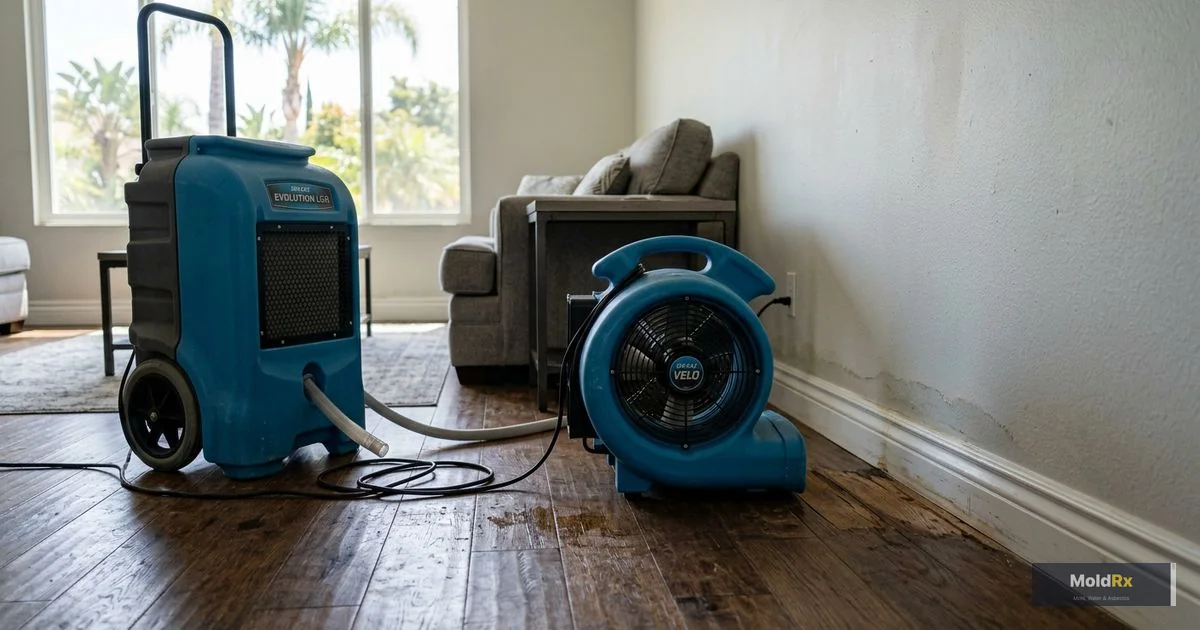
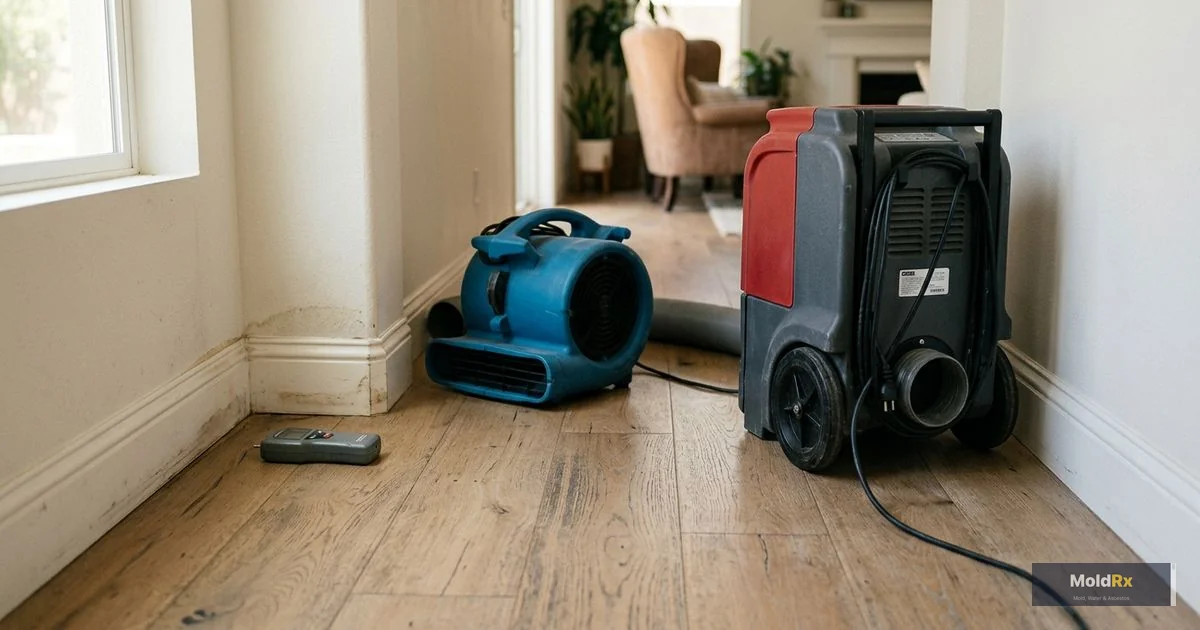
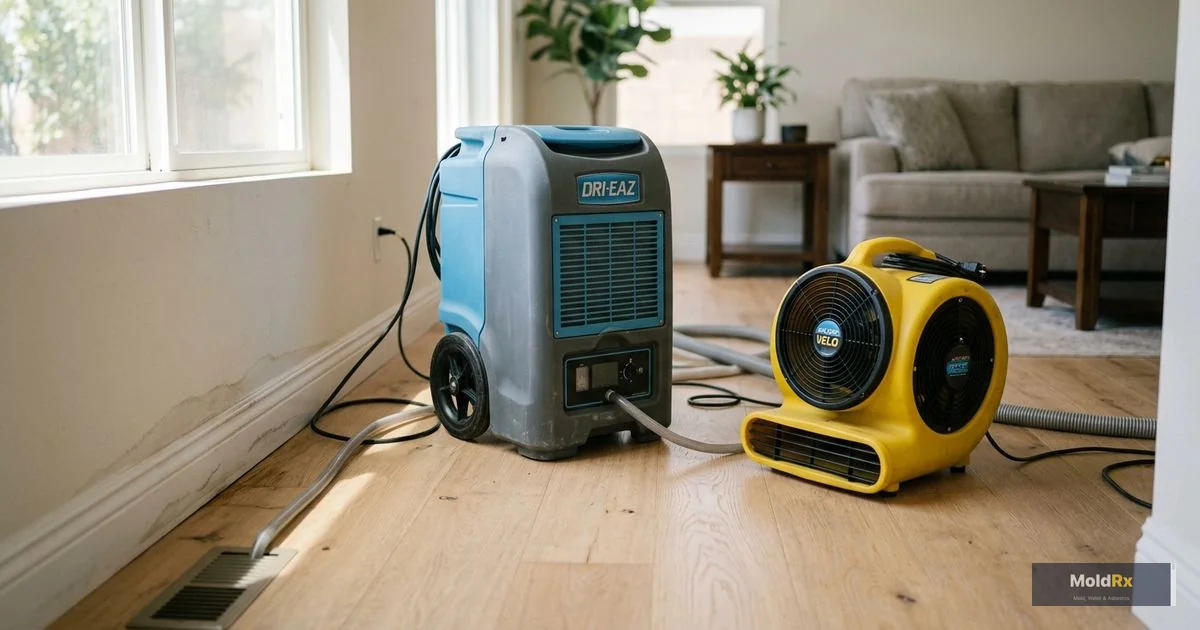
- Industrial air movers create targeted airflow patterns that draw moisture from saturated building materials — positioned and repositioned based on daily moisture readings, not guesswork
- Commercial dehumidifiers remove moisture from the air, preventing the evaporation-reabsorption cycle that extends drying times and leaves residual moisture in materials
- Injectidry and cavity drying systems force dry air into wall cavities, under cabinets, inside ceiling assemblies, and through other enclosed spaces that conventional air movers cannot reach
- Daily moisture monitoring using calibrated moisture meters documents drying progress at multiple points throughout the affected area, ensuring every material reaches the moisture content levels specified by IICRC S500 professional standards
Critical for Jurupa Valley properties: Do not open windows and rely on the dry desert air to handle drying. Uncontrolled drying causes uneven moisture removal — surfaces dry while deep structural moisture remains trapped. This is how warping, cracking, and hidden mold growth occur. Professional controlled drying is the only reliable path to verified dry conditions.
Structural drying typically requires 3 to 5 days for contained events and 7 to 14 days for major flooding or multi-room saturation. The timeline is dictated by moisture meter readings, not a calendar. The job is done when the numbers confirm it is done.
Phase 4: Cleaning, Sanitization, and Restoration
Once drying is verified complete:
- Antimicrobial application to all affected surfaces prevents mold colonization during the vulnerable period between drying completion and reconstruction
- Salvageable materials that dried within acceptable parameters and timeframes are cleaned, treated, and preserved
- Non-salvageable materials — saturated insulation, compromised drywall, delaminated flooring, anything contacted by Category 3 water — are removed, properly disposed of, and replaced
- Air quality verification confirms the indoor environment meets safety standards for occupancy
- Complete documentation package compiled — moisture logs, photo documentation, equipment records, materials inventory, and itemized work reports ready for insurance submission
What to Expect When You Call MoldRx for Jurupa Valley Water Damage
-
Immediate emergency response — 24/7, no exceptions. Water damage at 3 a.m. on a Sunday is no less urgent than water damage at noon on a Tuesday. Our vetted professionals respond accordingly.
-
Honesty about the scope of what you are facing. If the damage is contained and manageable, you will hear that — we are not going to manufacture urgency to inflate the job. If the damage is extensive, if mold is already present, if contaminated water is involved, you will hear that too. No sugarcoating, no hedging. You get the facts so you can make informed decisions.
-
Communication you can actually understand. Daily updates, moisture readings explained in plain language, timeline expectations based on data rather than optimism. You will know what is happening in your property and why each step is necessary.
-
Insurance documentation that does the heavy lifting for your claim. Water damage claims succeed or fail based on documentation quality. Our specialists produce detailed evidence packages — photos, moisture maps, equipment logs, material inventories, contamination classifications — as a standard part of every emergency response.
-
Mold prevention as the overriding priority in every decision. In Jurupa Valley's climate, the combination of trapped moisture and high temperatures creates ideal mold incubation conditions. Every drying decision, every material removal threshold, every antimicrobial application is made to ensure mold does not become your next — and far more expensive — problem.
Jurupa Valley Neighborhoods and Areas We Serve
Our vetted water damage restoration specialists respond to emergencies across every Jurupa Valley community:
Rubidoux — older homes with aging galvanized and copper plumbing, proximity to the Santa Ana River floodplain, elevated flood risk during winter storms.
Glen Avon — low-density residential with 1960s-1970s construction, original slab foundations, and aging water and sewer infrastructure.
Pedley — established neighborhood with mixed-era housing stock, mature landscaping with irrigation systems that stress foundations, and proximity to flood control channels.
Mira Loma — equestrian and rural properties on half-acre to multi-acre lots, well water and septic systems, detached structures with independent plumbing, and deep alluvial soils from the Santa Ana River floodplain.
Jurupa Hills, Indian Hills, Belltown, Crestmore Heights, Sunnyslope, and Sky Country — diverse residential communities ranging from mid-century homes to newer developments, each with location-specific water damage profiles.
We cover ZIP codes 92509, 91752, and 91761, and respond to emergencies in neighboring communities including Riverside to the east, Norco to the south, Eastvale to the west, and Fontana to the north.
Whether you own a single-family home, manage a multi-unit property, operate a commercial building, or own a rural equestrian estate in Jurupa Valley — we coordinate restoration services matched to your specific property type, construction era, and situation.
Related Services in Jurupa Valley
Water damage that is not addressed with full urgency and thoroughness leads directly to mold growth — and in Jurupa Valley's heat, that timeline is accelerated. We also offer Mold Removal in Jurupa Valley, Asbestos Removal in Jurupa Valley, Mold Testing in Jurupa Valley, and Asbestos Testing in Jurupa Valley services to Jurupa Valley property owners.
→ Learn more about remediation services in Jurupa Valley
Frequently Asked Questions
How fast can you respond to a water damage emergency in Jurupa Valley?
We treat every water damage call as what it is — an active emergency. Our vetted specialists respond to Jurupa Valley properties as quickly as possible, with the goal of beginning extraction within hours. This includes nights, weekends, and holidays. Jurupa Valley's spread-out geography means some areas are further from staging locations than others, but the response priority is always immediate. The faster extraction begins, the less you pay in total restoration costs.
My home in Rubidoux flooded from a storm. Is floodwater different from a pipe burst?
Completely different, and this distinction is critical. Stormwater and Santa Ana River floodwater is classified as Category 3 — black water — meaning it contains sewage, agricultural contaminants, chemical pollutants, and biological hazards. Every material it contacts requires either specialized decontamination or complete removal. The safety protocols, equipment, and disposal requirements are far more extensive than a clean water pipe burst. Our specialists are equipped and trained for Category 3 contamination response, including proper personal protective equipment, containment procedures, and disposal in compliance with health regulations.
Will my insurance cover flood damage in Jurupa Valley?
Standard homeowner's insurance policies typically do not cover external flooding — including Santa Ana River flooding and stormwater intrusion. Flood coverage requires a separate policy, usually through the National Flood Insurance Program (NFIP) or a private flood insurer. However, most policies do cover sudden and accidental interior water damage from burst pipes, appliance failures, and water heater ruptures. Regardless of coverage specifics, thorough documentation is essential. Our specialists produce comprehensive evidence packages for every emergency response.
How long does water damage restoration take in Jurupa Valley?
The timeline is determined by the severity of water intrusion, the materials affected, and the water category. A contained pipe burst affecting one or two rooms may require 3 to 5 days of drying. Major flooding, multi-room saturation, or Category 3 contamination events can require 10 to 14 days of structural drying plus additional time for reconstruction. We base timelines on moisture meter data, not optimistic estimates. The job is complete when verified dry conditions are achieved.
I have an equestrian property in Mira Loma with well water and a septic system. Does that change the restoration approach?
Significantly. Properties with well water systems and septic have additional vulnerabilities and contamination risks that standard suburban restoration protocols do not account for. Septic backup introduces Category 3 contamination requiring specialized handling. Well pump failures can cause both supply interruption (preventing flushing of drain lines) and pressure surge damage. Our specialists assess the full property infrastructure — including detached structures, well houses, and septic proximity — during the initial emergency assessment.
Can I dry out my Jurupa Valley home myself with fans and open windows?
No. This is one of the most costly mistakes homeowners make, and Jurupa Valley's dry heat makes the temptation even stronger. Opening windows and running household fans creates uncontrolled drying that removes surface moisture while leaving deep structural moisture trapped inside walls, subfloors, and framing. The result looks dry but is not. Hidden moisture feeds mold growth for weeks before visible signs appear. Professional structural drying using industrial equipment, controlled airflow, and daily moisture monitoring is the only way to achieve verified dry conditions that prevent mold colonization.
Act Now — Water Damage in Jurupa Valley Escalates Fast
If water is in your Jurupa Valley home right now, the clock is already running against you. Mold colonization begins within 24 to 48 hours. Structural damage compounds by the hour. Jurupa Valley's extreme heat accelerates moisture-related deterioration inside wall cavities and under floors. The cost of restoration is increasing right now, while you are reading this page.
MoldRx coordinates water damage restoration through vetted professionals who know Jurupa Valley properties — the galvanized pipes in Rubidoux, the equestrian estates in Mira Loma, the flood exposure along the Santa Ana River corridor, and the climate factors that make professional drying non-negotiable. We respond immediately because that is what this situation demands.
Contact MoldRx now for emergency water damage restoration in Jurupa Valley. 24/7 response. Honest assessment. Professional execution. No delay, no runaround — just the urgent, qualified response your property needs right now.