Asbestos Testing in Jurupa Valley, CA — MoldRx
Vetted Asbestos Testing Specialists Serving Jurupa Valley and Western Riverside County
Jurupa Valley is one of the most structurally diverse cities in the Inland Empire. Incorporated on July 1, 2011, by combining nine previously unincorporated communities — Rubidoux, Glen Avon, Pedley, Mira Loma, Sunnyslope, Belltown, Indian Hills, Crestmore Heights, and Jurupa Hills — the city spans roughly 44 square miles and serves approximately 115,000 residents across ZIP codes 92509 and 91752.
That patchwork origin produced a housing stock unlike almost any other Southern California community. Between the 1940s worker cottages in Rubidoux, the mid-century ranch homes in Glen Avon, the converted agricultural buildings in Mira Loma, and the equestrian estates with multiple outbuildings throughout the city, Jurupa Valley properties span nearly every construction era that overlapped with peak asbestos use in America. The median construction year for Jurupa Valley housing is 1980 — placing the majority of the city's 28,400+ housing units squarely in the window when asbestos-containing materials were standard in residential, commercial, and agricultural construction. Professional asbestos testing is the only way to know what is in your building materials before renovation, demolition, or any project that disturbs existing construction.
Why Jurupa Valley's History Makes Asbestos Testing Essential
Nine Communities, Nine Construction Timelines
In 1838, this land became Rancho Jurupa under a Mexican land grant to Don Juan Bandini. What followed was more than 170 years of development that unfolded differently in each community — and each timeline carries different asbestos implications.
Rubidoux, originally known as West Riverside, is the oldest community in the city. Homes dating to the 1940s and 1950s make this the highest asbestos risk zone — materials have been in place for 70 to 80+ years, enough time for adhesives, insulation, and roofing to deteriorate under Inland Empire heat.
Glen Avon, established as Glen Avon Heights in 1909, developed through the mid-20th century. One-story ranch homes from the 1950s and 1960s are prevalent, many with detached garages and workshops built with the same asbestos-era materials.
Pedley evolved as a semi-rural community with homes from the 1950s onward, frequently featuring detached garages, workshops, and accessory structures that each require independent evaluation.
Mira Loma, originally named Wineville (renamed November 1, 1930), was primarily an agricultural community for decades. The conversion of farmland to residential and industrial use means properties range from converted farm structures to mid-century tract homes to modern logistics warehouses. Older agricultural buildings commonly contain asbestos cement panels and industrial-grade insulation.
Sunnyslope, Belltown, Indian Hills, Crestmore Heights, and Jurupa Hills round out the city, each contributing homes from different construction periods including foothill properties spanning multiple building eras.
The Equestrian and Rural Property Factor
Jurupa Valley is known for its equestrian character — large-lot rural residential zoning is common, and the city's General Plan prioritizes preserving this heritage. This creates an asbestos testing situation fundamentally different from a typical suburban community. A standard tract home has one structure to evaluate. A Jurupa Valley equestrian property may have four, five, or more:
- Main residences from the 1950s or 1960s with standard residential asbestos-containing materials
- Barns and stables commonly built with corrugated asbestos cement roofing panels, cement siding, and industrial insulation
- Casitas and ADUs — multi-generational housing units that may contain asbestos if built before 1980
- Workshops and tack rooms — concrete block structures with asbestos cement roofing, older insulation, and fireproofing materials
- Covered arenas and equestrian facilities with mechanical systems incorporating asbestos-containing gaskets, seals, and insulation
Testing every structure that will be disturbed is not optional under California law — it is a regulatory requirement.
The Industrial and Logistics Corridor
Jurupa Valley's location along Interstates 15, 10, and 215 has made the Mira Loma area one of the Inland Empire's most active logistics corridors. Older commercial and industrial properties that predate this modern warehouse era may contain asbestos in spray-on fireproofing, thermal insulation on boilers and piping, ceiling tiles, transite panels, and electrical panel components. Business owners should be aware of testing requirements before any renovation, tenant improvement, or demolition of older commercial structures.
Where Asbestos Hides in Jurupa Valley Properties
In a pre-1980 Jurupa Valley home or building, asbestos-containing materials can be found throughout the structure. None can be identified as asbestos-containing or asbestos-free by visual inspection — only NVLAP-accredited laboratory analysis provides a definitive answer.
- Popcorn ceilings and textured coatings — Often containing chrysotile asbestos at 2 to 10 percent concentration
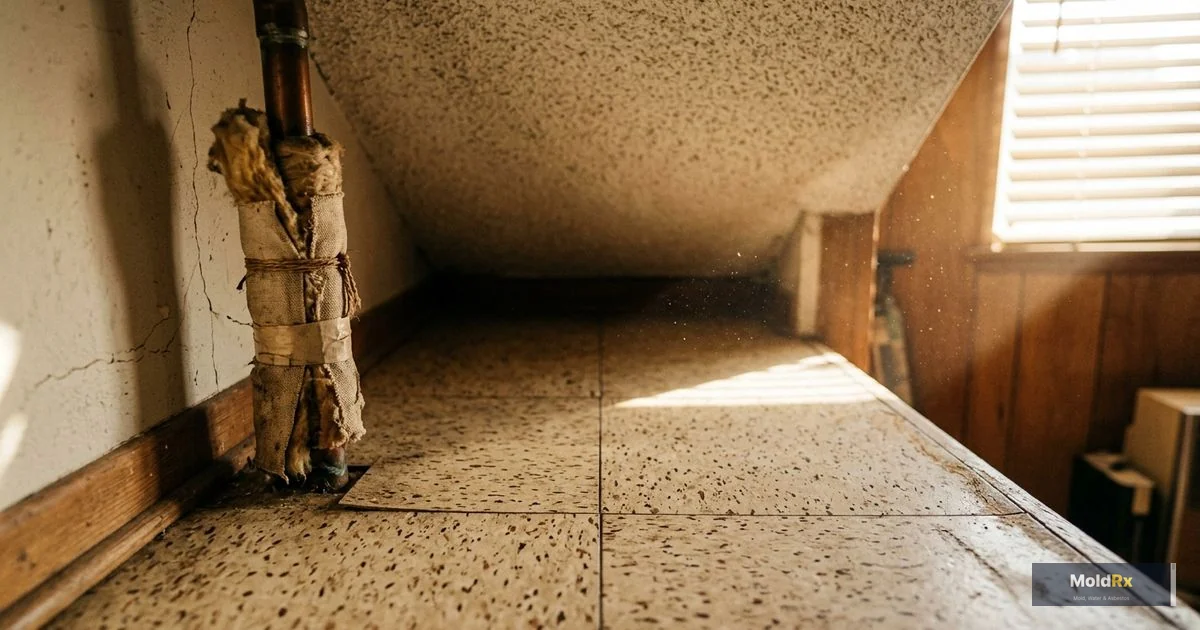
- 9x9-inch vinyl floor tiles and black mastic adhesive — Among the most commonly identified asbestos materials in Inland Empire homes
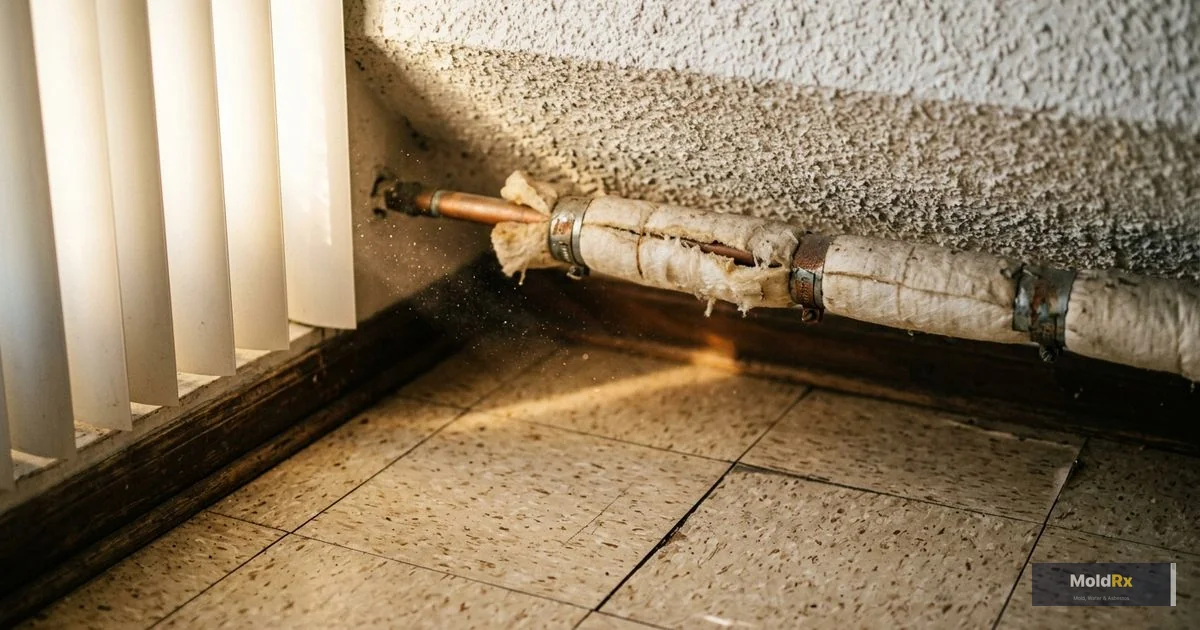
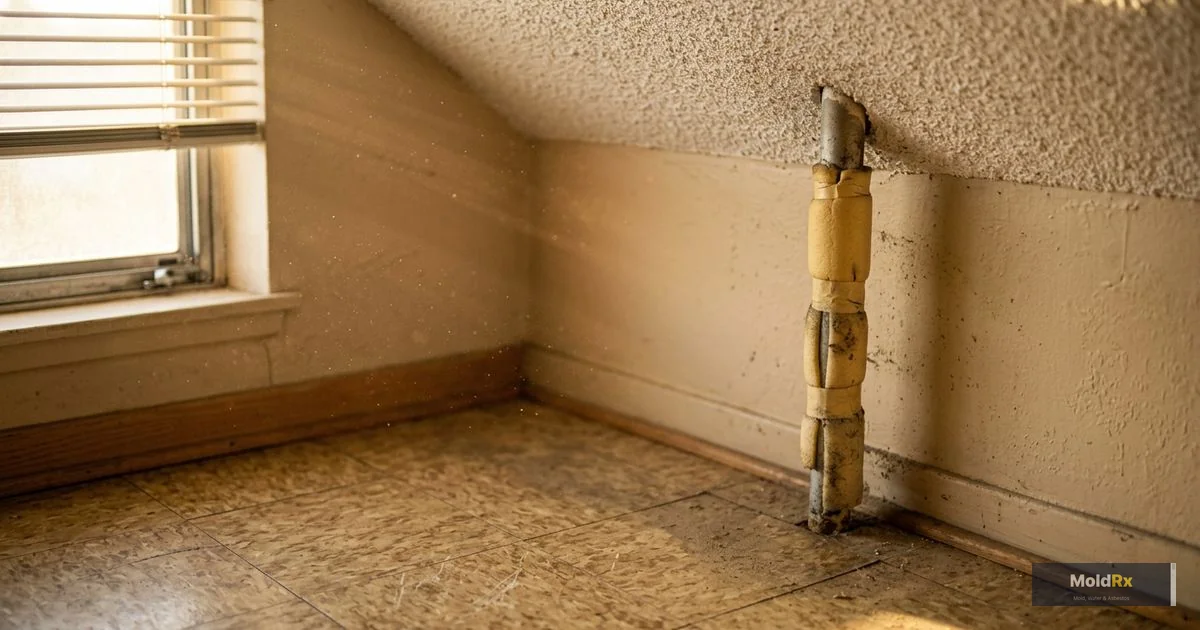
- Pipe insulation and duct wrapping — Corrugated insulation around hot water pipes, boiler connections, and HVAC ductwork
- HVAC duct tape, connectors, and gaskets — In older forced-air systems running hard through Jurupa Valley's hot summers
- Roofing shingles, felt underlayment, and flashing — Including corrugated cement panels on agricultural outbuildings
- Drywall joint compound — Invisible once painted, hazardous when walls are sanded, cut, or demolished
- Cement siding and exterior stucco — Fiber-cement products reinforced with chrysotile asbestos
- Vermiculite attic insulation — Loose-fill insulation potentially contaminated with tremolite asbestos
- Transite panels and cement board — Used extensively in agricultural and industrial buildings
- Window glazing putty and exterior caulking — Older sealants that become brittle and crumble with age
The Health Case for Testing Before Disturbing Materials
Asbestos fibers are microscopic — up to 700 times thinner than a human hair. When materials containing these fibers are cut, sanded, scraped, or broken, the fibers become airborne and can remain suspended in indoor air for hours. Once inhaled, they lodge deep in lung tissue where the body cannot expel or dissolve them.
The health consequences develop over 20 to 50 years: mesothelioma (an aggressive cancer of the lung or abdominal lining), asbestosis (irreversible lung scarring), lung cancer (elevated risk, compounded by smoking), and pleural thickening (permanent changes to the lung lining).
A homeowner who tears out old flooring in a Rubidoux ranch home or scrapes a popcorn ceiling in a Glen Avon tract house without testing can inhale a concentrated dose of fibers and feel fine for decades before disease manifests. Testing before disturbance is the only reliable prevention.
Jurupa Valley's Climate and Material Deterioration
Jurupa Valley's hot-summer Mediterranean climate brings summer temperatures regularly reaching the mid-90s to low 100s with only about 18 to 19 inches of annual rainfall. This accelerates the aging of older building materials in ways that directly affect asbestos risk.
- Extreme heat cycles cause asbestos-cement shingles, corrugated cement panels, and fiber-cement siding to expand and contract daily, creating microfractures over decades that allow fibers to separate from the material matrix
- Persistent dryness causes adhesives, caulking, insulation, and joint compounds to become brittle and friable faster than in coastal environments
- Heavy HVAC use means older systems with asbestos-containing duct insulation and tape circulate air past deteriorating materials month after month during the extended hot season
- Santa Ana winds create pressure differentials that can draw fibers from deteriorating materials in attics and wall cavities into occupied living areas
- Outdoor structures weather faster — barns, stables, and workshops that are not climate-controlled experience the full intensity of Jurupa Valley's heat and UV exposure
Regulatory Requirements That Apply to Jurupa Valley Properties
Jurupa Valley falls under overlapping federal, state, and regional asbestos regulations. Understanding these requirements before you begin a project protects you from both health hazards and legal liability.
AHERA (Asbestos Hazard Emergency Response Act). Enacted in 1986, AHERA established the inspector accreditation standards and laboratory protocols that apply across all professional asbestos testing. It requires that laboratories hold accreditation through the NIST National Voluntary Laboratory Accreditation Program (NVLAP) and that inspectors hold an unexpired AHERA Building Inspector certificate.
OSHA 29 CFR 1926.1101. The federal construction asbestos standard, OSHA 1926.1101, requires building owners to identify asbestos-containing materials before any construction, renovation, or demolition and sets a permissible exposure limit of 0.1 f/cc over an 8-hour time-weighted average.
Cal/OSHA Title 8, Section 1529. California's parallel standard, Cal/OSHA Title 8 §1529, mirrors and in several areas exceeds federal requirements. It mandates identification of asbestos-containing materials before any disturbance, classifies asbestos work into four risk classes, and requires specific training and medical surveillance. Enforcement applies to all Jurupa Valley properties.
SCAQMD Rule 1403. Jurupa Valley falls within the South Coast Air Quality Management District. SCAQMD Rule 1403 governs asbestos emissions from demolition and renovation and requires:
- An asbestos survey before any demolition or renovation, regardless of building age or scope
- Written notification to SCAQMD at least 10 working days before projects involving 100+ square feet of asbestos-containing material or any demolition
- Sampling and analysis by NVLAP-accredited laboratories using approved PLM methodology
- Wet removal methods, proper containment, and approved disposal
- Violations carry fines reaching tens of thousands of dollars and potential project shutdown
CSLB C-22 Licensing. When testing reveals asbestos requiring abatement, California law mandates removal by a contractor holding a CSLB C-22 (Asbestos Abatement) license. C-22 licensees must maintain active DOSH registration and meet training requirements under Cal/OSHA Title 8 §1529. MoldRx only sends vetted professionals who understand the full regulatory chain from testing through clearance.
Riverside County and Jurupa Valley Permits. The Jurupa Valley planning division or Riverside County building department may require asbestos testing documentation as part of the permit process for renovation or demolition of older structures. California also requires property sellers to disclose known hazardous materials, making testing documentation a practical asset in any transaction involving pre-1980 properties.
How Professional Asbestos Testing Works in Jurupa Valley
Step 1: Property Assessment and Sample Planning
A qualified specialist evaluates your Jurupa Valley property to identify every material that may contain asbestos — including less obvious suspects like adhesives, window glazing putty, electrical panel backing, and transite panels in agricultural structures. For multi-structure properties, the assessment covers every building your project will affect. If certain structures or materials do not need testing, we will tell you.
Step 2: Safe Sample Collection
Samples are collected following EPA NESHAP and Cal/OSHA protocols designed to prevent fiber release:
- Each suspect material is wetted before sampling to suppress fiber dispersal
- Samples are collected using specialized tools with minimal disturbance
- Each sample is sealed in a labeled container with documented location, structure identification, and condition assessment
- Chain-of-custody documentation tracks each sample from collection through laboratory delivery
Improper sampling can release fibers into your living space and transform a contained material into an active airborne hazard. Professional collection prevents this. On-site work typically takes one to three hours for a standard property, with additional time for multi-structure parcels.
Step 3: NVLAP-Accredited Laboratory Analysis
Samples are submitted to a laboratory holding NVLAP accreditation for bulk asbestos analysis, as required by both AHERA and SCAQMD Rule 1403. The primary analytical method is polarized light microscopy (PLM), which identifies asbestos fiber type (chrysotile, amosite, crocidolite, tremolite, anthophyllite, or actinolite), estimated concentration (materials at or above 1% are regulated under both federal and California standards), and fiber condition.
For situations requiring greater sensitivity — air monitoring during abatement or inconclusive PLM results — transmission electron microscopy (TEM) provides detection at much lower fiber concentrations. AHERA specifically requires TEM for post-abatement air clearance in school buildings.
Standard PLM results are typically available within 3 to 5 business days. Rush processing can deliver results within 24 hours.
Step 4: Report Delivery and Honest Next-Steps Guidance
Your report provides a material-by-material, structure-by-structure breakdown with laboratory results, condition assessments, and clear recommendations:
- Materials confirmed asbestos-free — Cleared for work without asbestos-specific precautions
- Asbestos-containing materials in good condition — Can be managed in place through periodic monitoring
- Damaged or soon-to-be-disturbed asbestos materials — Require abatement by a CSLB C-22 licensed contractor before other trades begin
- Regulatory documentation satisfying SCAQMD Rule 1403, Cal/OSHA Title 8 §1529, and OSHA 1926.1101
For multi-structure properties, the report covers each building individually. Not every positive result requires immediate removal — honest guidance means telling you when management in place is the right approach and when abatement is genuinely necessary.
When Jurupa Valley Property Owners Need Asbestos Testing
Before Any Renovation or Demolition
If your Jurupa Valley home, outbuilding, or commercial building was constructed before 1980, California regulations require asbestos identification before work that could disturb suspect materials. SCAQMD Rule 1403 requires a survey regardless of project size, with limited exceptions for minor residential work under 100 square feet of intact material.
Before Buying or Selling Property
Buyers planning renovations on a pre-1980 property need test results before committing to a budget — particularly for equestrian properties where the main home may be the least expensive structure to address. Sellers benefit from proactive testing that satisfies California disclosure requirements.
When Converting Agricultural or Industrial Structures
Agricultural building conversions are among the most important situations for asbestos testing in Jurupa Valley. Older farm buildings, dairy structures, and equipment sheds commonly contain asbestos cement panels and industrial insulation at higher concentrations than residential products. Both Cal/OSHA Title 8 §1529 and SCAQMD Rule 1403 require a survey before this type of work begins.
When You Discover Damaged Materials or After Property Damage
Crumbling ceiling texture, cracked floor tiles, fraying insulation, or deteriorating roofing in a pre-1980 property should prompt testing. Similarly, flooding, fire, or seismic events can disturb previously stable asbestos-containing materials. Testing should be part of any damage assessment before restoration work begins.
What Materials Should Be Tested on a Jurupa Valley Property
Main Residence
Flooring: Vinyl tiles (9x9-inch and 12x12-inch), sheet vinyl, and black mastic adhesive. Ceilings: Popcorn and acoustic textures, ceiling tiles. Insulation: Pipe wrap, duct insulation, HVAC tape, and vermiculite loose-fill in attics. Walls: Joint compound, textured finishes, and plaster in older sections. Exterior: Roof shingles, felt, cement siding, stucco, window putty, and caulking. Mechanical: Furnace gaskets, duct connectors, water heater components.
Outbuildings, Barns, and Equestrian Structures
Roofing and siding: Corrugated asbestos cement panels, built-up roofing, and composition shingles. Insulation and mechanical: Pipe insulation, duct wrapping, gaskets, and seals in heated structures including wash racks and tack rooms. Walls: Transite board and cement board panels. Flooring: Vinyl tiles or sheet vinyl in finished workshop or tack room areas.
Commercial and Industrial Properties
Spray-on fireproofing, thermal insulation on boilers and piping, ceiling tiles, floor tiles, and electrical panel components. Older buildings along Mission Boulevard, Limonite Avenue, and the logistics corridors should be evaluated before any tenant improvement or demolition project.
Jurupa Valley Areas We Serve
MoldRx only sends vetted asbestos testing professionals to properties throughout Jurupa Valley, covering ZIP codes 92509 and 91752:
- Rubidoux — The oldest community, homes dating to the 1940s and 1950s with the highest asbestos risk
- Glen Avon — Mid-century ranch homes and larger properties with outbuildings
- Pedley — Semi-rural properties with homes from the 1950s onward and multiple accessory structures
- Mira Loma — The widest range of property types, from converted farm structures to mid-century homes to modern logistics facilities
- Sunnyslope, Belltown, and Indian Hills — Residential communities with varying housing ages
- Crestmore Heights and Jurupa Hills — Foothill and hillside properties spanning multiple building eras
- Properties along Mission Boulevard, Limonite Avenue, and the I-15 corridor
We also serve neighboring communities including Riverside to the east, Eastvale to the west, Norco to the south, and Fontana to the north.
What to Expect Working With MoldRx in Jurupa Valley
- Honest assessment. If testing is not necessary, we tell you. We do not push unnecessary services.
- Multi-structure expertise. We evaluate every structure your project will affect — main home, barns, workshops, casitas, garages, covered arenas.
- Clear communication. Plain language, straight answers, and a timeline you can plan around.
- Complete documentation. Your report meets Cal/OSHA Title 8 §1529, SCAQMD Rule 1403, OSHA 1926.1101, and AHERA laboratory standards — a permanent record for permits, disclosures, and contractor coordination.
- Honest next-steps guidance. We explain when management in place is the right approach and when abatement is genuinely necessary.
- Reasonable timeline. On-site collection in one to three hours. NVLAP-accredited PLM results in 3 to 5 business days, rush available.
Related Services in Jurupa Valley
In addition to asbestos testing, we also offer Mold Removal in Jurupa Valley, Asbestos Removal in Jurupa Valley, Water Damage Restoration in Jurupa Valley, and Mold Testing in Jurupa Valley services to Jurupa Valley property owners.
→ Learn more about remediation services in Jurupa Valley
Frequently Asked Questions
When is asbestos testing required before renovation in Jurupa Valley?
Under SCAQMD Rule 1403 and Cal/OSHA Title 8 §1529, an asbestos survey is required before any renovation or demolition that might disturb materials, with limited exceptions for minor residential work under 100 square feet of intact material. This applies to outbuildings, barns, and accessory structures, not just the main residence.
What materials should be tested?
Common asbestos-containing materials include popcorn ceilings, 9x9-inch floor tiles with black mastic, pipe and duct insulation, HVAC tape, roofing shingles and felt, cement siding, joint compound, vermiculite insulation, and window putty. On equestrian properties, corrugated cement roofing, transite board, and industrial insulation in outbuildings are additional concerns. Certainty comes only from NVLAP-accredited PLM or TEM analysis.
Do outbuildings and equestrian structures need testing?
Yes, if they will be renovated, demolished, or disturbed, and if they were built before 1980. SCAQMD Rule 1403 requires a survey before demolition of any structure regardless of type. Agricultural outbuildings commonly contain asbestos at higher concentrations than residential products, and each structure should be evaluated independently.
I am converting an old agricultural building. Do I need asbestos testing?
Absolutely. Older farm buildings, dairy structures, and equipment sheds commonly contain asbestos cement panels and industrial insulation at higher concentrations than residential products. Both Cal/OSHA Title 8 §1529 and SCAQMD Rule 1403 require a survey before conversion work, and abatement by a CSLB C-22 licensed contractor protects both workers and future occupants.
What happens if asbestos is found?
It depends on the material's condition and your plans. Intact, undisturbed materials can often be managed in place — an EPA-endorsed approach that avoids unnecessary cost. Damaged or soon-to-be-disturbed materials must be removed by a CSLB C-22 licensed abatement contractor before other trades begin. Your report identifies each positive material by building and location with recommended actions.
What is the difference between PLM and TEM analysis?
PLM (polarized light microscopy) is the standard method for bulk material samples, identifying asbestos fiber type and concentration. TEM (transmission electron microscopy) provides higher sensitivity for air samples during or after abatement, or when PLM results are inconclusive. AHERA requires TEM for post-abatement clearance. Both methods must be performed by NVLAP-accredited laboratories.
How long does the process take?
On-site collection takes one to three hours for a standard property, with additional time for multi-structure parcels. NVLAP-accredited PLM results arrive in 3 to 5 business days, with rush processing available within 24 hours. Most projects are completed from contact to report within one week.
How does SCAQMD Rule 1403 affect my renovation project?
SCAQMD Rule 1403 requires an asbestos survey before any demolition or renovation in Jurupa Valley. If asbestos will be disturbed, written notification must go to SCAQMD at least 10 working days before work begins on projects involving 100+ square feet of regulated material or any demolition. All identified asbestos must be removed by a CSLB C-22 licensed contractor before renovation proceeds. Violations carry substantial fines.
Schedule Asbestos Testing in Jurupa Valley
Jurupa Valley's nine communities brought together nine distinct construction histories under one city — from the 1940s worker cottages in Rubidoux to the equestrian estates with multiple outbuildings scattered across rural-zoned parcels. Asbestos risk varies by neighborhood, property type, structure, and material — and professional testing is the only way to replace assumption with documented fact.
If you are planning renovation, converting an agricultural structure, demolishing an aging outbuilding, or working on any pre-1980 building in the city, testing is the responsible first step. MoldRx only sends vetted asbestos testing specialists who follow the protocols required by Cal/OSHA Title 8 §1529, SCAQMD Rule 1403, and OSHA 1926.1101 to deliver accurate, documented, actionable results.
No guesswork. No runaround. Contact MoldRx to schedule asbestos testing for your Jurupa Valley property — call (888) 609-8907 or request your free estimate online.