Asbestos Testing in Irvine, CA — MoldRx
Vetted Asbestos Testing Specialists Serving Irvine and Central Orange County
Irvine's reputation as one of America's most carefully planned cities — clean streets, manicured villages, top-rated schools — can make it easy to forget what is actually inside the walls. A significant portion of the city's 310,000-plus residents live in homes built during the 1970s and early 1980s, the exact window when asbestos-containing materials were standard in residential construction. Add the city's unusually high condo and townhouse density, and asbestos testing is relevant to far more property owners than most people assume.
If you are planning a renovation, preparing a unit for sale, or managing improvements for an HOA in one of Irvine's older villages, professional asbestos testing is the step that separates a well-planned project from an expensive mistake.
Request your free asbestos testing consultation or call (888) 609-8907 — MoldRx only sends vetted, certified asbestos inspectors to Irvine properties.
Why Irvine Properties Need Asbestos Testing
Master-Planned Does Not Mean Asbestos-Free
In 1959, the University of California selected 1,000 acres of the Irvine Ranch for a new campus. Architect William Pereira was commissioned to master-plan an entire city around it. UC Irvine opened in 1965, and the first residential village — University Park — debuted in 1966. What followed was one of the largest sustained residential construction programs in Southern California history:
- University Park (1966) — Irvine's original village. Townhouses and single-family homes now approaching 60 years old.
- Turtle Rock (1967) — Hillside community near UCI with single-family homes and original condominiums.
- El Camino Real (early 1970s) — Over 2,300 homes including 821 townhomes. Multiple tract builders mean material composition varies by section.
- Westpark, Walnut, and Culverdale (late 1960s–1970s) — Both attached and detached housing from peak asbestos use.
- Woodbridge (1975–1980s) — Over 9,600 units centered around two lakes. Triplexes styled as single estates mean more units share structural materials containing asbestos.
- Northwood (1970s–1990s) — Approximately 7,600 units built in multiple phases. Earlier phases carry significantly higher asbestos probability.
The critical fact: these villages were built during the exact years when asbestos was a routine ingredient in ceiling textures, floor tiles, pipe insulation, joint compounds, roofing, and fireproofing. Asbestos was not fully phased out of building products until the late 1970s, and certain products remained available into the mid-1980s.
Newer Villages and the Great Park
Not all of Irvine carries asbestos risk. Villages like Oak Creek, Quail Hill, Portola Springs, Stonegate, Orchard Hills, and the Great Park neighborhoods — built on the remediated former MCAS El Toro site from 2014 onward — post-date the asbestos era entirely. If your property is in a pre-1985 village, testing before renovation is both a regulatory requirement and a practical necessity. If you are in a Great Park or post-2000 neighborhood, you can focus your renovation budget elsewhere.
Where Asbestos Hides in Irvine Homes
Despite Irvine's well-maintained appearance, homes and condos from the 1966–1985 construction window may contain asbestos in numerous building components. You cannot identify asbestos by looking at a material — laboratory analysis is the only way to confirm its presence. Common locations include:
- Popcorn ceilings and textured coatings — Extremely common in 1970s Irvine homes and condos. Acoustic ceiling treatments frequently contained chrysotile asbestos at 2 to 10 percent concentration. Removing these dated textures is one of the most common renovation triggers for testing.
- Vinyl floor tiles and adhesive — The 9x9-inch tiles in kitchens, bathrooms, and laundry areas, plus the black mastic adhesive beneath them. New flooring is frequently installed directly over old tiles, concealing the asbestos layer underneath.
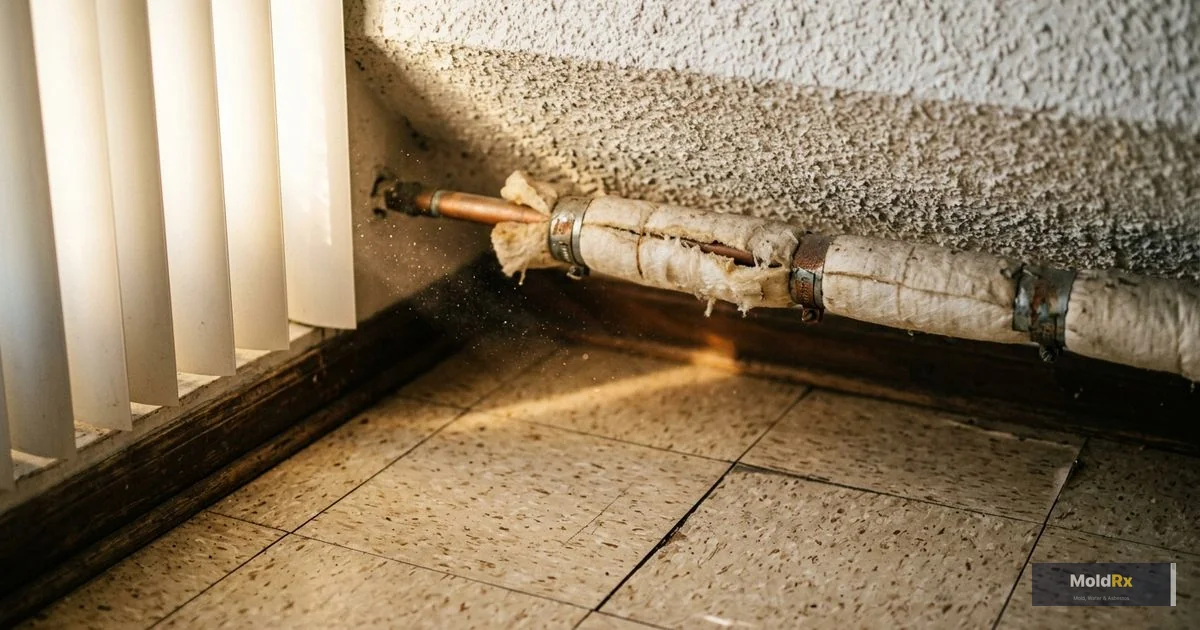
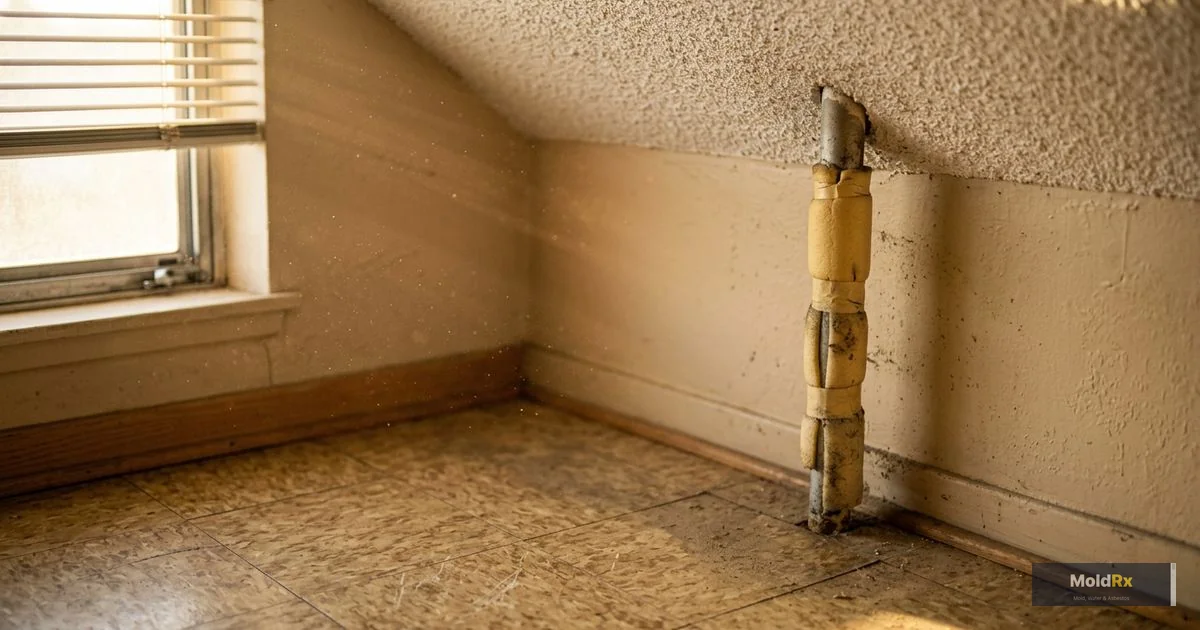
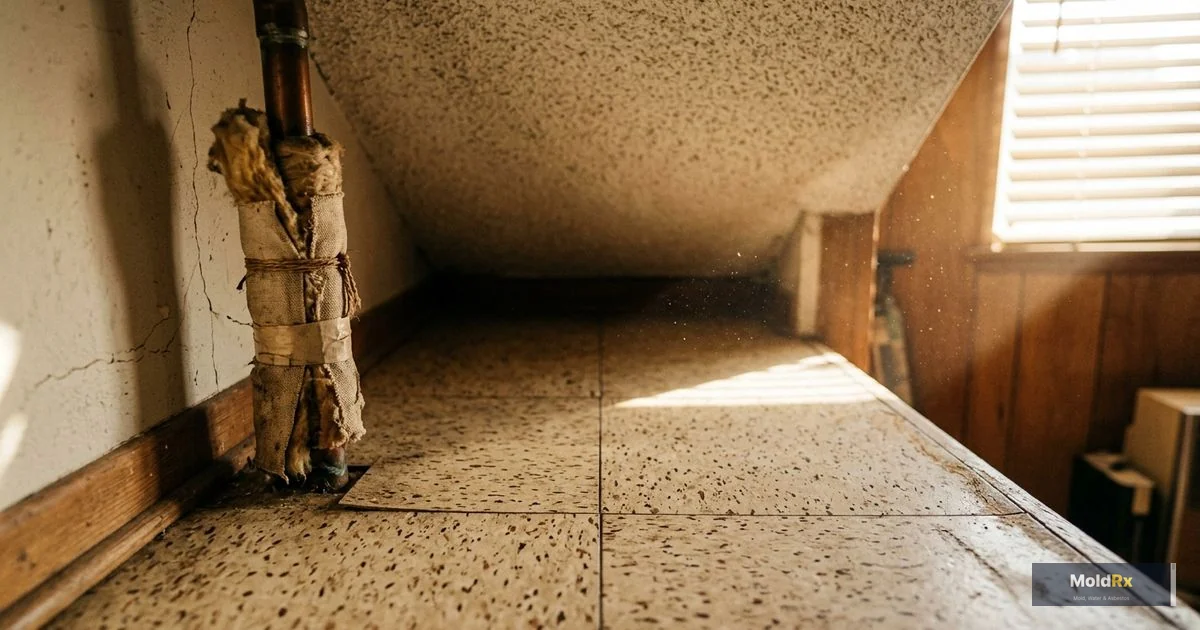
- Pipe and duct insulation — Asbestos wrapping on hot water pipes, heating systems, and HVAC ductwork was standard. In Irvine's mild climate, HVAC systems run regularly for comfort cooling, placing ongoing stress on older insulated components.
- Drywall joint compound — Pre-1975 joint compound is invisible once painted and one of the most commonly disturbed materials during renovation. Any time a wall is cut, drilled, or sanded, joint compound dust becomes airborne.
- Fireproofing and acoustic materials — Multi-unit buildings from this era frequently used asbestos-containing spray-on fireproofing in ceilings, party walls, and mechanical spaces.
- Roofing materials — Original roofing felt, shingles, and sealants on 1970s homes and condo buildings may contain asbestos.
- Window glazing and caulking — Older putty and sealants around original windows sometimes contain asbestos fibers.
- Exterior stucco and cement products — Some stucco formulations and cement-board siding from the 1970s included asbestos as a reinforcing fiber.
The Health Reality
Asbestos-containing materials left undisturbed generally do not pose an immediate health risk. The danger begins when materials are disturbed — cut, scraped, drilled, sanded, or demolished — releasing microscopic fibers that can remain airborne for hours. Once inhaled, these fibers lodge in lung tissue and can cause mesothelioma, asbestosis, and lung cancer, with symptoms appearing 10 to 50 years after exposure. You cannot see, smell, or taste asbestos fibers, which is why the regulatory framework treats pre-renovation testing as a legal requirement rather than optional due diligence.
Regulatory Framework — What Irvine Property Owners Need to Know
Asbestos testing and abatement in Irvine is governed by overlapping federal, state, and regional regulations. Understanding these before your project starts prevents permit delays, contractor disputes, and potential enforcement actions.
SCAQMD Rule 1403 — Asbestos Emissions From Demolition and Renovation
Irvine falls within the South Coast Air Quality Management District. SCAQMD Rule 1403 requires:
- A survey for asbestos-containing materials before any renovation or demolition — regardless of the building's age, the size of the renovation, or whether the owner believes asbestos is present. The survey must be conducted by a Cal/OSHA-certified inspector or an individual holding a current AHERA (Asbestos Hazard Emergency Response Act) Building Inspector certificate.
- Written notification to SCAQMD at least 10 working days before demolition. Renovation projects disturbing asbestos-containing materials exceeding 100 square feet also require notification.
- Analysis by a NVLAP-accredited laboratory. All asbestos analyses performed under Rule 1403 must be conducted by labs accredited through the National Voluntary Laboratory Accreditation Program (NVLAP), administered by NIST.
- Proper removal, containment, and disposal of confirmed asbestos-containing materials before demolition or renovation proceeds.
Cal/OSHA Title 8 Section 1529 — Asbestos in Construction
Cal/OSHA Title 8 §1529 regulates asbestos exposure in all construction work performed in California, including demolition, removal, encapsulation, alteration, and renovation. Key requirements include:
- Employer obligation to identify asbestos before employees begin work that could disturb suspect materials.
- Exposure monitoring and regulated work areas when asbestos disturbance is anticipated.
- Mandatory use of DOSH-registered contractors for abatement involving more than 100 square feet of asbestos-containing construction materials.
- Worker training, medical surveillance, and respiratory protection requirements that go beyond the federal baseline.
OSHA 1926.1101 — Federal Asbestos Standard for Construction
The federal OSHA 1926.1101 standard establishes baseline requirements for asbestos exposure during construction activities nationwide, including a permissible exposure limit of 0.1 fibers per cubic centimeter and a competent-person requirement on all worksites. California's Cal/OSHA §1529 meets or exceeds these federal requirements — contractors working on Irvine projects must comply with whichever standard is more protective, which in practice is always the California standard.
City of Irvine Permit Requirements
When you pull a building permit from the City of Irvine for renovation or demolition work on a pre-1980 property, you may be required to provide documentation of a completed asbestos survey. California Health and Safety Code Section 19827.5 requires evidence of SCAQMD demolition notification before the city issues demolition permits. Having a professional testing report completed before you apply for permits prevents delays in the approval process and demonstrates compliance with both SCAQMD and Cal/OSHA requirements.
Abatement Contractor Requirements
If asbestos is confirmed and your project requires removal, California law mandates a contractor holding a CSLB C-22 (Asbestos Abatement) license with active DOSH registration. Your testing report provides the documentation needed to scope removal work and submit SCAQMD notifications.
Schedule your Irvine asbestos testing or call (888) 609-8907 — get documented results before your project timeline begins.
How Asbestos Testing Works — Step by Step
MoldRx only sends vetted asbestos testing specialists who follow EPA-compliant protocols and understand Irvine's village-by-village construction history. Here is what the process looks like.
Step 1 — Consultation and Scope
We start by understanding your property and project — modernizing a Woodbridge condo, renovating a Turtle Rock kitchen, preparing a University Park townhouse for sale, or coordinating a building-wide assessment for an HOA board. The answers determine which materials need sampling and whether shared-wall or common-area considerations apply. For HOAs, we coordinate multi-unit testing programs that reduce per-unit costs and provide comprehensive documentation.
Step 2 — Professional Sample Collection
A certified specialist inspects your property, identifies suspect materials, and collects samples using controlled techniques. Each material is wetted before extraction and sealed in a labeled container with location documentation. In condo and townhouse settings, the specialist also evaluates materials near shared walls and common systems. Sample collection typically requires one to three hours depending on property size.
Step 3 — NVLAP-Accredited Laboratory Analysis
All samples go to a NVLAP-accredited laboratory — the same accreditation standard mandated by AHERA for schools and public buildings. Two analytical methods are used:
- Polarized Light Microscopy (PLM) — The standard method for bulk material analysis. PLM identifies asbestos fiber type (chrysotile, amosite, crocidolite, tremolite, actinolite, or anthophyllite) and determines percentage concentration. Appropriate for most residential scenarios.
- Transmission Electron Microscopy (TEM) — A higher-sensitivity method for inconclusive PLM results or low-concentration materials. TEM operates at 20,000x+ magnification, detecting asbestos below 1% concentration. Sometimes required for air clearance monitoring after abatement.
Standard turnaround is three to five business days. Rush processing is available for time-sensitive schedules.
Step 4 — Results Interpretation and Project Guidance
You receive a clear written report covering every sample, its exact location, the laboratory findings, and the regulatory implications. We walk you through the results in plain language:
- No asbestos detected. Documented clearance for those materials. Proceed with your renovation — the report satisfies SCAQMD Rule 1403 and supports your permit application.
- Asbestos found in materials that will not be disturbed. Management in place is often the practical approach. Document the material's presence and avoid it during renovation.
- Asbestos found in materials your project will disturb. Licensed abatement by a CSLB C-22 contractor must occur before construction. We explain the SCAQMD notification requirements and timeline impact.
- Asbestos found in shared or common-area materials. For condos and townhouses, this may require HOA coordination. Your report provides the documentation for those conversations.
Condos, Townhouses, and HOA Considerations in Irvine
Irvine's unusually high density of condominiums and townhomes — particularly in the older villages — creates asbestos considerations that go beyond what single-family homeowners face. If you own a unit in a 1970s or early 1980s Irvine condo or townhouse complex, or if you serve on an HOA board, these factors deserve attention.
Shared Structural Elements
Party walls, common ceilings, shared attic spaces, and connected HVAC systems mean that asbestos in one unit's materials may affect adjacent units during renovation. Testing before work begins protects not only the unit owner but every resident in the building.
HOA Renovation Approvals
Many Irvine HOAs — particularly the Woodbridge Village Association, Northwood community associations, and El Camino Real HOAs — require evidence of asbestos testing before approving renovation projects in pre-1985 buildings. Having your report in hand before submitting architectural modification requests eliminates a common approval bottleneck.
Staggered Renovation Risk
In a 50-year-old condo building where individual owners renovate at different times, each project potentially disturbs materials affecting the entire structure. HOA boards that commission comprehensive building surveys create a shared resource that simplifies individual renovation approvals for years.
Common Area Materials
Hallways, stairwells, parking structures, laundry rooms, and utility rooms in older Irvine condo complexes may contain asbestos in flooring, ceiling tiles, pipe insulation, and fireproofing. HOA boards authorizing common-area maintenance have the same testing obligations under SCAQMD Rule 1403 as individual unit owners.
Irvine Villages and Neighborhoods We Serve
MoldRx only sends vetted asbestos testing specialists who understand the construction timeline and material patterns specific to each Irvine village.
High Asbestos Probability — Pre-1985 Construction
- University Park (1966) — Irvine's first village. Homes approaching 60 years old with high probability of asbestos in popcorn ceilings, original flooring, and pipe insulation.
- Turtle Rock (1967) — Hillside homes and condos near UCI. Original materials may remain behind cosmetic updates.
- El Camino Real (early 1970s) — Over 2,300 homes including 821 townhomes. Multiple tract builders mean asbestos content varies between sections.
- Woodbridge (1975–1980s) — 9,600+ units. The mix of single-family homes, townhomes, and triplexes means both individual owners and the Woodbridge Village Association should include testing in every renovation plan.
- Northwood — early phases (1970s–early 1980s) — The 2,020 attached condos and townhouses in Northwood's earliest phases carry the highest risk.
- Westpark, Walnut, and Culverdale (late 1960s–1970s) — Attached and detached housing from peak asbestos use years.
Low or No Asbestos Risk — Post-1990 Construction
- Oak Creek, Quail Hill, Portola Springs, Stonegate, Orchard Hills — Built well after the asbestos era. Testing generally not required.
- Great Park Neighborhoods (Beacon Park, Pavilion Park, Parasol Park, etc.) — Contemporary construction on the remediated former MCAS El Toro site. No asbestos-containing materials.
- Northwood — late phases (late 1980s–1990s) — Generally below the risk threshold, though individual evaluation is recommended for homes built 1985–1990.
ZIP Codes Covered
We cover all Irvine ZIP codes: 92602, 92603, 92604, 92606, 92612, 92614, 92617, 92618, and 92620. We also serve neighboring communities including Tustin to the north, Lake Forest and Laguna Hills to the south, Costa Mesa and Newport Beach to the west, and Foothill Ranch to the east.
Common Irvine Projects That Require Asbestos Testing
Understanding which projects trigger testing requirements helps you build the right timeline and budget from the start.
Kitchen and Bathroom Remodels
Removing popcorn ceilings, replacing floor tiles, cutting into walls for new plumbing or electrical — each activity can release asbestos fibers if materials are positive. Under SCAQMD Rule 1403, testing must happen before demolition begins. Building testing into your project timeline prevents contractor delays and permit complications.
Condo Unit Modernization
Updating a 1970s-era condo in Woodbridge, El Camino Real, or Turtle Rock typically involves disturbing original flooring, textured ceilings, and wall materials. In a shared-wall building, the disturbance radius extends beyond your unit. Testing provides the documentation your HOA requires and protects neighboring residents.
Whole-House Renovation
A full asbestos survey before demolition is both a regulatory requirement and a project-cost safeguard. Discovering asbestos mid-project stops work, triggers abatement costs, and creates schedule delays. Discovery before permits are pulled integrates abatement into the budget from day one.
Real Estate Transactions
California law requires sellers to disclose known hazardous materials, including asbestos. In Irvine's active market, a testing report provides clarity for buyers and liability protection for sellers. For older village condos that change hands frequently, current testing documentation streamlines the transaction.
HOA Common Area Maintenance
Re-roofing, hallway flooring replacement, pipe insulation upgrades, parking structure repairs, and HVAC overhauls in older condo complexes all potentially disturb asbestos-containing materials. HOA boards should commission testing before authorizing maintenance bids to ensure accurate scoping and regulatory compliance.
What Sets MoldRx Apart
- Vetted specialists only. MoldRx only sends certified, experienced asbestos inspectors with current AHERA Building Inspector certification and EPA sampling protocols.
- NVLAP-accredited analysis. Every sample goes to a NVLAP-accredited lab for PLM or TEM analysis. No shortcuts, no uncertified labs.
- Irvine-specific knowledge. Our specialists understand the village-by-village construction timeline and the HOA documentation requirements for condo and townhouse renovations.
- Regulatory-compliant documentation. Your report satisfies SCAQMD Rule 1403, Cal/OSHA §1529, City of Irvine permits, HOA submissions, and California real estate disclosures. One report covers every framework.
- No conflict of interest. We test and report. We do not perform abatement, so there is no incentive to manufacture findings. You get objective laboratory data and honest guidance.
- Plain-language communication. When we reference SCAQMD Rule 1403 or Cal/OSHA Title 8 §1529, we explain what it means for your specific project in practical terms.
Frequently Asked Questions
When is asbestos testing required in Irvine?
SCAQMD Rule 1403 requires an asbestos survey before renovation or demolition — regardless of building age. In practice, any project disturbing building materials in a pre-1985 Irvine home or condo requires testing. Many HOAs impose additional testing requirements before approving renovation plans. Testing is also recommended before purchasing pre-1985 properties and when you notice damaged or deteriorating materials.
My Irvine condo was built in the late 1970s. Does my HOA need to be involved in asbestos testing?
It depends on your HOA's governing documents and the scope of your renovation. Many Irvine condo HOAs — particularly in Woodbridge, El Camino Real, Turtle Rock, and Northwood — require testing documentation before approving renovation permits in pre-1985 buildings. If your project involves shared walls, ceilings, or common-area systems, the HOA should be informed. Our specialists can coordinate with HOA requirements so the report satisfies both your project needs and the association's approval process.
What materials in a 1970s Irvine home are most likely to contain asbestos?
The highest-probability materials include popcorn ceilings, 9x9-inch vinyl floor tiles and black mastic adhesive, pipe and duct insulation, drywall joint compound, spray-on fireproofing, roofing felt and shingles, and window caulking. In condos and townhomes, shared-wall materials and common-area components are additional considerations. Specific materials vary by village and tract builder, which is why PLM or TEM laboratory analysis is necessary rather than visual inspection.
How are asbestos samples collected in a condo or townhouse?
The same EPA protocols apply as in single-family homes. Suspect materials are wetted, a small sample is extracted with specialized tools, and each sample is sealed in a labeled container. In condo settings, the specialist also evaluates materials near shared walls and common systems. The process is quiet, contained, and does not require coordination with neighbors unless shared infrastructure is being directly sampled.
What happens if asbestos is found in my Irvine property?
Intact, undisturbed materials can often be managed in place with periodic monitoring. Materials that will be disturbed during renovation must be removed by a DOSH-registered, CSLB C-22 licensed abatement contractor before construction begins. SCAQMD notification is required for abatement exceeding 100 square feet. In multi-unit buildings, findings may require HOA coordination. Your report provides specific guidance for each material and the documentation needed to scope abatement.
Does Irvine's newer construction make asbestos less of a citywide concern?
For newer villages like Great Park, Orchard Hills, and Stonegate, asbestos is not a concern. However, the older villages — University Park, Turtle Rock, El Camino Real, Woodbridge, early Northwood, and Westpark — contain thousands of homes built during the asbestos era and remain among Irvine's most desirable, renovation-active communities. In these neighborhoods, testing before renovation is every bit as important as in any other city with 1970s-era housing.
Can I collect my own asbestos samples?
California allows owner-occupants of residential buildings with four or fewer units to collect their own samples under the homeowner exception in Cal/OSHA regulations. However, samples must still be analyzed by a NVLAP-accredited laboratory, and improper collection can release fibers — creating the exact hazard you are trying to identify. Professional collection follows EPA containment protocols, and the resulting report carries more weight with HOAs, building departments, and real estate parties than self-collected samples.
How long does asbestos testing take from start to finish?
On-site sample collection takes one to three hours. NVLAP-accredited lab analysis requires three to five business days (rush available). Most Irvine residential projects are completed from consultation to final report within one week.
Related Services in Irvine
In addition to asbestos testing, we also offer Mold Removal in Irvine, Asbestos Removal in Irvine, Water Damage Restoration in Irvine, and Mold Testing in Irvine services to Irvine property owners.
Learn more about remediation services in Irvine
Get Asbestos Testing in Irvine
University Park is approaching 60 years old. Turtle Rock is close behind. Woodbridge broke ground in 1975. El Camino Real's townhomes date to the early 1970s. These are established, desirable communities — and the materials inside them reflect the era when they were constructed.
Whether you are remodeling a Woodbridge condo, renovating a Northwood home, managing an HOA common-area project, or preparing any pre-1985 Irvine property for sale, testing is the responsible first step. It protects your health, keeps your project compliant with SCAQMD Rule 1403 and Cal/OSHA Title 8 §1529, satisfies HOA requirements, and gives you objective, NVLAP-accredited laboratory data.
No guesswork. No scare tactics. Just vetted specialists, accredited analysis, and straight answers.
Get your free asbestos testing estimate or call (888) 609-8907 — vetted Irvine specialists ready to help you plan your project safely.