Emergency Water Damage Restoration in Indian Wells, CA — 24/7 Rapid Response
Water is inside your Indian Wells property right now. Call (888) 609-8907 immediately. MoldRx only sends vetted, IICRC S500-certified water damage restoration specialists — never the cheapest available crew. Every minute you wait compounds the damage.
This is not a situation that resolves itself. Not in Indian Wells. Not in a city where summer wall cavity temperatures exceed 140 degrees, where 51% of homes sit vacant for months at a time, and where $2 million median home values mean every hour of uncontrolled water intrusion translates into exponentially escalating destruction. Behind your travertine. Under your engineered hardwood. Inside the custom millwork of your desert estate — moisture is wicking through materials right now, and the physics of what happens next in this climate are brutal and unforgiving.
The difference between a contained restoration and a catastrophic gut-and-rebuild is measured in hours.
If water is actively spreading, stop reading. Call (888) 609-8907 now.
If you need to understand the scope of what is happening and what professional restoration looks like in Indian Wells, keep reading. This page exists because your property demands better than guesswork.
Why Water Damage in Indian Wells Demands Immediate Emergency Response
Indian Wells is not a typical Riverside County community, and water damage here behaves unlike anywhere else in Southern California. This is one of the most extreme microclimates in the continental United States — summer ambient temperatures routinely exceed 115 degrees Fahrenheit, annual rainfall averages barely 3 inches, and the hard-packed alluvial desert soil surrounding every property rejects water rather than absorbing it. When water intrusion occurs, every environmental condition in this city accelerates the destruction.
The Desert Heat Paradox That Destroys Homes From the Inside
Most homeowners assume the desert dries everything out. That assumption has cost Indian Wells property owners millions. Extreme heat supercharges microbial colonization and accelerates material degradation at a rate that defies expectations.
According to IICRC S520 guidelines, mold colonization can initiate within 24 to 48 hours under favorable conditions. Inside an Indian Wells wall cavity during summer — where trapped air temperatures reach 140 degrees with moisture present — our vetted specialists have documented colonization initiating in as little as 12 to 18 hours.
The surface deception compounds the crisis. Single-digit relative humidity pulls moisture from exposed surfaces rapidly, making countertops and floors feel dry. Homeowners assume the problem resolved itself. Meanwhile, the subfloor, wall cavities, insulation, and structural framing remain saturated — feeding microbial growth in concealed spaces. By the time the smell hits weeks later, the remediation scope has multiplied.
51% Seasonal Vacancy: The Statistic That Changes Everything
According to census housing data, approximately 51% of Indian Wells homes are seasonally vacant — second homes, snowbird retreats, Vintage Club estates, Desert Horizons residences occupied only November through April. For five to seven months, more than half the homes in this city of roughly 5,000 residents sit unmonitored during the most dangerous period for water damage: summer monsoon season and extreme heat.
A supply line fails in June. A pool system cracks in July. A monsoon pushes stormwater through a foundation gap in August. Nobody is there to stop it. The water sits for weeks. Sometimes months.
When the homeowner returns in October, they walk into Category 3 contamination — grossly contaminated water containing pathogenic bacteria and fungi per IICRC S500. What started as a clean Category 1 supply line break has degraded through Category 2 into the worst-case scenario requiring full containment, demolition of porous materials, antimicrobial treatment, and HEPA-filtered negative air throughout restoration.
This repeats every year. It is preventable — but only with immediate professional response.
Your property cannot wait. Request your free emergency estimate now.
Water Damage Categories and Classes: What Is Happening Inside Your Property Right Now
Understanding the IICRC S500 classification system is not academic. It directly determines the urgency, scope, method, and timeline of restoration your Indian Wells property requires. Every water damage event is classified along two axes — and in this climate, classification escalates faster than almost anywhere else.
Contamination Categories
-
Category 1 — Clean Water. Originates from a sanitary source: supply lines, toilet tank failures, appliance feeds, or rainwater. No substantial health risk from initial contact. In Indian Wells heat, Category 1 degrades to Category 2 within 24 to 48 hours if not extracted — faster in summer.
-
Category 2 — Gray Water. Contains contaminants that may cause illness. Sources include dishwasher discharge, washing machine overflow, sump pump failures, and degraded Category 1 water. Requires additional PPE and antimicrobial protocols per IICRC S500 standards.
-
Category 3 — Black Water. Grossly contaminated. Sources include sewage backup, monsoon floodwater, groundwater intrusion, and any stagnant Category 1 or 2 water supporting pathogenic microbial growth. In Indian Wells' seasonally vacant homes, Category 3 is alarmingly common. Requires full containment, removal of all affected porous materials, HEPA air filtration, and antimicrobial treatment per IICRC S500 and EPA guidelines. No shortcuts.
Drying Classes
- Class 1 — Least absorption. Affects a small area with low-porosity materials (concrete, stone). Minimal evaporation load.
- Class 2 — Significant absorption. Water has wicked into carpet, cushion, drywall up to 24 inches, and similar porous materials. Moderate evaporation load.
- Class 3 — Greatest absorption. Water from overhead sources or floor-to-ceiling saturation. Insulation, carpet, cushion, and substrates fully saturated. High evaporation load.
- Class 4 — Specialty drying. Involves materials with very low permeance: hardwood flooring, plaster walls, concrete, natural stone, custom tile — all of which dominate Indian Wells luxury construction. Requires specialized low-grain-refrigerant dehumidification and extended drying protocols that standard equipment cannot achieve.
Most Indian Wells properties fall into Class 3 or Class 4 drying difficulty. The travertine, marble, engineered hardwood, plaster veneer, and custom concrete that define this community's desert contemporary and mid-century modern architecture demand IICRC S500 Class 4 specialty drying protocols. Getting this wrong means destroying materials that could have been saved — or worse, sealing moisture inside substrates that appear dry on the surface but remain saturated underneath, guaranteeing mold colonization within weeks.
What Causes Water Damage in Indian Wells Properties
The sources of water intrusion in Indian Wells are specific to this community's geography, construction history, extreme climate, and the unique demands placed on residential infrastructure. Our vetted specialists encounter the same failure patterns year after year.
Plumbing System Failures and Slab Leaks
Indian Wells residential development came in two waves: the original country club era of the 1960s through 1980s — Eldorado, The Vintage Club, Indian Wells Country Club — and the luxury estate boom of the 1990s through early 2000s, including The Reserve and Desert Horizons. Earlier properties often contain original copper supply lines with decades of mineral deposit buildup from the Coachella Valley's notoriously hard water. Later properties feature complex plumbing serving multiple master baths, outdoor kitchens, pool houses, guest casitas, and extensive irrigation — more connection points, more failure points.
Extreme thermal cycling — 40-degree swings between day and night — stresses pipe fittings, solder joints, and connections. Slab leaks are endemic because repeated expansion and contraction of soil and slab fatigues copper lines embedded in concrete. Water migrates beneath the slab for days or weeks before any visible interior evidence appears.
Pool, Spa, and Water Feature Failures
Nearly every Indian Wells property has at least one pool. Many have multiple water features — infinity pools, spas, fountains, misting systems. The equipment driving these systems operates under extreme thermal stress year-round. Equipment failures and connection fractures discharge thousands of gallons before anyone notices, especially in vacant homes where pool systems run on automation with zero human oversight for months.
Monsoon Season Flooding
July through September brings the North American Monsoon — violent thunderstorms that dump an inch or more of rain in under an hour onto desert hardpan that absorbs nothing. Runoff concentrates instantly into washes and drainage channels.
The flood risk here is documented and escalating. Indian Wells has secured $10 million in federal funding for the Whitewater Channel Lining Project — 7,400 linear feet of reinforced slope protection. Tropical Storm Hilary in 2023 dumped half a year's rain in one day and opened a sinkhole on an Indian Wells street. The August 2025 monsoon caused flash flooding and road closures across the western Coachella Valley, with Riverside County declaring a local emergency.
Floodwater entering a home is immediately classified as Category 3 — black water under IICRC S500 standards. It carries soil bacteria, petrochemicals, pesticide residue, and potentially sewage. There is no drying this out with fans. It requires immediate professional intervention with full containment and EPA-compliant protocols.
HVAC Condensation and Mechanical Failures
AC systems in Indian Wells run 8 to 10 months per year. Condensate drain lines clog. Drain pans overflow. Evaporator coils leak. Because HVAC equipment sits in attics and mechanical rooms homeowners rarely inspect, these failures saturate surrounding materials for weeks before detection — creating Class 3 or Class 4 damage in concealed spaces where microbial colonization is well established before anyone discovers the problem.
Irrigation System Failures
The landscaping that distinguishes Indian Wells properties requires extensive irrigation. Buried lines, drip systems, sprinkler valves, and controllers operate under pressure daily. When a line fractures or a valve fails to close, water saturates foundation perimeters, migrates under slabs, and wicks into wall assemblies from below — often producing zero visible interior evidence until damage is severe.
How MoldRx-Vetted Specialists Restore Indian Wells Properties
MoldRx only sends IICRC S500 and IICRC S520-certified restoration professionals. Every specialist carries active certifications, appropriate CSLB licensing, and operates in full compliance with Cal/OSHA regulations and EPA indoor air quality standards. Non-negotiable. Your property requires specialists who understand luxury construction and Class 4 drying science — not a crew with a truck and a wet-vac.
Phase 1: Emergency Response and Containment (Hours 0-4)
The first four hours determine whether this becomes a contained restoration or an escalating disaster:
- Source identification and shutoff — stopping the water before anything else
- Contamination category assessment — Category 1, 2, or 3 classification changes the entire protocol, PPE requirements, and disposal procedures
- Commercial-grade water extraction — truck-mounted and portable units rated for high-volume removal
- Containment of affected areas — critical in Category 2 and 3 events to prevent cross-contamination
- Emergency board-up and tarping if intrusion is structural — roof breach, window failure, or monsoon damage
Phase 2: Moisture Mapping and Damage Classification (Hours 4-12)
Once standing water is removed, the real assessment begins — no guessing:
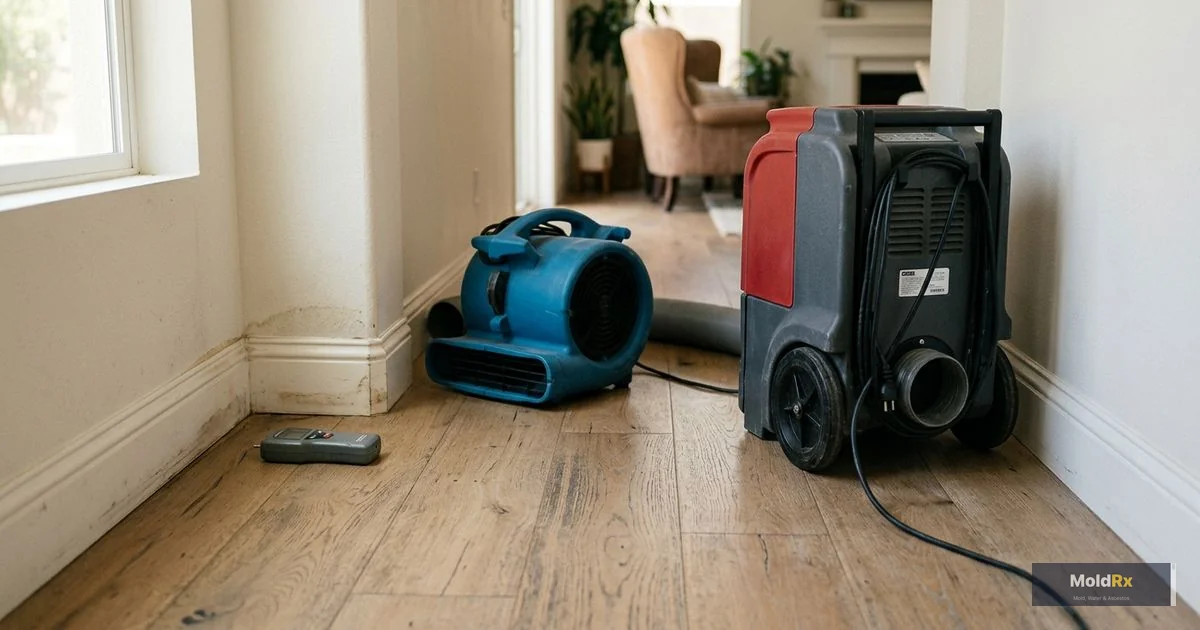
- Thermal imaging cameras to identify moisture behind walls, under flooring, and in ceiling cavities without destructive investigation
- Pin and pinless moisture meters to map the complete migration path through every structural material
- Psychrometric calculations calibrated to Indian Wells' desert environment — drying targets depend on ambient temperature, humidity, and vapor pressure specific to this microclimate
Every zone is classified by IICRC S500 Class (1 through 4). In Indian Wells luxury homes, Class 4 specialty drying is the norm.
Phase 3: Structural Drying and Dehumidification (Days 1-5+)
This is where Indian Wells restorations diverge sharply from standard approaches. Desert conditions create a counterintuitive drying environment that punishes conventional methods:
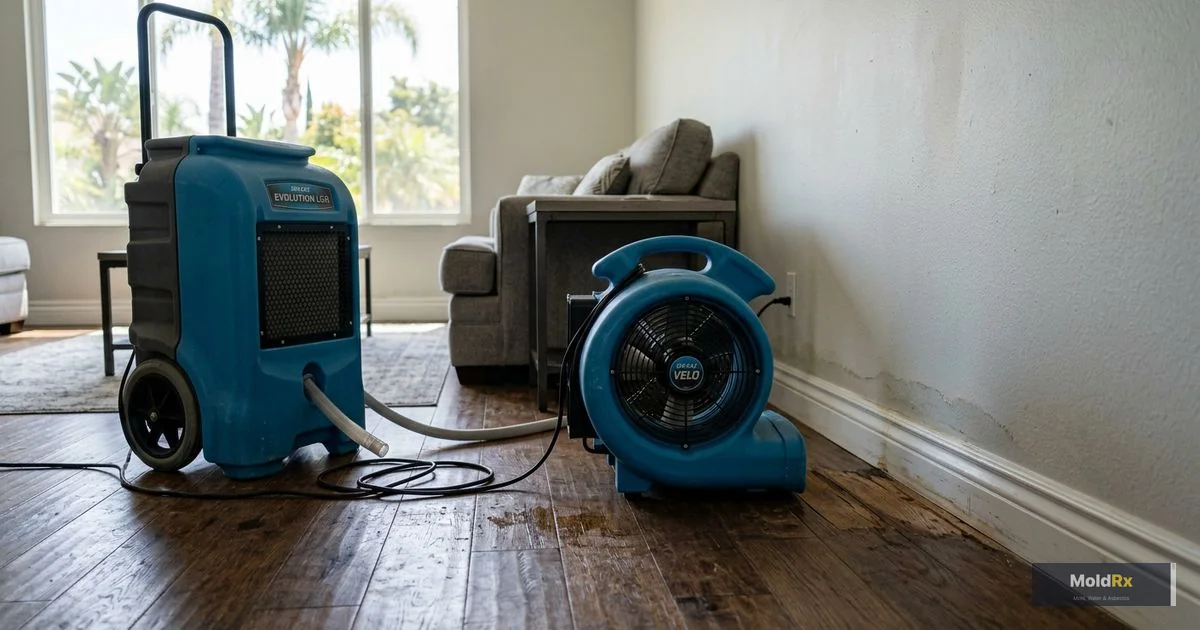
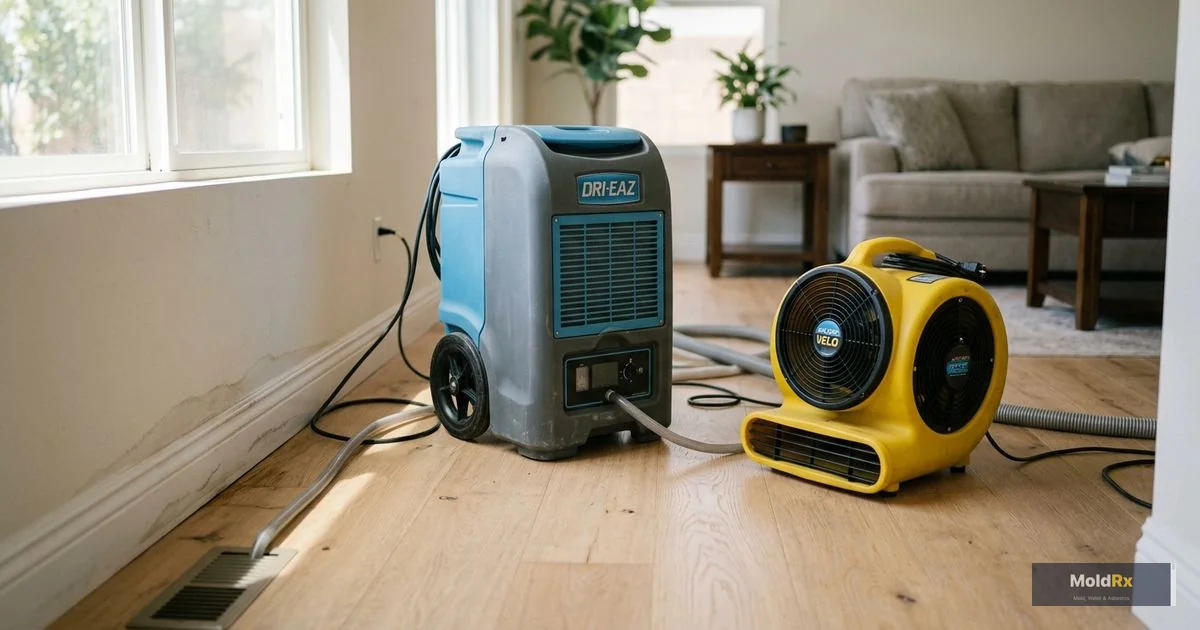
- Low-grain refrigerant (LGR) dehumidifiers are mandatory for Class 4 materials — standard refrigerant dehumidifiers cannot achieve the vapor pressure differential needed to extract moisture from dense substrates like travertine, marble, plaster, and hardwood
- Axial and centrifugal air movers positioned based on psychrometric data, not assumption — incorrect placement in Indian Wells' low-humidity environment causes surface materials to dry too rapidly while trapping moisture underneath, guaranteeing delamination, cracking, and concealed mold
- Daily moisture monitoring with documented readings verifying progressive drying toward the target goals established during Phase 2 — no shortcuts, no estimating
- Antimicrobial treatment applied to all affected materials per IICRC S520 protocols — not optional in Indian Wells heat, where microbial colonization timelines are compressed far below the standard 24-to-48-hour window
Phase 4: Restoration and Verification (Days 5-14+)
Once all affected materials reach verified dry standard:
- Selective demolition only where necessary — our vetted specialists do not tear out materials that can be saved. Indian Wells homes contain custom millwork, imported stone, and designer finishes that are irreplaceable. If it can be dried and verified clean per IICRC S500 standards, it stays.
- Complete documentation of every phase — moisture readings, thermal images, equipment placement logs, material disposal records, antimicrobial application reports. This documentation is critical for insurance claims on Indian Wells properties, which frequently involve high-value claims where proper records are the difference between full coverage and a disputed payout.
- Final clearance testing to verify moisture levels in all affected materials meet or exceed acceptable standards before any reconstruction begins
- Air quality verification confirming microbial contamination has been eliminated per EPA indoor air quality guidelines
Do not gamble with your Indian Wells property. Get your free emergency estimate or call (888) 609-8907 right now.
Protecting Seasonally Vacant Indian Wells Properties
With over half of Indian Wells homes sitting vacant during the hottest and most flood-prone months of the year, seasonal water damage is not a risk — it is a statistical certainty for a significant number of properties annually. The combination of aging plumbing under extreme thermal stress, pool equipment running without oversight, monsoon flooding, and zero human monitoring creates conditions that guarantee losses.
The Vacant Home Destruction Timeline
A Category 1 supply line failure in a vacant Indian Wells home during summer follows a predictable and devastating timeline:
- Hours 1-6: Water spreads across flooring, begins wicking into baseboards and lower drywall. Highly recoverable with immediate professional extraction.
- Hours 6-24: Water migrates into wall cavities, saturates insulation, reaches subfloor and slab. Interior temperatures accelerate moisture absorption into every porous material in the affected zone.
- Hours 24-72: Degradation toward Category 2 accelerates as stagnant conditions and heat promote explosive microbial growth. Mold spores activate. Drywall loses structural integrity. Hardwood flooring cups and buckles.
- Days 3-14: Full transition to Category 2 or Category 3 contamination. Mold colonies establish on all organic materials. Structural framing absorbs moisture. Required demolition scope expands dramatically.
- Weeks 2-12+: Active mold colonization throughout the affected zone. Entire rooms require gutting to framing. Structural members may require treatment or replacement. The restoration scope is now measured in tens of thousands of dollars and weeks of professional work.
This is not hypothetical. This is what our vetted specialists encounter in Indian Wells seasonally vacant homes every fall when owners return.
Vacancy Protection Recommendations
Our vetted specialists consistently recommend:
- Automatic water shutoff systems with leak detection sensors at all supply points, water heaters, and appliance connections
- Smart water monitors that alert you to unusual flow patterns via smartphone — so a midnight pipe failure in July triggers your phone in Maine or Montana immediately
- Weekly property checks during monsoon season (July through September) — either through a property management service or trusted local contact
- Pool and water feature winterization or professional monitoring during vacancy periods
Indian Wells Communities and Areas We Serve
Our vetted water damage restoration specialists respond to emergencies throughout all of Indian Wells, CA (ZIP code 92210), including:
- The Vintage Club — one of the most exclusive private golf communities in the nation, with approximately 495 homes requiring white-glove restoration approaches that match the caliber of these properties
- Eldorado Country Club — one of Indian Wells' original communities, established in the 1950s, with homes ranging from preserved mid-century modern estates to fully renovated contemporary residences
- Desert Horizons Country Club — private golf and country club community with distinctive desert architecture
- The Reserve — secluded private golf club and residential community set within pristine native desert landscape
- Indian Wells Country Club — the city's namesake community spanning multiple decades of construction and architectural styles
- Indian Wells Golf Resort estates and surrounding luxury neighborhoods
- Highway 111 commercial properties and mixed-use developments
We also serve neighboring Palm Desert, La Quinta, and Rancho Mirage — the entire western Coachella Valley corridor. Whether your Indian Wells property is a full-time residence, a seasonal home, a vacation rental, or a commercial property, our vetted specialists carry the certifications, equipment, and desert-specific expertise your property demands.
Frequently Asked Questions
How fast do I need to act on water damage in Indian Wells?
Immediately. Not tomorrow morning. Not after you call your insurance company. Right now. In Indian Wells' extreme heat, IICRC S520 mold colonization timelines compress well below the standard 24-to-48-hour window cited for temperate climates. Interior wall temperatures during summer create incubation conditions that initiate colonization in 12 to 18 hours. Every hour of delay expands the affected area, escalates the contamination category, extends the restoration timeline, and increases the scope of materials that cannot be saved. Call (888) 609-8907 and get a certified crew en route while you address everything else.
I just returned to my seasonal Indian Wells home and found water damage — what do I do?
This is one of the most common emergency calls our Indian Wells specialists receive. If the water source is still active, shut off your main water supply immediately — the shutoff valve is typically near the street or in the garage. Do not enter areas with standing water if there is any possibility it has reached electrical outlets, panels, or appliances. Do not attempt to clean up Category 2 or Category 3 water yourself — it poses genuine health risks including exposure to pathogenic bacteria and mold. Call (888) 609-8907 for emergency assessment. Our vetted specialists will determine the contamination category, damage class, and full restoration scope before any work begins.
What is the difference between Category 1, 2, and 3 water damage?
Category 1 is clean water from a sanitary source — supply lines, toilet tanks, appliance feeds. Category 2 is gray water containing contaminants that can cause illness — dishwasher and washing machine discharge, degraded Category 1 water, sump pump failures. Category 3 is black water — grossly contaminated with pathogenic agents from sewage, floodwater, or long-standing stagnant water. The category determines the entire restoration protocol: required PPE, containment procedures, disposal requirements, and whether affected materials can be restored or must be removed per IICRC S500 standards. In Indian Wells, category escalation happens faster due to extreme heat — what enters as Category 1 can become Category 3 within days in a vacant home during summer.
Will my homeowner's insurance cover water damage restoration?
Most policies cover sudden and accidental water damage — burst pipes, appliance failures, water heater ruptures. Gradual damage or external flooding typically requires separate coverage. The critical factor is documentation. Our IICRC S500-certified specialists document every phase with moisture readings, thermal imaging, photographs, equipment logs, and detailed reports formatted to support insurance claims. For Indian Wells' high-value properties, proper documentation is the difference between full coverage and a disputed claim.
How long does water damage restoration take in Indian Wells?
A contained Category 1, Class 2 event may take 3 to 5 days for extraction and drying plus reconstruction time. A Category 3, Class 4 event — common in Indian Wells luxury homes and seasonal vacancy situations — can take 2 to 4 weeks for demolition, drying, antimicrobial treatment, clearance testing, and reconstruction. Our vetted specialists provide realistic timelines after assessment, not guesses.
Can luxury materials like hardwood, travertine, and marble be saved after water damage?
Often yes — but only with correct Class 4 specialty drying protocols applied promptly. Hardwood, natural stone, plaster, and custom concrete require low-grain refrigerant dehumidification and carefully controlled drying rates. Too fast causes cracking and delamination. Too slow allows mold to establish within the material. This is why you need IICRC S500-certified specialists — the margin for error on irreplaceable materials is razor-thin. When extraction and specialty drying begin within 24 hours, salvage rates increase dramatically.
What should I do about monsoon flood damage in Indian Wells?
Monsoon floodwater is automatically Category 3 — black water under IICRC S500 standards. Do not attempt cleanup yourself. Do not wade through standing water. Do not turn on HVAC systems — they spread contamination through ducts. Shut off electrical power to affected areas if safe. Call (888) 609-8907 for emergency response. Category 3 flood restoration requires full containment, HEPA filtration, removal of affected porous materials, antimicrobial treatment, and EPA-compliant disposal.
Related Services in Indian Wells
Water damage and mold are directly connected — especially in Indian Wells, where heat-accelerated mold colonization means most water damage events unaddressed for more than 48 hours also require mold remediation. If you suspect mold is already present, tell us when you call — it changes the restoration protocol and the certifications required.
MoldRx connects Indian Wells property owners with vetted specialists for Mold Removal in Indian Wells, Asbestos Removal in Indian Wells, Water Damage Restoration in Indian Wells, Mold Testing in Indian Wells, and Asbestos Testing in Indian Wells.
Learn more about remediation services in Indian Wells
Your Property Is Taking Damage Right Now. Act.
Water damage does not pause. Every hour in an Indian Wells home with active water intrusion — especially when 115-degree heat turns every wall cavity into a microbial incubator — escalates the contamination category, expands the affected area, and transforms a manageable emergency into something far worse.
MoldRx only sends vetted, IICRC S500-certified, IICRC S520-certified, CSLB-licensed, Cal/OSHA-compliant professionals to Indian Wells properties. We send the right crew — specialists who understand luxury desert construction, Classes 1 through 4 drying science, Categories 1 through 3 contamination protocols, and the demands of Coachella Valley properties where the margin for error is zero.
No runaround. No upselling. No guesswork.
Get your free emergency estimate now or call (888) 609-8907 — 24 hours a day, 7 days a week, 365 days a year.