Asbestos Testing in Highland, CA — MoldRx
Vetted Asbestos Testing Professionals Serving Highland and the Inland Empire
Highland sits at 1,907 feet at the base of the San Bernardino Mountains, a foothill community of approximately 56,000 residents spread across two distinct construction eras. Western Highland — south of Highland Avenue and west of the 210 freeway — was built out during the 1950s through the 1970s, the peak decades of asbestos use in American construction. Eastern Highland, anchored by the East Highland Ranch master-planned community, was developed from the late 1980s through the 2000s, after most asbestos-containing products had been phased out. This split creates asbestos risk that varies block by block. If you own a pre-1980 home in Highland's older western neighborhoods, professional asbestos testing is a regulatory and safety prerequisite before any renovation or demolition. SCAQMD Rule 1403 requires a certified asbestos survey before work begins on structures of any age, and Cal/OSHA Title 8 Section 1529 presumes certain materials in pre-1980 buildings contain asbestos until laboratory testing proves otherwise.
MoldRx only sends vetted asbestos testing professionals who understand both the regulatory framework and the specific construction patterns found across Highland's foothill neighborhoods.
Schedule your free asbestos testing consultation or call (888) 609-8907 — we will scope your project and explain exactly what testing involves.
When Asbestos Testing Is Necessary in Highland
Highland's construction timeline creates straightforward decision points for when testing is legally required versus strongly recommended.
Before Any Renovation or Demolition (California Law)
SCAQMD Rule 1403 mandates an asbestos survey before renovation or demolition — residential and commercial, regardless of building age. The survey must be conducted by a Cal/OSHA-certified inspector or an individual holding a current AHERA Building Inspector certificate. The only narrow exception is single-unit dwelling renovation disturbing less than 100 square feet of intact material. Kitchen tearouts, bathroom remodels, flooring replacement, popcorn ceiling removal, re-roofing, and duct replacement all trigger the requirement. Non-compliance penalties can exceed $20,000 per day.
Before Buying or Selling a Pre-1980 Property
California disclosure law requires sellers to report known hazardous materials. In western Highland, where the housing stock is dominated by 1950s through 1970s ranch homes, a pre-purchase asbestos test gives buyers documented information about what renovation will actually involve. A report identifying asbestos provides disclosure documentation that protects both buyer and seller.
When Materials Show Visible Damage or Deterioration
Crumbling pipe insulation, ceiling texture peeling after a roof leak, cracked vinyl tiles lifting at the edges. Highland's climate — summer highs in the mid-90s to low 100s, winter nights dropping into the mid-30s — subjects building materials to decades of thermal cycling that gradually degrades asbestos-containing products. Damaged materials can release fibers during routine daily activity. Testing determines whether the deteriorating material contains asbestos.
After Fire Damage or Wildfire Exposure
Highland's foothill geography places the community at the wildland-urban interface. The 2024 Line Fire burned nearly 44,000 acres in the San Bernardino Mountains above Highland. Fire damage to pre-1980 structures can compromise asbestos-containing materials — heat fractures transite siding, melts vinyl tile adhesive, and collapses insulation. Post-fire assessment of older Highland homes should include asbestos testing before any cleanup or reconstruction begins.
Common Asbestos-Containing Materials in Highland Homes
Highland's primary construction boom during the 1950s-1970s coincided with peak asbestos use in American building products. Knowing where asbestos is most likely helps you understand the testing scope your project requires.
Popcorn Ceilings and Textured Coatings
The spray-applied ceiling texture common in mid-century Inland Empire homes frequently contained chrysotile asbestos at concentrations of 2% to 10%. The EPA banned asbestos in spray-applied surfacing in 1978, but existing stock continued to be applied into the early 1980s. Scraping a textured ceiling without testing is one of the most frequent sources of residential asbestos exposure — the material crumbles on contact and releases microscopic fibers that remain airborne for hours.
Vinyl Floor Tiles and Mastic
The 9"x9" vinyl floor tiles standard in kitchens, bathrooms, and utility rooms from the 1950s through the early 1980s contained 5% to 70% chrysotile asbestos. The black cutback adhesive (mastic) beneath them frequently contains asbestos as well. In older Highland homes, these tiles are commonly found beneath carpet or newer flooring — installed over and forgotten. Intact tiles are low-risk, but sanding, scraping, or breaking them during removal releases fibers.
Pipe and Duct Insulation
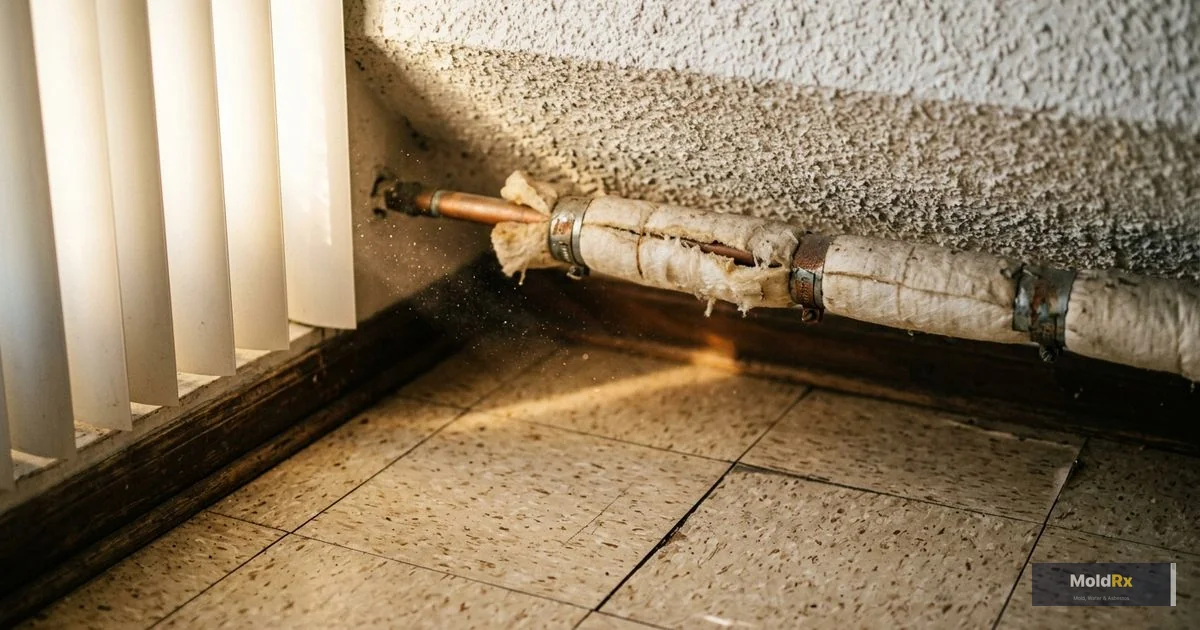
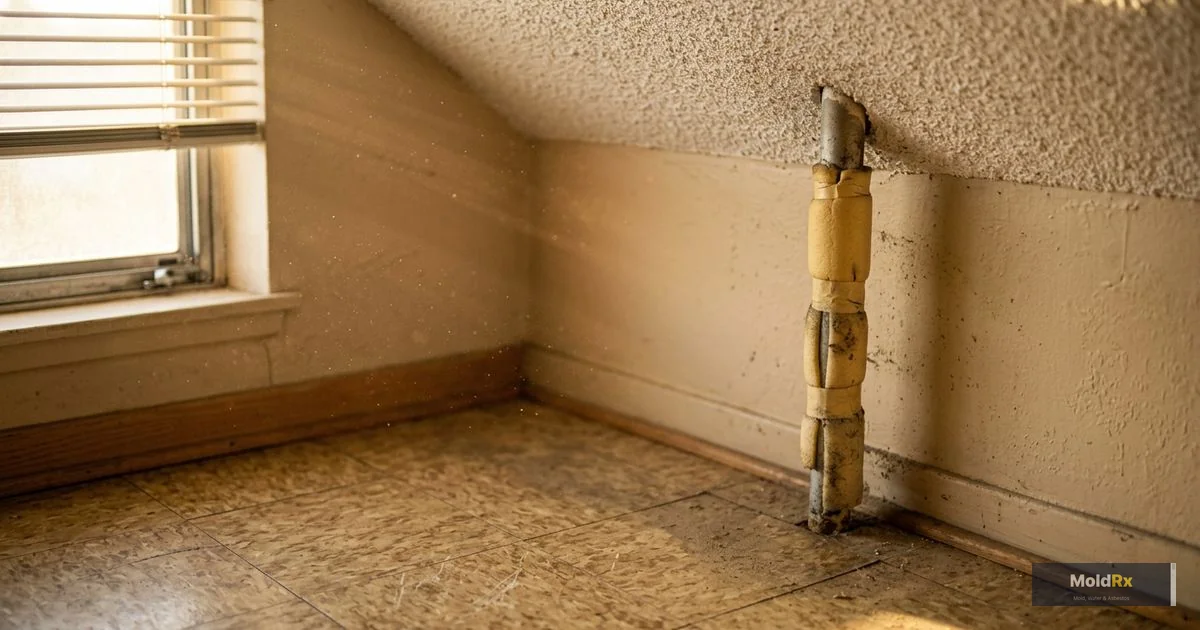
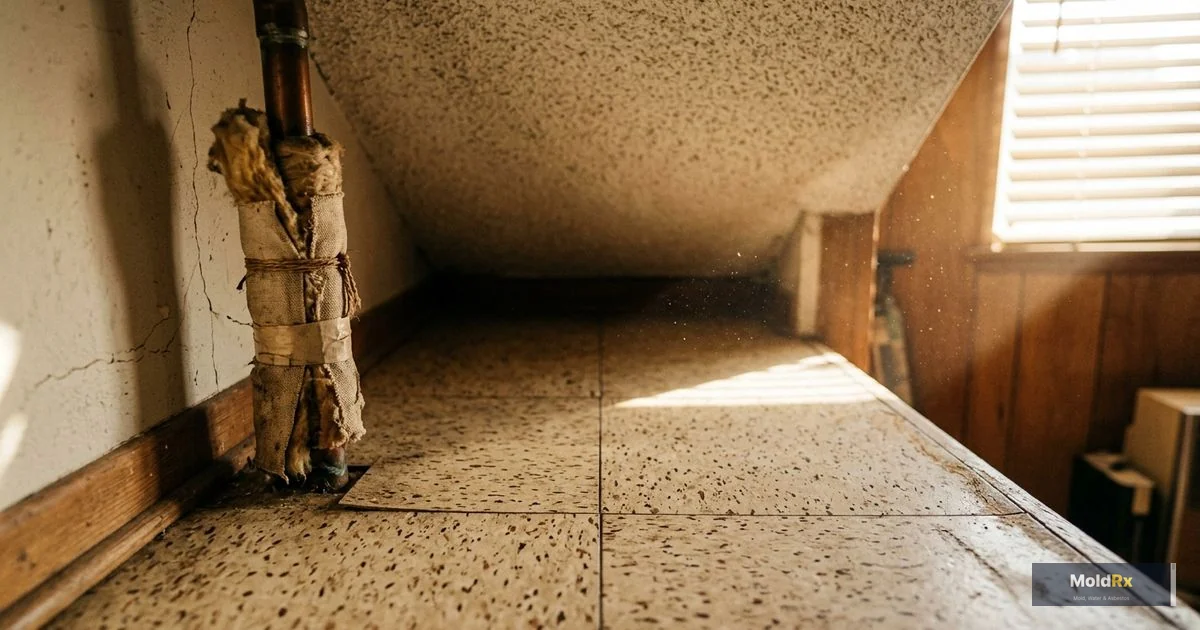
Corrugated paper wrap, calcium-silicate blocks, and asbestos cloth wrapping on hot water pipes, heating ducts, and furnace components were standard through the 1970s. Highland's semi-arid climate means HVAC systems have been heavily used for decades, and the insulation around these systems has endured significant thermal stress. Duct sealing tape and flexible duct connectors from the 1960s-1970s are additional materials that may contain asbestos.
Roofing Materials
Asbestos-cement roofing shingles, rolled roofing, felt underlayment, and flashing cement were popular throughout the Inland Empire for their durability under extreme summer heat. Many Highland homes still have original roofing from the 1960s and 1970s. These materials are low-risk while intact but become a testing and abatement issue at roof replacement time — and Highland's sun exposure means many of these roofs are now past their service life.
Drywall Joint Compound
Joint compound manufactured before 1975 commonly contained asbestos fibers. Invisible once walls are painted, it is one of the most frequently overlooked asbestos sources in renovation projects. Any project involving cutting into drywall, removing walls, or sanding surfaces should include joint compound testing.
Exterior Cement Siding and Stucco
Many older Highland homes feature cement-based exterior materials that incorporated asbestos fibers for reinforcement and fire protection. Asbestos-cement siding (transite) was marketed heavily in California from the 1930s through the 1970s. These products are low-risk when intact, but drilling, sawing, or demolishing them releases concentrated fiber loads.
Vermiculite Attic Insulation
A significant portion of vermiculite insulation sold in the United States came from the Libby, Montana mine, contaminated with tremolite asbestos. The EPA recommends treating all vermiculite insulation as potentially contaminated until tested. In Highland, where 1970s-era energy retrofits added attic insulation to many older homes, this material appears with meaningful frequency.
Window Caulking and Glazing Putty
Older sealants around windows and bathroom fixtures sometimes contain asbestos. Window replacement and bathroom renovation in pre-1980 Highland homes should include testing of existing caulking and glazing compounds.
How Asbestos Testing Works
MoldRx only sends vetted testing professionals who follow EPA-compliant procedures from start to finish.
Step 1: Pre-Testing Consultation
Testing begins with a conversation about your Highland property. When was the home built? What materials will your renovation disturb? The year of construction and neighborhood — western Highland versus East Highland Ranch — immediately narrows the scope. A 1968 ranch home near Highland Avenue requires a very different sampling plan than a 1992 home in East Highland Ranch.
Step 2: On-Site Inspection and Bulk Sample Collection
A certified inspector visits your property, identifies suspect materials, and collects bulk samples following EPA procedures. Each material is sampled separately — wetted to suppress fiber release, removed in a small section, and sealed in a labeled container. Homogeneous materials like floor tiles require a minimum of three samples per distinct area. Professional sampling prevents the fiber release that would occur from improper dry-scraping or breaking of suspect materials.
Step 3: NVLAP-Accredited Laboratory Analysis
Samples go to an NVLAP-accredited laboratory. The primary method is PLM (Polarized Light Microscopy), which identifies asbestos fiber type and estimates concentration above approximately 1%. PLM is accepted by EPA, OSHA 1926.1101, and Cal/OSHA Title 8 Section 1529 for compliance. When PLM results are negative but low-level asbestos is suspected, TEM (Transmission Electron Microscopy) provides higher sensitivity. Standard PLM turnaround is 3 to 5 business days; rush service (24 to 48 hours) is available.
Step 4: Results Interpretation and Recommendations
You receive a written report identifying each material sampled, whether asbestos was detected, the fiber type, and estimated concentration. Any material exceeding 1% is classified as ACM under federal and California regulations. We walk you through what each result means for your project:
- No asbestos detected — Documented clearance to proceed with standard construction.
- Asbestos present, materials will not be disturbed — Management in place is often the safest option.
- Asbestos present, renovation will disturb the material — Licensed abatement by a CSLB C-22 contractor must be completed before construction begins.
- Asbestos present in damaged materials — Immediate encapsulation or removal may be needed regardless of renovation plans.
Get your free consultation or call (888) 609-8907 — no obligations, just clear answers about your Highland property.
Highland-Specific Asbestos Risk by Neighborhood and Era
Highland's development history creates distinct asbestos risk profiles depending on where your property sits and when it was built.
Western Highland / Historic Core (1950s-1970s) — Highest Risk
The neighborhoods south of Highland Avenue and west of the 210 freeway — including the Historic District along Palm Avenue — contain Highland's oldest housing stock. Ranch homes, small apartment complexes, and modest houses built during the post-war expansion used asbestos-containing materials routinely. Popcorn ceilings, vinyl floor tiles, pipe insulation, joint compound, roofing felt, and cement siding from this era all carry high probability of containing asbestos.
East Highland and Greenspot Road Area (1960s-1970s) — High Risk
The neighborhoods around Greenspot Road and near the Santa Ana River wash include 1960s-1970s homes carrying the same peak-era asbestos risk as western Highland. Floor tiles, textured ceilings, and insulation products from this era should all be tested before renovation.
Highland Hills and Foothill Zone (Mixed Eras) — Variable Risk
Residential areas in the foothill zone have a mix of housing ages. 1960s-1970s homes carry standard peak-era risk; 1980s properties represent the transition period. Testing is advisable for any home here built before 1990.
East Highland Ranch (Late 1980s-2000s) — Low to Minimal Risk
The master-planned community on Highland's eastern edge was developed from the late 1980s through the 2000s, after asbestos was removed from most products. Generally not a concern, though properties built between 1986 and 1990 may warrant testing for floor tiles, roofing products, and cement-based components that remained in limited commercial use into the mid-1980s.
Neighborhoods Around Highland Community Park (1960s-1970s) — High Risk
Established mid-century residential areas surrounding the city's central recreation facilities were built during the peak asbestos decades. Standard testing scope applies for any renovation in these neighborhoods.
Regulations That Govern Asbestos Testing in Highland
Multiple overlapping federal, state, and regional regulations apply to asbestos in Highland properties.
SCAQMD Rule 1403
Highland falls within the South Coast Air Quality Management District. SCAQMD Rule 1403 requires a pre-renovation or pre-demolition asbestos survey for all structures regardless of building age. If ACM is found, SCAQMD must be notified at least 10 working days before removal begins. All abatement must be performed by DOSH-registered contractors following specific containment, removal, and disposal procedures. Violations carry substantial penalties.
Cal/OSHA Title 8 §1529
Cal/OSHA Title 8 §1529 requires determining the presence of ACM before any construction, alteration, repair, or renovation. In pre-1980 buildings, all thermal system insulation, surfacing material, and resilient flooring is presumed to contain asbestos until testing proves otherwise. The regulation classifies asbestos work into four classes based on risk, each with specific requirements for training, containment, respiratory protection, and air monitoring. Permissible exposure limits are 0.1 f/cc over an 8-hour workday and 1.0 f/cc over any 30-minute period.
Federal OSHA 1926.1101
OSHA 1926.1101 establishes the same exposure limits, work classifications, and presumption requirements as the state standard. Training requirements — 16 hours for workers, 32 hours for supervisors — represent the minimum competency for anyone disturbing ACM.
EPA AHERA
AHERA establishes inspection and laboratory accreditation requirements for asbestos. AHERA requires that laboratories hold NVLAP accreditation — the standard MoldRx's lab partners maintain. AHERA Building Inspector certification is one of the accepted credentials for conducting SCAQMD Rule 1403 surveys.
CSLB C-22 Asbestos Abatement Contractor Classification
If testing identifies asbestos requiring removal, California law requires abatement by a CSLB C-22 licensed contractor with at least four years of journey-level experience, a trade examination, and active DOSH registration.
Types of Asbestos Analysis
PLM (Polarized Light Microscopy)
PLM is the standard method for bulk building material samples, identifying asbestos fibers based on optical properties and detecting all six regulated fiber types. PLM estimates concentration as a percentage of total material, with a detection limit of approximately 1% — the regulatory threshold for classifying a material as ACM. Most residential testing follows EPA Method 600/R-93/116.
TEM (Transmission Electron Microscopy)
TEM provides magnification thousands of times greater than PLM. It is used when PLM results are negative but asbestos is still suspected — for example, when a floor tile's vinyl matrix masks fibers, or when testing vermiculite insulation. TEM is also the required method for air monitoring (clearance testing after abatement).
Point Counting
Point counting is a supplemental PLM technique used when visual estimation detects between 1% and 10% asbestos, providing a statistically valid concentration estimate near the regulatory threshold.
Can You Identify Asbestos by Looking at It?
No. Asbestos fibers are microscopic — invisible to the naked eye and mixed into building materials during manufacturing. A floor tile containing 30% chrysotile looks identical to one containing zero asbestos. No contractor, inspector, or homeowner can identify asbestos without laboratory analysis. The only reliable method is collecting samples following proper protocols and sending them to an NVLAP-accredited laboratory for PLM or TEM analysis.
What Happens If Asbestos Is Found?
A positive test result does not automatically mean your Highland home is dangerous or that expensive removal is required. The appropriate response depends on three factors: the condition of the material, your project scope, and applicable regulations.
When Removal Is Required
Removal is required when your renovation will physically disturb ACM. SCAQMD Rule 1403 requires notification at least 10 working days before removal, and all abatement must be performed by a DOSH-registered CSLB C-22 contractor following Cal/OSHA Title 8 §1529 containment and disposal procedures.
When Encapsulation May Be an Option
Encapsulation applies a sealant over intact ACM to prevent fiber release without removal. It is appropriate for materials in good condition that will remain in place — siding on an unrenovated wall or intact floor tiles being covered rather than removed. Less expensive than removal, but requires ongoing monitoring and must be disclosed in future transactions.
When Leaving It Undisturbed Is Acceptable
If ACM is in good condition and will not be disturbed, leaving it in place is often the safest option. Intact asbestos materials do not release fibers. Many Highland homeowners manage materials in untouched areas rather than removing everything at once.
What Sets MoldRx Apart in Highland
- Vetted professionals, every time. MoldRx only sends vetted asbestos testing specialists — no subcontractor roulette. The people who show up are the people we trust with our own homes.
- Honest assessment. If testing is not necessary, we will tell you. A 1995 East Highland Ranch home does not need a 20-sample survey.
- NVLAP-accredited lab partners. Every sample analyzed by a nationally accredited laboratory using PLM and TEM methods meeting EPA, OSHA 1926.1101, and Cal/OSHA Title 8 §1529 standards.
- Clear, actionable results. Plain language, specific recommendations, and a clear path forward.
- Local knowledge. We scope testing based on your property's actual age, neighborhood, and condition.
Highland ZIP Codes and Nearby Communities
We serve all properties within the 92346 and 92359 ZIP codes, including western Highland, East Highland, East Highland Ranch, Highland Hills, and the foothill zones. We also serve neighboring communities including San Bernardino, Redlands, Loma Linda, Grand Terrace, Yucaipa, and Running Springs.
Related Services in Highland
- Asbestos Removal in Highland
- Mold Removal in Highland
- Mold Testing in Highland
- Water Damage Restoration in Highland
Frequently Asked Questions
Is asbestos testing required before renovation in Highland?
Yes. SCAQMD Rule 1403 requires an asbestos survey before renovation or demolition in the South Coast district, which includes Highland. The survey must be performed by a Cal/OSHA-certified inspector or an individual holding a current AHERA Building Inspector certificate. The only exception is single-unit dwelling renovation involving less than 100 square feet of intact material. Most residential projects — kitchens, bathrooms, flooring, ceilings, re-roofing — exceed that threshold.
My Highland home was built in 1988 in East Highland Ranch. Do I need testing?
Possibly. Some asbestos-containing materials — particularly floor tiles, roofing products, and cement-based components — remained commercially available into the mid-1980s. Testing is a reasonable precaution for 1980-1990 homes, especially if your project involves flooring or roofing. After 1990, the likelihood of asbestos is very low.
How many samples need to be collected in a typical Highland home?
EPA procedures require a minimum of three samples per homogeneous material in each distinct area. A typical three-bedroom Highland ranch home undergoing renovation might need 10 to 20 samples across ceiling texture, floor tile, mastic, joint compound, pipe insulation, and roofing material. A focused project — testing only the popcorn ceiling before removal — may require as few as three to six samples.
How long does Highland asbestos testing take from start to finish?
The on-site visit typically takes one to three hours. Standard PLM analysis through an NVLAP-accredited laboratory takes 3 to 5 business days; rush service (24-48 hours) is available. The entire process from initial contact to final report usually takes about one week.
Can I collect asbestos samples myself?
California does not prohibit homeowners from collecting samples in their own single-family home, but it is strongly discouraged. Improper technique releases fibers into your living space, and samples collected by uncertified individuals may not be accepted for SCAQMD compliance, building permits, or real estate transactions.
What does a positive asbestos test result mean for my renovation?
A positive result means asbestos was detected at or above 1%, classifying that material as ACM. It does not mean immediate danger — undisturbed ACM does not release fibers. But if your renovation will disturb that material, licensed abatement by a CSLB C-22 contractor must be completed first. SCAQMD Rule 1403 notification is required at least 10 working days before removal. Your report identifies exactly which materials are positive and which are clear.
What is the difference between friable and non-friable asbestos?
Friable ACM can be crumbled by hand pressure — pipe insulation, spray-applied ceiling texture, deteriorated thermal insulation. Non-friable ACM is bound into a solid matrix — floor tiles, cement siding, roofing shingles. Non-friable materials can become friable through cutting, grinding, or demolition, which is why renovation triggers testing requirements regardless of current condition.
Will my general contractor handle asbestos testing?
Some general contractors coordinate testing, but many do not — and Cal/OSHA Title 8 §1529 places the legal obligation on the employer to determine asbestos presence before work begins. Getting testing done independently before your contractor starts is the most reliable approach. If asbestos is discovered mid-project, work stops until abatement is complete.
How accurate is PLM analysis?
PLM is the EPA-accepted standard, highly accurate for identifying asbestos type and estimating concentration. Its detection limit is approximately 1%, which is also the regulatory threshold. For materials suspected of containing less than 1% asbestos, TEM provides higher sensitivity.
Do all pre-1980 Highland homes contain asbestos?
No, but the probability is high. Industry data suggests 80% or more of pre-1980 buildings contain at least one ACM. Given western Highland's construction patterns — mass-produced ranch homes using standardized materials from the peak asbestos decades — the realistic expectation is that most pre-1980 homes contain asbestos in at least one material. Laboratory testing is the only way to know.
Get Asbestos Testing in Highland
For the thousands of Highland residents living in pre-1980 homes — the ranch houses west of the 210, the properties near the historic Palm Avenue district, the foothill neighborhoods that predate the city's 1987 incorporation — asbestos testing is the documented starting point for any renovation, real estate transaction, or response to damaged materials.
Professional testing gives you laboratory-verified information about what is in your Highland home. It tells you which materials are safe to disturb and which require licensed abatement, keeps your project in compliance with SCAQMD Rule 1403 and Cal/OSHA Title 8 §1529, and provides documentation for disclosure requirements, building permits, and contractor coordination.
MoldRx only sends vetted asbestos testing professionals who understand Highland's housing stock and the differences between the city's older western neighborhoods and its newer eastern developments. Honest answers and practical guidance, every time.
Call MoldRx at (888) 609-8907 or request your free estimate online — know what is in your Highland home before you start your project.