Asbestos Testing in Hesperia, CA -- MoldRx
Licensed Asbestos Testing Professionals Serving Hesperia and the High Desert
Planning a kitchen remodel, replacing the roof, or buying one of the older homes near The Mesa? Before anyone starts pulling up flooring or scraping ceilings, you need to know what is in the materials you are about to disturb. Hesperia sits at roughly 3,200 feet in the High Desert of San Bernardino County, and its housing stock tells a specific story -- a small desert community that exploded during the 1980s and 1990s, with thousands of homes built during or just after the peak era of asbestos use in residential construction. Asbestos is invisible to the naked eye, impossible to identify without lab analysis, and dangerous only when disturbed -- which is exactly what renovation does. California law requires testing before disturbing materials in pre-1980 buildings, and air quality regulations extend that requirement to structures of any age before demolition. MoldRx only sends vetted asbestos testing professionals who understand the regulatory requirements and construction patterns across Hesperia and the Victor Valley.
Request your free consultation -- we'll help you determine if testing is needed for your project.
When Asbestos Testing Is Necessary in Hesperia
Not every project requires asbestos testing, but more situations call for it than most Hesperia homeowners realize.
Before Any Renovation or Demolition (California Law)
Hesperia falls within the Mojave Desert Air Quality Management District (MDAQMD), which requires an asbestos survey before renovation or demolition -- residential and commercial, regardless of building age. A certified consultant must complete the survey before you pull a permit. The only exception is single-unit dwelling renovation disturbing less than 100 square feet of intact material. Kitchen tearouts, flooring replacement, popcorn ceiling removal -- all require testing first.
When Buying or Selling a Property
California disclosure laws require sellers to report known hazards. A pre-purchase asbestos test gives buyers a clear picture of what they are acquiring and what renovation will cost after closing. In Hesperia's market, where housing stock spans the 1950s through the 1990s, this information directly affects negotiations and post-close budgets.
When Materials Are Visibly Damaged or Deteriorating
Crumbling pipe insulation, flaking ceiling texture, cracked floor tiles lifting at the edges -- if materials in an older Hesperia home show visible deterioration, the risk of fiber release increases. The High Desert climate works against building materials: summer temperatures exceed 100 degrees, winter nights drop below freezing, and persistent dryness accelerates degradation. Testing identifies whether damaged material contains asbestos so you can make informed decisions about repair, encapsulation, or removal.
Before Roof Replacement, Flooring Updates, or Remodeling
The three most common renovation projects in Hesperia all frequently involve ACM. Roofing felt and flashing cement from the 1960s-1970s often contain asbestos. Vinyl floor tiles and their mastic are among the most common ACM in residential construction. Textured ceilings applied before 1980 regularly test positive. Testing determines whether standard procedures suffice or licensed abatement is required first.
Common Asbestos-Containing Materials in Hesperia Homes
Hesperia's housing spans several distinct eras. The earliest homes arrived in the 1950s-1960s after developer M. Penn Phillips and boxer Jack Dempsey subdivided 23,000 acres into 30,000 parcels -- one of the largest land sales in California history. Then came the explosive 1980s, when population surged over 270 percent, driven by affordable land and Interstate 15. By 1990, households had grown from roughly 4,000 to over 16,700. Each era brought different asbestos risks.
Floor Tiles and Mastic (9"x9" Vinyl)
Produced from the 1950s through the early 1980s, 9"x9" vinyl floor tiles contained 5% to 70% chrysotile asbestos. The black cutback adhesive (mastic) beneath them frequently contains asbestos as well. In Hesperia's older homes near The Mesa, these tiles are commonly found beneath newer flooring layers. Intact tiles are low-risk, but sanding, scraping, or breaking them during removal releases fibers. If your home has that telltale 9-inch tile pattern under the carpet, do not pull it up without testing.
Popcorn and Textured Ceilings
Spray-applied textured ceilings were standard in affordable construction from the mid-1960s through 1980. Hesperia ranch-style homes from this period frequently have popcorn or stippled ceilings containing chrysotile asbestos. The EPA banned asbestos in spray-applied surfacing in 1978, but existing stock continued into the early 1980s -- meaning even homes built during Hesperia's boom may have asbestos ceilings. Scraping textured ceilings without testing is one of the most common sources of residential asbestos exposure.
Pipe and Duct Insulation
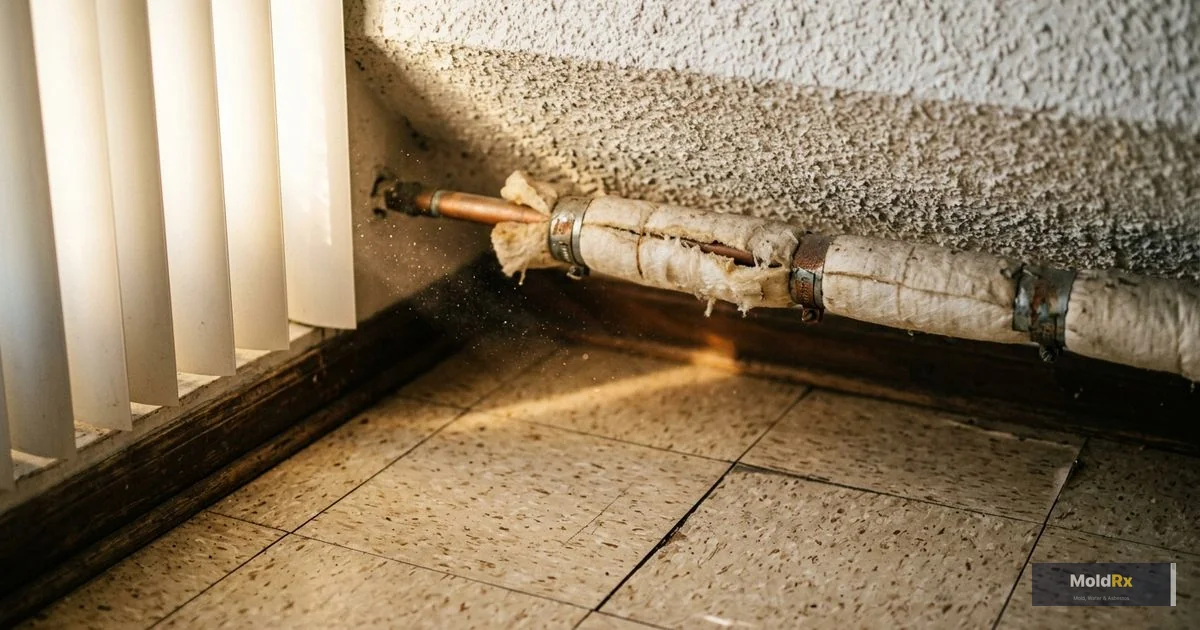
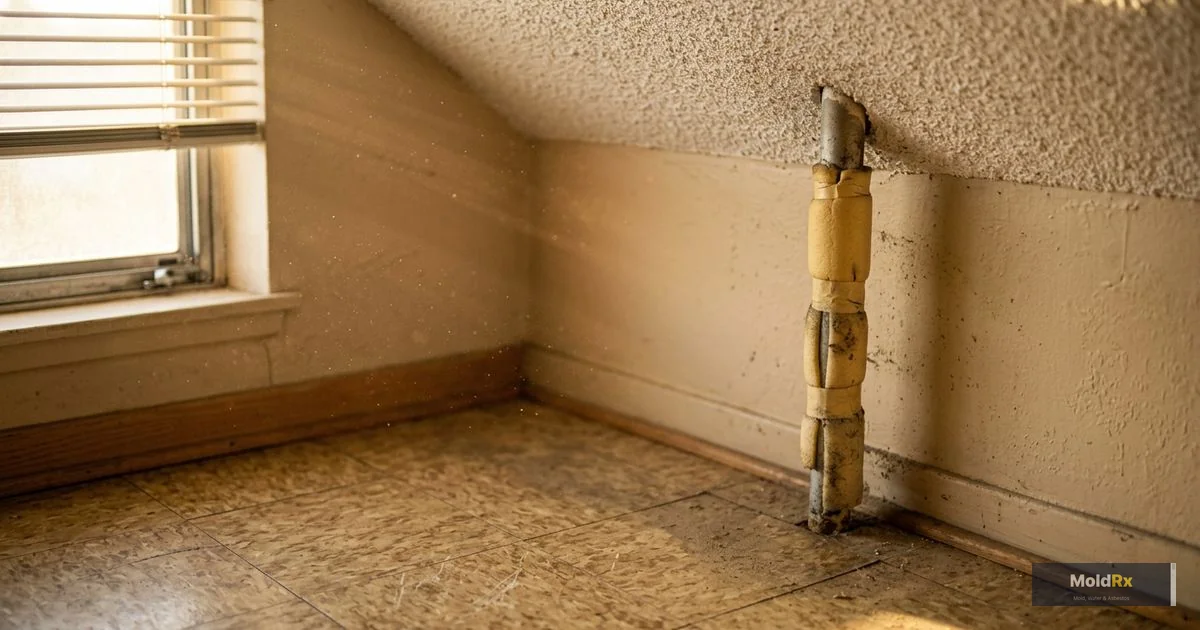
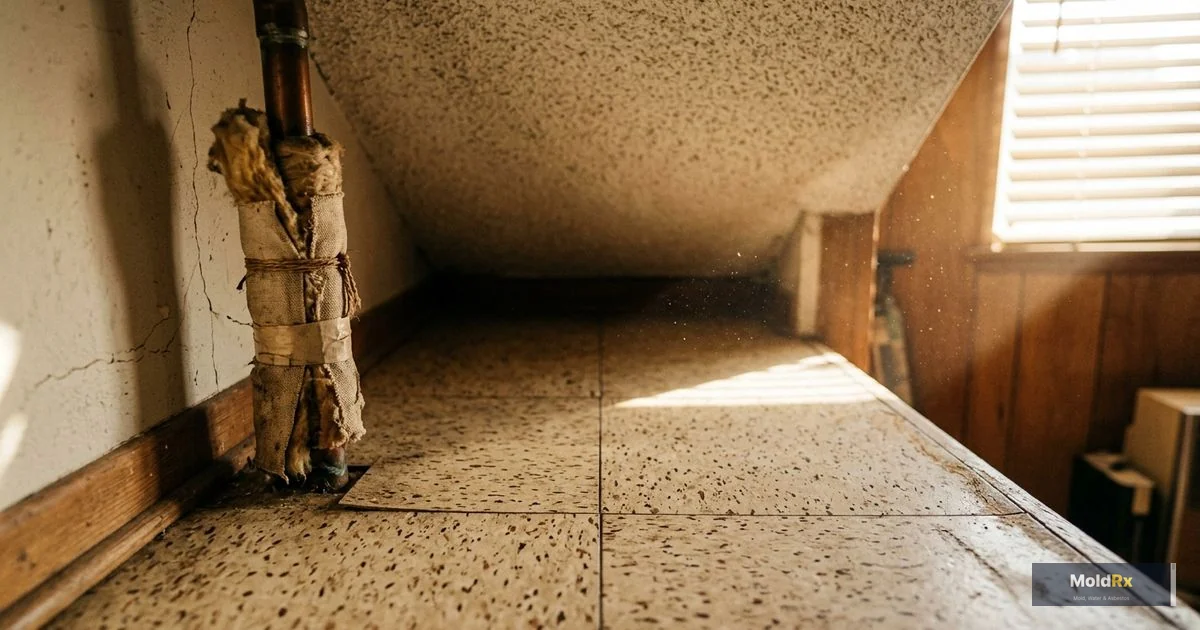
Corrugated paper wrap, calcium-silicate blocks, and air-cell insulation on heating pipes and ductwork in pre-1980 homes commonly contain asbestos. In Hesperia, where winters at 3,200 feet bring freezing temperatures and summers push past 100 degrees, heating and cooling systems were essential in every home. Pipe insulation in crawl spaces, garages, and utility closets is often the most deteriorated ACM because these areas receive less maintenance attention.
Roofing Materials and Siding
Asbestos-cement roofing shingles and siding panels were widely used in California construction through the 1970s. Dense and durable, they remain serviceable for decades -- which means they are still on many older Hesperia homes, particularly in the Mesa area and near Main Street. Roofing felt and flashing cement from this era also commonly contain asbestos. These materials are low-risk while intact but become a testing and abatement issue at roof replacement time. The High Desert's intense UV exposure and temperature swings eventually degrade even durable roofing, making replacement inevitable.
Joint Compound, Plaster, and Caulking
Drywall joint compound manufactured before 1980 frequently contained asbestos for workability and crack resistance. Plaster and caulking from this era also tested positive at high rates. These materials are in virtually every pre-1980 Hesperia home. Because joint compound is applied at every seam and screw hole, even a small project can disturb a large quantity of material.
Vermiculite Attic Insulation
A significant portion of vermiculite insulation sold in the United States came from the Libby, Montana mine, contaminated with tremolite asbestos. It appears as small, accordion-shaped granules -- gray-brown or gold -- in attic spaces. The EPA recommends treating all vermiculite as potentially contaminated until tested. In Hesperia's climate, attic insulation was a common retrofit during the 1970s energy crisis and the 1980s building boom, when contractors insulated aggressively to manage extreme seasonal temperature swings.
How Asbestos Testing Works
Understanding the testing process helps you plan your project timeline. From initial call to final report, here is what to expect.
1. Pre-Testing Consultation
Testing begins with a conversation about your property and your project -- when the home was built, what materials you plan to disturb, and whether you have noticed any damage. This determines which areas need sampling and how many samples are required. For a straightforward kitchen or bathroom renovation, the inspector can usually scope the work during a phone consultation. For whole-home or pre-purchase testing, a walk-through may be scheduled.
2. Bulk Sample Collection
A certified inspector collects bulk samples following EPA procedures. Each suspected material is sampled separately -- the inspector wets the material to suppress fiber release, removes a small section, and seals it in a labeled container. Homogeneous materials like floor tiles require a minimum of three samples per distinct area. The process is minimally invasive, and each collection point is sealed after sampling.
3. NVLAP-Accredited Laboratory Analysis
Samples go to an NVLAP-accredited laboratory. The primary method is PLM (Polarized Light Microscopy), which identifies asbestos fiber type and estimates concentration above approximately 1%. When PLM results are negative but low-level asbestos is suspected, TEM provides higher sensitivity. Standard PLM turnaround is 3 to 5 business days; rush service (24 to 48 hours) is available.
4. Results Interpretation and Recommendations
You receive a written report identifying each material sampled, whether asbestos was detected, the fiber type, and the estimated concentration. We walk you through what each result means for your project: which materials require licensed abatement, which can be managed in place, and which areas are clear for standard work.
Types of Asbestos Analysis
Different analytical methods serve different purposes depending on material type, regulatory context, and required certainty.
PLM (Polarized Light Microscopy)
The standard method for bulk building material samples. The analyst identifies asbestos fibers based on optical properties and can detect all six regulated fiber types. PLM estimates concentration as a percentage of total material and is accepted by EPA, OSHA, and Cal/OSHA. Most residential testing in Hesperia uses PLM following EPA Method 600/R-93/116.
TEM (Transmission Electron Microscopy)
TEM provides higher magnification, detecting fibers too small for light microscopy. It is used when PLM results are negative but asbestos is still suspected -- for example, when floor tile matrix material masks fibers, or when testing vermiculite insulation. TEM is also the required method for air monitoring samples.
Point Counting
A supplemental PLM technique used when visual estimation detects between 1% and 10% asbestos. The analyst counts grid points falling on asbestos versus non-asbestos material, providing a statistically valid concentration estimate. EPA specifies point counting for determinations near the 1% threshold -- the dividing line between ACM and non-ACM under NESHAP.
Can You Identify Asbestos by Looking at It?
No. Asbestos fibers are microscopic -- 0.1 to 10 micrometers in diameter, mixed into building material matrices during manufacturing. A floor tile containing 30% chrysotile looks identical to one containing none. Popcorn ceiling texture with asbestos is visually indistinguishable from texture without it. Even experienced inspectors cannot determine asbestos content by sight. Online guides claiming to help you "spot" asbestos by color or texture are misleading. The only way to confirm or rule out asbestos is laboratory analysis of a physical sample.
What Happens If Asbestos Is Found?
A positive result does not automatically mean your home is dangerous or that expensive removal is required. The appropriate response depends on material condition, project scope, and applicable regulations.
When Removal Is Required
Removal is required when renovation or demolition will physically disturb ACM -- tearing out positive-testing flooring, removing a wall with ACM joint compound, or scraping an asbestos-containing ceiling. MDAQMD regulations require notification at least 10 working days before removal, and all abatement must be performed by a DOSH-registered contractor. No exemptions for homeowner self-abatement on multi-unit residential properties.
When Encapsulation May Be an Option
Encapsulation applies a sealant over intact ACM to prevent fiber release without removal. It is appropriate for materials in good condition that will remain in place -- asbestos-cement siding on a wall not being renovated, or intact floor tiles being covered with new flooring. In Hesperia, where many homeowners renovate in phases, encapsulation can protect materials in rooms not included in the current project.
When Leaving It Undisturbed Is Acceptable
If ACM is in good condition and will not be disturbed, leaving it in place is often the safest option. Intact asbestos materials do not release fibers. Many Hesperia homeowners discover asbestos during testing for one project and manage materials in other areas rather than removing everything at once -- a practical and cost-effective strategy.
Regulations That Require Asbestos Testing in California
Multiple overlapping regulations govern asbestos testing in Hesperia. Understanding which apply helps you plan timelines and avoid compliance issues.
SCAQMD Rule 1403 / MDAQMD Equivalent (Pre-Renovation/Demolition Survey)
The regulation most directly relevant to Hesperia homeowners. Hesperia is within the Mojave Desert Air Quality Management District (MDAQMD), which enforces asbestos notification and survey requirements equivalent to SCAQMD Rule 1403. A certified consultant must complete an asbestos survey before any renovation or demolition, regardless of building age. If asbestos is found, notification must be submitted at least 10 working days before removal. Penalties for non-compliance can exceed $20,000 per day.
Cal/OSHA Title 8 Section 1529
California's construction-industry standard requires determining ACM or presumed ACM (PACM) presence before any construction, alteration, repair, or renovation. In pre-1980 buildings, all thermal system insulation, surfacing material, and resilient flooring is presumed to contain asbestos until testing proves otherwise.
EPA AHERA and California Health and Safety Code
AHERA establishes the inspection protocols and accreditation requirements that underpin residential testing -- inspectors hold AHERA certifications and follow AHERA-derived sampling procedures. California Health and Safety Code establishes contractor licensing and notification obligations. Any person performing asbestos-related work must be registered with DOSH.
OSHA 1926.1101
The federal construction standard mirrors Cal/OSHA requirements, requiring pre-work assessments and specific work practices for activities that may disturb ACM.
Hesperia-Specific Asbestos Risk by Construction Era
Hesperia's development history creates distinct risk profiles based on when a home was built.
1950s-1960s (Phillips-Dempsey Era and Original Town Center): Hesperia's earliest homes near the original town center and The Mesa carry the highest asbestos risk. Nearly every material category -- flooring, ceilings, insulation, roofing, siding, joint compound -- may contain asbestos. These homes are now 60 to 75 years old and materials have had decades to deteriorate. Testing is essential before any renovation.
1970s (Pre-Incorporation Growth): As Interstate 15 opened High Desert access, Hesperia grew steadily. Homes from this decade commonly contain asbestos in popcorn ceilings, floor tiles, pipe insulation, and joint compound. The Mesa continued developing through this era, and properties along Main Street and Bear Valley Road from the 1970s warrant thorough pre-renovation testing.
1980s (Boom Decade -- 270% Population Growth): The defining era for Hesperia. Population surged from roughly 5,000 to over 50,000, and construction was the leading industry. The city incorporated in 1988. EPA had banned asbestos in several product categories, but existing stock continued to be installed. Early 1980s homes may contain asbestos in floor tiles, roofing, and cement-based materials. Mid-to-late 1980s homes have lower risk, but testing is recommended -- especially for popcorn ceilings using remaining asbestos inventory.
1990s (Continued Expansion): Affordable housing continued drawing families from the Los Angeles Basin. Homes from this decade carry significantly lower asbestos risk. Most building materials manufactured after 1990 do not contain asbestos, though some imported products continued to include it. Testing may be warranted for specific materials if renovation involves demolition.
2000s and Later (Modern Construction): Newer subdivisions carry minimal asbestos risk. MDAQMD regulations still require a survey before demolition regardless of age. For renovation, your inspector can assess whether testing is warranted.
What Sets MoldRx Apart
- Honest assessment. If testing is not necessary for your project, we will tell you. We have no financial incentive to recommend testing or abatement you do not need.
- NVLAP-accredited lab partners. Every sample is analyzed by a nationally accredited laboratory using PLM and, when warranted, TEM methods that meet EPA and Cal/OSHA standards.
- Clear, actionable results. No jargon-filled reports that leave you guessing. Plain language, specific recommendations, and a clear path forward for your project.
- Family-owned accountability. We only send vetted asbestos testing professionals we stand behind. No subcontractor roulette -- the people who show up are the people we trust with our own homes.
Get your free consultation -- no obligations.
Hesperia Neighborhoods We Serve
Our asbestos testing services cover all residential and commercial properties in Hesperia, including:
- The Mesa -- One of Hesperia's oldest neighborhoods, with homes dating from the early 1970s and some structures reaching back to the 1950s-1960s Phillips-Dempsey development era. Properties from the earlier decades carry the highest asbestos risk in original flooring, insulation, ceiling texture, and roofing materials.
- Main Street Corridor -- The historic spine of Hesperia with residential and commercial properties spanning multiple decades. Older buildings along this corridor may contain asbestos in nearly every material category.
- Bear Valley Road Area -- Hesperia's primary corridor with development from the 1980s through 2000s. Early 1980s homes warrant testing, particularly for textured ceilings and floor tile installed during the boom.
- Hesperia Lakes / Hesperia Palisades -- 1980s and 1990s residential development with moderately lower asbestos risk. Early 1980s homes may still contain ACM in flooring, roofing, and ceiling materials.
- Oak Hills -- A mix of rural and suburban properties northwest of central Hesperia. Homes date from the 1970s through 2000s. Older ranch properties with original construction carry moderate-to-high asbestos risk.
- Old Trail Rancho -- Established neighborhood with homes from the 1950s through the early 2000s. The wide range of construction eras means asbestos risk varies significantly property to property.
Nearby Communities
We also serve surrounding High Desert communities including Victorville, Apple Valley, Adelanto, Oak Hills, Phelan, Oro Grande, and Lucerne Valley.
Related Services in Hesperia
-> All services
Frequently Asked Questions
Is asbestos testing required before renovation in California?
Yes. MDAQMD regulations require an asbestos survey before renovation or demolition, regardless of building age. The survey must be performed by a certified consultant. The only exception is single-unit dwelling renovation involving less than 100 square feet of intact material. Most residential projects -- kitchens, bathrooms, flooring, ceilings -- require testing.
How many samples need to be collected?
EPA procedures require a minimum of three samples per homogeneous material in each distinct area. A three-bedroom home undergoing full renovation might need 10 to 20 samples across ceiling texture, floor tile, mastic, joint compound, insulation, and roofing material. Your inspector determines the exact number based on property and project scope.
How long do asbestos test results take?
Standard PLM analysis takes 3 to 5 business days from the time samples arrive at the lab. Rush service is available with turnaround as fast as 24 hours. TEM analysis, if needed, typically requires 5 to 7 business days. Your inspector can advise on which turnaround fits your project schedule.
Can I collect asbestos samples myself?
California does not prohibit homeowners from collecting samples in their own single-family home, but it is strongly discouraged. Improper technique can release fibers into your living space. Additionally, samples collected by uncertified individuals may not be accepted for regulatory compliance. If you need results for a building permit, MDAQMD notification, or real estate transaction, use a certified inspector.
What does a positive asbestos test mean?
A positive result means asbestos fibers were detected. Any material exceeding 1% asbestos is classified as ACM under federal and California law. A positive result does not mean immediate danger -- intact, undisturbed ACM does not release fibers. But if renovation will disturb that material, licensed abatement must be performed first.
How accurate is PLM analysis?
PLM is the EPA-accepted standard and highly accurate for identifying asbestos type and concentration. Its detection limit is approximately 1%, which is also the regulatory threshold. For materials with complex matrices (floor tile, certain mastics) where low-level asbestos is suspected, TEM provides higher sensitivity.
Do all pre-1980 homes in Hesperia contain asbestos?
No, but industry data suggests 80% or more of pre-1980 buildings contain at least one ACM. Some homes may have had asbestos removed during previous renovations; others were built with non-asbestos alternatives. Laboratory testing is the only way to determine what your specific home contains.
What is the difference between friable and non-friable asbestos?
Friable ACM can be crumbled by hand pressure -- pipe insulation, spray-applied ceiling texture, deteriorated thermal insulation. Non-friable ACM is bound into a solid matrix -- floor tiles, cement siding, roofing shingles. Non-friable materials become friable through cutting, grinding, or sanding, which is why renovation triggers testing requirements regardless of current condition.
Do I need testing if my Hesperia home was built after 1980?
Most of Hesperia's housing dates to the 1980s boom or later. For early 1980s homes, asbestos risk is still moderate -- existing product inventory continued to be installed. For mid-1980s and later, risk is lower but not zero. Some products (roofing materials, gaskets, imported tiles) contained asbestos after initial EPA bans. If your home is being demolished, testing is required regardless of age. For renovation, your inspector can assess whether testing is warranted.
Will my contractor handle asbestos testing?
Some general contractors coordinate testing as part of pre-construction, but many do not. Cal/OSHA requires contractors to determine whether asbestos is present before work begins, but does not specify who performs the testing. Getting testing done independently before your contractor starts is the most reliable approach -- if asbestos is discovered mid-project, work stops until abatement is complete, adding weeks and significant cost.
Get Asbestos Testing in Hesperia
Planning a remodel, replacing a roof, or buying a property in Hesperia -- testing gives you the information you need before the first wall comes down. With housing dominated by 1980s and 1990s construction and pockets of older homes reaching back to the 1950s, knowing what is in your walls is the starting point for every responsible renovation.
Call MoldRx to schedule your asbestos test -- (888) 609-8907. Know before you start.