Asbestos Testing in Hemet, CA
MoldRx Only Sends Vetted Asbestos Testing Specialists to Hemet and the San Jacinto Valley
Hemet occupies the center of the San Jacinto Valley in western Riverside County, a city of roughly 90,000 residents sitting at about 1,600 feet elevation between the San Jacinto Mountains to the east and the low hills separating the valley from Menifee and Perris to the west. Incorporated in 1910 as a small agricultural trading center for the valley's citrus, apricot, and walnut groves, Hemet spent its first five decades as a quiet farm town. In 1950 the population was approximately 10,000. Then the character of the city changed.
In the early 1960s, the development of Sierra Dawn Estates — widely recognized as the nation's first mobile home subdivision where individual lots were sold rather than rented, marketed with the help of television personality Art Linkletter — established Hemet as a retirement destination. The concept proved enormously successful. Through the 1960s, 1970s, and 1980s, a succession of mobile home parks, manufactured home communities, and age-restricted 55-and-older subdivisions reshaped the city into one of Southern California's most recognized retirement areas. Panorama Village (built 1962-1968), Seven Hills (1970s through 2006), and dozens of mobile home parks filled the valley floor. By the 2020 census, Hemet's population had reached 89,833.
The critical fact for any property owner planning renovation, demolition, or a property transaction: the bulk of Hemet's housing stock was built during the decades when asbestos was a standard ingredient in American construction materials. Professional laboratory testing is the only way to confirm what a specific property contains, and California law requires that identification before work that may disturb materials in pre-1980 structures. The information below covers what you need to know before the first wall is opened.
Ready to get started? Request your free estimate or call (888) 609-8907 to speak with someone today.
How Asbestos Entered Hemet's Housing Stock
Asbestos is a naturally occurring fibrous mineral that appeared in more than 3,000 commercial building products during the twentieth century. Its fire resistance, tensile strength, and low cost made it standard in everything from floor tiles to roof shingles. In residential construction, asbestos use peaked between approximately 1940 and 1978, then tapered as federal and state restrictions took hold. The practical cutoff extends to the mid-1980s because products manufactured before the ban continued circulating through supply chains.
The Farm Town Era: Early 1900s Through the 1950s
Hemet's oldest surviving housing is concentrated near the historic downtown area along Florida Avenue. Homes dating from the 1920s through the 1950s used construction materials common to the period — plaster walls, pipe insulation, roofing felts, knob-and-tube wiring insulation, and early linoleum or vinyl flooring products that routinely contained asbestos. These buildings represent the highest probability of asbestos-containing materials in the city. The 1950s brought Hemet's first wave of postwar suburban-style tract development, and contractors received products containing asbestos as a routine manufacturing ingredient: vinyl floor tiles, textured ceiling coatings, pipe insulation, roofing shingles, and joint compounds.
The Retirement Boom: 1960s and 1970s — The Primary Risk Window
This is the era that created modern Hemet and produced the largest share of its current housing stock. Population growth during the 1960s exceeded 8.5 percent annually. Sierra Dawn Estates launched the mobile home subdivision model. Panorama Village added 501 conventional homes between 1962 and 1968. Dozens of mobile home parks were platted and filled. By the 1970s, Seven Hills was underway, and conventional single-family subdivisions were expanding in every direction from the original town center.
Asbestos was used extensively in both site-built homes and manufactured housing from this era. Floor tiles, ceiling textures, insulation, roofing, siding, joint compound, duct wrapping, and pipe insulation all routinely contained chrysotile or amosite asbestos fibers. Properties built in Hemet during the 1960s and 1970s should be presumed to contain asbestos until laboratory testing using polarized light microscopy (PLM) proves otherwise.
The 1980s Transition
Development continued strongly through the 1980s as more conventional subdivisions and the continued expansion of existing 55-and-older communities added thousands of homes. California banned asbestos in most construction products in 1977, but manufacturers were permitted to exhaust existing inventory. Some asbestos-containing products remained on shelves through the mid-1980s. Homes built between 1978 and approximately 1986 fall into a transition zone where testing before renovation of original materials is warranted.
The 2000s and Beyond
Four Seasons at Hemet (over 1,100 homes, built 2003-2011) and Solera Diamond Valley (completed 2017) were built well after asbestos was phased out of domestic construction materials. These newer communities carry low asbestos risk. Testing is generally unnecessary for post-2000 homes unless specific circumstances — such as a pre-existing structure on the lot — suggest otherwise.
Retirement Communities and 55-Plus Housing: What You Need to Know
A home in a 55-plus community built in 1972 carries exactly the same asbestos risk as a conventional home built in 1972 on the other side of town. The age restriction on the community governs who can live there — it says nothing about what was used to build it. Sierra Dawn (1960s), Panorama Village (1962-1968), and the early phases of Seven Hills (1970s) were all constructed during the peak of asbestos use in American building materials.
Homes in retirement communities also tend to experience renovation cycles as successive owners update the property. Each remodel — a kitchen refresh, new flooring, a bathroom update, textured ceiling removal — is a potential exposure event if original materials contain asbestos and testing was never performed. In many cases, previous owners completed renovations decades ago without any asbestos assessment, potentially spreading fibers within wall cavities, attic spaces, or under new flooring layers.
For adults over 55, the stakes are heightened. Asbestos-related diseases have latency periods of 10 to 50 years. Older adults who experienced previous occupational or environmental asbestos exposure are closer to the window where symptoms may develop. Additional exposure during a home renovation compounds whatever previous exposure has occurred. Testing is not abstract risk management for this population — it is a concrete health protection measure.
Mobile Homes and Manufactured Housing: A Concentrated Risk
Mobile homes account for approximately 23 percent of Hemet's total housing stock — one of the highest proportions in Riverside County. Units manufactured before 1980 used asbestos in vinyl sheet flooring with felt backing, ceiling panels, cement-asbestos exterior siding, duct wrapping, pipe insulation, electrical panel components, and furnace heat shields and gaskets.
The compact construction of mobile homes means that disturbing asbestos-containing materials in one area spreads fibers throughout the entire living space far more quickly than in a conventional home. Even seemingly minor work — replacing a section of vinyl flooring, adjusting a ceiling panel, modifying ductwork — can release fibers if the materials involved contain asbestos. Testing before any repair or renovation work in a pre-1980 mobile home is essential.
Common Asbestos-Containing Materials in Hemet's Site-Built Homes
If your Hemet property was built before 1980, any of the following materials may contain asbestos. None can be identified through visual inspection alone — a floor tile with 5 percent chrysotile looks identical to one with zero percent. Laboratory analysis using PLM is the only definitive identification method.
- Popcorn and acoustic ceiling textures — Spray-applied coatings standard from the late 1950s through the late 1970s
- Vinyl floor tiles and mastic — Both 9-inch and 12-inch tiles and the black cutback adhesive beneath them
- Joint compound and drywall mud — Taping compounds concealed under multiple coats of paint
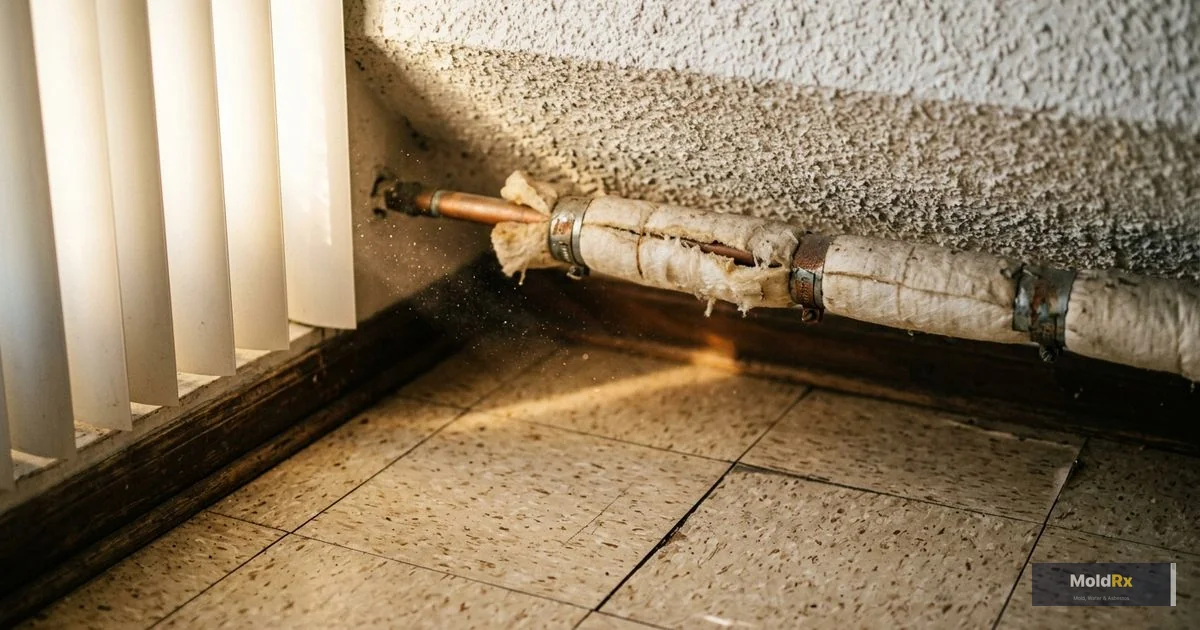
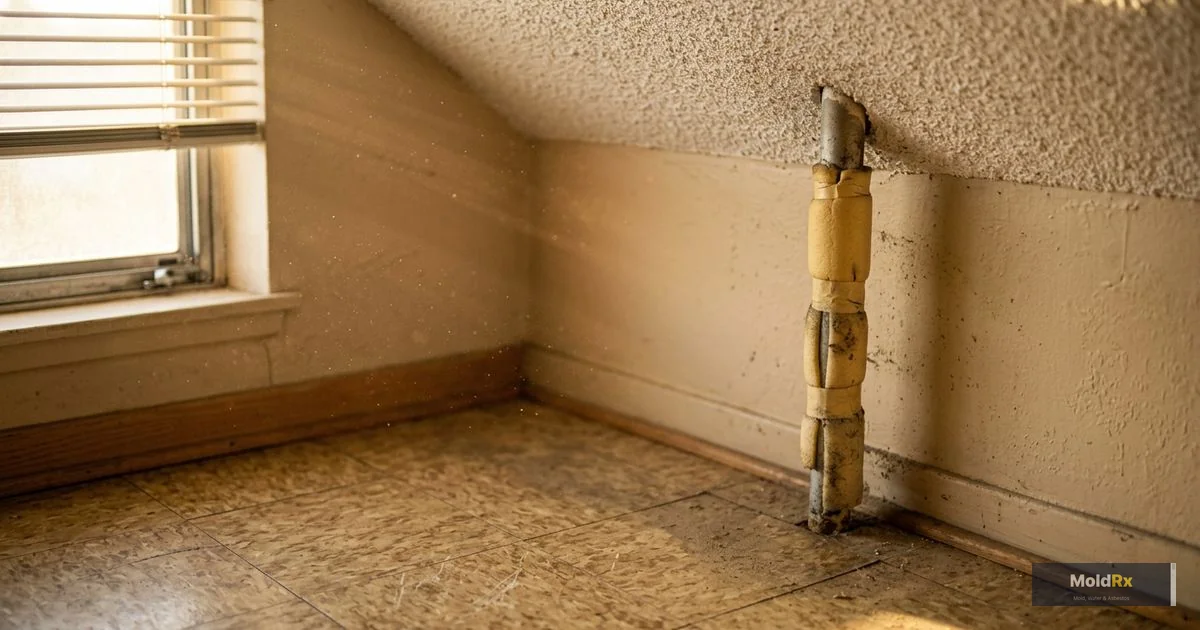
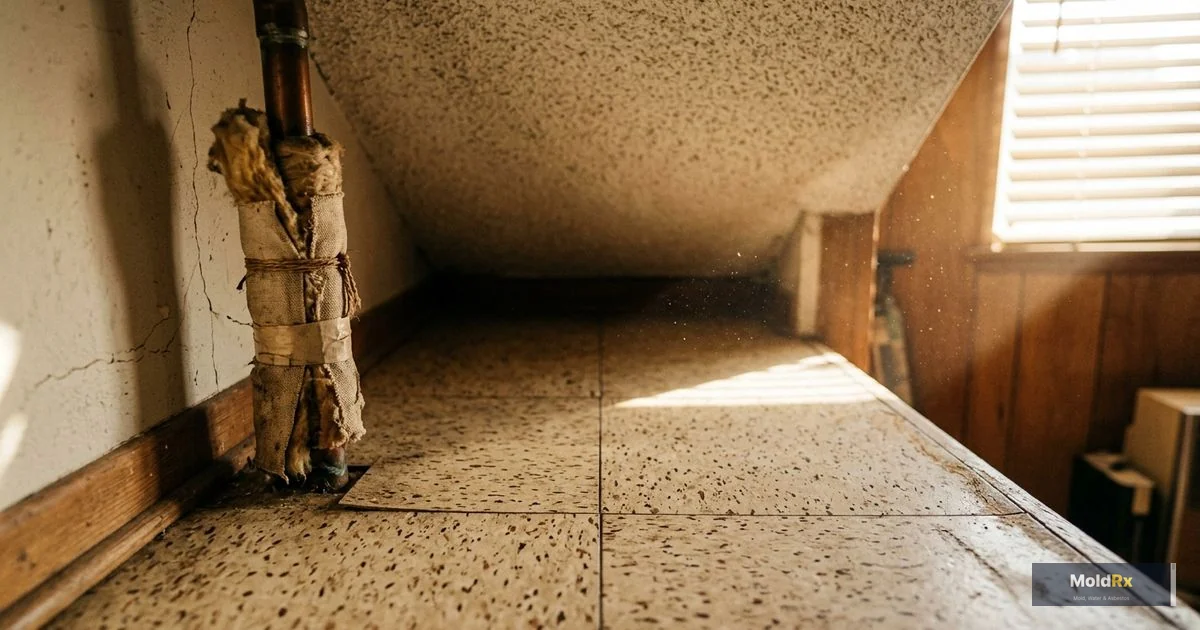
- Pipe insulation — Wrapping on hot water pipes, water heater connections, and heating system piping
- Duct insulation and duct tape — Insulation around forced-air HVAC ductwork and fabric-backed tape at duct joints
- Roofing shingles, felt, and flashing — Cement-asbestos shingles and asbestos-reinforced underlayment
- Cement-asbestos (transite) siding — Rigid exterior cladding common on mid-century homes throughout the valley
- Vermiculite attic insulation — Loose-fill insulation often contaminated with tremolite asbestos
- Window glazing putty and caulking — Around glass panes, tubs, sinks, and exterior joints
- Plaster — In older homes from the 1940s and 1950s, plaster may contain asbestos as a reinforcing fiber
- Electrical panel components — Arc chutes, backing boards, and insulation within older panels
Climate and Material Degradation
Hemet's semi-arid climate pushes summer temperatures into the mid-90s and low 100s, with attic temperatures in older homes exceeding 130 degrees Fahrenheit. Thermal cycling between summer extremes and cooler San Jacinto Valley winters stresses building materials over decades, causing cracking and embrittlement in roofing, insulation, ductwork, and exterior cladding — all common asbestos locations. HVAC systems run six to seven months per year for cooling alone, and over the life of a 50- or 60-year-old home these systems have been serviced and repaired multiple times, potentially disturbing asbestos-containing duct insulation, furnace components, or pipe wrapping.
Why Asbestos Testing Matters: Health and Legal Context
The Health Risk
Asbestos fibers are microscopic, invisible, and odorless. Intact, undisturbed asbestos-containing materials generally pose limited risk. The danger arises when materials are disturbed — through renovation, demolition, weathering, or routine maintenance such as scraping a textured ceiling or pulling up old floor tiles. Once airborne, fibers embed permanently in lung tissue. The body cannot break them down or expel them. Over latency periods of 10 to 50 years, lodged fibers cause mesothelioma (a cancer almost exclusively caused by asbestos), asbestosis (irreversible lung scarring), and elevated lung cancer risk. No safe exposure threshold has been established. Identification before disturbance is the only reliable prevention strategy.
The Regulatory Framework That Applies to Hemet Property Owners
Multiple overlapping federal, state, and regional regulations govern asbestos identification and management. For Hemet property owners in Riverside County, the key authorities are:
EPA AHERA (Asbestos Hazard Emergency Response Act). AHERA established the accreditation standards for asbestos inspectors and mandates that laboratories hold accreditation through the NIST National Voluntary Laboratory Accreditation Program (NVLAP).
OSHA 29 CFR 1926.1101. The federal construction industry standard (OSHA 1926.1101) requires building owners to identify asbestos-containing materials before construction, renovation, or demolition and sets the permissible exposure limit at 0.1 fibers per cubic centimeter over an 8-hour time-weighted average.
Cal/OSHA Title 8, Section 1529. California's state standard (Cal/OSHA Title 8 §1529) mirrors and in certain respects exceeds federal requirements, mandating identification of asbestos-containing materials before any work that may disturb them.
SCAQMD Rule 1403. Hemet falls within the South Coast Air Quality Management District. SCAQMD Rule 1403 requires an asbestos survey before demolition and before renovation that may disturb 100 or more square feet of suspect material. Written notification to SCAQMD is required at least 10 working days before regulated work begins. Laboratory-confirmed results from an accredited facility are mandatory.
NVLAP Laboratory Accreditation. Administered by NIST, the NVLAP program accredits laboratories for bulk asbestos analysis via PLM and airborne analysis via TEM. Every sample MoldRx facilitates goes to an NVLAP-accredited laboratory meeting ISO/IEC 17025 standards.
CSLB C-22 Licensing. When removal becomes necessary, California requires the work be performed by a contractor holding the CSLB C-22 Asbestos Abatement classification from the Contractors State License Board.
These requirements apply equally to conventional homes, mobile homes, retirement community properties, and commercial buildings in Hemet.
How Asbestos Testing Works in Hemet
Here is the process from first contact through final report.
Step 1: Consultation and Property Evaluation
The process starts with understanding your property: when it was built, its construction type, renovation history, and what work you are planning. A 1965 mobile home in one of Hemet's established parks has fundamentally different testing priorities than a 1970s conventional home in Seven Hills or a 1950s property near downtown Florida Avenue. A homeowner replacing flooring in a 1970 Panorama Village unit needs targeted testing of the existing flooring and adhesive. A buyer purchasing a 1962 home who plans a comprehensive renovation needs a broader survey. The sampling plan is designed to answer your actual questions — no more, no less.
Step 2: Professional Sample Collection
A vetted specialist visits your property and collects physical samples from each suspect material following EPA NESHAP and Cal/OSHA Title 8 §1529 protocols:
- Each material is wetted before sampling to suppress fiber release
- Representative samples are extracted using specialized cutting and coring tools
- Each sample is sealed in a labeled container with a unique identifier
- A chain-of-custody form documents the collector, collection time, and sample location
A typical Hemet home requires 5 to 20 samples depending on age, construction type, and project scope. Sample collection is completed in a single visit, generally within a few hours. You do not need to vacate your home.
Step 3: NVLAP-Accredited Laboratory Analysis
Samples are submitted to a laboratory holding NVLAP accreditation for bulk asbestos analysis. The primary analytical method is polarized light microscopy (PLM), which identifies:
- Whether asbestos is present in the sample
- The specific type of asbestos (chrysotile, amosite, crocidolite, tremolite, actinolite, or anthophyllite)
- The concentration percentage within the material
When greater sensitivity is required — for clearance testing after abatement or when PLM results are inconclusive at low concentrations — transmission electron microscopy (TEM) provides finer-scale resolution. Standard PLM results arrive within 3 to 5 business days. Rush processing is available when real estate closings or project deadlines require it.
Step 4: Report, Interpretation, and Practical Guidance
Your report identifies every material sampled, its location, and whether asbestos was detected. For positive results, asbestos type and concentration are documented. The report specifies which materials require professional abatement by a CSLB C-22 licensed contractor before renovation, which are intact and can be managed in place, and provides regulatory documentation meeting SCAQMD Rule 1403, Cal/OSHA Title 8 §1529, and OSHA 1926.1101 requirements. If specific materials do not need testing given your project scope, you will be told directly.
Have questions about your property? Request your free estimate or call (888) 609-8907 — no obligation, no pressure.
Understanding Your Hemet Property's Risk Profile
High-Risk Properties: Pre-1980 Construction
Homes, mobile homes, retirement community properties, and commercial buildings from the 1950s through the 1970s have a high probability of containing asbestos. Testing is essential before renovation, demolition, or major maintenance, and it is a legal prerequisite under Cal/OSHA Title 8 §1529 and SCAQMD Rule 1403.
Transition Properties: 1980s
Homes from 1980-1989 warrant evaluation when original materials will be disturbed. The asbestos phase-out was gradual, and some products remained on shelves through the mid-1980s.
Low-Risk Properties: Post-1990 Construction
Homes built after 1990, including Four Seasons at Hemet (2003-2011) and Solera Diamond Valley (2017), carry low asbestos risk. Testing is generally unnecessary unless specific circumstances suggest otherwise.
What to Expect During the Process
- Minimal disruption. Samples are small, and wetting procedures prevent fiber release. You do not need to vacate your home.
- Single-visit turnaround. On-site work is completed in one visit. Standard lab results arrive within 3 to 5 business days. Rush processing is available.
- Complete documentation. Your report satisfies Cal/OSHA Title 8 §1529, SCAQMD Rule 1403, and OSHA 1926.1101 requirements for contractor coordination, real estate transactions, and building department submissions.
- Honest guidance. The specialists MoldRx sends have no financial incentive to find asbestos. You receive factual lab results and straightforward recommendations.
Hemet Neighborhoods and Areas We Serve
MoldRx sends vetted asbestos testing specialists to properties throughout the City of Hemet and the surrounding San Jacinto Valley. We serve Hemet's primary ZIP codes — 92543, 92544, 92545, and 92546 — and all neighborhoods and communities, including:
- Historic downtown Hemet and the commercial corridor along Florida Avenue
- Sierra Dawn Estates and other established mobile home communities
- Panorama Village, Seven Hills, and other age-restricted 55-plus communities
- Four Seasons at Hemet and Solera Diamond Valley
- Residential corridors along Stetson Avenue and San Jacinto Street
- Valle Vista and East Hemet
- Properties near Diamond Valley Lake
- Mobile home parks throughout the city
Our coverage extends to neighboring communities including San Jacinto to the north, Valle Vista to the east, and the unincorporated areas between Hemet and Menifee to the west.
Related Services in Hemet
In addition to asbestos testing, MoldRx also sends vetted specialists for Mold Removal in Hemet, Asbestos Removal in Hemet, Water Damage Restoration in Hemet, and Mold Testing in Hemet.
Learn more about remediation services in Hemet
Frequently Asked Questions About Asbestos Testing in Hemet
I live in a 55-plus community in Hemet. Does the age restriction mean my home is newer or safer?
No. The age restriction governs who can live there, not when the buildings were constructed. Sierra Dawn (1960s), Panorama Village (1962-1968), and the earlier phases of Seven Hills (1970s) were built during the peak of asbestos use. If your community was built before 1980, testing before renovation is important. Communities built through the mid-1980s also warrant evaluation. Newer communities like Four Seasons at Hemet (2003-2011) are generally low risk.
Are mobile homes in Hemet at risk for asbestos?
Yes. Mobile homes manufactured before 1980 commonly contain asbestos in vinyl flooring, ceiling panels, duct wrapping, exterior siding, pipe insulation, and electrical components. Hemet has one of the highest concentrations of mobile home parks in Riverside County, with units dating to the 1960s and 1970s. Compact construction means even minor repair work can spread fibers throughout the entire unit. Testing before any work on a pre-1980 mobile home is essential.
When is asbestos testing legally required in Hemet?
Cal/OSHA Title 8 §1529 requires identification of asbestos-containing materials before renovation or demolition of pre-1980 structures. SCAQMD Rule 1403 requires an asbestos survey before demolition and before renovation involving 100 or more square feet of suspect material, plus written notification to SCAQMD at least 10 working days before regulated work begins. These apply to all property types in Hemet. Testing is also strongly recommended before purchasing older properties or when damaged materials are observed.
What happens if asbestos is found in my Hemet home?
Finding asbestos does not require immediate evacuation or emergency action in most cases. The response depends on the material's condition and your project plans. Intact materials that will not be disturbed can be managed in place through periodic visual inspection — the "operations and maintenance" approach, which is fully regulatory-compliant. Materials that are damaged, deteriorating, or will be disturbed by renovation or demolition must be professionally removed by a CSLB C-22 licensed abatement contractor before other work begins. Your testing report specifies findings for each material and recommends the appropriate action.
What is the difference between PLM and TEM analysis?
PLM (polarized light microscopy) is the standard method for analyzing bulk material samples — pieces of floor tile, ceiling texture, insulation, and similar materials collected from your property. It identifies asbestos type and concentration percentage. TEM (transmission electron microscopy) operates at much higher magnification and is used primarily for air monitoring samples and clearance testing after abatement, or when PLM results are inconclusive at very low fiber concentrations. Both methods require NVLAP-accredited laboratory facilities.
Should I test before buying a home in Hemet?
Testing is strongly recommended for any Hemet home built before the mid-1980s. An asbestos inspection gives you documented knowledge of what is present before closing, directly affecting renovation planning and budgeting. For the many investors and younger families purchasing affordable older properties in Hemet for renovation, pre-purchase testing prevents surprises and regulatory complications.
How long does the entire testing process take?
On-site sample collection is completed in a single visit, typically within a few hours for a site-built home and somewhat faster for mobile homes. Standard NVLAP-accredited PLM analysis takes 3 to 5 business days. Rush processing is available. From initial contact to final report delivery, most Hemet residential projects are completed within one week.
Can asbestos-containing materials be left in place?
Yes. Intact materials in good condition that will not be disturbed can remain safely in place with periodic monitoring. This operations and maintenance approach is recognized by OSHA 1926.1101, Cal/OSHA Title 8 §1529, and SCAQMD Rule 1403 as an acceptable management strategy. Removal is required only when materials will be disturbed by renovation or demolition, or when they have deteriorated to the point of active fiber release.
Schedule Asbestos Testing for Your Hemet Property
From mobile home parks and 55-plus communities built in the 1960s and 1970s to conventional subdivisions and downtown commercial properties, thousands of Hemet properties share the same question: what materials are inside, and are they safe to disturb? Professional testing answers that question. California law under Cal/OSHA Title 8 §1529 and SCAQMD Rule 1403 requires it before renovation and demolition of older structures.
MoldRx only sends vetted asbestos testing specialists who understand Hemet's construction history, the specific materials found in its retirement communities and mobile home parks, and the full regulatory framework that applies to your project. You get NVLAP-accredited laboratory results, proper documentation for every applicable regulation, and honest guidance about what the findings mean and what to do next.
No guesswork. No runaround. Request your free estimate or call (888) 609-8907 to schedule asbestos testing for your Hemet property.