Asbestos Testing in Grand Terrace, CA — MoldRx
Vetted Asbestos Testing Specialists Serving Grand Terrace and the Inland Empire
Grand Terrace occupies roughly 3.5 square miles of terrace-elevated land in western San Bernardino County, tucked between Colton, Riverside, Loma Linda, and Highgrove along the I-215 corridor. With approximately 13,150 residents within the 92313 ZIP code, the city has carried the nickname "The Blue Mountain City" since well before its 1978 incorporation — a reference to the blue lupine wildflowers that once blanketed the slopes of the 2,300-foot peak defining the eastern skyline.
That residential history is directly relevant to anyone who owns or plans to purchase property here. Grand Terrace was built almost entirely during the decades when asbestos was a standard construction material. Before you open a wall, pull up a floor, or close on a purchase, professional asbestos testing is the only reliable way to know what you are dealing with — and the only way to stay on the right side of California's strict regulatory framework.
Why Grand Terrace Properties Need Asbestos Testing
From Citrus Groves to Suburban Rooftops — A Construction Timeline That Matters
Grand Terrace's development story begins with agriculture. The construction of the Gage Canal — a 22.5-mile waterway bringing Santa Ana River water to the elevated terrace land — transformed the area into productive citrus country in the late 1800s. By 1904, Charles Patton and M.L. Howell had purchased 300 acres, divided it into 8-to-20-acre parcels, and formally named their tract "Grand Terrace." Citrus remained the economic backbone for decades, even after the devastating freeze of 1913 that destroyed many groves.
The shift from agriculture to residential suburb followed the broader Inland Empire pattern. Post-war military and industrial employment at nearby Norton Air Force Base and San Bernardino railroad facilities drew families eastward. Grand Terrace's affordable land and quiet elevation made it attractive, and by the 1950s, tract homes were replacing the last of the citrus groves.
The bulk of Grand Terrace's residential construction happened between the late 1950s and the early 1980s. By the time residents voted 82 percent in favor of incorporation on November 30, 1978, most of the community's roughly 4,900 housing units were already standing. The ranch-style homes, Colonial Revival designs, and Spanish Revival properties that define the city's streetscape were products of the same supply chains that relied heavily on asbestos-containing building products.
If a Grand Terrace home was built before 1980, it should be considered a candidate for testing before any renovation, demolition, or change of ownership.
The Inland Empire Climate Factor
Grand Terrace sits at approximately 1,065 feet of elevation, slightly above the surrounding valley floor. The semi-arid Mediterranean climate brings summer temperatures regularly into the mid-90s, with spikes above 100 degrees, and annual rainfall averaging only about 15 inches. Builders designed homes to withstand heat, maximize insulation against temperature extremes, and resist fire — goals that frequently led to the selection of asbestos-containing materials for:
- Roofing and underlayment. Asbestos cement shingles and roofing felt were prized for heat resistance under relentless Inland Empire sun. Many Grand Terrace roofs still carry original materials from this era.
- HVAC ductwork and furnace insulation. With air conditioning running heavily from May through October, older duct insulation, furnace cement, and plenum linings are among the most frequently identified asbestos-containing components in Grand Terrace homes.
- Attic and wall insulation. Vermiculite loose-fill insulation — some sourced from the Libby, Montana mine and contaminated with tremolite asbestos — was poured into attics and wall cavities throughout this period.
- Exterior stucco and cement siding. Stucco mixes and fiber-cement siding products used across Grand Terrace commonly contained chrysotile asbestos for reinforcement and fire resistance.
The dry climate has preserved many of these materials in stable condition for decades. Undisturbed asbestos-containing products can sit quietly inside walls, above ceilings, and beneath floors without releasing fibers. That stability ends the moment someone begins a renovation.
Where Asbestos Hides in a Typical Grand Terrace Home
The mid-century construction patterns common in Grand Terrace mean that asbestos can appear in a wide range of building components. Here are the materials our inspectors encounter most frequently in homes throughout the 92313 ZIP code:
- Popcorn ceilings and textured wall coatings. The stippled "cottage cheese" ceiling treatment applied from the 1950s through the late 1970s frequently contained chrysotile asbestos at 1 to 10 percent concentration — the single most commonly identified asbestos-containing material in Inland Empire homes.
- Vinyl floor tiles and mastic adhesive. The classic 9x9-inch floor tiles installed in kitchens, bathrooms, and utility rooms often contain asbestos, as does the black mastic adhesive bonding them to the subfloor. Transition-era 12x12-inch tiles (late 1970s through early 1980s) may also test positive.
- Drywall joint compound. The mud used to finish drywall seams in pre-1975 construction frequently contained asbestos fibers. Once painted and finished, this material is invisible — but it becomes a serious exposure source when walls are sanded, scored, cut, or demolished.
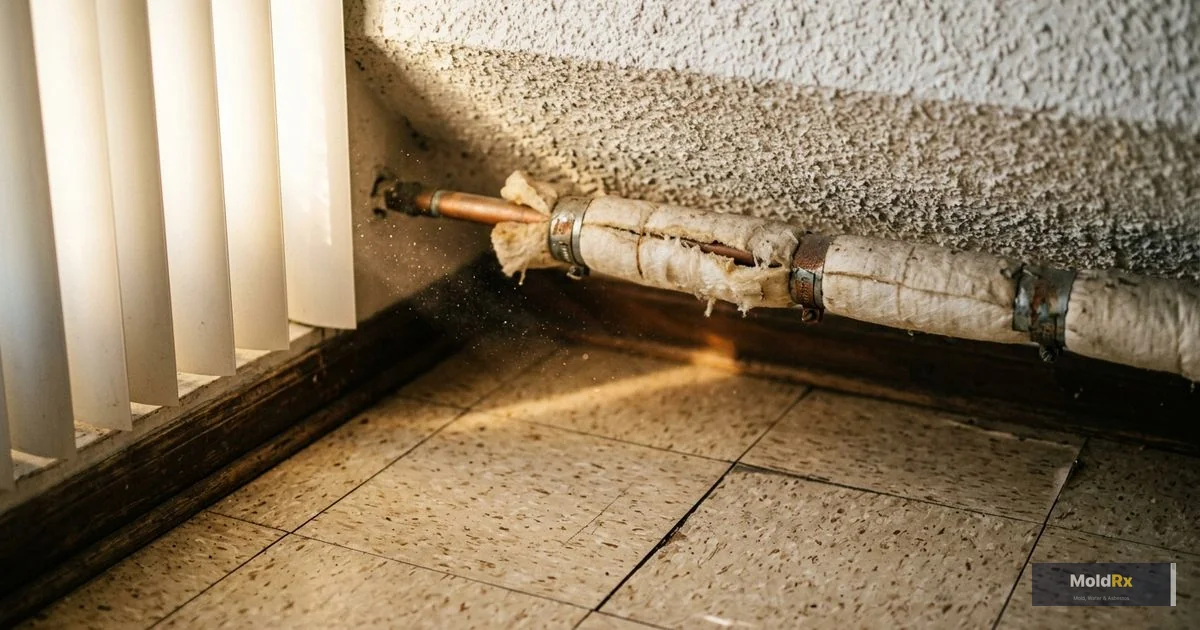
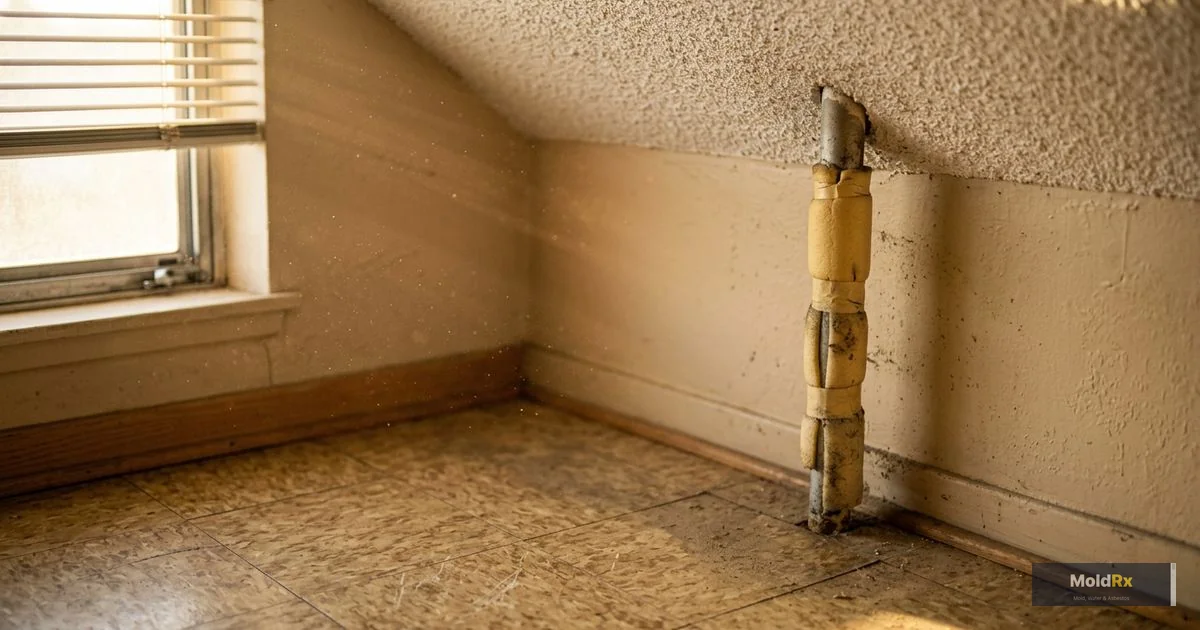
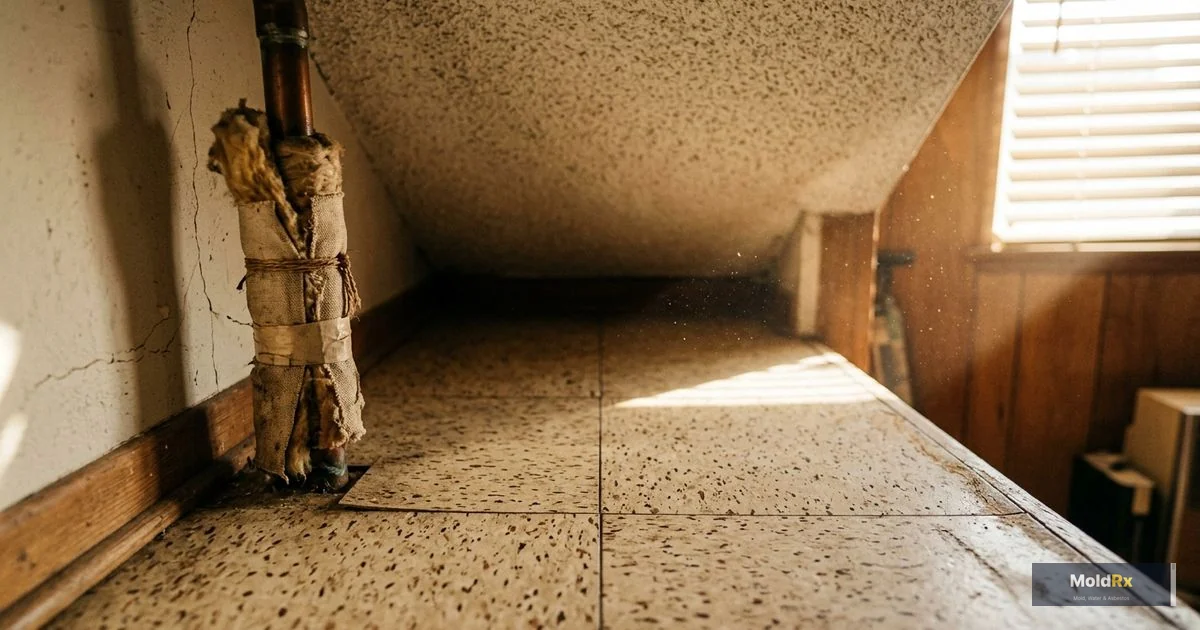
- Pipe insulation and boiler wrapping. Hot water pipes and older heating components were commonly insulated with asbestos-containing corrugated paper, tape, or cement. Pipe insulation in crawl spaces is especially prone to deterioration.
- Electrical panel backing and wire insulation. Some older electrical components, particularly behind breaker panels, used asbestos as heat shielding.
- Window glazing compound and caulking. Older sealants around windows and plumbing penetrations sometimes contain asbestos fibers.
- Duct tape and HVAC sealing. The original cloth-backed duct tape and mastic used to seal HVAC joints in mid-century systems commonly contained asbestos.
Understanding the Health Risk
Asbestos-containing materials that remain intact, undisturbed, and in good condition do not release fibers. The risk equation changes the moment materials are disturbed — scraped, sanded, drilled, broken, or demolished. Microscopic asbestos fibers become airborne, invisible and odorless, small enough to penetrate deep into lung tissue where they can cause mesothelioma, asbestosis, and lung cancer.
The latency period between exposure and disease onset ranges from 10 to 50 years. You will not feel immediate symptoms after inhaling asbestos fibers. By the time disease manifests, the exposure cannot be undone. This is why testing before disturbance is not optional — it is the only way to know what you are dealing with before it becomes an irreversible health problem.
How Professional Asbestos Testing Works in Grand Terrace
MoldRx only sends vetted, trained asbestos testing specialists to Grand Terrace properties. The process follows a systematic protocol designed to give you reliable, legally defensible answers without creating unnecessary risk.
Step 1 — Consultation and Scope Definition
Every project begins with understanding your situation. Are you remodeling a kitchen? Replacing a roof? Buying a 1967 ranch home on Vista Grande Drive? Preparing a property for demolition? The scope of your project determines which materials need to be sampled and helps our team plan the most efficient inspection strategy. There is no value in testing materials you will never touch, and there is serious risk in skipping materials you will.
Step 2 — On-Site Inspection and Sample Collection
A trained specialist visits your Grand Terrace property, conducts a visual assessment of suspect materials, and collects samples following EPA and AHERA (Asbestos Hazard Emergency Response Act) protocols. Each material is wetted before a small section is extracted, suppressing fiber release. Samples are sealed in labeled containers and documented with their exact location in the structure.
Improper sampling — scraping a ceiling with a putty knife, snapping floor tile, or dry-cutting into insulation — can release fibers into your living space and transform a safe material into an active hazard. Professional sampling exists specifically to prevent this.
Step 3 — NVLAP-Accredited Laboratory Analysis
All samples are analyzed at an independent laboratory accredited under the National Voluntary Laboratory Accreditation Program (NVLAP). The primary analytical method is polarized light microscopy (PLM), which identifies asbestos fiber type (chrysotile, amosite, crocidolite, tremolite, actinolite, or anthophyllite) and estimates concentration. When greater sensitivity is needed — for air samples, clearance monitoring, or low-concentration materials — transmission electron microscopy (TEM) provides fiber-level resolution.
The laboratory is independent of MoldRx and independent of any abatement contractor. Results reflect what the samples contain.
Step 4 — Results Interpretation and Project Guidance
You receive a written report documenting every material tested, which samples contain asbestos, fiber type, and concentration. Our team walks you through the practical implications:
- No asbestos detected. You have documented clearance to proceed with your project. The report serves as evidence for permit applications, contractor coordination, and real estate files.
- Asbestos present in materials that will not be disturbed. In many cases, the safest and most cost-effective approach is to leave the material in place and monitor its condition periodically. This strategy — called management in place — is endorsed by the EPA and is a legitimate, widely used approach.
- Asbestos present in materials that will be disturbed. If your renovation involves cutting into, removing, or otherwise disturbing asbestos-containing materials, licensed abatement by a CSLB C-22 certified contractor must be completed before any construction work begins.
- Asbestos present in deteriorating materials. Materials that are crumbling, water-damaged, or physically degrading may require immediate encapsulation or removal regardless of whether a renovation is planned.
Schedule your free asbestos testing estimate — call (888) 609-8907 or book online.
California and Regional Asbestos Regulations That Apply to Grand Terrace
Grand Terrace falls within the jurisdiction of some of the strictest asbestos regulations in the country. Understanding the regulatory landscape before you begin a project saves time, money, and legal exposure.
SCAQMD Rule 1403 — Asbestos Emissions From Demolition and Renovation Activities
The South Coast Air Quality Management District (SCAQMD) enforces Rule 1403 across its four-county jurisdiction, which includes all of San Bernardino County. This rule requires:
- A thorough asbestos survey before any demolition or renovation of structures where asbestos-containing materials may be present. Pre-1980 structures are presumed to contain asbestos unless a survey proves otherwise.
- Written notification to SCAQMD at least 10 working days before work begins. As of November 2016, all Rule 1403 notifications must be submitted through SCAQMD's online web application.
- Proper removal, handling, and disposal of all identified asbestos-containing materials before demolition or renovation proceeds. Materials must be wetted, bagged, labeled, and transported to approved disposal facilities.
- On-site supervisory personnel who have completed training and hold accreditation under AHERA (Asbestos Hazard Emergency Response Act).
Violations of Rule 1403 carry substantial penalties, including fines and project stop-work orders. A professional asbestos testing report is the foundational document that determines whether Rule 1403 abatement and notification procedures apply to your project.
Cal/OSHA Title 8, Section 1529 — Asbestos Standards for Construction
California's Occupational Safety and Health Administration enforces Title 8 §1529, which governs all construction activities involving asbestos-containing materials. Key requirements include:
- Exposure assessments before work begins on materials known or presumed to contain asbestos.
- Engineering controls — negative-pressure containment, wet methods, and HEPA-filtered ventilation — to prevent fiber release.
- Personal protective equipment (PPE) for all workers, including properly fitted respirators.
- Medical surveillance for workers with occupational asbestos exposure.
- Regulated waste disposal through licensed facilities.
OSHA 1926.1101 — Federal Asbestos Standard for Construction
The federal standard under OSHA 1926.1101 establishes baseline requirements that apply nationwide. California's Cal/OSHA standards meet or exceed these federal requirements, but the federal standard remains relevant for projects involving federal funding or multi-state contractors working in Grand Terrace.
CSLB C-22 — Asbestos Abatement Contractor License
Any contractor performing asbestos abatement in California — containment, encapsulation, removal, or disposal — must hold a C-22 Asbestos Abatement classification from the Contractors State License Board (CSLB). C-22 holders must maintain active registration with Cal/OSHA DOSH and document at least four years of journeyman-level abatement experience. If your testing results require abatement, MoldRx only sends vetted C-22 licensed contractors.
Real Estate Disclosure Requirements
California law requires sellers to disclose known asbestos-containing materials to prospective buyers. A professional testing report backed by NVLAP-accredited lab results provides documented evidence that protects both parties in a Grand Terrace transaction — eliminating guesswork for buyers and demonstrating due diligence for sellers.
What Grand Terrace Property Owners Should Know Before Starting a Project
Renovation and Remodeling
Grand Terrace's aging housing stock means many homeowners are undertaking updates — kitchen remodels, flooring replacements, popcorn ceiling removal, re-roofing, and room additions. Every one of these projects can disturb asbestos-containing materials. Testing before you start protects your family, your workers, and your legal standing. It also prevents the far more expensive scenario of discovering asbestos mid-project, which typically means a full work stoppage, emergency containment, and remediation costs that dwarf the original testing investment.
Home Purchase and Sale
Whether you are buying or selling a Grand Terrace property, a pre-transaction asbestos assessment provides clarity. Buyers learn what they are inheriting, sellers fulfill disclosure obligations with documented evidence, and lenders increasingly expect this documentation for pre-1980 properties.
Demolition
SCAQMD Rule 1403 makes a pre-demolition asbestos survey mandatory for any structure in Grand Terrace — no exceptions. The survey must be completed and any identified asbestos-containing materials properly abated before a demolition permit will be issued. Plan this step early to prevent costly delays.
Property Management
If you manage rental properties in Grand Terrace — particularly older multi-unit buildings from the 1960s and 1970s — periodic asbestos assessments protect your tenants, your liability exposure, and your maintenance teams. Knowing what materials are present allows you to plan routine maintenance without inadvertently disturbing asbestos-containing components.
Grand Terrace Neighborhoods and Areas We Serve
MoldRx sends vetted asbestos testing specialists to every neighborhood and property type in Grand Terrace, including:
- Blue Mountain area. The established hillside neighborhood near Grand Terrace's namesake peak, featuring mid-century ranch homes with potential asbestos in original roofing, siding, insulation, and textured ceiling materials. Many homes here date to the 1960s with original building components that have never been tested.
- Indian Knolls. South of Barton Road, close to the I-215 and SR-10 interchange. Homes date primarily from the 1960s and 1970s — peak asbestos era — and commonly feature 9x9-inch vinyl floor tiles, popcorn ceilings, and original duct insulation.
- Grand Terrace Estates and Cooley Ranch. Residential areas with properties from the heart of the asbestos construction window. Cooley Ranch has seen redevelopment attention that makes pre-renovation testing especially relevant.
- Barton Road corridor. Residential and commercial properties along Grand Terrace's main commercial street, where Stater Bros., Grocery Outlet, and local businesses occupy structures that may contain asbestos.
- Vista Grande Drive and De Berry Street areas. Classic 1960s-1970s ranch homes representing the most common property type in Grand Terrace — and the type most likely to contain multiple asbestos-bearing materials.
We cover the entire 92313 ZIP code and neighboring communities including Colton, Riverside, Loma Linda, Highgrove, and Highland. Not sure if your property falls in our service area? Call and ask.
Related Services in Grand Terrace
In addition to asbestos testing, MoldRx also provides Mold Removal in Grand Terrace, Asbestos Removal in Grand Terrace, Water Damage Restoration in Grand Terrace, and Mold Testing in Grand Terrace services to Grand Terrace property owners.
Learn more about remediation services in Grand Terrace
Frequently Asked Questions
When is asbestos testing legally required in Grand Terrace?
SCAQMD Rule 1403 requires a professional asbestos survey before any renovation or demolition of structures where asbestos-containing materials may be present — effectively any pre-1980 building in Grand Terrace. Beyond the regulatory mandate, testing is strongly recommended before purchasing older properties, when you notice deteriorating building materials, before any project involving walls, floors, or ceilings, and whenever you want documented baseline information. The survey must be performed by trained personnel, and analysis completed by an NVLAP-accredited facility.
What materials in a Grand Terrace home are most likely to contain asbestos?
Given the city's 1950s-through-1970s construction era, the most frequently identified asbestos-containing materials include popcorn ceilings, 9x9-inch vinyl floor tiles and their black mastic adhesive, pipe and duct insulation, roofing shingles and felt, drywall joint compound, textured wall coatings, cement exterior siding, HVAC duct sealing tape, and vermiculite attic insulation. In a pre-1980 Grand Terrace home, any original building material should be treated as suspect until PLM or TEM laboratory analysis confirms otherwise.
How are samples collected safely?
A trained specialist wets each suspect material to suppress fiber release, extracts a small sample using specialized tools, and immediately seals it in a labeled container. The sample area is cleaned and any debris is contained. This controlled process — consistent with AHERA protocols — prevents contamination of your living space and is exactly why professional sampling matters. Amateur collection methods (scraping, breaking, dry-cutting) can release the very fibers you are trying to identify.
What happens if asbestos is found in my Grand Terrace home?
The presence of asbestos does not automatically require removal. The correct response depends on the material's condition and whether your project will disturb it. Intact, undisturbed materials can often be managed in place with periodic monitoring. Deteriorating materials may require encapsulation. Materials that will be disturbed must be abated by a CSLB C-22 licensed contractor before construction begins, with SCAQMD Rule 1403 notification filed at least 10 working days in advance.
Is it safe to live in a Grand Terrace home that contains asbestos?
Yes, in most cases. Asbestos-containing materials that are intact and undisturbed do not release fibers and do not pose an immediate health risk. The danger arises only when materials are disturbed, damaged, or allowed to deteriorate. Knowing what is in your home through professional testing allows you to manage materials appropriately, make informed decisions about future renovations, and brief any contractors or maintenance workers before they begin work that could disturb hidden materials.
How long does the entire testing process take?
On-site inspection and sample collection typically takes one to three hours depending on property size and number of materials sampled. Laboratory analysis at the NVLAP-accredited facility takes three to five business days for standard turnaround, with rush options available. Once results are in, our team reviews them with you and provides clear guidance for your situation.
What is the difference between PLM and TEM analysis?
Polarized light microscopy (PLM) is the standard method for bulk material analysis — it identifies asbestos fiber type, estimates concentration, and is the method specified by SCAQMD Rule 1403 and accepted by Cal/OSHA for compliance. Transmission electron microscopy (TEM) provides higher-resolution analysis for air monitoring, post-abatement clearance, and situations where PLM results are inconclusive. Your specialist will recommend the appropriate method based on your materials and project.
Do I need asbestos testing if my Grand Terrace home was built after 1980?
Properties built between 1980 and roughly 1985 may still contain asbestos-era products. California's phased asbestos restrictions began in 1977, but contractors routinely used existing inventory for months or years afterward. If your home was built during this transition window, testing remains advisable — particularly for joint compound, roofing products, and floor tiles produced in massive quantities before the ban took effect.
Get Asbestos Testing in Grand Terrace
Grand Terrace may be one of San Bernardino County's smallest cities, but its housing stock carries the same asbestos considerations as any Inland Empire community built during the mid-20th century. The ranch homes along Vista Grande, the textured ceilings in Indian Knolls bungalows, the original floor tiles in Blue Mountain area kitchens, the ductwork insulation in homes along De Berry Street — all of these materials are products of an era when asbestos was used freely, without question, and without disclosure.
If you are planning renovations, buying or selling property, preparing for demolition, or simply want a documented baseline, professional asbestos testing gives you the answers you need. It satisfies SCAQMD Rule 1403 requirements, fulfills Cal/OSHA Title 8 §1529 obligations, provides documentation for real estate transactions and permit applications, and protects the people living and working inside the structure.
MoldRx only sends vetted asbestos testing specialists who understand Grand Terrace's construction patterns, know what to look for in a 1965 ranch home versus a 1978 tract build, and will give you honest answers about whether testing is needed, what the results mean, and what to do next.
No guesswork. No runaround. Just clear, documented answers.
Get your free asbestos testing estimate for Grand Terrace — call (888) 609-8907 or schedule online.