Emergency Water Damage Restoration in Garden Grove, CA — MoldRx
24/7 Emergency Water Damage Restoration Serving Garden Grove and Central Orange County — Call (888) 609-8907 Now
You are reading this because water is inside your Garden Grove home or business right now — or it was there recently and you are not sure what to do next. Either way, the clock is already running against you.
Water damage in Garden Grove is not something you can address tomorrow. It is a structural emergency. Every hour that water sits inside your walls, pools beneath your flooring, or saturates the slab foundation beneath your 1950s ranch home, the damage compounds — drywall dissolves from the core outward, original hardwood subfloors delaminate beyond salvage, insulation collapses under its own saturated weight, and mold colonies germinate inside wall cavities within 24 to 48 hours. The EPA and IICRC S520 confirm that timeline. In Garden Grove's moderate humidity — averaging 65 percent and regularly climbing into the low 70s during late spring — germination accelerates because the air itself resists drying.
Garden Grove is home to more than 175,000 residents packed into 18 square miles of Central Orange County. That density means aging infrastructure, shared property boundaries, and plumbing systems that were never designed to last seven decades. When water damage strikes here, it spreads fast and hides in places you cannot see — behind walls that have been painted over a dozen times, beneath flooring layered over original 1950s subfloors, and inside HVAC systems running through original ductwork.
MoldRx only sends vetted water damage restoration professionals who hold current IICRC S500 certification — the national standard governing water damage inspection, extraction, drying, and restoration. Every technician carries CSLB licensing, follows Cal/OSHA safety protocols, and complies with EPA guidelines for contaminated water handling. We do not operate as a lead aggregator. We do not send random contractors. When we put a team in your home, our reputation goes with them.
Call now for emergency water damage restoration — (888) 609-8907. Every hour you wait, the damage gets worse.
Why Water Damage in Garden Grove Is a Different Emergency
Garden Grove was incorporated in 1956 at the epicenter of Orange County's postwar suburban explosion. The city grew from strawberry fields and dairy farms into wall-to-wall residential tracts in barely two decades. That breakneck development built one of the most vulnerable housing stocks in Southern California — and your home is almost certainly part of it.
1950s-1970s Construction at Catastrophic Plumbing Failure Age
The majority of Garden Grove's residential construction happened between 1952 and 1975. That means most homes are now 50 to 74 years old — and the plumbing systems inside them are the same age. Original galvanized steel supply pipes have been corroding from the inside out for decades. The mineral deposits in Orange County's water supply accelerate that corrosion. Cast iron drain lines develop pinhole leaks at every joint and fitting. Copper supply lines fatigued from thousands of thermal expansion and contraction cycles are cracking at solder joints behind walls you cannot see.
These systems do not give you warning. They fail at 2 AM on a Tuesday while you are sleeping. They fail behind the wall in the guest bedroom no one has entered in two weeks. They fail six inches behind your kitchen cabinet where a slow drip saturates the subfloor for months before the vinyl starts bubbling. By the time you see the stain on the ceiling, feel the warm spot on the slab, or notice your water bill doubled — hundreds or thousands of gallons have already saturated structural materials.
Older water heaters are a particular concern. Many Garden Grove homes still have water heaters that are 12 to 15 years past their rated lifespan. When a 40- or 50-gallon tank fails in a garage or interior closet, the entire volume drains across flooring and soaks into walls within minutes. Supply line connections to washing machines and dishwashers — original flex hoses never replaced — crack and burst without warning.
Zinsco and Federal Pacific electrical panels — common in 1960s and 1970s Garden Grove homes — compound the danger. Water intrusion near failing electrical panels creates shock and fire hazards alongside the water damage itself.
Garden Grove's Flood Channel Network and Low-Lying Vulnerability
Garden Grove sits in the flat alluvial plain of Central Orange County, crossed by a network of flood control channels that the Orange County Flood Control District built to manage the region's concentrated rainfall. The Westminster Channel runs through the city. The Garden Grove-Wintersburg Channel drains the northern sections. The East Garden Grove-Wintersburg Channel carries runoff from upstream communities through residential neighborhoods toward the ocean.
These channels work — until they do not. During intense winter storms, channel capacity can be exceeded. Backup flooding pushes water into garages, ground-floor living spaces, and commercial properties along Garden Grove Boulevard and Harbor Boulevard. Low-lying neighborhoods near channel crossings are especially vulnerable. Properties in West Garden Grove and areas near Brookhurst Street sit in natural drainage paths where water concentrates during heavy rain events.
FEMA flood zone maps designate portions of Garden Grove as Special Flood Hazard Areas (SFHA) — areas with a 1 percent annual chance of flooding. But flood damage in Garden Grove does not require your property to sit inside a FEMA zone. Overwhelmed storm drains, sheet flooding across flat terrain, and channel overflow affect properties across the entire city.
Southern California's rainfall pattern makes this worse. Garden Grove receives 12 to 14 inches of annual rainfall — but virtually all of it falls between November and March. The same soil that has been baking in summer drought conditions for eight months cannot absorb water efficiently when winter storms arrive. That water has to go somewhere, and in a city as flat and densely developed as Garden Grove, it goes into homes.
Little Saigon: Multi-Generational Homes with Unique Vulnerability
Garden Grove's Little Saigon district — the largest Vietnamese-American commercial and residential community in the United States — presents distinct water damage challenges. Many homes in this area feature permitted additions, ADUs (accessory dwelling units), and multi-generational living configurations built onto original 1950s and 1960s tract homes. These additions connect new plumbing to original systems that were never designed to handle the increased load. Junction points between old galvanized pipe and newer copper or PEX are failure points. Additional bathrooms, kitchens, and laundry connections stress aging supply and drain lines.
Garage conversions — common throughout Little Saigon — often lack the drainage, ventilation, and waterproofing standards of original construction. When water intrusion affects these spaces, damage can be extensive because the original garage slab was never designed with interior moisture management in mind.
The 24-to-48-Hour Mold Window Is Not Flexible
Mold colonization begins within 24 to 48 hours of moisture exposure. The EPA and IICRC S520 confirm this timeline. Garden Grove's average humidity of 65 percent — significantly higher than inland communities — means the mold window here is tighter than in drier parts of Southern California. Stachybotrys chartarum — black mold — can colonize within 48 to 72 hours on saturated drywall.
Original HVAC systems in many Garden Grove homes lack modern ventilation standards. Moisture trapped inside wall cavities, beneath flooring, and in ceiling spaces creates its own microclimate — relative humidity exceeding 90 percent inside a sealed wall assembly. Older ductwork spreads contaminated air and moisture through the entire home. Box fans and open windows do not reach moisture trapped inside structural assemblies. Professional drying within the first 24 hours is the single most effective mold prevention measure available.
Request your free estimate now — (888) 609-8907. We document everything for your insurance claim from minute one.
Water Damage Categories and Classes: What You Are Dealing With
The IICRC S500 standard classifies water damage by contamination level and physical scope. Understanding your classification determines safety protocols, equipment requirements, and which materials can be saved versus what must be removed.
Category 1 (Clean Water) — from a sanitary source: broken supply line, water heater inlet, ice maker connection. Not an immediate health threat, but degrades to Category 2 or Category 3 within 48 to 72 hours if not extracted. In Garden Grove's moderate humidity, this degradation happens on the faster end of that timeline.
Category 2 (Gray Water) — significant contamination from washing machine overflow, dishwasher discharge, HVAC condensate overflow, or toilet overflow without solids. Requires antimicrobial treatment. Contacted porous materials — carpet pad, particleboard, unsealed drywall — typically require removal. In Garden Grove's older homes with multiple layers of flooring over original subfloors, gray water wicks into hidden materials that are difficult to reach without removal.
Category 3 (Black Water) — the most hazardous classification. Sewage backups, flood channel overflow, storm drain backup, and any standing water present long enough to support pathogen growth. Channel overflow flooding in Garden Grove is Category 3 across the board. Full PPE required. All contacted porous materials removed. No exceptions.
The IICRC S500 also classifies physical scope into four classes:
- Class 1 — minimal absorption, small area affected
- Class 2 — significant absorption across a room with wall wicking, common in Garden Grove supply line failures where water travels along original subfloors beneath multiple flooring layers
- Class 3 — water from overhead saturating walls, ceilings, insulation, and floors simultaneously, the most common class in water heater failures located in interior closets and second-story laundry rooms
- Class 4 — specialty drying of low-permeability materials: concrete slabs, hardwood flooring, plaster walls in older homes, frequent in Garden Grove slab leak scenarios where moisture migrates through aging foundations
Our Water Damage Restoration Process
Every water damage event is different, but the IICRC S500 protocol provides the systematic framework our vetted professionals follow on every Garden Grove job.
1. Emergency Response and Assessment — Technicians identify the water source, classify the water category (Categories 1 through 3) and damage class (Classes 1 through 4), and map the full extent of moisture intrusion using thermal imaging and penetrating moisture meters. In Garden Grove's 1950s-through-1970s housing stock, hidden pathways through original framing, aging insulation, and decades of modified plumbing runs mean moisture routinely migrates far beyond the visible damage zone. In homes with additions and ADUs common in the Little Saigon area, junction points between original and added construction create pathways water exploits.
2. Water Extraction — Standing water is removed immediately using truck-mounted and portable extraction units. Submersible pumps handle deep standing water from flood events. For supply line failures in older homes, extraction targets wall cavities, subfloor assemblies, and insulation in ceiling spaces. Every gallon removed reduces drying time and limits secondary damage.
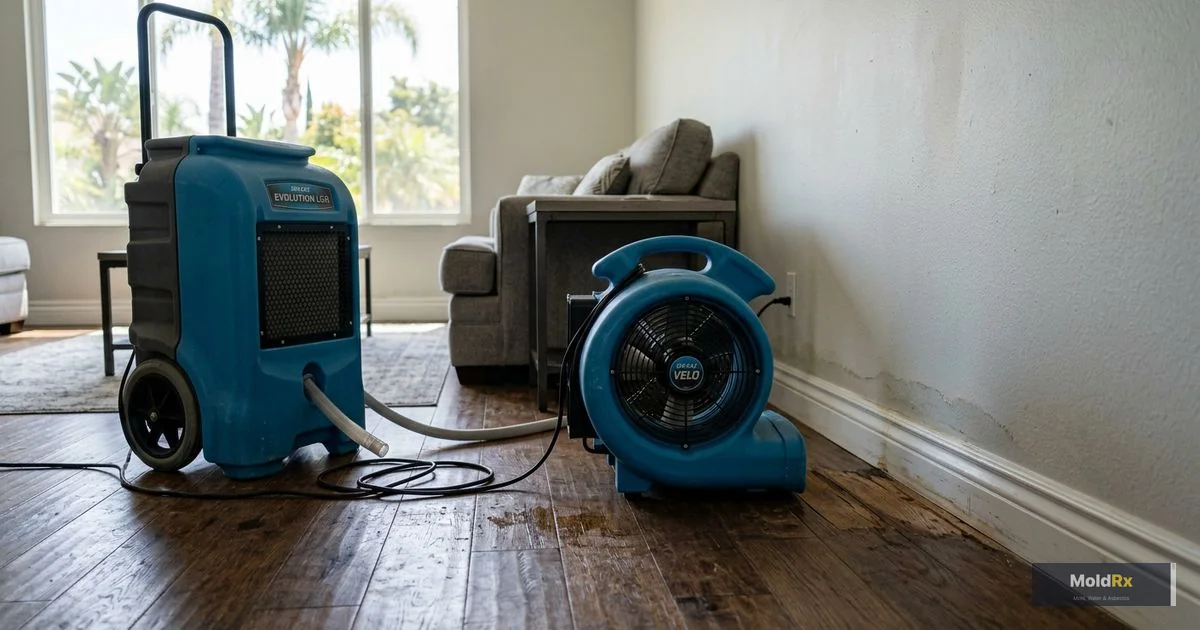
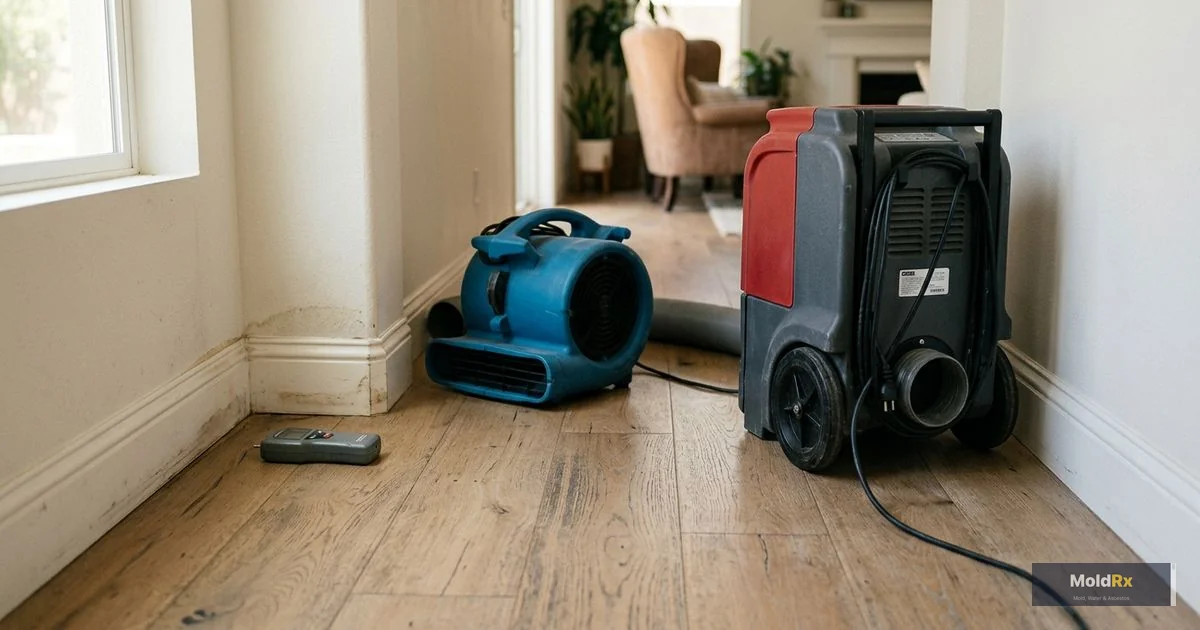
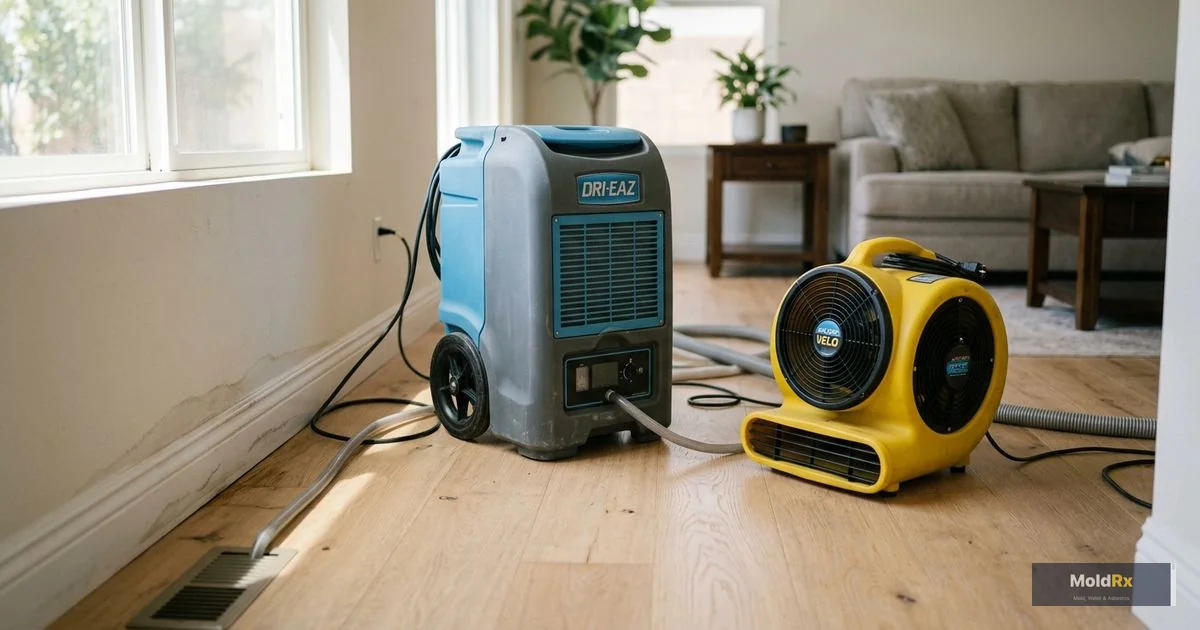
3. Structural Drying and Dehumidification — Commercial-grade dehumidifiers and high-velocity air movers positioned according to psychrometric calculations calibrated for Garden Grove's moderate-humidity coastal climate. Garden Grove's 65 percent average humidity means dehumidification is more critical here than in drier inland areas — ambient air alone will not dry saturated materials. Wall cavities receive directed airflow through injection drying systems. Moisture-trapping older HVAC ductwork is addressed to prevent recirculation of humid air.
4. Moisture Monitoring and Documentation — Daily moisture readings using pin-type and pinless meters, thermo-hygrometers, and thermal imaging. Every reading logged with timestamps for your insurance adjuster per IICRC S500 standards. In older Garden Grove homes with plaster walls, multiple flooring layers, and additions built over decades, specialized monitoring ensures moisture trapped in dense assemblies is fully addressed.
5. Cleaning, Sanitizing, and Antimicrobial Treatment — Category 2 and Category 3 losses require antimicrobial application to all contacted structural materials. HEPA air scrubbers filter airborne contaminants. All protocols comply with Cal/OSHA safety requirements and IICRC S500/IICRC S520 standards.
6. Restoration and Rebuild — All rebuild work performed by CSLB-licensed professionals. In pre-1980 Garden Grove properties, material removal requires awareness of potential asbestos-containing materials — popcorn ceilings, vinyl flooring, pipe insulation, and textured wall compounds from the 1950s through 1970s are common asbestos sources. Testing before disturbance is standard protocol per EPA and Cal/OSHA regulations.
Insurance Documentation Starts the Moment We Arrive
Delayed response can result in denied claims — insurers argue that secondary damage resulted from failure to mitigate. Professional documentation beginning the moment technicians arrive establishes the timeline insurers need. Most homeowner's policies cover sudden and accidental water damage. Flood damage from channel overflow or storm drain backup typically requires separate flood insurance — and in Garden Grove, where FEMA has designated portions of the city as Special Flood Hazard Areas, many property owners carry this coverage or should.
Our documentation includes timestamped photographs, water category and damage class classification per IICRC S500, daily moisture readings, equipment placement records, drying progress reports, and final verification readings — the objective evidence your adjuster needs to validate the claim.
What to Do Right Now Before We Arrive
- Shut off the water source if you can reach the shutoff safely. For slab leaks, turn off the main supply at the meter. For appliance failures, close the supply valve behind the unit. For water heater ruptures, close the cold water inlet valve.
- Turn off electricity to affected areas at the breaker panel. Never step into standing water near active outlets or electrical connections. In homes with Zinsco or Federal Pacific panels, exercise extreme caution — these panels have documented failure rates.
- Move valuables to dry ground. Remove documents, photos, electronics, and irreplaceable items from affected rooms.
- Document everything with photos and video before moving anything. This evidence is critical for your insurance claim.
- Do not use a household vacuum on standing water — shock hazard.
- Do not run fans or your HVAC system. You risk spreading contaminated moisture through ductwork and into unaffected rooms. Older Garden Grove ductwork is especially prone to distributing moisture throughout the home.
- Do not pull up flooring yourself in pre-1980 homes — disturbing original vinyl flooring or adhesives may release asbestos fibers.
Then call (888) 609-8907 immediately.
What Sets MoldRx Apart
- We only send vetted professionals. MoldRx does not operate as a lead aggregator or blind referral service. When we put a team in your home, our reputation goes with them. Every professional has been vetted for CSLB licensing, IICRC S500 certification, insurance, and work quality. If something is not right, you call us directly.
- Fast emergency response. Water damage is the most time-sensitive restoration service that exists. The faster extraction begins, the more of your property we save and the lower the total cost.
- IICRC S500-certified technicians only. Every technician holds current certification and understands Central Orange County conditions — the humidity, the housing stock, the hidden pathways in 1950s and 1960s construction. Not general handymen guessing at dry times.
- Complete insurance documentation. From the first photo to the final moisture reading, every step documented per IICRC S500 standards with timestamped evidence your adjuster can verify.
- Psychrometric drying science calibrated for Garden Grove's moderate-humidity coastal climate — proper dehumidification protocols that account for the 65 percent average humidity that makes structural drying here fundamentally different from inland desert environments.
Garden Grove Neighborhoods We Serve
MoldRx provides emergency water damage restoration throughout Garden Grove and the surrounding Central Orange County communities:
- West Garden Grove — Some of the oldest residential construction in the city, 1950s tract homes with original plumbing now 70+ years old. Low-lying areas near the Westminster Channel face elevated flood risk. Galvanized pipe failures, slab leaks, and water heater ruptures are the primary emergency calls.
- Eastside / East Garden Grove — 1960s and 1970s construction along the Chapman Avenue and Lampson Avenue corridors. Homes here frequently feature garage conversions and additions that stress original plumbing systems. Supply line failures and washing machine connection bursts are common.
- Historic Downtown / Main Street District — The oldest residential and commercial core, including pre-1960 construction with the most aged plumbing and electrical systems in the city. Commercial properties along Main Street face flat-roof ponding and aging drainage infrastructure.
- Little Saigon District — Multi-generational homes with ADUs, permitted additions, and garage conversions built onto original 1950s and 1960s tract homes. Junction points between old and new plumbing are primary failure points. Increased fixture loads stress aging supply and drain systems. Water damage in these homes often affects both the original structure and the addition simultaneously.
- Brookhurst Street Corridor — Residential and commercial properties along one of Garden Grove's primary north-south arteries. Older commercial buildings with flat roofs and aging plumbing. Residential side streets feature 1960s tract homes on slab foundations.
- Garden Grove Boulevard Corridor — Major east-west commercial corridor with mixed-use properties. Aging plumbing, storm drain overflow during heavy rains, and flat-roof ponding create multiple water damage risk factors.
- Neighborhoods near Garden Grove Regional Park — Properties in lower-elevation areas near the park and Westminster Channel face flood risk during major storm events. The 1960s housing stock here has original plumbing at critical failure age.
Coverage includes all Garden Grove ZIP codes — 92840, 92841, 92842, 92843, 92844, and 92845 — plus neighboring communities including Westminster, Santa Ana, Anaheim, Stanton, Cypress, and Fountain Valley.
Related Services
- Mold Removal in Garden Grove — If the 24-to-48-hour mold window has passed, IICRC S520 remediation is the next step.
- Mold Testing in Garden Grove — Air quality and surface sampling to confirm whether mold colonization has begun after water damage.
- Asbestos Testing in Garden Grove — Pre-1980 Garden Grove homes may contain asbestos in popcorn ceilings, vinyl flooring, and pipe insulation. Water damage requiring material removal should include testing first.
- Asbestos Removal in Garden Grove — Licensed abatement required under Cal/OSHA and EPA regulations when asbestos-containing materials are disturbed during restoration.
-> Learn more about remediation services in Garden Grove
Frequently Asked Questions
How quickly do you respond to water damage emergencies in Garden Grove?
We treat every call as an emergency. Garden Grove sits at the center of our Central Orange County coverage area. The 24-to-48-hour mold window confirmed by the EPA and IICRC S520 is not flexible — and Garden Grove's higher humidity accelerates that timeline. Extraction that starts within the first few hours saves exponentially more material and costs exponentially less than extraction that starts the next day.
What should I do first when I discover water damage?
Stop the water source if you safely can. Turn off electricity to affected areas at the breaker panel. Then call (888) 609-8907 immediately. Do not attempt to dry the area with fans — you risk spreading contaminated moisture through older ductwork and into unaffected rooms. Do not pull up flooring in pre-1980 homes without asbestos testing.
Does homeowner's insurance cover water damage restoration?
Most policies cover sudden and accidental water damage — burst pipes, failed appliances, water heater ruptures. Flood damage from channel overflow or storm drain backup typically requires separate flood insurance. Given that FEMA has designated portions of Garden Grove as Special Flood Hazard Areas, property owners near flood channels should verify their coverage. We document every aspect of the restoration per IICRC S500 standards to support your claim from minute one.
How long does water damage restoration take?
A contained Category 1 event in one room may reach dry standard in three to five days. A major event involving multiple rooms, Category 3 water from channel flooding, or saturation in a home with additions and multiple flooring layers can require one to three weeks. We do not rush the process — incomplete drying leads to mold, and IICRC S520 mold remediation costs far more than doing the drying right the first time.
Can mold really grow that fast in Garden Grove?
Yes. Garden Grove's average humidity of 65 percent provides ambient moisture that supports mold germination even without standing water. A saturated wall assembly creates its own microclimate — relative humidity inside that wall exceeds 90 percent. Combined with moderate temperatures, conditions inside a wet wall cavity in Garden Grove are ideal for rapid colonization. The EPA confirms mold begins growing in 24 to 48 hours. Professional extraction and controlled drying per IICRC S500 and IICRC S520 are the only reliable countermeasures.
Will you work with my insurance adjuster?
Yes. We provide complete technical documentation — photos, moisture readings, drying logs, equipment records, verification data — directly to your adjuster per IICRC S500 standards. Documentation begins the moment our team arrives.
Should I worry about asbestos during water damage restoration?
If your Garden Grove home was built before 1980, it may contain asbestos in popcorn ceilings, vinyl flooring and adhesives, pipe insulation, textured wall compounds, or other building materials. Water damage restoration that requires removing these materials should include asbestos testing before any disturbance. Our vetted professionals follow EPA and Cal/OSHA protocols for handling potential asbestos-containing materials.
Get Emergency Water Damage Restoration in Garden Grove Now
Water damage is an active emergency that gets worse with every hour. The materials in your home are absorbing water right now. Mold spores are finding the moisture they need. Whether it is a burst supply line in a 1955 tract home, a water heater that just failed in your garage, a washing machine connection that let go at 3 AM, flood channel overflow during a winter storm, or a slab leak that has been saturating your foundation for weeks — waiting makes everything worse. In Garden Grove's 65 percent humidity, the 24-to-48-hour mold window is tighter than anywhere inland.
MoldRx only sends vetted water damage restoration professionals who follow IICRC S500 standards, carry current CSLB licensing, and understand Central Orange County's moderate-humidity coastal climate and aging 1950s-through-1970s housing stock. Every technician complies with Cal/OSHA safety standards and EPA guidelines for contaminated water handling. Full documentation for your insurance claim starts the moment we arrive.
Every hour matters. Do not wait.
Call MoldRx now for emergency water damage restoration — (888) 609-8907. Fast response. Professional extraction. Complete insurance documentation.