Asbestos Testing in Garden Grove, CA — MoldRx
Vetted Asbestos Testing Professionals Serving Garden Grove and Central Orange County
You are planning a renovation, preparing a property for sale, or staring at a textured ceiling in a house built the same year Disneyland opened down the road. Whatever brought you here, the core question is practical: does your Garden Grove property contain asbestos, and what does that mean for the work you are about to do?
Garden Grove is one of the most densely built postwar suburbs in Orange County. The city was named the fastest-growing city in America in the late 1950s, and nearly all of that explosive construction happened during the exact decades when asbestos was a default ingredient in residential building materials. If your property was built before 1980, asbestos testing is not optional caution — it is a regulatory requirement and a critical planning step.
MoldRx only sends vetted, AHERA-certified asbestos testing professionals to Garden Grove properties. Every sample is analyzed at an NVLAP-accredited laboratory. You get documented results, plain-language interpretation, and practical guidance for your specific project.
Schedule your free estimate or call (888) 609-8907
Why Garden Grove Properties Carry Elevated Asbestos Risk
The Fastest-Growing City in America — Built During Peak Asbestos Years
Garden Grove's trajectory from farming community to suburban city is one of the most concentrated building booms in Southern California history. In 1950, the population stood at 3,762. By 1956, when the city officially incorporated, it had already surged past 41,000. By 1960, the census recorded 84,238 residents. By 1970, Garden Grove had crossed 120,000 — a thirty-fold increase in twenty years.
Building permit records show single-family construction peaked in 1959 with over 3,084 permits in a single year. Developers like the Rossmoor Corporation built out entire neighborhoods in months — thousands of three-bedroom, one-bath ranch homes averaging 1,500 square feet, selling for roughly $7,000 apiece.
The median construction year for Garden Grove's housing stock falls in the mid-1960s — the peak era of asbestos use in American construction.
Construction Completed Before Any Asbestos Restrictions Existed
Between 1940 and 1978, asbestos was added to dozens of standard building products — ceiling textures, floor tiles, pipe insulation, roofing, joint compound, siding — because it was fireproof, cheap, and durable. The EPA did not begin restricting asbestos until 1973. Garden Grove's housing stock was almost entirely complete before any of those restrictions existed.
Where Asbestos Hides in Garden Grove Homes
In a mid-century Garden Grove home, asbestos-containing materials can appear in locations most homeowners would never suspect. The most common include:
-
Popcorn ceilings and textured coatings. The stippled "cottage cheese" ceilings that were standard in 1960s tract construction frequently contained chrysotile asbestos at concentrations of 5 to 10 percent by weight. These are found in bedrooms, hallways, living rooms, and kitchens throughout Garden Grove's housing stock.
-
9x9-inch vinyl floor tiles and mastic adhesive. These distinctive square tiles were installed in kitchens, bathrooms, and utility rooms in homes across every Garden Grove ZIP code. The black mastic adhesive beneath them often contains asbestos as well, which means pulling up flooring can release fibers even if the tiles themselves test clean.
-
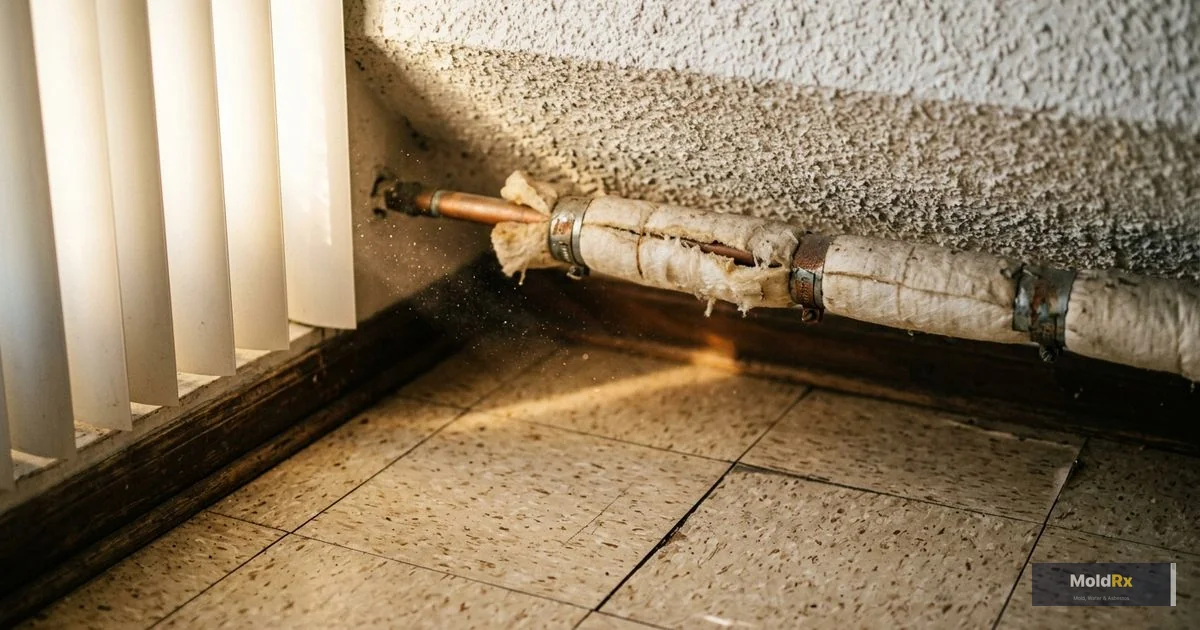
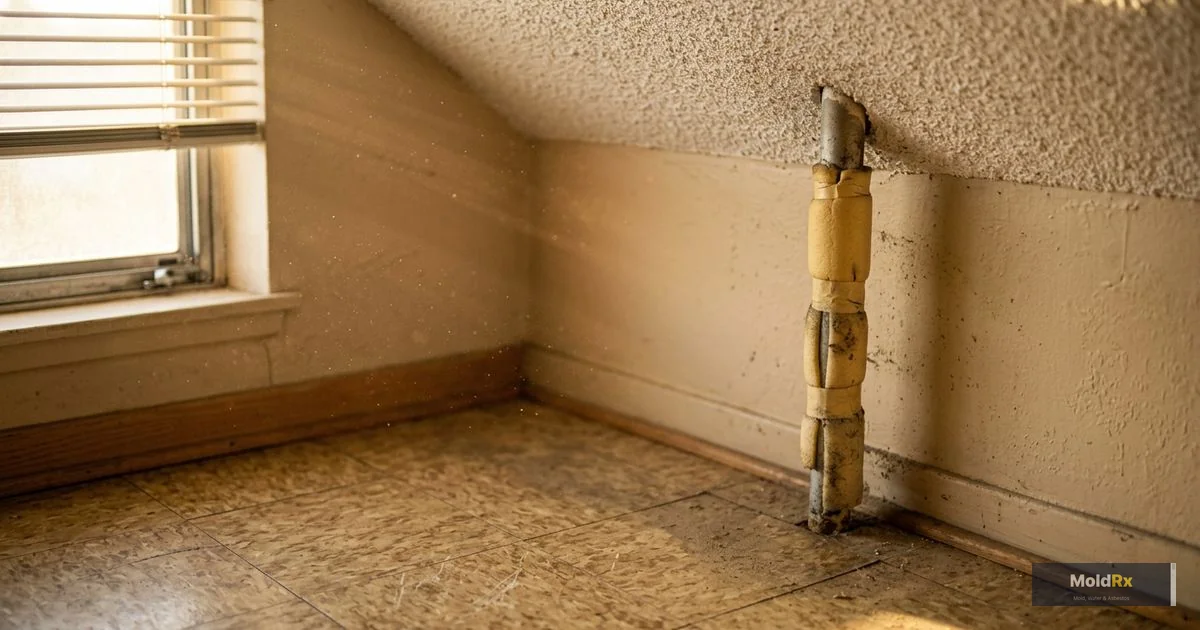
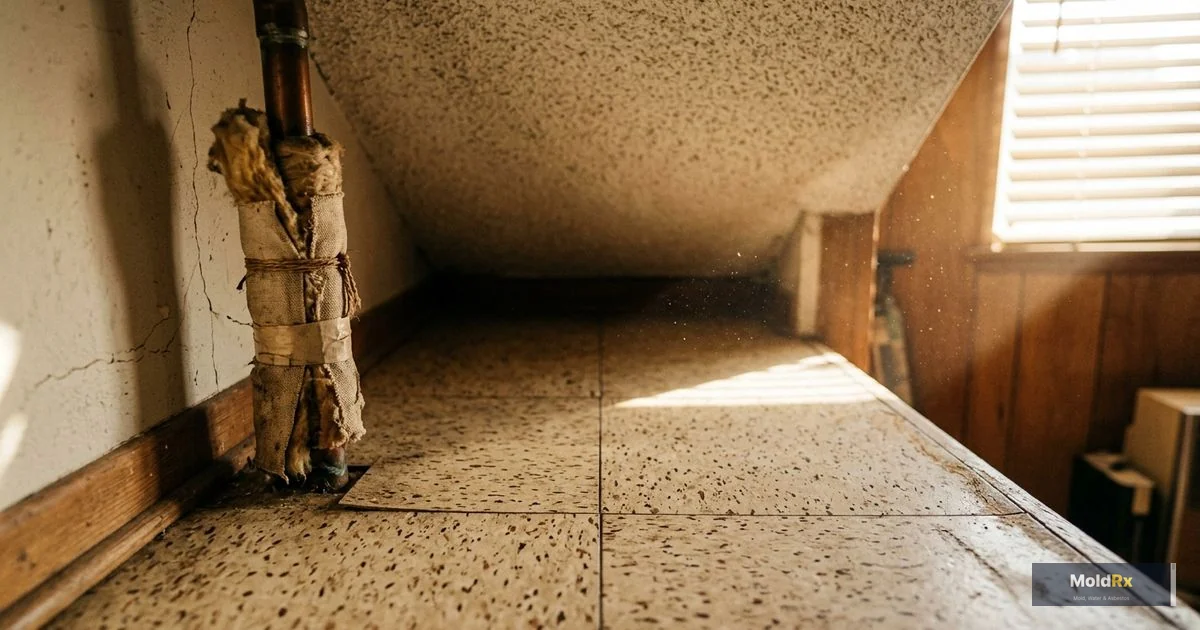
Pipe insulation and duct wrapping. Older HVAC systems used asbestos-containing insulation on hot water pipes, heating ducts, and furnace components. Given Garden Grove's semi-arid climate, these systems have been working hard for decades and the insulation shows its age.
-
Joint compound and wall texture. Pre-1975 drywall joint compound frequently contained chrysotile asbestos. Once painted over, it is entirely invisible — one of the most commonly overlooked sources.
-
Roofing materials. Asbestos cement shingles and felt underlayment were standard through the 1970s. Contractors sometimes installed new roofing directly over old asbestos-containing layers.
-
Exterior siding. Asbestos cement siding was popular for durability and fire resistance. Many Garden Grove ranch homes in 92840, 92841, and 92843 still have original asbestos-containing exteriors beneath newer finishes.
-
Vermiculite attic insulation. Loose-fill insulation that looks like small gray-brown pebbles may be vermiculite contaminated with tremolite asbestos. Over 70 percent of vermiculite sold in the U.S. between 1923 and 1990 came from a contaminated mine in Libby, Montana.
-
HVAC components. Older furnaces, heating ducts, and the duct tape used to seal them may contain asbestos — relevant if you are upgrading a system that has been running for 50-plus years.
The Health Risk Is Real but Manageable
Intact, undisturbed asbestos-containing materials generally do not pose an immediate health threat — the fibers are locked within the material's matrix. Garden Grove's dry, mild climate means building materials age slowly here without the moisture-driven deterioration common in other regions.
The danger begins the moment someone cuts, drills, sands, or demolishes those materials. Microscopic asbestos fibers become airborne, invisible and odorless, and can remain suspended in indoor air for hours. Once inhaled, they lodge permanently in lung tissue. Mesothelioma, asbestosis, and asbestos-related lung cancer can develop 10 to 50 years after exposure. There is no safe exposure level.
This is why testing happens before any work begins. Not during. Not after.
What California Law Requires Before You Renovate in Garden Grove
Garden Grove falls within the jurisdiction of the South Coast Air Quality Management District (SCAQMD) and is subject to both state and federal asbestos regulations. If you are planning renovation or demolition work on a pre-1980 property, understanding these requirements is a non-negotiable part of project planning.
SCAQMD Rule 1403
SCAQMD Rule 1403 governs asbestos emissions during building demolition and renovation across Orange, Los Angeles, Riverside, and San Bernardino counties. The rule requires:
-
A pre-project asbestos survey before any demolition or renovation — regardless of building age or size. The survey must be conducted by a certified asbestos consultant and documented in a signed report. Importantly, laboratory analyses performed to comply with Rule 1403 must be conducted by an NVLAP-accredited laboratory.
-
Written notification to SCAQMD at least 14 days before starting any demolition project, even if no asbestos was found. For renovation projects that will disturb asbestos-containing materials, notification is also required.
-
Proper abatement procedures if asbestos-containing materials are identified and will be disturbed. A registered asbestos removal contractor must perform the work before general construction proceeds.
The only residential exception: renovation of a single-unit dwelling where less than 100 square feet of intact material is removed or stripped. For anything beyond that threshold, the full survey requirement applies.
Penalties for non-compliance are steep — fines can exceed $20,000 per day, and negligence leading to bodily harm or environmental contamination can trigger criminal penalties.
Cal/OSHA Title 8 Section 1529
Cal/OSHA Title 8 Section 1529 (Cal/OSHA Title 8 §1529) is the state standard that governs all construction-related asbestos work. Key requirements:
-
Any renovation or demolition of pre-1980 construction requires an asbestos survey conducted by a Cal/OSHA-certified consultant or, as permitted by Cal/OSHA, a person holding an unexpired AHERA Building Inspector certificate from a Cal/OSHA-approved course.
-
When more than 100 square feet of asbestos-containing material (concentration above 0.1 percent) will be disturbed, only trained, DOSH-registered professionals may perform the work. Below 100 square feet, contractors must still comply with all Cal/OSHA safety regulations — only the registration requirement is waived.
-
General contractors on any project involving asbestos-containing materials have a legal duty to verify that the asbestos abatement contractor is in compliance with Section 1529.
Federal OSHA 1926.1101
OSHA 1926.1101 is the federal construction industry standard for asbestos. It establishes permissible exposure limits (PEL) of 0.1 fibers per cubic centimeter over an eight-hour time-weighted average and an excursion limit of 1.0 fiber per cubic centimeter over a 30-minute period. The standard classifies asbestos construction work into four classes based on the type of material being disturbed, with Class I (removal of thermal system insulation and surfacing material) requiring the most stringent controls.
CSLB C-22 License Requirement
In California, asbestos abatement work must be performed by a contractor holding a CSLB C-22 (Asbestos Abatement) specialty license issued by the Contractors State License Board. This ensures that any removal work on your Garden Grove property is performed by professionals with documented training, insurance, and regulatory compliance. Always verify that any abatement contractor holds an active C-22 license before signing a contract.
Disclosure Requirements
If you are selling a Garden Grove home, California law requires disclosure of known asbestos-containing materials to potential buyers. A professional testing report provides documented evidence that protects both parties in the transaction. For buyers, having test results before closing eliminates one of the largest unknowns in purchasing a mid-century property.
Request your free estimate or call (888) 609-8907
How Asbestos Testing Works in Garden Grove
Getting clear, documented answers about asbestos in your Garden Grove property follows a straightforward four-step process. Here is what to expect.
Step 1: Pre-Inspection Consultation
Before anyone arrives at your property, we discuss your situation. Are you planning a kitchen remodel in a 1962 ranch home near Brookhurst and Chapman? Replacing flooring in a duplex off Garden Grove Boulevard? Buying a fixer-upper in the 92844 ZIP code? Preparing to scrape popcorn ceilings in a home near Christ Cathedral? The scope of your project determines the scope of testing required. A single-room renovation may need only two or three samples. A whole-house assessment before a sale might require eight to twelve or more.
Step 2: On-Site Assessment and Sample Collection
A vetted asbestos testing professional inspects your property to identify suspect materials based on age, type, condition, and location — checking obvious suspects like popcorn ceilings and floor tiles, but also less visible materials like pipe insulation in the attic, mastic under carpet, joint compound on walls, and HVAC duct connections.
Samples are collected following EPA-approved protocols: wetting the material to suppress fiber release, carefully extracting a small sample with specialized tools, sealing it in a labeled container, and documenting the exact location. Each material type gets its own sample and its own analysis.
This is not a DIY step. Improper sampling can release fibers into your living space and contaminate areas that were previously safe. Professional sampling gets answers without creating the hazard you are trying to identify.
Step 3: NVLAP-Accredited Laboratory Analysis
Samples go to an NVLAP-accredited laboratory for analysis using Polarized Light Microscopy (PLM) — the standard method that identifies asbestos fiber type and concentration — or Transmission Electron Microscopy (TEM) when higher sensitivity is needed. TEM detects fibers at concentrations below the PLM detection threshold.
The laboratory is independent. Results identify whether asbestos is present, the specific mineral type, and the concentration. Standard turnaround is three to five business days, with rush processing available.
Step 4: Results Interpretation and Project Planning
You receive a clear report explaining which materials tested positive, which tested negative, and what those results mean for your project. If asbestos is present, we walk you through your options:
-
Leave it in place. Undisturbed materials in good condition outside your renovation scope can remain safely as-is — the most common outcome for Garden Grove homeowners.
-
Encapsulation. Sealing materials with a protective coating prevents fiber release without full removal, appropriate for some flooring, roofing, or siding applications.
-
Professional removal. When your project requires disturbing asbestos-containing materials, a DOSH-registered contractor with an active CSLB C-22 license handles removal. Your testing report provides documentation to scope the work and obtain SCAQMD notifications.
-
Periodic monitoring. Materials that remain in place should be visually inspected periodically to ensure they do not deteriorate.
Common Renovation Projects That Require Testing in Garden Grove
Garden Grove homeowners do not always realize which projects trigger the asbestos testing requirement. Here is a practical guide to the most common scenarios.
Kitchen and Bathroom Remodels
Pulling up old floor tiles, scraping textured ceilings, ripping out cabinetry fastened through asbestos-containing drywall compound, replacing plumbing surrounded by pipe insulation — each activity can release fibers if the materials test positive. In a city where the typical kitchen was built in the early 1960s, testing before demolition is essential.
Flooring Replacement
Removing carpet in a 1960s Garden Grove home often reveals 9x9-inch vinyl tiles underneath with black mastic adhesive beneath. Both are common asbestos carriers. Even installing new flooring over old requires knowing what lies beneath for future disclosure and safety planning.
Popcorn Ceiling Removal
Dry-scraping an asbestos-containing popcorn ceiling can contaminate an entire house with airborne fibers in minutes. Always test before scraping — Garden Grove is a city where most homes were built before 1970.
Whole-House Renovation or Room Addition
Opening walls, rerouting plumbing, replacing ductwork, or adding square footage to a pre-1980 home requires a comprehensive asbestos survey. A pre-project survey saves time and money by identifying issues before contractors bid rather than mid-project.
Roof Replacement
Cement-asbestos roof shingles were common on homes built through the 1970s. If your Garden Grove home still has its original roof — or previous roofing was installed over older layers — testing determines whether abatement is needed first.
HVAC System Upgrades
Replacing an older furnace, upgrading ductwork, or installing a mini-split often involves disturbing insulated ducts, pipe wrapping, and furnace components that may contain asbestos. A frequently overlooked testing trigger.
Real Estate Transactions
Buyers of pre-1980 Garden Grove properties increasingly request testing during due diligence. Sellers who provide a clean report remove a negotiation obstacle. Given that Garden Grove's housing stock sits squarely in the peak asbestos era, testing is becoming standard in older home transactions.
Garden Grove Neighborhoods and Areas We Serve
MoldRx only sends vetted asbestos testing professionals to Garden Grove properties. Our coverage spans every neighborhood and ZIP code in the city.
-
West Garden Grove (92845). The western section features well-maintained 1960s ranch homes that are increasingly popular renovation targets. Proximity to Seal Beach and Los Alamitos drives property values and remodeling activity — making pre-renovation asbestos testing essential for homeowners upgrading these mid-century properties.
-
Central Garden Grove (92840). The city's most populated ZIP code includes the areas surrounding Garden Grove Park, the Civic Center, and the commercial corridors along Garden Grove Boulevard. A mix of single-family ranch homes, duplexes, and apartment complexes — nearly all built between 1955 and 1975 — makes this a high-probability area for asbestos-containing materials.
-
North Garden Grove (92841). Residential neighborhoods north of Garden Grove Boulevard, characterized by their tight-knit community atmosphere and 1960s tract housing. Close proximity to Knott's Berry Farm and the Buena Park border. The same construction-era materials found throughout Garden Grove are present here.
-
East Garden Grove and Little Saigon (92843, 92844). The eastern sections encompass portions of the Little Saigon cultural district — the largest Vietnamese community outside of Vietnam — and a dense mix of residential and commercial properties. Many commercial buildings along Bolsa Avenue and Brookhurst Street were built or renovated during the asbestos era. Residential properties in these ZIP codes carry the same mid-century asbestos risks as the rest of Garden Grove's housing stock.
-
Brookhurst Corridor and Christ Cathedral area. Properties along Brookhurst and Chapman include commercial buildings, strip malls, and residential neighborhoods dating to the 1960s peak. The Christ Cathedral landmark — the former Crystal Cathedral, designed by Philip Johnson and completed in 1981 — anchors the area near Chapman and Lewis Street, but surrounding neighborhoods were built two decades earlier with all associated asbestos-era materials.
We serve all Garden Grove ZIP codes: 92840, 92841, 92843, 92844, and 92845. We also work with property owners in neighboring cities including Westminster to the south, Stanton to the north, Anaheim to the northeast, Santa Ana to the southeast, and Fountain Valley to the southwest.
Get your free estimate or call (888) 609-8907
What to Expect Working With MoldRx
-
Vetted professionals only. MoldRx only sends vetted specialists holding current AHERA Building Inspector certification. You get someone who understands mid-century construction and knows where to look in a Garden Grove tract home.
-
NVLAP-accredited lab analysis. Every sample is analyzed at an NVLAP-accredited laboratory using PLM or TEM methods — verified analysis that satisfies SCAQMD Rule 1403, Cal/OSHA Title 8 §1529, and OSHA 1926.1101 documentation requirements.
-
Honest scope. If materials are clearly modern or outside your renovation footprint, we tell you they do not need testing. You only pay for what genuinely warrants analysis.
-
Plain-language communication. You will understand exactly what was tested, what the lab found, and what your options are — regulations explained in practical terms.
-
Compliant documentation. Your report meets standards required by SCAQMD, Cal/OSHA, the City of Garden Grove building department, real estate transactions, and contractor coordination. One report covers all purposes.
-
No pressure to escalate. Many Garden Grove homeowners discover asbestos in materials they were never planning to disturb. We tell you when removal is necessary and when it is not.
Frequently Asked Questions
When is asbestos testing required before renovating in Garden Grove?
SCAQMD Rule 1403 requires an asbestos survey before renovation or demolition on any building in Orange County. Cal/OSHA Title 8 §1529 separately requires surveys for pre-1980 construction. The only residential exception applies to single-unit dwellings where less than 100 square feet of intact material will be removed. For Garden Grove — where the vast majority of homes predate 1980 — testing is effectively a standard pre-renovation requirement.
What materials in a Garden Grove home are most likely to contain asbestos?
Given the city's dominant 1950s-through-1970s construction era, the highest-risk materials include popcorn ceilings, 9x9-inch vinyl floor tiles and their black mastic adhesive, pipe and duct insulation, roof shingles and felt underlayment, drywall joint compound, exterior cement siding, vermiculite attic insulation, and textured wall coatings. In a pre-1980 Garden Grove home, the safe assumption is that any original building material could contain asbestos until PLM or TEM laboratory analysis proves otherwise.
How are asbestos samples collected safely?
Trained, AHERA-certified professionals wet the suspect material to suppress fiber release, then carefully extract a small sample using specialized tools. The sample is immediately sealed in a labeled container for laboratory transport. The surrounding area is cleaned and any debris is properly contained. This controlled process prevents contamination of your living space and is precisely why professional sampling matters.
What happens if asbestos is found in my Garden Grove home?
Finding asbestos does not automatically mean removal. Intact, undisturbed materials can often be managed in place through monitoring — the most common outcome. Damaged materials may be candidates for encapsulation. Materials that will be disturbed by your renovation must be professionally removed by a DOSH-registered contractor with a CSLB C-22 license before construction begins. Your testing report provides documentation needed to scope removal and file SCAQMD notifications.
Can I collect asbestos samples myself?
California allows owner-occupants of buildings with four or fewer units to collect their own samples, but the samples must still be analyzed by an NVLAP-accredited laboratory. Improper collection can release fibers into your home — creating the exact hazard you are trying to identify. For most Garden Grove homeowners, the safety margin of professional collection far outweighs any DIY savings.
How long does asbestos testing take?
On-site inspection and sample collection takes one to three hours depending on property size. NVLAP-accredited laboratory analysis requires three to five business days, with rush processing available. Once results are back, we review findings and discuss next steps.
What is the difference between PLM and TEM analysis?
PLM (Polarized Light Microscopy) is the standard method for identifying asbestos in bulk materials — it identifies fiber type and concentration. TEM (Transmission Electron Microscopy) detects fibers at lower concentrations and is used when PLM results are inconclusive or higher precision is required. Both are performed at NVLAP-accredited laboratories.
Does Garden Grove require an asbestos survey for building permits?
The City of Garden Grove follows SCAQMD requirements for renovation and demolition permits on pre-1980 structures. You may be asked to provide asbestos survey documentation when pulling permits. Having testing done before applying prevents delays and keeps your project on track.
Related Services in Garden Grove
In addition to asbestos testing, we also offer Mold Removal in Garden Grove, Asbestos Removal in Garden Grove, Water Damage Restoration in Garden Grove, and Mold Testing in Garden Grove services to Garden Grove property owners.
Learn more about remediation services in Garden Grove
Get Asbestos Testing in Garden Grove
Garden Grove's housing stock tells the story of postwar Southern California at its most concentrated — from the ranch homes in West Garden Grove to the neighborhoods surrounding Christ Cathedral and the residential streets behind Little Saigon's commercial corridors, the same mid-century materials are embedded in the bones of this city.
If you are about to start a renovation, close on a mid-century home, or pull permits for demolition work, asbestos testing protects your project timeline, your budget, your legal standing, and your family's health. Our vetted professionals understand Garden Grove's construction patterns and the regulatory landscape under SCAQMD Rule 1403 and Cal/OSHA Title 8 §1529.
No scare tactics. No unnecessary work. Just documented answers so you can plan with confidence. Contact MoldRx today.